Summary – 28 April 2009

The forecasters started off the afternoon running through two archive CASA cases.  These were the 10 Feb 2009 Central OK tornado case, and the 8 May 2007 mini-supercell tornado case.  A quick summary of the comments relayed during our post-mortem briefing include:

  • Nice having a 4 minute “lead-time” to WSR-88D volume scan updates.
  • Small scale feature evolution is very detailed on single CASA radars.
  • CASA multi-radar merger masked the details seen on the individual radars.  Time synching can somethme cause features to be slightly off in space, and are thus mashed.
  • Attenuation is nicely filled in by other radars in multi-radar merger, however (see above).
  • Still needed KTLX for comparison, especially to determine areas of attenuation.
  • Situational awareness is going to be challenging when trying to analyze more than 2 single radars at a time.
  • For WDSSII GUI:  Add colormap editor, different background colors for each panel/radar; configure placement of legend.

The evening multi-radar/sensor algorithm IOP was for two isolated supercells in SE NM.  The first storm occured just N of Roswell, but was unfortunately trending to weaker intensity just as we started working it.  We localized to WFO ABQ and used the Cannon AFB 88D (KFDX) radar to support warnings.  The forecaters issued several SVR warnings on the cell, but the warning server hiccuped, and these warnings were not saved.

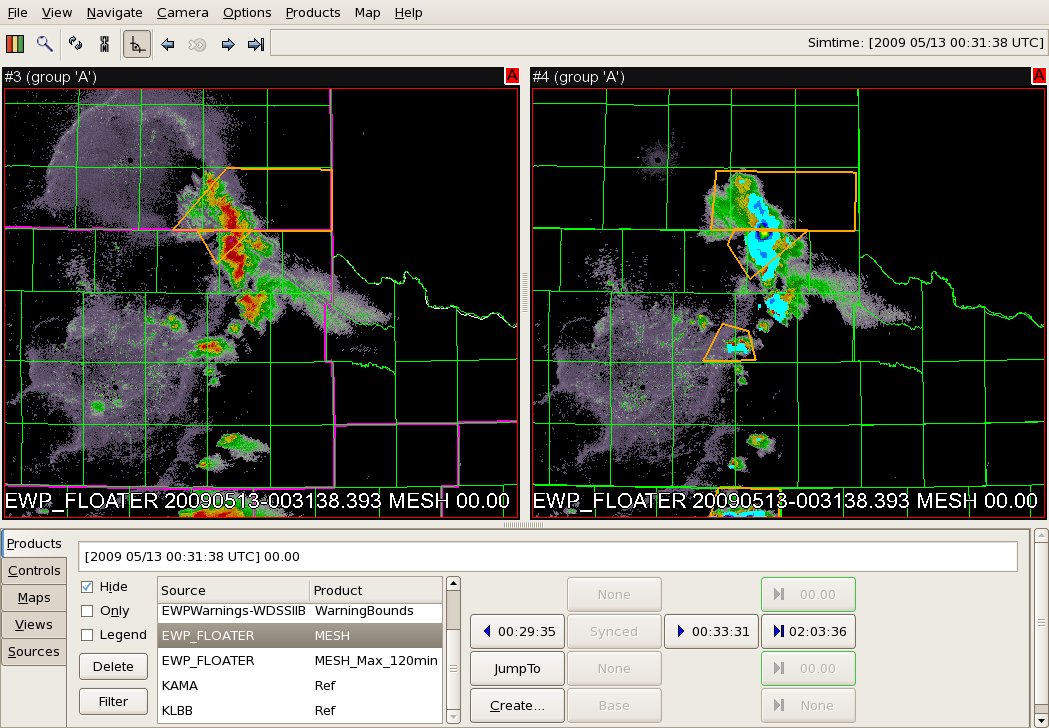
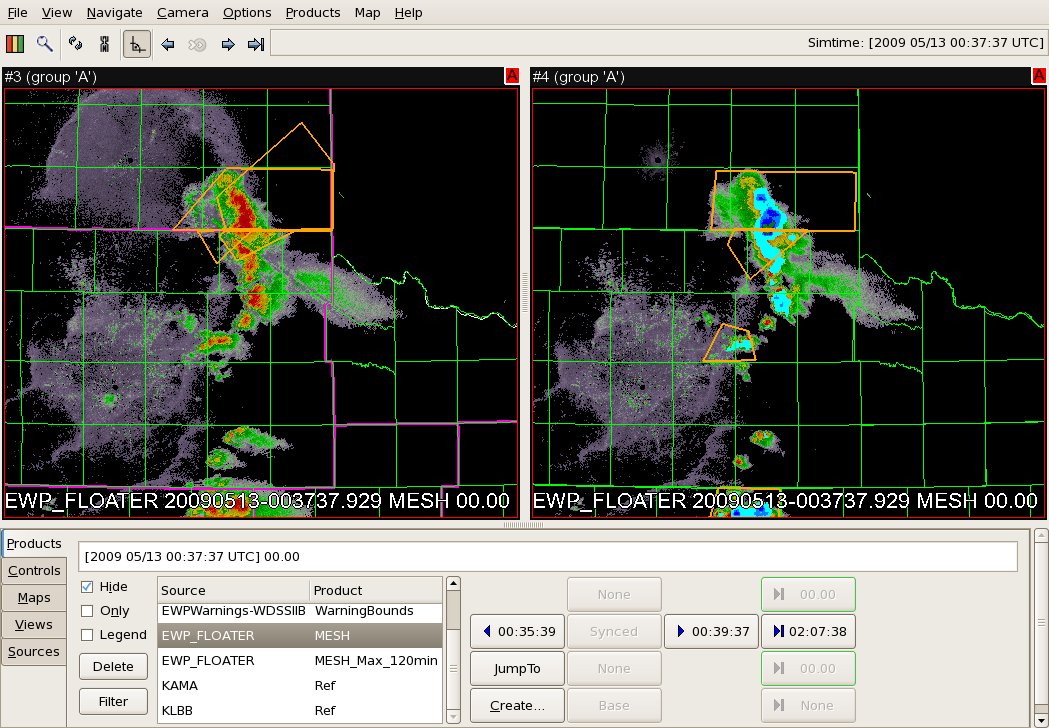
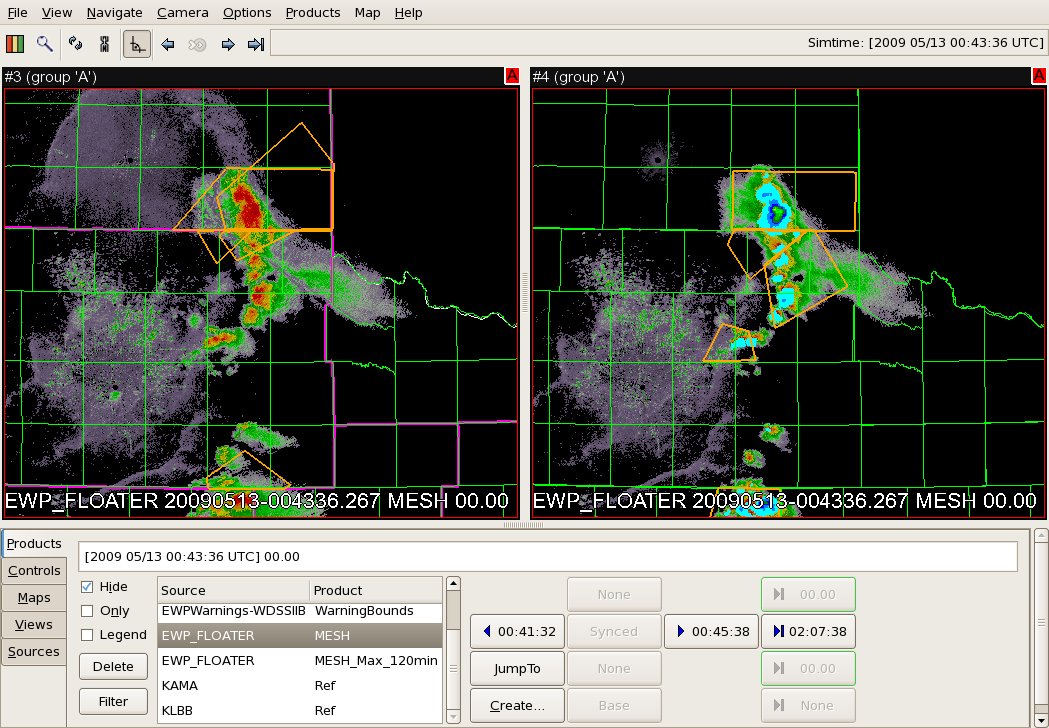
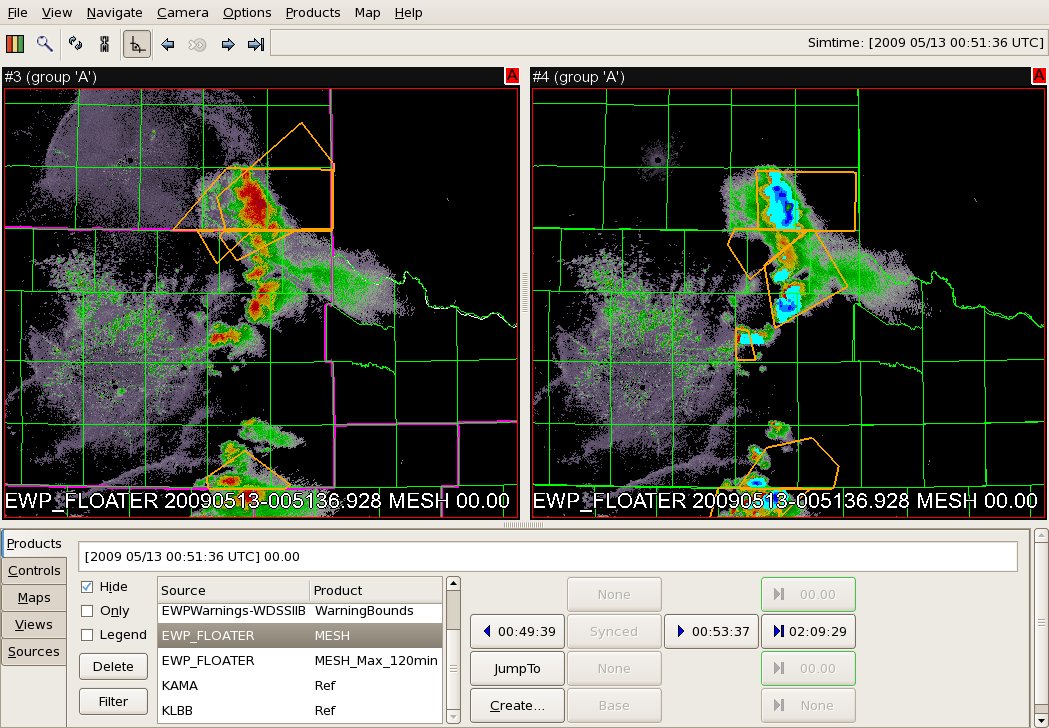
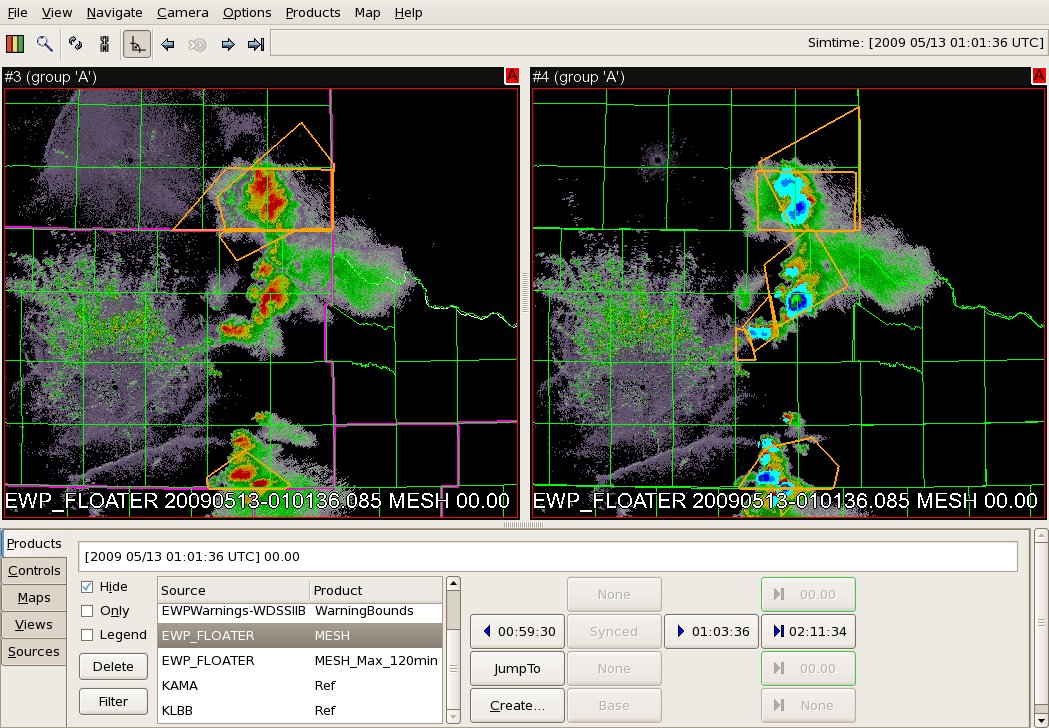
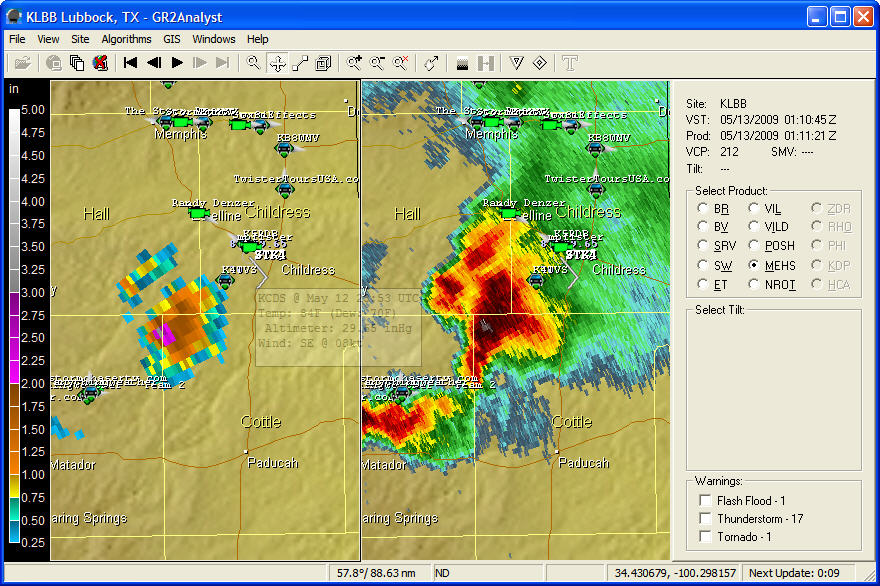
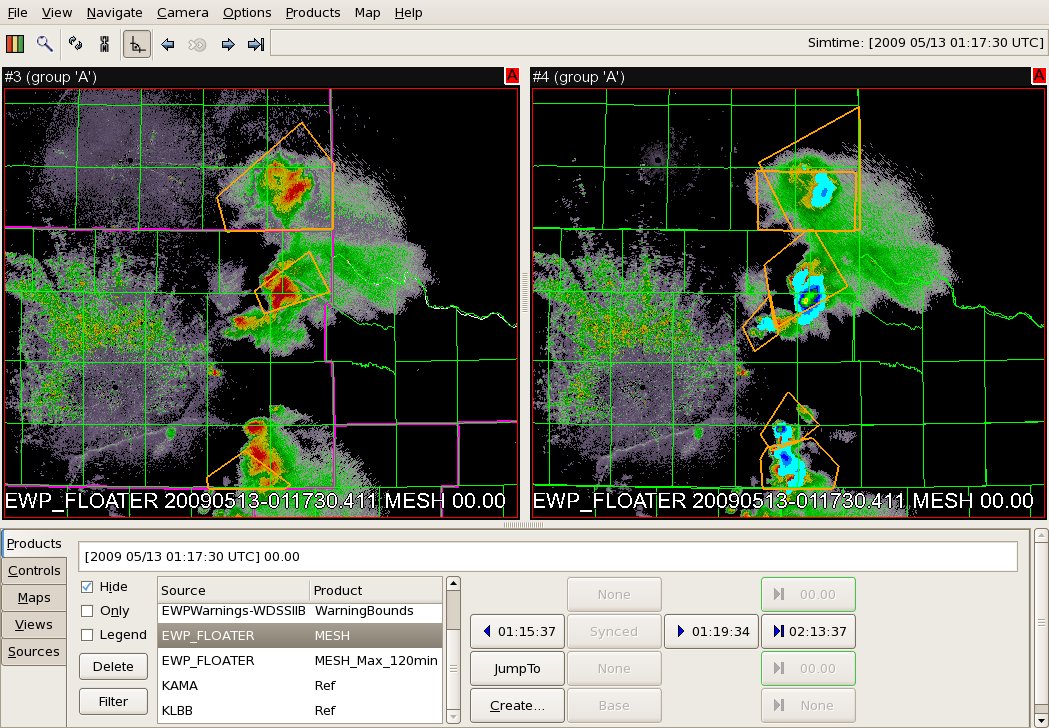
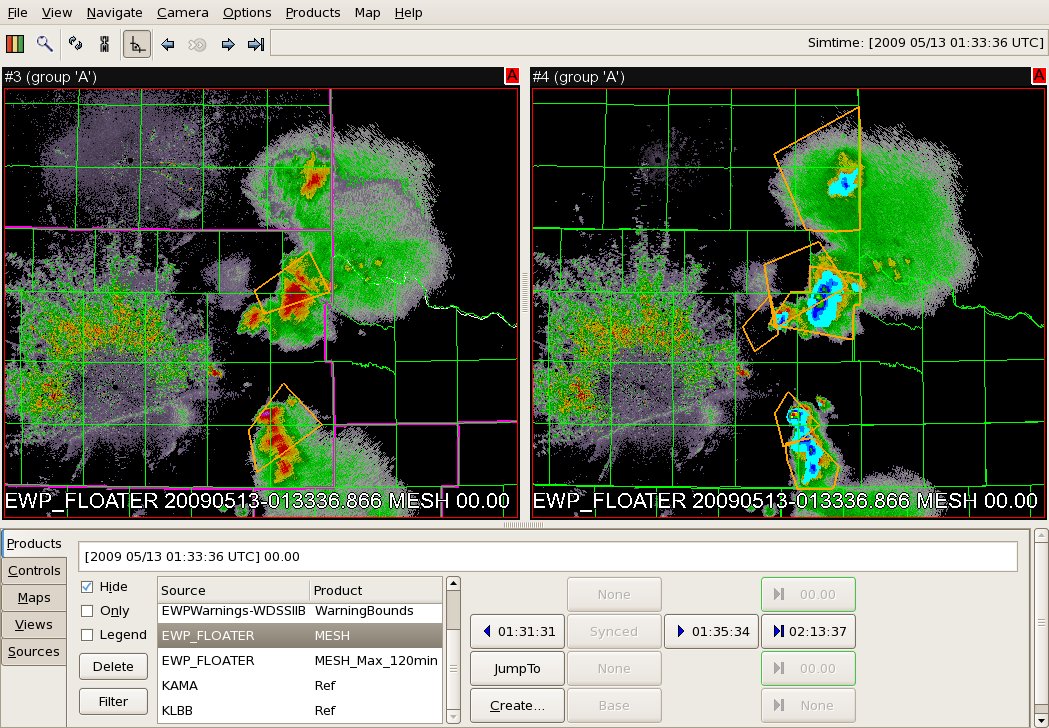
Nevertheless, a second more-severe supercell deveoped just E of Carlsbad, and the forecasters warned on that storm for about 90 minutes, both SVRs and TORs.  We localized to WFO MAF and used the Midland 88D radar (KMAF) to support the warnings.  To support the severe hail decisions, the forecasters used the H50_Above_H253 (50 dBZ above -20C altitude), 50 dBZ Echo Tops, and the MESH products.  The MESH swaths were particularly useful in placing the proper warning polygon angle to capture the storm motion.  The figures below show the differences between the EWP experimental warning polygons (Fig. 1) with the offical warnings from WFO MAF (Fig. 2).  Note how the EWP warnings capture the storm motion better.

FIgure 1.  EWP Warnings (amber = SVR; red = TOR)

Figure 2.  WFO MAF warnings (amber = SVR; red = TOR)

There was generally good agreement between the MESH estimates and the very few hail reports from these storms.  The forecasdters commented that it would be nice to be able to have a user-configurable Echo Top product so that one could choose the dBZ level on the fly (e.g., 60 dBZ Echo Tops).

The forecasters also issued a TOR on the storm, albeit after the WFO MAF pulled the trigger.  The reasoning for holding off on the TOR was a temporary decrease in the LLSD multi-radar azimuthal shear trends.  When they re-strnegthened, they issued a TOR.

The forecasters recommended the ability to overlay contours of the multi-radar fields over the single radar images.  They also recommended that the EWP have several AWIPS default procedures with the WDSSII grids in place before the new set of forecasters arrive.

Other assorted comments:  The MRMS products saved time by calculating heights and reflectivities within hail growth regions, versus traditional analysis methods.  The 18 dBZ Echo Top color scale needed to be improved.  The 1-3 minute latency on the MRMS grids sometimes impeded the full comparison to 88D data.  Anticyclonic rotation tracks would be useful.

Greg Stumpf (EWP Weekly Coordinator, 27 Apr – 1 May 2009)

Tags: None

Live Blog – 28 April 2009 (8:40pm: wrap-up)

MAF started issuing TORs at 7:35pm (CDT).  EWP started at 8:35 CDT.

First take-away – the MESH and ROT tracks giving a better handle on the storm motion, and thus the EWP warning polygons were more to the rifght than the MAF polygons.

For SVR – went from holfball hail to baseball hail, influenced the MESH and the H50_above_H253 (went from 16 to 20 kft).  Ref -20 up to 61 dBZ.

Felt that these products were useful over alltilts – so they looked at WDSSII products more, versus the confort zone of the all tilts analysis.

There were notificaiton issues that affected our SA this evening.  Also, at first, the warnings were not being transmitted – we fixed that later for our MAF exercise.  We didn’t archive any of the ABQ warnings.

Will post images soon…

Greg Stumpf (EWP Weekly Coordinator, 27 Apr – 1 May 2009)

Tags: None

Live Blog – 28 April 2009 (8:30pm)

Issued TOR on storm in Eddy County NM.  Based on rotation really ramping up.  WDSSII was not corroborating it, but base KMAF data was showing strong LL shear, continiuty.

Turns out the 3-6 km 120min rotation track showed an increase.  But the 0-2 shear (what they were looking at) showed decreasing trend.  TORpedoed it nonetheless.

Greg Stumpf (EWP Weekly Coordinator, 27 Apr – 1 May 2009)

Tags: None

Live Blog – 28 April 2009 (8:05pm)

Did some analysis of the azimuthal shear, but decided to hold off on TOR.  Considering updating their SVR as the storm is right turning some more and the hail numbers are staying up.

SVR was sent to replace original polygon.  Original polygon might have covered it, but it was more right-turning.  MESH track, right turn in MESH track.

Greg Stumpf (EWP Weekly Coordinator, 27 Apr – 1 May 2009)

Tags: None

Live Blog – 28 April 2009 (7:45pm)

Issuing SVR on Eddy storm now.  Strong mid-altitude rotationat 14 kft.  Over 60 dBZ @ -20degC.  16 kft H50_above_H253.  MESH > 1.5″  MESH history for continuity.  MR helped refine the warning.  Helped to contruct polygon.  MESH track revealed the right turn, and polygon was adjusted for that.  Spotter report alone might have messed up track.

Greg Stumpf (EWP Weekly Coordinator, 27 Apr – 1 May 2009)

Tags: None

Live Blog – 28 April 2009 (7:15pm)

Issuing an SVS now based on M1.25″ hail report 15 N ROW.

It appears that our first warning did not get transmitted to the px1 server.  We’re looking into it.  We’re also expecting bugs – it’s our first time doing this!

Greg Stumpf (EWP Weekly Coordinator, 27 Apr – 1 May 2009)

Tags: None

Live Blog – 28 April 2009 (6:55pm)

Our first live blog entry…

Our forecasters are currently getting familiar with the multi-radar/sensor products on an isolated supercell which is to the SW of the Cannon AFB radar site, east of Roswell.

Storm has developed a nice TBSS.  MESH tracks also trending upwards again, above 1″.  Sue and Steve are issuing our first experimental SVR warning.

Greg Stumpf (EWP Weekly Coordinator, 27 Apr – 1 May 2009)

Tags: None

Outlook – 28 April 2009

Southwesterly flow aloft continues with the broad trough over the western U. S.  Small impulses through the flow are likely for the next few days, with some timing to produce convection in the southern High Plains.  On the surface, a strong upslope pattern is prevelent over eastern NM and SW TX, but as of 1pm, most of the area east of the mountains are socked in with low clouds, fog, and cool temperatures.  There is evidence of the erosion of the low clouds on the west edge, and this trend is expected to continue into the evening.

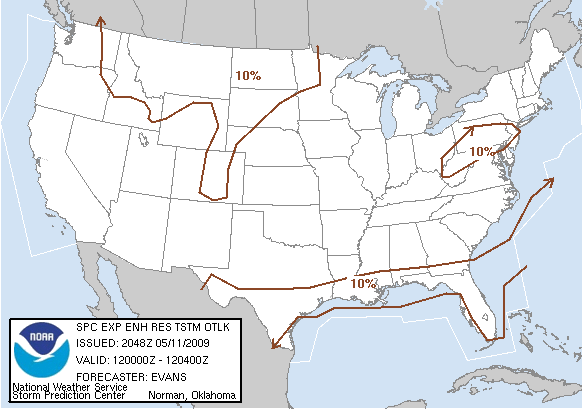
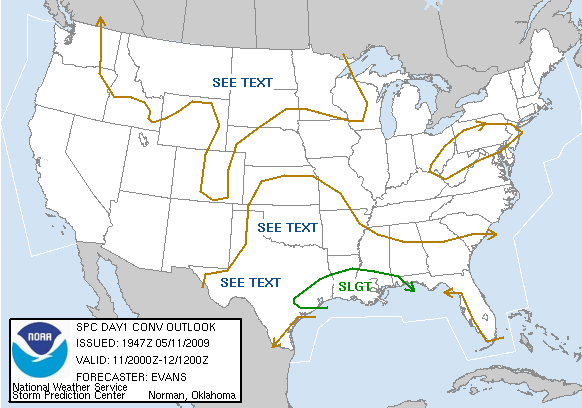
The SPC DY1 outlook is seen here:

So, we are expecting an IOP for the multi-radar/sensor algorithms for SW TX and SE NM starting around 5pm.  Before that, we will have the forecasters run through several CASA archive cases.

Greg Stumpf (EWP Weekly Coordinator, 27 Apr – 1 May 2009)

Tags: None

Summary – 27 April 2009

Today we crammed!  Got the general orientation, WDSSII GUI, PAR, and CASA training in as quickly as possible in order to work an early IOP on the storms in Central OK.  Unfortunately, as soon as we were ready, the storms decided to fizzle out.  Therefore, we conducted a very short real-time IOP on the remaining convection using the PAR data.  There was one decent example of the descending reflectivity core that was highly resolved by the PAR data, but for the most part, there was little to be observed.

The rest of the evening was spent having the visiting forecasters go through a PAR archive case (T.S. Erin Aug 2007) to gather feedback.  We then completed the training sessions for the multi-radar/sensor applications and the LMA project during the final hour of the shift.

DY2 appears to be a West Texas event, and most likely our IOP will focus on the multi-radar/sensor applications.

Greg Stumpf (EWP Weekly Coordinator, 27 April – 1 May 2009)

Tags: None