I was part of a group of 5 new forecasters who reported for duty at 1PM on Monday, June 7, 2010. It was week 8 of the EWP, with each week bringing in new forecasters. The first couple of hours were spent training on the new products we were being asked to evaluate. The objective was to determine which, if any, of the newer products would be useful in a short-fused warning situation. Our feedback would be given via surveys at the end of each day and during debriefs at the start of the following day. Real-time reports were supplied by students and the SHAVE (Severe Hazards Analysis & Verification Experiment), if applicable, during the week.
Each spring, NSSL and SPC jointly put together the Hazardous Weather Testbed (HWT) in Norman, Oklahoma. The two main program areas are the Experimental Forecast Program (EFP) and the Experimental Warning Program (EWP). The EFP focuses on the weather prediction models while the EWP tests concepts and technology and focuses on short-fused warnings.
Severe weather was expected Monday afternoon over the Central Plains. I have to admit, the first day, I was relying more on the products with which I was comfortable with rather than the new products. However, I did try to compare their output to the real-time reports we were given and my “crutch” products. Several of us did participate in a “canned” case using the total lightning products with storms over northern Oklahoma. The lightning data was helpful, yet confusing, because there were several lightning jumps as the updrafts increased. These storms were made up of multiple updrafts so it was difficult to determine which updraft was key in forecasting severe weather.
During the debrief on Tuesday, I was not overly confident that the “new” products were going to be of much help. But, I thought, it was early, and I needed to give them a chance. Plus, it was a slightly different environment than back at my office and that probably had an impact on my analysis so far.
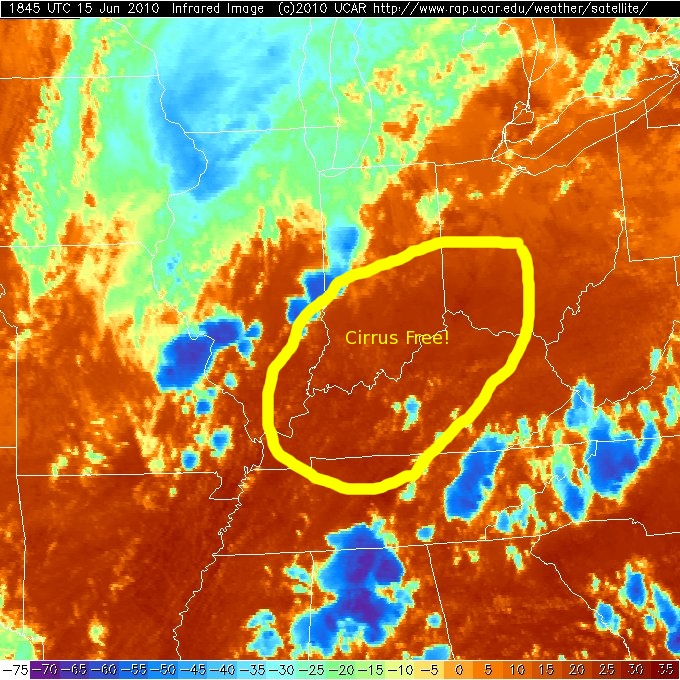
Thankfully, more severe weather was expected that day. The software allow us to create a virtual forecast just about anywhere. We were not allowed to see what the actual forecast office was doing so that we would not be biased. The focus Tuesday afternoon and evening was over Kansas. I really worked to bring more of the new products into use and my comfort level was rising. We were able to make use of the convective initiation products as long as cirrus was not in the area. The convective initiation products did show convection quickly developing over Texas where the skies were generally clear.
It became clear to me that reflectivity on the -20 degree C surface was extremely helpful and I began to bring in more of the estimated hail size (MESH). These were the MRMS (Multiple Radar/Multiple Sensor) products. The MRMS products took advantage of all radars and were helpful as storms moved over the KICT WSR-88D’s “cone of silence” where one could see the storm increasing in intensity, but probably not to severe levels. Many of the products would allow a forecaster to pick out the strongest storms rather quickly. While there were many products available to us, not all of them appeared helpful.
On Wednesday, the debrief was more vocal as we began to find more and more useful products and examples were given of where certain products excelled and where they were not helpful. There were a few storms in the Alabama lightning network area, so that was the area of focus that day. We saw several instances where the total lightning was picking up on storms before the AWIPS lightning mapper program picked up on them. One could see the utility of this in the future, bringing with it a potential for lighting statements and potentially lightning based warnings. We continued to test all of the products available to us.
By Thursday, I was excited about the prospect of testing more of the new products. It seemed that everyone’s confidence was increasing dramatically using the newer products, especially the MRMS products. We were in luck as supercells were developing outside of Denver. We could see via the situational awareness display that VORTEX 2 was going to be on those storms. They provided us with real-time written reports and live video of the storms. I thought how nice this would be to have on a regular basis back in Paducah.
My partner and I were warning on the supercells. I relied heavily on the MESH and both the 0-2 km and 3-6 km 30 minute rotational track products. They clearly pointed out the areas of concern. I did look at the traditional products, but with the reverse weighting of what I used back on Monday. As the event moved on, one supercell became several. This is where the MRMS products shined. We created a split screen situation awareness display. The MESH and our warnings were contained on one side with the rotational tracks and our warnings on the other. From this, you could quickly look up and ensure that everything was covered. We were not too concerned with becoming overly focused on these storms with that configuration.
Friday was an early day, arriving at the weather building at 10AM. We reviewed the week’s events and discussed ways to improve them. Some ideas were as simple as changing color scales, while others were to allow more “on-the-fly” changes to look at reflectivity on different temperature surfaces and different dBZ cores. Before we left, Dan Neitfield, SOO WFO OAX, gave a presentation on how they handle tornado warnings in Omaha.
My experience at the EWP was fantastic and I hope to go back again. I have learned a tremendous amount about what may be available shortly to the field, and hopefully, helped the researchers look at different ideas and improve upon all of the work that has already been done. I could clearly see how several of these products would immediately help back at the office. While we are blessed with good radar coverage at Paducah, these products would help us even further in critical situations. I could recall past situations where we would have benefited from having these products available. I knew I was going to miss having them once I got back to Paducah. Thankfully, they are available as test products on the WDSS-II website. http://wdssii.nssl.noaa.gov/ .
Pat Spoden (SOO, NWS Paducah, KY – 2010 Week 8 Evaluator)