An official website of the United States government
Here’s how you know
Official websites use .gov A
.gov website belongs to an official government
organization in the United States.
Secure .gov websites use HTTPS A
lock (
) or https:// means you’ve safely connected to
the .gov website. Share sensitive information only on official,
secure websites.
The cold front over NC-Kansas and SE Nebraska was monitored for further development. As expected, storms began to build SW-wards towards the KS boarder and CI products were effective in highlighting the area with highest probabilities for potential development along that boundary.
The event occurred over Clay and York counties (Nebraska). A series of images will be added to show the evolution:
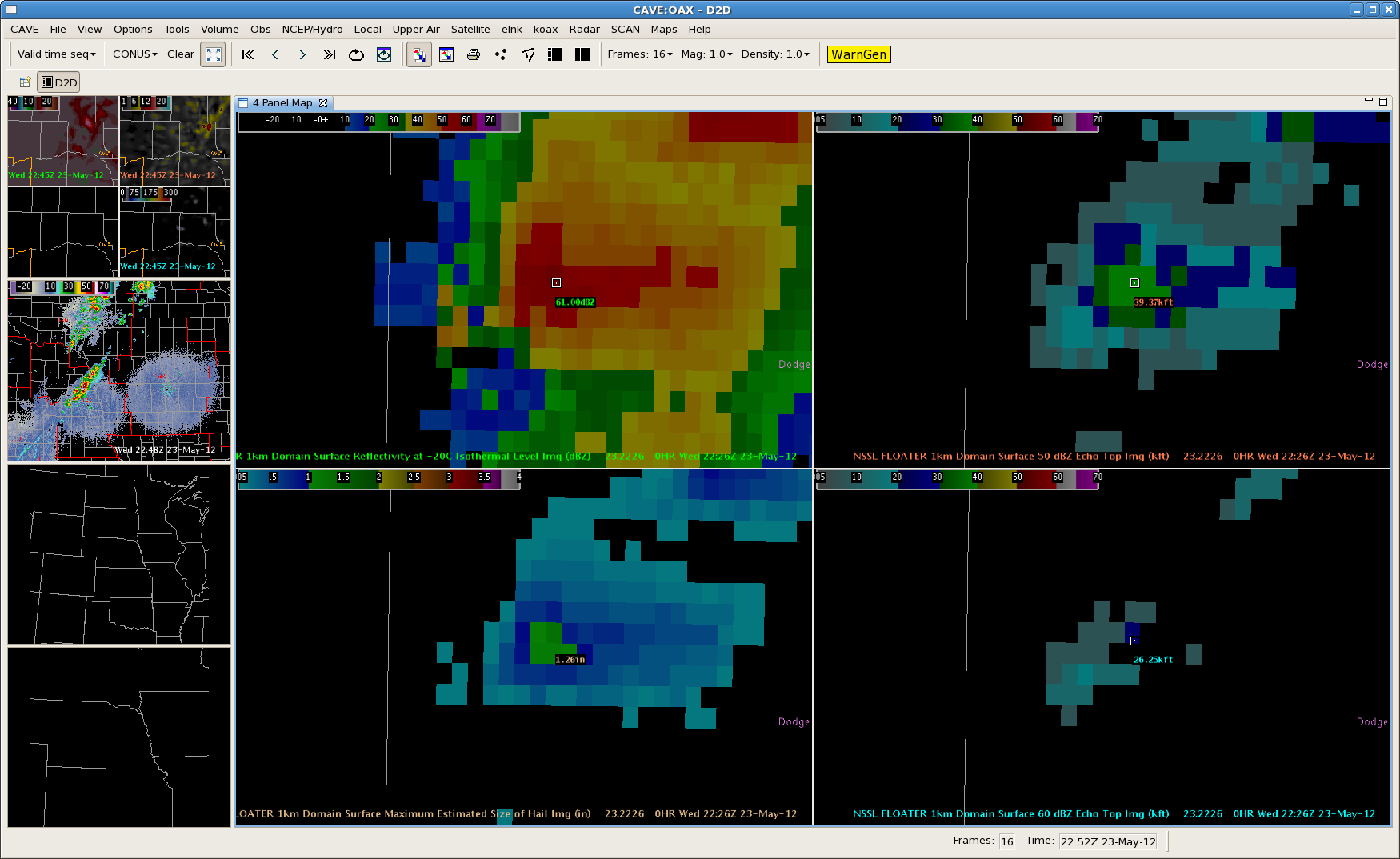
UAHCI product upper left, CIMMS Cld top cooling upper right, lightning data lower left and surface reflectivity at -10 C isothermal level at 2232 ZUAHCI product upper left, CIMMS Cld top cooling upper right, lightning data lower left and surface reflectivity at -10 C isothermal level at 2245 ZUAHCI product upper left, CIMMS Cld top cooling upper right, lightning data lower left and surface reflectivity at -10 C isothermal level at 2302 Z
Roughly 30 min before surface reflectivity at -10C isothermal level revealed first signs of development, the CI product highlighted both counties with 50-60 % probabilities. The cloud top cooling product showed values of -15 to -25K/15 min at 2315Z (not shown) and the first significant reflectivity signal (56 dbZ ) became visible at 2330 Z. At 00Z onwards a 63 dBz cell evolved out of that NE of York.
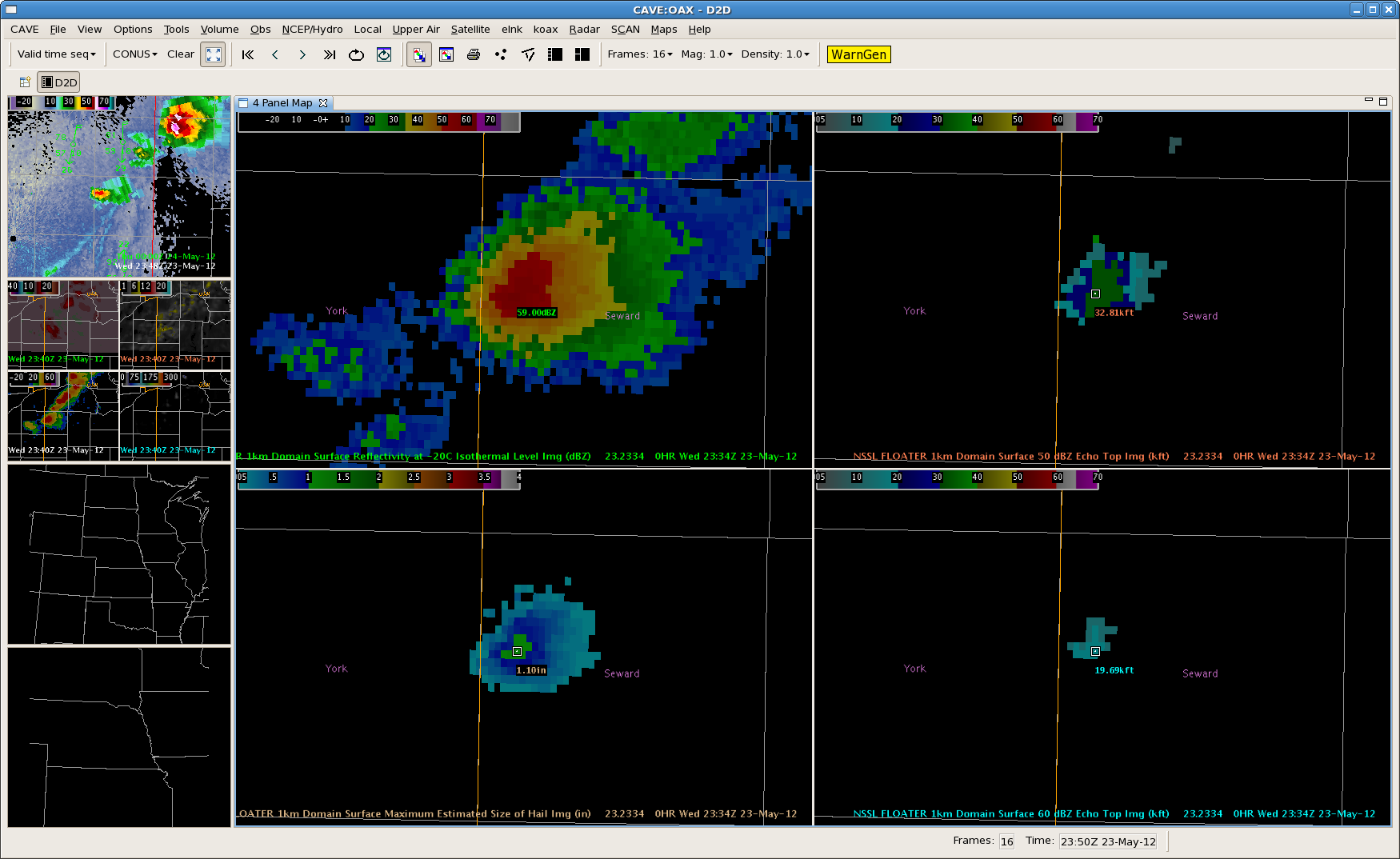
Issued a severe thunderstorm warning strictly off of explosive CTC at 2315 UTC (previous post), with very little showing up on radar at the time. As would be expected, through the following 15-20 minutes, the storm exploded, with MRMS MESH spiking up to 1″ by 2334 UTC, and a quarter size hail report by 2336 UTC. This gave us 21 minutes of lead time from the initial warning issuance off of CTC. Would have likely issued the warning based on traditional base products by 2325 UTC, 10 minutes after the CTC-based issuance.
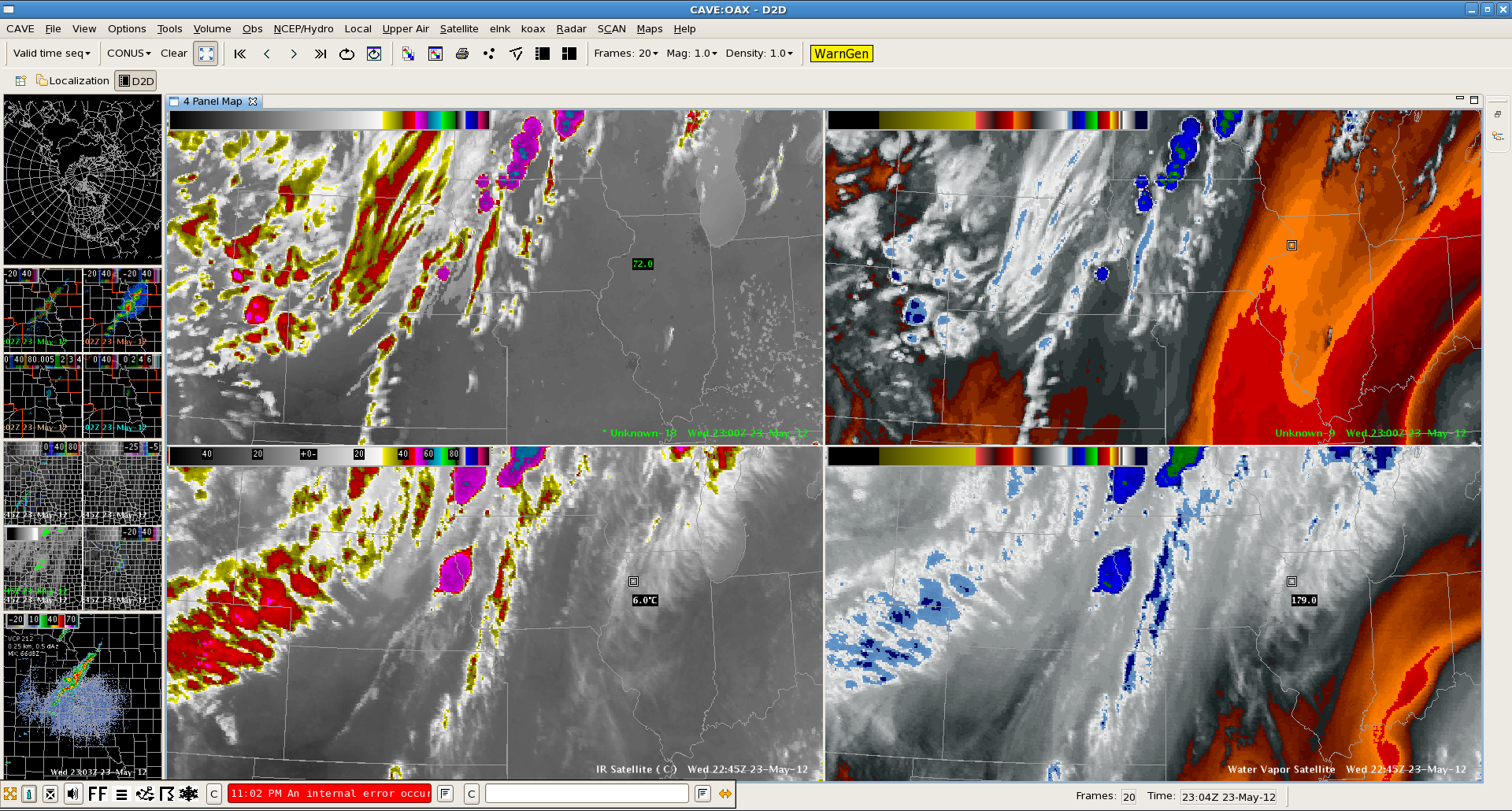
The area over E-Nebraska was monitored for initiation. The synthetic images did a pretty good job in timing of thunderstorm development. The real development occurred only slightly to the north to what the synthetic ones proposed. The model forecast however overestimated the development along the cold front over C/S Kansas, where warm mid-levels prevented DMC of developing until now (although showers finally try to form at 23Z onwards).
Synthetic IR/WV in the upper left and right with real data in the lower half
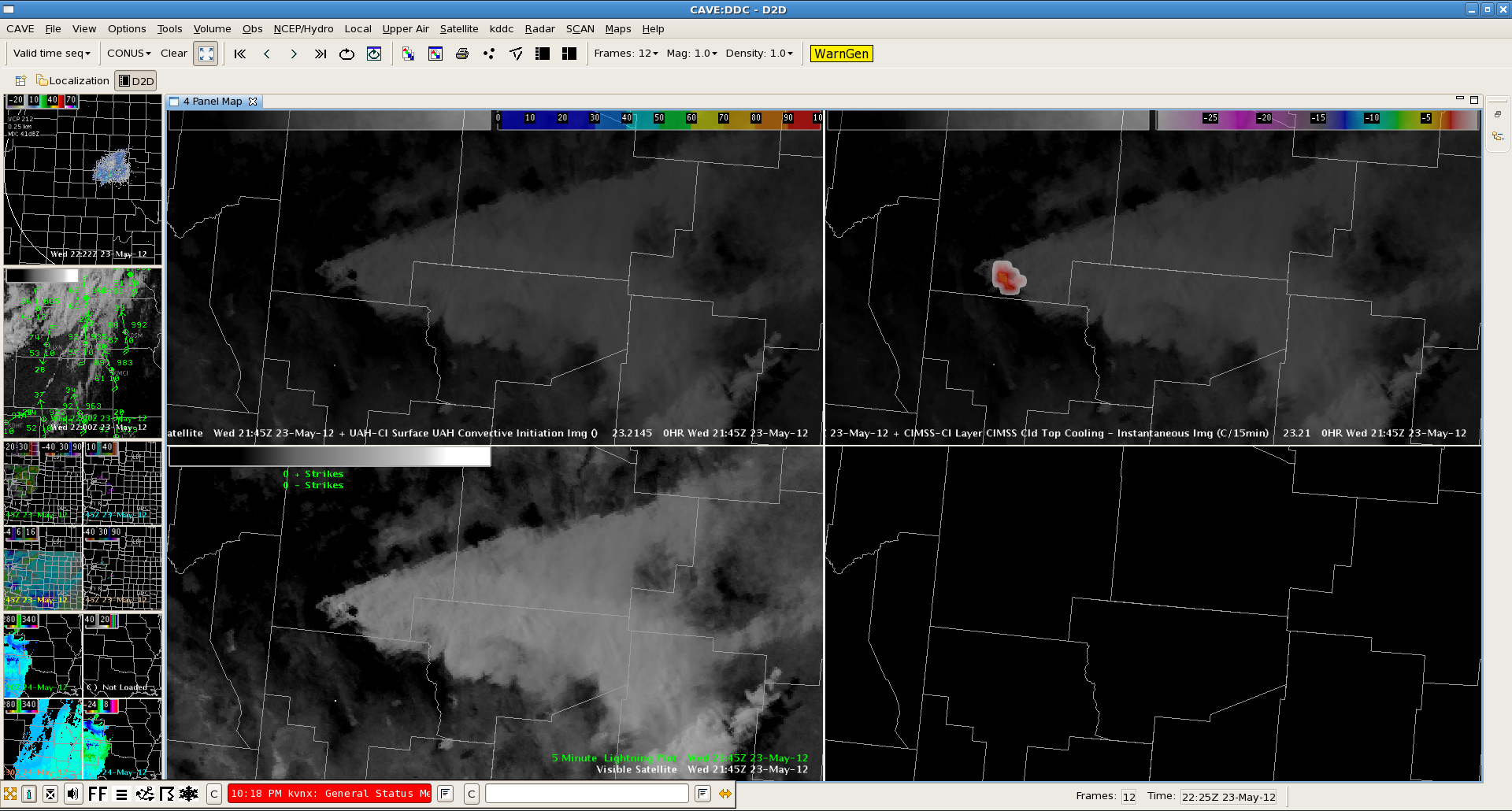
Between 2130 and 2145 Z another burst of the extensive smoke plume occurred, which was also captured by the CIMMS Cld Top Cooling product with values mainly below -5K/15 min.
Smoke plume with CIMMS Cld top cooling in the upper right
Latest VIS imagery indicates a rapid increase in convection along slowly SE-ward progressing cold front, namely over Hodgeman, Ness and Rush counties. UAH-CI product already showed modest probabilities (50-60 %) for CI with no reflectivity yet present in local radar data.
UAH-CI product placed in the upper left corner at 2130 Z
Latest HRRR is a bit more optimistic with SW-ward zipping convection compared to OUN WRF. Still unsure if storms can initiate in that area with warm mid-level tongue partly covering the cold front/dry line. Strong shear now gradually moving in from the west, so increasing storm organization is likely in case of initiation.
At about 2130 UTC we decided to end operations over the Carolinas and move to the central Plains. McKinney & Hirsh are working the Hastings CWA (GID) while Strassberg & Kleinsasser are covering the Omaha CWA (OAX). Our to observers Helge & McCormick are checking out DDC (though concern over the cap in this region might move them to CO or Iowa).
Meanwhile the SPC issued a watch for the region as well…
SPC Watch for 2100 UTC to 0400 UTC on 23-24 May 2012
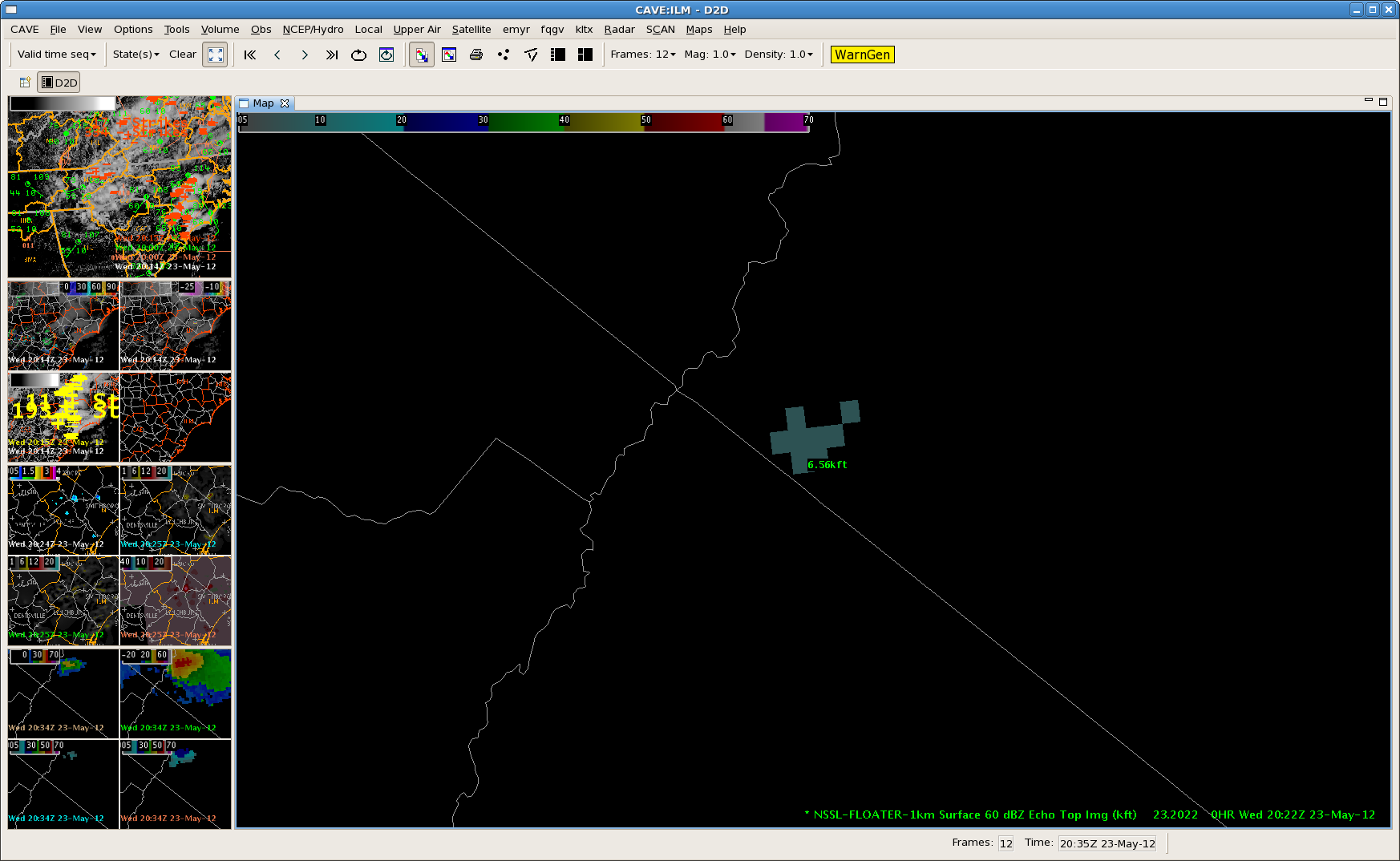
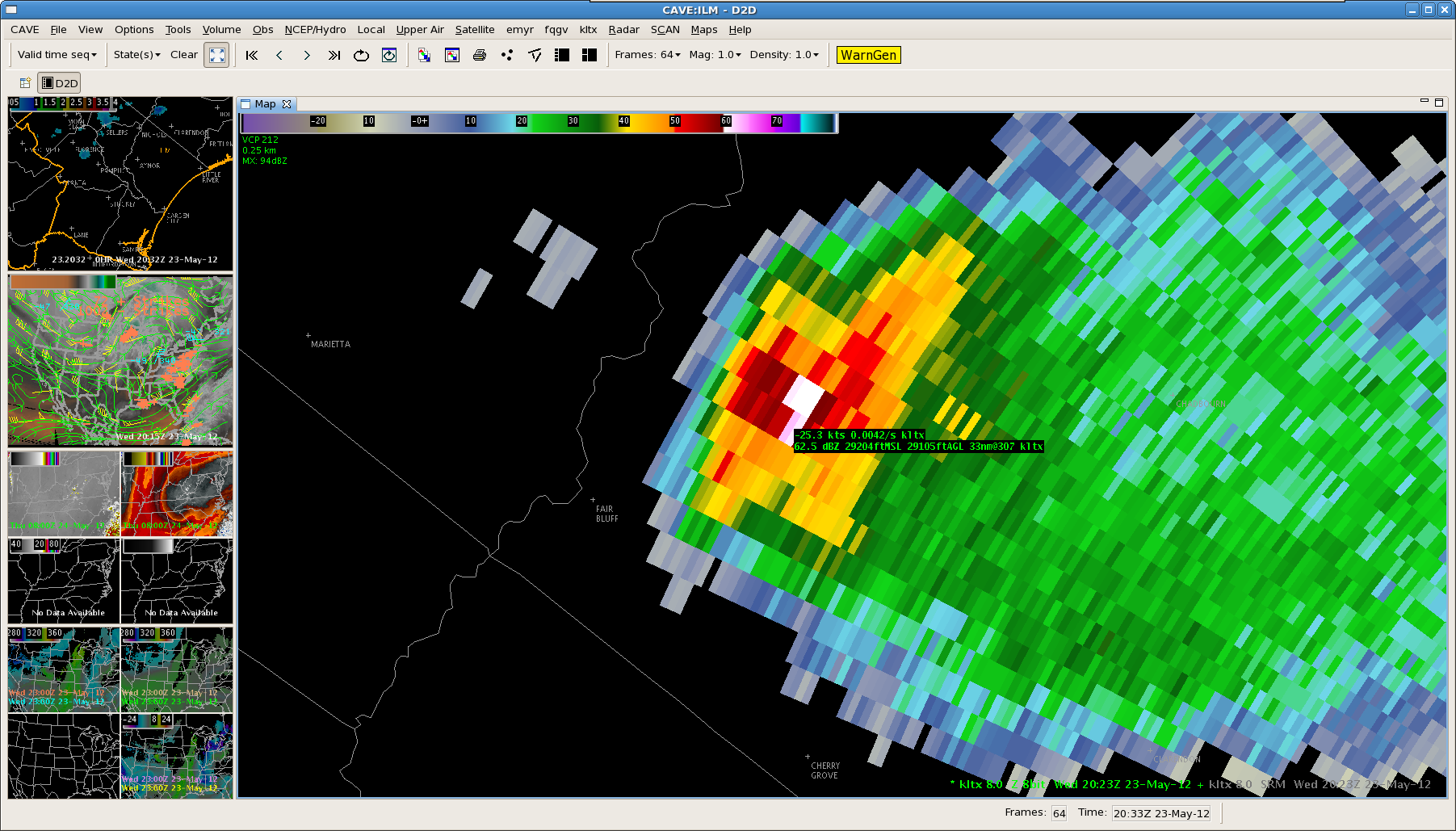
The top image is the MRMS estimate of the 60dbz echo top of a storm over Wilmington NC CWA, estimating the 60dbz echo top around 6500 ft at 2022 UTC on 5/23. However, the bottom image is the corresponding KLTX 8.0 degree slice, indicating 60-62dbz to at least 29,000 ft. At least in this instance, the MRMS 60dbz echo top algorithm did not perform well.
2022 UTC MRMS 60dbz echo top of only 6500 ft.2023 UTC KTLX 8.0 degree slice indicating 60-62 dbz to at least 29,000 ft, proving the MRMS 60dbz echo top algorithm incorrect in this instance.
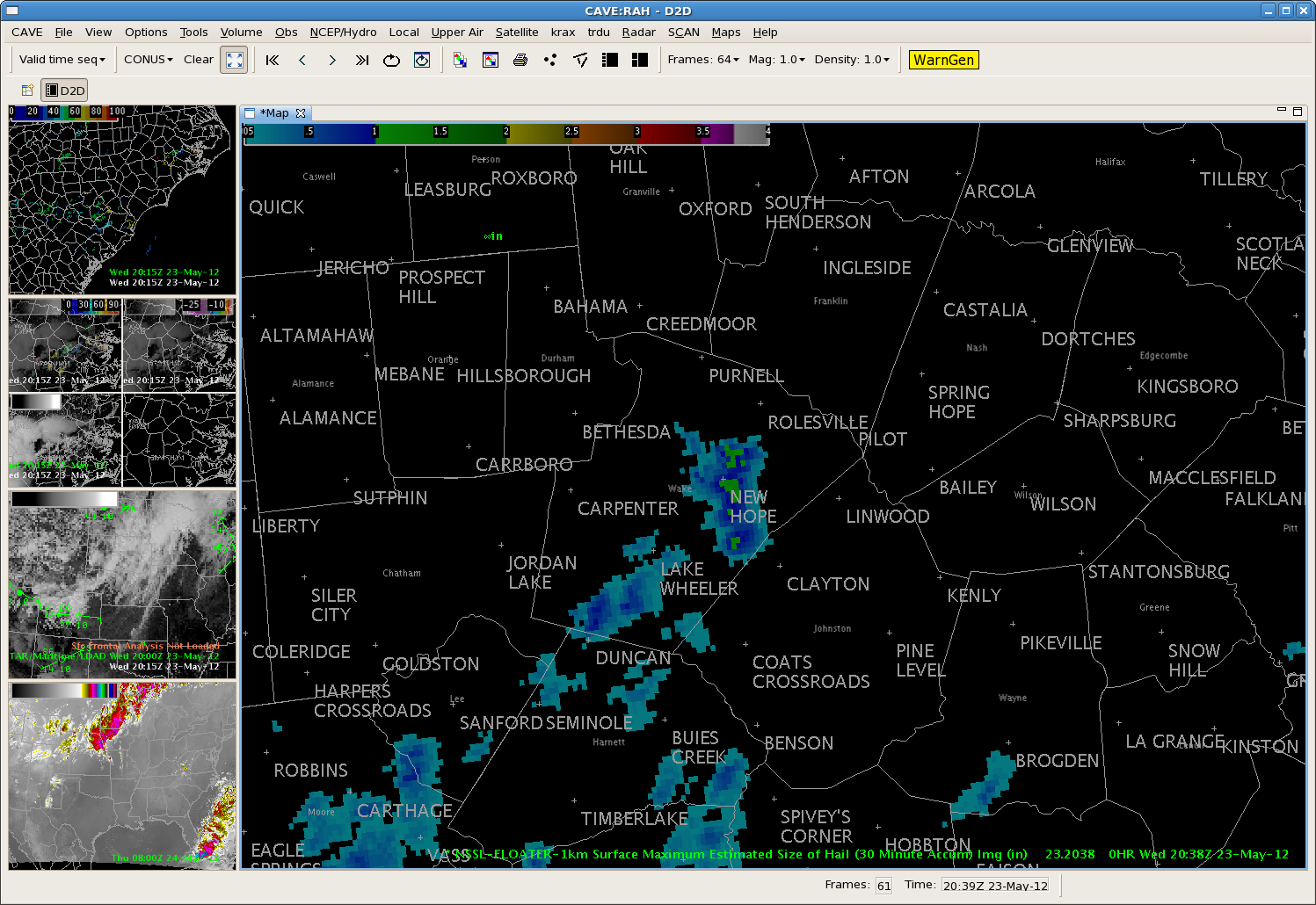
We got some reports of large hail in Raleigh, but I couldn’t seem to find it on the map (top). I needed to zoom in (bottom) quite a bit to see the label for the second largest city in NC. AWIPS II developers…can this be fixed? Zooming out should show the major cities, but it currently shows random small towns.
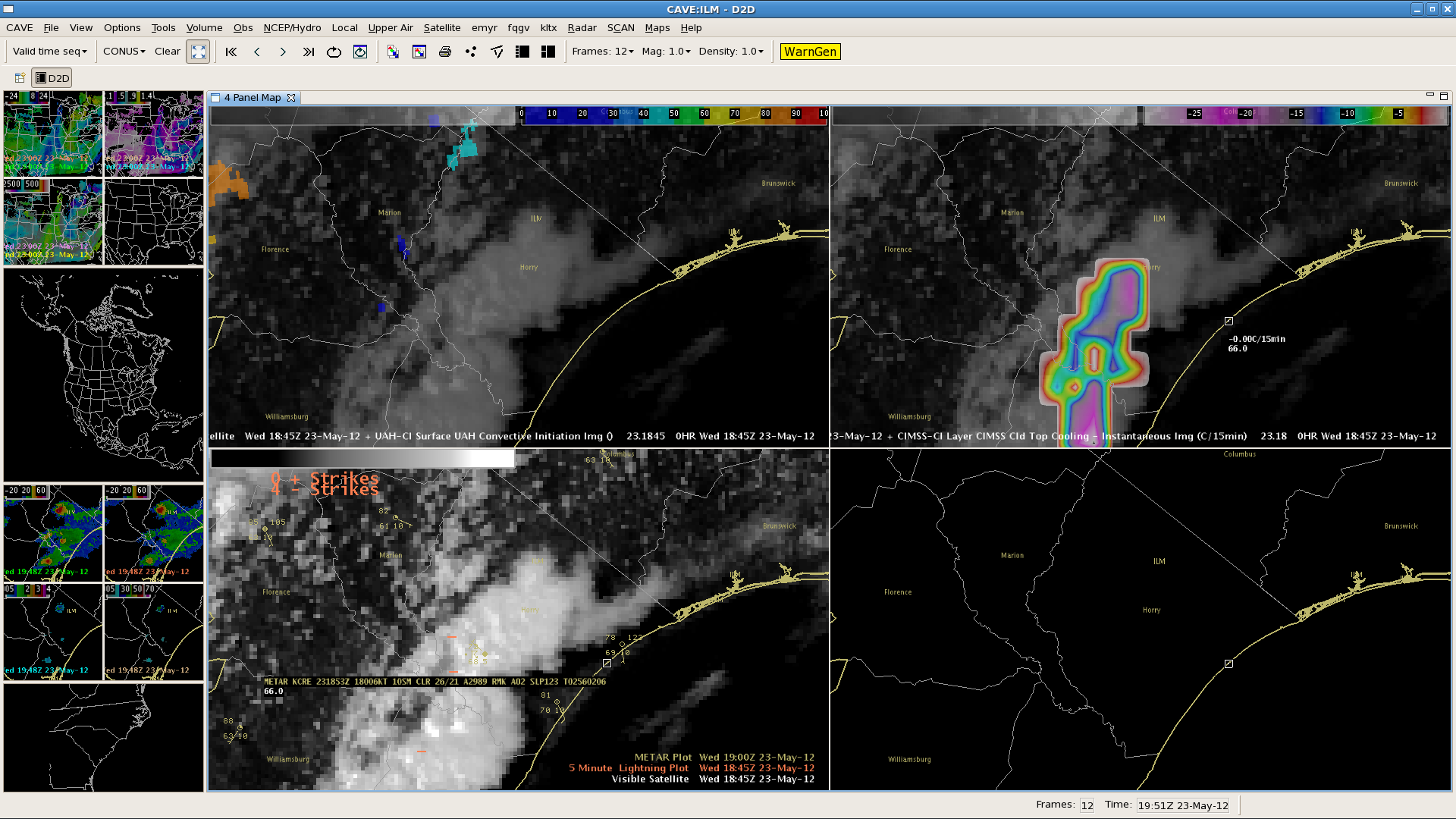
Here in WFO ILM, we have had some great success with the CIMMS Cloud Top Cooling (CTC) product this afternoon (see our previous post). Here is another success story from Horry County, SC. First we will look at the Cloud Top Cooling product at 1845Z (Top Right panel):
1845Z Cloud Top Cooling (CTC) image from WFO ILM (Top Right Panel).
There are two “bull’s eye’s” over SC. Our storm is the northern “bull’s eye”. The CTC showed cooling rates of -21C/15minutes AT 1845Z, which typically correlates to strong convection with significant lead times averaging 45 minutes before Maximum Expected Size of Hail (MESH) exceeds 1″. Now let’s look at some verification. First is the MESH image from 1936Z (lower left panel). This is the first time the MESH exceeded 1″ for a LEAD TIME OF 51 minutes!
1936Z MESH product for WFO ILM (Lower Left panel).
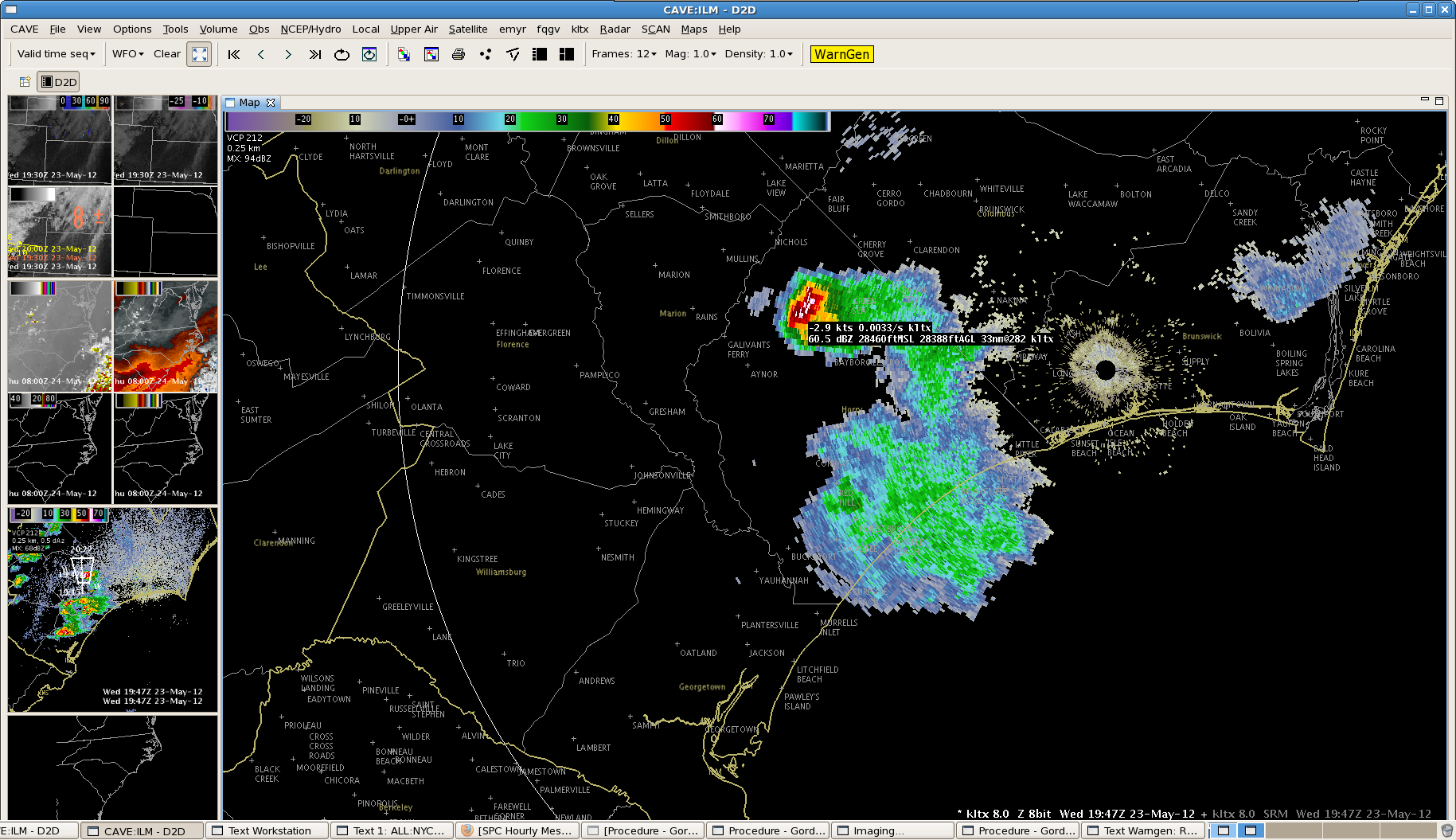
And now for a conventional radar image from 1947Z from the KLTX Radar:
1947Z KTLX Radar image.
The cursor readout shows this storm has 60dbz echos up over 28,000ft…which is above even the -30C level from the 12Z CHS sounding (~25,000ft). We finally got verification of quarter size hail in NW Horry County by around 20Z, though the reports seem to have not come from directly beneath the core of the storm so some larger hail was possibly produced. Now let’s examine some NSSL 3DVAR Imagery:
KTLX Base Reflectivity (top left), NSSL 3DVAR Max Divergence (Top Right), NSSL 3DVAR Max Updraft Composite (Lower Left) and NSSL 3DVAR Max Vorticity (Lower Right) at 2005Z.
You can easily identify this storm based on the Max Divergence above 8km, Updraft Composite, and Max Vorticity Images as all show local, significant maxima. Today, the CTC product has shown significant value in lead time for severe hail beneath the Southeastern CONUS upper low.–Gordon Strassberg for WFO ILM.