MPX: User Error Tor Warning “might” work out

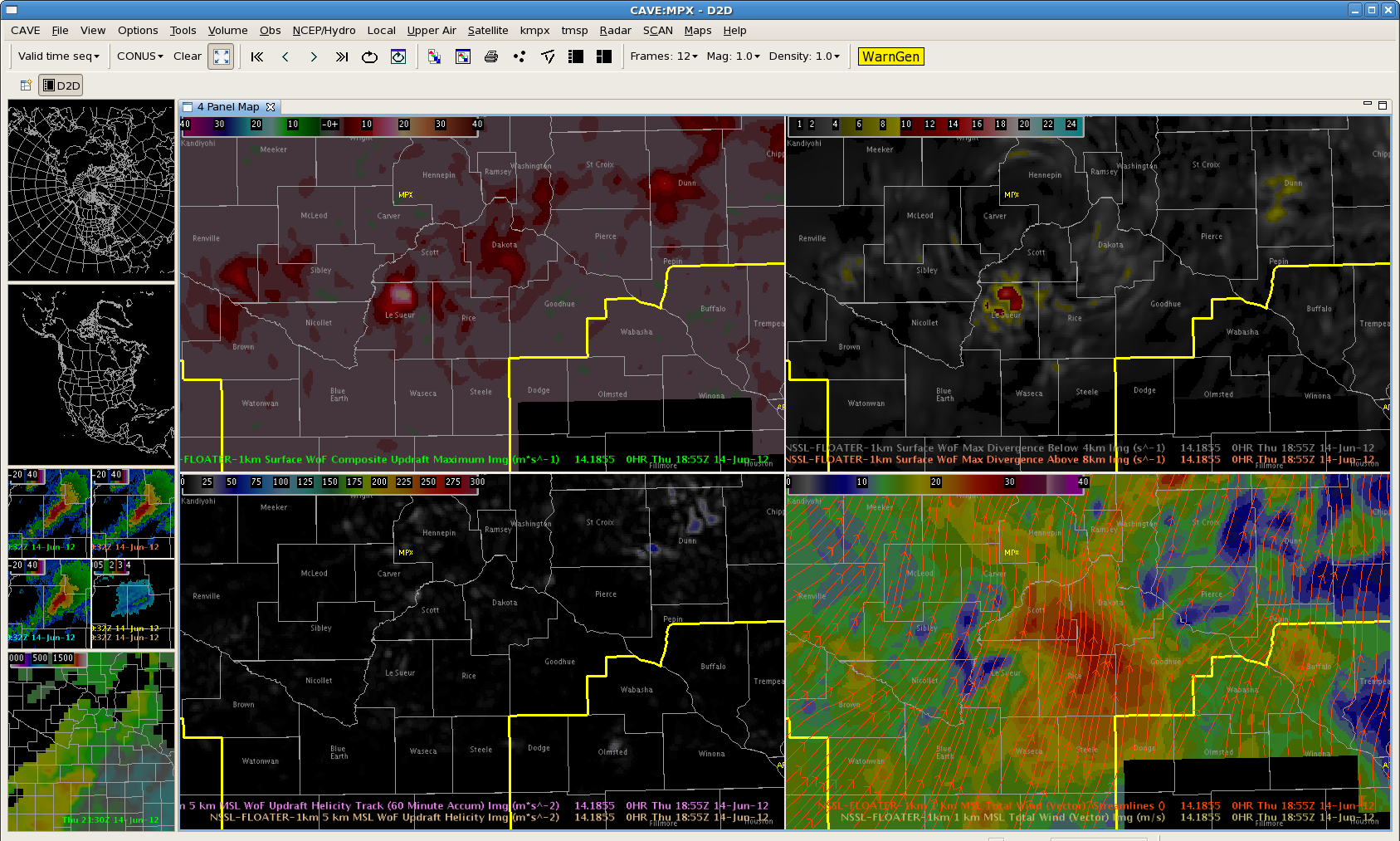
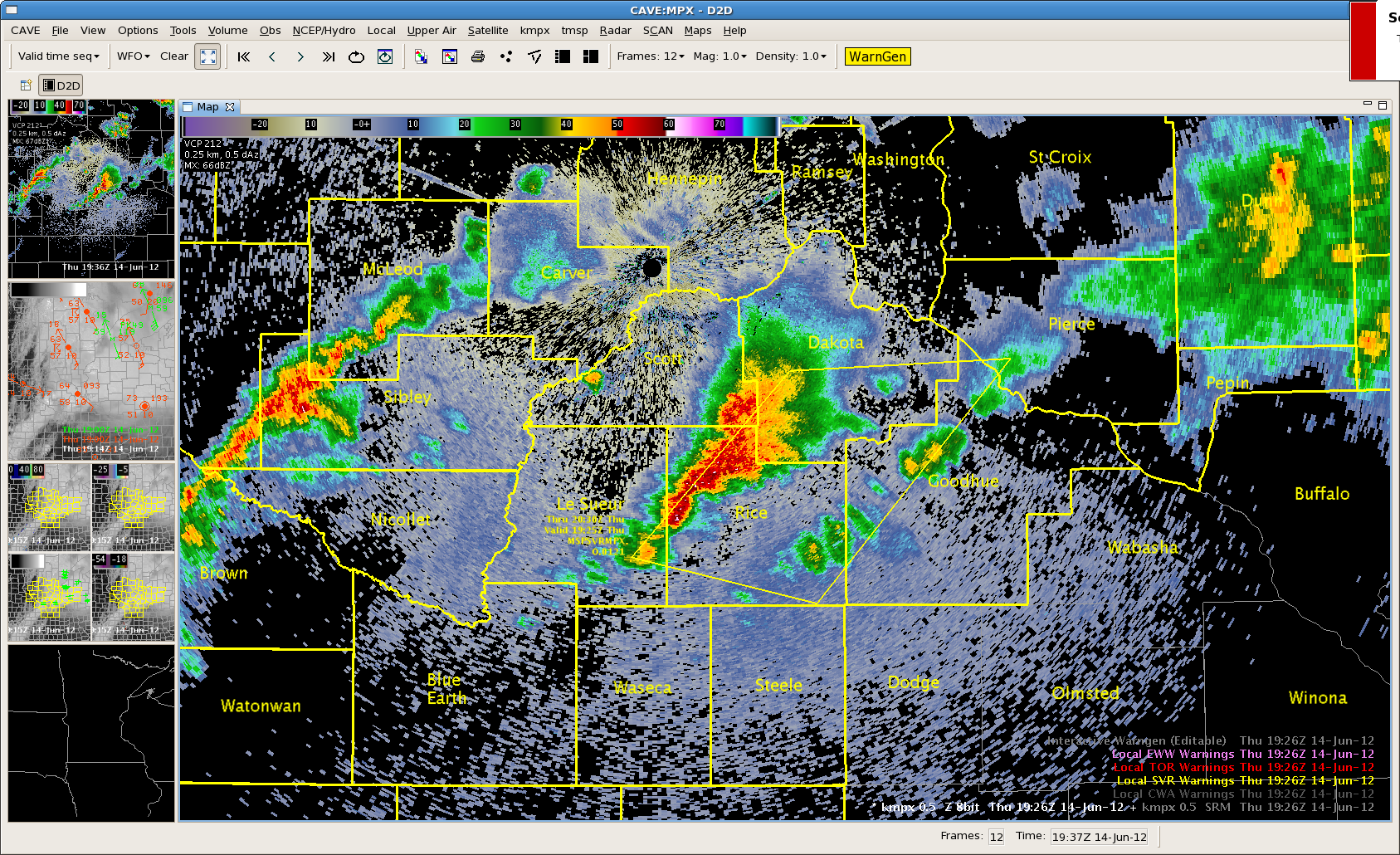
Well, I issued a TOR for Rice County storm, but it should have been a SVR. Total User Error. Anyhow, it may end up working out. We were thinking that the original azimuthal shear was associated with the storm bowing out. However, in the past few volume scans that circ tightened up and became more distinct. It would make sense for a brief tornado to occur given that this storm is right along the boundary left from the morning MCS. -MRD

Tags: None

FSD – should we be shifting to OAX (CTC)?

Cloud cover seems to be inhibiting convective initiation in FSD CWA. Looking toward OAX, CTC signature showing up over eastern Nebraska. CTC showing cooling rate of -24 degrees C/15 mins over Dodge/Cuming Counties in Nebraska. It also shows -19 degrees over Polk County NE at 2015z.

Reflectivity is increasing in the storms in these counties.

We have shifted to OAX and issued warning for Butler County. This storm was associated with the previous CTC signature over Polk County in Nebraska.

Tim/Steve

Tags: None

GID Waiting for the First Storms…A Few Early Indicators

Quiet on the southwestern front at this hour…but we are starting to see a few echoes along the boundary.  Latest OUNWRF wants to gen up a few storms along the boundary in the next hour or two…but then really gens up quite a bit of convection with a fairly large cold pool generating towards the 5 PM hour.

Not many signals being noted in the CTC or the CI products at this time, but we did get a CI 72 indication with a small tower going up on the boundary on the previous pass…will see if anything comes of it. Looking to the southwest upstream in the environmental flow, we note a few Cu towers going up at a faster rate and thinking this activity could move up into our area in the next 3 hours.  See no reason why it won’t get going to the southwest given available instability.

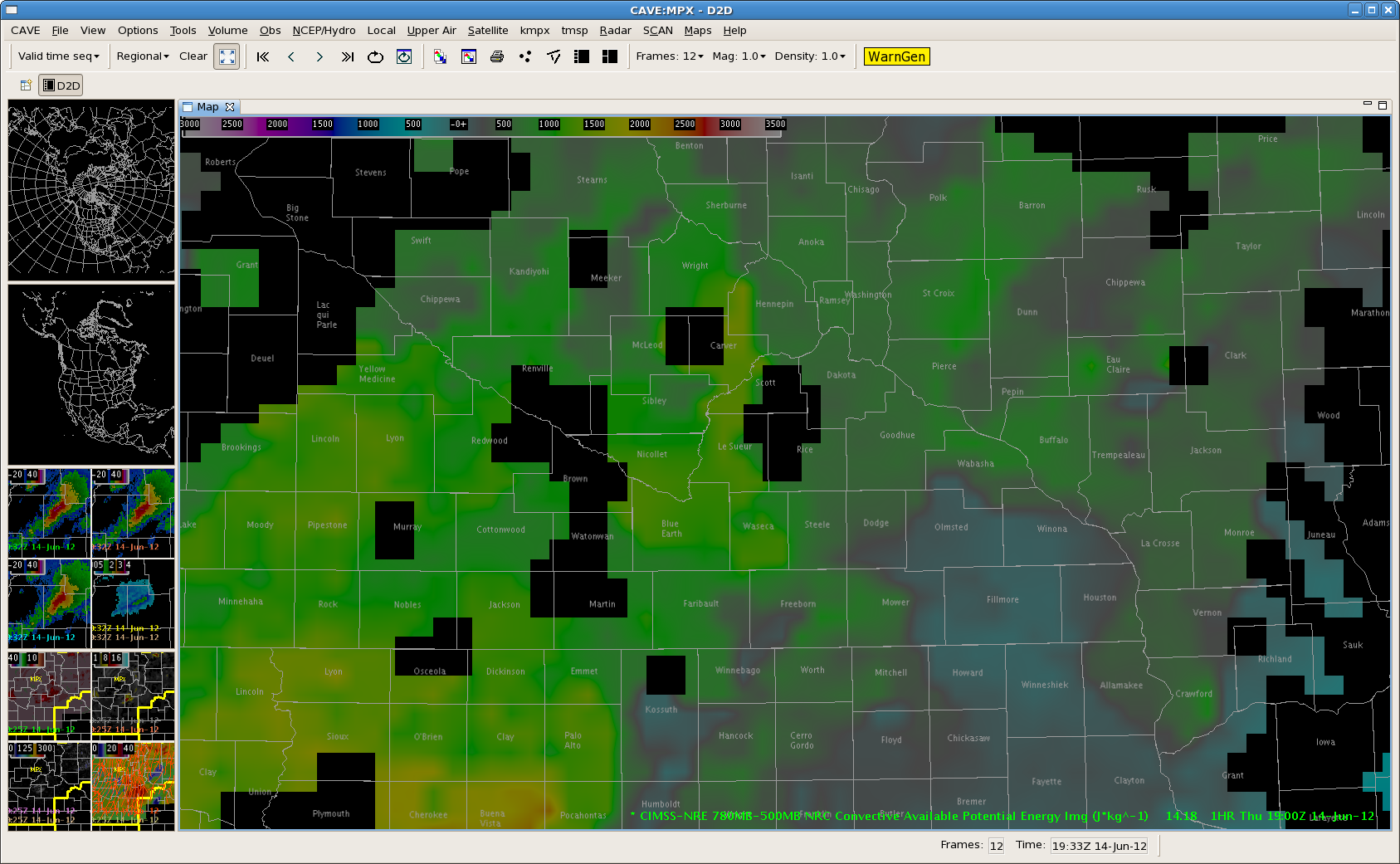
NRE theta-e products showing a fairly unstable airmass over the area…and with near full insolation on the Cu field southeast of the boundary we expect initiation in the next 2 hours across the forecast area…

Garmon/Skov

Tags: None

FSD – CTC signature just east of CWA at 1930z

Watching convection developing just past the FSD CWA line in Des Moines area as Cloud Top Cooling is showing a steady decrease in cloud top cooling rates from -8 degrees C/15 minutes over Pocahontas County IA at 1915z to -19 degrees C/15  minutes over Palo Alto County IA at 1932z.

Here is the KFSD reflectivity and enhanced echo top. Echo top was up to 37 kft on the storm in Pocahontas County IA at 1950z.

Update…this appears to be a false alarm as cell has continued to weaken and no cloud to ground lightning was indicated. Echo top reached 39kft before collapsing.

Tim/Steve

Tags: None

MPX: Severe Warning dieux.

Thunderstorms are beginning to increase in coverage over the southwest portion of the MPX CWA. Modest increases in updraft strength and upper divergence coincided well 50 dbz reaching over 33kft. 60 dbz exceeded 22 kft. Felt hail was a certainty with the storm, as it rode near the warm front.

Tags: None

MPX: 1st warning of the day

Line of storms over Dakota and Rice County has intensified with MESH increasing to 1.73 inches at 1925Z. At 1900Z, composite updraft increased to 17 while we saw an increase of upper divergence. Expect large hail although this storm is right along the instability gradient so we could start to see some wind problems soon as 1km 3dvar wind shows 25+ m/s. MRD/TY

Tags: None

OUTLOOK: 14 June 2012

Today, were are focused on the Upper Mississippi Valley for severe convective development.  A potent, negatively-tilted shortwave trough is moving quickly across the north-central U.S.   Strong deep-layer shear associated with the trough should combine with moderate (to strong) instability and deep moisture to produce severe convection, including supercells.  It is uncertain, however, whether sufficient heating can occur in the wake of a late-morning mesoscale convective system across eastern Minnesota and western Wisconsin.  If destabilization can occur in the vicinity of the residual outflow boundary, tornadoes will be possible.

A secondary area of interest is in south-central Nebraska, where the surface front curves to the southwest.  In this area, the moisture is both deep and quality; the instability , strong to extreme; and the winds at the surface should back, augmenting — to some extent — the marginal wind shear.  That said, severe hail and winds should be the primary threats.

We will start operations in the Minneapolis (MN), Sioux Falls (SD), and Hastings (NE) county warning areas, with an eye toward the  Duluth (MN) CWA — should destabilization occur.

-G. Garfield, Week 5 Coordinator

Tags: None

EWP STATUS FOR 14 JUNE 2012: 1-9 p.m. SHIFT

EWP STATUS FOR 14 JUNE 2012: 1-9 p.m. SHIFT

On Thursday, we will begin our shift at 1 p.m.  The operational models depict a strong, negatively-tilted shortwave trough entering the Upper Midwest by early afternoon.  The associated strong deep-layer shear and moderate instability will support supercells/organized convection in Minnesota and Wisconsin during the afternoon/evening hours.   Given moderate low-level shear and low LCLs, a tornado threat may emerge as well.  However, this may be tempered by a relatively quick transition to the linear convective mode, owing to the strong forcing associated with the ejecting upper trough.  Current thinking is that the Duluth, Minneapolis, and LaCrosse county warning areas are the most likely candidates for severe operations.

– G. Garfield, Week 5 Coordinator

Tags: None