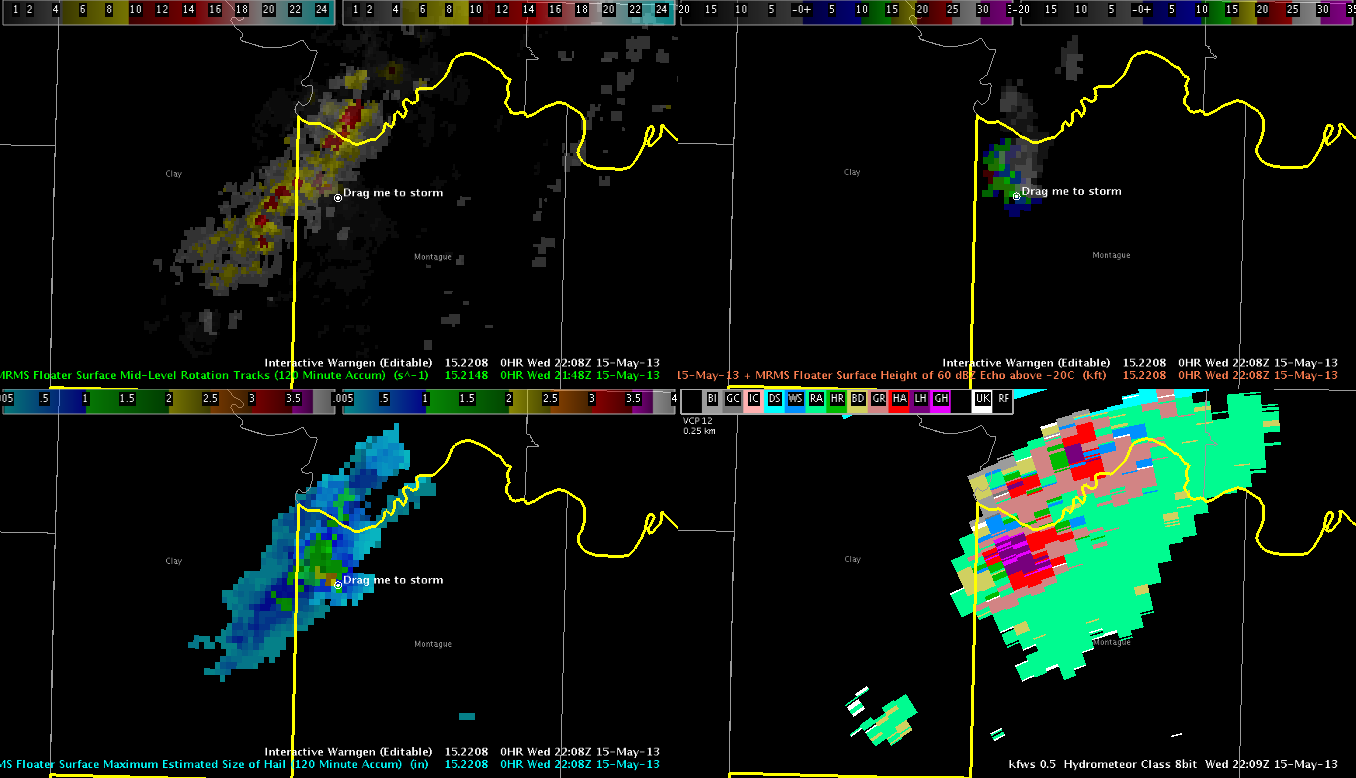
Severe at 2205Z in Montague County…what does baseball sized hail look like on MRMS?

Got a tall and strong storm in Montague County in the northwest corner of the FWD CWA.  It built up very quickly, and we almost were too slow with the warning.  Below is a four panel of various MRMS fields:  upper left=mid level rotation tracks, upper right=height of 60 dBZ echo above -20C level, lower left=MESH, lower right=hydrometeor class with HSDA.  Note the orange MESH pixels, showing 2.5″+ hail, as well as the area of large/giant hail on the HSDA product.  The warning went out at 2205Z, and we got the first reports of golfball/baseball sized hail at 2208Z.  Just in time!

CL

MRMS_golfball_baseball_hail_051513)2209

Tags: None

18Z LAPS vs Reality

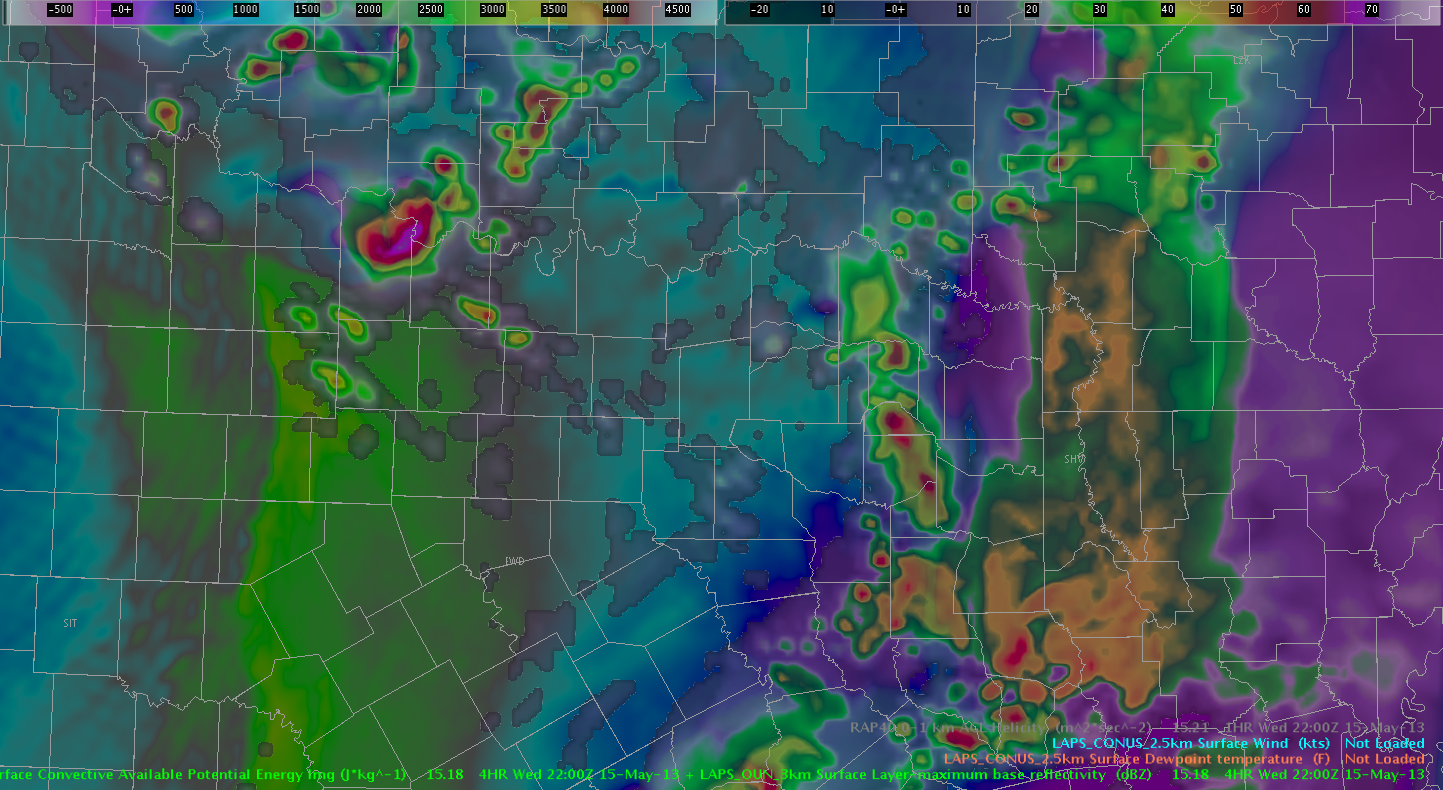
The 18Z LAPS 4-hour forecast of sfc layer maximum reflectivity showed the development of a large, supercellular storm near the Gray /  Montague border.

18zlaps_f04

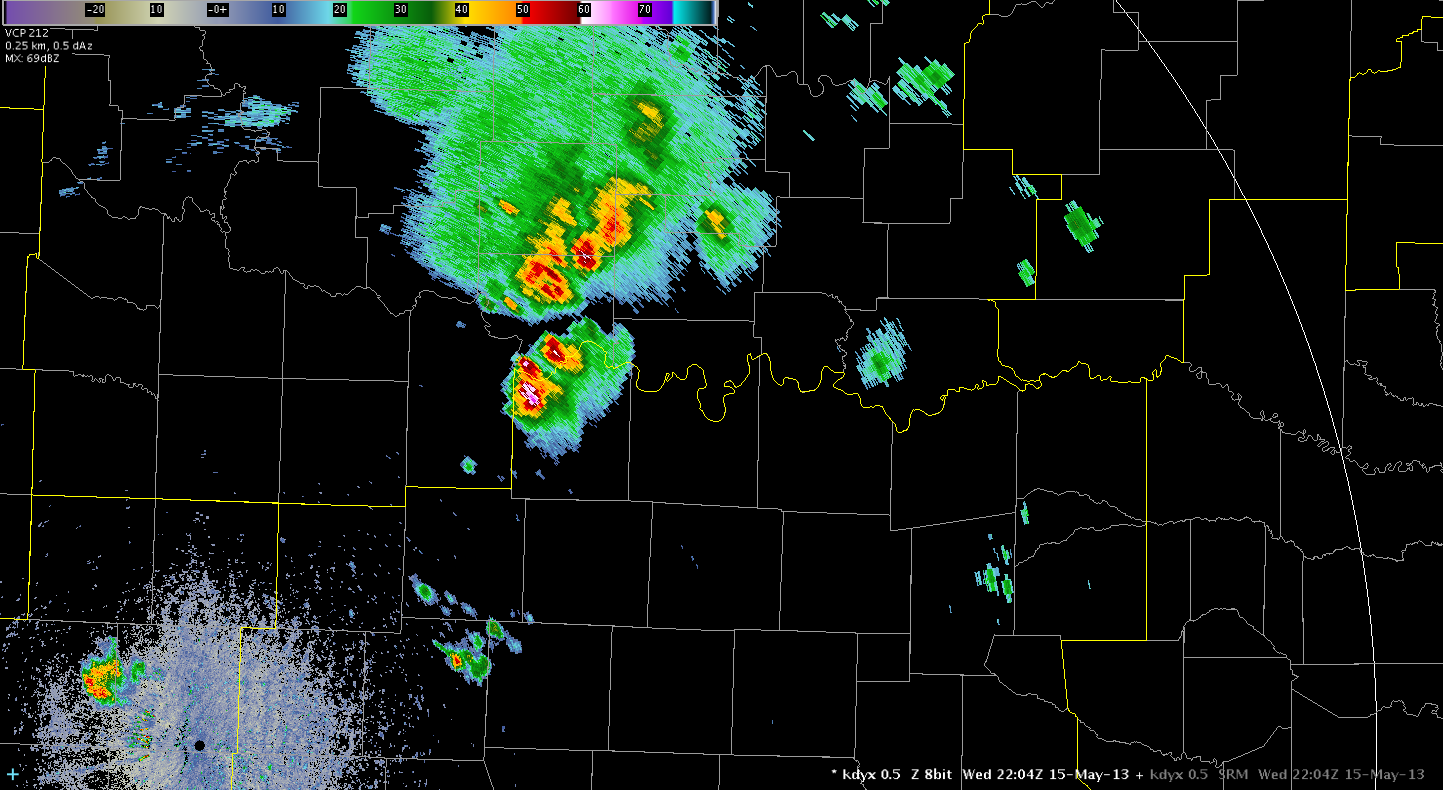
Here is the actual reflectivity image from 2204Z.

2204_Z

Golfball- to baseball-sized hail has been reported with this storm.

Picca

Tags: None

CIRA NSSL WRF Simulated IR Underestimates Cloud Cover Over Oklahoma

The top image is CIRA/NSSL WRF Simulated IR while the bottom image is observed IR around 22 UTC.  The simulated IR underestimated cloud cover over Oklahoma where a mid/upper low was centered.  The convection over the Rockies in Colorado and New Mexico as well as cooler cloud tops over eastern Texas and Louisiana were handled well by the simulated IR.  The convection near Lubbock, Texas was captured very well.
was handled very well by the simulated IR.  The band of

Tags: None

2116Z Comanche County SVR

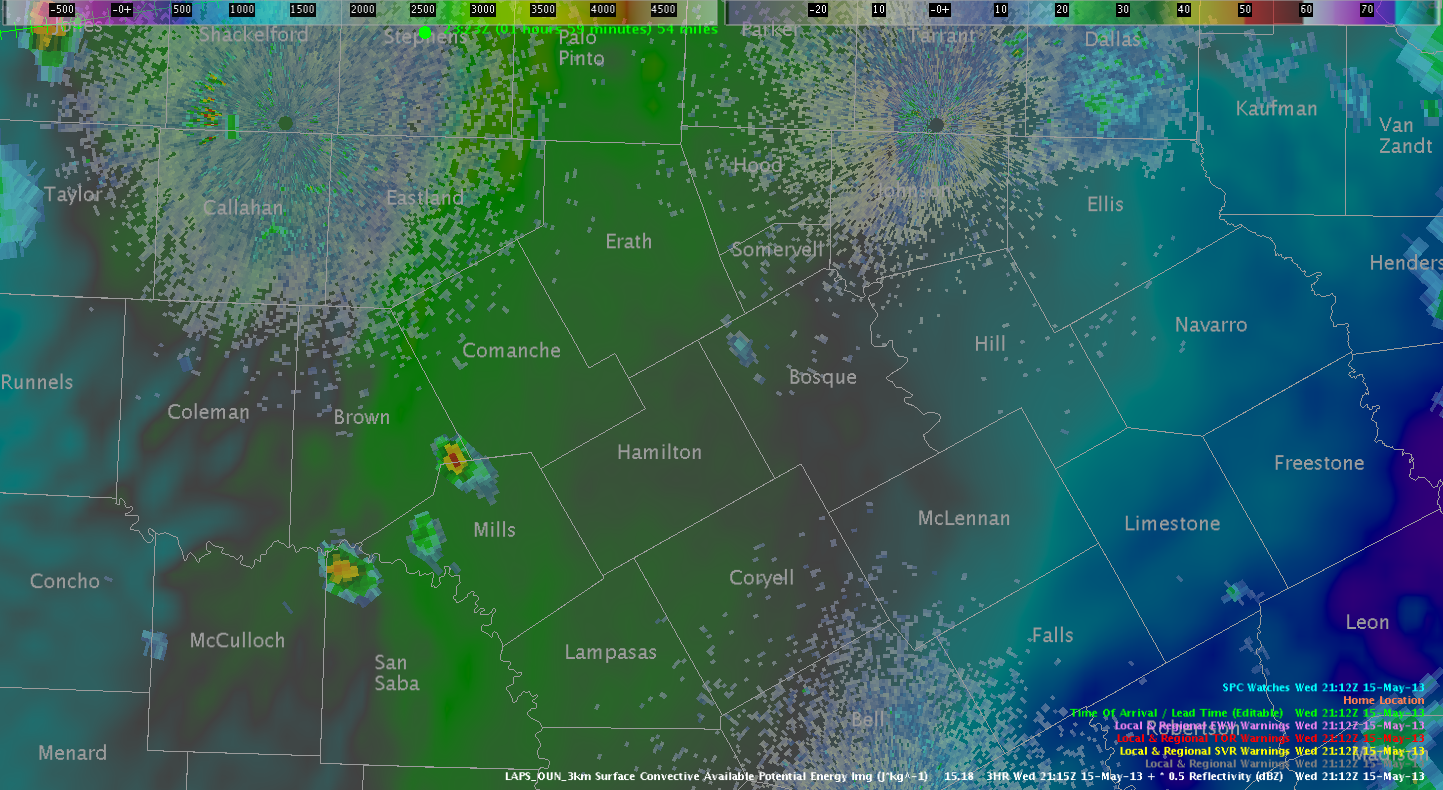
Based upon CTC rates around -20 to -25 C and initiation within a LAPS-analyzed region of approx. 2500 J/kg of CAPE, we warned on a cell that was developing around the Brown/Comanche/Mills intersection, expecting that strong cooling rates within an axis of (model-represented) good instability would at least result in a hail threat. However, the cell quickly weakened as it moved into the FWD CWA. Based upon recent sounding from MPEX in Seymour, TX, current atmospheric column across central TX may be too dry, resulting in growing updrafts entraining too much dry air and dissipating from negative buoyancy.

CTC Rate (SW portion of CWA)

15may_ctc

LAPS-analyzed Instability

15may_laps

Tags: None

LAPS on the right way regarding dryline organization and decaying storms

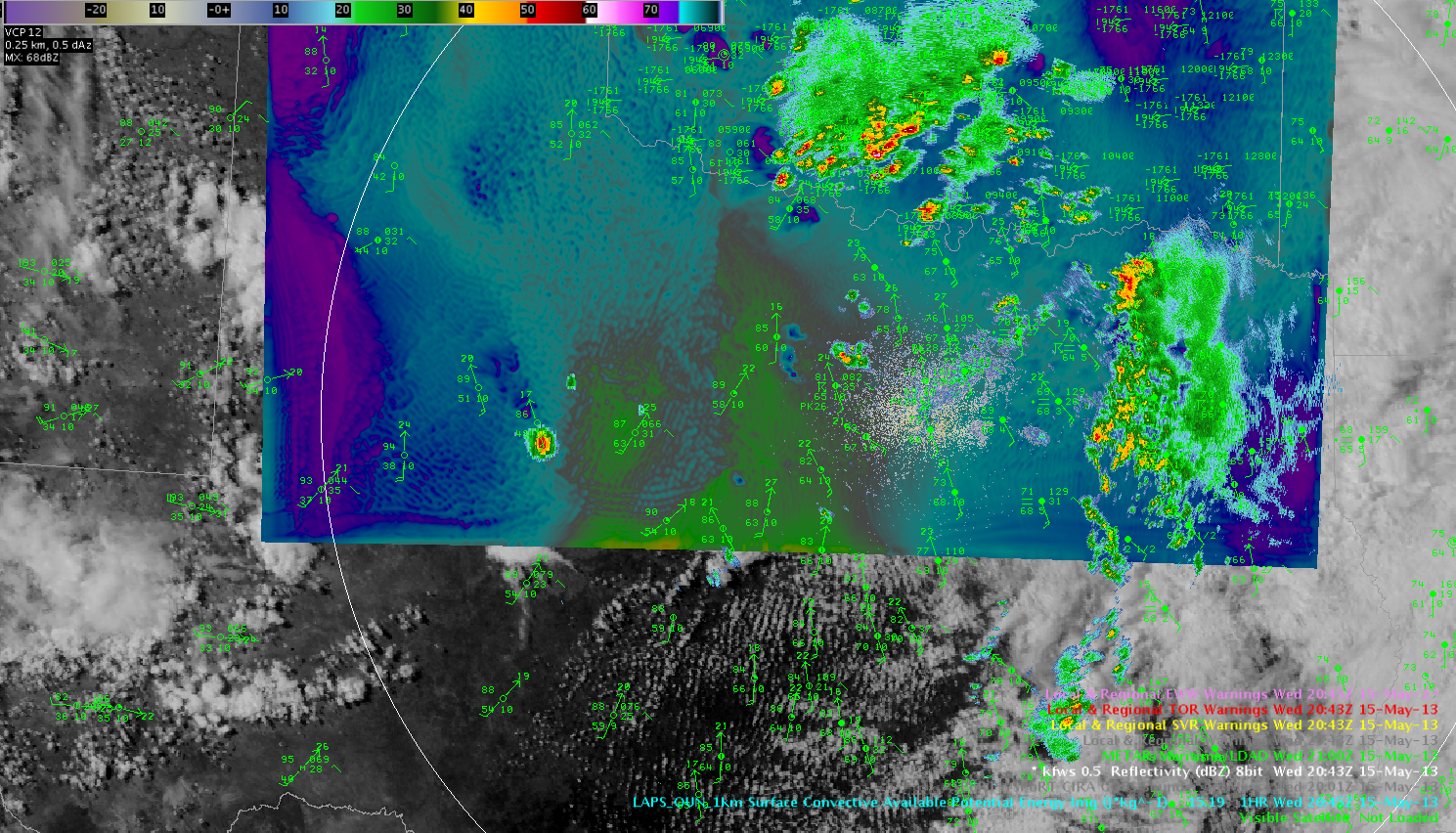
I was wondering why LAPS constantly showed weakening trends with discrete storms entering a north-south aligned CAPE tongue just west of KABI. Rapid strengthening occurred just after initiation:

initiation_21ZLAPS 1km overlaid with reflectivity/VIS.

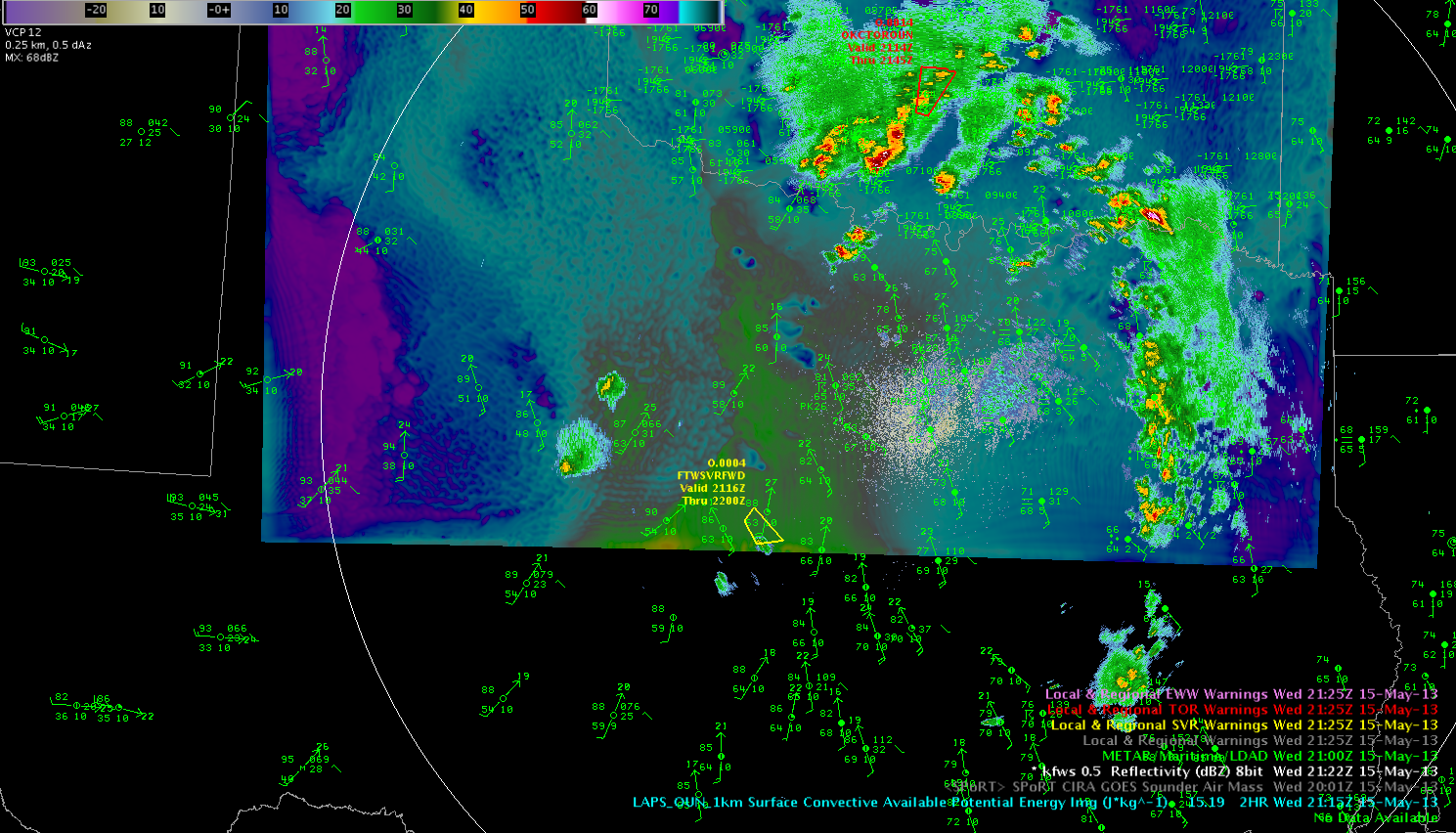
CAPE (LAPS) peaked in excess of 2000 J/kg in the area where storms were expected to move in. However, as seen below, storms gradually weakened during the following scans and so did the CAPE plume in LAPS:

initiation_2130Z The guess is that there was some strengthening of the dryline with enhanced postfrontal mixing occurring (personal talk). Also, there might be an evolving dryline bulge to the southwest of Dallas. Accompanied broadening area of backing winds is now present to the east/northeast of the decaying storms  and the focus for initiation of most intense storms in the next few hours remains next to the Dallas/Fort Worth area (as constantly seen in OUN WRF/LAPS). 2145Z features 15-20 kt SE-early surface winds in this area with rapid thunderstorm growth. Helge

Tags: None

Flash Extent Density Comparison with MRMS Data Near Ratliff City, OK on 15May2013

A lightning jump of 18 Flash/Min to 40 Flash/Min between 1908 and 1909Z  with a second jump to 51 Flash/Min at 1912Z preceded a rapid increase in vertically integrated ice, MESH, and reflectivity at the -10C isotherm. A 1″ hail report was then acquired at 1926Z in Ratliff City.

The following plot shows the flash extent density trace for the storm approaching Ratliff City, OK. Focus on the timeframe between roughly 1900Z and 1930Z. Notice the strong jump between 1908Z and 1909Z.

traceMESH jumped from 0.63in (1910Z) to 1.10in (1912Z) to 1.26in (1914Z) with the last detection of 1.02in (1924Z) before dropping off thereafter. The following images show the jump from 1910Z to 1912Z.

MESH1910May15

MESH1912Mazy15

Looking at the vertically integrated ice product…there was an increase in values from 14 kg/m2 (1908Z) to 20 kg/m2 (1910Z) to 32 kg/m2 (1912Z) with consistently high values above 30 kg/m2 through 1924Z. See the images below as the storm approached Ratliff City.VII_1902VII_1910VII_1912

Regarding reflectivity at the -10C isotherm…there was an increase to 59dBZ  by 1912Z then 61dBZ at 1914Z (not shown).

Again, the 1″ hail report was acquired in Ratliff City at 1926Z which gives the lightning flash extent density tool a 17min lead time to the 1″ hail report.

RJM

Tags: None

SPoRT CIRA GOES Sounder Depicts Short Wave/Developing Convection in W TX

The images at 19 and 20 UTC respectively depicted an area of drier air, most likely associated with a short wave on the back side of a mid/upper low over southwest Oklahoma. This wave seems to be enhancing cloud top cooling and convection generation over west Texas, near Lubbock.  We will keep a close eye on this feature to see if this wave will allow for explosive convection 22-01UTC near a dryline from near Childress to San Angelo with very unstable (2000-3000 J/kg) air near and east of the dryline. Michael Scotten
Tags: None

Why are storms struggling early? LAPS to the rescue again…

The cells that have formed in the western portion of the FWD CWA have so far been fairly pedestrian.  Initially, this was puzzling, as there appeared to be several favorable factors for more vigorous activity.  My partner here pulled up my favorite product, the LAPS CAPE analysis, and he may have found the answer.  The storms are forming along an instability gradient (the blue/green interface towards the bottom of the image), and moving eastward into an area that was worked over by morning convection (lighter blue colors).  So, they waddle along and weaken in the more hostile environment.  Mystery solved, at least partially!  Still expecting more exciting weather soon as a watch just went up.

CL

LAPS_CAPE_051513_2030

Tags: None

Mesoscale Discussion 21 UTC 05/15/13 Central/North Texas and Southern Oklahoma

Thunderstorm coverage is expected to increase 21-02z across north and central Texas as daytime heating should erode capping. Think isolated to scattered supercells will develop near or just east of the dryline where best instability (2000-3000 J/kg) and increasing shear (0-6 km 30-55 kt).  Very large hail would be the main hazard with supercells, thought damaging winds and perhaps a tornado or two may occur as well. Highest storm coverage will most likely be across western north Texas and Oklahoma where capping is weakest closer to the mid/upper low.  The best chance for supercells with the biggest hail is expected over northwest Texas where best instability and shear are forecast. Across Oklahoma, weak capping and limited heating from ongoing convection are expected to limit the overall severe potential, though a stray damaging wind or hail report remain possible, mainly through 02z. With low LCLs and locally enhanced 0-1 km SRH values 150 to 200 m2/s2, short lived weak tornadoes are possible, mainly over central and eastern Oklahoma through 01z. Additional severe storms may develop farther south near or east of the dryline, across central and south Texas though stronger capping is expected to reduce the number of storms.  The supercells may evolve into mini squall lines/MCS clusters 01-03z as they move southeast and are expected to slowly weaken. However, damaging wind and large hail may the main hazards with any MCS.

Tags: None

Slow moving low atop Oklahoma

An healthy looking low pressure area has moved towards SW OK with lots of convection already ongoing.

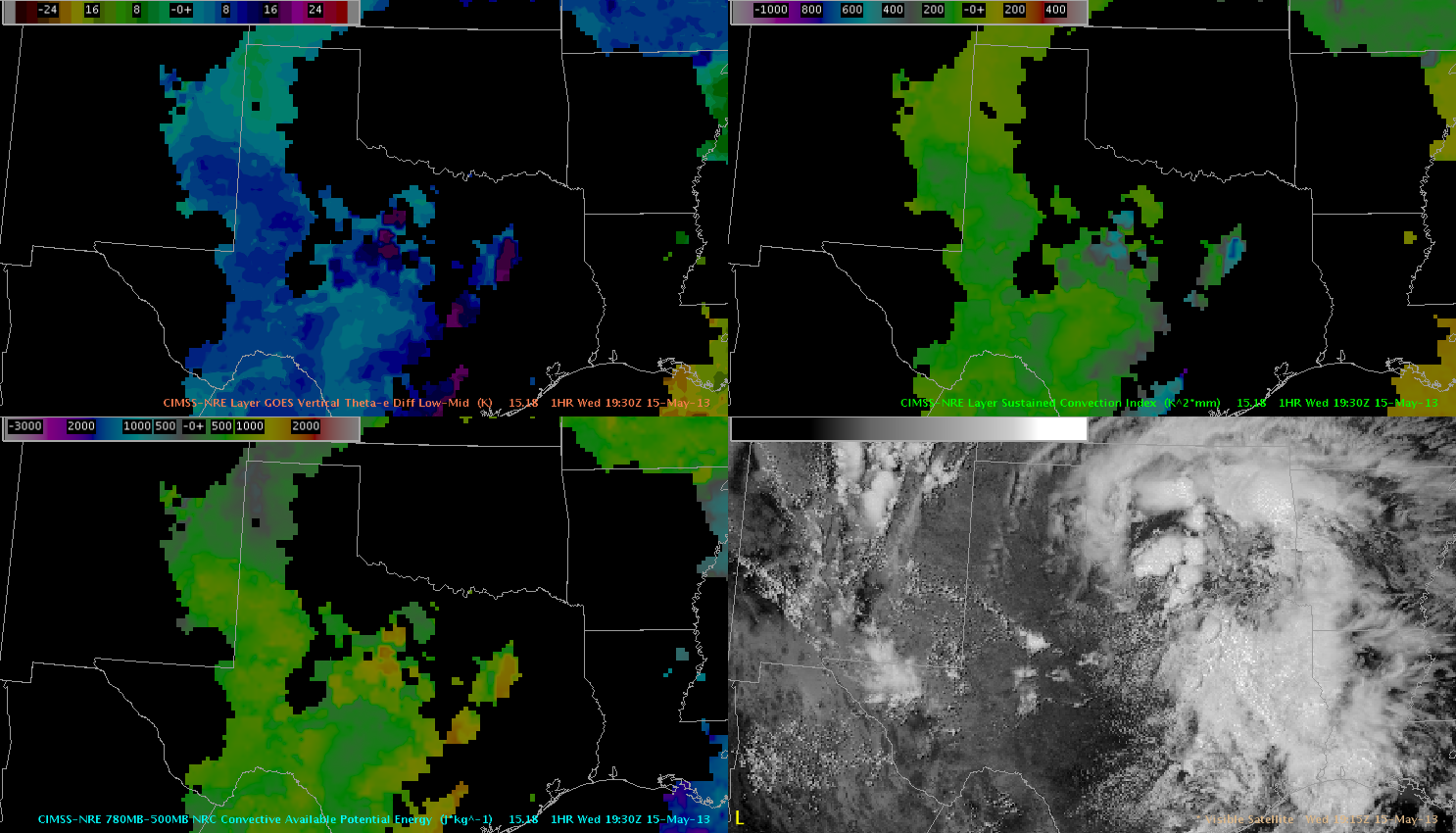
NRE_overviewupper left: GOES Vertical Theta-e Diff low-mid, upper right: Sustained Convection Index, lower left: CAPE and lower right: VIS

The main swath of unstable air is visualized nicely with that product, showing a tongue of very unstable air expanding from the far W-Gulf coast towards S-Oklahoma. The ‘sustained convection index’ highlights that area, where strong and longer lived updrafts might evolve betimes (and given agitate Cu field development, it won’t take that long for that). NRE CAPE field has 1500 J/kg just south of OK and with ongoing diabatic heating, we expect a further increase during the following hours. So, using the NRE product the focus for strong/sustained convection clearly shifts in the Dallas/Fort Worth area and south.
Also using the theta-e diff low-mid product, conditions for at least isolated to scattered initiation towards the Lubbock area  seems to be plausible, given westward expanding plume of unstable air and interaction with others mesoscale features at the surface. In fact, there currently evolves  an east-west aligned theta-e tongue just south of Lubbock, which overlaps nicely with evolving showers and thunderstorms.  Helge

Tags: None