ProbSevere v3 for Low End Storms

In the training we reviewed for ProbSevere v3, it was frequently mentioned that overall the values we would see in v3 would tend to be a bit lower than in v2, which is what you’d expect in a better calibrated model. (Given what we know about storms and their potential severity, v2 often seemed a little too sure of itself, right?)

However, in looking at the relatively puny convection over Charleston’s CWA today, I’m seeing a lot of the opposite. That is, instances where v3 is noticeably higher than v2. As I think about it, I believe we’re seeing more evidence here of a better calibrated model, as it’s ultimately showing less certainty than v2 about storms not being severe which seems to make sense intuitively. We’ve all had our share of days where a storm one thinks is relatively benign ends up overperforming and though I don’t have any actual evidence to prove this, it appears that ProbSevere is, in its way, taking that into account. Ultimately, this is giving me a bit more confidence in its output.

An example of a somewhat low end thunderstorm where v3’s percentage (29%) is noticeably higher than v2’s (2%). V2 seems a bit too certain that this storm is not severe. As forecasters, we know better.

– Earl Grey Tea

Tags: None

Random NUCAPS Observations

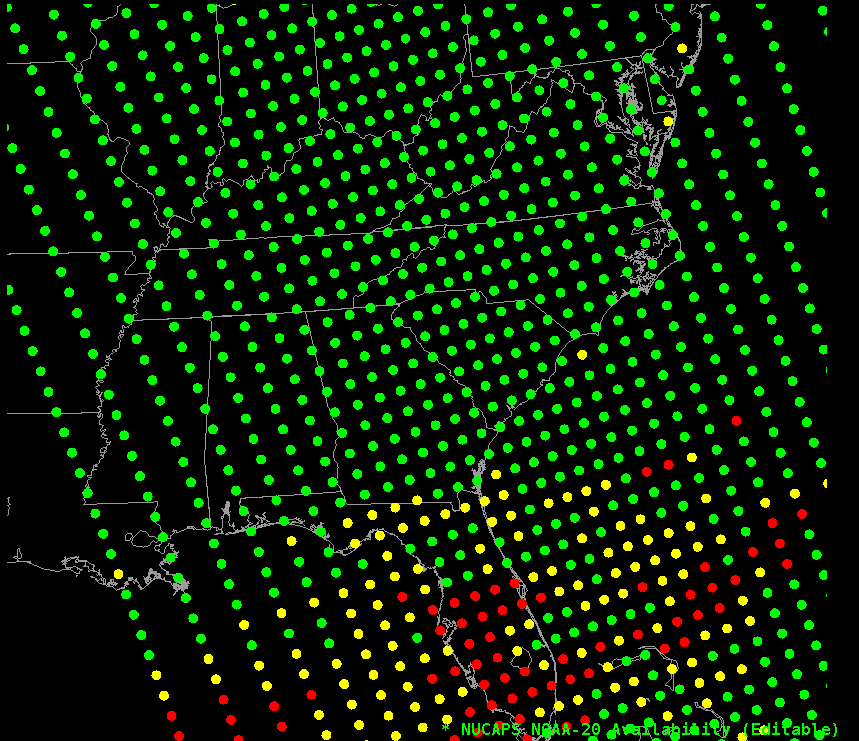
Thunderstorms in the Charleston CWA are marginally interesting at best today so I have been spending some time browsing some parameters that aren’t necessarily severe weather related. NUCAPS availability across the eastern United States looks pretty good today!

I haven’t had the opportunity to use the pop-up skew-t functionality in AWIPS until now (didn’t even know it existed, in fact). It is a bit buried and it took me a few tries to get it to work, but this makes it a lot easier to go through all of these different points and try to find an area of interest without having to go into the occasional information overload that is NSHARP unnecessarily.

After looking at some soundings I went to explore the gridded NUCAPS data, which looks very promising. There was a slight learning curve as I had to get used to the polar orbiting satellite paradigm once again, but being able to see the data from all of the points in a plan view format can help with the information overload mentioned above. I noticed the gridded NUCAPS has some ozone and Haines Index fields. Air quality and fire weather are kind of a big deal where I forecast out west, so these fields will be fun to explore once they’re available in my home AWIPS. Seems like the Ozone Anomaly fields might be a bit easier to understand than the Total Ozone, as apparently Dobson units measure the ozone differently than something like PPM. I tried to investigate this data for the west after that NUCAPS pass came in today but a lot of the gridded data was incomplete. I suspect it was due to the lack of available soundings (saw a fair amount of yellow and red for whatever reason). I’ll take another look tomorrow.

– Earl Grey Tea

Tags: None

ProbSevere in Jacksonville

The 0.5 degree SRM from JAX shows a concentrated area of wind within the cluster of storms in St. John County, FL with radar estimates of the wind near 50kts. Given the lightning jump illustrated by FED values quickly rising to ~170 flashes per 5 min, the storm is intensifying.

However, ProbSevere values are rather low with version 3 showing only 22% and version 2 showing 33%. ProbWind surprisingly was even lower with only 19%. This is a reflection of the lack of base radar data involved in the ProbSevere and ProbWind algorithms. Especially for ProbWind, base radar velocity data needs to be included in ProbWind for this product to be useful in identifying wind producing severe thunderstorms.

It would be useful to integrate base radar data from multiple single radars and combine these values into one algorithm. It may be useful to identify notable/sharp changes within velocity data between pixels which could help in picking out downdrafts.

– Fear the Shear

Tags: None

Modified NUCAPS Sampling: PopUp vs Nsharp

When trying to sample NUCAPS and modified NUCAPS soundings (via Volume > Popup SkewT) I realized that the popup SkewT only showed the actual NUCAPS profile (there was a notable peculiarity in the modified profile boundary layer that I was looking for in the popup).

I don’t think this was an error in AWIPS, because when right-clicking and selecting ‘sample cloud heights/radar skewT’, the options presented only include NUCAPS, not also modified NUCAPS. So, by my understanding, when displaying modified NUCAPS, the popup SkewT will reference the original.

This second image, perhaps, further illustrates the issue. When displaying only the modified NUCAPS on the map and selecting the profile of interest (in the FSD CWA), the sounding with the interestingly-generated inversion (I believe the subject of another blog post) displays in NsharpEditor. However, the popup SkewT profile does not, because it seems to be showing the original NUCAPS profile.

– Guillermo

Tags: None

Storms in northern and central Florida

GLM:

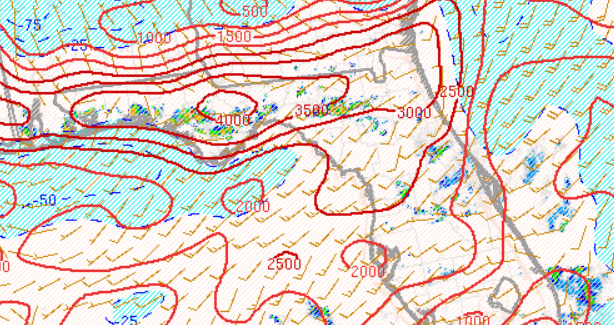
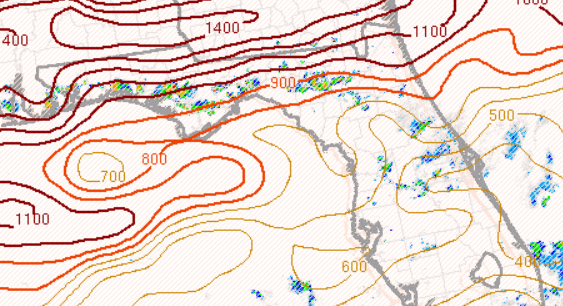
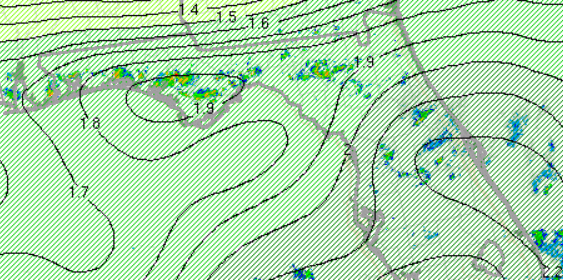
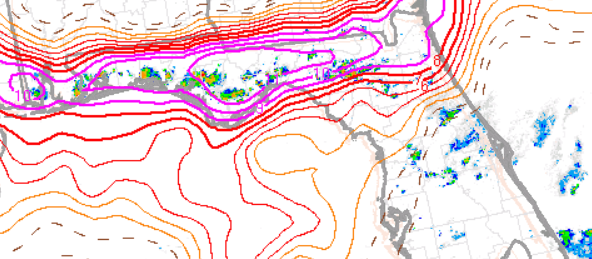
On the afternoon of June 15, 2 different convective regimes were noted across Florida, with different GLM lightning characteristics. A cold front was sinking southward towards the Florida panhandle, with convection developing along the Gulf sea breeze along the FL panhandle. Convection of more uncertain forcing developed in Central Florida.

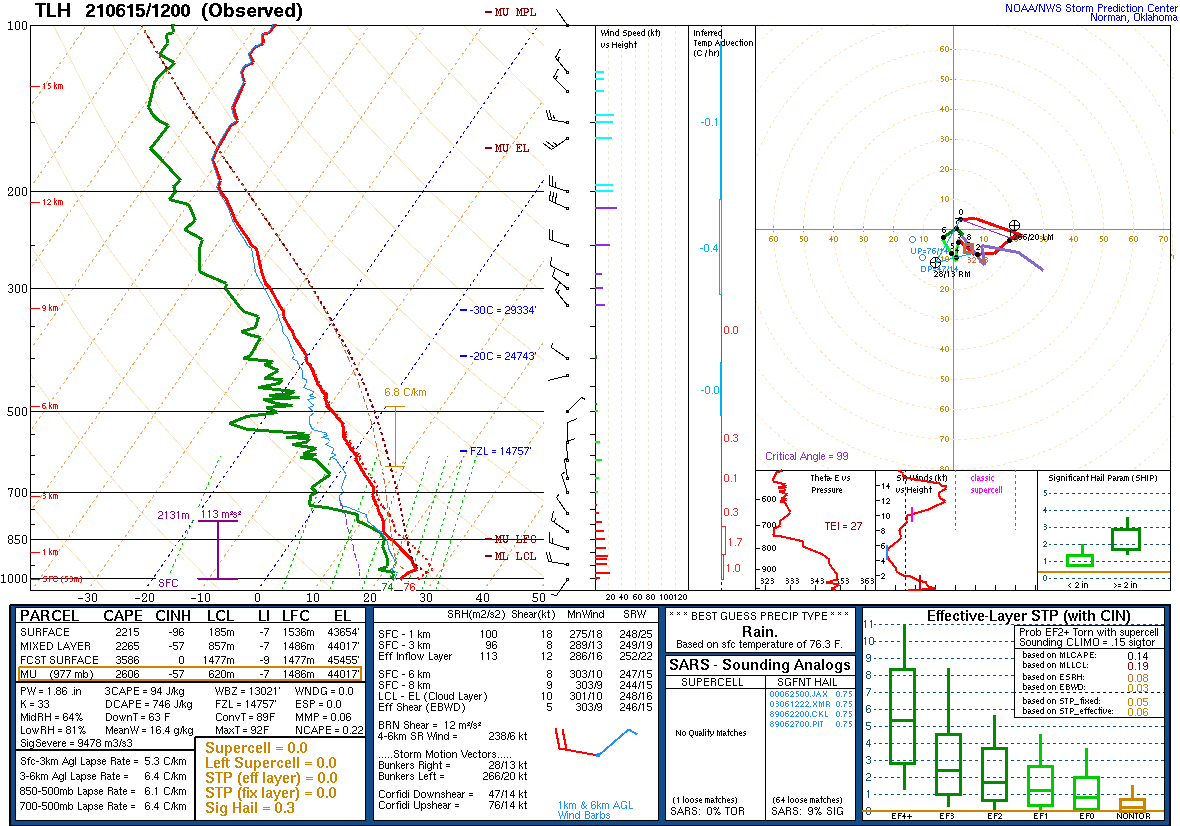
Convection along the FL panhandle had higher MLCAPE and DCAPE due to mid-level drier air and steeper lapse rates, with somewhat lower PWATs. SBCAPE in excess of 5000 J/kg and MLCAPE in excess of 3000 J/kg was unusually high for this region. Convection in central FL was in a more tropical air mass, with PWATs at or above 2 inches and more saturated profiles. Convection in the FL panhandle developed in an area with very high microburst composite parameter values, indicating conditions very favorable for microbursts and localized damaging wind gusts.

12z TAE sounding:
15z XMR sounding:

MLCAPE 19z:
19z DCAPE:
19z PWATs:
Microburst composite parameter 19z:
The FL panhandle convection was more intense on radar and also had higher flash extent densities. It also tended to have lower minimum flash areas, centered on locally strong updrafts. Notable hail cores were observed aloft, and melting of these hailstones caused strong downdrafts and damaging wind reports, and in a few instances quarter size hail made it to the ground, with one instance of golf ball size hail..

1920z:
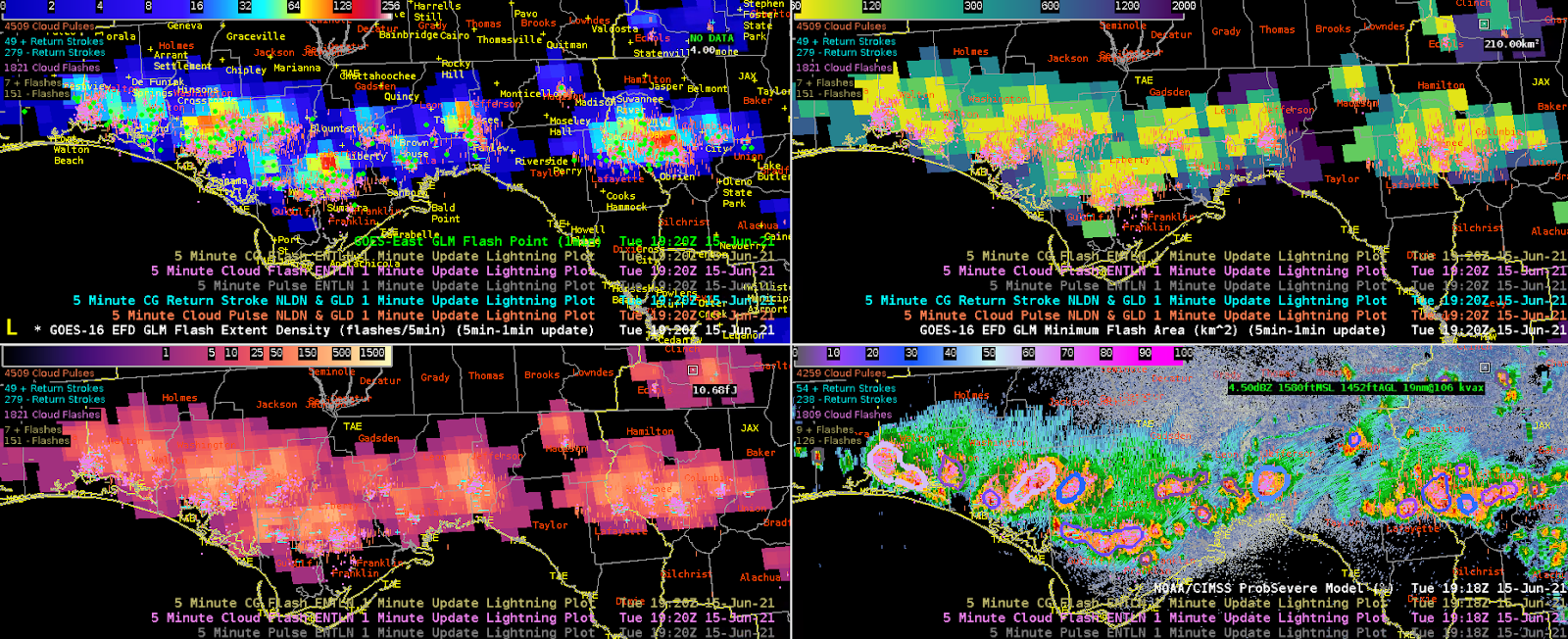
The central FL convection was weaker and had also been going on for longer, so there was some convective debris stratiform precipitation with larger minimum flash areas. Flash extent densities were lower than in the FL panhandle. There were still areas of lower minimum flash area centered on the updrafts.
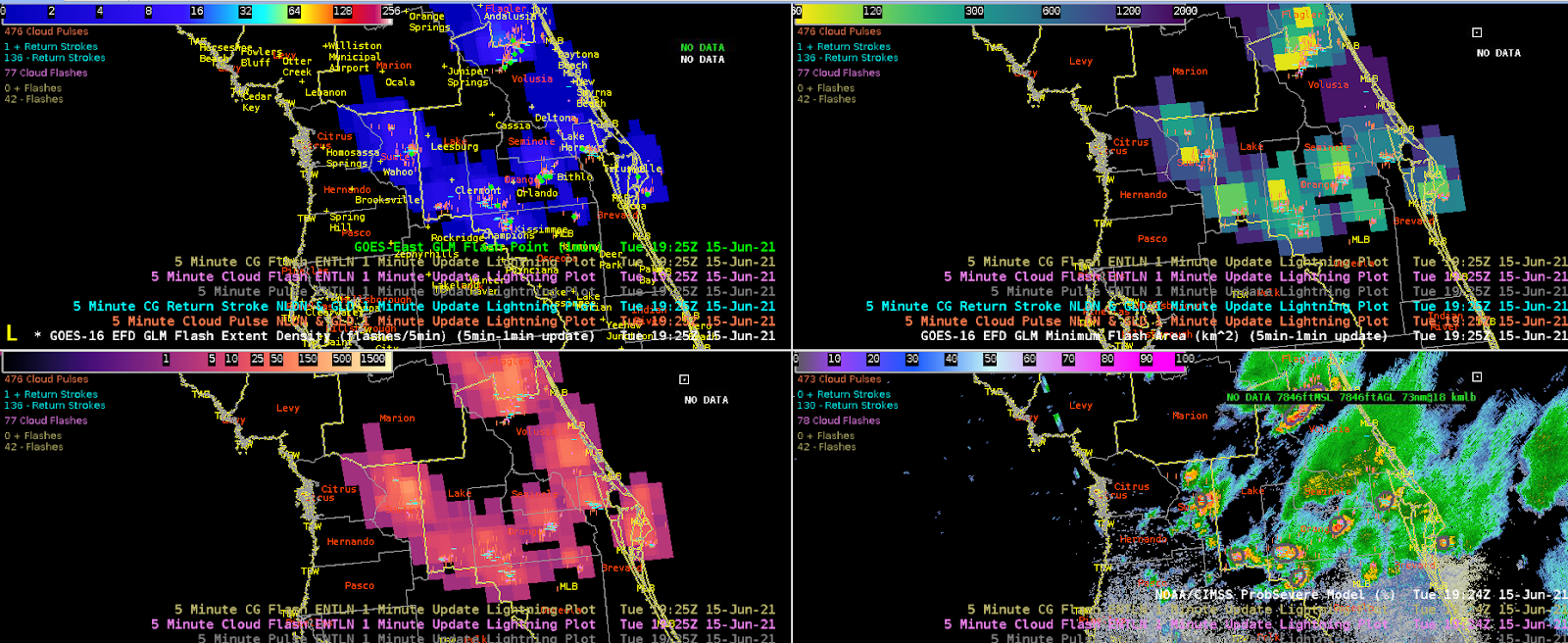
The GLM flash points were very useful and lined up with the NLDN and ENTLN strikes and flashes. The parallax correction was especially useful for DSS purposes as partners often request notification on lightning strikes within a particular radius on the order of 8 to 20 miles, so an accurate location is important. At first glance there were much less flash points but this appeared to be due to the data only being 1 minute data without having the 5 minute accumulation that the NLDN and ENTLN offers. Having this similar 5 minute accumulation would be imperative for using the GLM flash points in operations. The sampled metadata for the flash points appeared less useful operationally. The flash area would be more of interest than the duration, but with a large number of flash points some sort of graphical depiction would be needed, and flash extent density seems to serve this purpose.

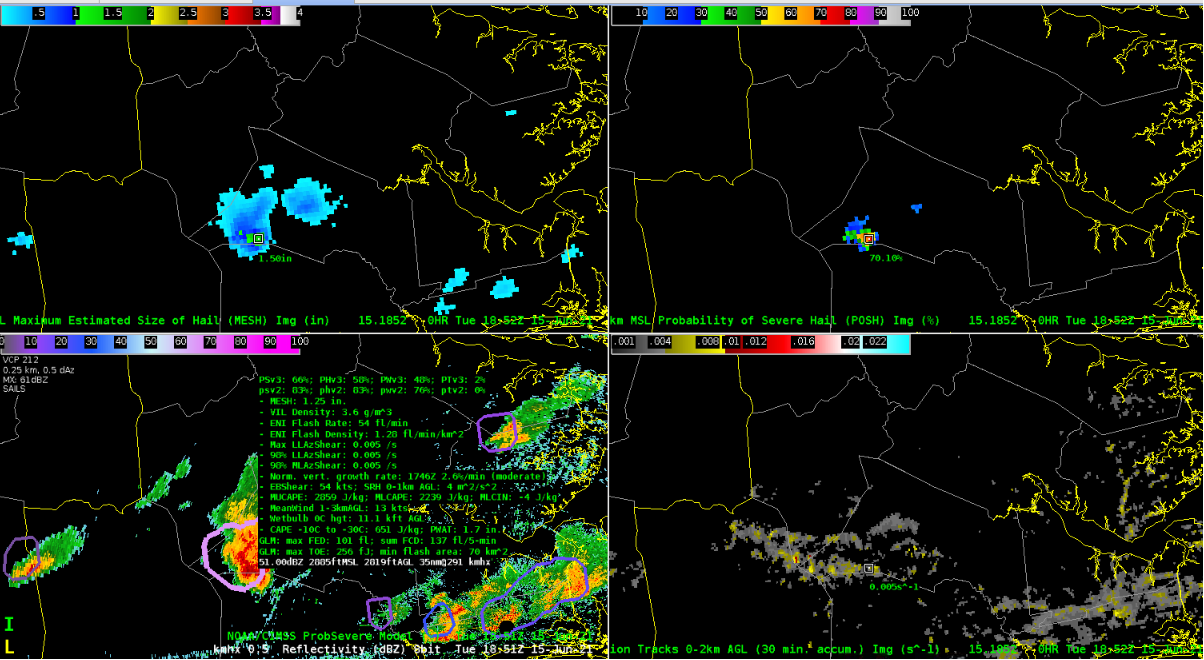
ProbSevere:

One interesting thing that was noted was v3 had much lower ProbHail than v2, while still having decent ProbSevere (mainly wind-driven values). We speculated that this was due to some of the machine learning based on environment and climatology, since severe hail would be less likely this time of the year with higher freezing levels/hot surface temperatures causing melting. However, in this case a golf ball size hail LSR was issued at 19:59z (report time appeared to be incorrect) for 2 ENE Saunders in Bay County, FL. This was comparable to MRMS MESH which maxed out at 1.89”.

On the technical side, I did want to note that typically I have sampling turned off in AWIPS, but then double-click on something that I want to sample. Since the ProbSevere timeseries plugin is also opened by double-clicking on the object, sometimes when I meant to double-click to sample the ProbSevere values I accidentally ended up opening a time series. And then I would double-click outside the ProbSevere area to sample something else or turn off sampling and I would get a black banner. Perhaps the timeseries doubleclick function could be turned on and off by making the ProbSevere product editable or not editable in the legend.

NUCAPS:

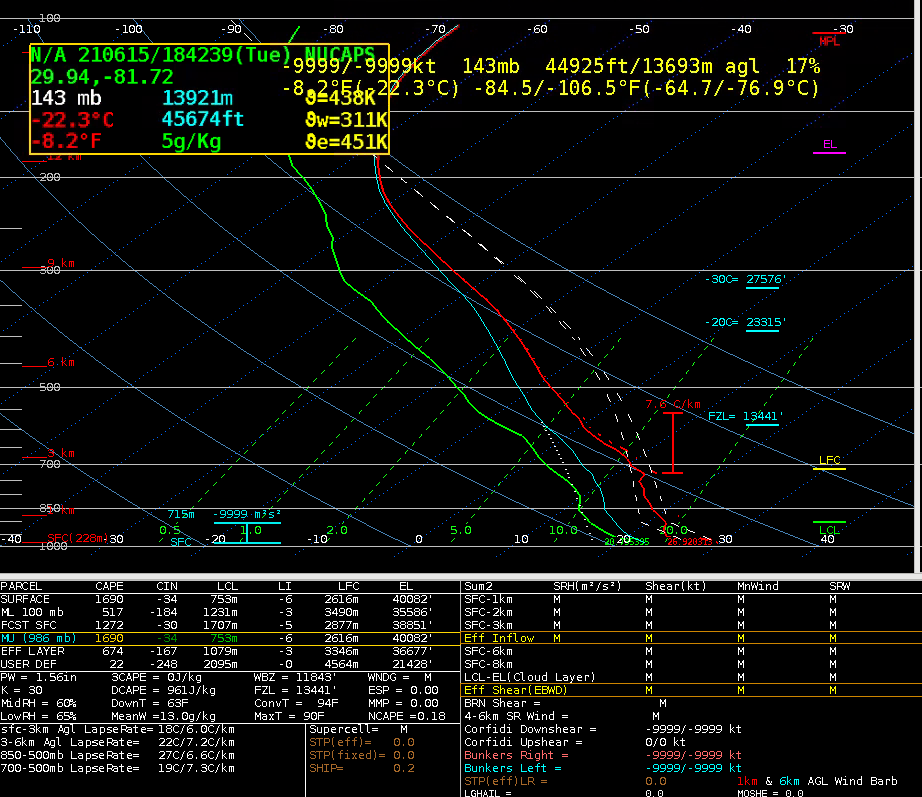
Gridded NUCAPS and individual NUCAPS soundings at 1840z showed steeper 700-500mb lapse rates than what was shown on the SPC mesoanalysis and some of the morning soundings, in areas away from convection. It’s hard to say which one was right, but the hail cores observed do seem more consistent with 700-500 mb lapse rates of near 7 C/km or greater. (Note that it would be useful to have contours to go with the images on the gridded NUCAPS plots.)

NOAA-20 sounding availability and example sounding (1823z)

1840z gridded NUCAPS 700-500mb lapse rate:
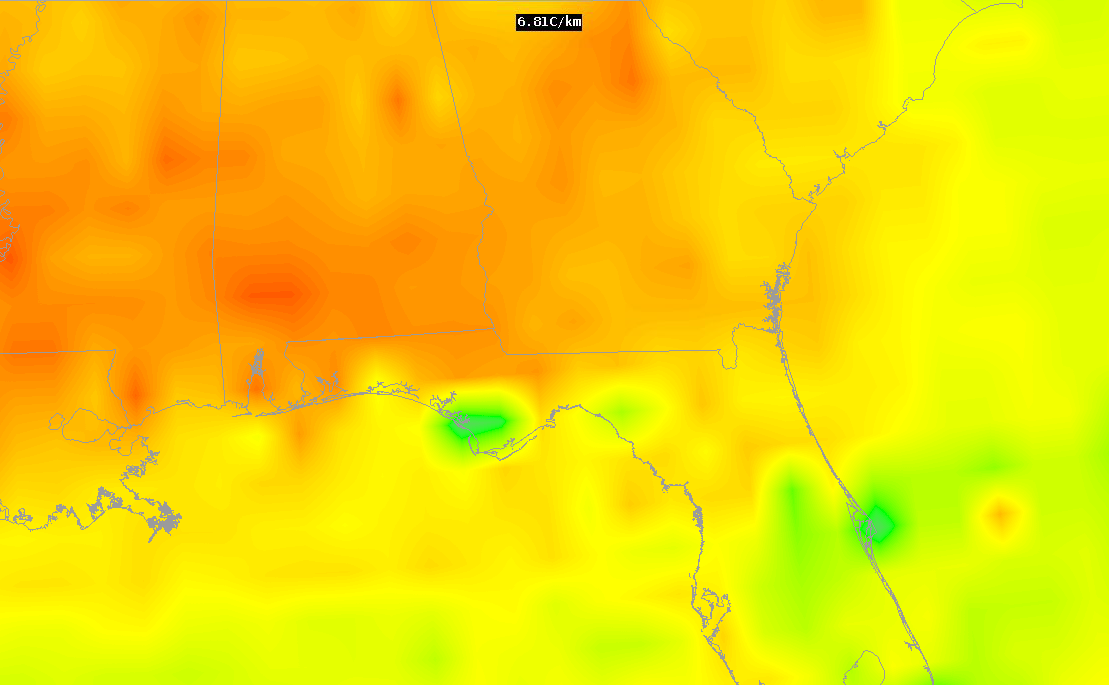
18z SPC mesoanalysis 700-500mb lapse rate:

NUCAPS also indicated the more saturated profiles/weaker lapse rates in the central FL convective regime.
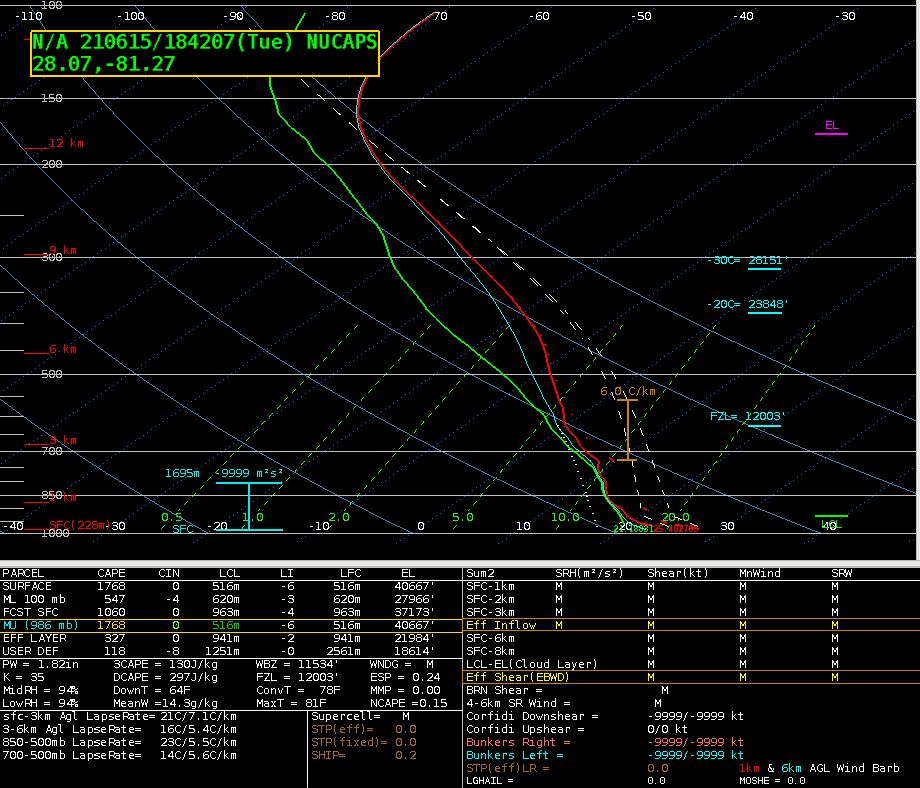
NUCAPS did indicate some of the higher CAPE values, but with missing data in much of the area of interest as convection had already initiated when the pass occurred.

– Barry Allen

Tags: None

Prob Severe V 3

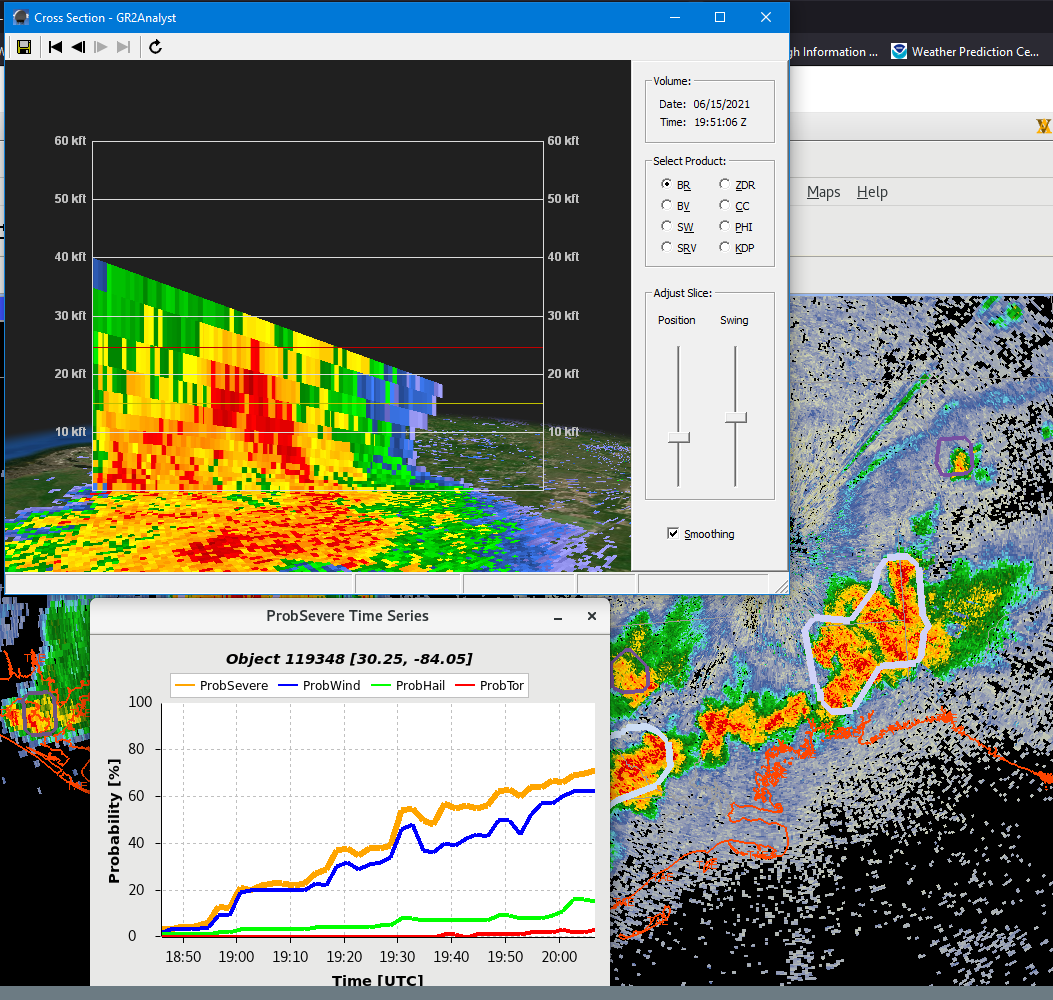
See a significant improvement in the Prob Severe with V3.  Looking at a particular storm in the panhandle of FL shows a significant difference between the two versions.  The image below is the cell to the right of the screen and the new prob severe v3 time series along with a cross section from GRAnlysist.

What can’t be seen is the sample over the prob severe v3 outline which shows both the v2 and v3 output.  In this case, the v2 showed a 65% chance for severe hail but the v3 only showed 7% for severe hail.  Severe wind was 52% and 58% respectively.  Looking at the cross section and knowing the PW values are in the 1.7-1.8 range shows the main threat would be more of a wind/rain rather than hail.  This is a big improvement.  To be honest, the issue with over forecasting hail on the v2 is a big reason why I usually don’t use prob severe.  Seeing this change with V3, I am much more likely to be looking at it as it seems to be more refined and takes the climate, area and conditions into account before producing significant hail or wind values.  While I don’t think it was looking at the cross section to help make its decision, this cross section is a very good example of a wind risk over hail.

-Strato-Dragon

Tags: None

ProbSevere Time Series & Cell Merger

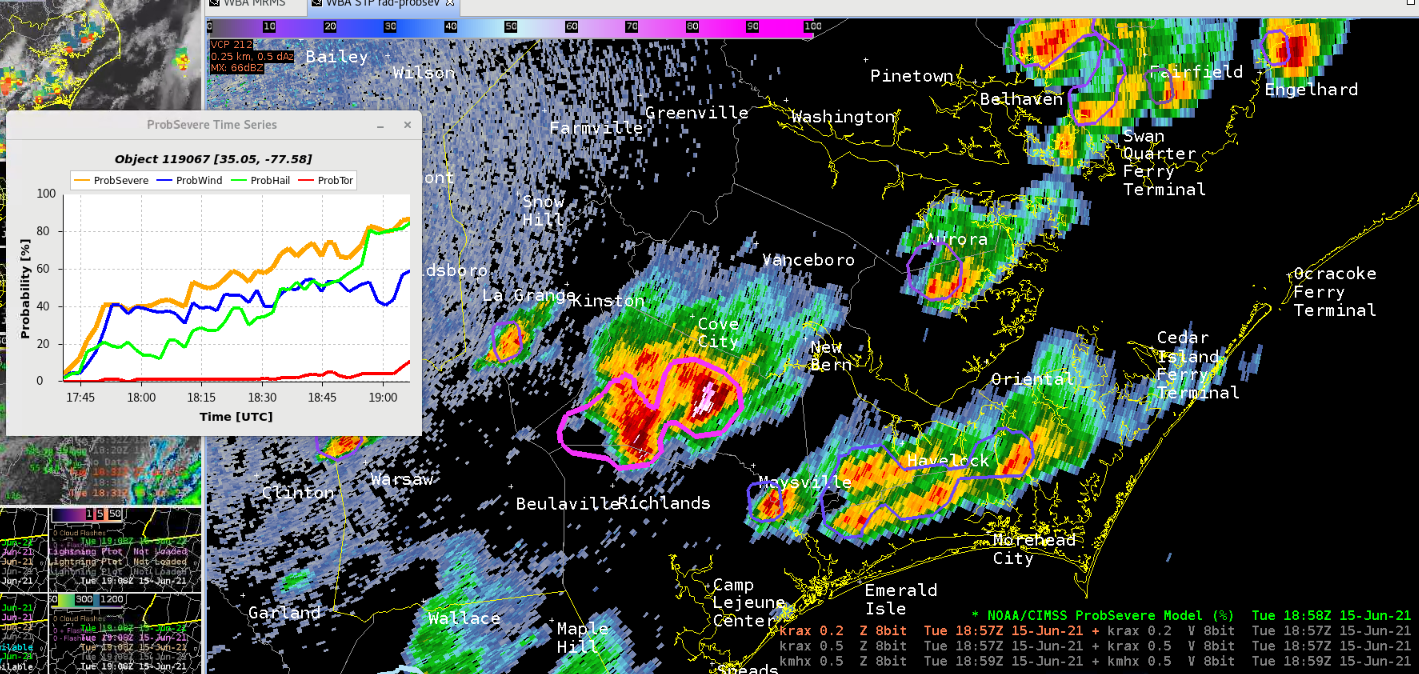
Two separate thunderstorms gradually merged to the WSW of New Bern between 1845-1900 UTC. As ProbSev polygons merged into 1, some of the probabilities took a small dip. Eventually the eastern storm cell intensified slightly, bringing ProbSev values back up.

– Guillermo

Tags: None

ProbSevere Data Readout/Sampling

The ProbSevere readout is useful with all the details shown, but when in 4-panel mode, it takes up a lot of space, sometimes with some data being omitted by the frame. Would it be possible to have the option of a simplified readout displaying only the top 2 line probabilities and then have the option of displaying the additional data? (Perhaps akin to the double left click on a ProbSev polygon for the time series chart)

– Guillermo

Tags: None

Optical Wind Inferences

The “All” winds display setting was useful in combining the multiple layers of wind data, however, without a proper understanding that the winds displayed (and subsequently shaded), a user may incorrectly infer regions of convergence/divergence. I found it useful to ‘build’ the wind layers from the top of the atmosphere (100-50mb) down, to see in which layer the winds displayed where located.

Circled in red are areas that one might incorrectly infer the presence of strong speed divergence, when, while divergence may be present, the winds displayed are at different levels of the atmosphere based on the level of the optical wind sensing. Perhaps there is a way to color-code the wind barbs to correlate height / pressure level (Red for surface with a gradient toward blue for 100mb, or so)?

– Guillermo

Tags: None

NUCAPS Sounding comparison to Observed Sounding

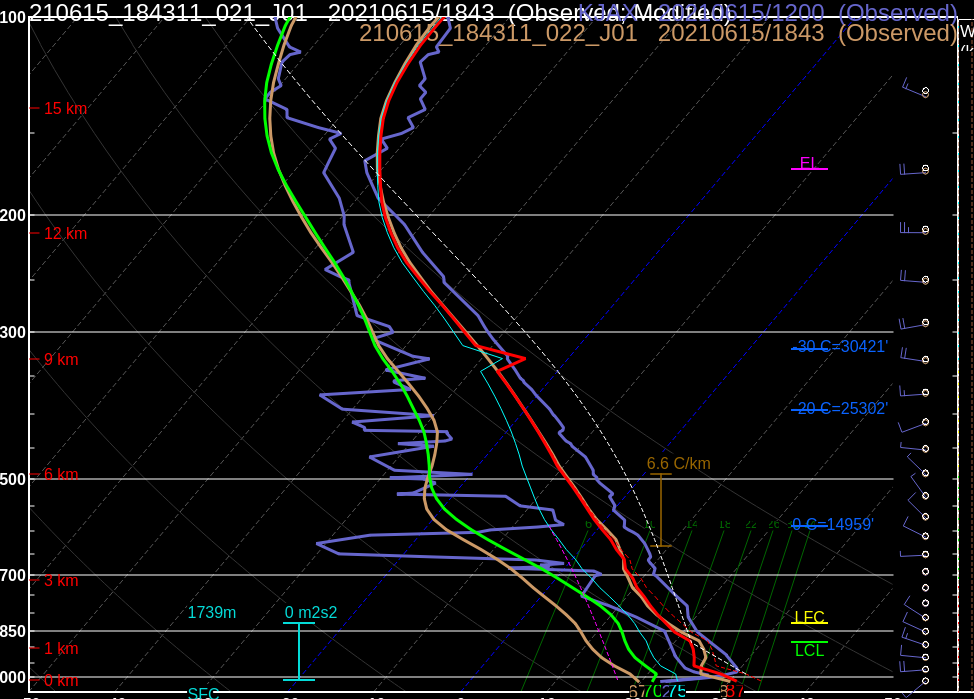
Noticed an across the board temperature discrepancy between the Observed Sounding at KJAX and two of the NUCAPS soundings from the afternoon pass of NOAA-20.  Looked at two different NUCAPS soundings which straddled KJAX.  The morning sounding at KJAX (12Z) showed a typical morning, warm tropical but capped sounding.  The two NUCAPS soundings were from six hours later showed a surface change that would be expected but then showed decent cooling from the morning through the entire column.  The image below shows the two NUCAPS soundings, one is in focus (red/green), the second NUCAPS soundings is the drab color and the observed sounding is in blue.  This shows the two NUCAPS soundings to be very similar and follow each other well but are also a few to several degrees cooler than the observed sounding. 

While I would expect some areas of the column to cool with a sea breeze front coming through, but not the entire column.  When I see this type of discrepancy, it makes me not want to trust the NUCAPS sounding in this case as it does not seem to make much sense with the ground truth of the actual measured RAOB.  Of note, when the NUCAPS sounding was taken, the line of sight was free of clouds and the “dots” were green; however, there were thunderstorms to the north and west of KJAX and they had an outflow boundary approaching the area rapidly.  Could this have made a difference?  I don’t know but it is worth noting this did occur.  Also, we also noted the NUCAPS soundings for this area were all cold in comparison to the morning RAOB.  Looking further west to KTLH, the NUCAPS soundings and the observed soundings looked much closer and made a lot more sense.  So, could this be a marine layer influence?  Could this be just a bad batch?  Could this be a bad thermometer and wet bulb sensor on the actual RAOB?  All valid questions that I can’t answer but put here as possibilities that can’t be verified.  

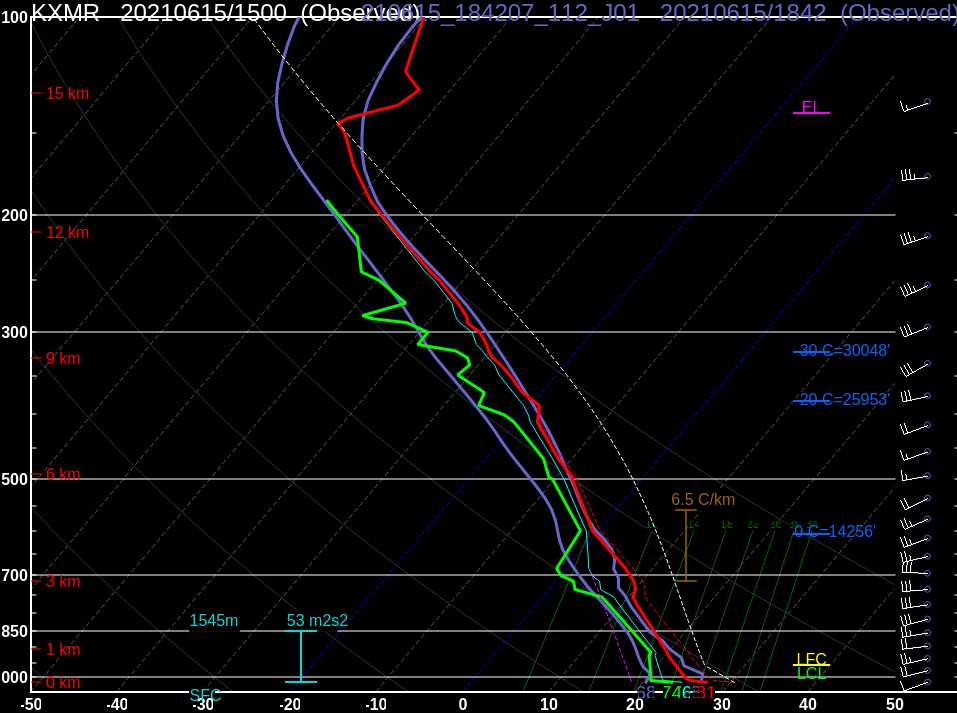
Of note, we also looked at the differences between the KSC 15Z sounding and the afternoon and the afternoon pass of the NOAA-20 NUCAPS soundings.  These two were much closer and seemed to be much closer together.  Also note, the time difference between the two soundings is only 3 hours in comparison to six.  The image below is the KSC sounding comparison.  The sounding in focus is the actual KSC RAOB and the NUCAPS sounding is in the background.

-Strato-Dragon

Tags: None