Remember to look underneath the hood

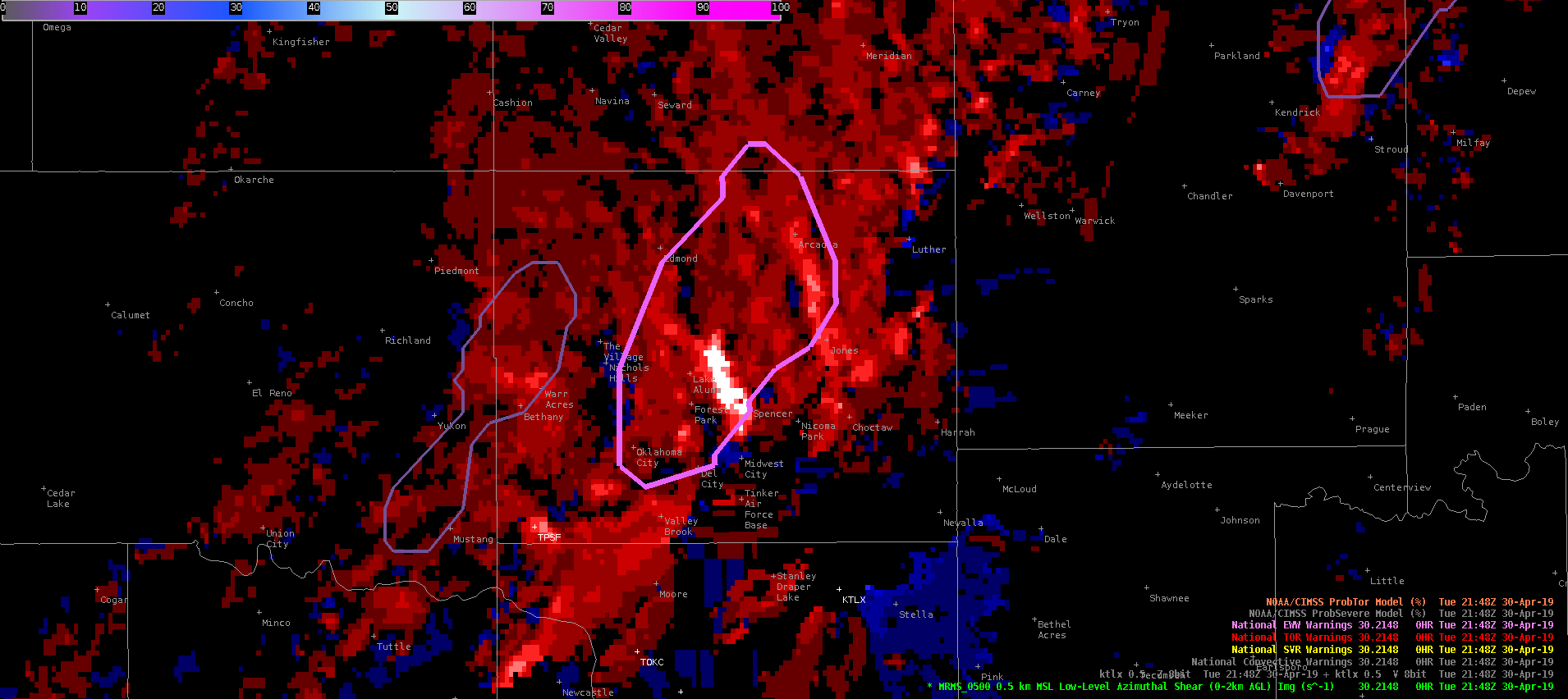
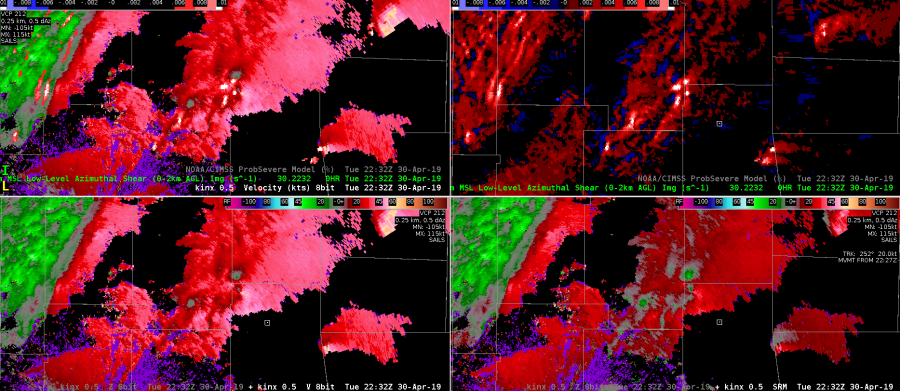
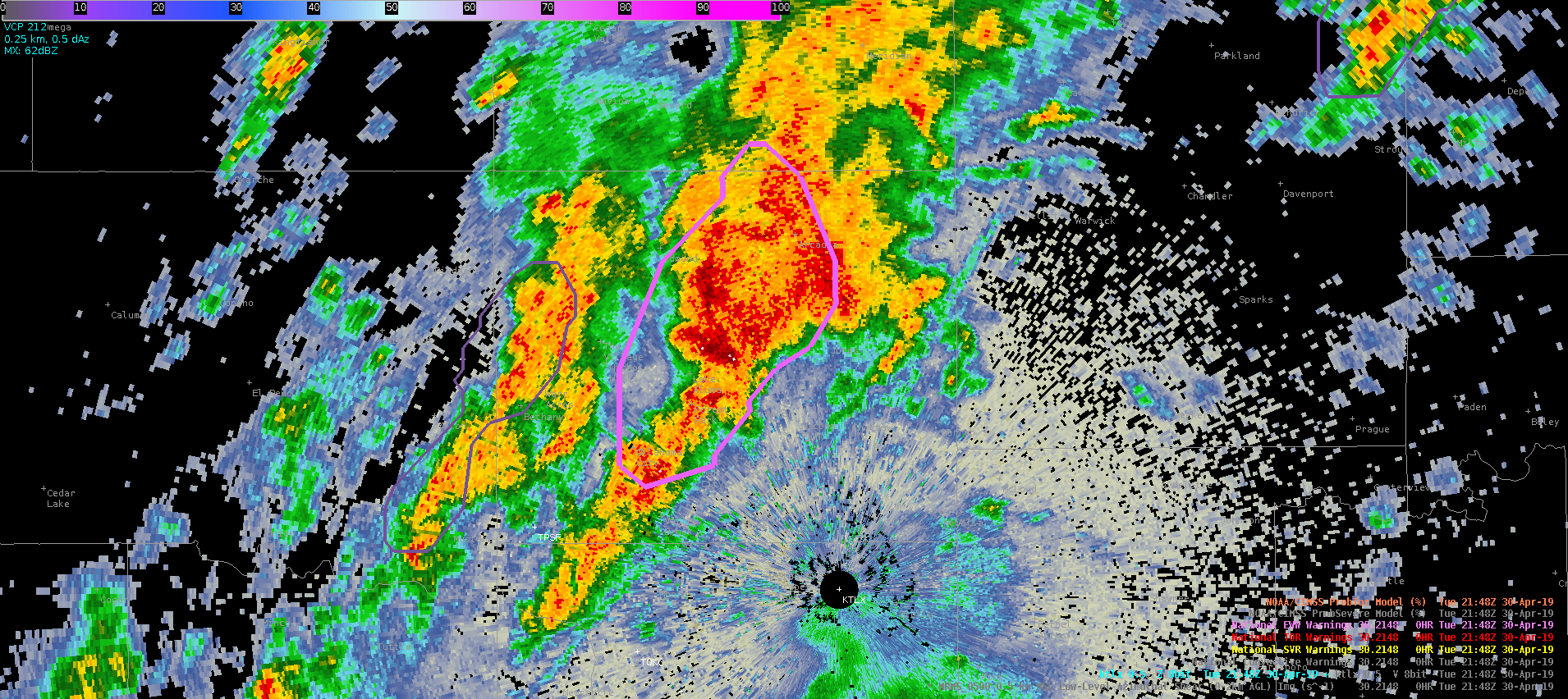
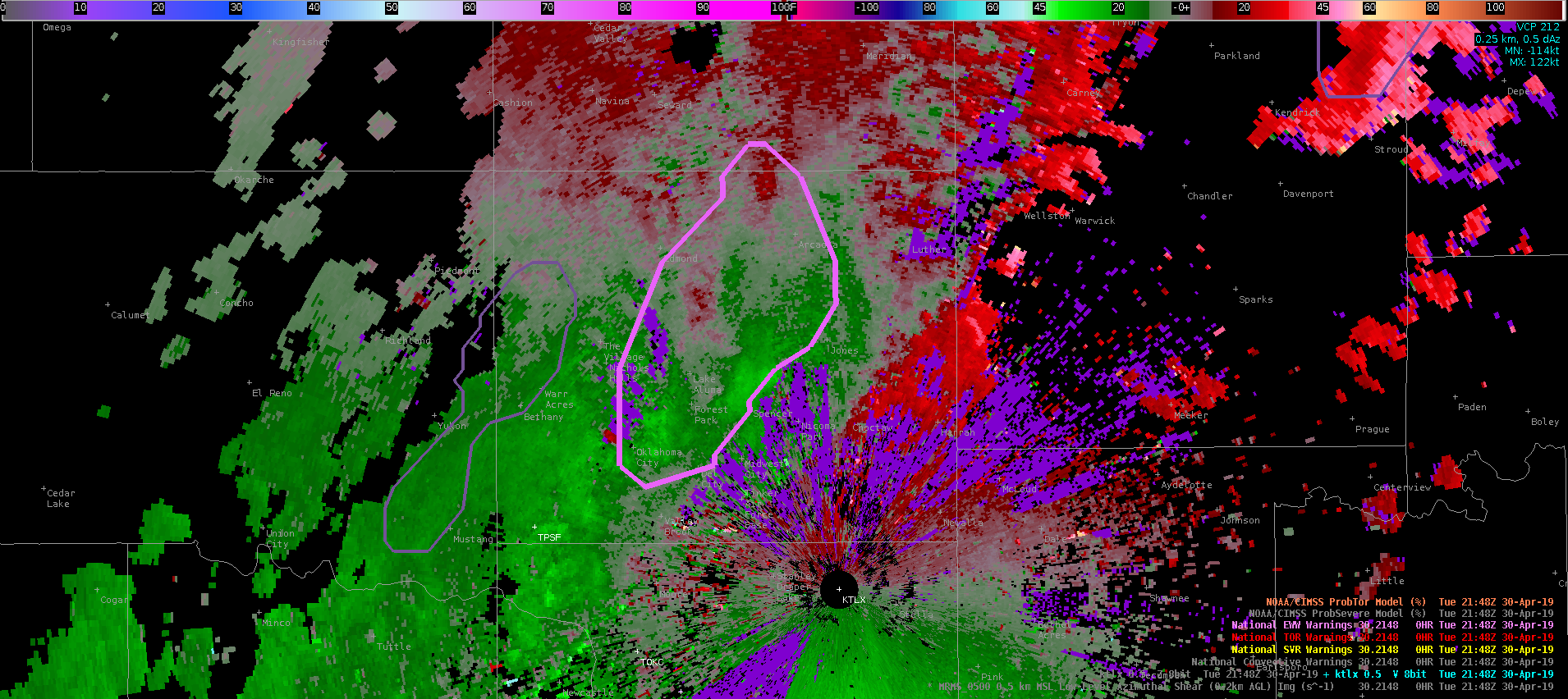
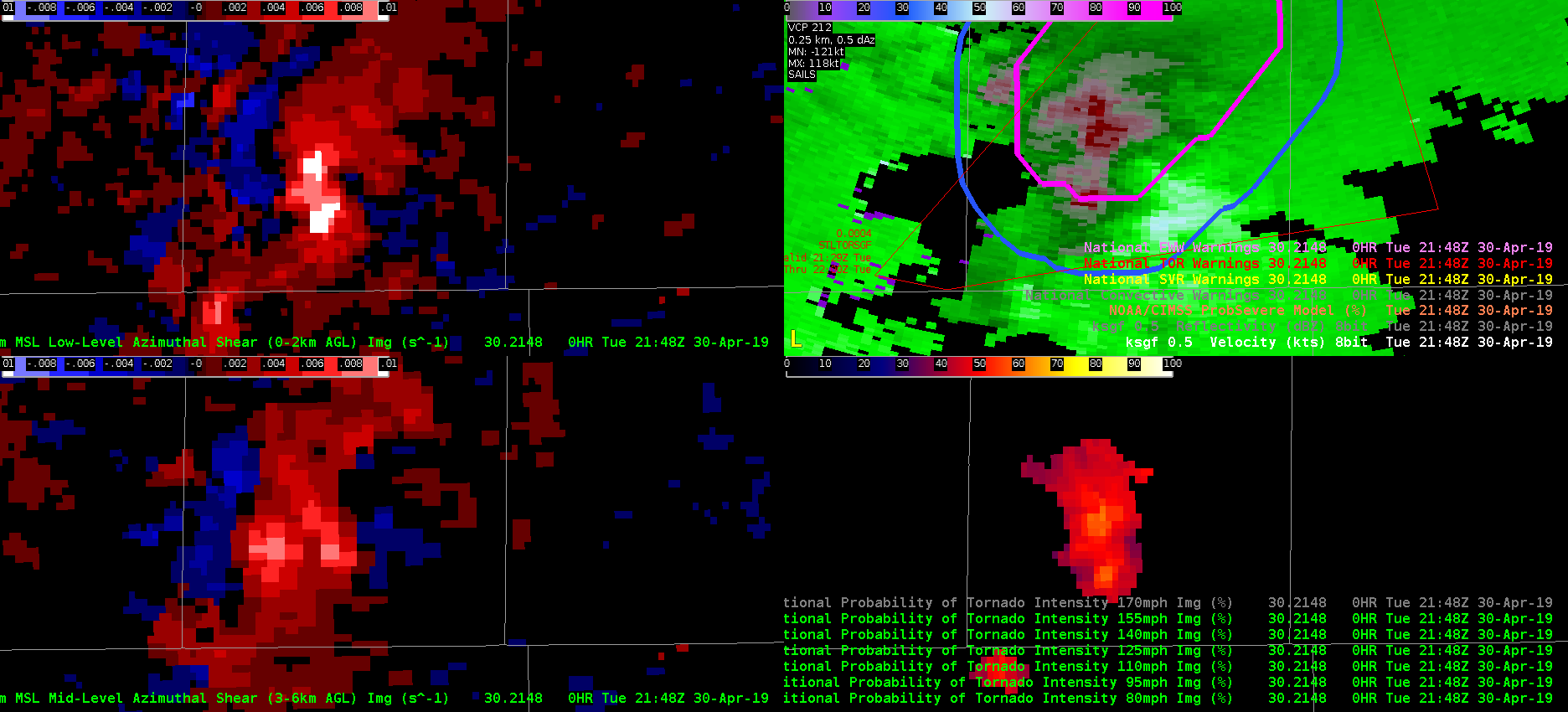
Here’s another example where a casual look at ProbTor might cause some confusion. Flow parallel to the boundary across the OKC metro eventually won out and the semi-discrete cells merged into a messy, slow-moving mess shortly before 22z. At 2148z, ProbTor peaked at 74% for the mass of convection just NE of OKC. However, KTLX velocity showed no immediate areas of concern. The answer to the high ProbTor was found in the 0-2km merged AzShear product. AzShear showed an enhanced area of shear to the NE of OKC near Spencer with generally convergent and broad flow. This is a good example of how ProbTor can be useful in operations: it quickly highlights areas for further investigation that can either be confirmed or thrown out with a very quick interrogation of the base data. In this case, ProbTor worked well, it was just biased by the abnormal/noisy AzShear data.

–Stanley Cupp

2148z KTLX base refl (top), base velocity (middle), and 0-2km AzShear (bottom) with 74% ProbTor contour overlaid on each
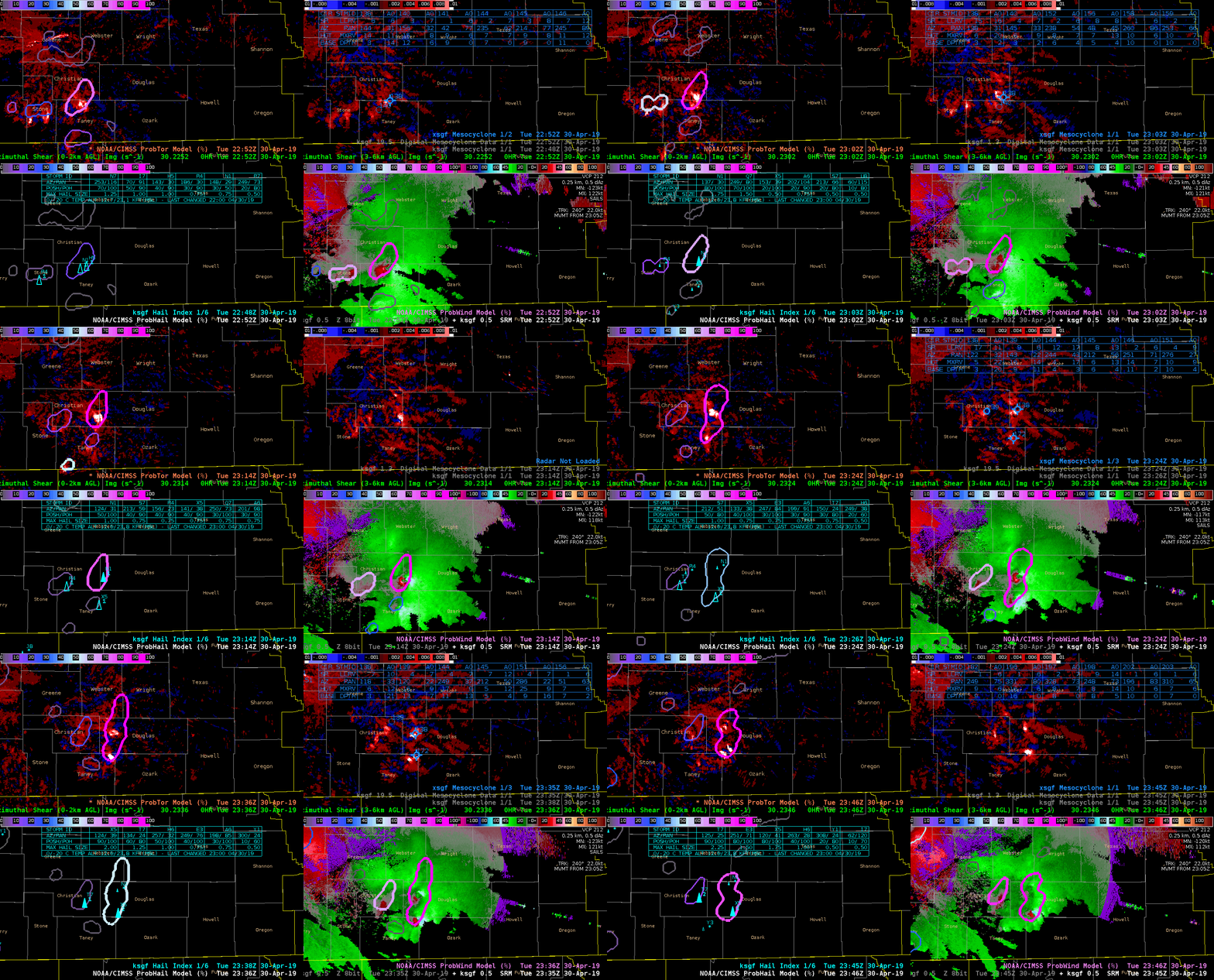
Why hello friend – merging supercells into a single ProbTor Object


Here a strengthening southern supercell invaded the personal space of its “more aged” northern neighbor. The merger did not change the  ProbTor values of the original, stronger storm (90%) but did eventually show a slightly lower value (87%) despite the southern storm becoming more intense in rotation. There were only subtle differences noted in the ingredients and nothing stood out as to why the Prob values dropped.

As for the new mesocyclone algorithm (xmda) the strength rank jumped to 25 (max value) at 23:32. It is difficult to follow the individual storms in the attribute table since they jump from page to page and are ordered by ID versus strength. Having the cell ID color coded at certain values (e.g. above 10 colored yellow, above 15 colored blue, etc.) would help more quickly discriminate the strongest mesocyclones, especially if you have to move to another page. ProbWind (lower right panel) continues to be very high for these supercells (consistently >90%) although no wind reports were received by SGF.

0-2km AzShear/ProbTor (UL), 3-6km AzShear/xmda (UR), HI/ProbHail (LL), Z/SRM/ProbWind (LR)

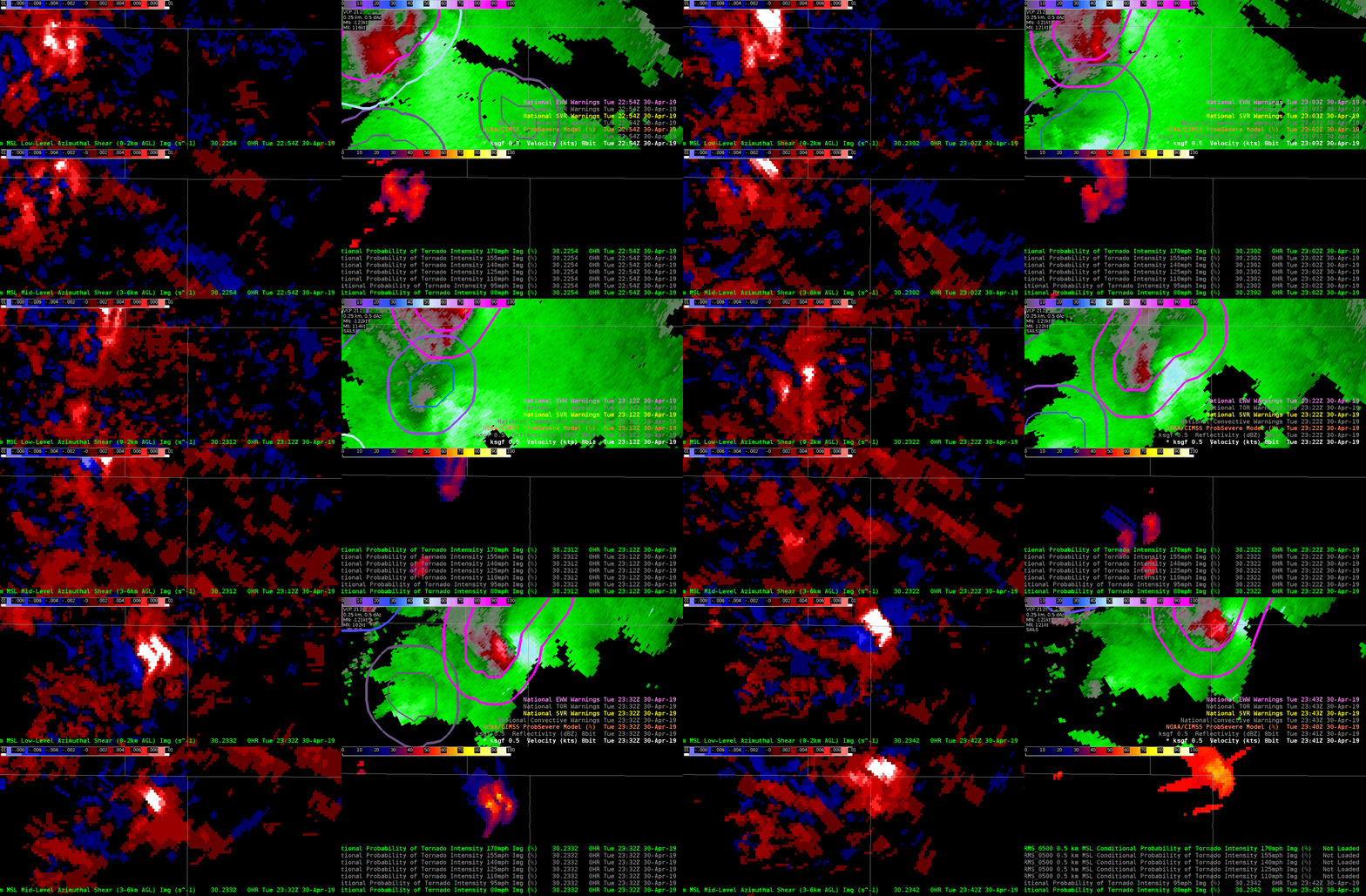
CPTI example

CPTI closely followed the 0-2 Az Shear product in both shape and intensity. This included all velocity time matching errors. These time matching errors decreased the usefulness of the product each time they were seen. CPTI prob of highest winds appeared more useful than the lower thresholds, better enhancing where the threat of strong winds was actually located. Lower thresholds (example at end of loop) appeared to be too broadbrushed for applicable use.

Az Shear Possibilities

I’ve seen some great promise from the low level az shear this week so far. One thing that I do not like about the default product is that it has a lot of noise/extra info in it that tends to clutter up your screen. An idea that I had was to filter more of the noise by making a large portion of the scale transparent. Take a glance at the velocity field and see how it matches up with the AZ shear extremes.

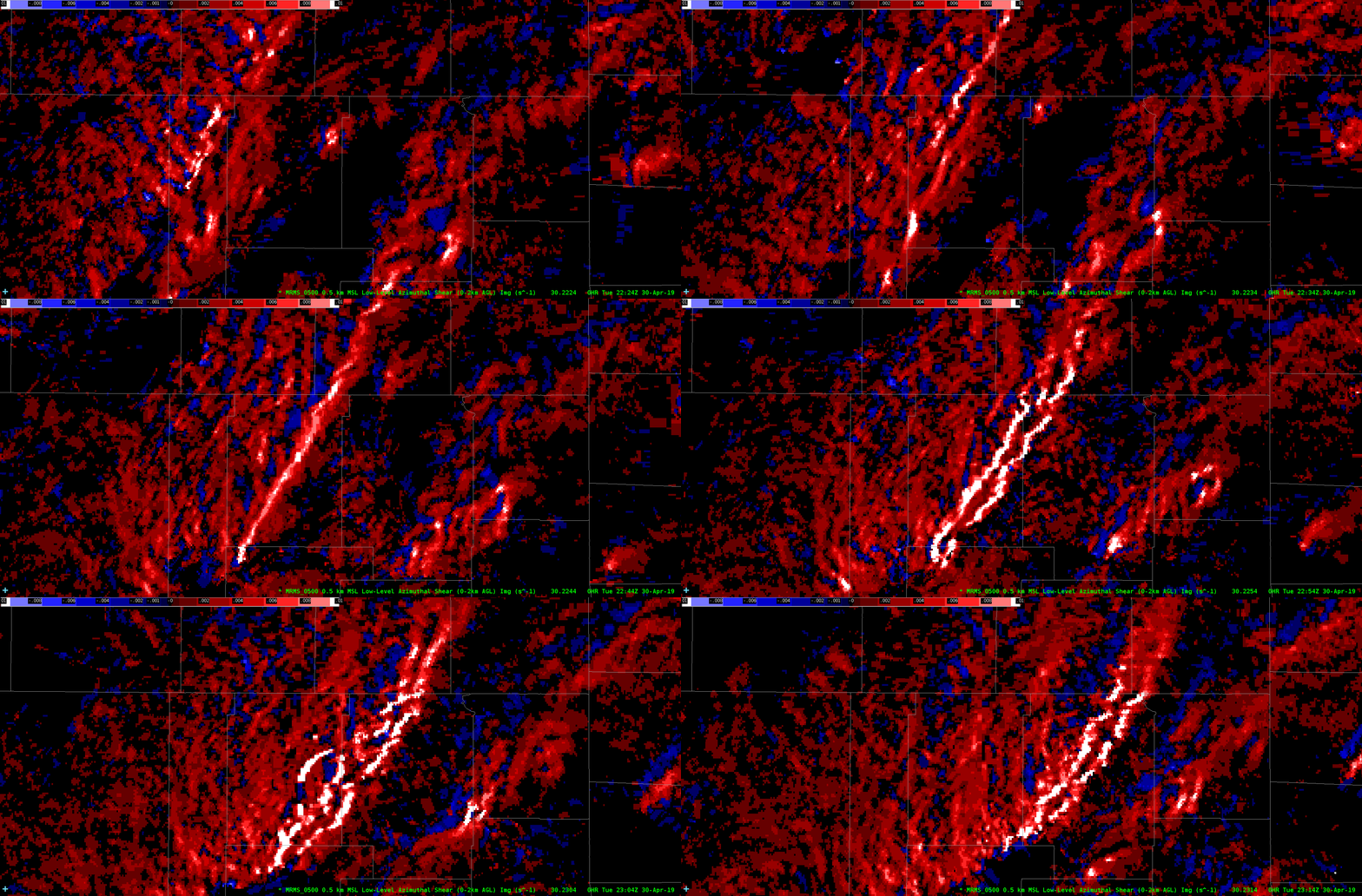
Shown here is a comparison of the default vs the “enhanced” low level az shear.

Another advantage I could see with only displaying the “extremes” would be the ability to include velocity data underneath the image. This can be especially useful since the MRMS data is feeding the AZ Shear. Why? Well the velocity couplet you are examining is likely to progress a bit “faster” using the baseline radar data rather than MRMS, so they likely will be right next to each other.

Az Shear overlay on Velocity Data

Other thoughts I have had going this route is possibly changing the “red” side of the color scale to something other than red so that it doesn’t match the color scale used by velocity data on radar. I did like a “yellow” scale as it did not largely conflict with the color scales expressed by the velocity data.

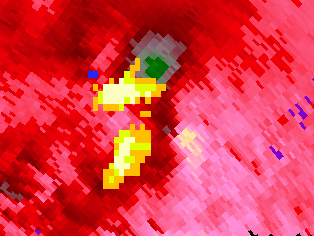
An attempt at a “yellow extremes” color table.

As a whole I think this product has some great potential at drawing your attention to portions of the storm very quickly.

South Beach

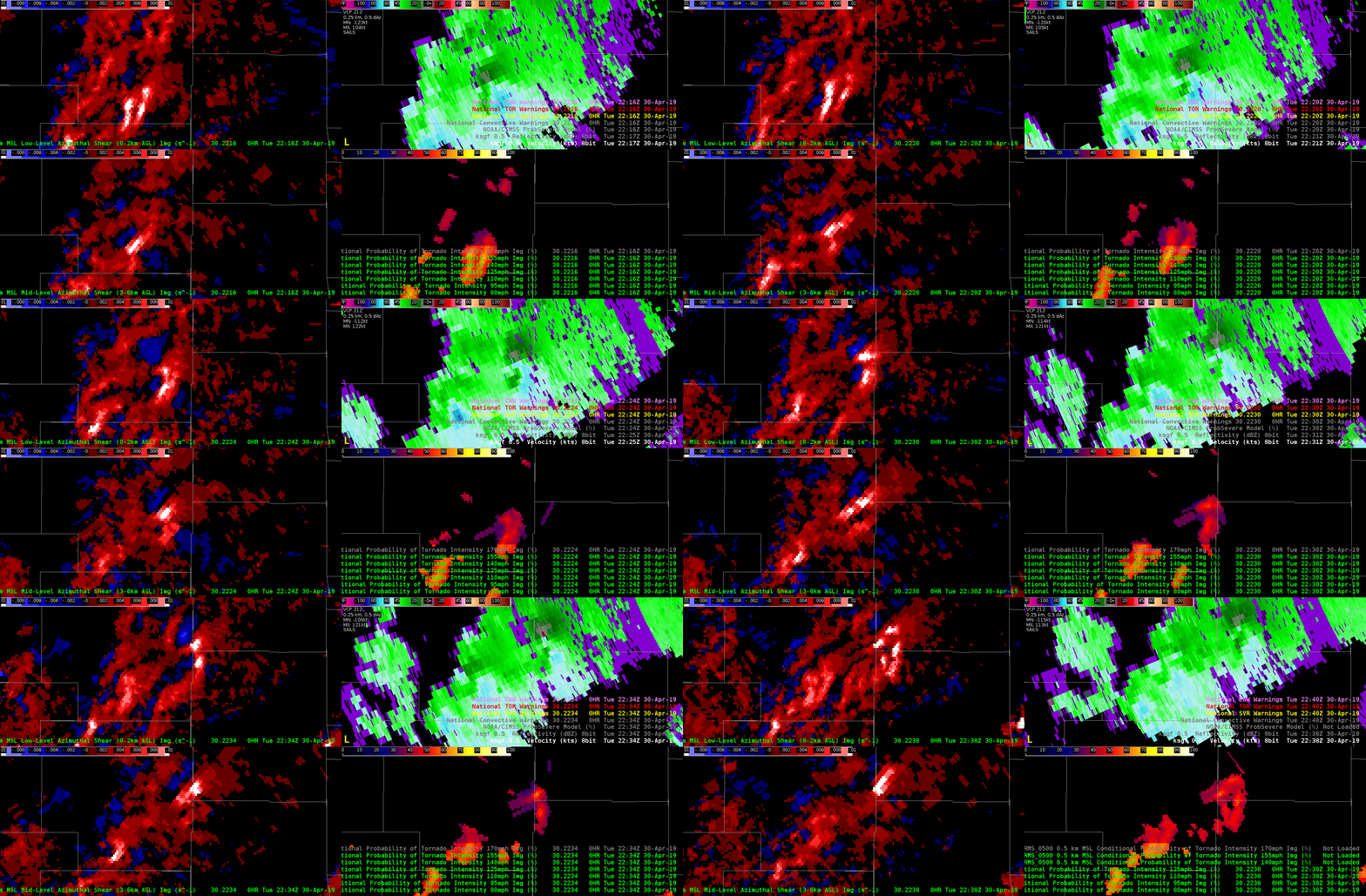
Odd AzShear data: 22:16

Az shear shows a double scan signature on the top left here. This seems like it would result from SGF scanning the shear at one time and Tulsa hitting it at another. Clearly there are not two lines of shear here per radar single scans.

Another example of a double AzShear signal. Likely coming from radar timestamp matching issues.
Tags: None

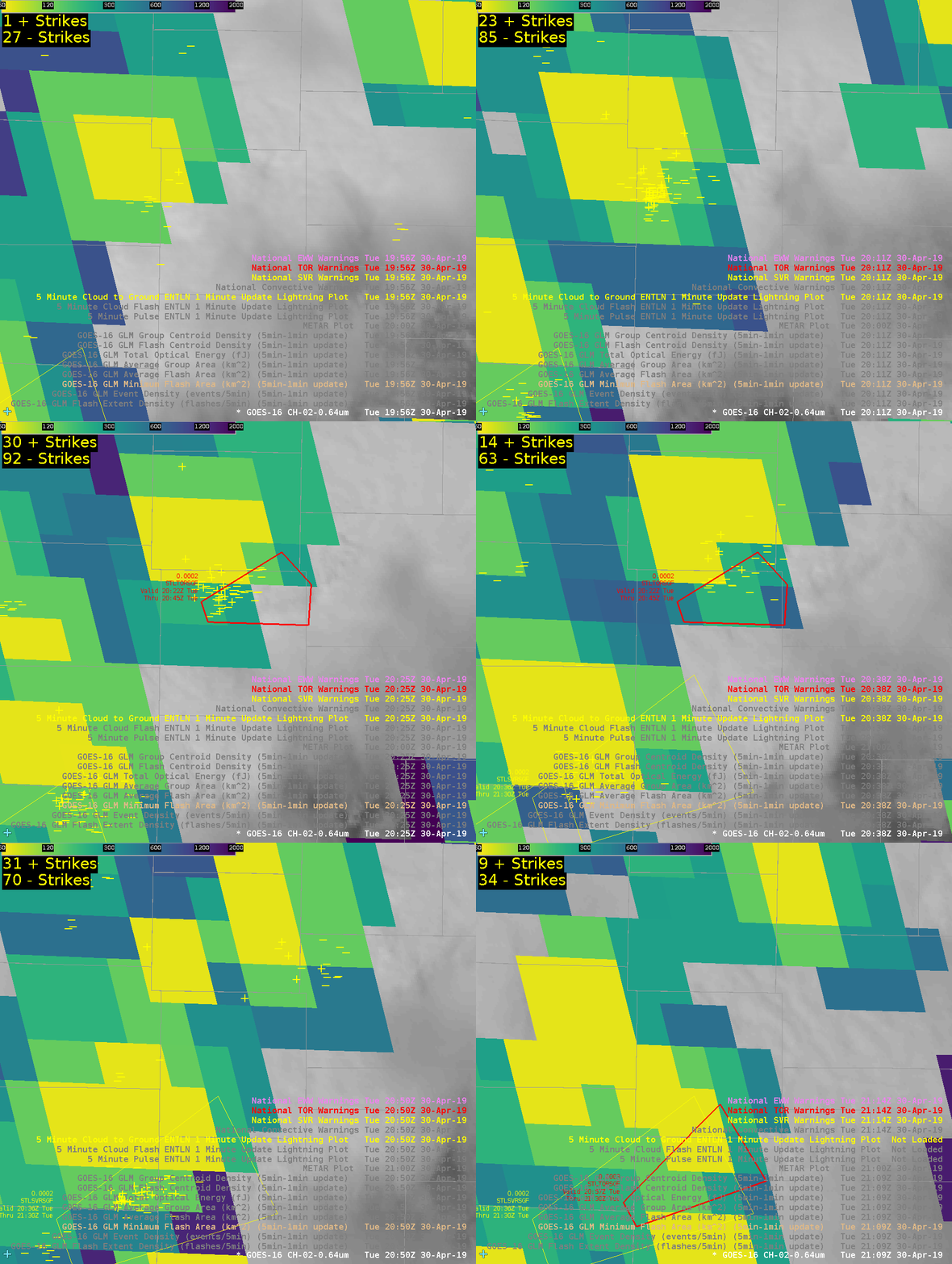
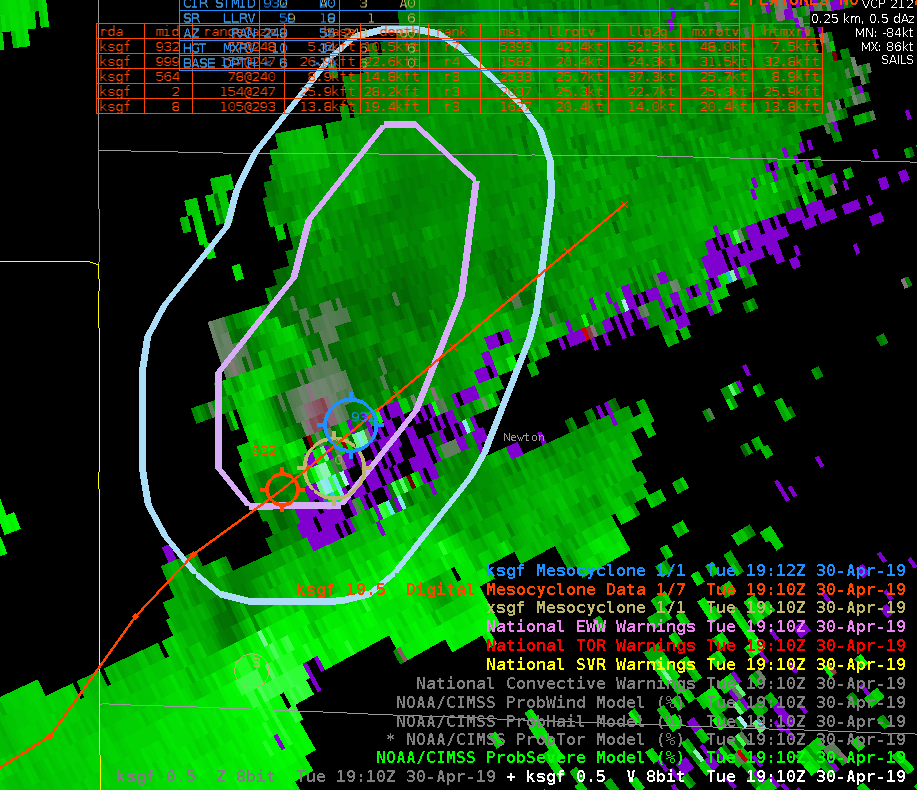
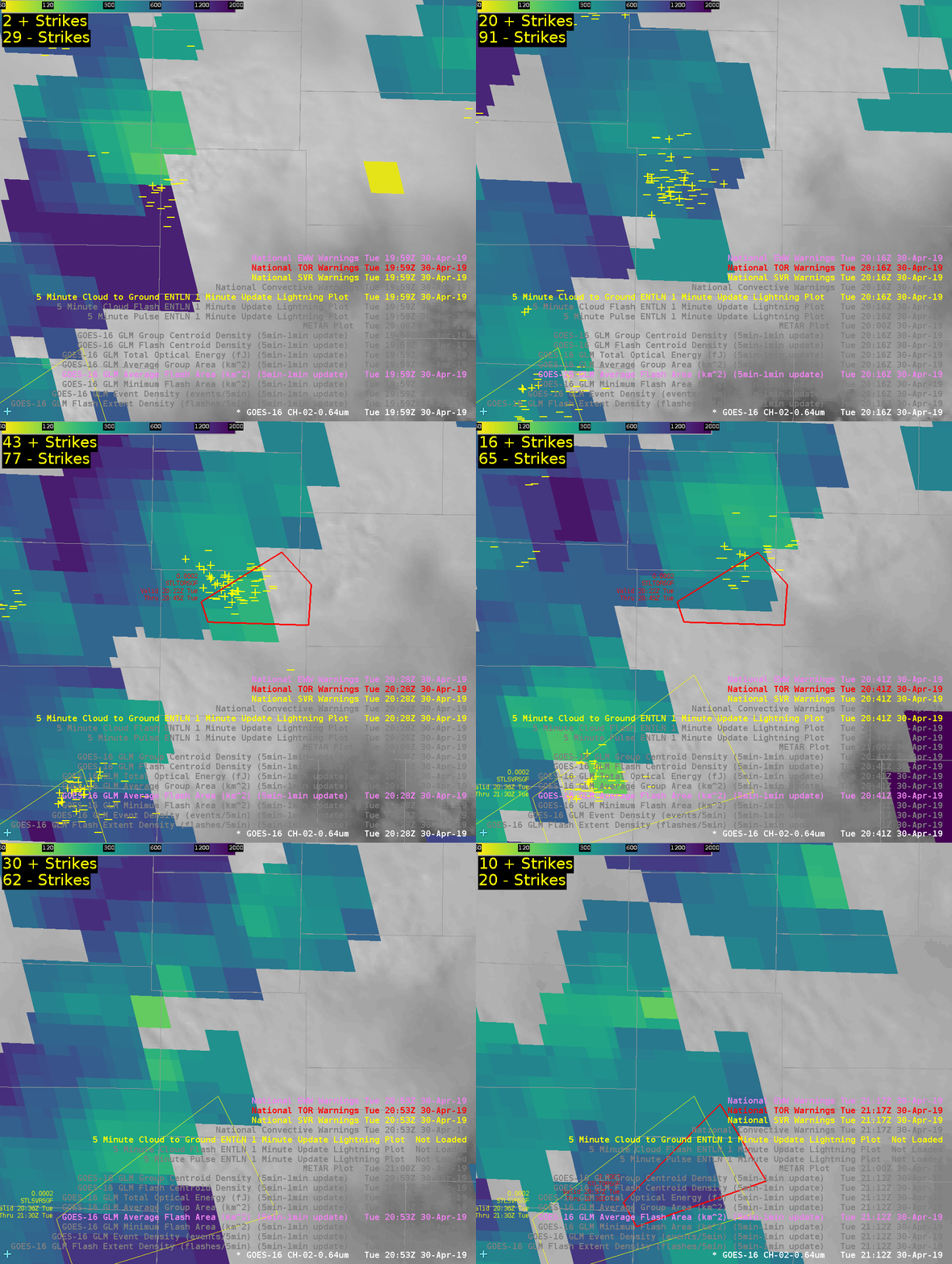
HWT day 2: 19:10 GLM and AzShear observations of Missouri tornadic supercell

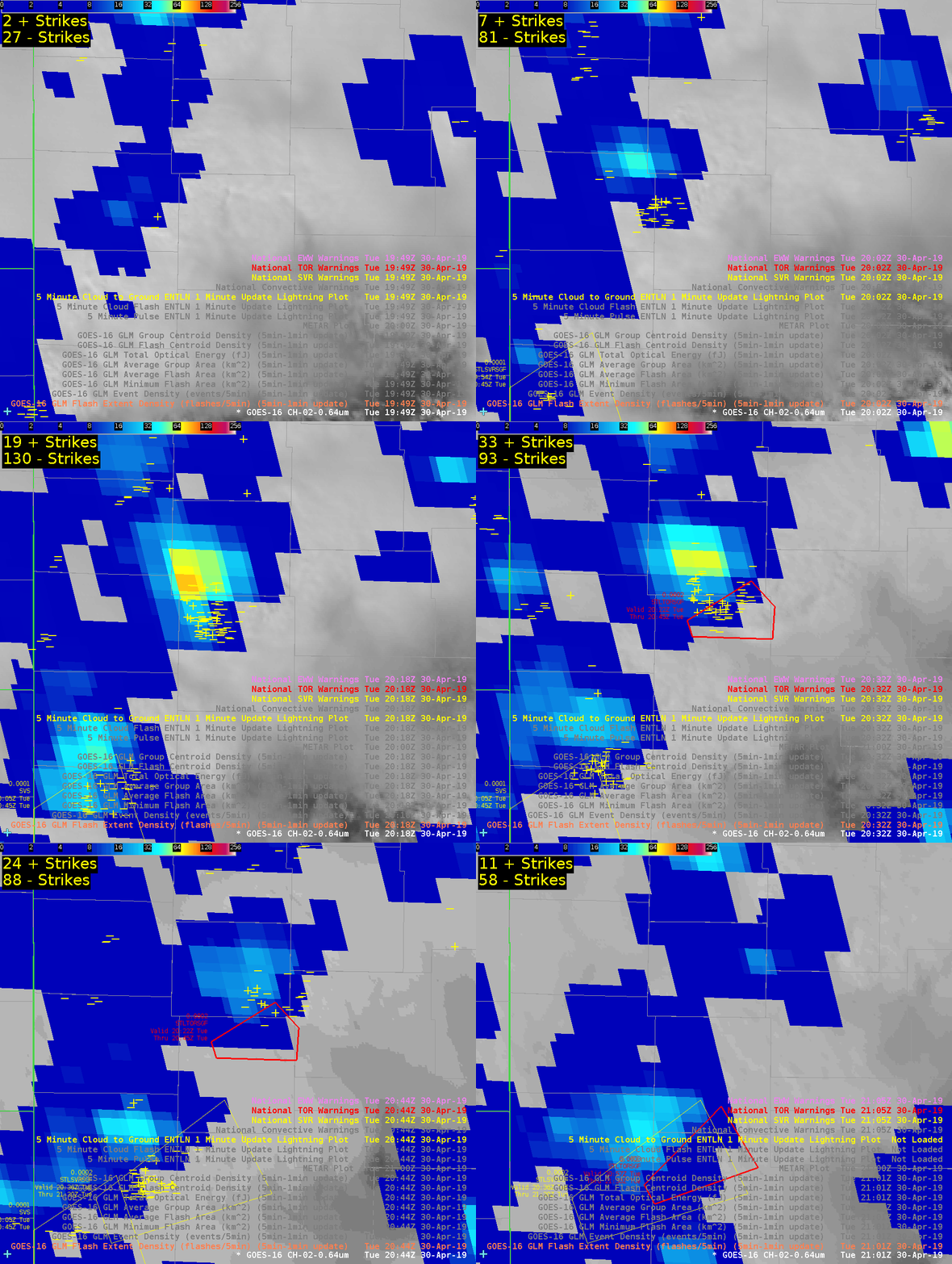
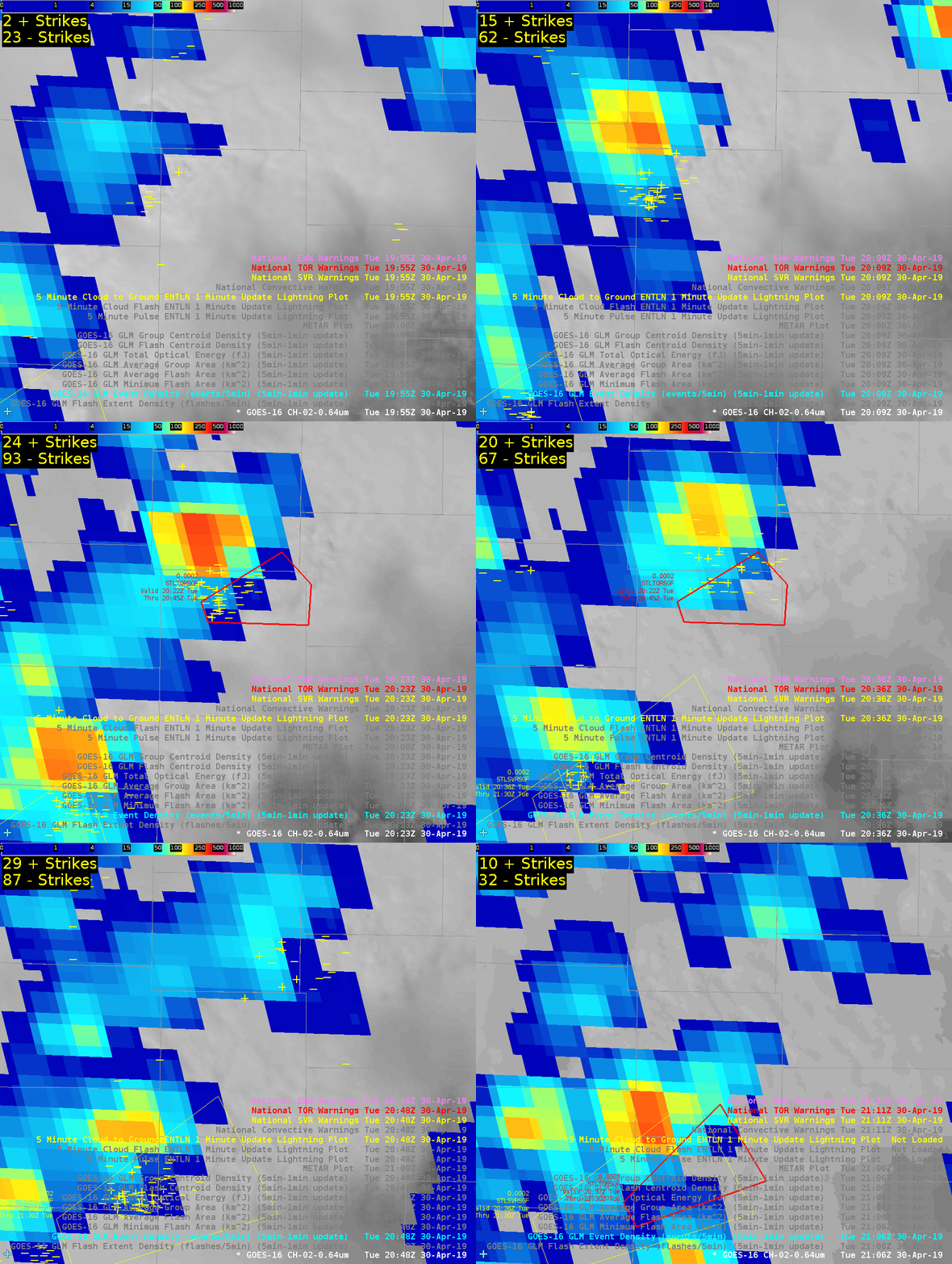
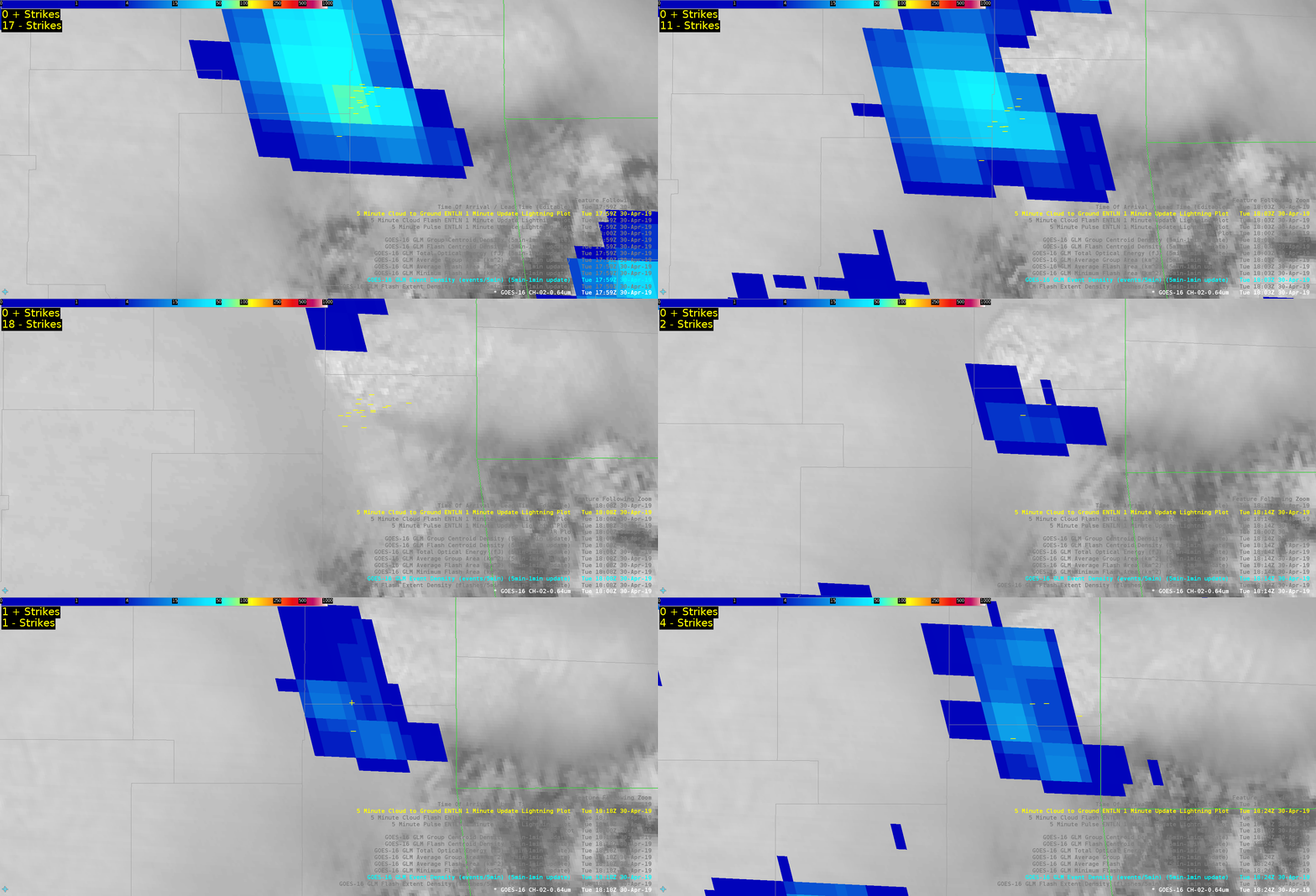
Feature following zoom showing the GLM pulsing phenomena associated with intensification/weakening of a supercell in OK/MO. During the third pulse, a TOR warning was issued.

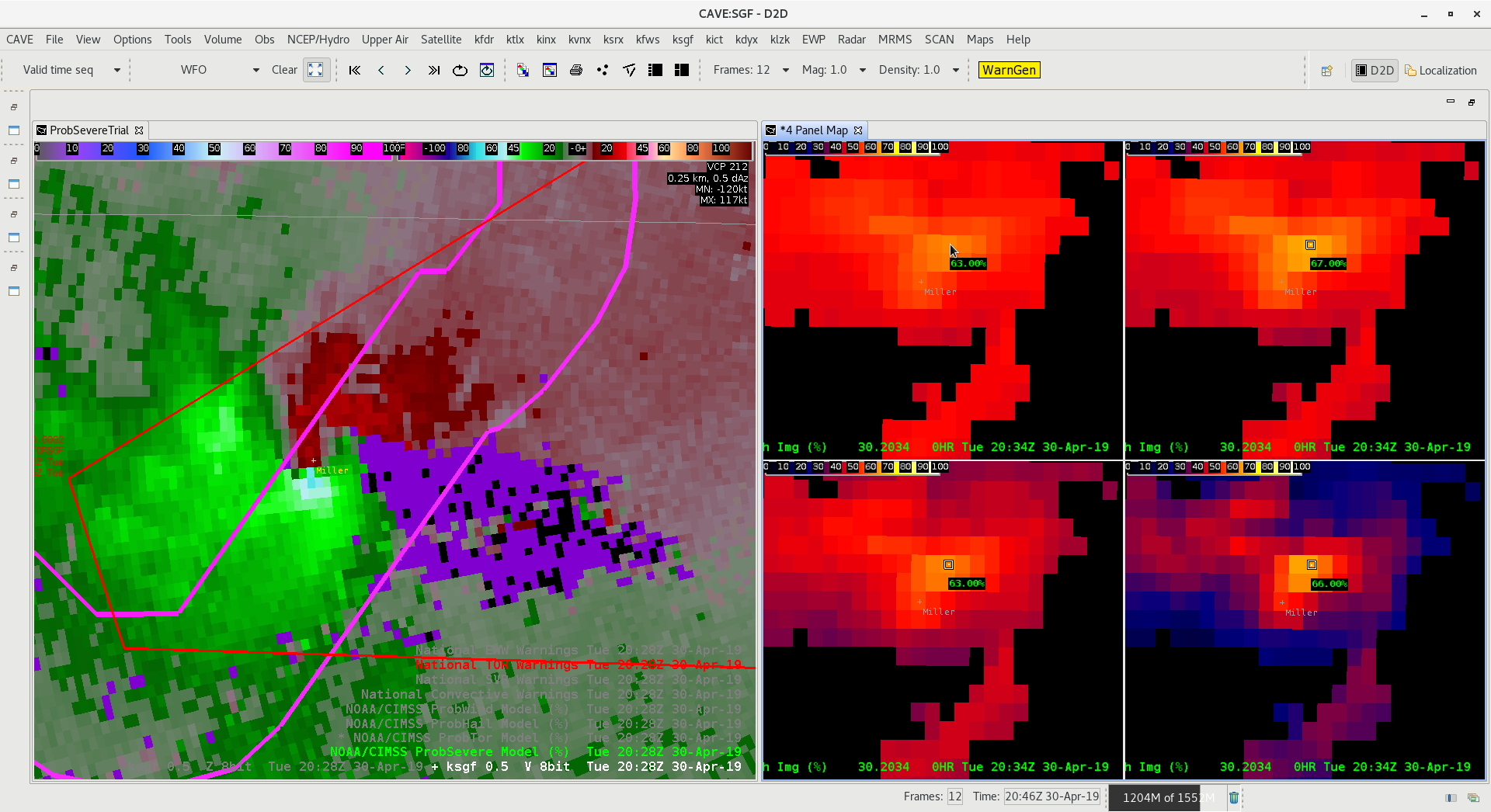
Case of CPTI values on a confirmed tornado near Miller, MO. No confirmed damage estimates yet, but TOR was confirmed at this time visually and with a TDS

Lightning jump preceding a tornado and then confirmed touchdown in MOEvent Density over the same cell

Minimum Flash area showing updraft core
 

Average Flash Area


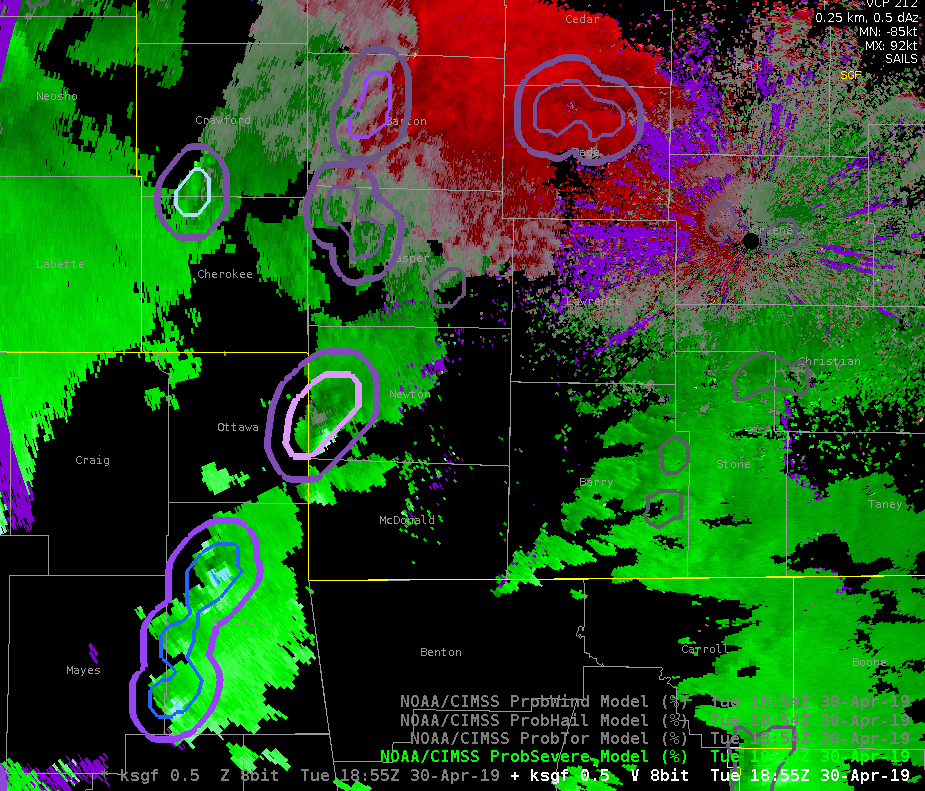
This is a case where AzShear overdid the tornadic threat This supercell had a circulation that never really tightened up. ProbSevere also vastly overestimated the tornado threat, likely due to nearby storm interactions and mergers. When convection gets messy, can we rely on these products as much?
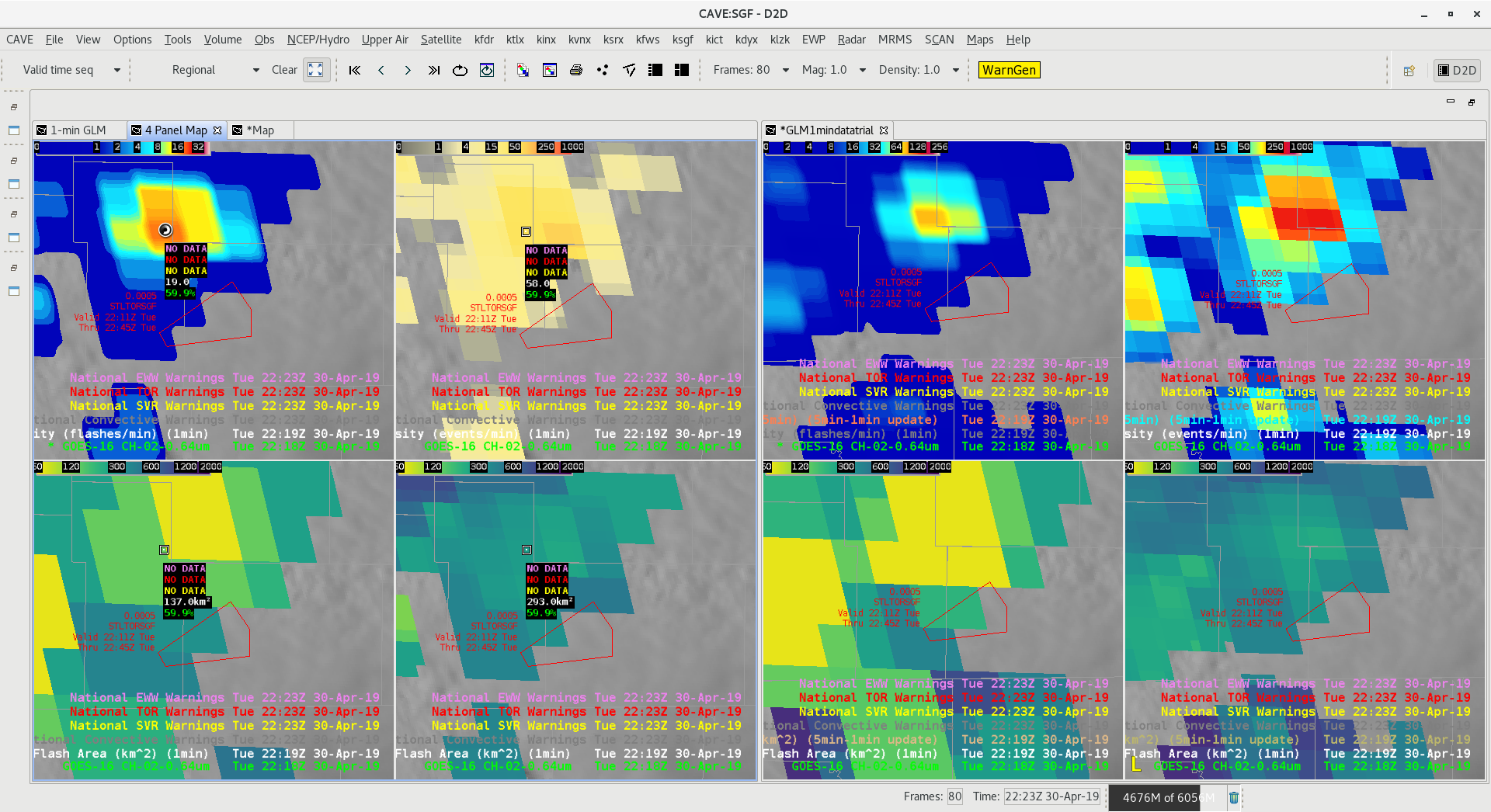
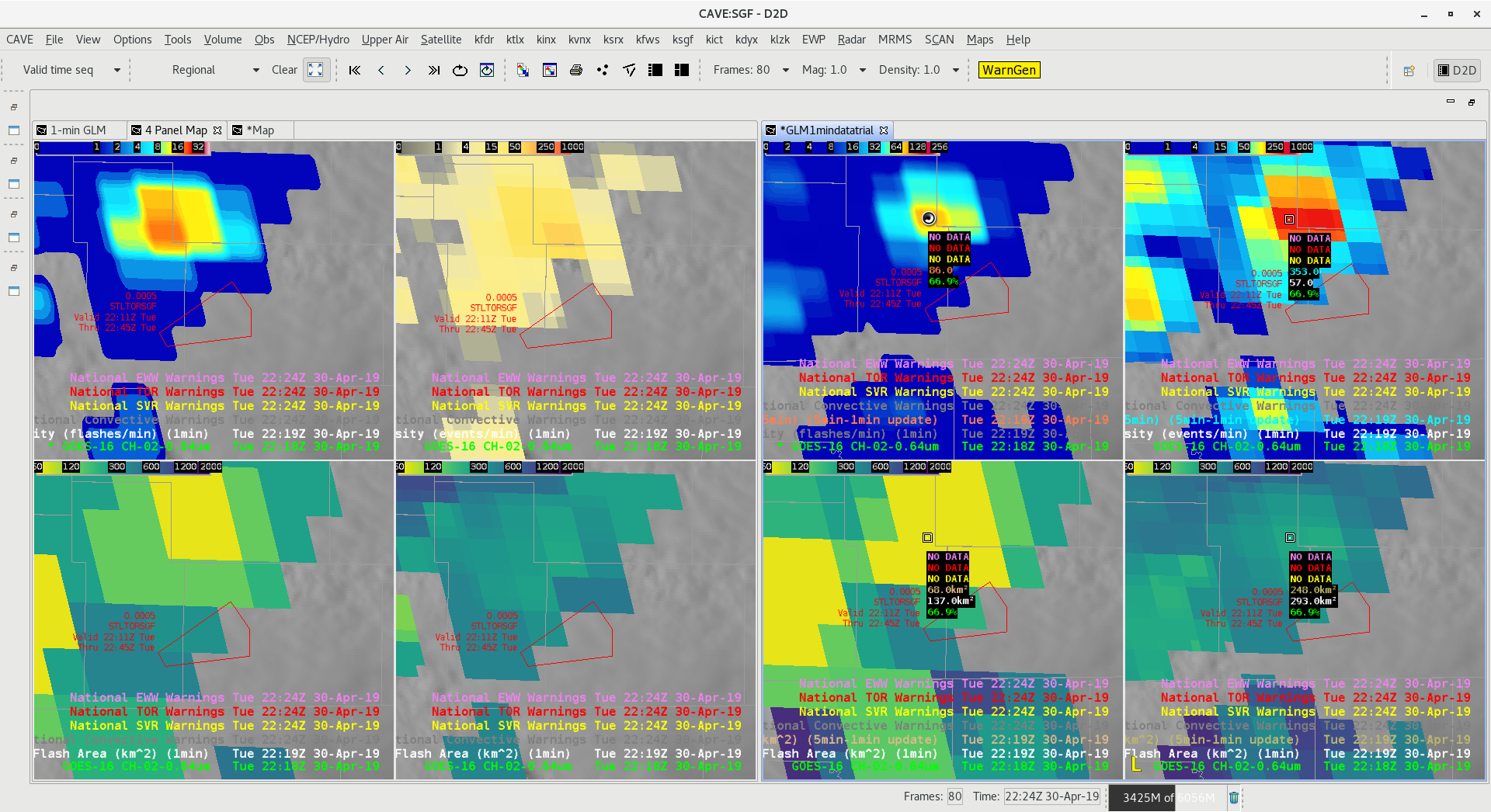
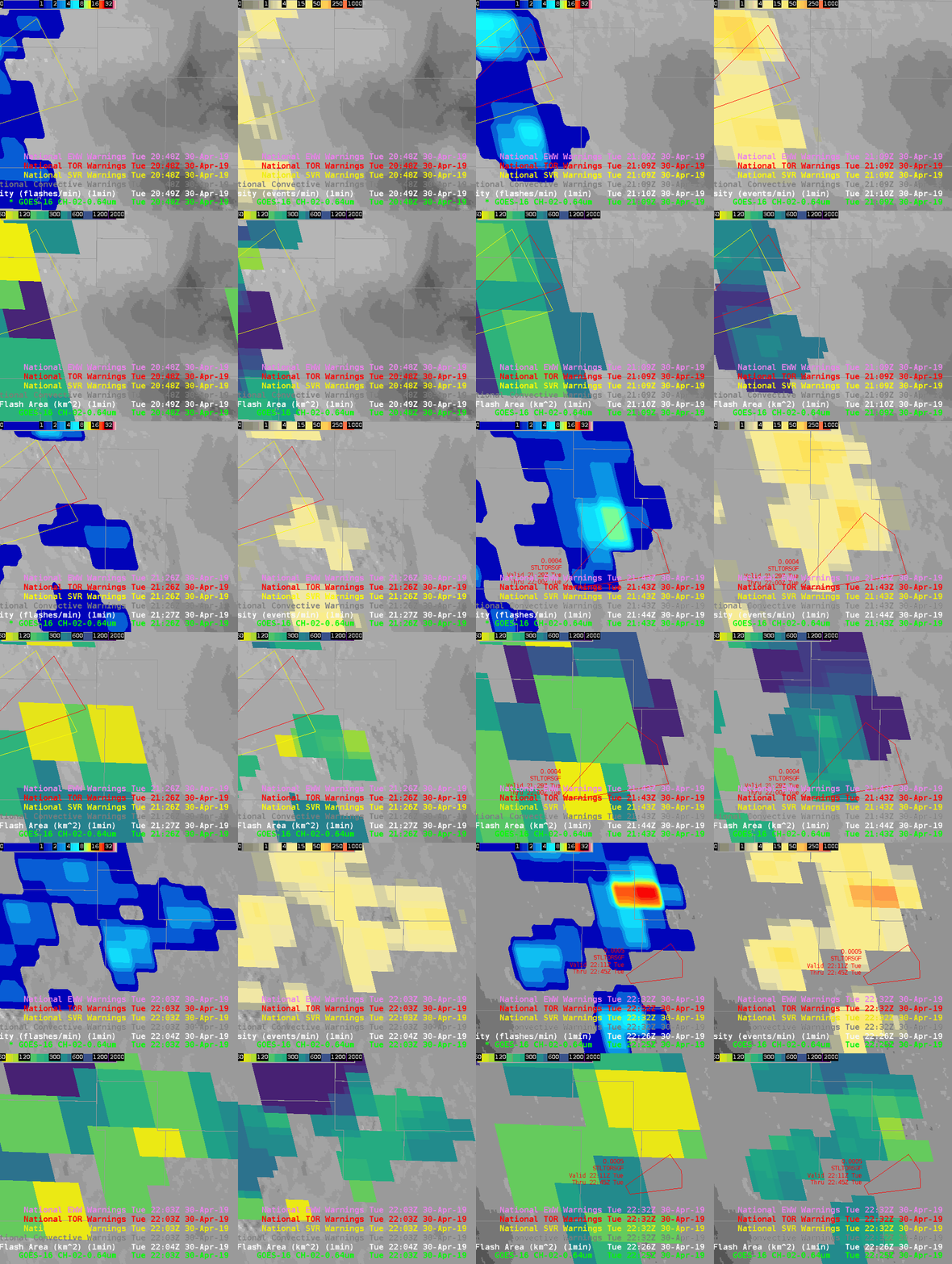
 

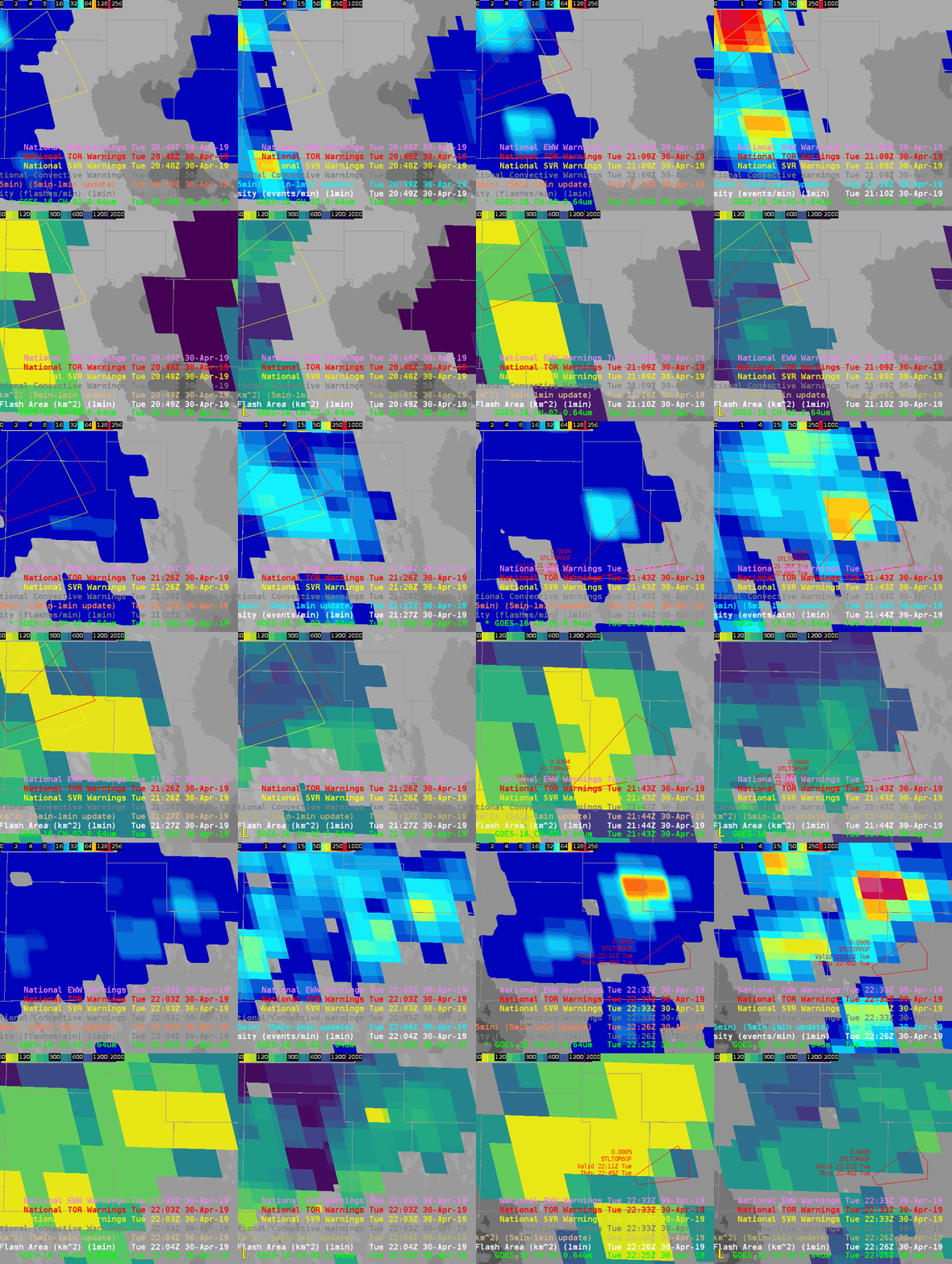
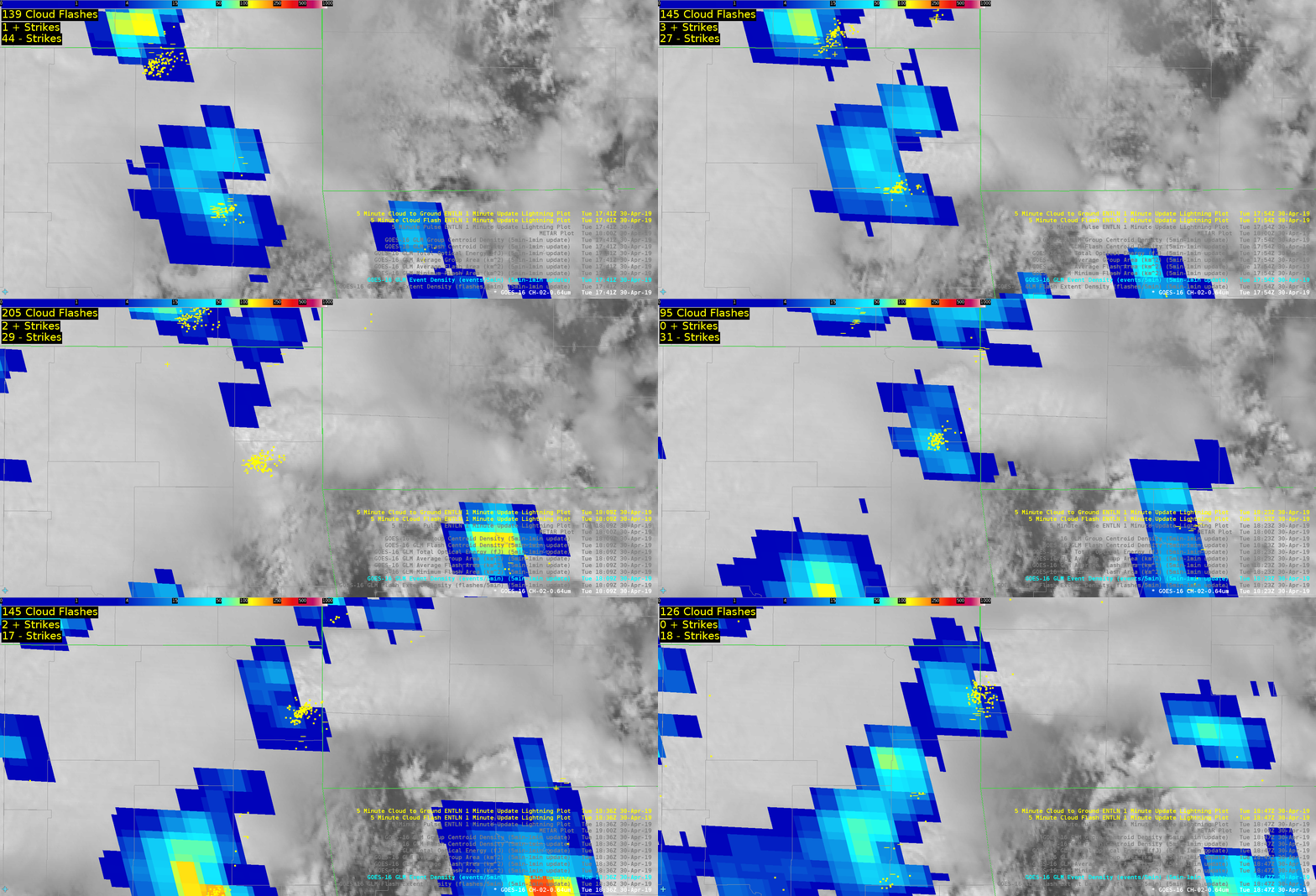
The two images above compare a 4 panel of 1 min GLM data (left four panels) versus 5 min data (right four panels). While the 5 min data was much smoother to view from an animation and trend sense, the 1 min data did provide some fine temporal resolution help during periods of rapid storm intensification preceding this tornado warning.

The above two loops compare 1 min looping (top 4 panel) versus 5 min looping (bottom 4 panels). In a loop the ‘flashy’ nature of 1 min data makes it less desirable in operations, however manual toggling and advancing still make this data useful.


Max Value Readout for GLM in upper left of screen?


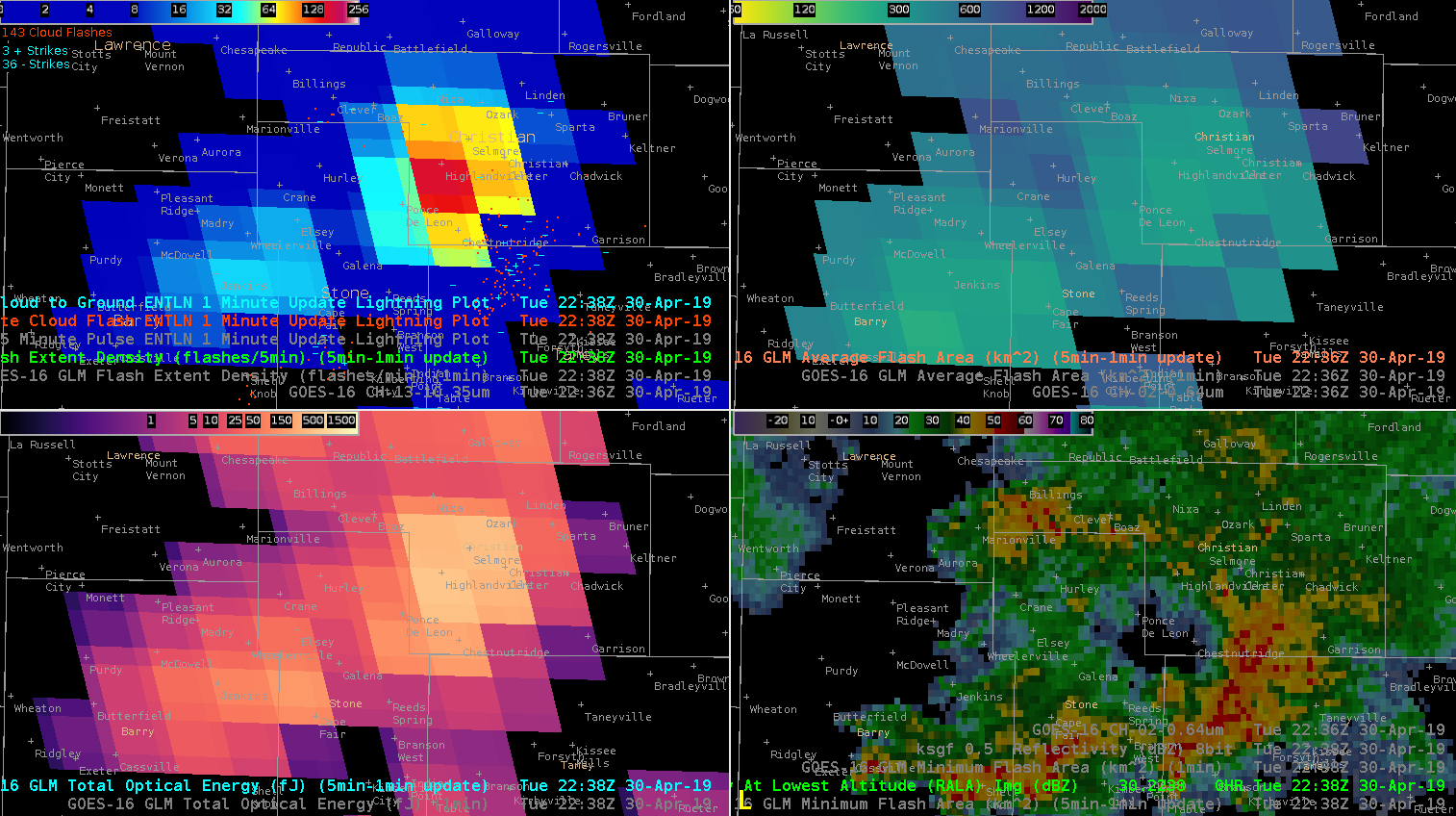
GLM FED maxed out at 160 fl/5-min and TOE at 580 fJ on this cell in southern MO. It would be nice to have the maximum value, at least for the FED and TOE products in the upper left corner like the ground-based networks have. This would also help with quantifying things such as lightning jumps or quickly comparing two cells.

GLM FED (UL), AFA (UR), TOE (LL), RLA (LR)

— SCoulomb

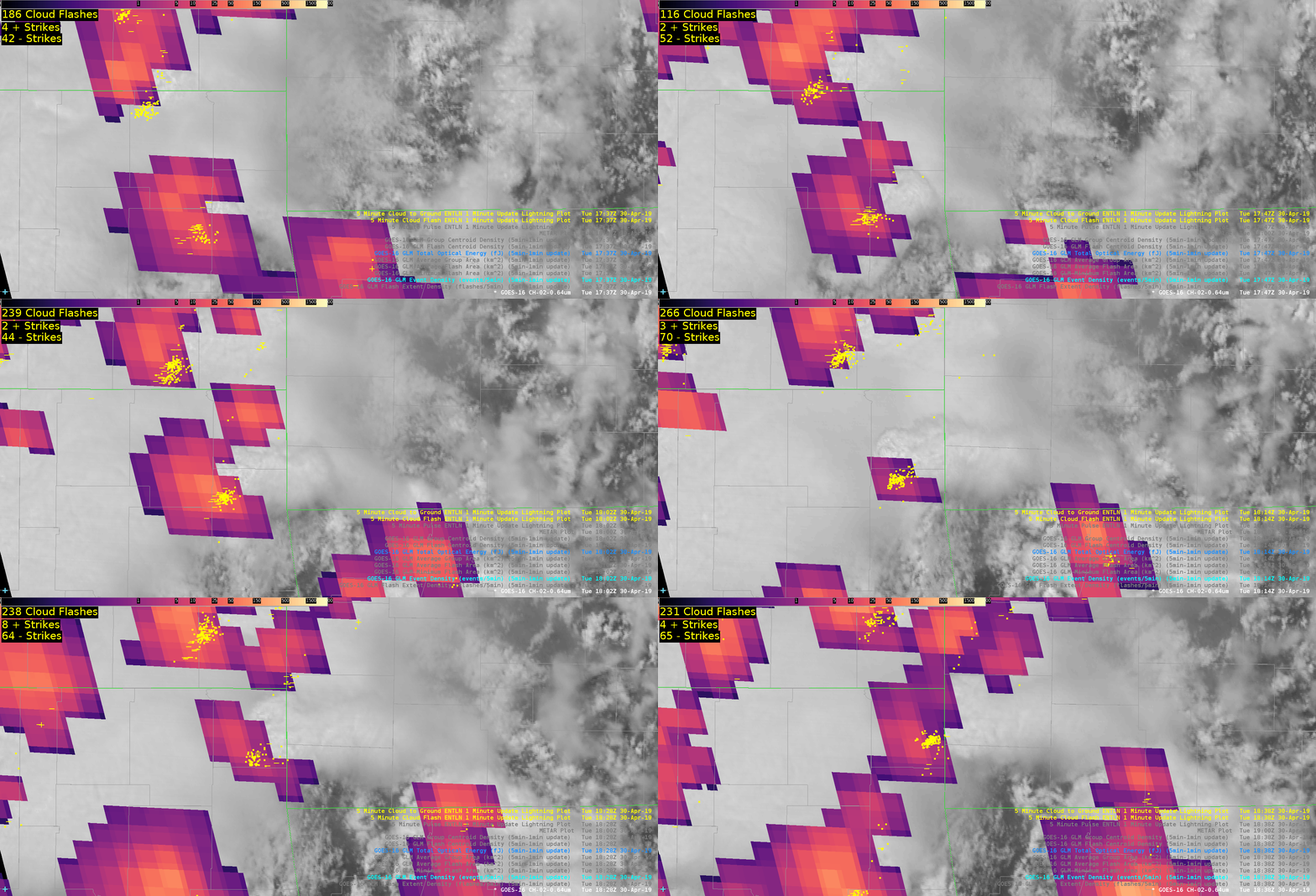
HWT Day 2 case blog: Start until 19:10

This rapidly developing supercell displayed a GLM lightning decrease as it intensified. This was a good example of optical attenuation due to an updraft core. ENTLN network is displayed, showing that there was a tremendous of CG and IC flashes despite low GLM values. Shown is the TOE product.

The same storm and lightning minimum shown in Event Density.


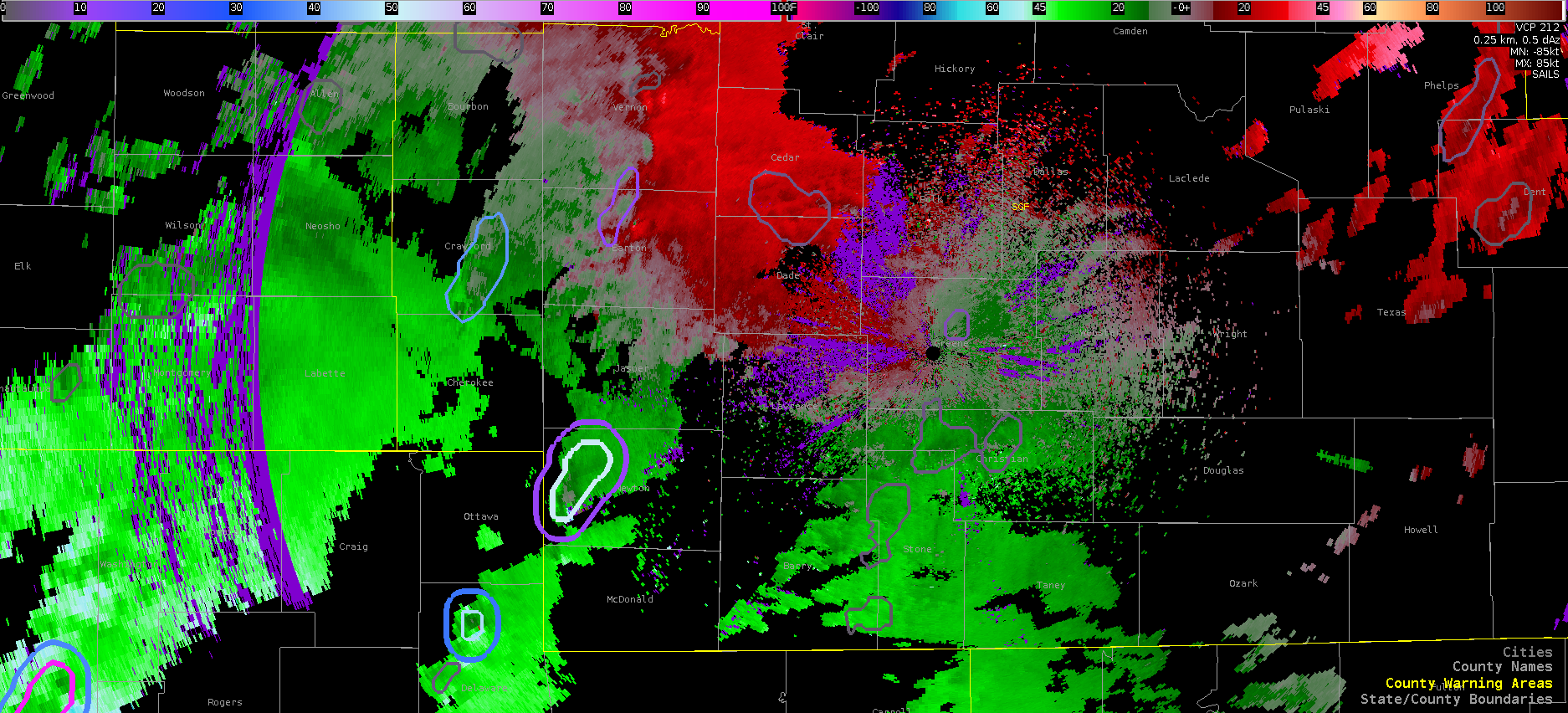
ProbTor was occasionally too aggressive. Only one of these storms was really concerning at this time given the environment and radar tilts further up in the volume. On a day like this, it would likely be prudent to increase the probtor threshold above 3%

Prob Tor contours showing  a new probtor threshold of 10% instead of 3%. This was edited on the fly in the localization file of the procedure itself. This view shows a less cluttered display given the amount of rotating storms this day.


Comparison of MDA products over a weak low topped supercell, as well as showing the probsevere contours. ProbTor was at 47% at the time, prompting the issuance of a Tor Warning.