EWP2012 Week 4 Summary: 4-8 June 2012

EWP2012 PROJECT OVERVIEW:

The National Oceanic and Atmospheric Administration (NOAA) Hazardous Weather Testbed (HWT) in Norman, Oklahoma, is a joint project of the National Weather Service (NWS) and the National Severe Storms Laboratory (NSSL).  The HWT provides a conceptual framework and a physical space to foster collaboration between research and operations to test and evaluate emerging technologies and science for NWS operations.  The Experimental Warning Program (EWP) at the HWT is hosting the 2012 Spring Program (EWP2012).  This is the fifth year for EWP activities in the testbed.  EWP2012 takes place across five weeks (Monday – Friday), from 7 May through 15 June.  There are no operations during Memorial Day week (28 May – 1 June).

EWP2012 is designed to test and evaluate new applications, techniques, and products to support Weather Forecast Office (WFO) severe convective weather warning operations.  There will be three primary projects geared toward WFO applications this spring, 1) evaluation of 3DVAR multi-radar real-time data assimilation fields being developed for the Warn-On-Forecast initiative, 2)  evaluation of multiple CONUS GOES-R convective applications, including pseudo-geostationary lightning mapper products when operations are expected within the Lightning Mapping Array domains (OK/west-TX, AL, DC, FL), and 3) evaluation of model performance and forecast utility of the OUN WRF when operations are expected in the Southern Plains.

WEEK 4 SUMMARY:

Week #4 travel support for visiting forecasters was provided by NSSL, the GOES-R program office, and the NWS Pilot Program.   We had six visiting NWS forecasters this week:  Marc Austin (WFO, Norman, OK), Rich Grumm (WFO, State College, PA), Chris Leonardi (WFO, Charleston, WV), Jennifer Palucki (WFO, Albuquerque, NM), Kristen Schuler (CWSU, Kansas City, MO), and Gary Skwira (WFO, Lubbock, TX).  Other visiting participants this week included Kathrin Wapler (Deutscher Wetterdienst, Germany), and Chris Karstens (Iowa State University).  The weather this week was once again characterized by severe weather events that were regionally-diverse.  However, there were no notably-exceptional severe weather events.
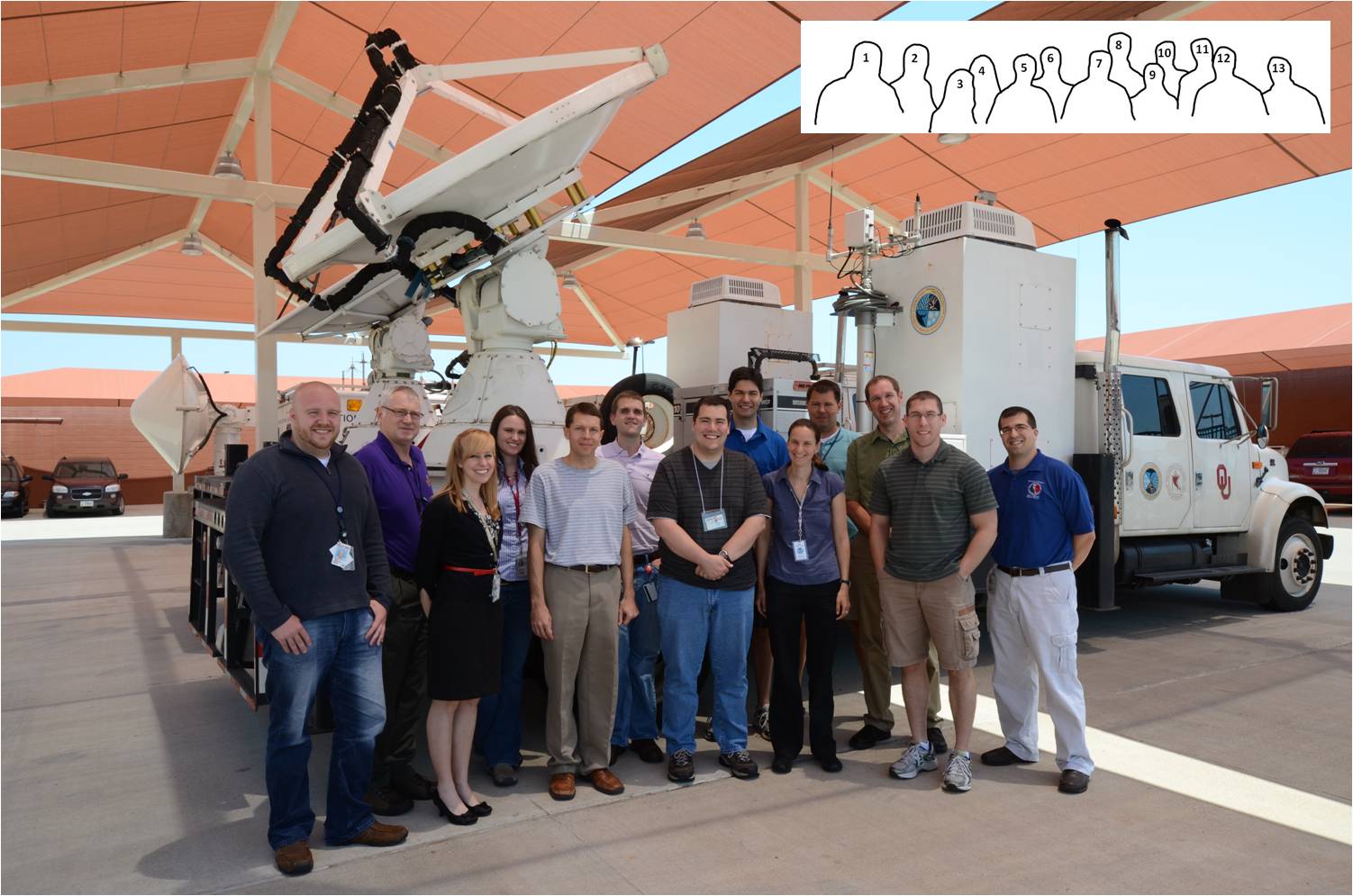
Photo:  1) Chris Siewert (CIMMS/SPC/GOES-R), 2)  Rich Grumm (WFO, State College, PA), 3)  Kristen Schuler (CWSU, Kansas City, MO), 4)  Jennifer Palucki (WFO, Albuquerque, NM), 5)  Gary Skwira (WFO, Lubbock, TX), 6)  Marc Austin (WFO, Norman, OK), 7)  Chris Leonardi (WFO, Charleston, WV), 8) Gabe Garfield (CIMMS/WFO Norman, OK), 9) Kathrin Wapler (Deutscher Wetterdienst, Germany), 10) Travis Smith (CIMMS/NSSL), 11) Greg Stumpf (CIMMS/NWS-MDL), 12) Chris Karstens (Iowa State University), and 13) Steve Martanaitis (NWS/WDTB). Photograph by Jim LaDue (NWS/WDTB).


REAL-TIME EVENT OVERVIEW:

4 June: Lubbock (LBB), Little Rock (LZK), Amarillo (AMA)

5 June: Norman (OUN), Jacksonville (JAX), Melbourne (MLB), Tallahassee (TAE), Great Falls (TFX)

6 June: Cheyenne (CYS), Boulder (BOU), Fort Worth (FWD)

7 June: Sterling (LWX), Boulder (BOU), Rapid City (UNR), Cheyenne (CYS)

FEEDBACK ON EXPERIMENTAL PRODUCTS:

3DVAR:

  • would like to see downdrafts depicted – for wet/dry microbursts
  • aviation uses:  downdrafts, turbulence (not necessarily related to convective weather)
  • does a pretty good job, with updraft strength.  Tornadoes also good.  But outflow winds are very radar dependent, range depend.  Assimilation methods may help with some of this.
  • would like to see TDWR data included.
  • would like to have a map depicting radar coverage (this is on the web site, but not in AWIPS2)

OUN-WRF:

This was the first week where the EWP has at least some forecasters working somewhere in the OUN WRF all four days.

  • it seems to be most useful for estimating storm mode and initiation time (though initiation sometimes has an early bias).
  • too many cold pool – interactions mess things up once convection is ongoing
  • used mostly pre-convection – then transitioned to radar-based products once convection was ongoing
  • was very useful to distinguish between supercells at day, and squall line at night on April 14
  • every run is so sensitive to the initial conditions.  But still does well on change of mode.  HRRR generated convection too far south on Thursday.  But OUN WRF was a little too far north
  • suggested improvement: add surface, dewpoint, wind flags, etc. To the special products.  To get an idea or sanity check to verify against sfc obs.  QPF would also be useful.

GOES-R Satellite products:

  • Simulated satellite was really useful.  Thought the NSSL WRF was spot-on
  • Nearcast products has agreement with OUN WRF
  • CI: “confetti” in UH product was interesting.  Lots of colors.  Liked the “Ultimate CI” AWIPS2 procedure
  • Returning forecaster really liked the probabilistic data field compared to the yes/no deterministic one shown last year

GOES-R PGLM:

  • was actually used this week – convection in the LMAs helps!
  • need 5- and 15-min products.  Also, color curves, hard to see grey
  • one “lightning jump” observed
  • forecasters would really like to see the 3D LMA data in FSI
  • to be deployed in 2016 (west) and 2017 (east)
  • useful for fire weather – source charges in dust storms creating CG lightning

There are more GOES-R feedback details on the GOES-R HWT Blog Weekly Summary.

OVERALL COMMENTS:

  • training before arriving is better than training all day Monday
  • would like to have more PI interaction to show them where to find the products on day #1, though
  • AWIPS2: better than expected.  Needs 64-bit version to fix multiple memory issues.
  • Liked discussion with developers.  Would like to see uncertainly in the products (when they work best / when they don’t) quantified in some way

CONTRIBUTORS:

Travis Smith, EWP2012 Week #4 Weekly Coordinator
Tags: None

BOU: In case you want to cut it close?

Sometimes you blow a forecast and convection fires up hours ahead of “schedule”. So TMU (Traffic Management Unit) comes running over and wants to know a few things…

1) How tall are these storms going to get?

2) Are these isolated supercells going to turn into a cluster….broken line…solid line…or remain isolated to widely scattered? And What jet routes are going to see the largest impact? Are some going to be completely compromised? Some planes are already deviating – is this going to get worse?

3) Where are these storms going?

4) How long do we have until they impact the arrival gates at [insert airport name here]?

So you can see that days like this can be extremely stressful for the CWSU meteorologist as well as the TMU and controllers. Satellite data has been great with respect to timing and location of convective initiation…but once those storms blow up – those satellite products are not necessarily useful as the event continues….

So what can we do with MRMS and 3DVAR data?

Figure 1: MRMS Products

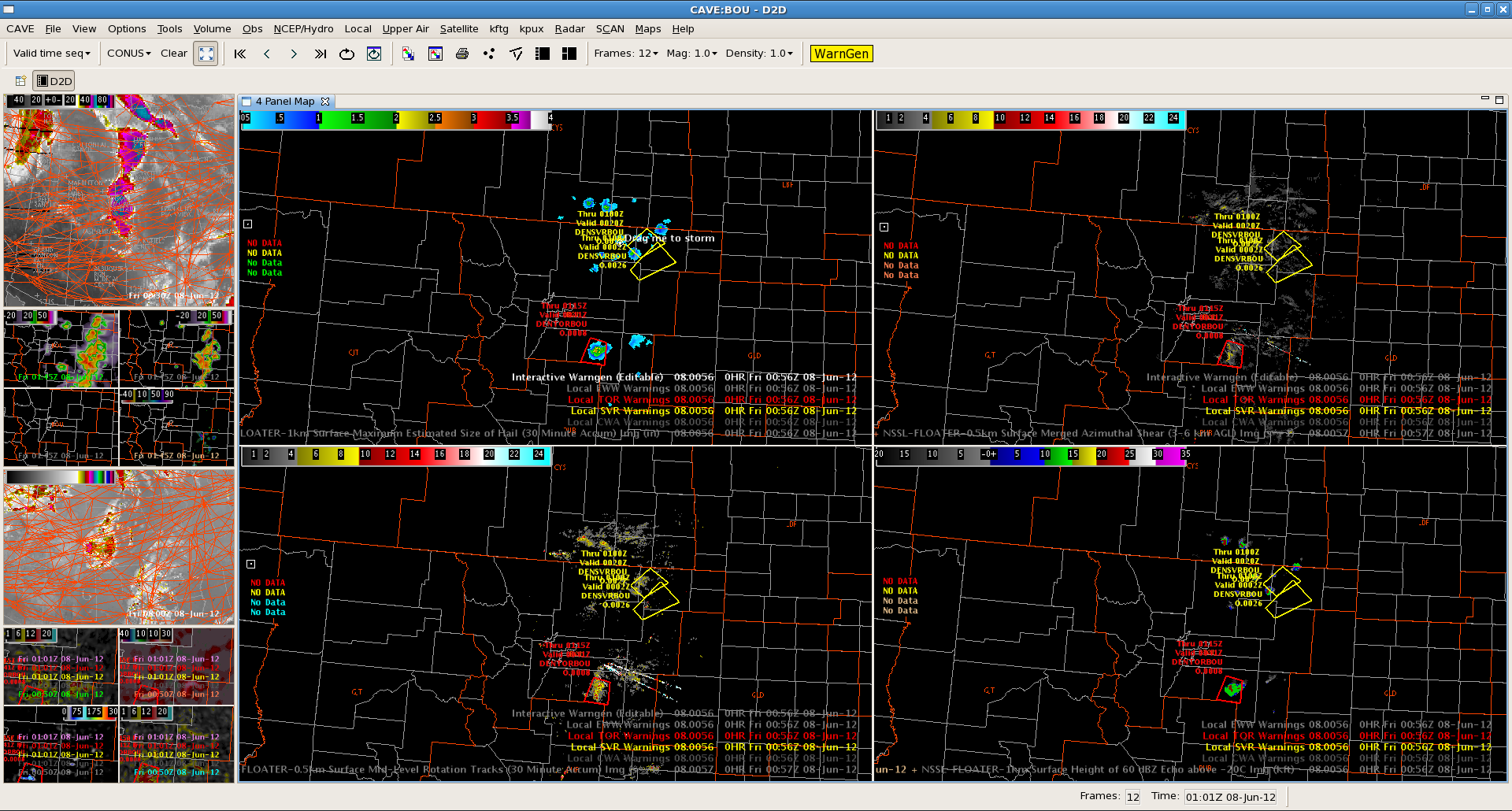
Figure 1 shows the MRMS products, including MESH, Azimuthal Shear, Mid-Level Rotation Tracks, and Height of 50dBZ and 60dBZ Echos above -20C.Sometimes pilots like to deviate as little as possible, and you’ll be asked if they can actually get thru the gaps between the thunderstorms. the MRMS data can really help you to visualize the true strength and areal extent of the thunderstorms. Overlay the jet routes and perhaps this information can be used to see if new playbooks truly need to be implemented at that point in time…or if air craft can remain on their routes and utilize those gaps between storms.

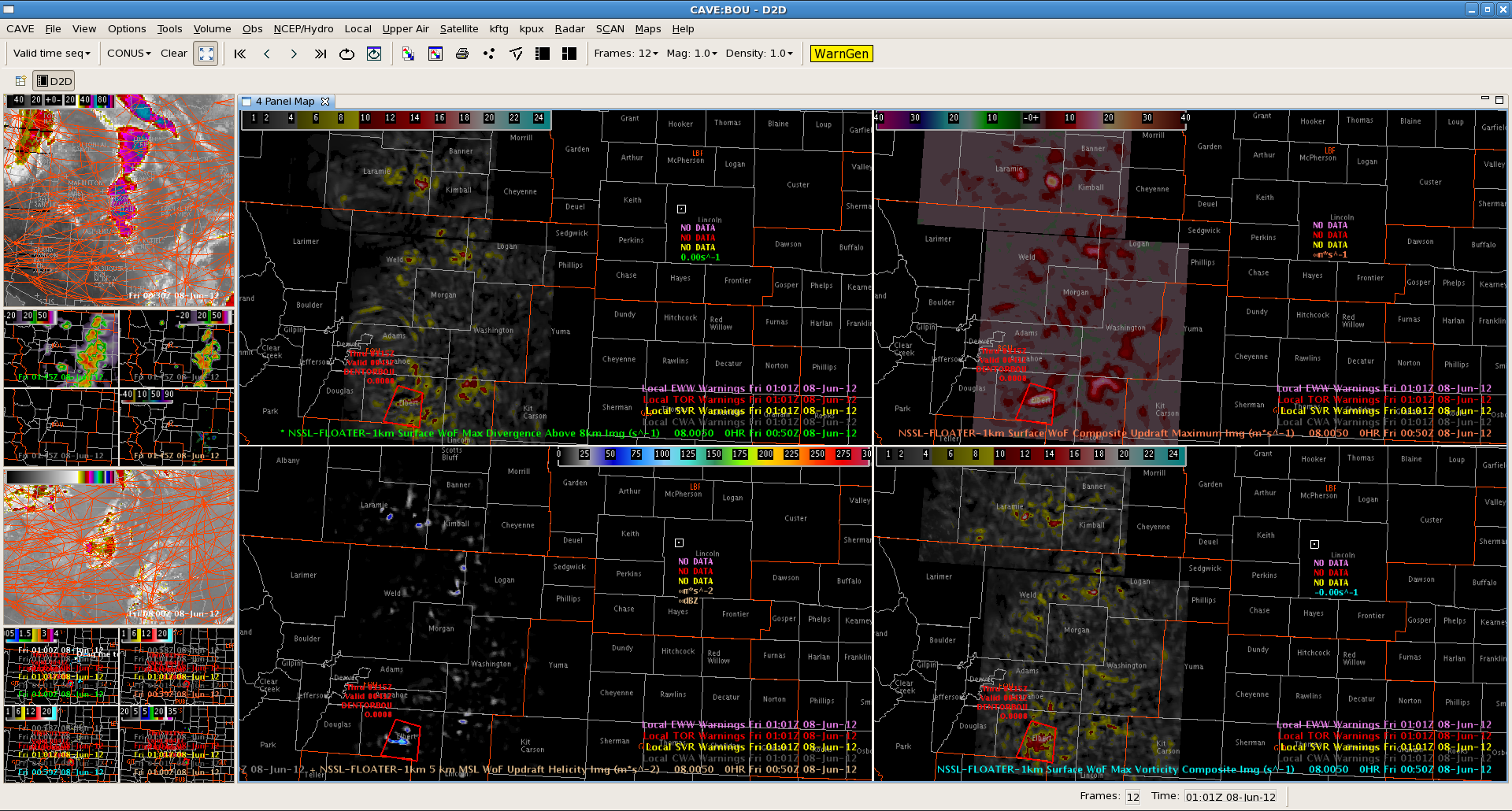
Figure 2 shows the 3DVAR data, including storm top divergence, updraft intensity, helicity, and vorticity…perhaps these products can also be used to identify the true impacts to different jet routes across the NAS.

Figure 2: 3DVAR Data

Just a thought!

Tags: None

UNR: Not all updrafts are created equal

Finally another updraft that exceeded the 11 m/s “threshold” that we found earlier, however, the MESH has only indicated hail sizes around 0.5 inch.  This particular updraft peaked at 17 m/s near Oglala, SD at 0005z. Earlier a severe thunderstorm warning was issued based on the 11 m/s updraft, but so far, no reports.

UNR updrafts (upper right) and MESH (lower right) at 0005Z

Update: The next updraft falls within the “normal” range for a strong storm, and MESH agrees.  A 15 m/s updraft on the tail end charlie and a MESH value of 1.02 inches. Waiting to see if there is a report…

UNR updraft composite (upper right) and MESH (lower right) at 0030z
Tags: None

A Classic Lemon Deep Convergence Zone (DCZ)

Note, a DCZ is not the DCVZ!

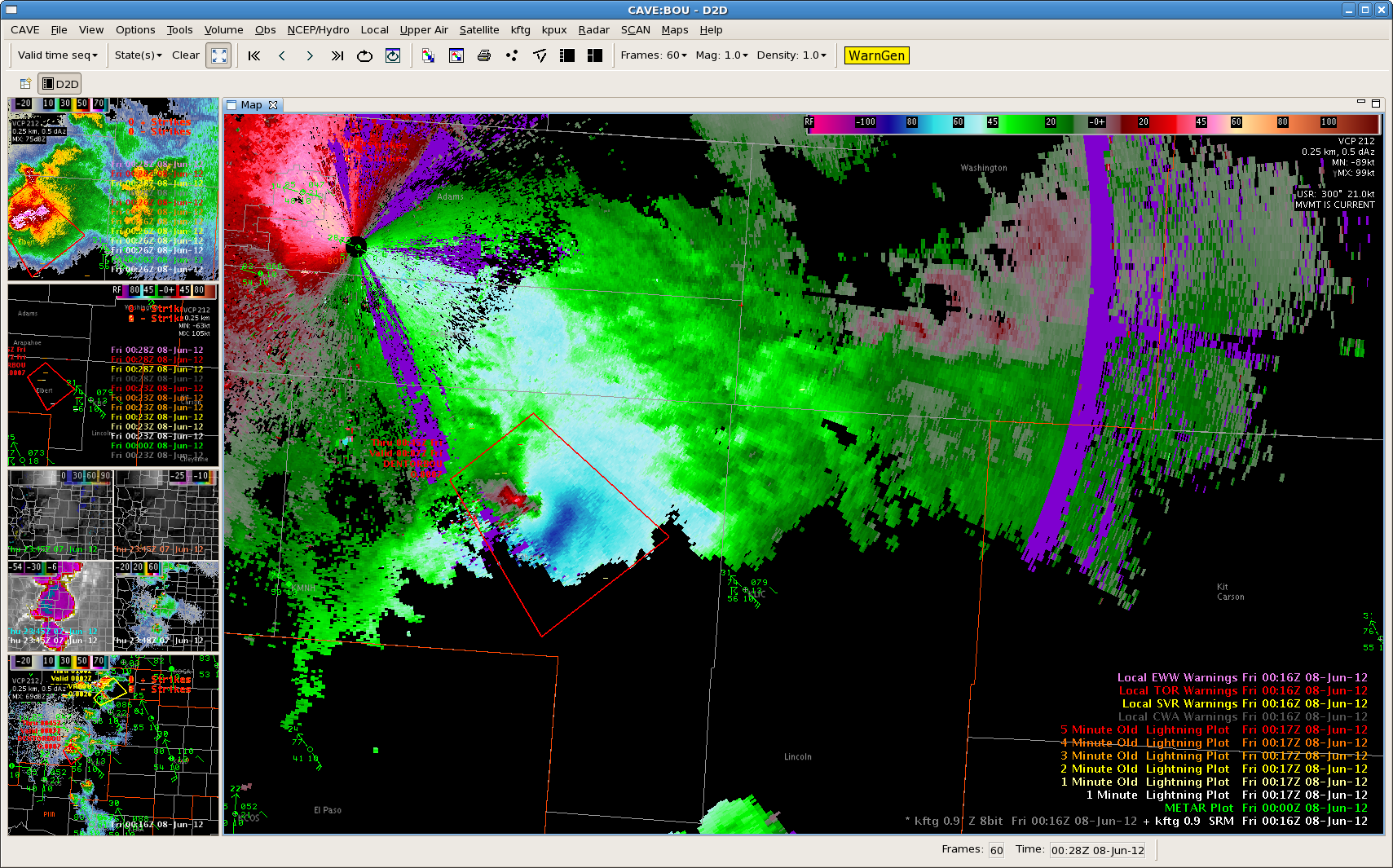
Here’s a velocity cross section from the Four-dminesional Stormcell Investigator (FSI) of the supercell near Byers, CO perpendicular to the convergence boundary.  This is a classic Les Lemon Deep Convergence Zone, transitioning to a storm summit divergence.

Greg Stumpf, EWP2012 Operations Coordinator


Tags: None

UNR: Finally a strong updraft! (But MESH says no!)

After seeing weak updrafts most of the day, we finally see an updraft that is worth mentioning!  Starting at 2300z and continuing at 2305z, our strongest updraft of the day occurred at 21 m/s, but whoops!  Someone forgot to tell the MESH!  After MESH had been saying hail in the 1 to 1.65 inch range for the last few volume scans, it came down to sub severe levels at 2305z and severe hail was never again reported by the MESH.

UPDATE: Golfball size hail was reported with the 21m/s updraft at 2254z (since 3dvar data is delayed one volume scan this is approximate time of the first 21 m/s updraft with MESH at 1.65 inches).  Quarter size hail was reported in a nearby area earlier with an 11m/s updraft.

UNR updraft composite (upper right) and MESH (lower left) at 2305z.
Tags: None

CYS:NEW POST FOR NEWER STORMS 7 June

Long term MESH shows track of our original storm and our new storm. Sometimes of big hail.

3-hours of MESH
TBS

Good 3 body spike with our new storm. Just saw real-time video of the tornado beneath it too.

Yet another good storm north of KCYS radar.

Rotation tracks with hook.

Hook and rotation tracks

More good images of the storms. Textbook supercells today. One more to our south out of our area.

Tags: None

CI products on the front range

Watching for CI in CO. We have noted moderate to high SOS hits on the higher terrain of CO west of DEN (1930Z and 2015Z images shown). Up to this point this activity has yet to convect. Conditions are ripe so we will see when it does take off.

Update: This initial activity did not convect.

Tags: None

UNR: Severe Storms with Weak’ish updrafts?

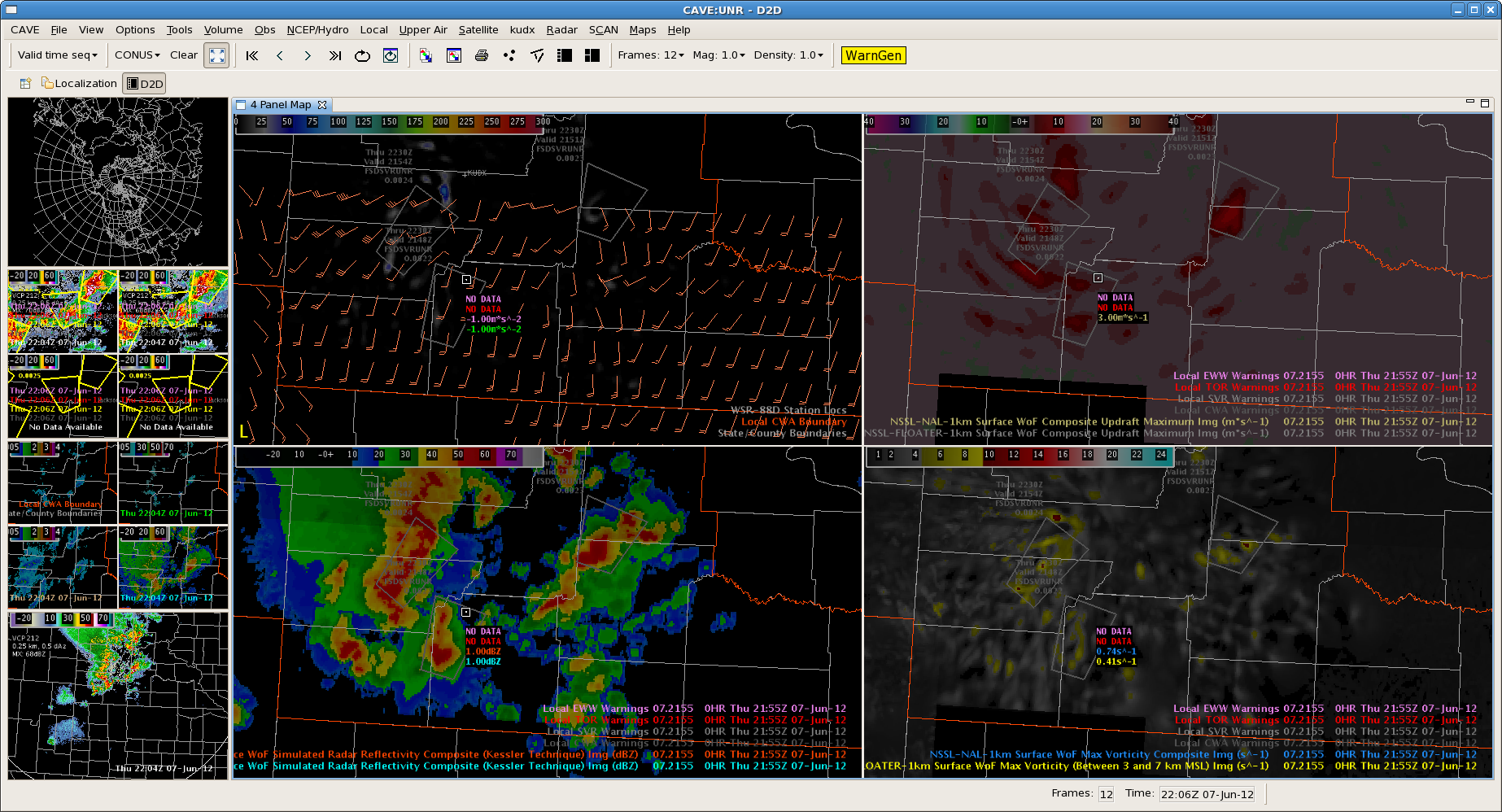
Low freezing (8500ft) and -20C (19900ft) heights are leading to efficient hail producers across the southern portion of the CWA.  However, 3DVAR data have been less than exciting.  Max updraft composite have only shown updraft strengths in the 7 to 9 m/s range near the time of warning issuance.  This is quite different than what was shown in the marginal severe cases of previous days, when maximum updrafts were generally on the order of 11 to 15 m/s.  In any case, the MESH was showing 1 to 1.5 inch hail in the severe storms (polygons noted by the gray outlines).

Weak updrafts in UNR - shown in upper right.
Tags: None

CYS: 3DVAR Rotation Products on a Tornadic Supercell

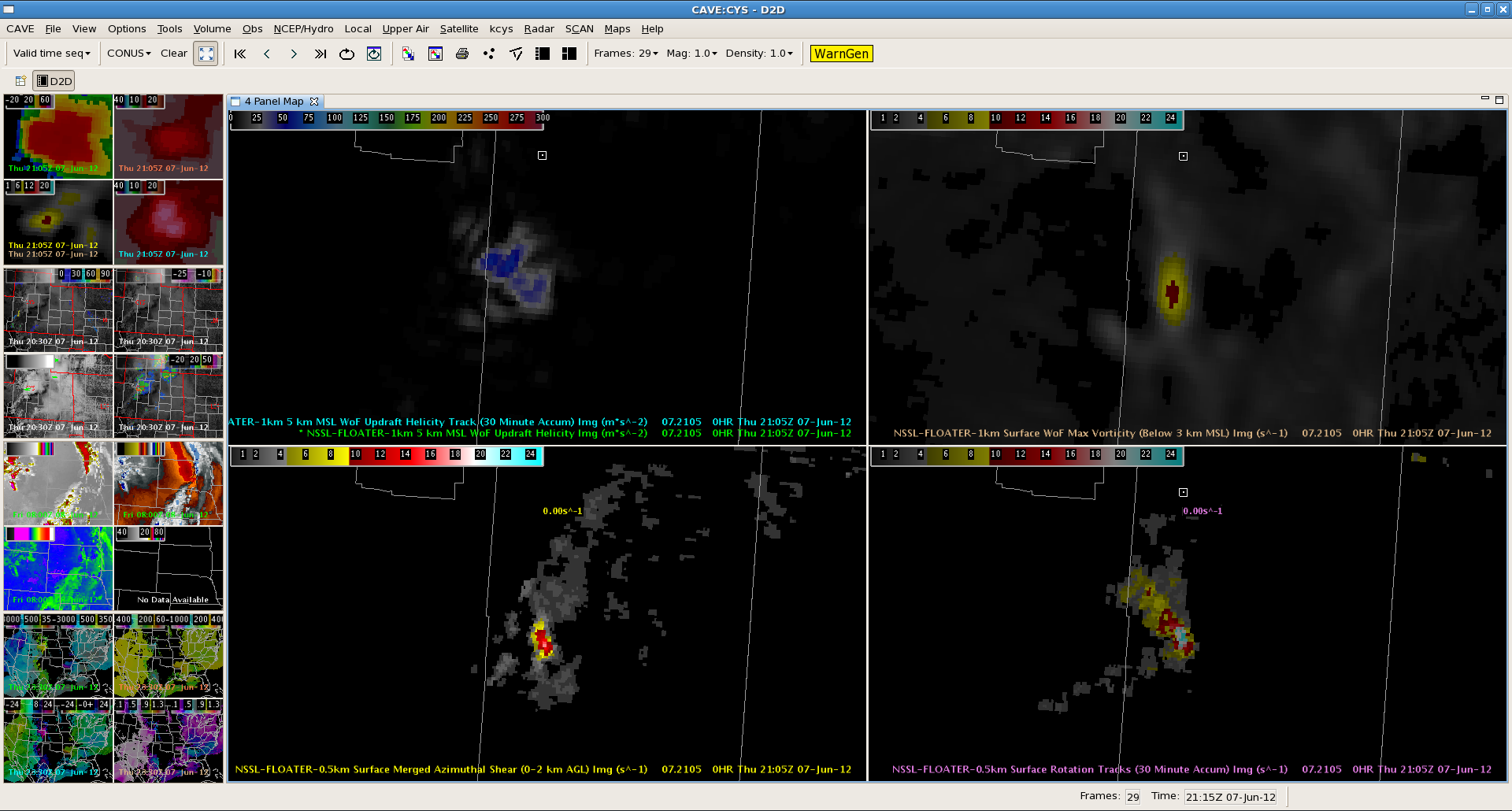
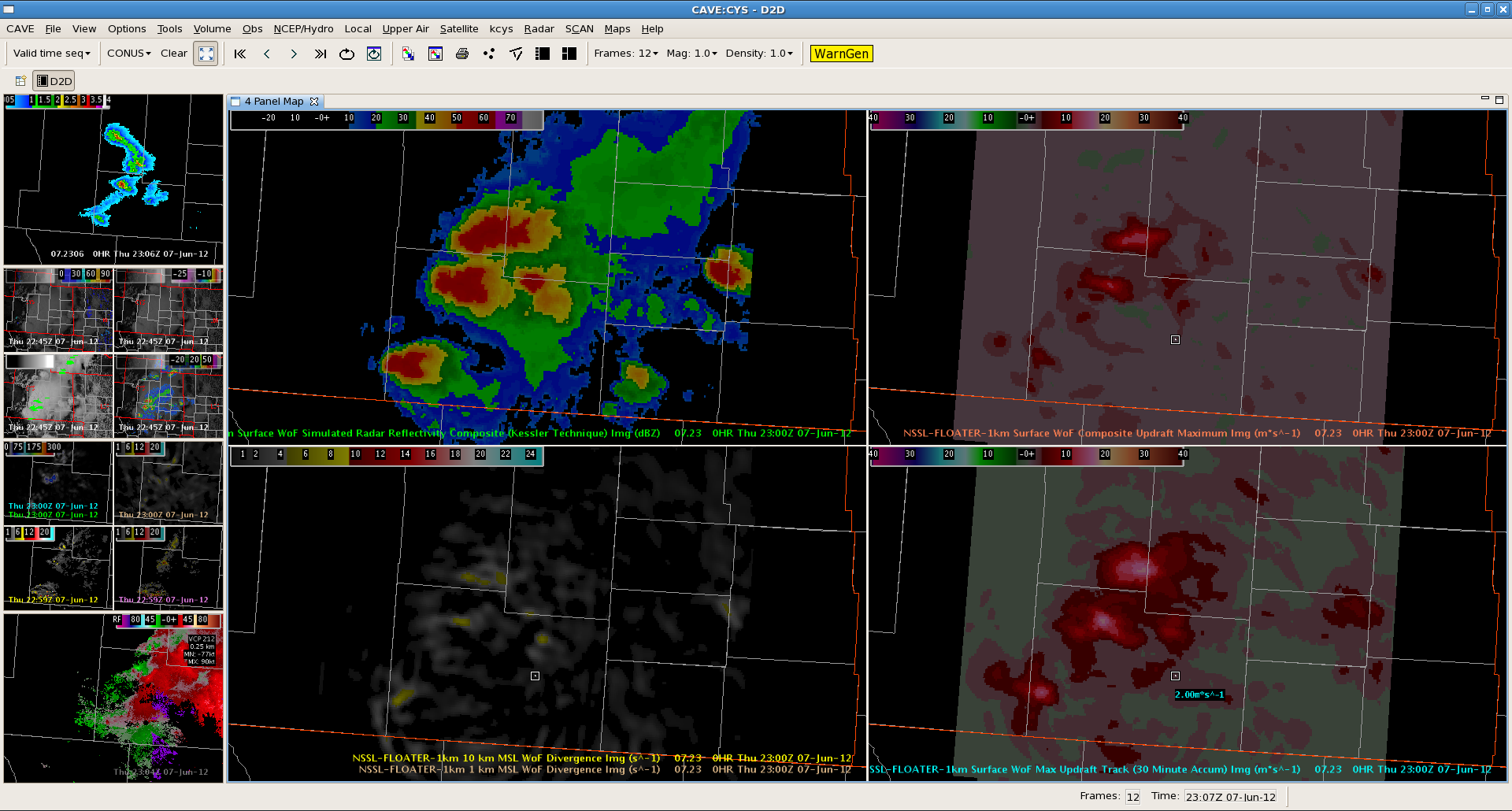
3D-VAR products have performed well given lack of radar coverage. They depict strong vorticity associated with a low level mesocyclone and tornado. Comparison to the MRMS rotation tracks confirms the location of this tornado, though the magnitude isn’t quite as significant. The second 4panel is from a later time with 3 distinct supercells in the CYS area. Again, 3DVAR shows skill in defining the greatest updraft areas as well as stronger updraft helicities associated with mesocyclones.