


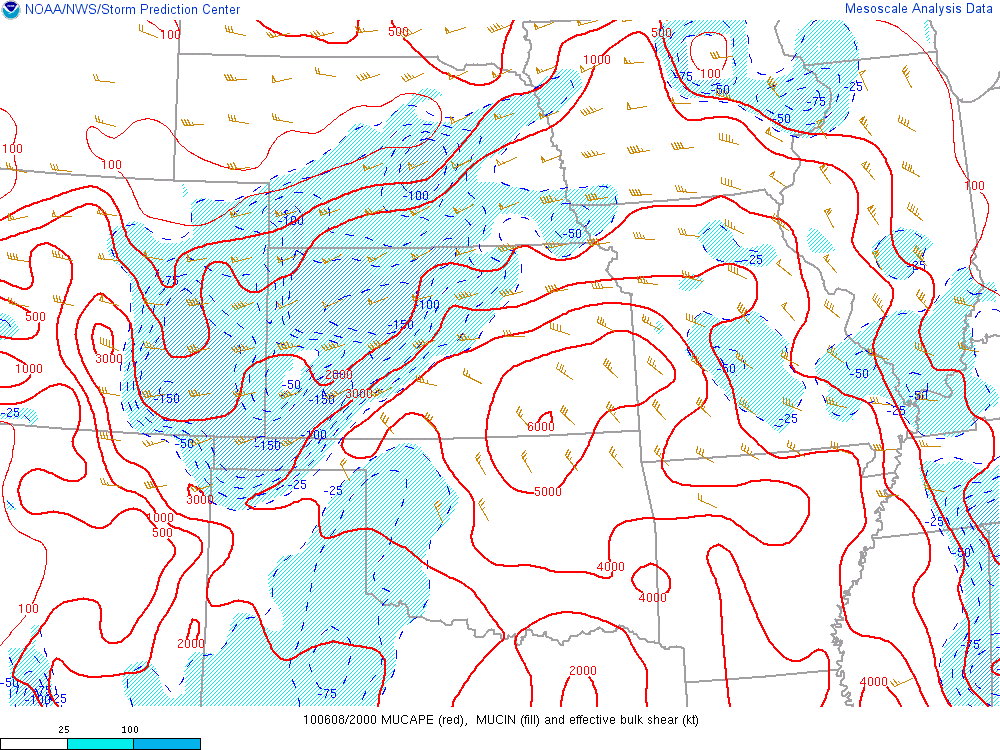
Dan D, who is working the ICT CWA has a severe storm forming right near KICT. He’s gone ahead and fired off a warning – so we’re off and running. Our IOP area appears very “juiced”:
Kevin Manross (EWP Weekly Coordinator, 7-11 June 2010)
Official websites use .gov
A
.gov website belongs to an official government
organization in the United States.
Secure .gov websites use HTTPS
A
lock (
) or https:// means you’ve safely connected to
the .gov website. Share sensitive information only on official,
secure websites.

Real-time posts made during testbed nowcast and warning operations.
Dan D, who is working the ICT CWA has a severe storm forming right near KICT. He’s gone ahead and fired off a warning – so we’re off and running. Our IOP area appears very “juiced”:
Kevin Manross (EWP Weekly Coordinator, 7-11 June 2010)
Forecastsers are now in the driver’s seat getting used to the data. We’ve encouraged them to issue warnings if/when they’re comfortable to do so.

Kevin Manross (EWP Weekly Coordinator, 7-11 June 2010)
Greg is showing the MRMS/GOES-R products on AWIPS. We’re focusing on the storms on the WY/NE border in the N part of the NWS CYS CWA. Soon we will sit the dorecasters down and have them get their feet wet.

Kevin Manross (EWP Weekly Coordinator, 7-11 June 2010)
Here is a Warning Decision Support System – II (WDSSII) image of the DC Lightning Mapping Array (LMA) Pseudo GLM product (colored grid squares) and a 3D mapping of the lightning flashes for a storm near Baltimore MD that was deemed severe by the EWP meteorologists. The image on the left is a view looking toward the northeast. The image on the right is a view looking toward the north west. The storm is moving southward, with is opposite the direction of the arrow on the cross section line. The orange polygons are the experimental severe thunderstorm warnings issued within the HWT.

Greg Stumpf (MRMS Principle Scientist)
After many hours of waiting for anything severe in the CTP CWA, we decided to cut them loose, and we are operating only with PHI and LWX.
Here’s a screen capture showing the isothermal reflectivity at -20C and Jim’s new color scale. He likes the 60 dBZ threshold at that level, so he turns it from white to blue, and thus has SVRed that cell.

Greg Stumpf (MRMS Principle Scientist)
We’re still operating as three CWAs, CTP, PHI, and LWX. CTP has remained quiet, with no warnings issued. LWX has started issuing warnings for storms over western VA and easter WV, based on hail. They have been using the Ref -20C and ET 50.
PHI has been the most active with a number of warnings. The PHI team has been using various MRMS products such as echo top, Ref at -20C, POSH, and MESH. MESH has had “varying” results, but they have been varifying their warnings with hail reports. Here’s a picture of PHI’s recent warnings

Greg Stumpf (MRMS Principle Scientist)
For the first time, we are actually running three CWAs: PHI, CTP, and LWX. The most convection, with some severe as deemed by our EWP participants, are in the PHI CWA, but we expect some severe weather in the other CWAs. But for the most part, this is a low-end severe weather event. Attached is a screen shot of the 120 min Hail Swath product from the multi-radar/multi-sensor (MRMS) system.

Greg Stumpf (MRMS Principle Scientist)
Great suggestion for a MRMS “diagnostic” product from the WFO participants: For each grid point, be able to determine which radars are contributing, what weighting factors are being used, and how many samples and at which heights are used for that grid point.
Greg Stumpf (MRMS Principle Scientist)
After a few hours of ops for two of our participants on the OUN CWA, we have shifted to a domain over the Front Range. One team is working the Cheyenne (CYS) CWA, and working two severe storms, although both storms are on their way out and they canceled the SVRs. A new storm is coming up near BFF, but they have not yet deemed it severe. One particular product of note has been the Reflectivity at -20C. That team had noted that a good threshold for severe is is 60 dBZ on that level, so the teams created a new color scale with a distinct color change at 60 dBZ. In addition, they wanted to change their MESH color scale to make the colors “hotter” across the board.
The other team is working the Boulder/Denver (BOU) CWA, which includes one storm that the VORTEX2 and SHAVE teams are working. That team has been using a combination of isothermal reflectivity and 50 dBZ echo tops, along with three-body scatter spike signatures to help with warning decisions. They too have also been making some changes to the colormaps to correspond to some local hail detection studies they have done at their WFOs.
AWIPS performance is tenuous today – it appears that having three or more displays running off the server causes network slowness when new products are requested, although currently it appears to be running fast. Grossing fingers!
Greg Stumpf (MRMS Principle Scientist)
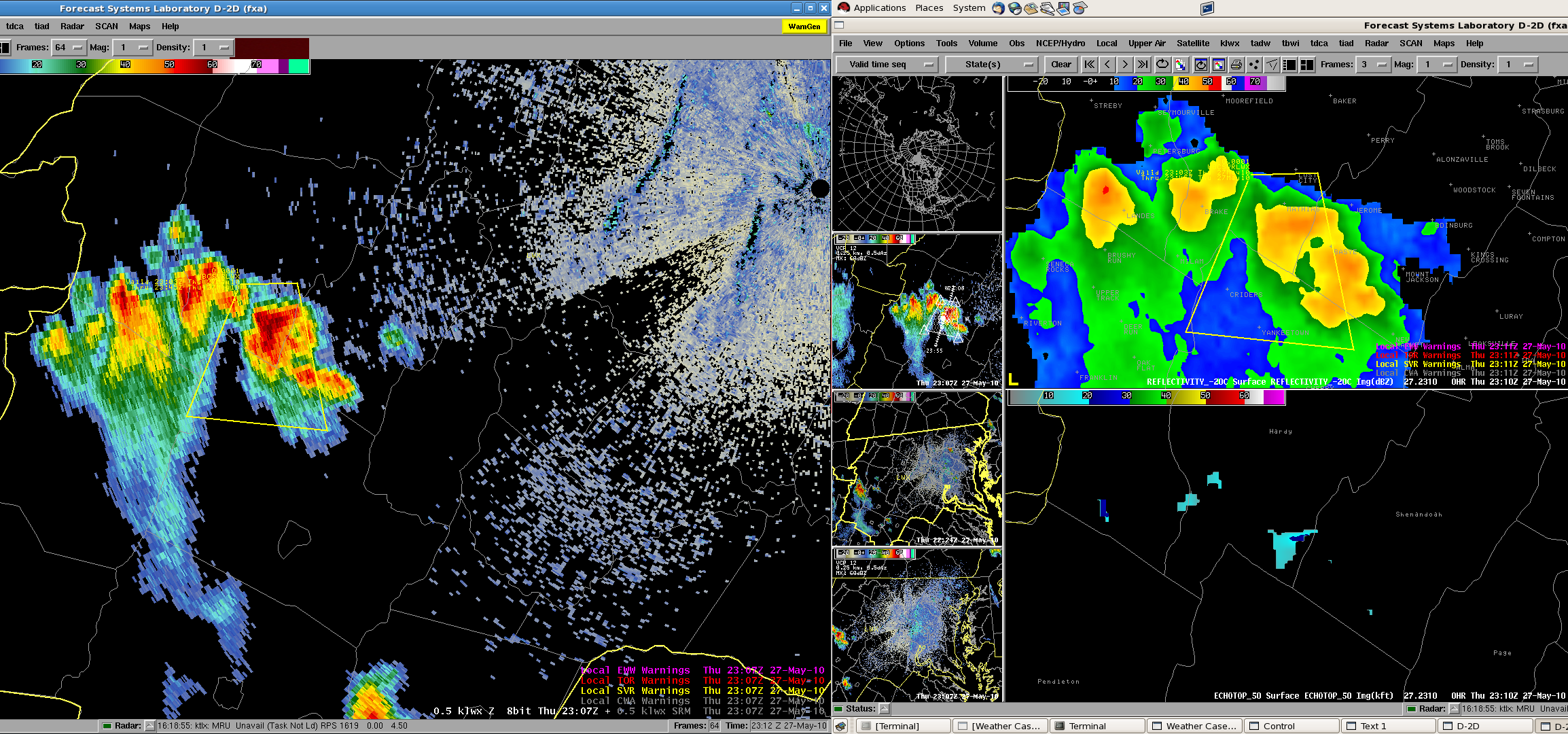
By 2300 UTC, forecasters were watching storms become better organized across the region. Unfortunately, around this same time period, the data flow for base radar data was running ~10 min behind. The MRMS products such as reflectivity at -20 C were still coming in close to real time and a few of the forecasters were able to issue warnings on these and the other experimental products (e.g., psuedoGLM and MESH) alone. SHAVE calls are also focused in this region for verification.
Kristin Kuhlman (EWP Weekly Coordinator, 24-28 May 2010)