


After a brief excursion into the KS/NE region, we’re re-localizing back to OUN with our evening forecaster shift.

Official websites use .gov
A
.gov website belongs to an official government
organization in the United States.
Secure .gov websites use HTTPS
A
lock (
) or https:// means you’ve safely connected to
the .gov website. Share sensitive information only on official,
secure websites.
Real-time posts made during testbed nowcast and warning operations.
After a brief excursion into the KS/NE region, we’re re-localizing back to OUN with our evening forecaster shift.
We’ve re-localized to the Dodge City, Wichita and Hastings CWA’s for the remainder of the shift. Focus will remain on the 3DVAR data and products with the severe and tornadic storms across the region.
Kevin D. and Bill are taking over the Hastings CWA while K. Brown is monitoring DDC and Steve is focusing on the ICT domain.
The startup of this switch has been slightly delayed due to technical problems with the ingest of experimental products. Expecting things going to be up and going in the next ten minutes. Multiple tornadic storms are already ongoing across the region.
With warning operations already underway for western Oklahoma, forecasters are deep into their storm analysis.
One of the more interesting features they have been picking up on is the consistent signals between the pGLM lightning trends and values from the MESH algorithm as well as the 3D-Var derived updraft fields.
This was well illustrated by the storm north of Elk City moving from Beckham to Roger Mills county. At approximately the same time ~1900-1915 UTC, the lightning rate increased from 5 to 15 flashes per min (per pGLM grid box, not per storm) as MESH ramped up and updraft increased within the 3D-Var product. Shortly after this increase, both the pGLM and MESH values decreased with this storm (the 3D-Var updraft values also showed this, but with a bit of a time lag).
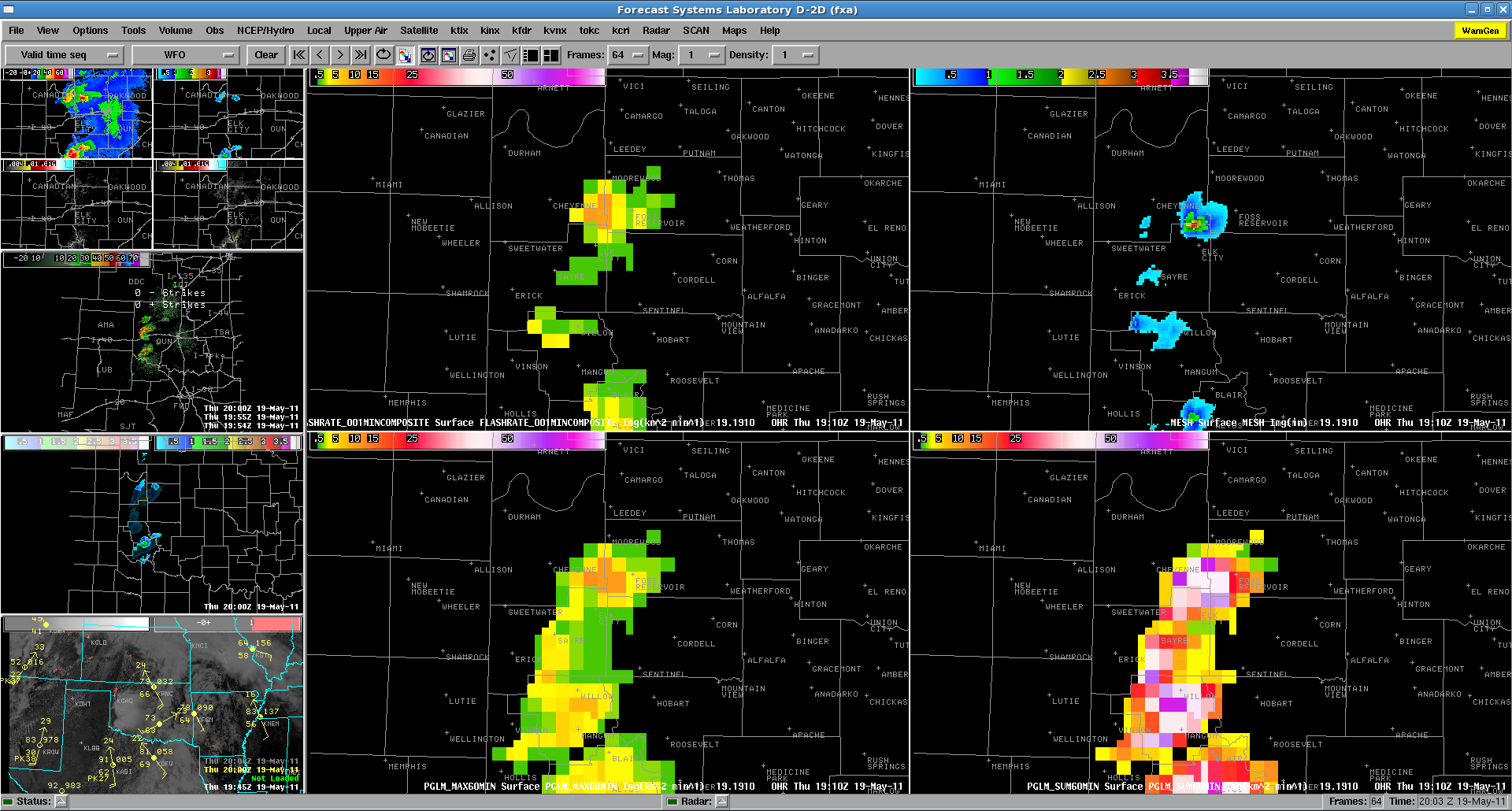
Also of note, prior to losing NLDN data, with the storms seemed to be producing relatively little CG lightning. In this case, the pGLM data was definitely giving a better view of the electrical activity and storm intensity. (1 to 1.75 in hail has already been reported across West and SW Oklahoma).
-K. Kuhlman (pGLM scientist, week 2)
2330Z Update: UAH CI indicating possible development across Garvin and McClain counties. There does appear to be an HCR in this location but we believe that the edge of thin cirrus clouds are causing algorithm to detect cloud cooling that is not real. Looks like we are going to move operational area to eastern Colorado where there is a lone supercell. kbrown
2230Z Update: Got a hit off of the UAH CI over southern Comanche county where there are weak echoes aloft (15-20dbz). These echoes are associated with a wildfire plume, however.
2140Z: Brief UAH CI detected across north-central Oklahoma in cloud streets (1832Z), but no subsequent echoes were detected.
Although there has been several hours of cu/tcu formation near and east of dryline, CI algorithms have not detected CI across OUN domain. From 20Z to 2115Z this is actually a good thing since no echoes have developed (good case of low false alarm). Before the CIMSS CI became contaminated with Ice Cloud Mask, there were a few hits for CI on leading edge of incoming cirrus across northwest Oklahoma between 19Z to 20Z. No echoes were subsequently detected.
Isolated CI hits from the UAH algorithm did accurately depict some elevated echoes over the OK/AR border but no lightning occurred. Leadtime for echoes was 15 to 30 minutes. kbrown

3DVAR wind field at 1.25 km showing strong southeasternly inflow on the south side of the complex and a bookend vortex on the north end.

Brian and Scott have been watching a storm in E Colorado that produced hail and wind damage. They commented that the 3DVAR analysis seems to produce a very realistic wind field at the 1.5 km level for the storm of interest.

Second tornado warning today, this one from the Goodland localization (Blair).
Earlier, the UAH-CI algorithm had shown some CI ‘yes’ detections for the region. Later updates of this algorithm may be able to incorporate trends and layer CI to more than the current yes/no configuration.
OUN-WRF continues to show trend for robust storm cells around the CO/KS border… missed initial storm warned shown here, but each additional run persists in developing significant convection across the area.
-K. Kuhlman

Issued TOR for eastern Cleveland with a shallow but continunous QLCS feature near Pink. TOR area is outside 3DVAR domain and PGLM 1min composite did not appear (qualitatively) to show a jump (or any organized pattern) associated with low level spinup. Values of 1min appear to be low, generally under 20 km**-2 min **-1. Warning basis solely on SRM.
–Curran

Brandon has been observing storms in Oklahoma with the 3DVAR and lightning products. The plot above shows a strong relationship between the maximum updraft intensity over the previous 60 minutes with CG lightning strikes over the same time period.
Brandon also noted that is is difficult to correlate the updraft intensity with reflectivity cores aloft due to the temporal lag in the 3DVAR products.
— Travis Smith
Focus this afternoon is spread across all the projects of the EWP this year (GOES-R, 3DVAR, short-range models).
A few of the forecasters are concentrating on the OUN CWA, analyzing the ongoing convection across the region. These forecasters (Curran/Vincent/Billings) will be issuing significant weather advisories after examining storms using the GOES-R pGLM lightning data and NSSL-3DVAR products in addition to their typical radar analyses.
Our other forecasters (Taylor/Blair) are monitoring the DDC and GLD CWA’s for convection initiation. Experimental products being brought into their analyses include the GOES-R proving ground CI products (UAH-SATCAST) and GOES Nearcast. They are also examining OUN-WRF and HRRR updates as they become available. In the future, a D-Prog/D-time type product might help the forecasters better visualize model trends. Significant weather advisories are also expected from this group as CI becomes evident.
Note: Discussions of forecasters with the GOES-R UAH-CI team have already lead to the modifications of their product remove detections of cloud objects and only display when CI is occurring.
-Kristin Kuhlman (Weekly Coordinator)
