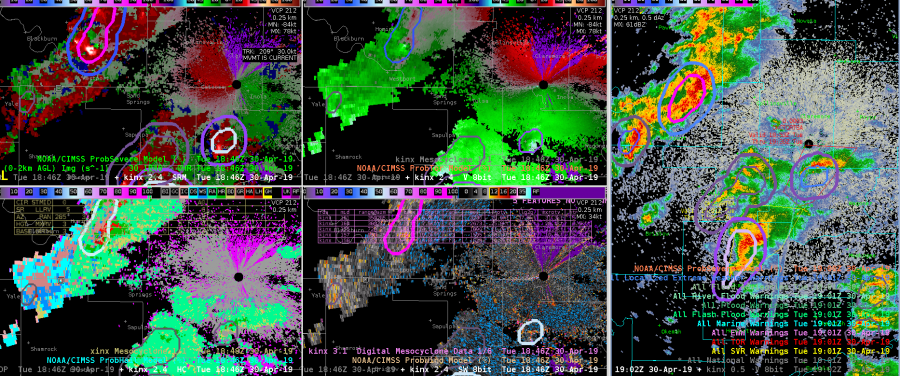
CPTI/AzShear anomaly

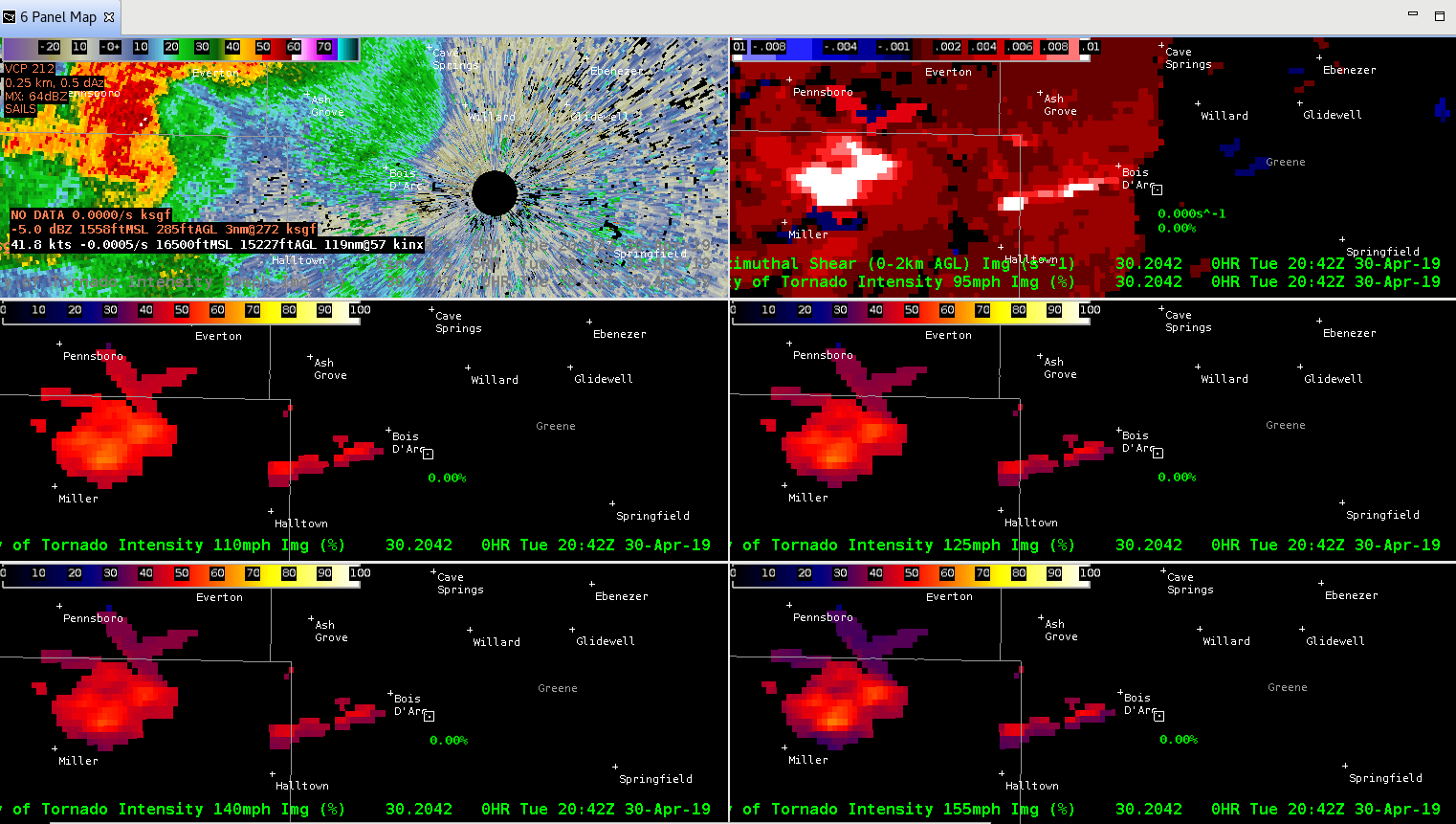
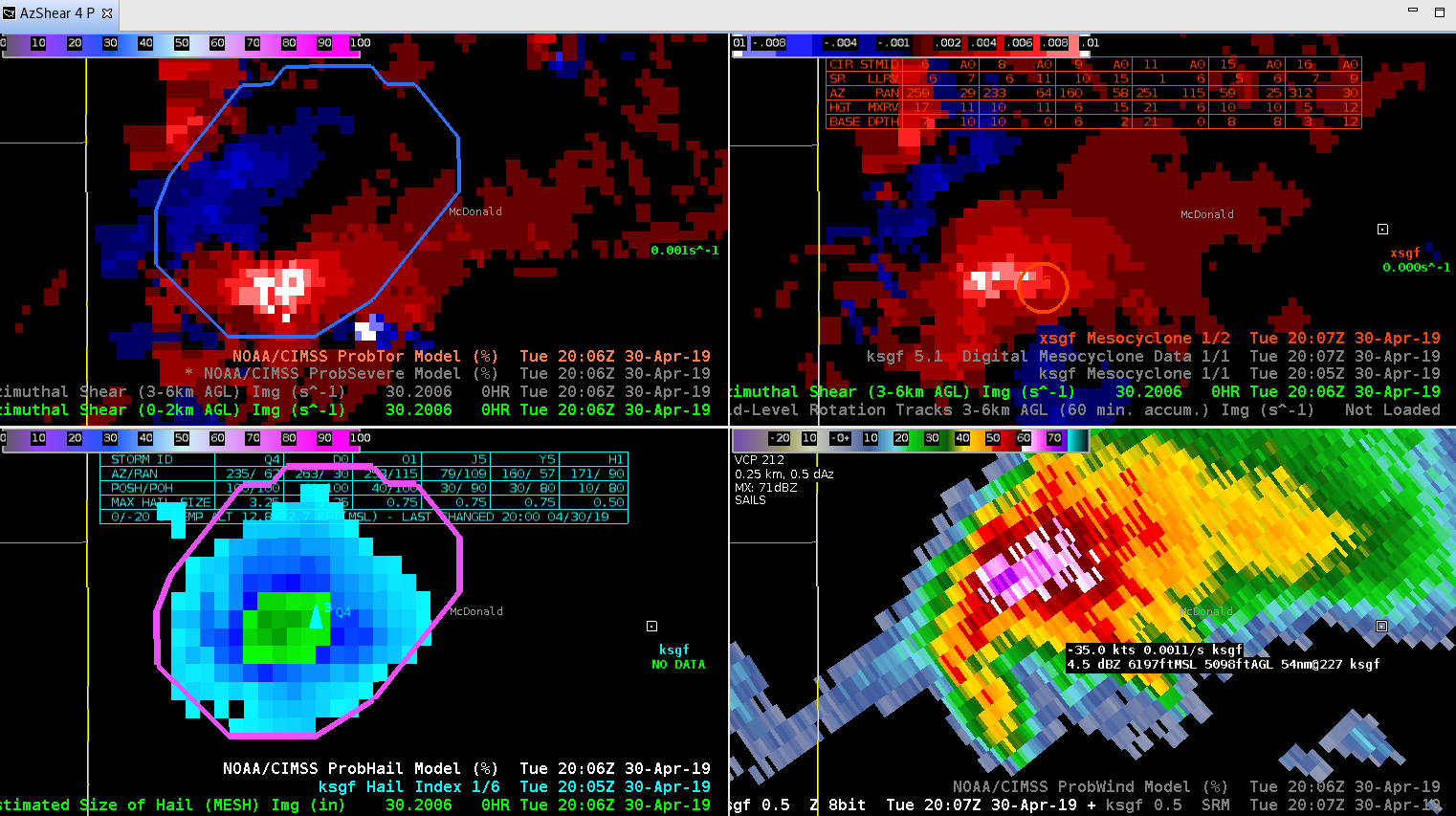
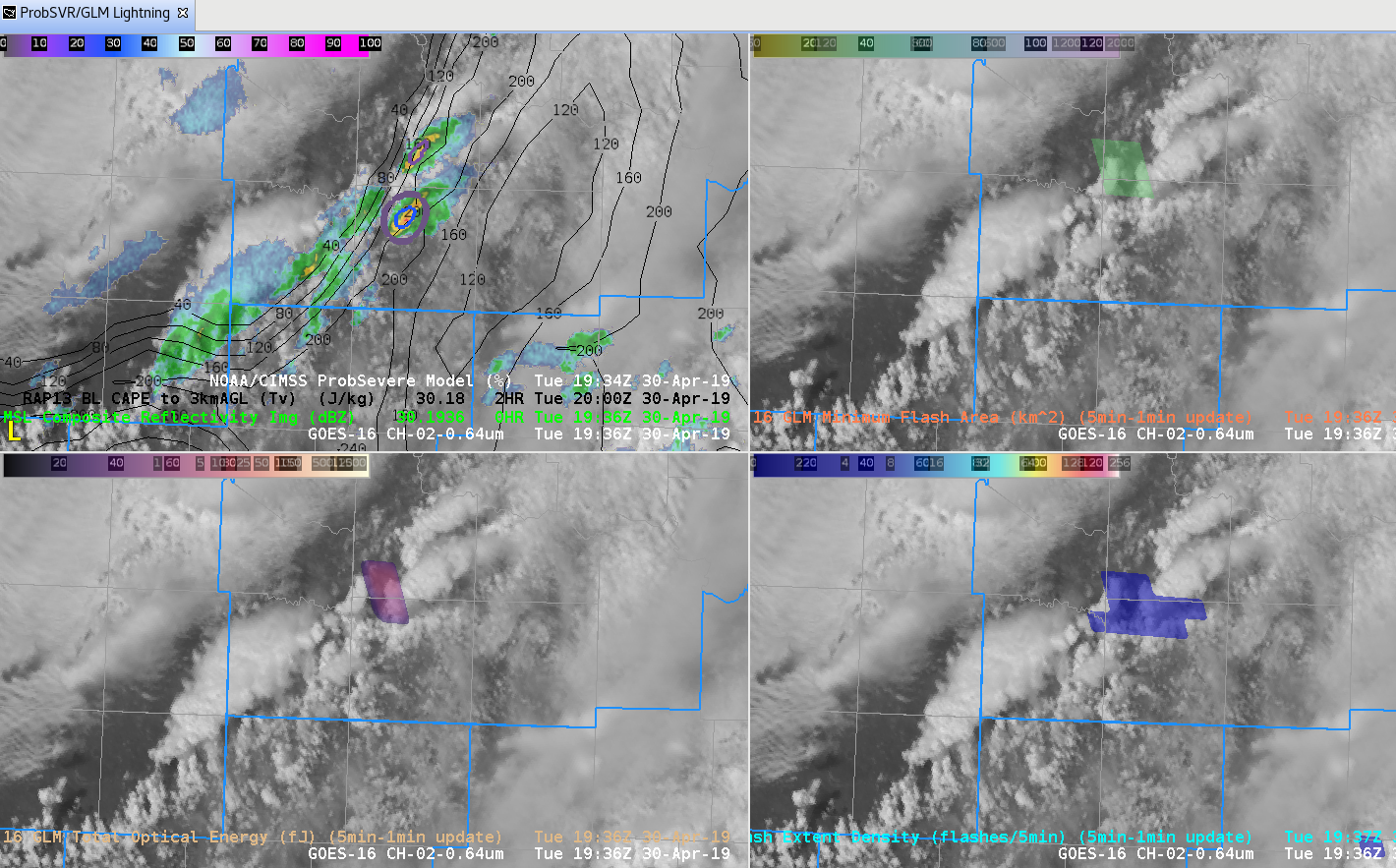
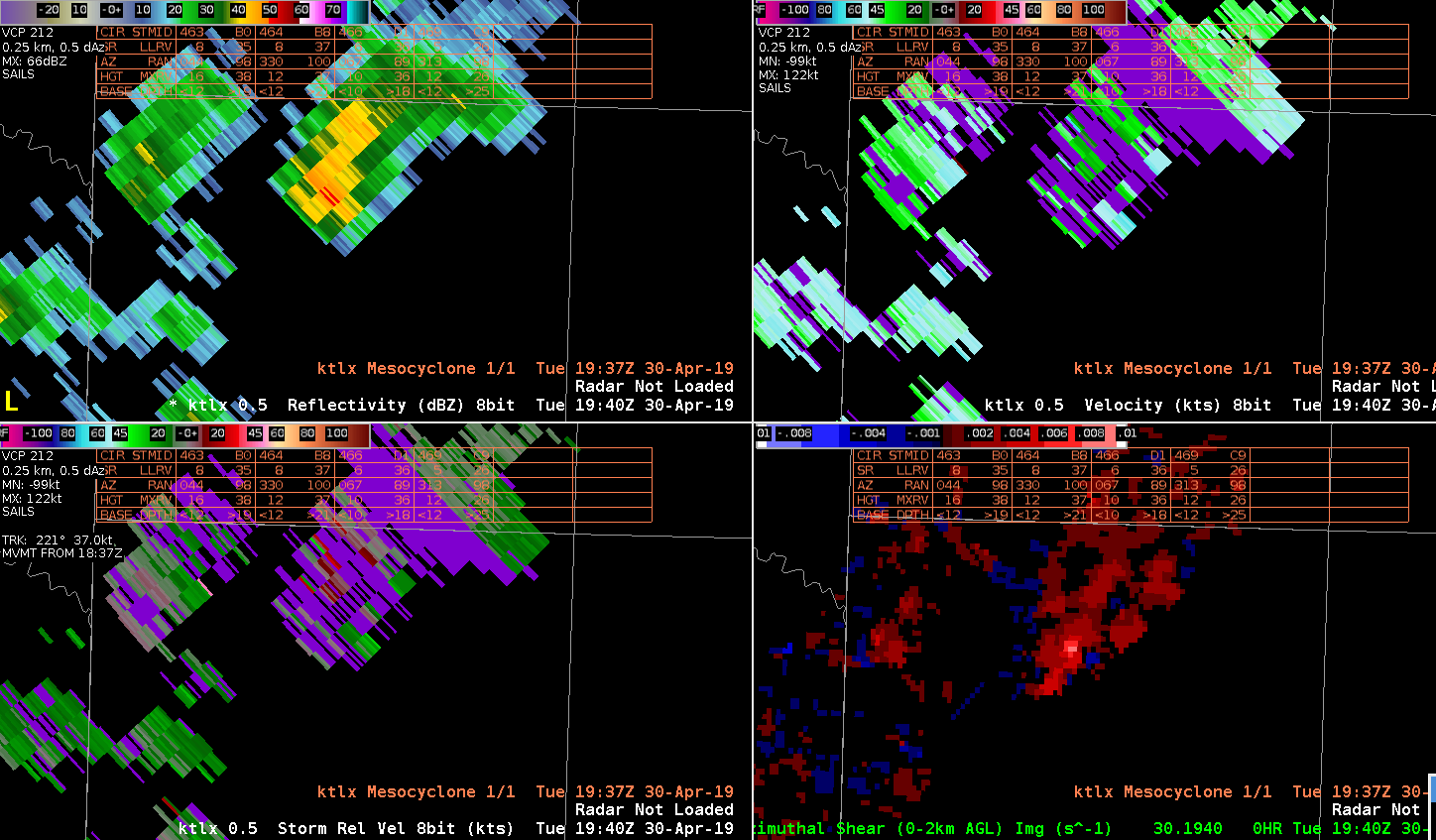
AzShear increased ahead of an approaching tornadic storm. At the same time the CPTI product also indicated an enhanced probability in the same area. Velocity data in the lowest few tilts became suspicious along the radials ahead of the storm as PRFs struggled to improve range folding.

— SCoulomb

Underwhelming ProbHail

ProbHail on the storm in southwest MO seemed to be too low based on other derived parameters (MESH/Hail Index) and storm structure. ProbHail was consistently 70-75%. It was explained that the hail cape (~750 J/kg), the EBShear (47kt) and lightning (29 flash/min) were relatively lower than one would expect given the environment. Justin showed the parameter space for each of the ingredients and how they were weighting down the overall ProbHail due to the ratios being <1.

— SCoulomb


Figure  1936Z

Thunderstorm developing in southwest Oklahoma along 0-3km CAPE boundary with GLM showing first signs of lightning.  If this storm remains attached to this boundary the environment supports possible tornadic development.  ProbTOR is showing 3% with this early development Figure 1936Z.   -Jake Johnson


A positive for AZ-Shear product it does not show range folding like base velocity/SRM products.  Might be useful tip.  -Jake Johnson


SC Entering Washington County

This storm has had consistent Azhear max for past several volume scans, but again does not seem to match low-level SRM scans very well. Prob Tor has increased and remained steady at about 75 to 77 % CPTI has remained slightly over 50%. Upgraded SVR to Tor possible. Reflectivity structure suggests increasing organization with well organized ZDR arc arc suggesting increasing SRH. May upgrade to tor shortly given better storm structure in base data. Quick Twip

Advantage of AZ Shear

Favorite part of the Azimuthal shear product so far is it can highlight some areas of the storm that need to be investigating…if you are watching a different storm and want to do a quick look at your CWA this can grab you attention to a storm that needs to be looked at next.

South Beach

AZShear and CPTI Product for TUL SC

Watching storm northeast of Hominy @ 1854 utc. 0-2 km AzShear has been showing persistent max with the cell but seemed to displaced to far west of broad circulation. 0-2 kn Azshear not very helpful with this storm given displacement. CPTI has been showing consistent 50-55% 80 mph intensity probs for past several scans.  – quik twip

Merged AZ-Shear 0-2km

AZ-Shear Merged 0-2km:

Notice AZ_Shear Merged 0-2km was not well defined with the rotation couplet as compared to the base/SRM velocity products from a single radar.  This product seems to work better in the single radar form versus merged form.

-Jake Johnson


Az Shear – the goods and bads

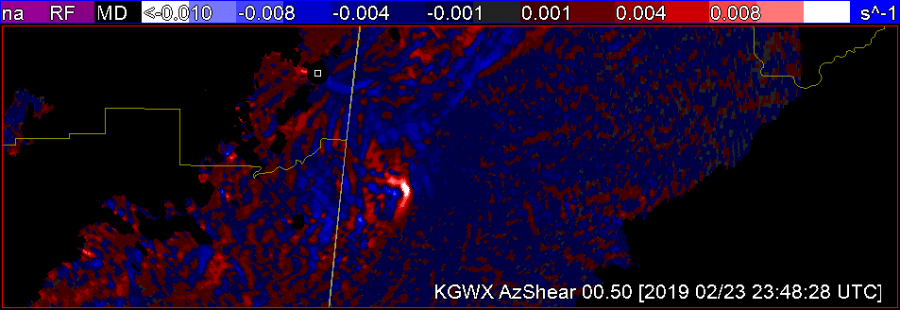
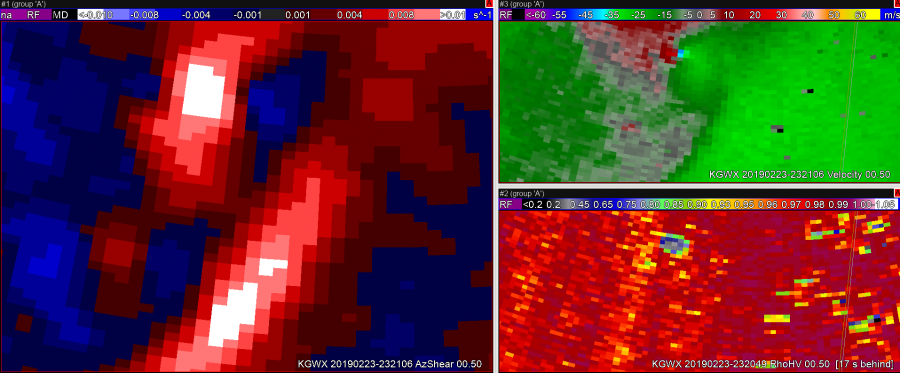
Photo above shows a double maximum in AzShear. One of these is clearly colocated with a TOR on ground via CC. However, velocity shows two very different situations, possible strong tornado on ground versus convergence along the RFD gust front. If you were just looking at the AzShear product, both of these areas would be cause for concern, when in fact the impacts are extremely different. Would be nice to be able to differentiate between extreme high values of AzShear near a tornado versus more broad convergence on any wind shift area.
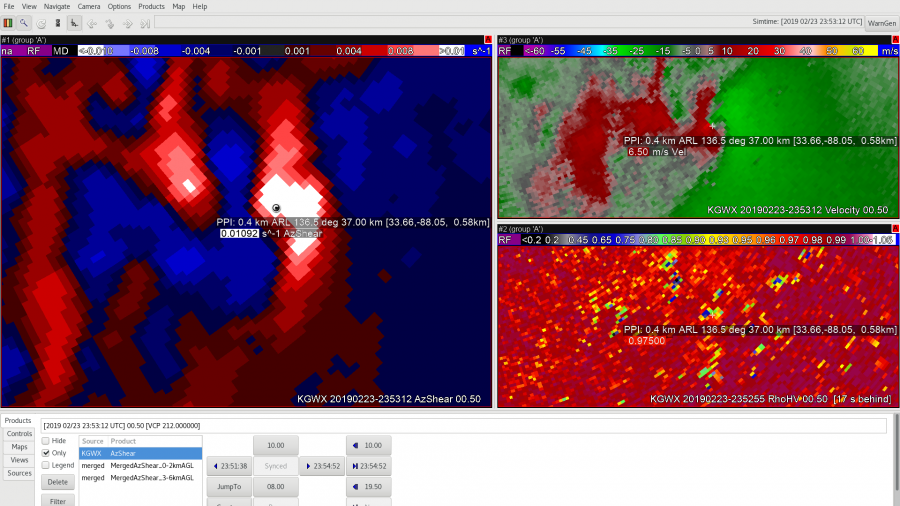


This next image shows a region where the AzShear maximum is too broad. This may simply be a color table issue, but clearly there is an area within the white region where a tornado is on the ground, and other regions within that max where only general convergence is occurring.
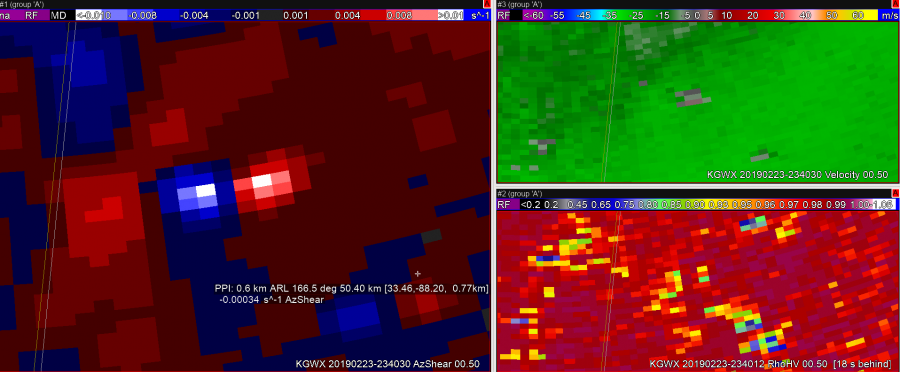
 

This image shows a location where some ground clutter is producing a false positive and negative AzShear couplet. Mathematically it makes sense to see this here given the V data, however to an untrained eye or someone just solely depending on AzShear you could be led astray.
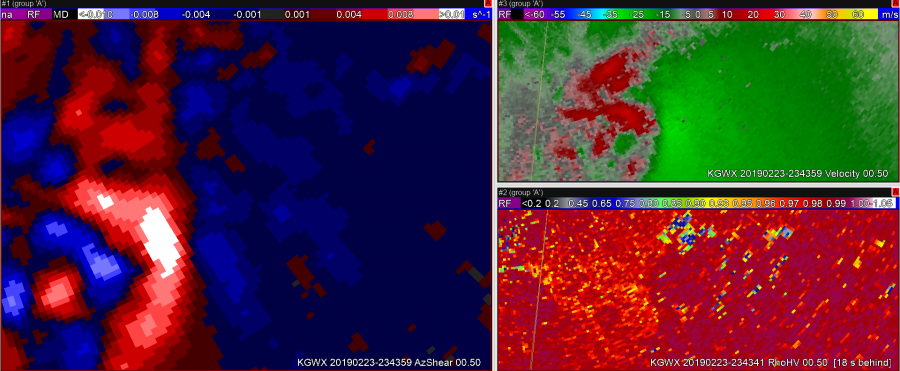
 

A positive of AzShear is that it can highlight areas of potential concern down the road. The above frame was just one of several frames showing strong convergence and high AzShear values preceding a second tornado from the main cell 10 minutes later. This could be particularly helpful in QLCS storm modes where convergence and shear increases in a broad sense along the main line prior to tornadogenesis. Also in this particular case, the V data was not entirely conclusive that convergence was increasing. AzShear was very conclusive here.


Dusty Davis

AZShear case 2/23/19

First impression of the single radar AzShear……display is rather noisy with lots of couplets…many not associated with any storm. Perhaps if had the option to filter out negative values (blue) so can focus on positive values only would make for easier digestion of data and enhance SA.   IN current state of product, would have have to be sure to compare to base velocity data, etc.

Azshear did  help draw my attention to potential cyclic nature of the storm and picked up on increasing shear to northeast perhaps a little sooner than if I had not been looking at it.  Pickup up on second circulation and locked on to it very well as second tornado(?) developed.

Azshear also seemed to highlight the shear along the RFD/Flanking line rather well.

0-2 km merged product provided similar information.  Did not have good feel for 3-6 km product yet.

Again, biggest drawback is the noisiness of Azshear.  I could see where this could distract from true area of shear associated with developing mesocyclone. Color enhancement could be improved as well.

Quik TWIP


AZ Shear

Az shear while noisy can be used to  quickly draw you attention to features of interest. It can point you to the center of strongest rotation very quickly helping a forecaster determine the area under the greatest threat from a tornadic circulation or where it is most intense.

South Beach