An official website of the United States government
Here’s how you know
Official websites use .gov A
.gov website belongs to an official government
organization in the United States.
Secure .gov websites use HTTPS A
lock (
) or https:// means you’ve safely connected to
the .gov website. Share sensitive information only on official,
secure websites.
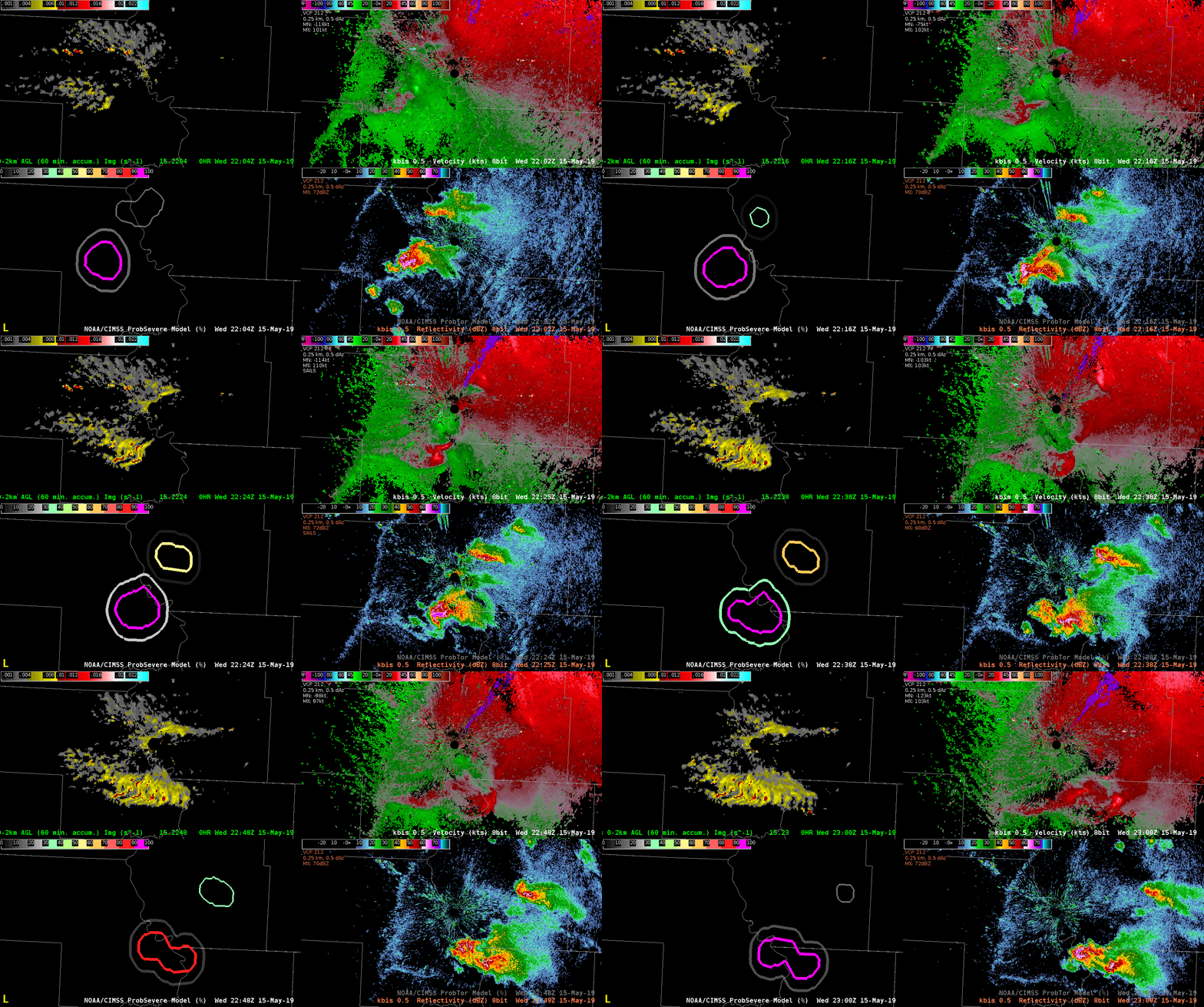
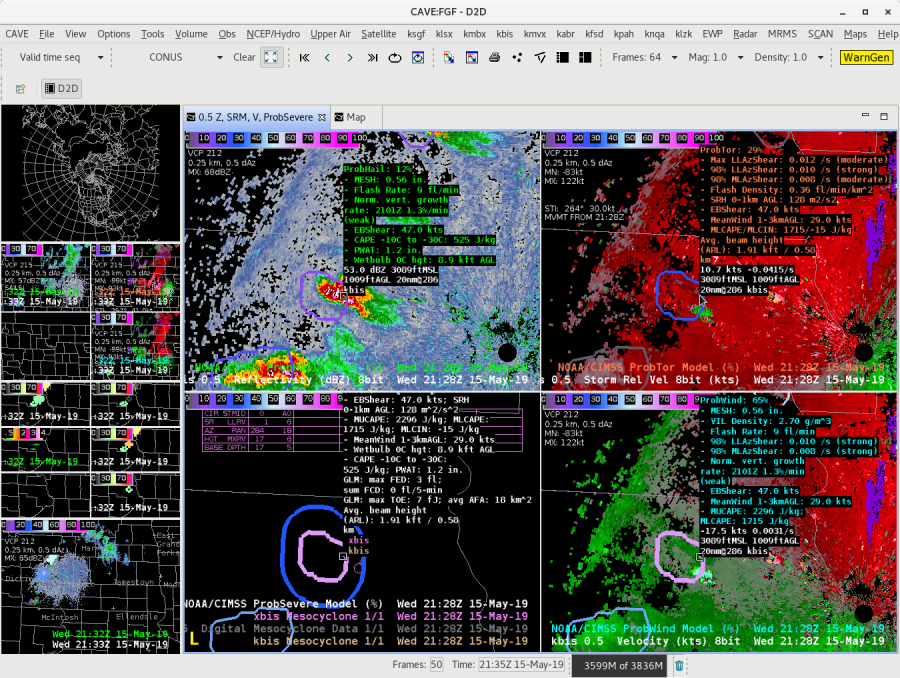
We continue to see significant issues with ProbTor that seems directly related to inflated Low Level AzShear values. This is likely due to an outflow boundary that is extremely well sampled by the KBIS radar. As this outflow boundary races ahead of convection, the actual tornado threat, which was never high to begin with, continues to drop even more.
ProbTor, on the other hand, places a tremendous amount of weight on LL AzShear, resulting in a persistently high ProbTor values.
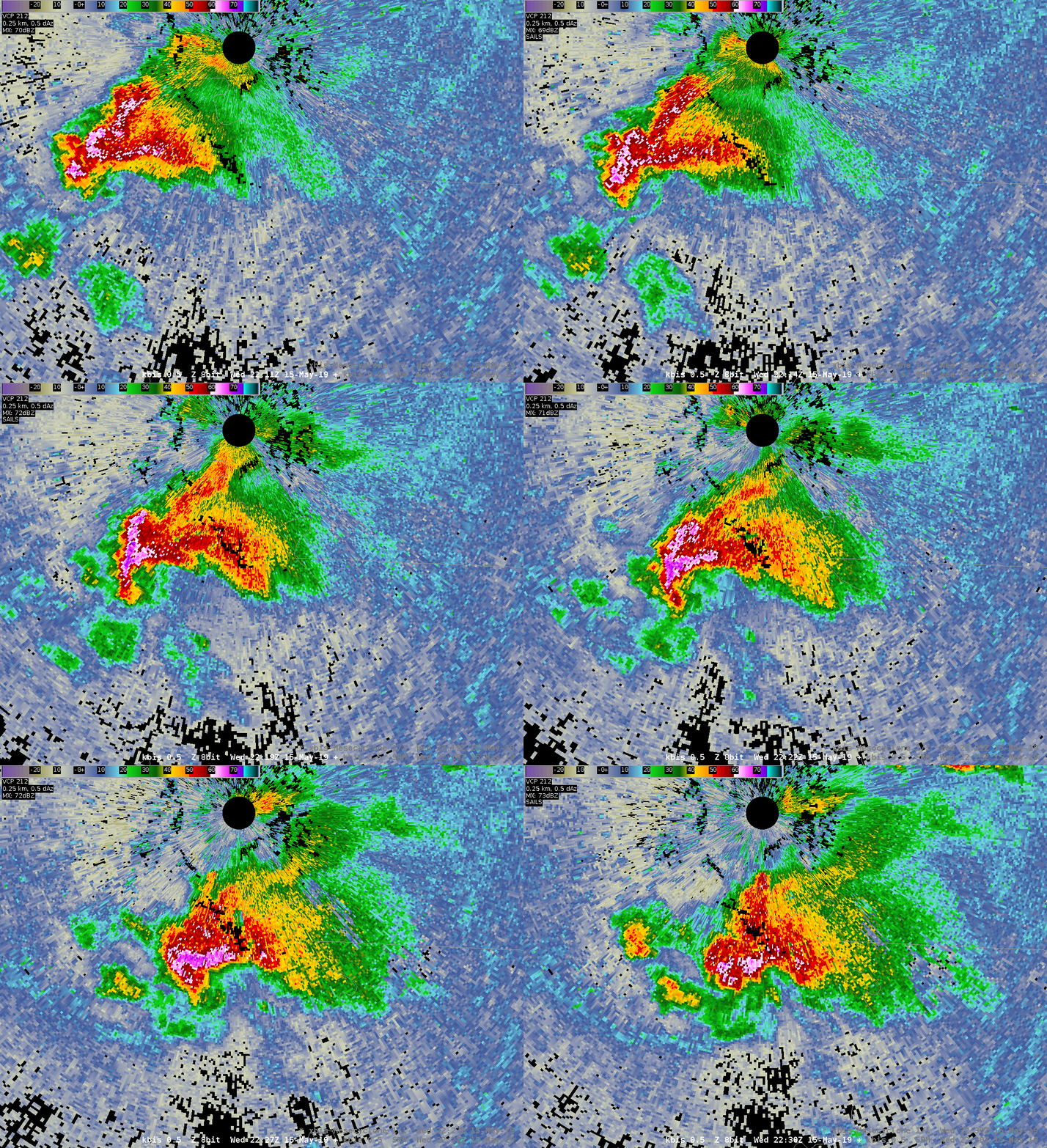
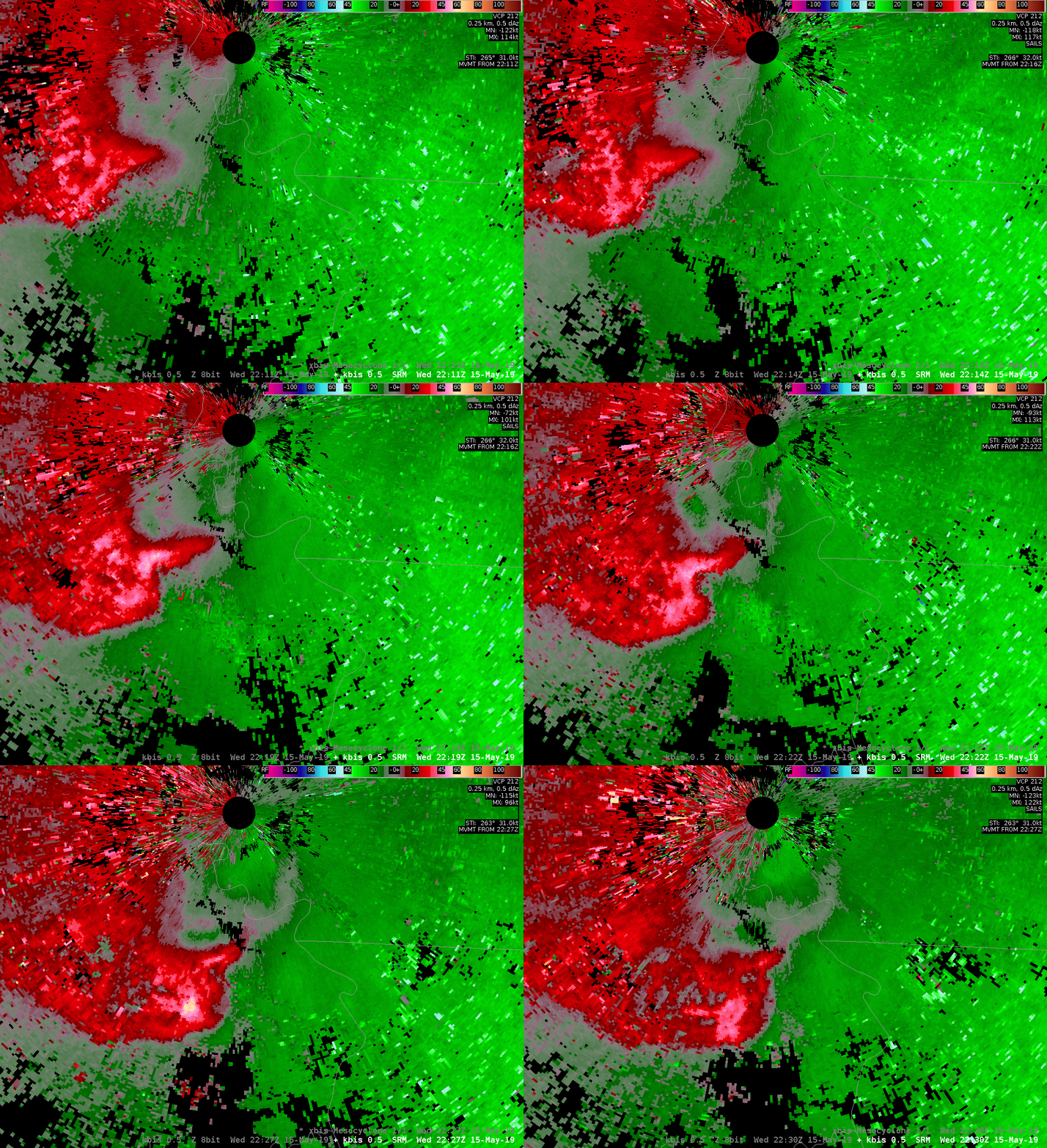
It was clear from the hail core aloft that this was severe. However, it was obvious around 2152Z that the RFD gusted out as was seen on reflectivity initially, and then later on the velocity images as the winds became less perpendicular to the beam. However, ProbTor continued to carry high probabilities, and even increased when it was clear on the velocity images there was no tornado threat. ProbTor was only keying on the outflow boundary. MRMS Rotation Tracks were also showing a swath of higher values along the outflow boundary.
Upper left: Orange ProbSevere with a green ring signifying escalated ProbTor
Bottom right: Low Level Rotation tracks with green ProbTor Object associated with the green ring at upper left.
Lower Left: KBIS base velocity.
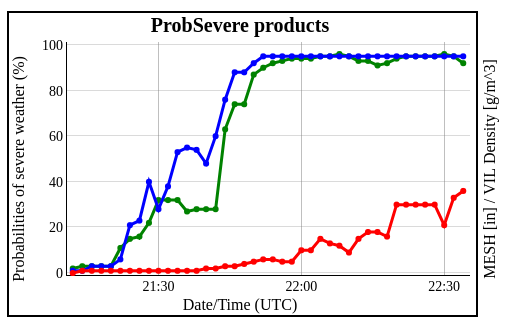
Key things to notice above – a spurious looking inbound maximum to the northwest of KBIS and a corresponding uptick in Low Level Rotation tracks in response to this shear zone that likely is just an artifact of sampling near the ground. Below, we see ProbTor climbing to over 40% (red trace). Be careful with ProbTor when the storm is close to a radar.
Suggestion: Instead of 0-2km, perhaps Low Level Rotation Track should be capped at the estimated LCL AGL.
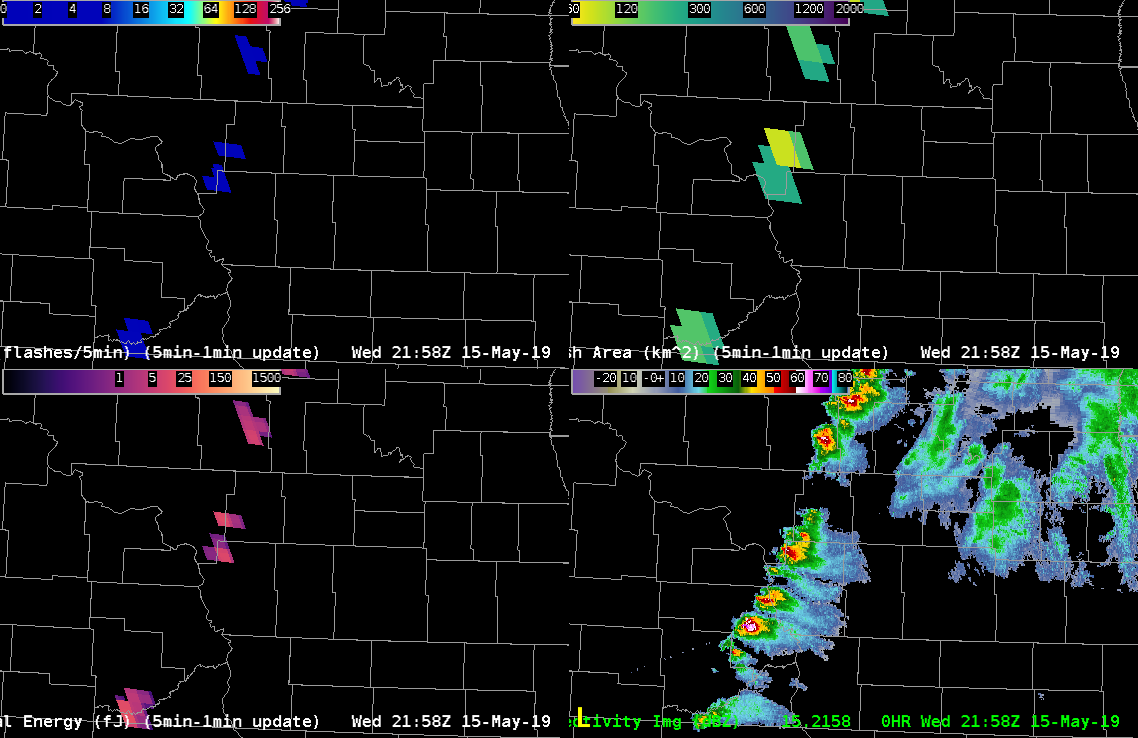
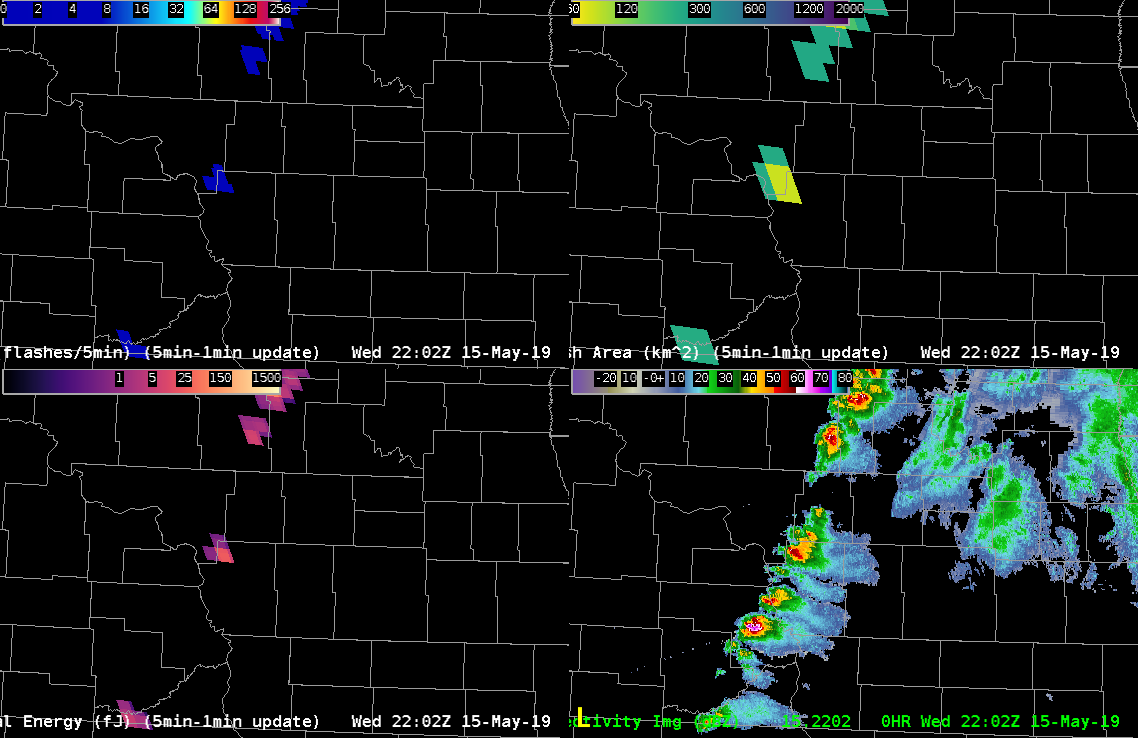
ProbSevere gives every indication of a severe storm over Morton County, ND (see ProbSevere read out below). The Earth Networks lightning suggests there of 52 fl/min but GLM FED gives 0 fl, TOE 0 fJ, and AFA 0 km^2. The two depictions below show those three GLM fields with the MRMS 1 km reflectivity. Perhaps there is an issue with viewing angle at this northern latitude. – Jonathan Wynn Smith (ESSIC/UMD)
ProbHail: 93%; ProbWind: 95%; ProbTor: 5%
– MESH: 1.83 in.
– VIL Density: 3.20 g/m^3
– ENI Flash Rate: 52 fl/min
– ENI Flash Density (max in last 30 min): 0.89 fl/min/km^2
– Max LLAzShear: 0.007 /s
– 98% LLAzShear: 0.006 /s
– 98% MLAzShear: 0.008 /s
– Norm. vert. growth rate: 2101Z 1.3%/min (weak)
– EBShear: 38.0 kts; SRH 0-1km AGL: 155 m^2/s^2
– MUCAPE: 2925 J/kg; MLCAPE: 1657 J/kg; MLCIN: -36 J/kg
– MeanWind 1-3kmAGL: 26.4 kts
– Wetbulb 0C hgt: 9.0 kft AGL
– CAPE -10C to -30C: 546 J/kg; PWAT: 1.3 in.
GLM: max FED: 0 fl; sum FCD: 0 fl/5-min
GLM: max TOE: 0 fJ; avg AFA: 0 km^2
Avg. beam height (ARL): 1.28 kft / 0.39 km Object ID: 273531
PS: 98
GLM Flash Extent Density product seems to have poor detection from both GOES 16/17 in the high plains. Perhaps this is related to the greater viewing angle due to latitude and being farther on the periphery. In this example, a very strong supercell was noted to have high total flash density values on ENTLN, while the GLM FED was very unimpressive. It was picking up on some flashes, but not enough to help the storm stand out from a lightning perspective. This could have negative impact on warning forecasters trying to use FED to identify stronger cells from a situational awareness perspective.
I initially loaded a 4-panel with 0.5 Reflectivity and ProbHail overlaid, 0.5 SRM and ProbTor overlaid, and 0.5 Vel and ProbWind overlaid, but I had not loaded the full ProbSevere Model in any of the 4 panels. I then noticed that there was a 29% ProbTor (which was erroneous with bad dealiasing), but my attention wasn’t called to it because the 2nd circle around the storm only appears on the full ProbSevere. It would seem like a good idea to either always have the full ProbSevere displayed or if folks prefer to load the threats separately, perhaps need to add a second circle around the ProbTor object.
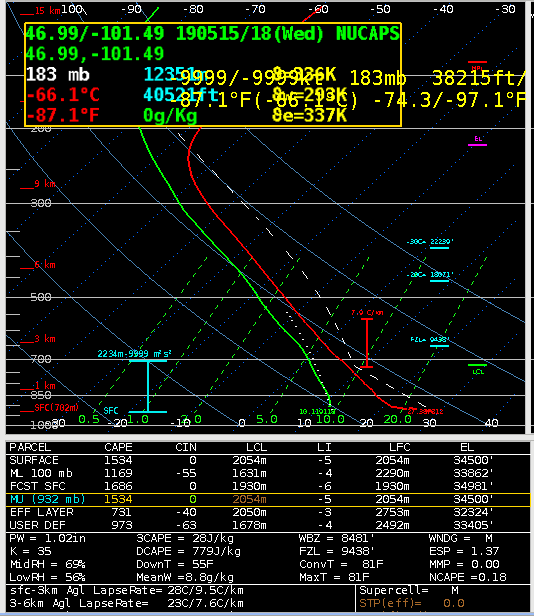
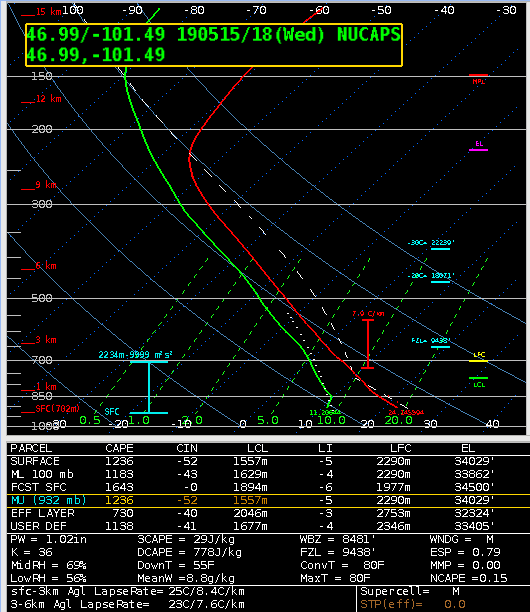
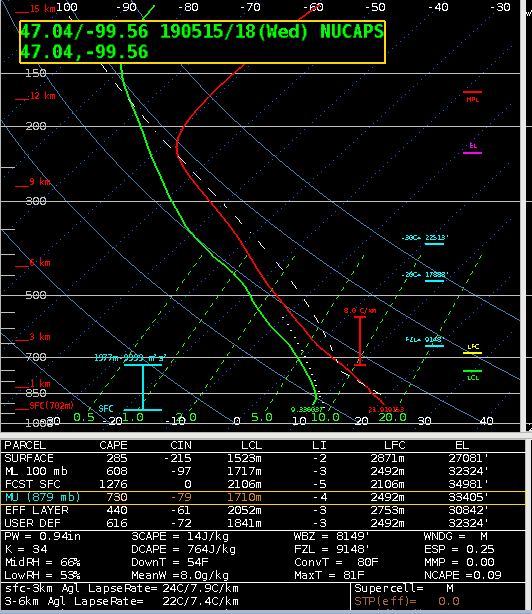
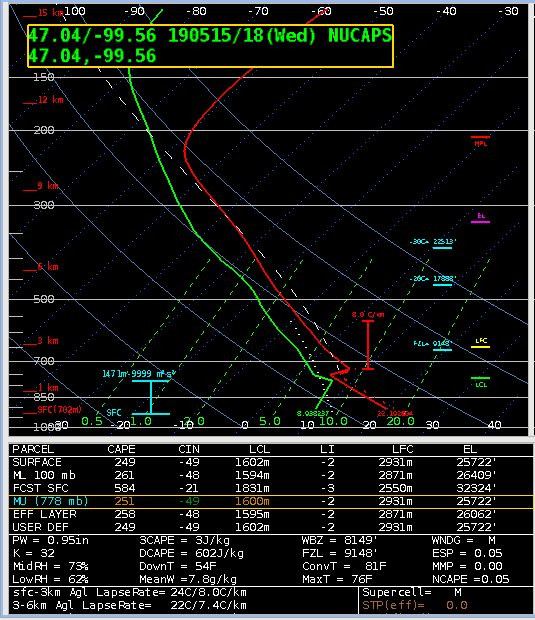
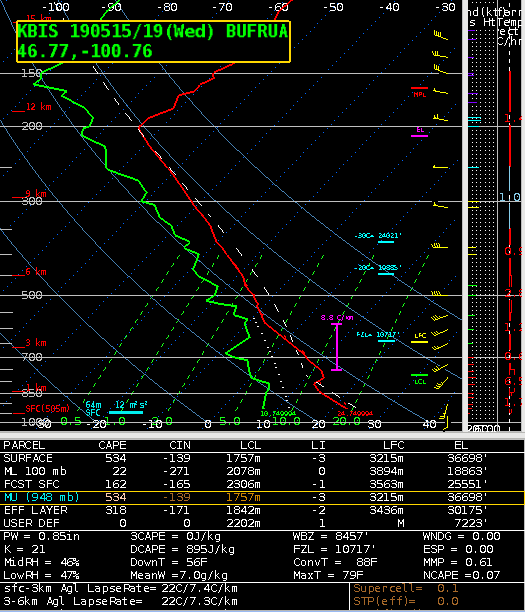
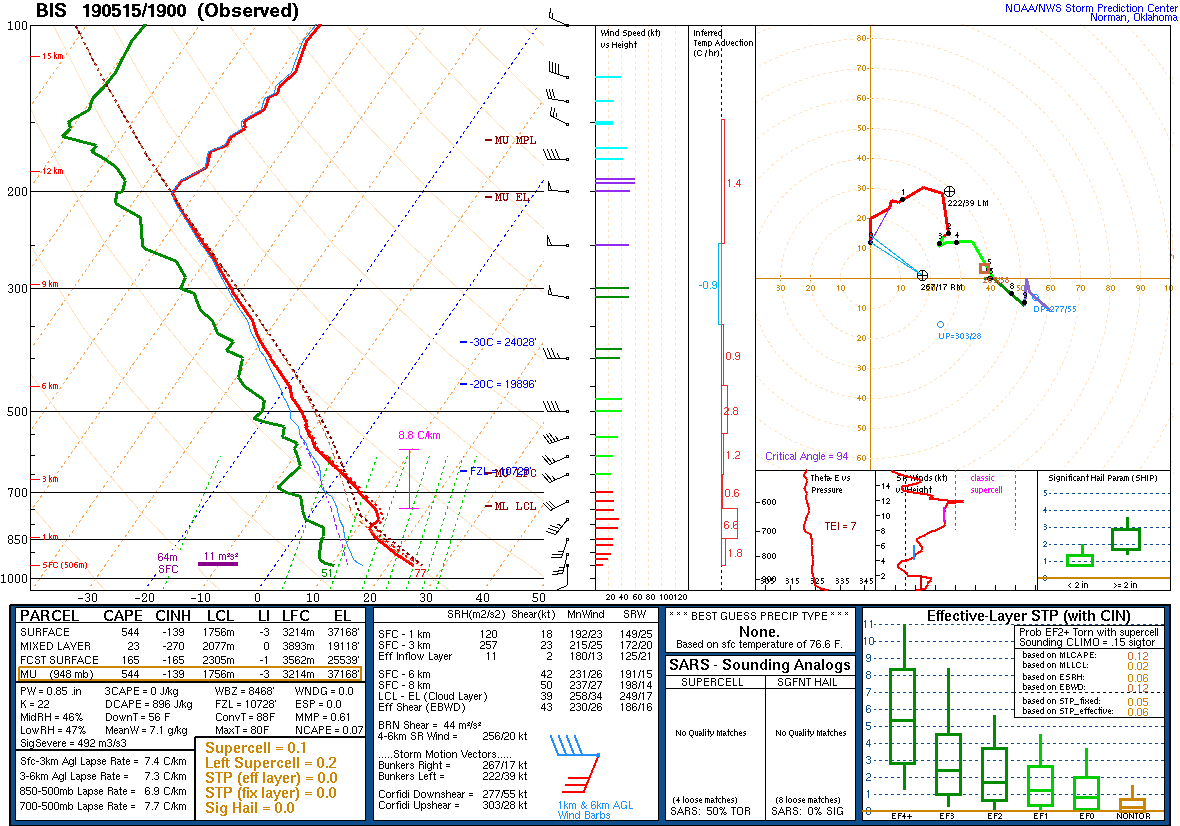
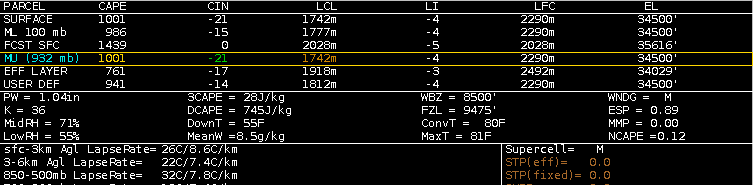
Compared KBIS observed 19z Skew-T to NUCAPS 20z Skew-T
Key points:
Lapse rate differences: Between 1-1.5C/km difference through all levels
SFC and MU CAPE was 500J/kg higher on the NUCAPS
Vertical profile is markedly different and is a much more saturated on the observed Skew-T
To further confuse matters the NUCAPS forecasted SFC CAPE values for the same location and time is 400J/kg…which is closer to the observed sounding than to the NUCAPS sounding.
Looking north of the ND/MT state up in Canada. Green (Red) is Event Density from GOES-16 (GOES-17) and yellow is ENTLN cloud to ground strikes. Remarkably good agreement in position, although the data smearing is evident and parallax isn’t much of an issue (yet?) given the shallow convection.
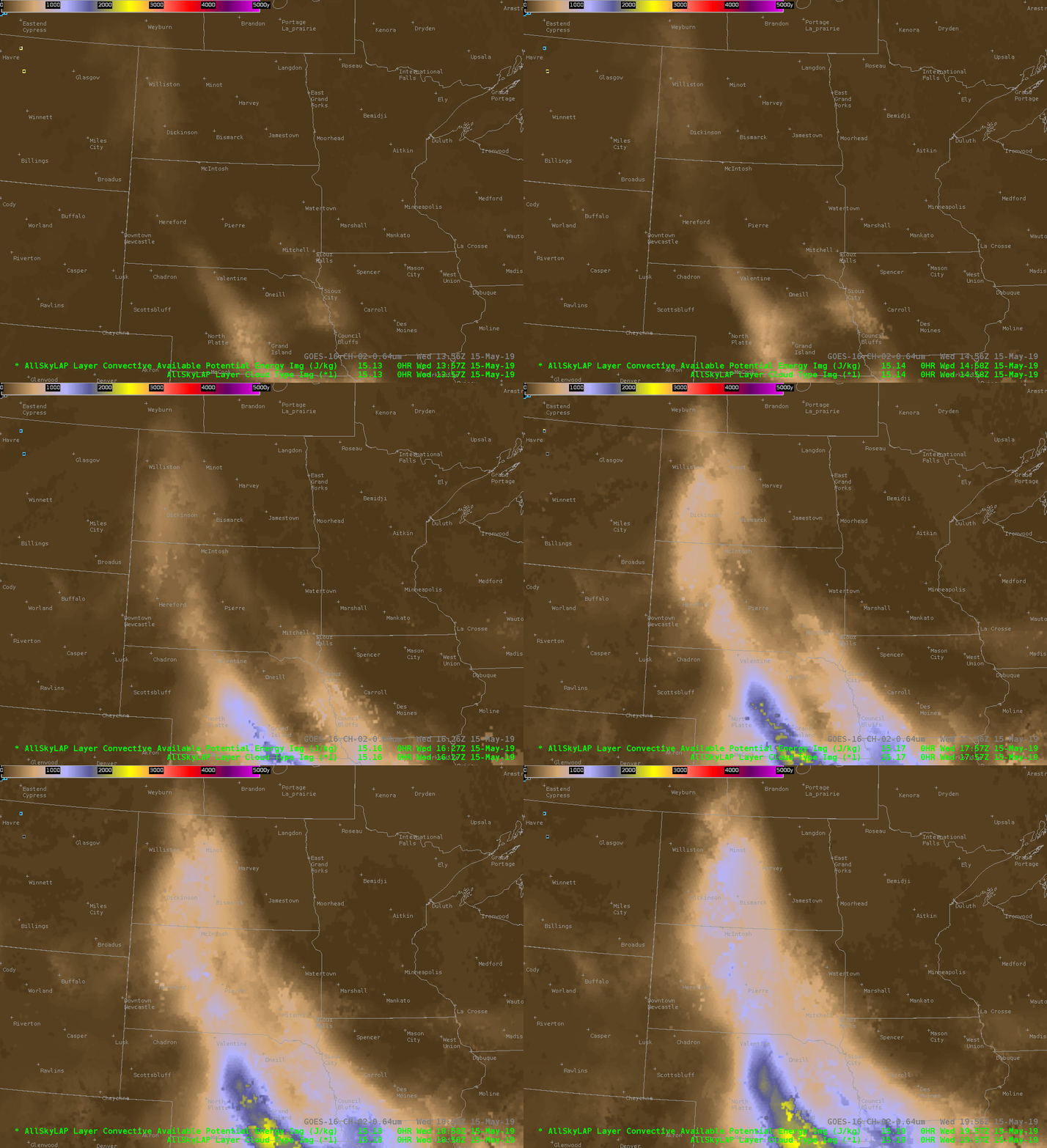
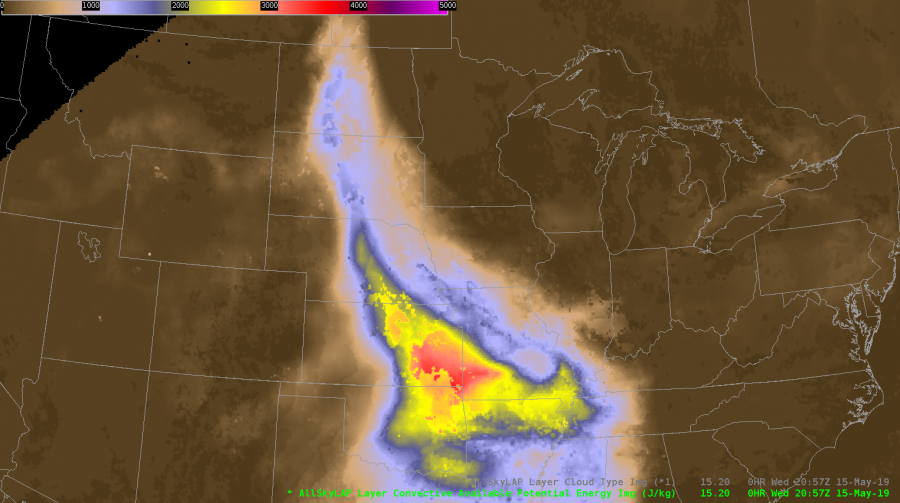
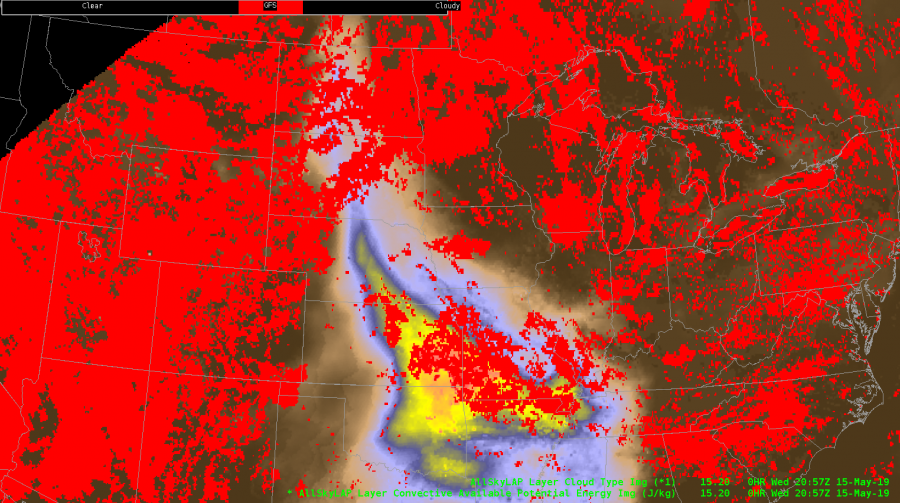
The 12Z Bismarck sounding was quite dry and and the surface observation at Bismarck was around 32F. Low level moisture has quickly rebounded this afternoon across central and western ND, however it remains dry across eastern ND. Dewpoints have come up into the upper 40s to near 50F and temperatures have climbed into the upper 70s. The AllSkyLAP CAPE loop clearly shows that instability is increasing across portions of ND with values topping out around 900 J/KG at 1930z, though most of the retrievals are GFS based because of cloud cover lingering in the area.
AllSkyLAP CAPE Loop
I decided to look at the NUCAPS soundings across the area to see if the CAPE values were similar. What I found was in the areas of low level moisture, the NUCAPS modified and unmodified sounding had similar MLCAPE values. However, as I checked NUCAPS soundings further east into the drier air, the un-modified soundings showed MLCAPE values that were far to high (should be near zero based on other observations), but the modified soundings were pretty spot on regarding the surface observations (especially Td, T may be slightly low), and thus MLCAPE values appeared to be more reasonable.
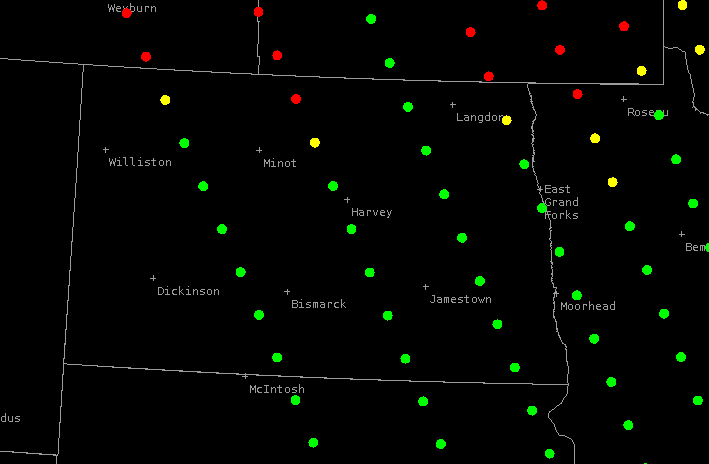
NUCAPS Swath. Soundings in quesiton are located just northwest of Bismarck, just northeast of Bismarck, and 2 dots east of Bismarck.
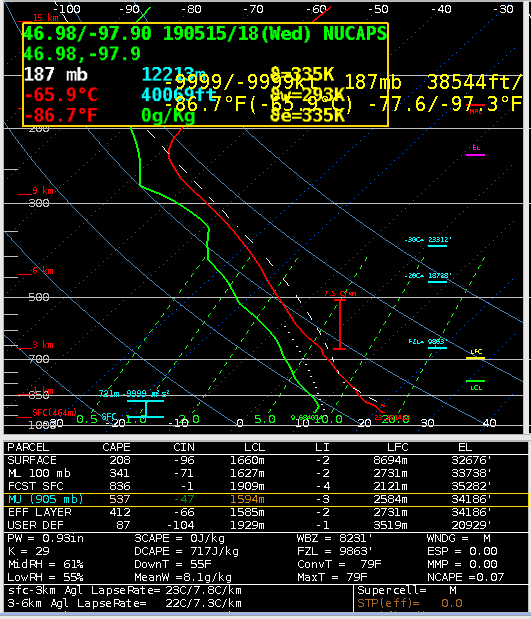
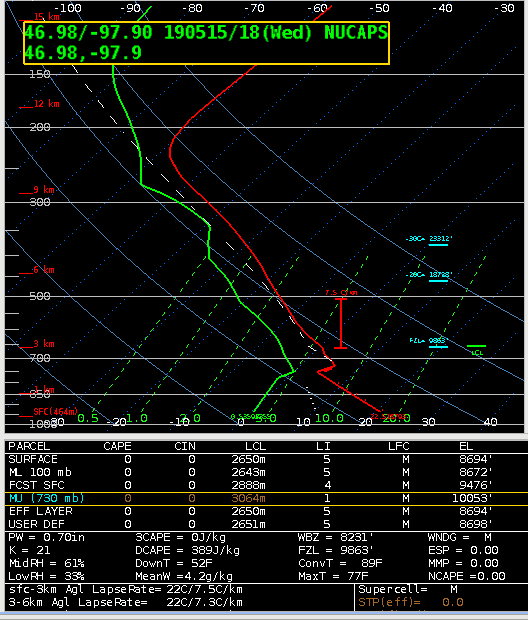
The next six images are the comparisons between the non-modified and modified NUCAPS soundings at three different locations. The first is near the peak in instability northwest of Bismarck, the second is east-northeast of Bismarck near the gradient, and the third is farther east into the drier air.
NOAA 20 Non-Modified NUCAPS Sounding just northwest of BismarckNOAA 20 RTMA Modified NUCAPS Sounding just northwest of Bismarck
NOAA 20 Non-Modified NUCAPS Sounding just ENE of Bismarck.NOAA 20 RTMA Modified NUCAPS Sounding just ENE of Bismarck.
NOAA 20 Non-Modified NUCAPS Sounding 2 Dots East of Bismarck.NOAA 20 RTMA Modified NUCAPS Sounding 2 Dots East of Bismarck.
With that said, the modified soundings seemed to do a decent job capturing the gradient in CAPE. The values appear to be a bit high compared to the AllSkyLAP CAPE (1183 vs 750 J/KG around the same time), and high also compared to the SPC Meso Analysis Page (around 500 J/KG).
Quick update…..
The Bismarck office fortunately did a 19Z sounding, which showed very weak MLCAPE, only 22 J/KG! So both the AllSkyLAP CAPE and the NUCAPS were overdone.






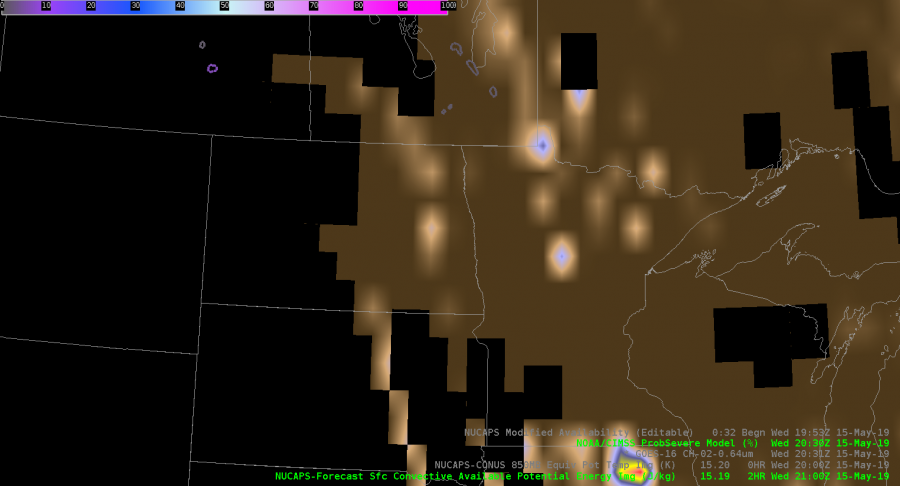 To further confuse matters the NUCAPS forecasted SFC CAPE values for the same location and time is 400J/kg…which is closer to the observed sounding than to the NUCAPS sounding.