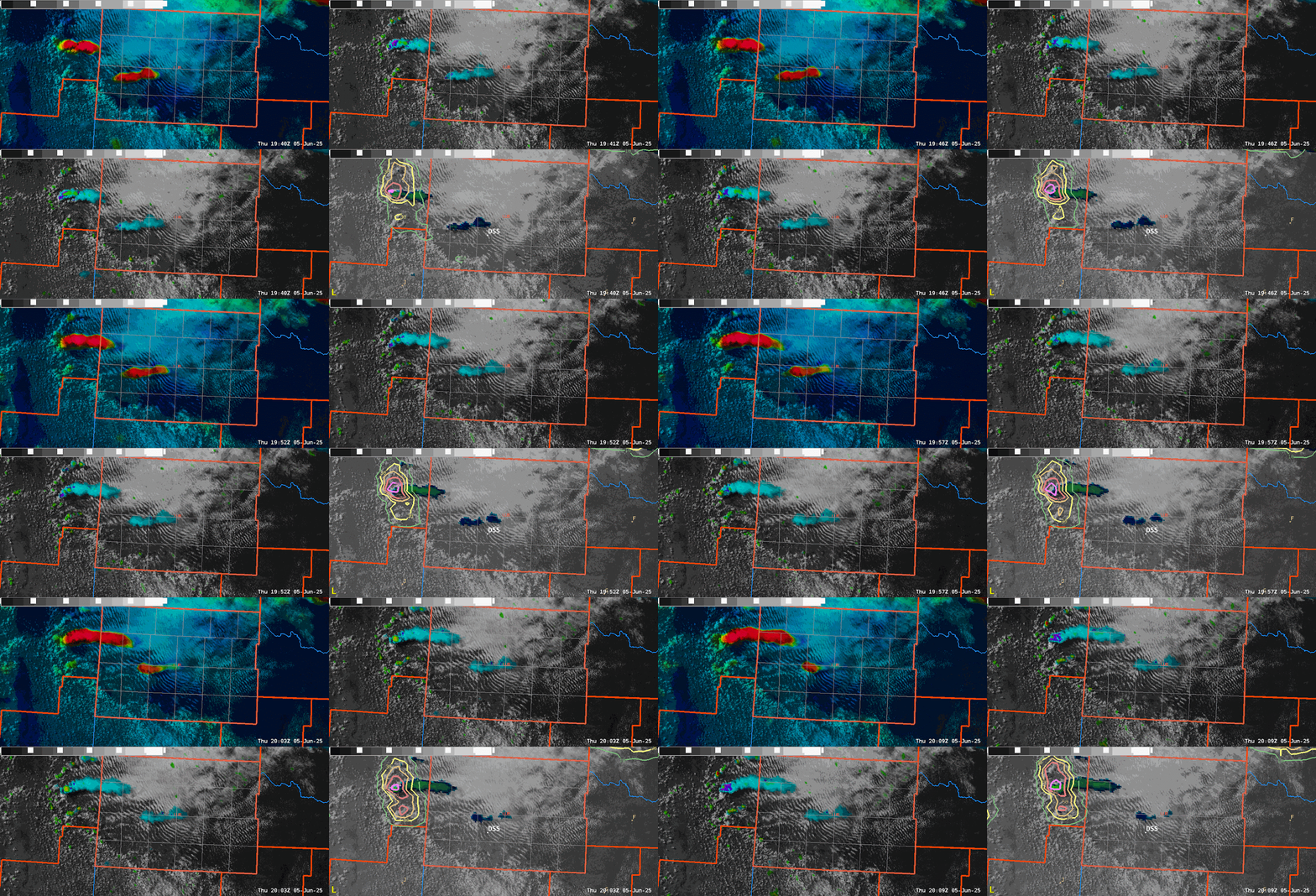
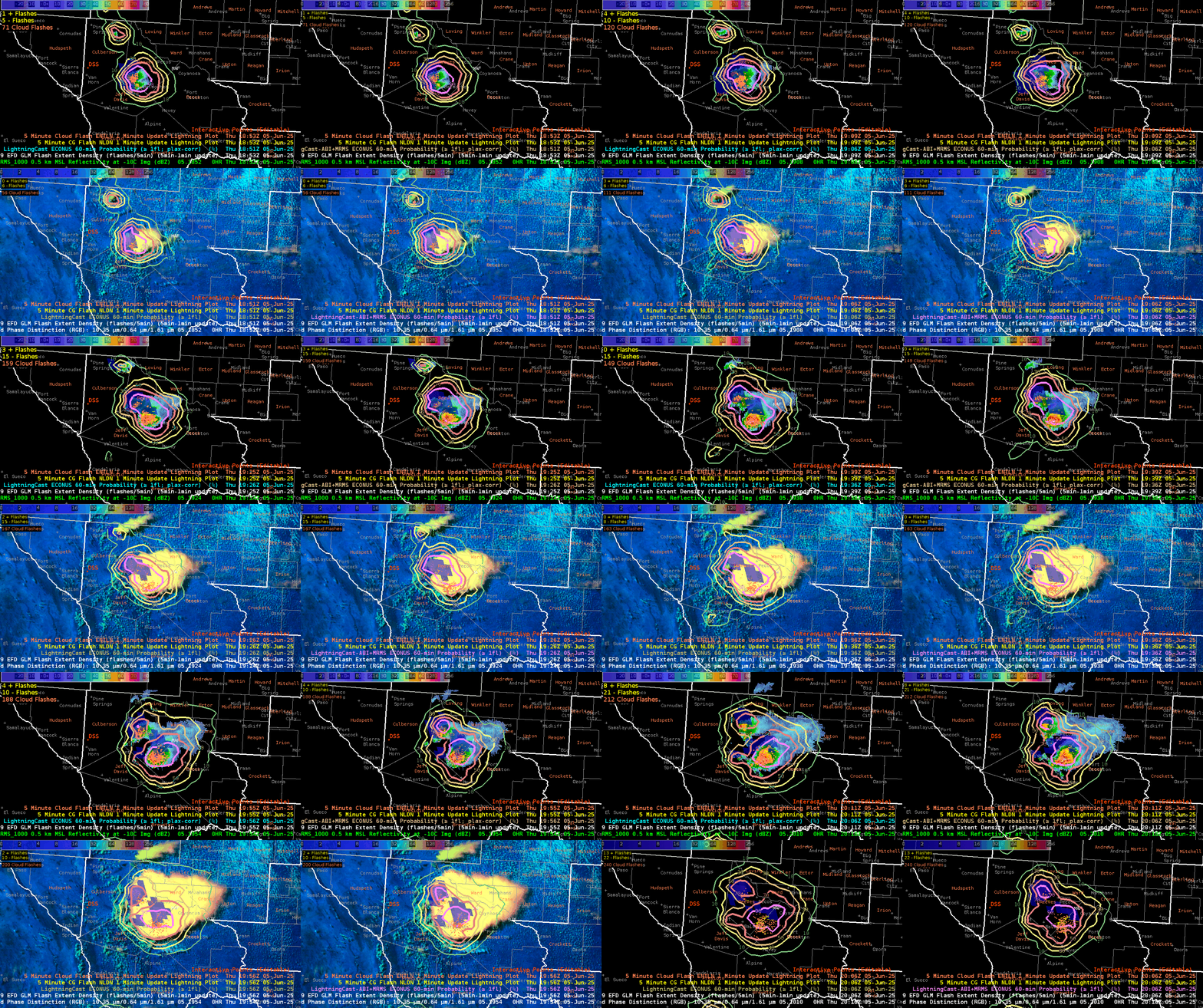
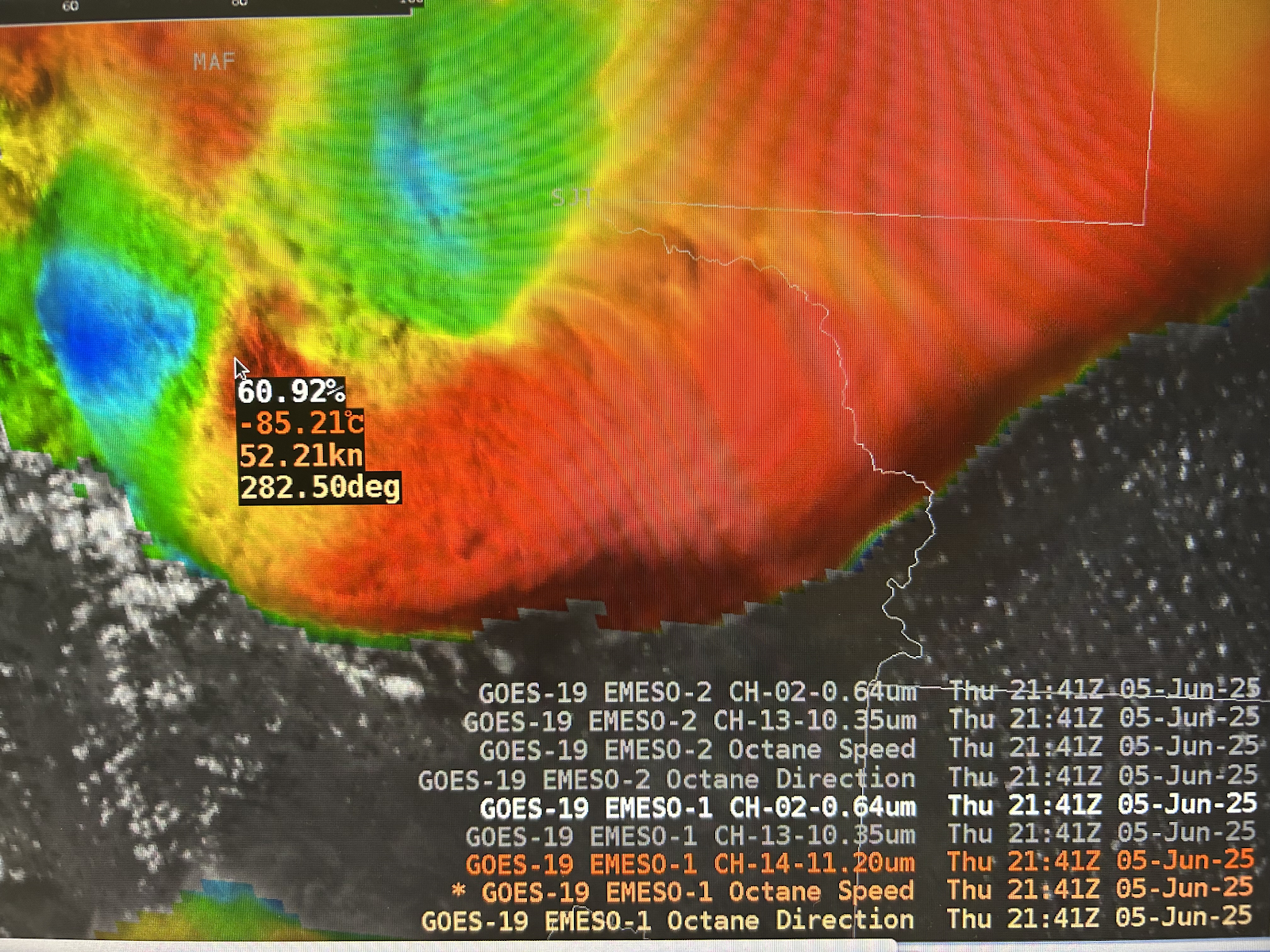
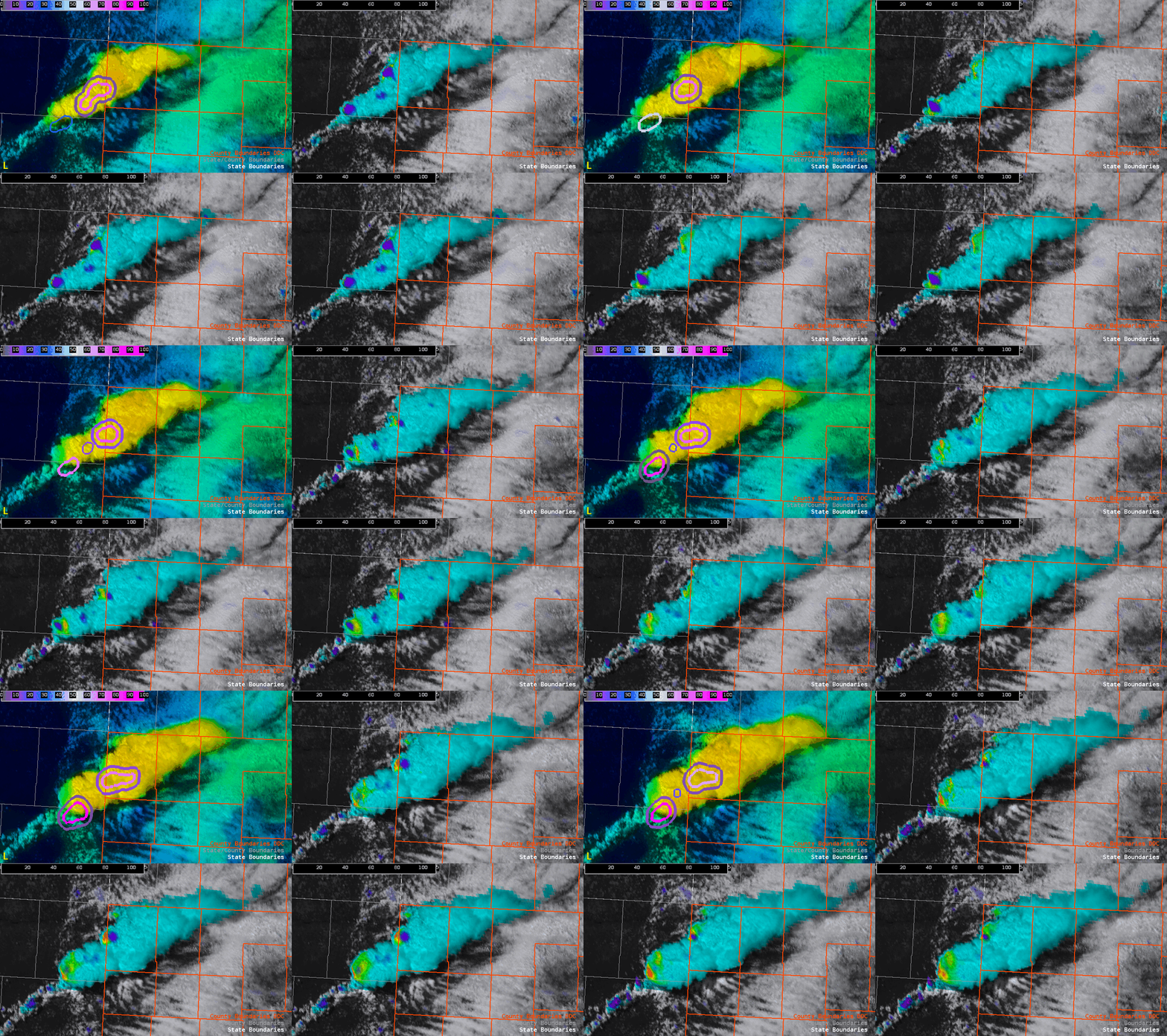
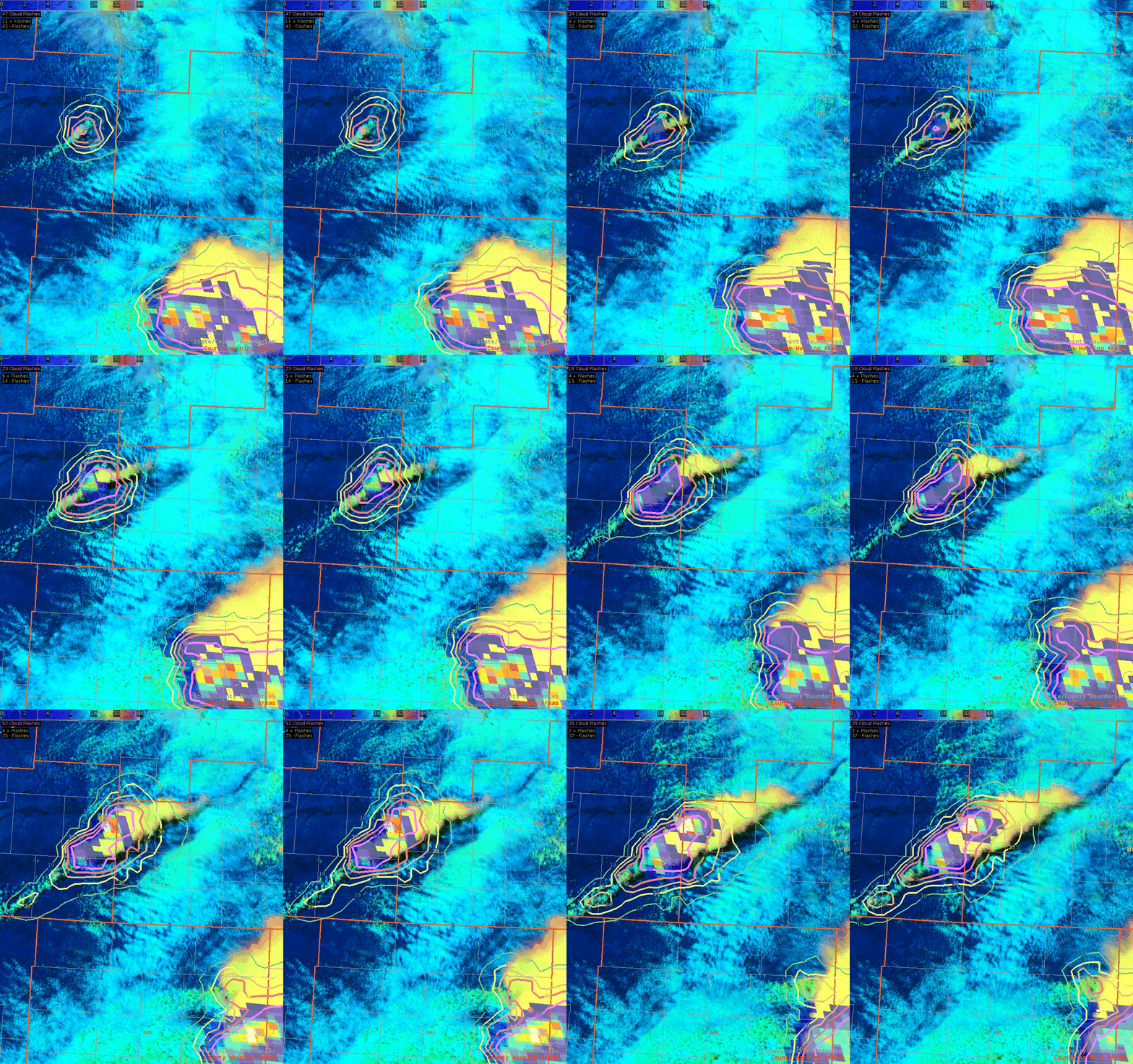
LightningCast: Version 1 vs Version 2

Throughout the day, there were a few instances of latency issues between version 1 and version 2. It was usually no more than a 30 second delay, but the right panel with version 2 of LightningCast often failed to load in AWIPS for a few moments despite there being no differences in the temporal resolution of each field. Example below of version 1 coming in faster than version 2. This delay was about 20 seconds.

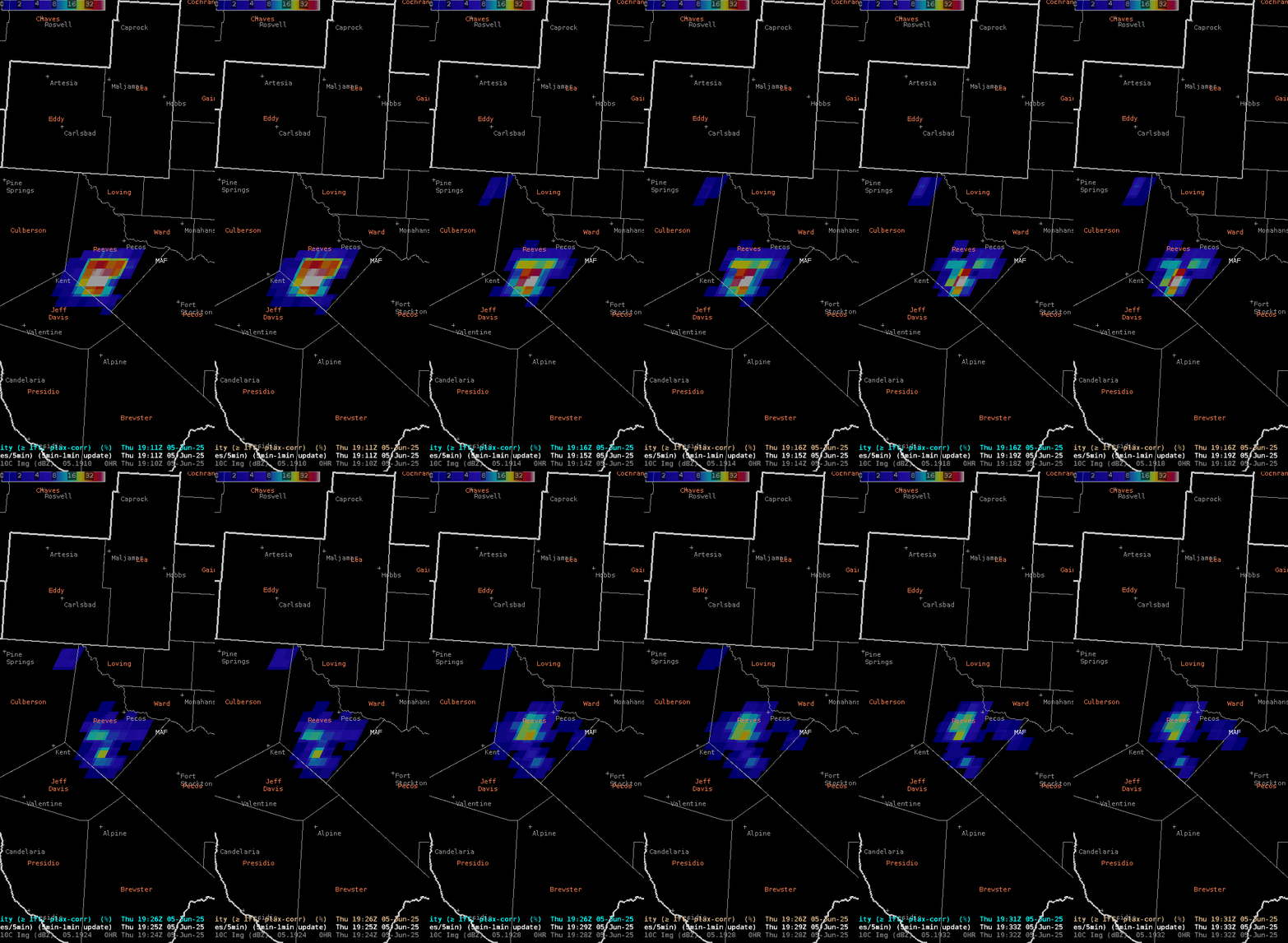
Though versions 1 and 2 of LightningCast perform generally similarly, I did notice a few times where version 2 captured the initiation of new convection better than version 1, such as the offshore cells popping up in these screenshots from 19:21 and 19:31Z.

19:21Z

19:31Z

– millibar

Tags: None

Using LightningCast and MesoAnywhere for Alligator Wrestling

Since we are relatively limited with the products we can use today as the meso sector doesn’t fully extend down into JAX’s area, I will be mainly using LightningCast and MesoAnywhere today. We are able to use the CONUS sector for GREMLIN, though I’m not too sure how useful it will be today with good radar coverage via KJAX. However, there are some more storms moving in from TAE’s area and with KVAX out for the day, it could prove useful.

There is already some discrepancies with the event so far with LightningCast V2 being slightly more bullish with the threat at the Alligator Wrestling event this afternoon as shown below in Figure 1.

Figure 1: LightningCast V1 (left panel) compared to V2 (right panel).

The LightningCast dashboard also shows this discrepancy (Figure 2) with a notable spike in probabilities from V1 followed by a significant decrease and a pretty gradual increase for V2.

Figure 2: LightningCast dashboard comparing V1 (warmer colored lines) and V2 (green line) over time at the event.

Additionally, MesoAnywhere has proven useful since we do not have a meso sector today. I found that it has been pretty good identifying more dominant storms in decaying clusters with pretty good lead time compared to using 5min imagery. Pretty obvious that this would be useful, but I see it as a pretty great tool as a former Florida WFO meteorologist. A lot can happen in 5 minutes and I see this being quite useful for summertime pulse convection.

As of 4:10PM ET, Lightningcast V2 continues to remain more bullish than V1. Figure 3 shows the contours in AWIPS and Figure 4 shows the dashboard. Both versions appear to be on a steady incline, though V2 is noticeably higher.

Figure 3: AWIPS LightningCast with V1 on the left and V2 on the right. The 30% contour is noticeably further south toward the Gator Wrestling Match and also has higher probabilities off the coast of St. Johns county.

Figure 4: LightningCast dashboard showing the probabilities across each version. As of typing this, both have begun to even out.

However, it does appear that V1 did a better job at picking up on the lightning threat for a storm over in TAE’s area covering Berrien and Lanier counties in GA. In Figure 5 below, both versions had a 90% contour over the developing storm with lightning following not too long after.

Figure 5: LightningCast V1 and V2 indicating the threat of lightning for a storm over Lanier and Berrien counties in GA.

In Figure 6, LightningCast shows the threat decreasing accordingly with time as the storm begins to ingest some cooler air, likely outflow from the southern storms. This product appears to be quite good with initiation and I hope we get more cases like this over the next couple days.

Figure 6: The storm over Berrien/Lanier counties in GA showing less of a signal for lightning over the next 60 minutes as it weakens.

Regarding the Gator Wrestling, chances have decreased to zero over time. Both V1 and V2 remained on the lower end for probabilities and verified well with only one GLM strike within 10mi (Figure 7).

Figure 7: Not a whole lot going on at the Alligator Wrestling Match.

Tags: None

Convective Decay Using LightningCast

We found LightningCast to be very useful for the decay of pulse-severe type convection. While the probs jumping up were great for CI, the opposite is true for cessation. The loop below demonstrates LightningCast signifying the cluster of cells decaying as they move across the JAX CWA, while remaining in a generally low-end GLM FED and a near constant ice phase. In other words, the LightningCast was a little quicker to jump on weakening trends than satellite data. This would also be very useful for DSS where we can brief a partner with an outdoor event with a quantitative probability that lightning will be over at their point within 60 minutes.

-millibar

Tags: None

Warning Operations with Satellite Data Only

In the absence of radar data, satellite data can be utilized for warning decision-making by utilizing a suite of satellite-derived products.

GREMLIN (synthetic composite reflectivity) used in tandem with OCTANE can depict an area of strengthening convection that would be capable of producing hazardous weather.

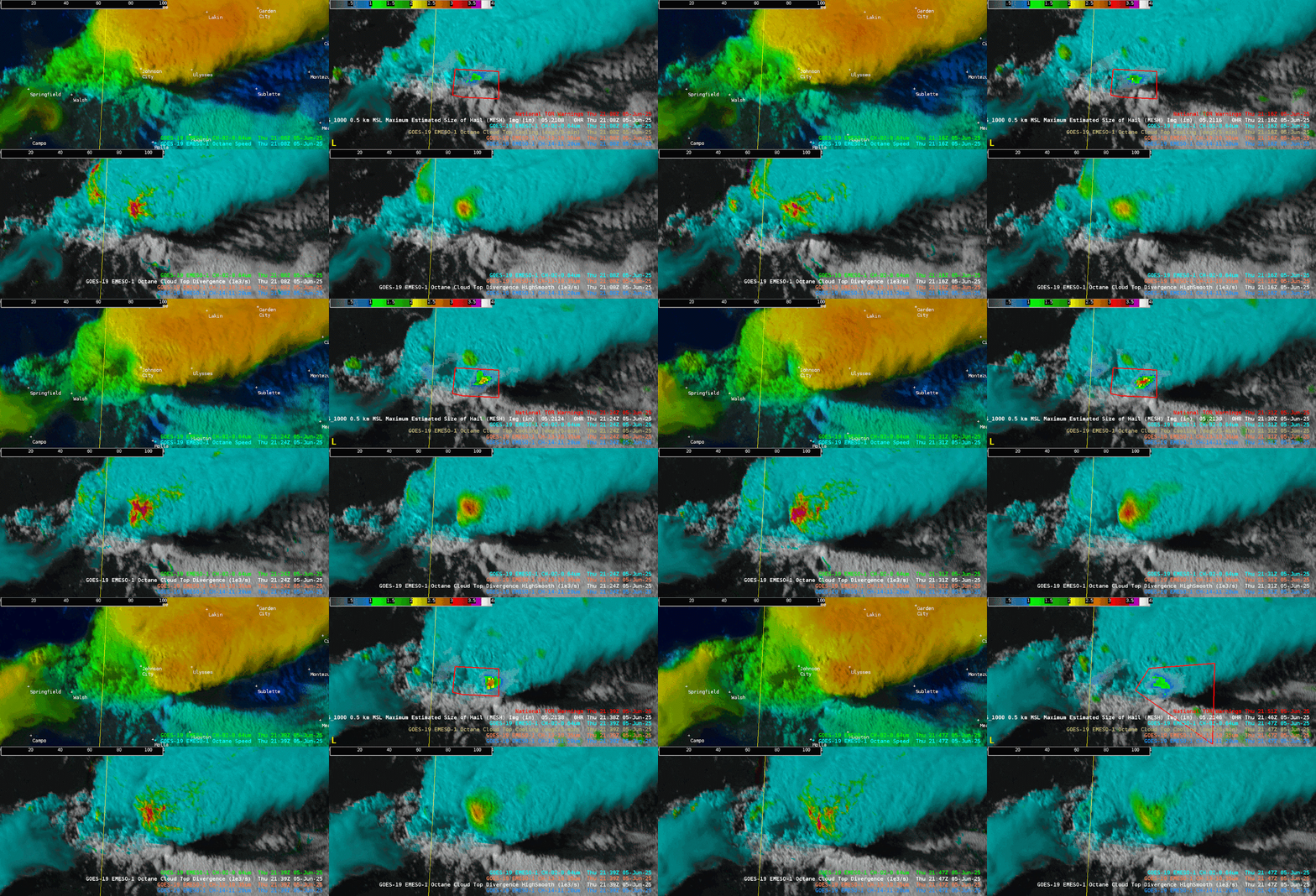
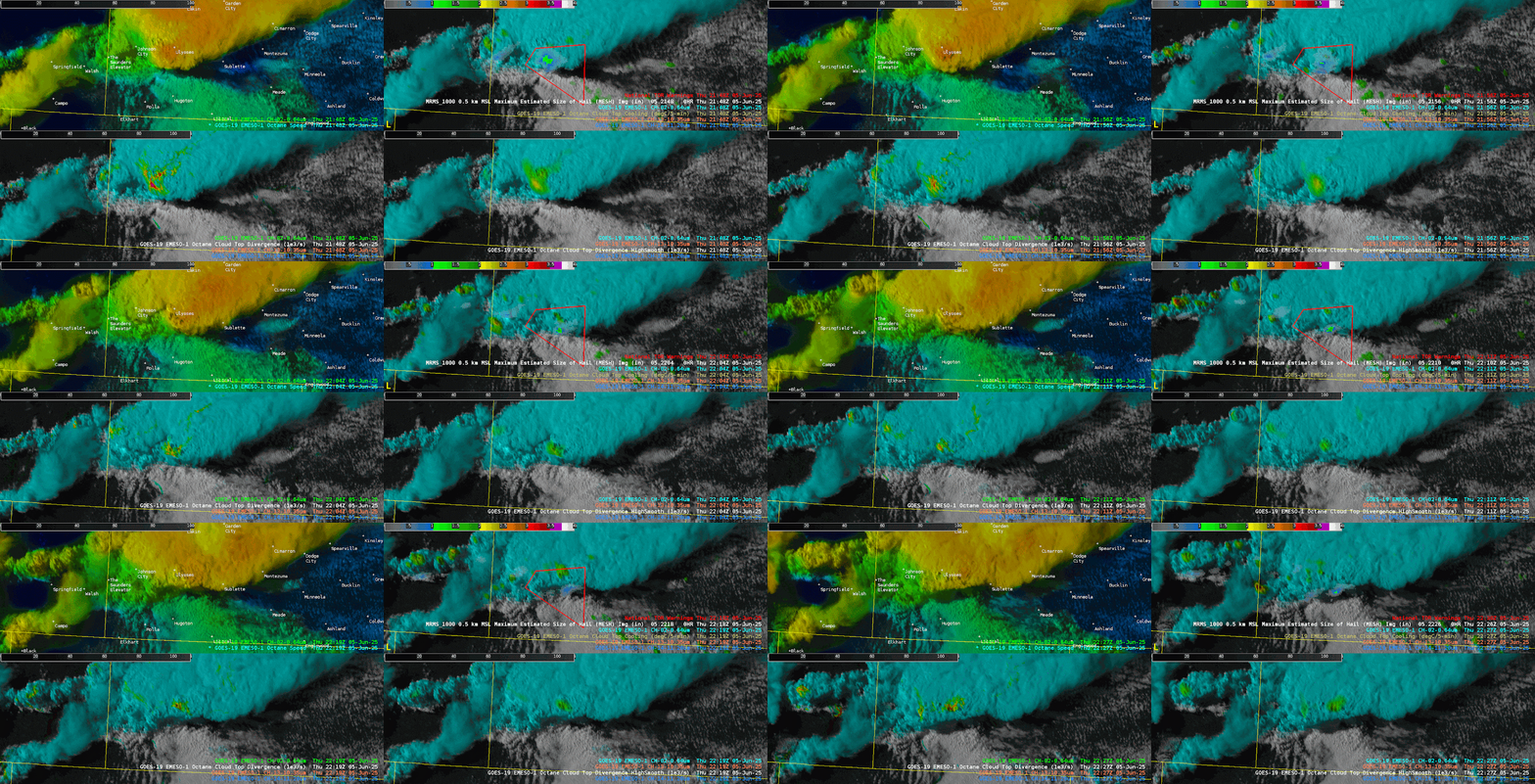
In the example shown below, OCTANE indicated strong cloud top divergence and GREMLIN showed increasing reflectivity, which resulted in increased confidence that convection is intensifying (as shown in this case). As a result, a special weather statement (SPS) was issued for a strong thunderstorm producing small hail and gusty winds. This storm would initially produce half inch to nickel hail.

Later on, cloud top divergence intensified further on the same thunderstorm:

Eventually, this storm would produce severe hail. This demonstrates the utility of monitoring satellite trends. If you have storm reports, you can use those trends to calibrate yourself on warning-decision making.

-Vrot

Tags: None

Day 3 – The Train Is On The Tracks OCTANE

I definitely felt more comfortable using OCTANE today and now that I understand it better, I was able to look at it compared to 10.3 imagery and I found that useful in differentiating which storms were still strengthening.

Jason showed us how to play around with the color tables for the OCTANE product and basically invert them so that the purples/pinks (cooler colors) represent cooler cloud tops, and the yellows/oranges/reds are the divergence. Conceptually I think this makes more sense to me putting cooler colors = cooling cloud tops.

GREMLIN

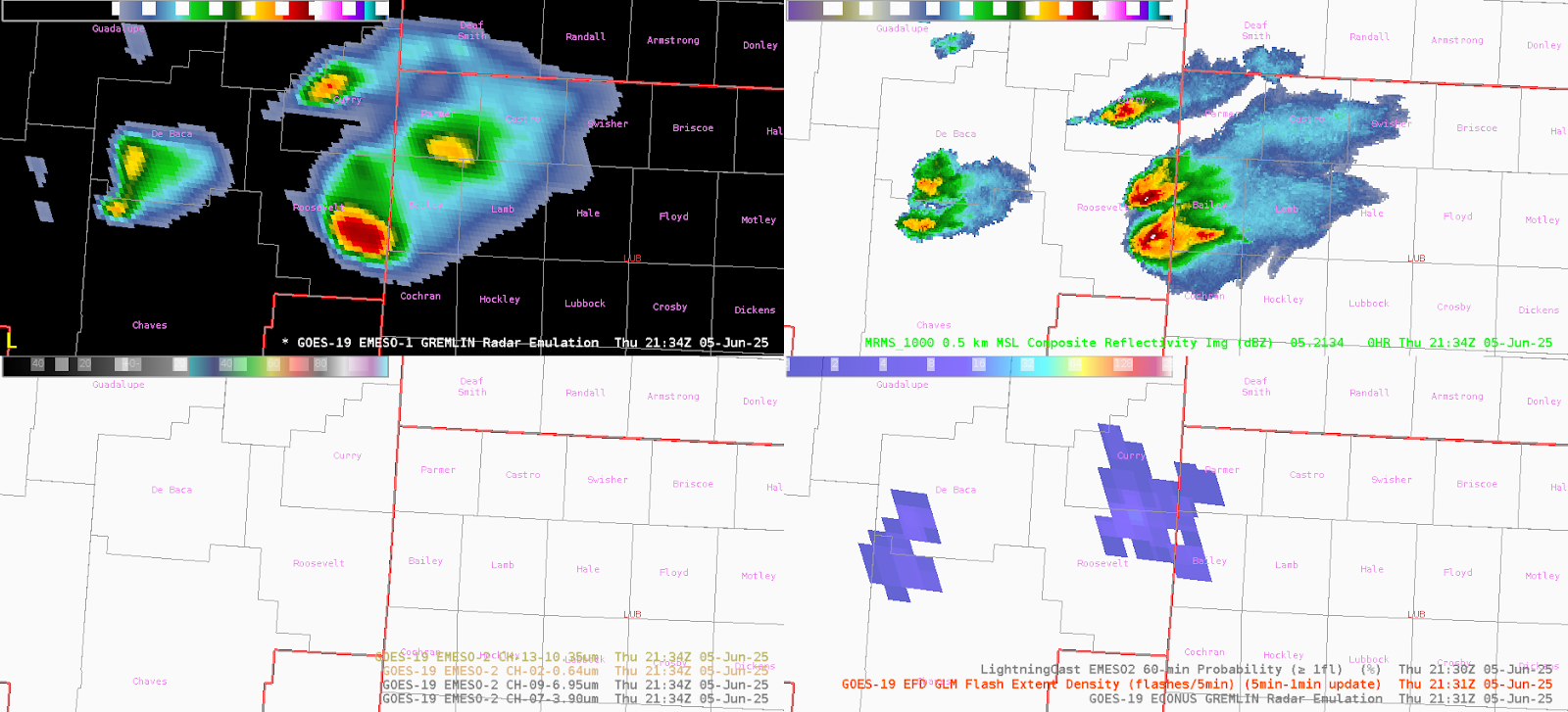
I feel like I saw very mixed results with GREMLIN with this event. There were times when the meso performed the best I’ve seen it all week (below)

…and then just two minutes later, not so much.

I’m not sure what attributed to the sudden drop off on what on radar appeared to be the strongest storm.

Later, GREMLIN seemed to be doing very well with the areas of more stratiform precip, which I don’t believe I’d gotten to see up until this point. Was curious if it typically does better in that type of environment.

LightningCast

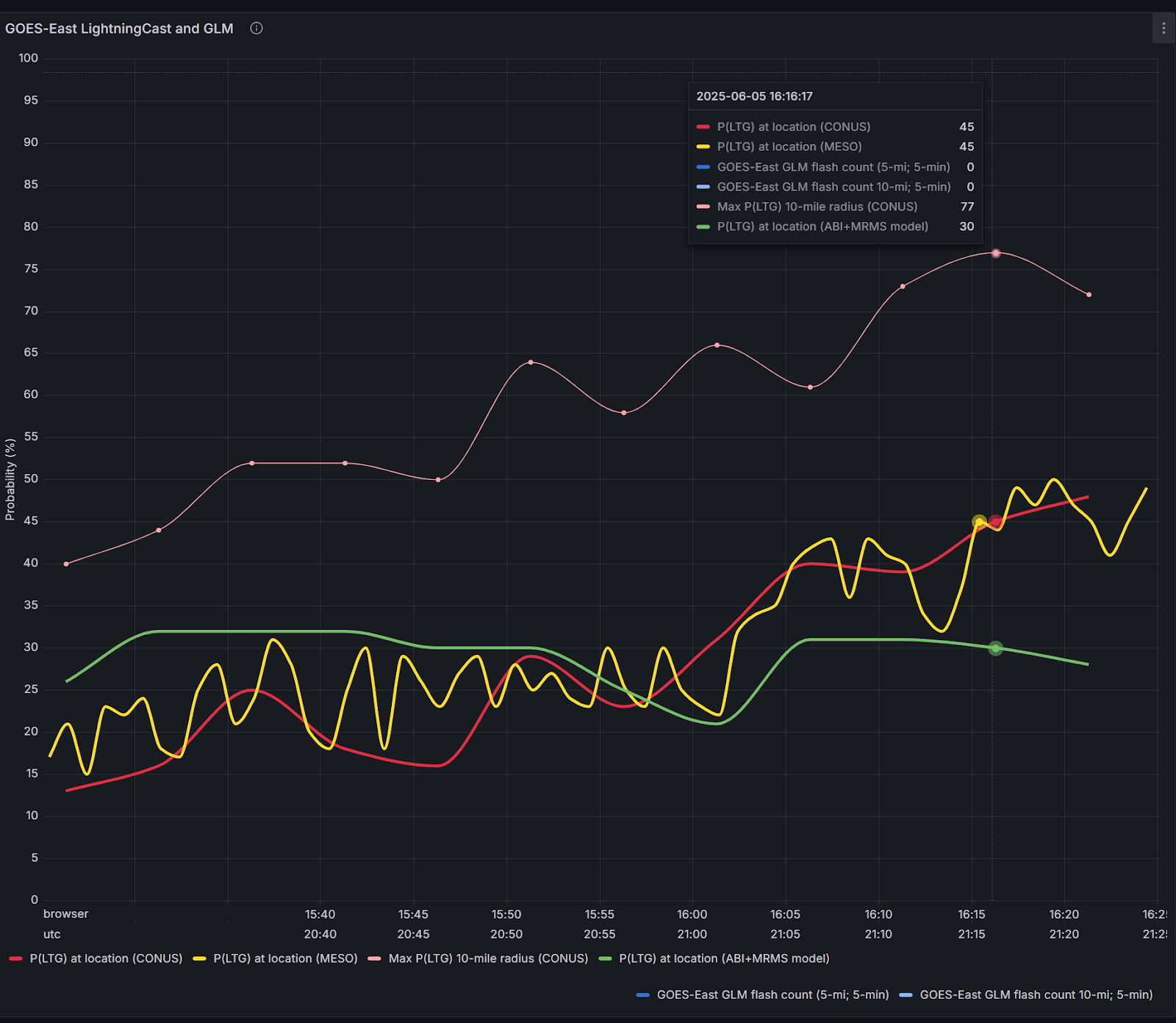
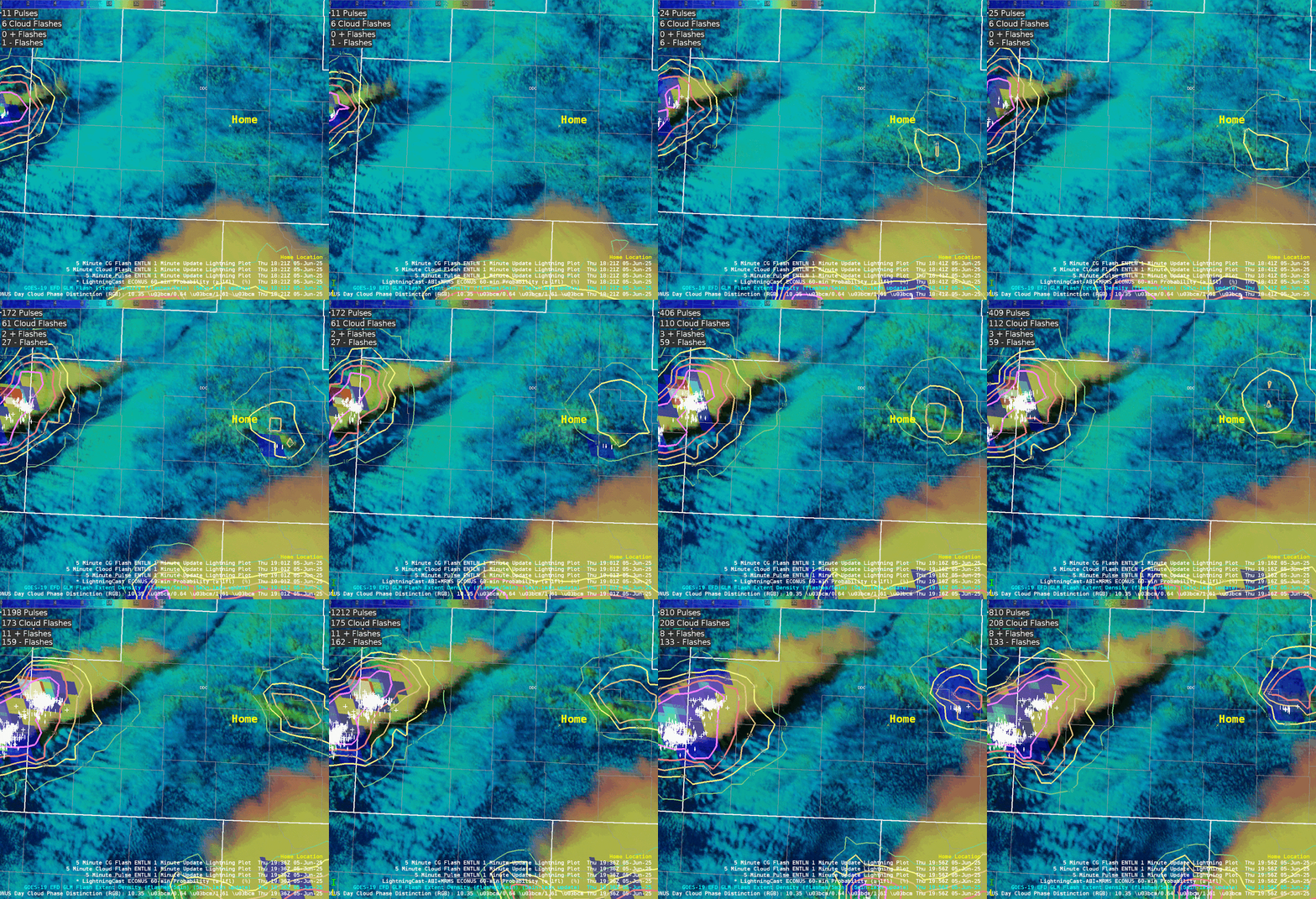
I wish I had grabbed more of the LightningCast plots since it was probably the product I was looking at the most since I was doing the DSS messages, but the plot below was the only one I did grab.

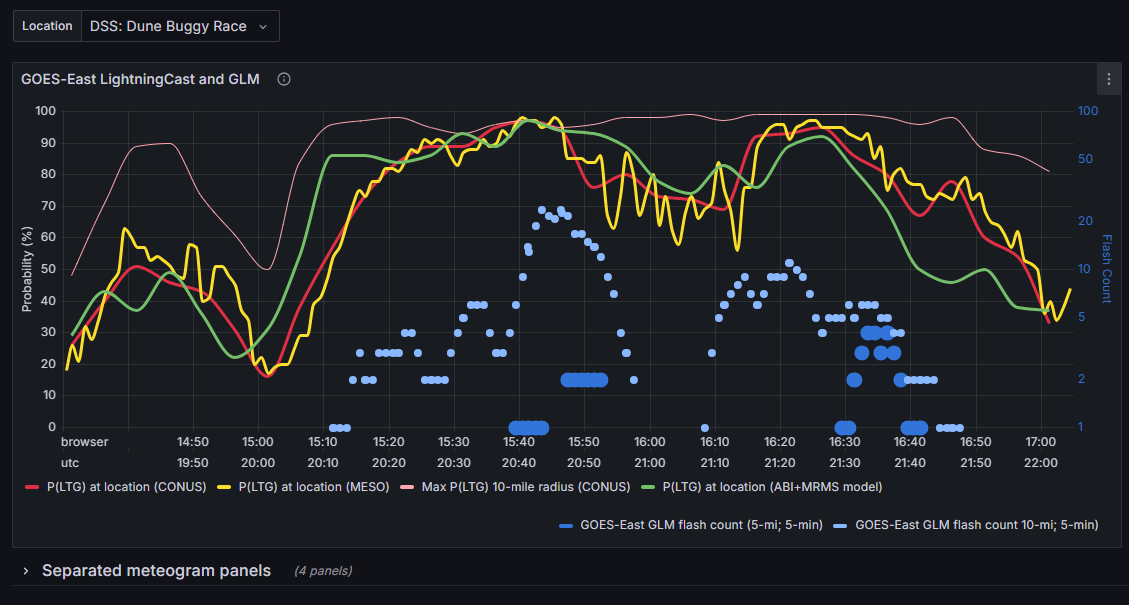
I was curious about the sudden dip in the V2 product because I don’t think I’d seen it be lower than both V1 before.

– Lightning McQueen

Tags: None

Calibrating Satellite Signatures Prior to Small Hail Report

A handful of severe thunderstorm warnings were issued for the Pittsburgh CWA by our team today given upticks in the satellite signatures. A pea-sized hail report came in at 1951z and this allowed us to calibrate the satellite signatures to the intensity of the storms. Thus, given the uptick in both Gremlin and Octane, we were able to realize that it would take a bit stronger of a signal to warrant large hail and potential a downstream warning.

Figure 1: Gremlin East CONUS reveals a rapid uptick in dBZ just before the pea size hail report at 1951z.

Figure 2: OCTANE already revealed CTD present in the part of the line that produced the hail report. Additionally, the cloud tops seemed to cool more just before the hail report.

– Aurora Borealis

In addition to my colleagues above, while in warning Ops today, it was noted as a group that after some initial calibration of what was going on weatherwise and looking at the Octane Products, the Octane products look to have at least done a slightly better job at noting which convection was just weak enough to not produce hail or wind reports while radar data might have struggled slightly more with pointing out wind and hail threats overall and what storms were the strongest.

Figure 3: Cells on the southern end of the map in the (orange circle) had more significant cloud top cooling but was much shorter lived and cloud top divergence was also slightly weaker. These storms failed to produce more than pea sized hail and no wind reports. While storms noted further north (pink circle)  while they had slightly weaker cloud top cooling with a more sustained cloud top divergence was responsible for some wind reports and potentially a tornado.

Meanwhile focusing on one of the radar related four panel products I tend to use in warning ops when differentiating between what storms to look at, the farther south storms, tended to have higher Vertically integrated Ice, higher MESH values, and overall looked slightly more structured than storms at the far northwestern periphery of the area. However, the further north storms are the ones that ended up producing winds reports which correlated with the better divergence aloft signal found in figure 1.

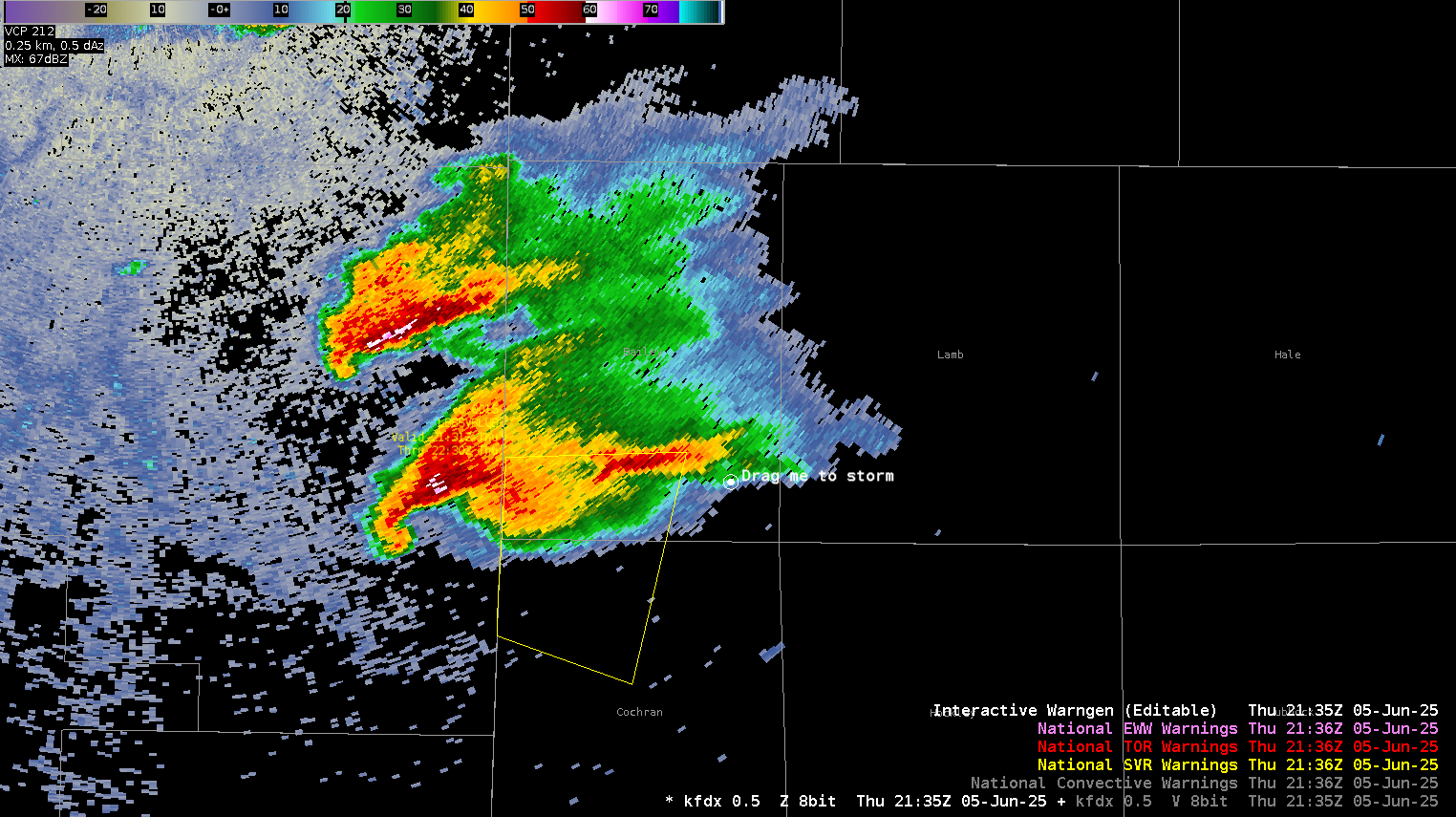
Figure 4: (Panel Contents from Upper left to Lower left: Upper left panel is RALA, upper right panel is MESH, lower right panel is 30 min rotation tracks, and lower left panel is Vertically Integrated Ice.

So overall it appears at least in this instance, the trends in upper level divergence as well as cloud top cooling may have been a slightly better indicator for potential severe thresholds of storm activity across the PBZ CWA.

-Sting Jet

Tags: None

Warning Operations with Satellite Data Only – Part 2

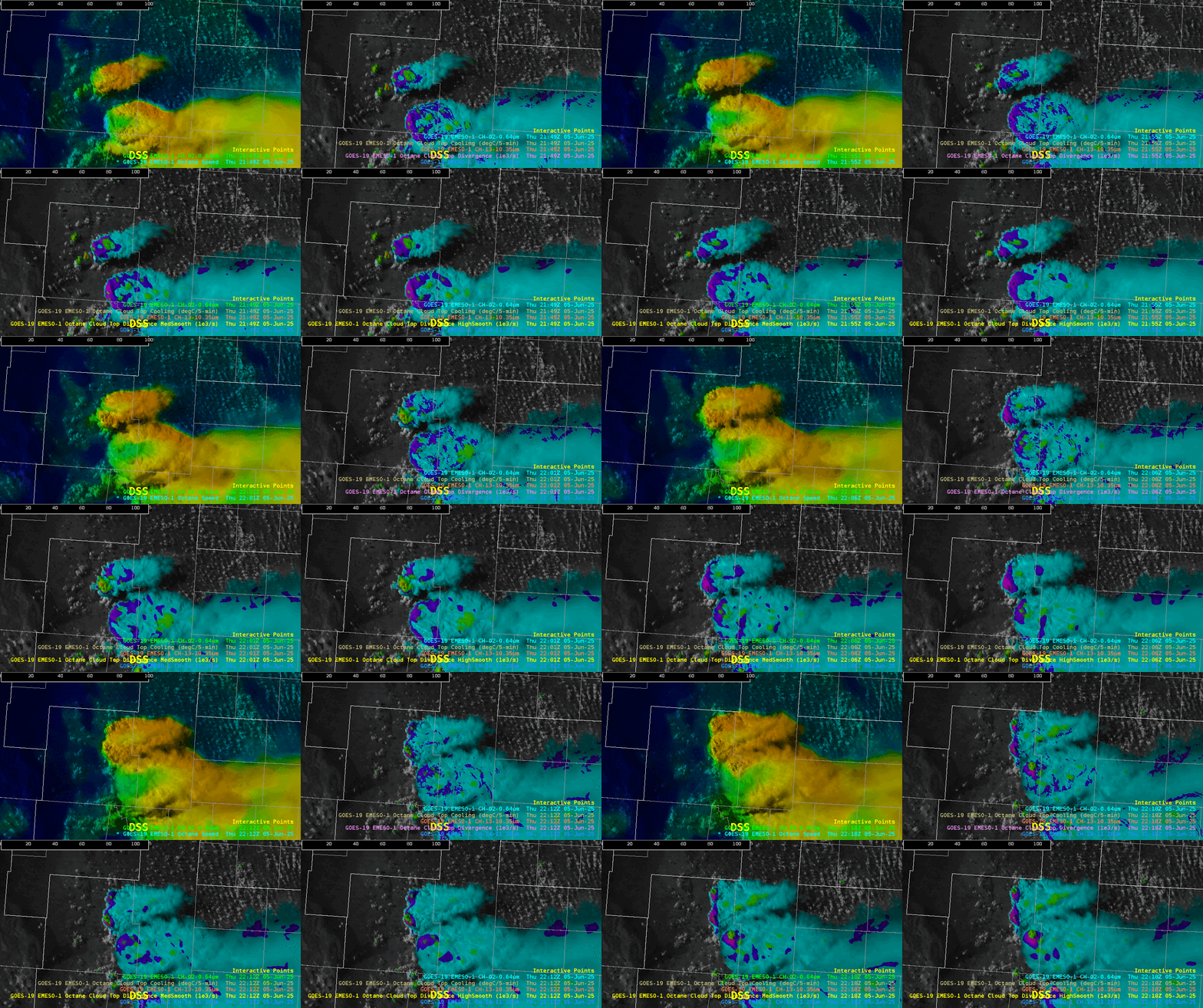
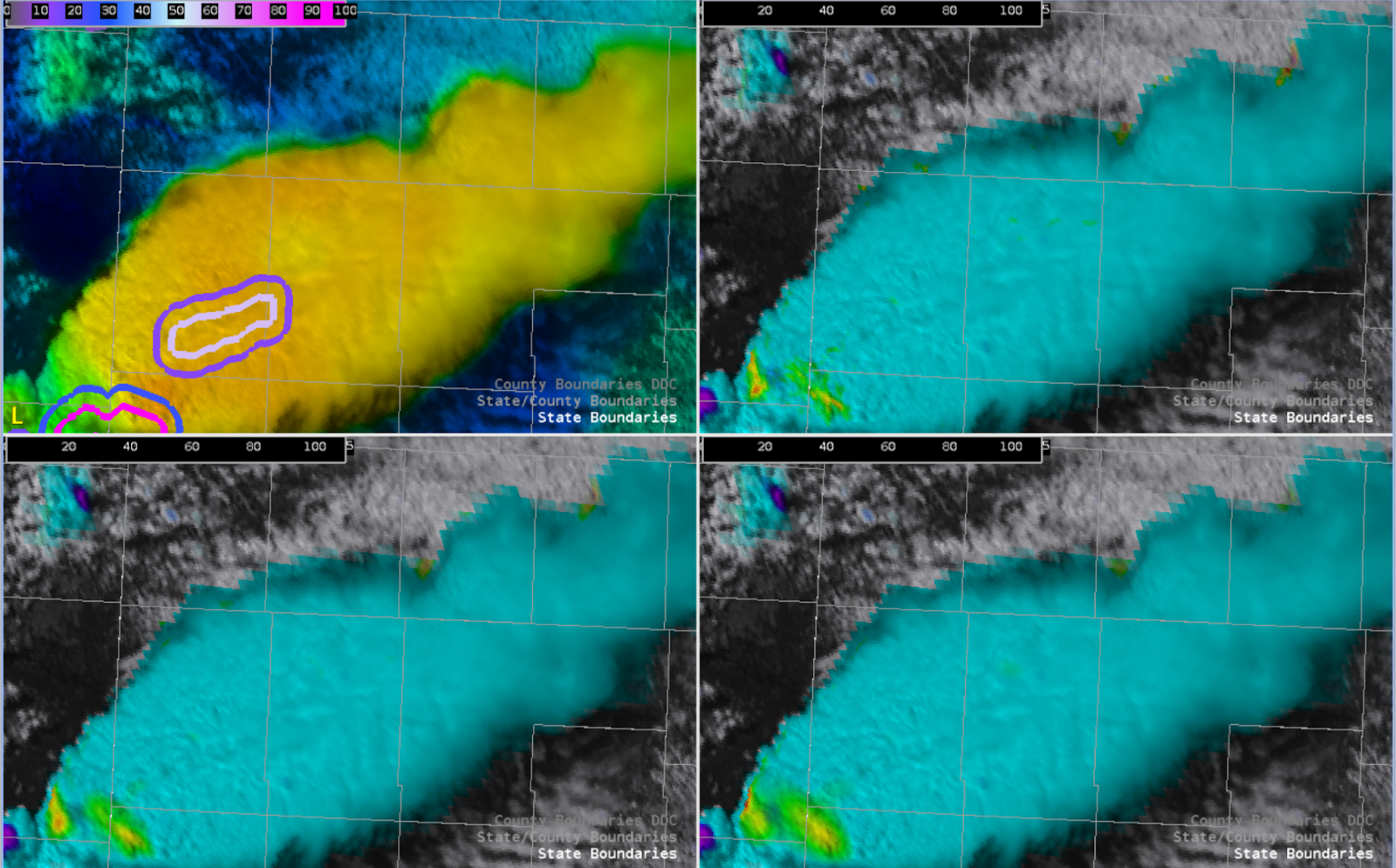
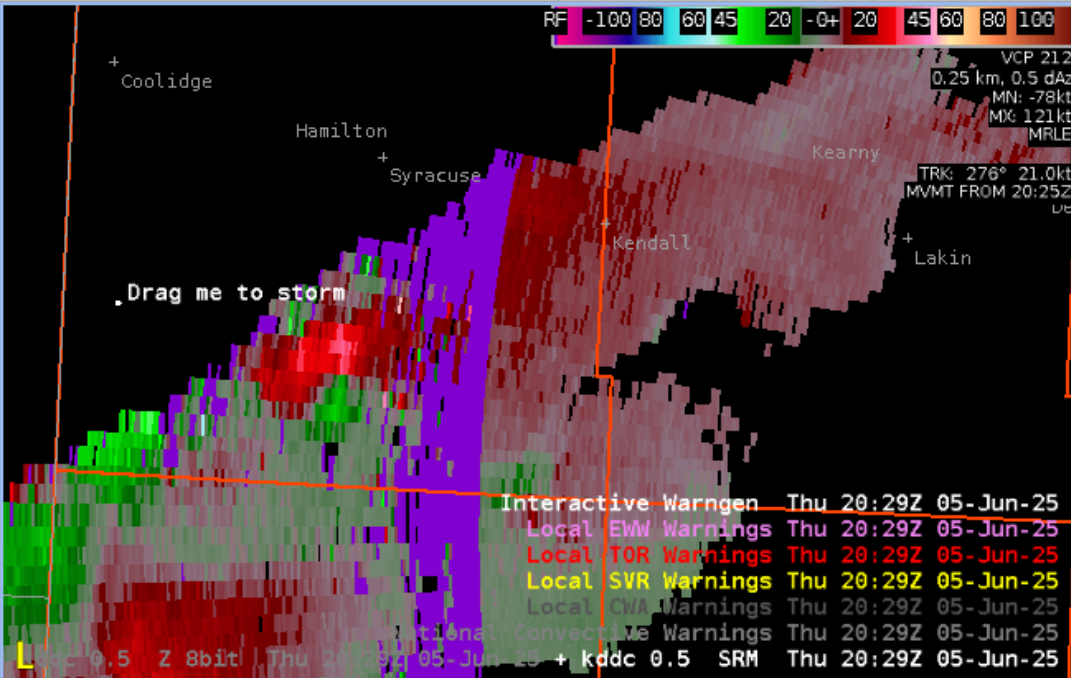
This is intended as a downstream follow-up to the first post of this name, which dealt with the issuance of an SPS for a cell north of North Platte, NE (Fig. 1).

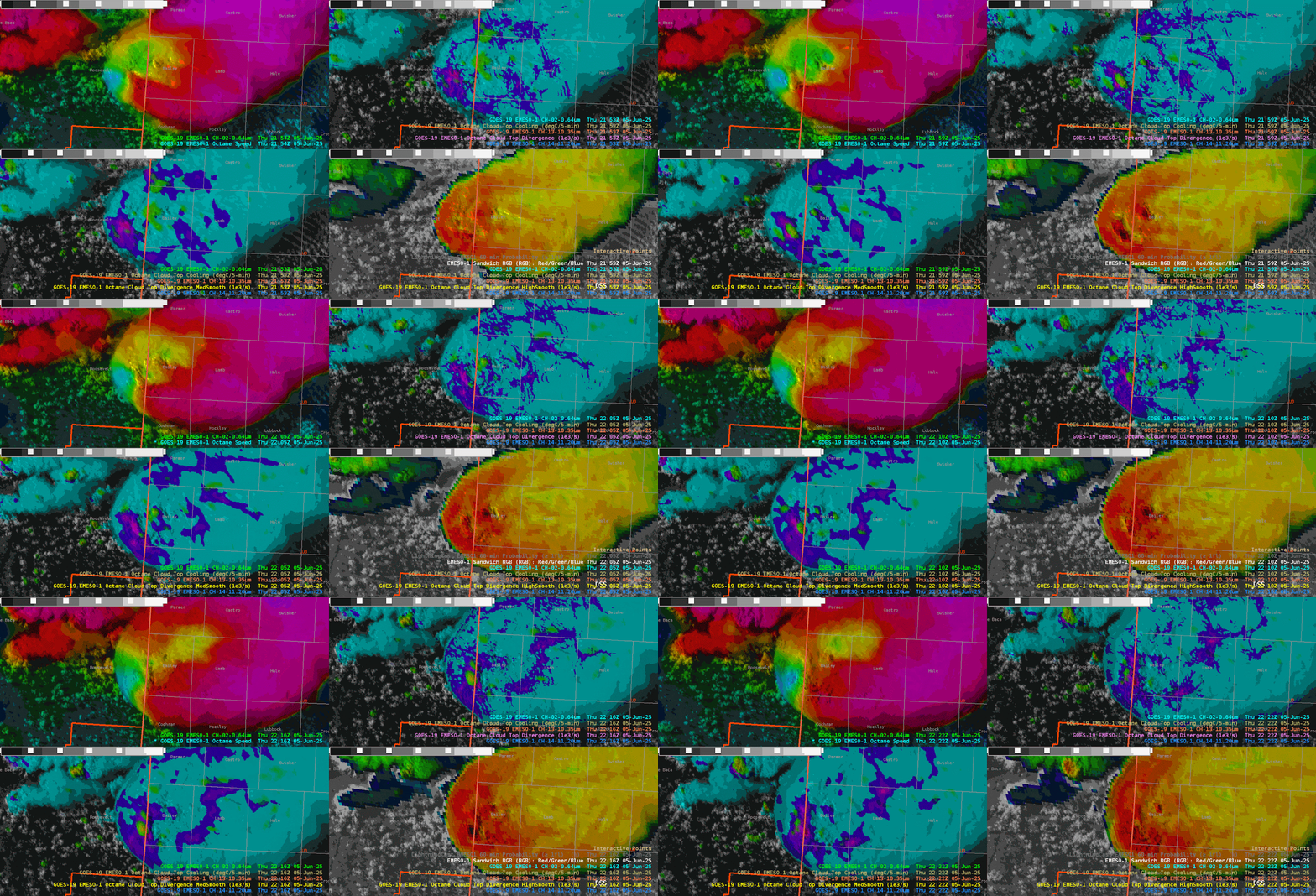
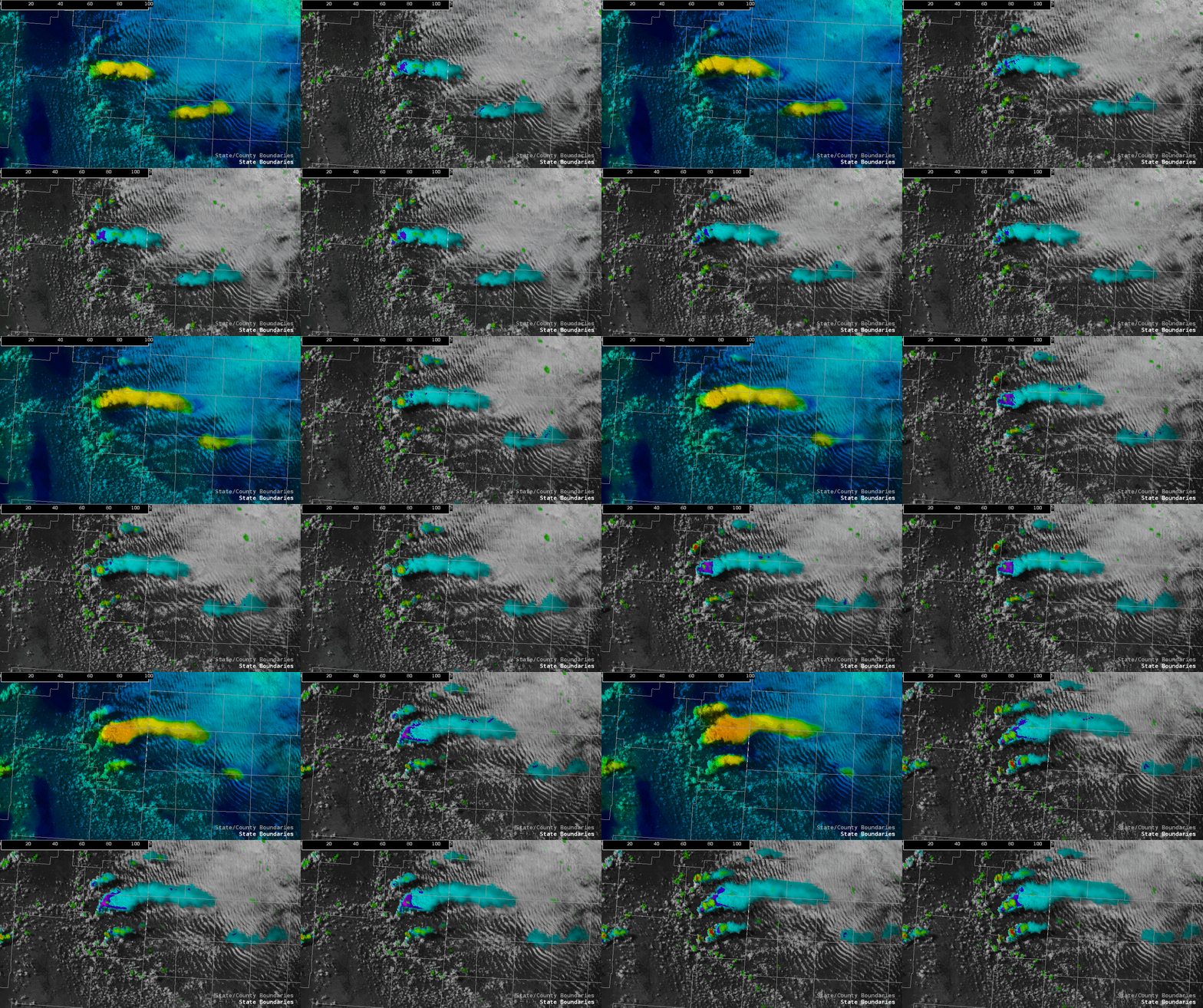
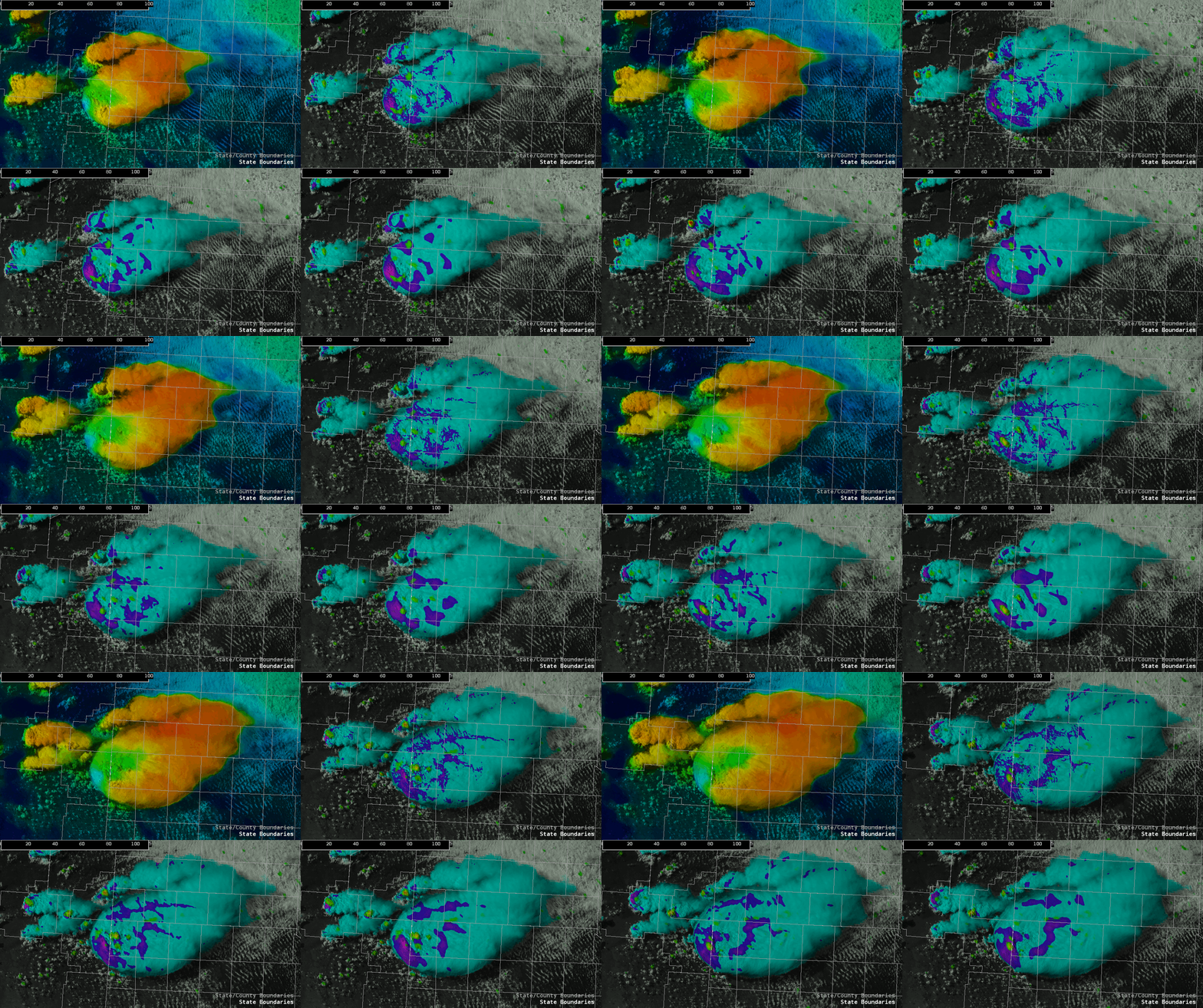
Fig. 1: 1935Z OCTANE Speed Sandwich (top left) and OCTANE Cloud Top Cooling/Divergence for no smoothing (top right), low smoothing (bottom left), and high smoothing (bottom right) around time of SPS issuance.

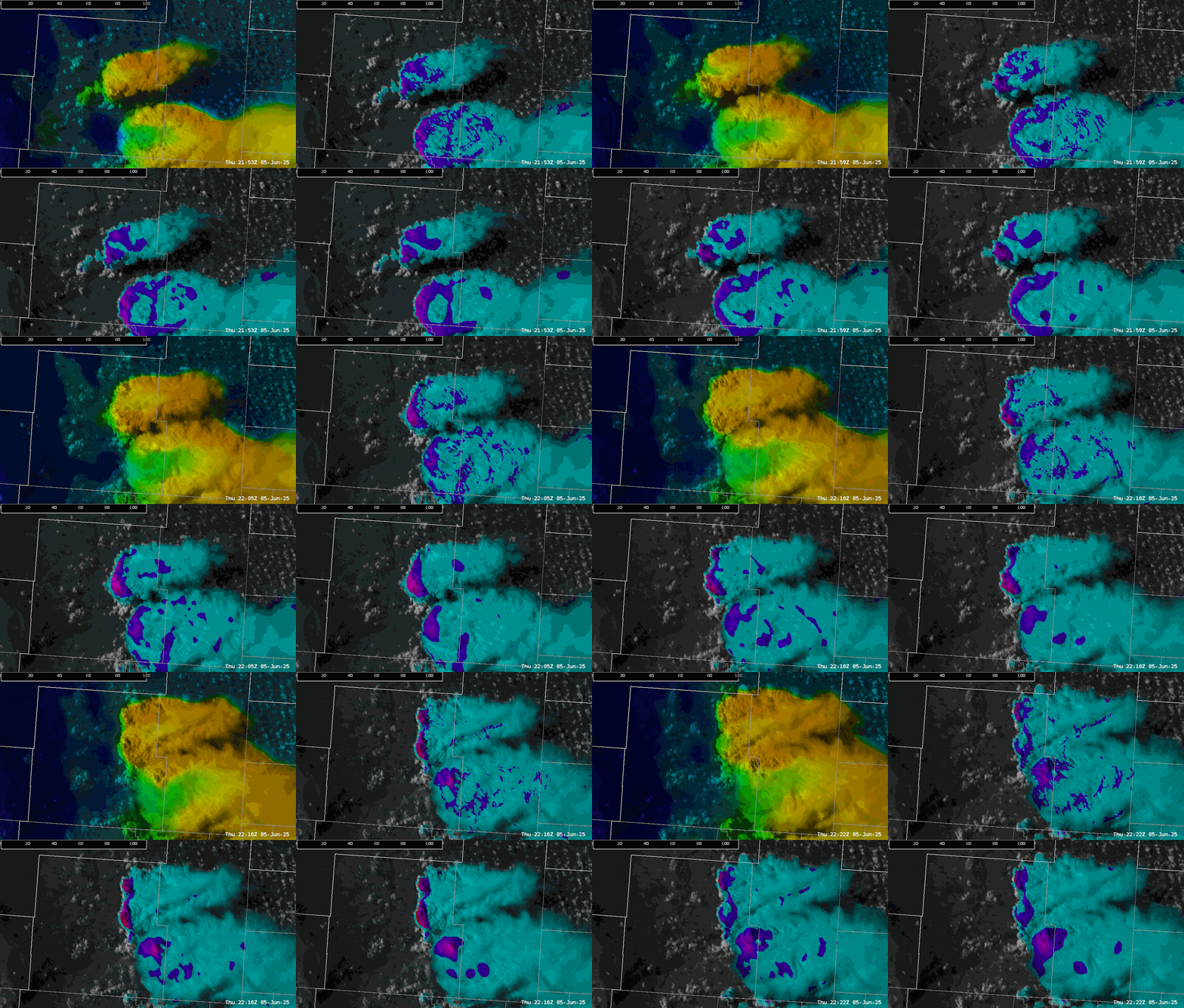
As the cell continued southeastward, cutting across northern and eastern parts of Lincoln County, NE, the storm did increase modestly in satellite presentation. The OCTANE Speed Sandwich (Fig. 2, top left) showed some signs of strengthening in the form of displaying higher winds (oranges), indicating a storm growing a bit higher and tapping into stronger winds aloft. The OCTANE Cloud Top Divergence and Cooling views (Fig. 2, same as Fig. 1) was also intermittent cloudtop cooling (greens) over the expected updraft location, indicating continued upward motion and updraft maintenance, and the cloudtop divergence was showing pink to intermittent red, indicating moderate to occasionally strong divergence.

Fig. 2: 2014-2032Z OCTANE Speed Sandwich (top left) and OCTANE Cloud Top Cooling/Divergence for no smoothing (top right), low smoothing (bottom left), and high smoothing (bottom right) around time of SPS issuance.

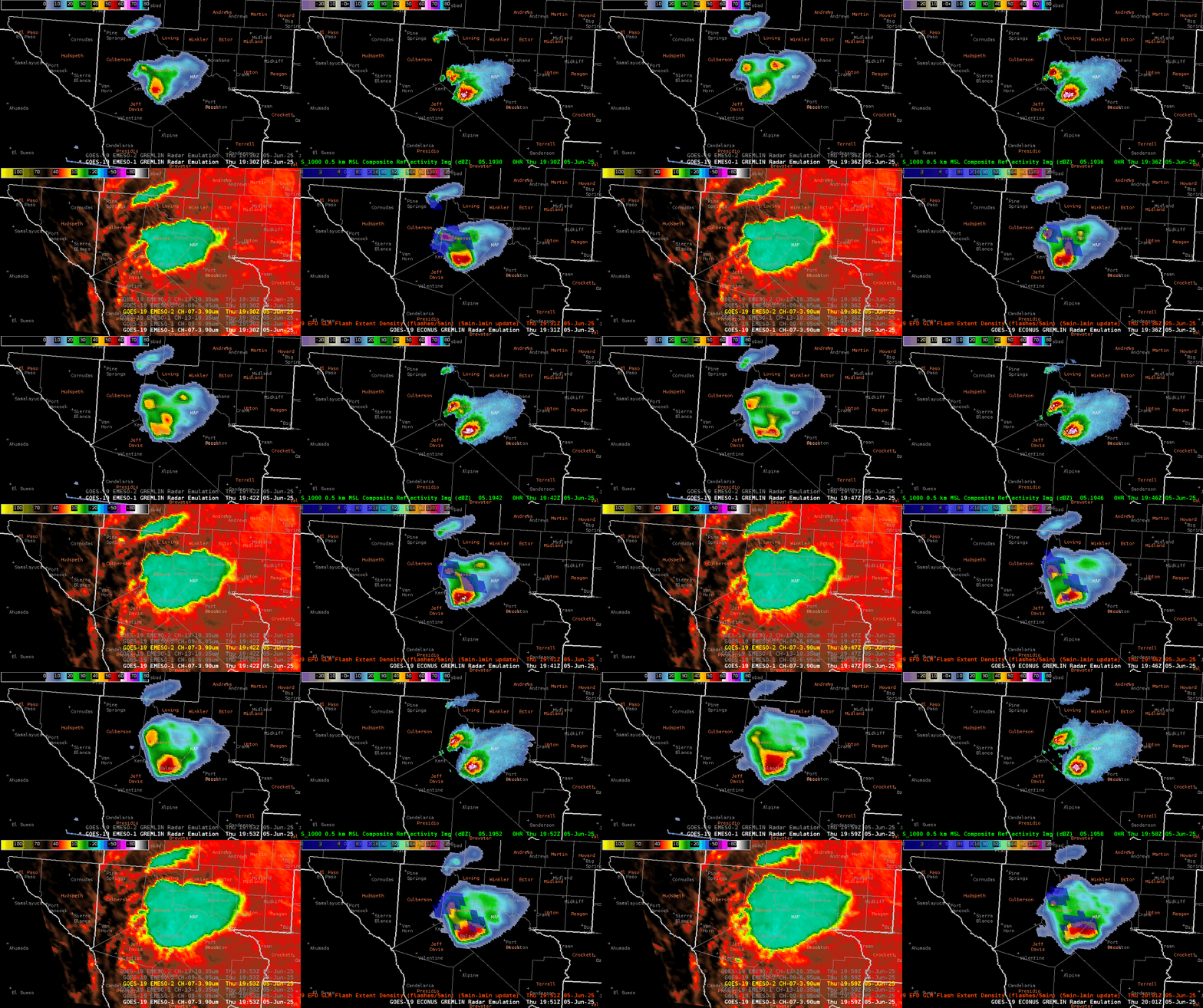
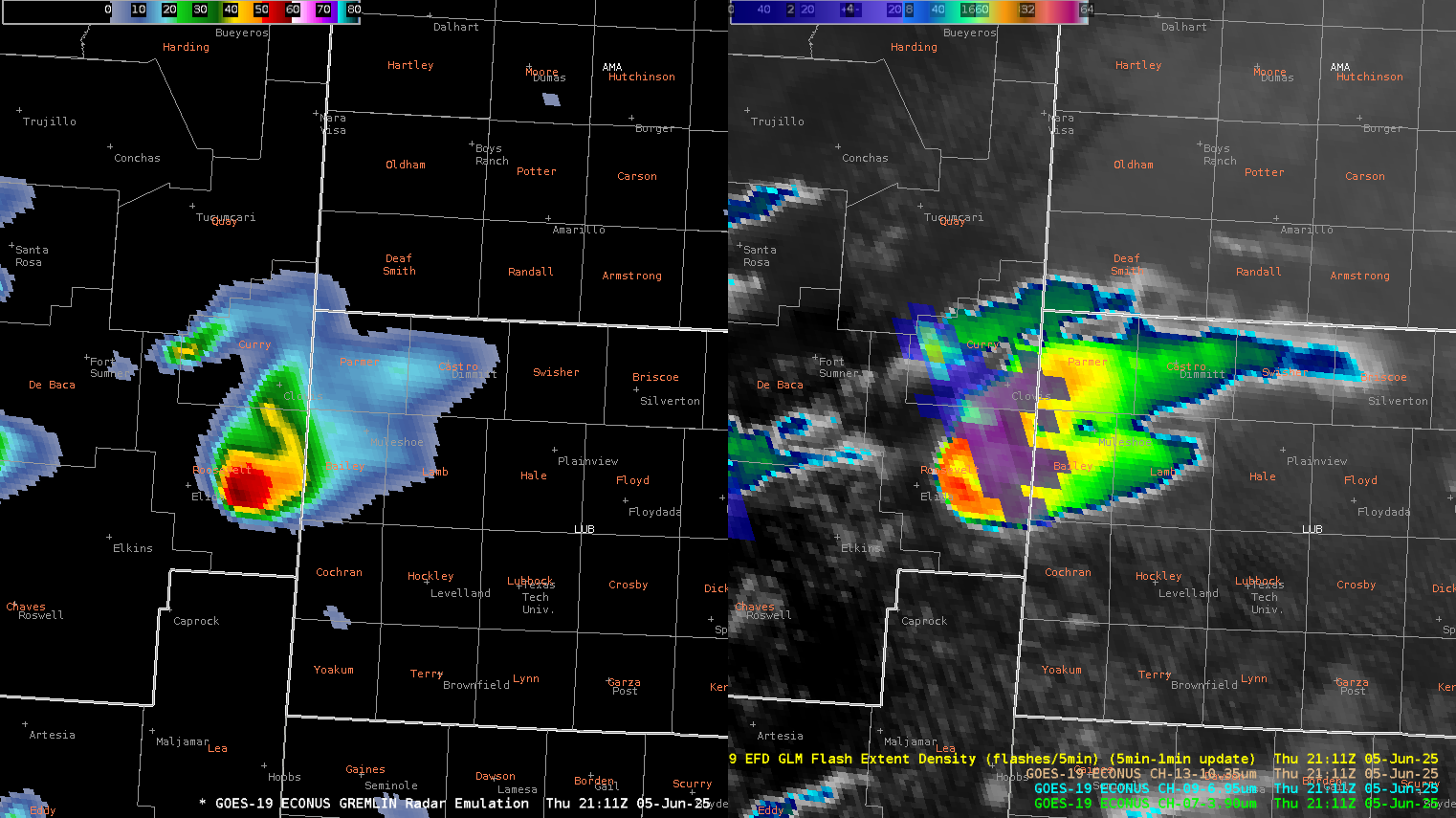
As shown in Fig. 3, the GOES-East CONUS GREMLIN output was somewhat underwhelming, and the GOES GLM lightning data shows no appreciable increase, but the 10.35µm IR imagery showed clear signs of higher cloud tops.

Fig. 3: 2014-2032Z GOES-East GREMLIN (left) and 10.35µm IR imagery with GLM Flash Extent Density overlaid (right).

While the signs of strengthening could have been used to justify increasing the size of the hail on a follow-on SPS over the initial half inch forecast, in this forecaster’s opinion it would have been difficult to justify upgrading to a Severe Warning at this time.

Continuing on down the line, we see (Fig. 4) the OCTANE Speed Sandwich product show cloud top wind speeds at least maintaining, if not increasing a touch further, indicating at least maintenance of strength, if not a bit of strengthening. The Cloud Top Divergence continues to show moderate (purple) to intermittently strong (red) divergence, and the Cloud Top Cooling continued to show occasional upward bursts in the updraft region. These would indicate the storm is likely at least worthy of a high-end SPS, and may be approaching severe thresholds.

Fig. 4: 2039-2103Z OCTANE Speed Sandwich (top left) and OCTANE Cloud Top Cooling/Divergence for no smoothing (top right), low smoothing (bottom left), and high smoothing (bottom right) around time of SPS issuance.

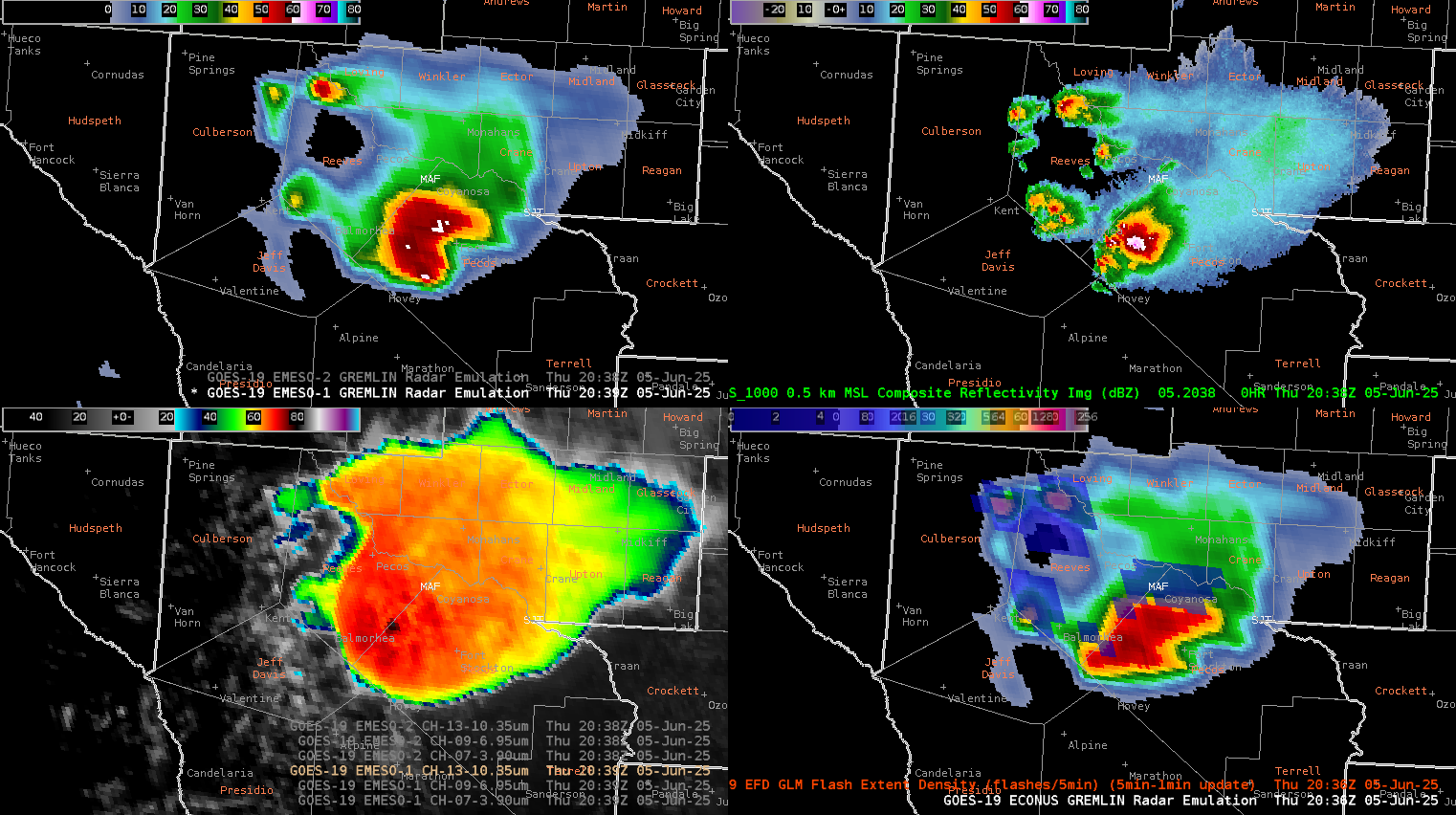
The GREMLIN simulated radar output from the same time (Fig. 5, left) shows fairly consistent moderately strong returns, in the high 40s dBZ to near 50dBZ. And understanding that GREMLIN tends to underestimate real radar returns somewhat and applying a mental adjustment, we can assume the storm is on the strong side, and appears to be more consistently strong. While the GLM never got very high, during this time period it does finally perk up somewhat and show modestly higher values, indicating a bit stronger updraft and more cloud ice and mixed phase precip aloft.

Fig. 5: 2039-2103Z GOES-East GREMLIN (left) and 10.35µm IR imagery with GLM Flash Extent Density overlaid (right).

Again, it might be hard to justify a warning at this time based solely on the satellite and lightning data and the at-best marginal modeled environmental data (no radiosonde sounding data available). However, at 2058z there was a public report of 0.88” hail (nickle-sized), just below severe thresholds. Combined with the data showing a decently strong storm in the satellite data, and the inherent increased uncertainty in dealing with just satellite and lightning data in the absence of radar data, in this forecaster’s opinion receiving a hail report just below severe thresholds likely would have been enough to justify putting out a severe warning. The office did issue an LSR for a report of 1” hail from an NWS Employee just east of Maxwell at 2106Z.

– Marko Ramius

Tags: None

Small Scale Boundaries and Low Topped Convection

The bottom left frame depicts a well defined outflow boundary pushing ahead of the convection in northeast FL. KJAX 0.5 degree Z is the only product in which this feature is visible, and it provides a lot of additional context as to what’s going on in the mesoscale and how that will impact the downstream convection. Will note that GREMLIN correctly identified this overall trend of weakening outflow dominant convection and was more obvious in its presentation than the RALA or base Z (which had very similar reflectivity presentations).

MRMS RALA (top left), GREMLIN (top right), base reflectivity (bottom left and right from JAX and MLB, respectively)

– millibar

Tags: None

MesoAnywhere and DSS Graphics

I made two DSS graphys- one using radar imagery and the other with the MesoAnywhere product:

The MesoAnywhere image highlighted what I was trying to communicate better in my opinion, but I hesitate when I think what I’m sharing might be ‘too science-y’ on the office socials.

– Lightning McQueen

Tags: None

MESO GREMLIN Struggles w/ Initiation + Parallaxing

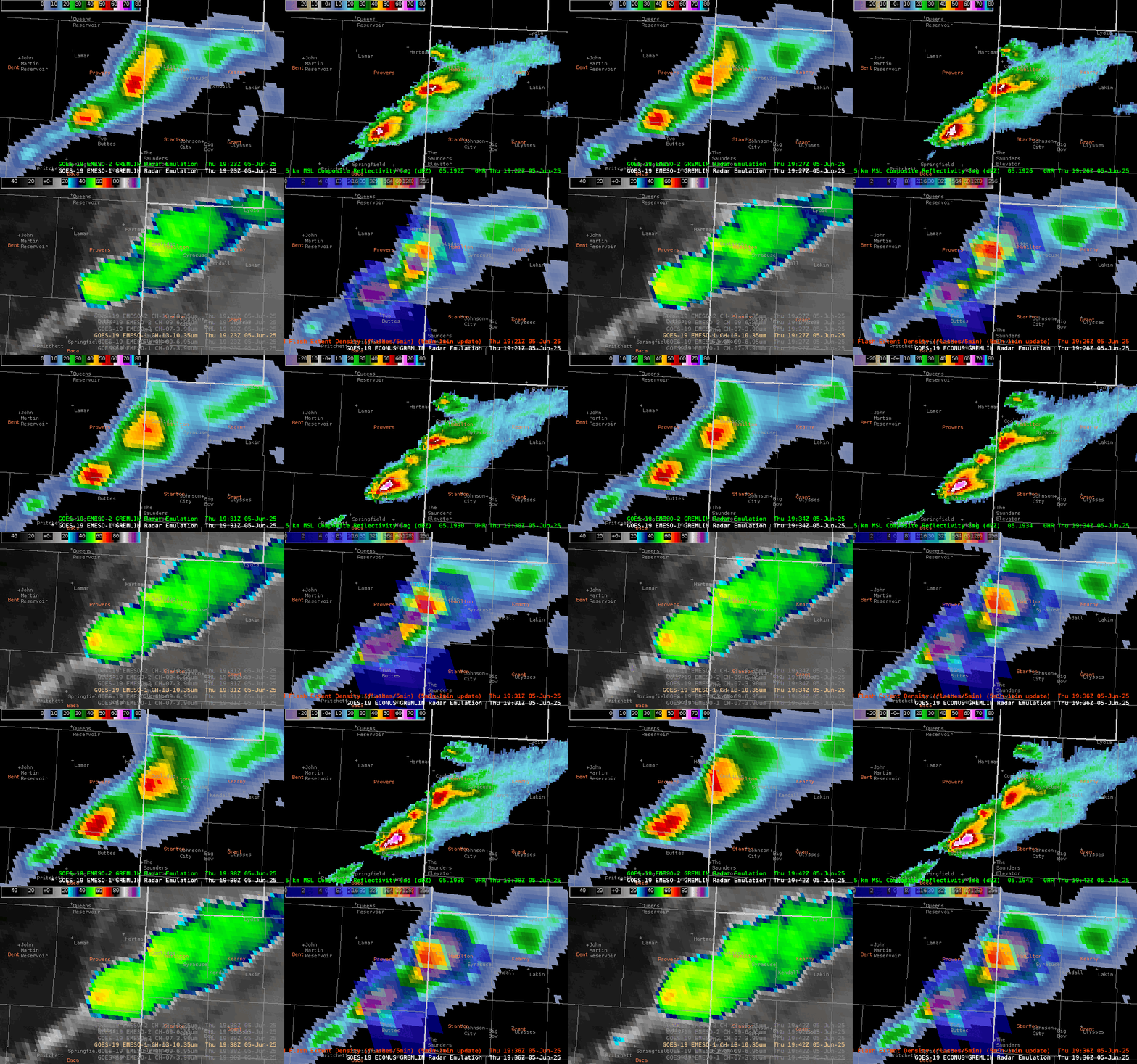
CONUS did better than the Meso sector with initiation throughout the majority of the event.

OCTANE did phenomenal with detecting the stronger storms, once again. I felt that I had ample lead time after hearing back regarding LSR’s from the storms I warned on. Following this, we noticed some pretty noticeable parallax issues with GREMLIN with respect to the warnings I issued.

I wonder how this would impact warning operations in areas where radar coverage is limited or nonexistent. Would this result in a higher POD and FAR for those offices as they’d likely have to draw larger polygons to account for this? Can this be fixed?

Ryan Cooper

Tags: None