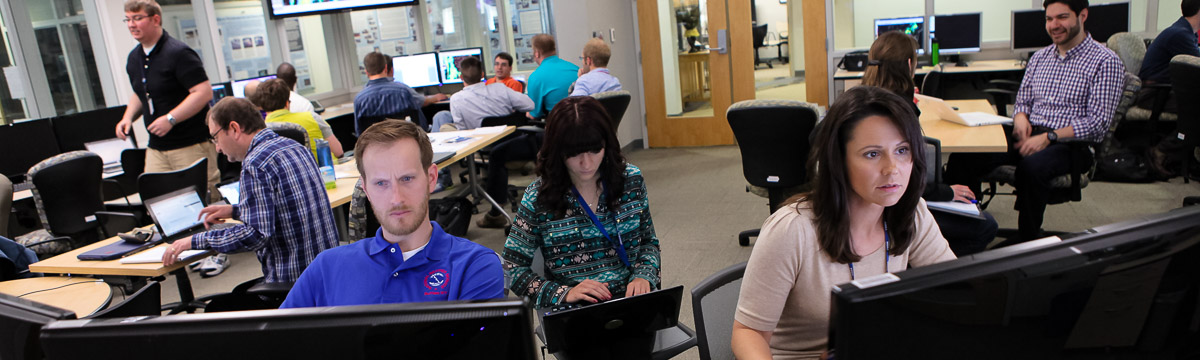
Sincerely appreciate the opportunity to attend HWT EWP the week of June 1st… definitely a worthwhile experience. Viewed phased-array radar (PAR), lightning mapping array (LMA), the CASA radar concept, and multi-radar/multi-sensor (MRMS) algorithms, and was given a peek at the PHI probabilistic warning program. Here is a summary of input provided (by myself and other participants) on each of these technologies based on EWP efforts that week…
LMA:
1) Viewed several real-time cases. Found this data potentially useful in the warning program in areas where radar data are sparse (e.g. western U.S.). Had a lower-resolution GLM version, similar to planned output from GOES-R, to review…and appeared sufficient in these areas despite lower resolution.
2) Interesting observation…some cells produced cg strikes first, others produced inter-cloud before cg, while others produced inter-cloud with no cg at all. Is there something about these different lightning patterns that can tell us something about storm structure or environment? Perhaps a future research topic.
3) When it comes to overall warning decision-making, LMA does not indicate anything that radar reflectivity structure doesn’t show. In fact, there is often a short lag between reflectivity trends and subsequent lightning trends.
4) Noted some problems with data beyond 100km from center of LMA sensor network…data seemed better closer to the center of network. In some instances, had cells producing impressive 1-minute cg strike rates on NLDN data (nearly continuous cg), while the LMA showed very little, despite apparently being located within range.
5) We had 5-minute averaged LMA data in AWIPS at the HWT…lower resolution of this data proved to be less useful than the high-resolution real-time data available online. For LMA data to be useful, the data in AWIPS will need to be the highest-resolution possible.
PAR:
1) Viewed data from < 1 minute volume scans for an impressive inland tropical storm event in OK.
2) Very helpful in assessing mini-supercells and tropical-cyclone tornado features. Velocity enhancement signatures (VES’s) stood out well, and in one instance, could watch strong low-level convergence evolve into rotation, allowing a possible warning with decent lead time before the TVS. In dealing with problem issues such as mini-supercells and TC tornadoes, PAR shows promise!
3) The resolution of the data was similar to current 88D super-res. The faster volume scans provided considerably more data to look at. This offers both a positive and a negative in the warning process. Positive: easier to monitor evolutions and view small scale features, with potential for a few extra minutes of warning lead time. Negative: Easier to “wait one more scan” knowing it was less than a minute away, compared to the longer 88D volume scans…which could minimize the potential increase in lead time.
4) Viewing rapid changes to small scale features requires research into understanding what we’re looking at. At times, I was fascinated at what I was seeing, but had no idea what exactly was occurring, and what it meant with regard to severe weather potential (e.g. was it increasing or decreasing). This also led to a feeling of “wait one more scan” to try to understand what was going on.
CASA:
1) Viewed a few different cases. Viewed data at scan rates of 1 minute or less.
2) Key benefit is greater coverage of low-level radar data, with more frequent data updates. Certainly beneficial when it comes to tornado threat detection.
3) Same positive and negative as for PAR above (#3).
4) Not a stand-alone warning tool…needs to be augmented with 88D data. CASA best as a tool that provides enhanced low-level radar coverage when it is needed (e.g. tornado or downburst potential). CASA radars have significant attenuation problems, this was seen in cases viewed. Less of a problem if used in conjunction with (rather than in place of) available 88D radar data.
MRMS:
1) Viewed several real-time cases covering the western, central, and eastern U.S.
2) Numerous algorithm fields available, with considerable redundancy (most focused on hail, tornado/meso, not much for wind threat).
3) Viewed situations when MRMS is very useful, such as for storms moving within the “cone of silence” of one radar, and for prioritizing numerous storms on display. At other times (e.g. few storms on radar), does not provide anything more than other displays (e.g. VIL).
4) Found Maximum Estimated Hail Size (MESH) quite useful in the real-time events. The MESH utilized was an improved version over what’s available now in the field.
5) Several reflectivity layer products (e.g. reflectivity depth above -10C, 50dBZ echo top, etc) that were also potentially useful in warning process.
6) MESH tracks and MESO tracks useful, particularly in post-event verification efforts.
7) Was interested in the time-height series of 18dBZ, 30dBZ, and 50dBZ echo tops overlaid on one display. Can storm intensity changes with time be related to periods when these lines press closer together with time, vs. times when the lines spread further apart?
PHI:
1) Came in early one day to get a peek at the probabilistic warning program, in which the warning areas move with the threat (rather than being fixed areas). This requires a change in philosophy, which can be challenging in the NWS.
2) Was impressed at the program…could graphically illustrate complex situations (merging cells, splitting cells, etc) much easier than trying to explain the threat areas in lengthy text products. In addition, by “advecting” the threat area, one can always provide maximum lead time downstream of the warned storm (rather than waiting for storm to approach end of polygon before issuing new polygon warning).
3) Did not view program as terribly complex, nor one that would involve considerable forecaster workload. In fact, if text product generation and dissemination can be mostly automated (since most products are worded similarly), workload could actually decrease, particularly in major events, allowing more time for data analysis (important if the above technologies are provided in operations).
Also gave a presentation on my Probabilistic-Augmented Warning System (PAWS) concept, suggesting it as a “middle-step” toward what is proposed with the PHI program. While viewed positively, the general viewpoint was to focus effort on PHI. There was no estimate as to when the PHI concept might become an operational entity for the NWS, though I would guess a 5-10 year range if not later (much later if introduced with Warn on Forecast concept in which it is linked to high-res numerical model output).
Key Concluding Thoughts:
1) EWP attendance very beneficial…and would encourage others to get involved. While there, I expressed the fact that the SOO community could provide a resource for additional evaluation, even if not located in Norman.
2) The technology evaluated was impressive, and offers much…not only in the area of operations, but also research, especially when viewing high-resolution output in rapid scan updates. Despite this, getting the money for operational implementation could be a tough sell, especially if “selling” requires a demonstration of verification score impact. Despite a favorable view of the technology in operations and research, I did not sense that it would positively impact verification scores that much. For example, < 1 minute radar scans offer the potential of adding a few extra minutes lead time to warning. However, this also makes it easier to wait another scan, since only 1 minute away (rather than 5 minutes), which would diminish this potential gain. Also watched SHAVE verification efforts during some events worked…amazing to see the difference in their report coverage vs. that of the WFO…a demonstration of the inaccuracy of our verification scores (our future funding is based on inaccurate numbers?).
3) Implementation of these technologies at the WFO will result in data overload, which gets even worse if you add high-res model output that could utilize these datasets. Of course, more data isn’t always better data. The forecaster will need to learn how to process the data (better prioritizing), and know when to stop looking at data and make the warning decision. Further automation (through algorithms) will be necessary to help forecasters process the data load. (This makes concepts such as PAWS and PHI very important, by placing forecaster focus on data analysis and not on product design.) In other words…SOO job security! 😉 Dual-pol will be a good start in this regard, as it will add products to the warning decision-process. Training needs to be developed, perhaps with the WES machine, that allows the SOO to evaluate the impact of adding more and more data (e.g. more products, faster update times, etc.) to forecaster warning decision-making. At the conclusion of the EWP, I suggested the need for continued leadership from the WDTB in this regard.
Again, I thought this was a beneficial experience, and appreciate the opportunity to participate. Thanks….
Pete Wolf (NWS Jacksonville FL – 2009 Week 5 Evaluator)