An official website of the United States government
Here’s how you know
Official websites use .gov A
.gov website belongs to an official government
organization in the United States.
Secure .gov websites use HTTPS A
lock (
) or https:// means you’ve safely connected to
the .gov website. Share sensitive information only on official,
secure websites.
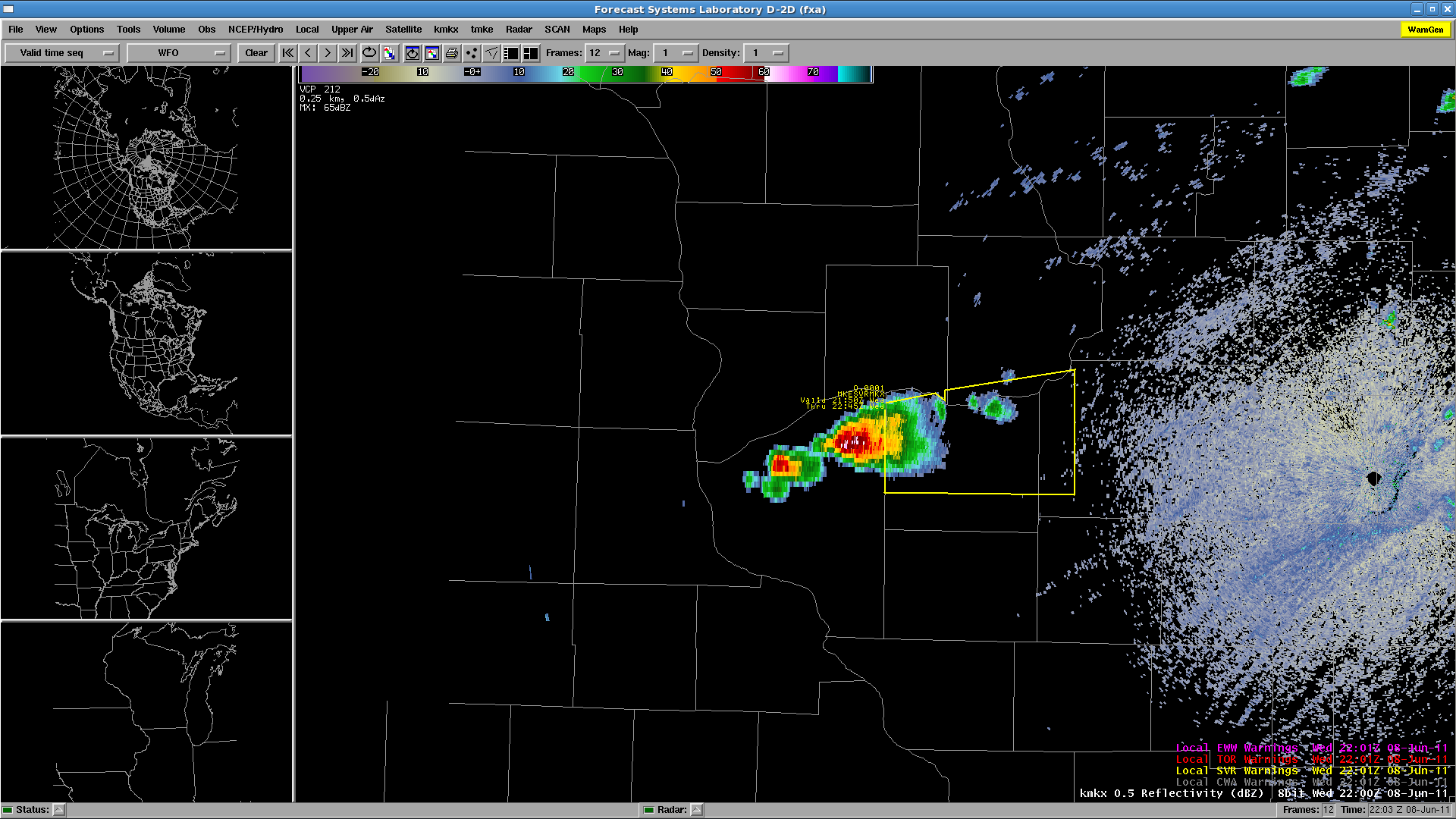
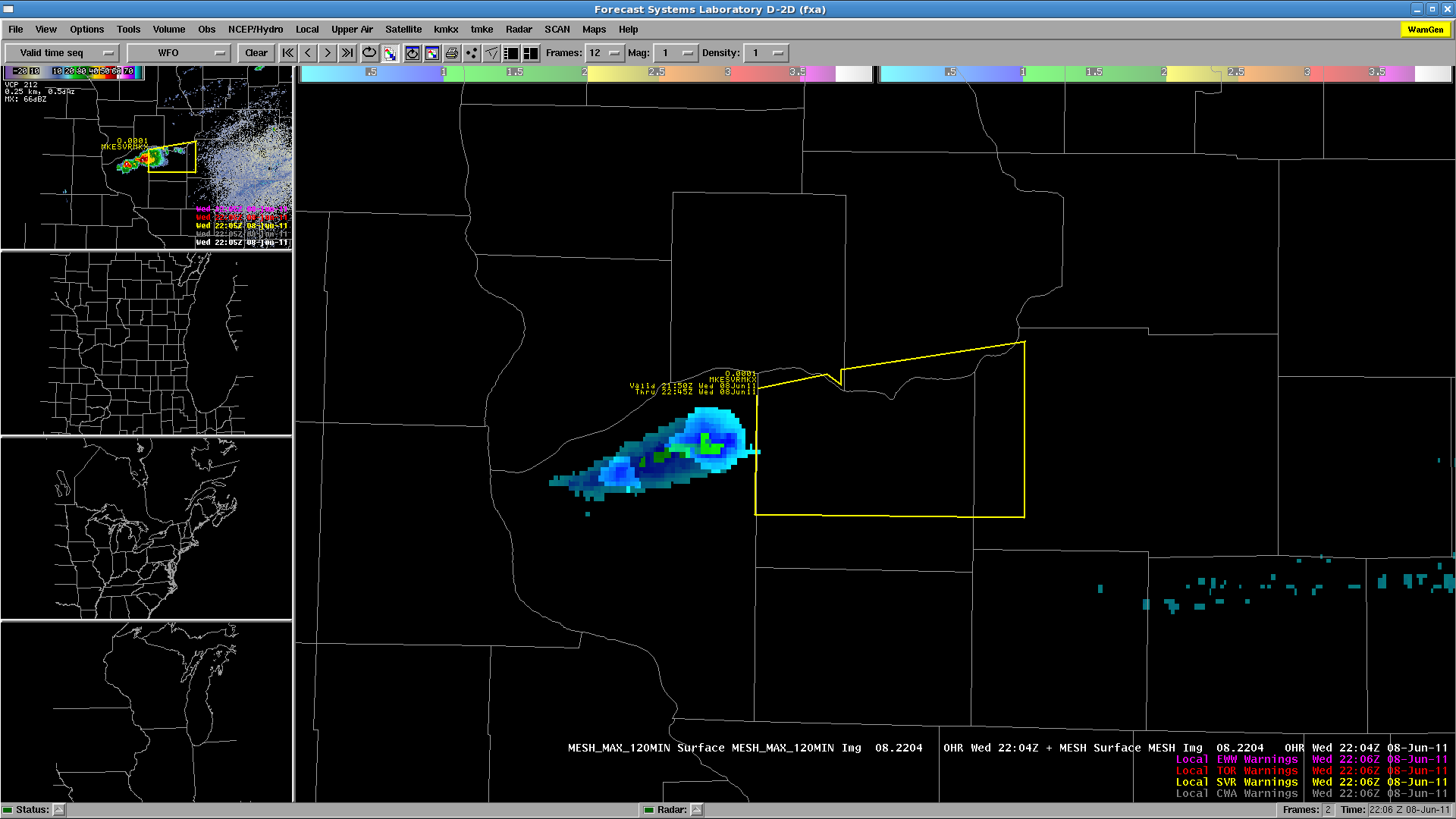
We have two CWAs operating now: MKX (Milwaukee/Sullivan WI) and DVN (Davenport/Quad Cities IA/IL). After a few hours of monitoring CI, we finally have our first severe storm in SE Wisconsin, getting ready to move into MKX CWA, so they issued a SVR warning on that cell.
Fig 1. KMKX reflectivity and SVR warning.
Fig 2. MESH, 2-hour MESH Swath, and SVR warning.
We were also monitoring the TX-OK-KS area for CI in the conditional risk area, but since storms are now firing in our current CWAs, we have abandoned that idea. OUN WRF evaluation may have to wait until Thursday. Note too that the OK-LMA is down (owing to the 24 May tornadoes), and thus we cannot evaluated PGLM data for Oklahoma.
SOUTHERLY FLOW WILL CONTINUE TO ALLOW FOR MODEST IMPROVEMENT IN BL MOISTURE ACROSS THE SOUTHERN HIGH PLAINS THIS AFTERNOON…WITH SURFACE DEWPOINTS LIKELY REACHING THE LOWER 50S ACROSS THE REGION BY LATE IN THE DAY. THIS WILL COMBINE WITH VERY HOT TEMPERATURES…AROUND 100…TO RESULT IN MODERATE INSTABILITY. DESPITE VERY WARM H7 TEMPS…AROUND 15 C…FORECAST SOUNDINGS ARE LARGELY UNCAPPED AND FEATURE A CLASSIC INVERTED-V STRUCTURE. BL CONVERGENCE…ESPECIALLY IN THE VICINITY OF THE DRYLINE/SYNOPTIC FRONT INTERSECTION SHOULD BE SUFFICIENT TO ALLOW FOR ISOLATED/WIDELY SCT CONVECTION BY LATE AFTERNOON. VERTICAL SHEAR SHOULD REMAIN QUITE WEAK…GENERALLY PRECLUDING ORGANIZED STORM STRUCTURES. HOWEVER…IN LIGHT OF THE THERMODYNAMIC STRUCTURE…THERE SHOULD BE AN ENHANCED RISK OF HIGH-BASED CONVECTION PRODUCING OCCASIONAL HYBRID WET/DRY MICROBURSTS ACROSS THE REGION BY THE END OF THE DAY.
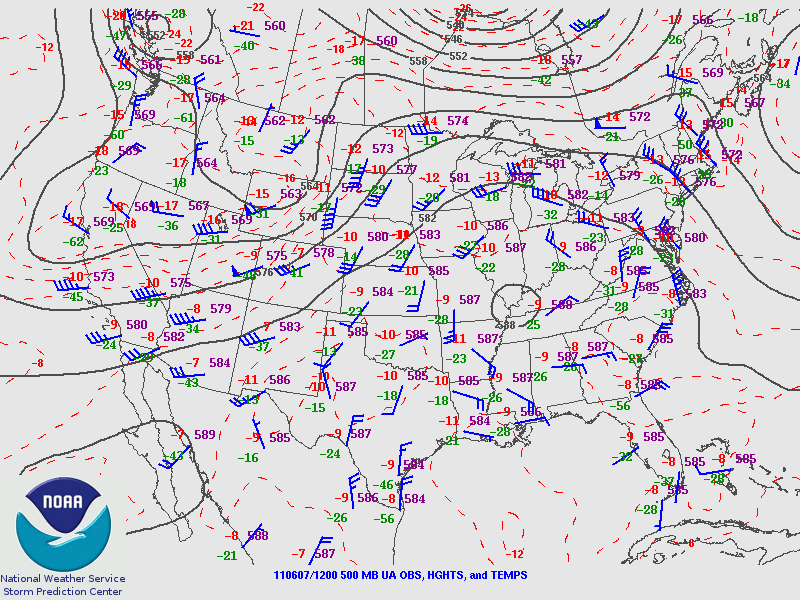
THE LARGE SCALE PATTERN OVER THE CONUS CONTINUES TO BE CHARACTERIZED BY AN EASTERN RIDGE/WESTERN TROUGH…WITH A SURFACE QUASI-STATIONARY FRONT EXTENDING FROM THE NORTHERN GREAT LAKES INTO THE CENTRAL PLAINS. AS OF WEDNESDAY MORNING…A SW TROUGH WAS RAPIDLY SHEARING OUT OVER ONTARIO…AS IT ENCOUNTERED THE STRONGLY CONFLUENT FLOW OVER EASTERN NORTH AMERICA.
GREAT LAKES/UPPER MISS VALLEY
THE AFTERNOON CONVECTIVE FORECAST IS SOMEWHAT COMPLICATED BY THE PRESENCE OF ONGOING WARM SECTOR CONVECTION FROM EXTREME EASTERN IA INTO EASTERN WI AND MI. OVERALL…THIS ACTIVITY HAS BEEN GRADUALLY TRENDING DOWNWARD IN TERMS OF COVERAGE/INTENSITY DURING THE PAST TWO HOURS. MEANWHILE…THERE IS A NARROW CORRIDOR BETWEEN THE FRONT AND THE BACK EDGE OF THIS CONVECTION THAT IS DESTABILIZING QUITE NICELY FROM SOUTH CENTRAL IA INTO NORTHERN WI (MLCAPE VALUES WERE ALREADY IN THE 2500-3000 J/KG RANGE IN THIS AREA AS OF 1600 UTC). lOW LEVEL SOUTHWEST FLOW IN THIS REGION SHOULD MAINTAIN SURFACE DEWPOINTS IN THE MID/UPPER 60S…WHILE AFTERNOON TEMPS SHOULD SOAR WELL INTO THE 90S. A CONSENSUS OF MODEL GUIDANCE SUGGESTS MLCAPE SHOULD EASILY EXCEED 3500 J/KG JUST AHEAD OF THE FRONT BY LATE AFTERNOON. THIS REGION IS ALONG THE SOUTHERN EDGE OF THE WESTERLIES…SO SHEAR PARAMETERS RANGE FROM FAIRLY STRONG ACROSS NORTHERN WI…TO RELATIVELY WEAK ACROSS SOUTHERN IA. THIS IS UNLIKELY TO CHANGE SIGNIFICANTLY THROUGHOUT THE DAY.
AS THE FRONT SLOWLY SAGS SOUTHEAST ACROSS THE REGION… SCATTERED THUNDERSTORMS ARE EXPECTED TO DEVELOP THIS AFTERNOON. LACK OF SIGNIFICANT LARGE-SCALE FORCING SHOULD LIMIT THE OVERALL COVERAGE. HOWEVER…CLUSTERING OF CONVECTION ALONG COLD POOLS COULD OCCUR…PARTICULARLY IN THE MORE WEAKLY SHEARED AIRMASS ACROSS EASTERN IA. ACROSS WI…STORMS MAY TEND TO BE MORE DISCRETE/SUPERCELLULAR IN NATURE. HOWEVER…WITH THE VEERED LOW-LEVEL FLOW…THE THREAT OF TORNADOES SEEMS TO BE LOW…UNLESS WINDS BACK LOCALLY IN THE VCNY OF LINGERING OUTFLOW/DIFF HEATING BOUNDARIES. OTHERWISE…THE MAIN THREATS WILL BE IN THE FORM OF LARGE HAIL…SOME OF WHICH COLD BE VERY LARGE…AND DAMAGING DOWNBURSTS IN ASSOCIATION WITH THE MORE ACTIVE MULTICELLULAR COLD POOLS.
NORTHEAST/NRN NEW ENGLAND
ALTHOUGH THE AIRMASS OVER THE NORTHEAST WILL BECOME QUITE UNSTABLE THIS AFTERNOON…THE PRESENCE OF THE UPPER RIDGE OVER THE EASTERN CONUS SUGGESTS THE LARGE SCALE PATTERN IS GENERALLY UNFAVORABLE FOR SIGNIFICANT CONVECTIVE DEVELOPMENT. THE SURFACE FRONT WILL ALSO REMAIN TOO FAR TO THE WEST OF THE REGION TO PROVIDE A FOCUS FOR CONVECTION THIS AFTERNOON. ALTHOUGH DIFF HEATING SHOULD RESULT IN INITIATION ACROSS THE HIGHER TERRAIN OF NORTHERN NY/NORTHERN NE THIS AFTERNOON…IT APPEARS COVERAGE IS LIKELY TO BE TOO ISOLATED TO WARRANT EWP OPERATIONS IN THIS REGION. (A HIGHER THREAT MAY EXIST IN THIS AREA AFTER 00Z…ESPECIALLY IF CONVECTION ORGANIZES ALONG THE FRONT ACROSS SOUTHEAST ONTARIO/SRN QUEBEC THIS AFTERNOON).
CENTRAL HIGH PLAINS
VERTICAL WIND SHEAR WILL LIKELY BE SUPPORTIVE OF A ROTATING STORM OR TWO BY EARLY EVENING…IF SUFFICIENT DESTABILATION CAN OCCUR IN THE WAKE OF DEPARTING SURFACE RIDGE OVER CENTRAL AND NORTHERN PLAINS. AT THIS TIME…RETURN FLOW OF INCREASINGLY MOIST UPSLOPE FLOW SUGGESTS ONLY MODEST DESTABILIZATION TODAY AND EXPECT VERY ISOLATED STORM COVERAGE THROUGH 03Z. THUS…BELIEVE EWP OPERATIONS SHOULD BE FOCUSED FARTHER EAST OVER GREAT LAKES/UPPER MISSISSIPPI VALLEY REGION.
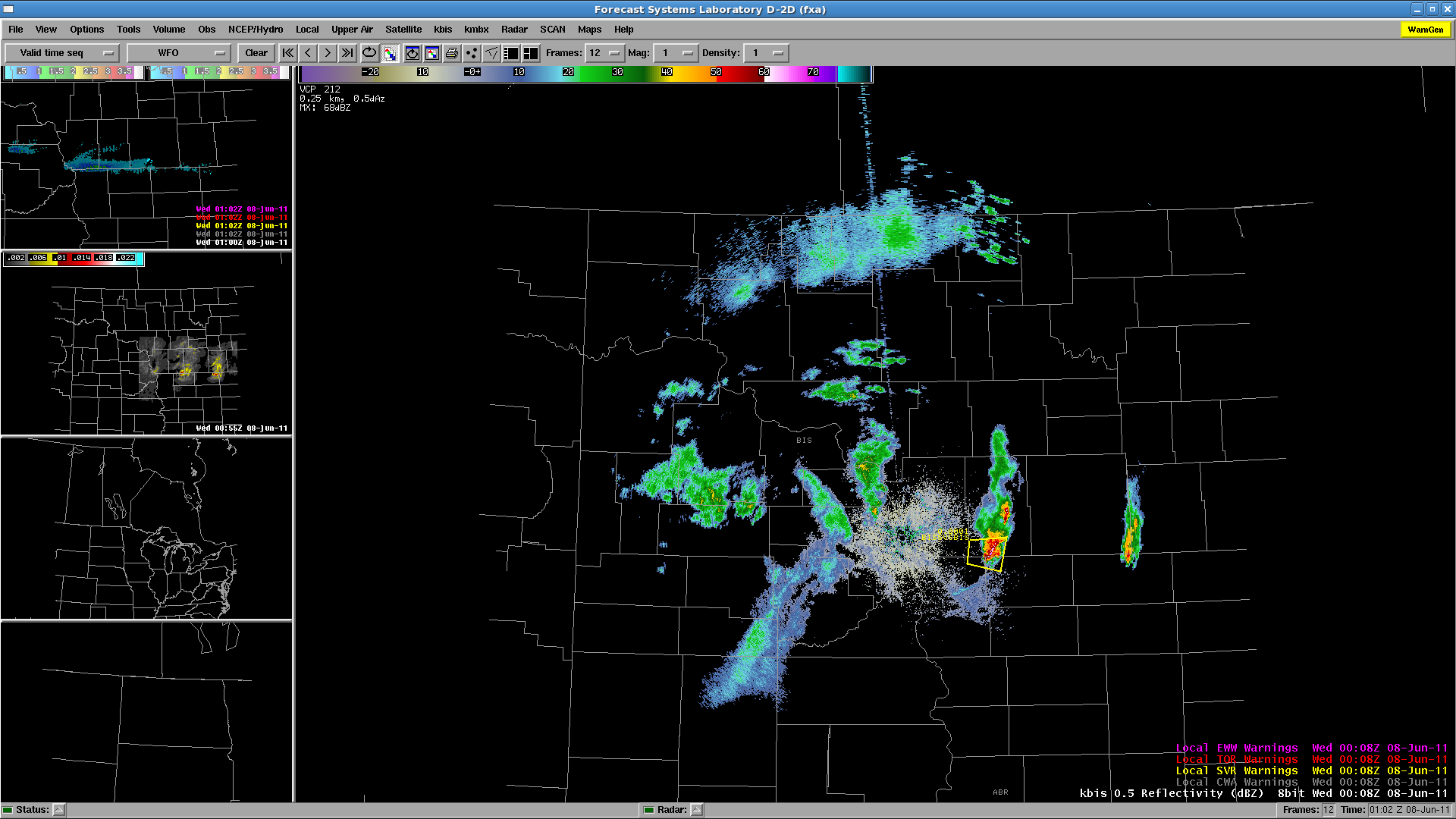
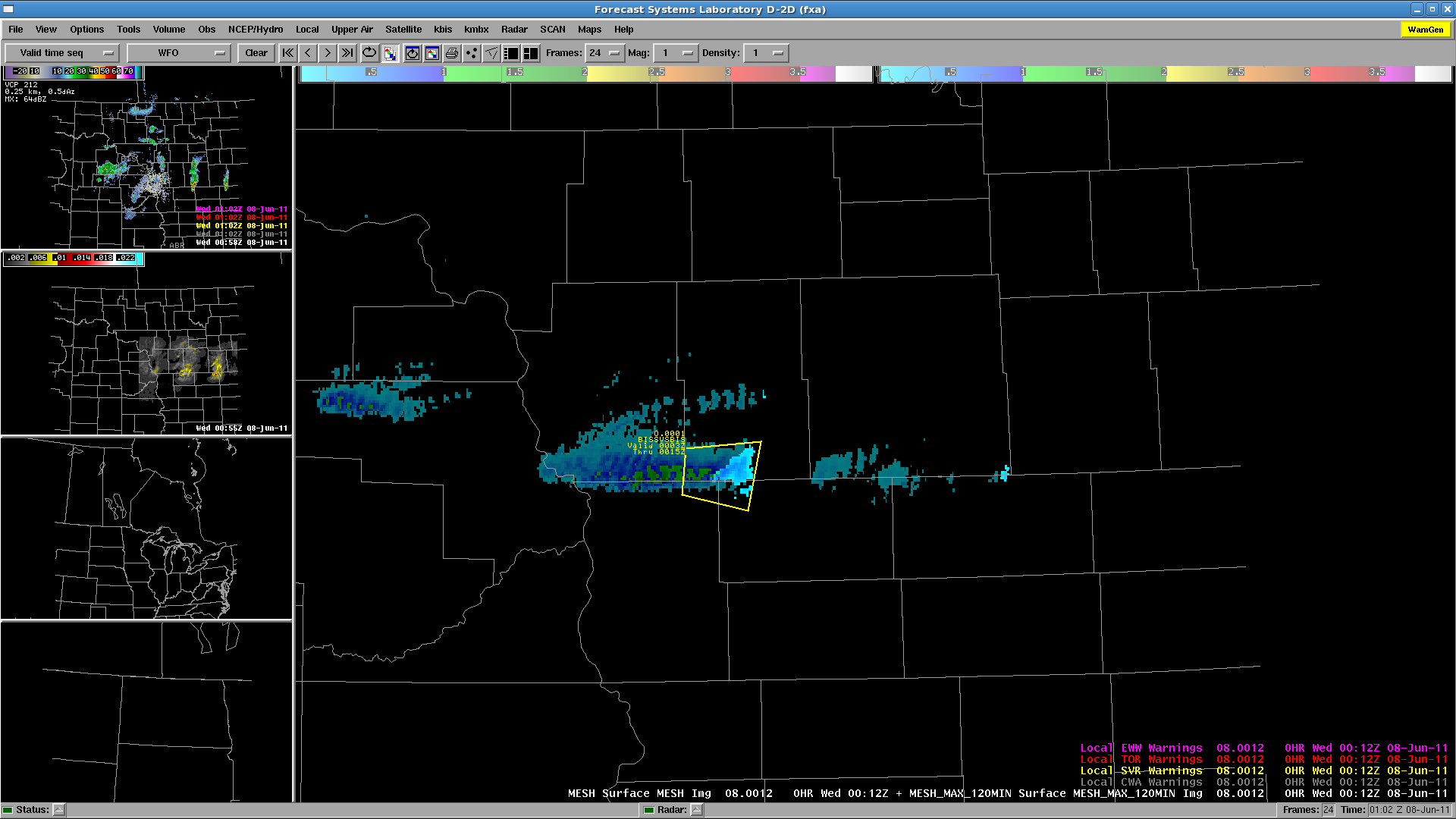
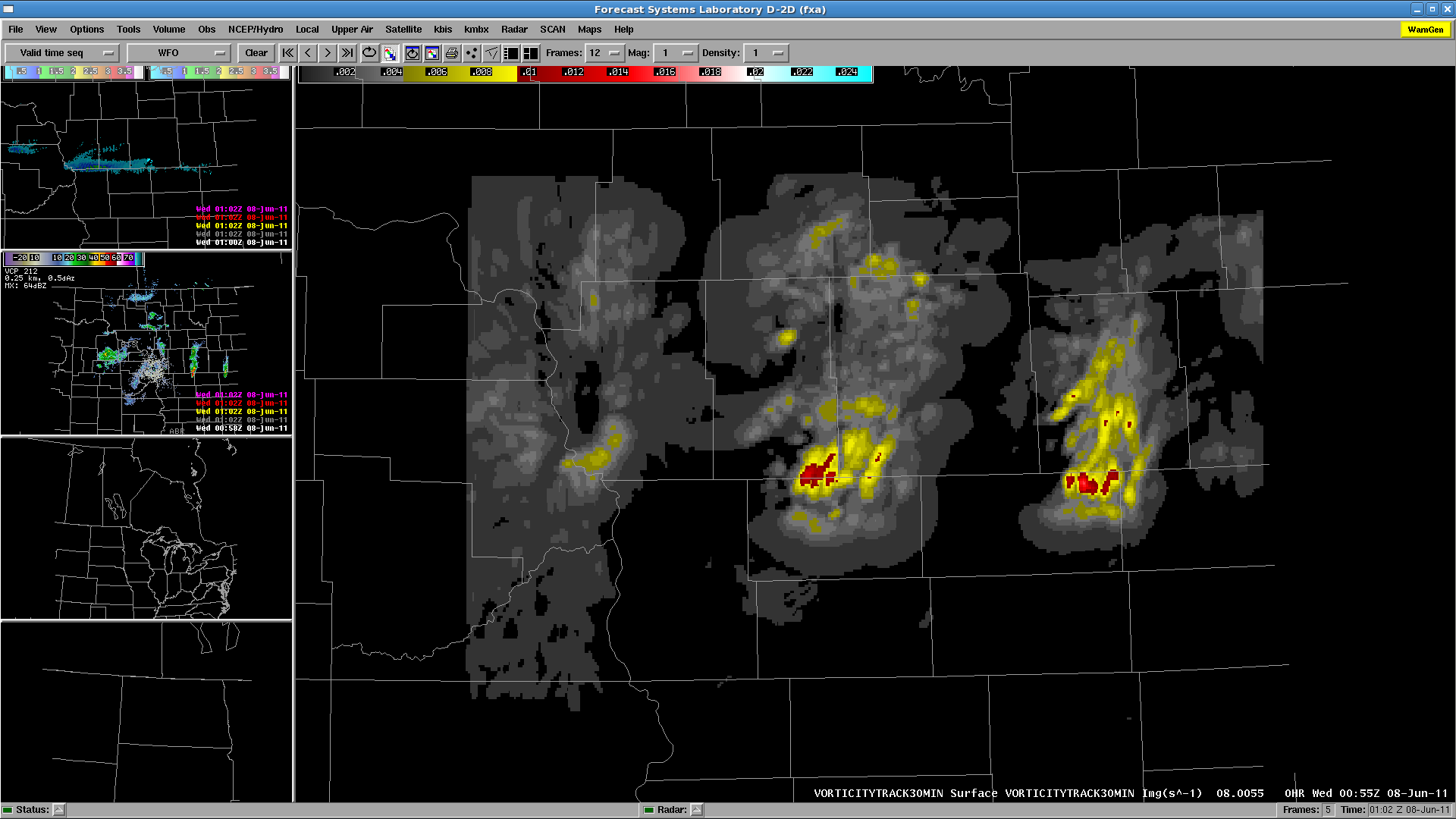
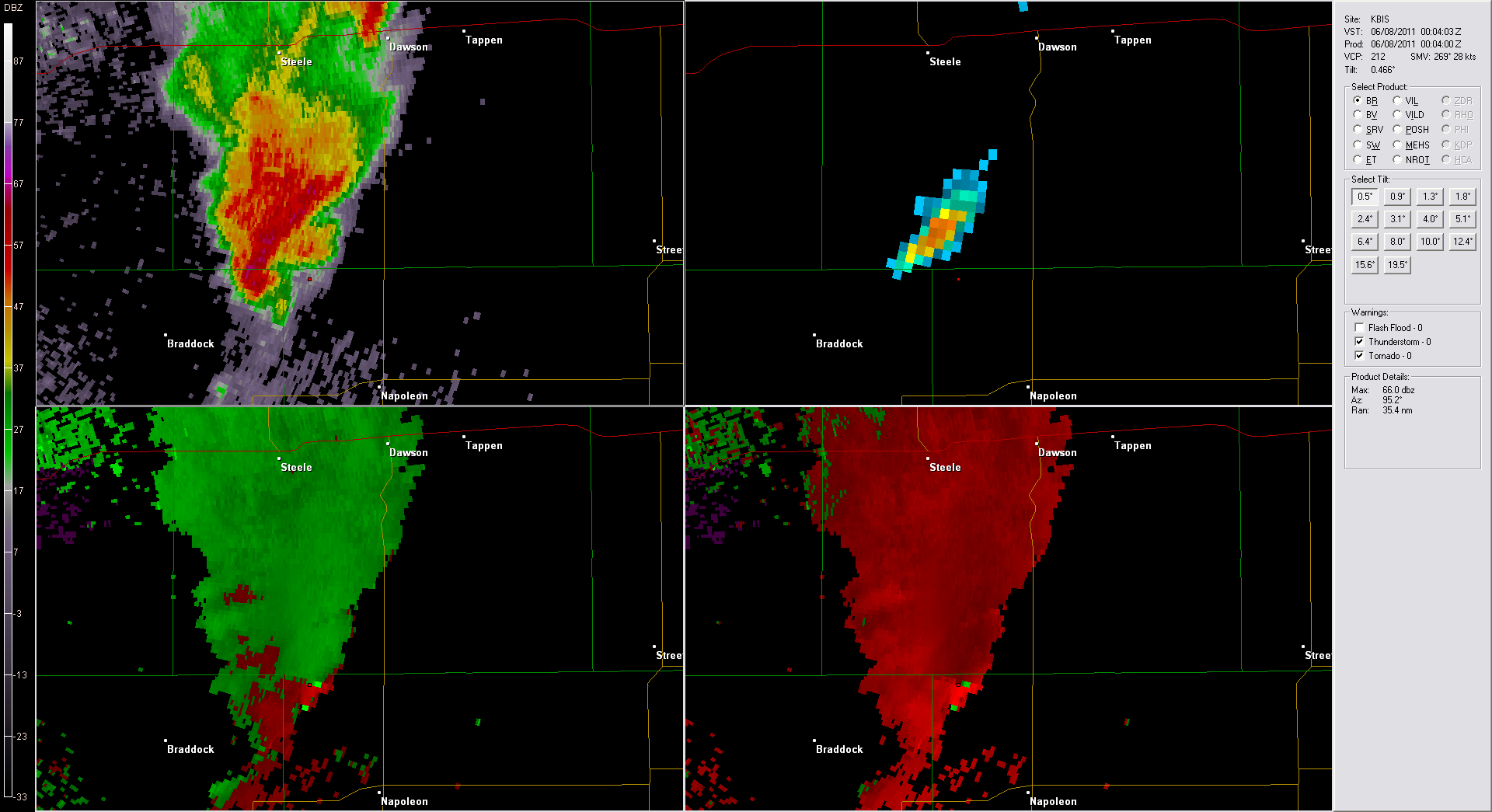
Bill and Justin worked three isolated storms in the BIS area, issuing a SVR warning on one of them. The basis for the SVR ground relative velocities, mainly a wind threat, perhaps 60-65 mph and 1″ hail. The actual WFO issued a Tornado Warning on the storm, but the EWP team felt that the circulation was too shallow to warrant a TOR. Our 3DVAR data feed was out until about 0040 UTC, and wasn’t used much for the warning. By then, the storms were below severe limits. While watching the 3DVAR on Jidong’s website prior to restoring the AWIPS feed, there was decent vorticity at 3km, perhaps at the time of the official NWS TOR warning. Here are some images:
Fig. 1. KBIS reflectivity and EWP SVR warning.
Fig 2. MESH and 120-min MESH Swath, and EWP SVR warning.
Fig 3. 30-min 3DVAR Vorticity Track.
Here’s an image at 0004 UTC at the time of the NWS TOR issuance. I’ve placed a marker where the supposed strong rotation couplet is observed. Note on the reflectivity image that this position is well out ahead of the “hook” in the clear air ahead of the storm core. Looks like side lobe contamination rather than a vortex couplet. There is no continuity upstairs either.
Fig 4. KBIS images from 0004 UTC 8 June 2011 from GR2AE.
We’ve wrapped up fpr the night, and the forecasters are filling out their surveys.
Enough waiting! We’ve decided to slide the MRMS and 3DVAR domains to the west to pick up the ongoing convection in BIS CWA. Re-locaizing the machines now. Will add BIS localization and either split Bill and Justin to BIS and FGF or put them both on BIS for now. They are taking a dinner break while AWIPS does its thing.
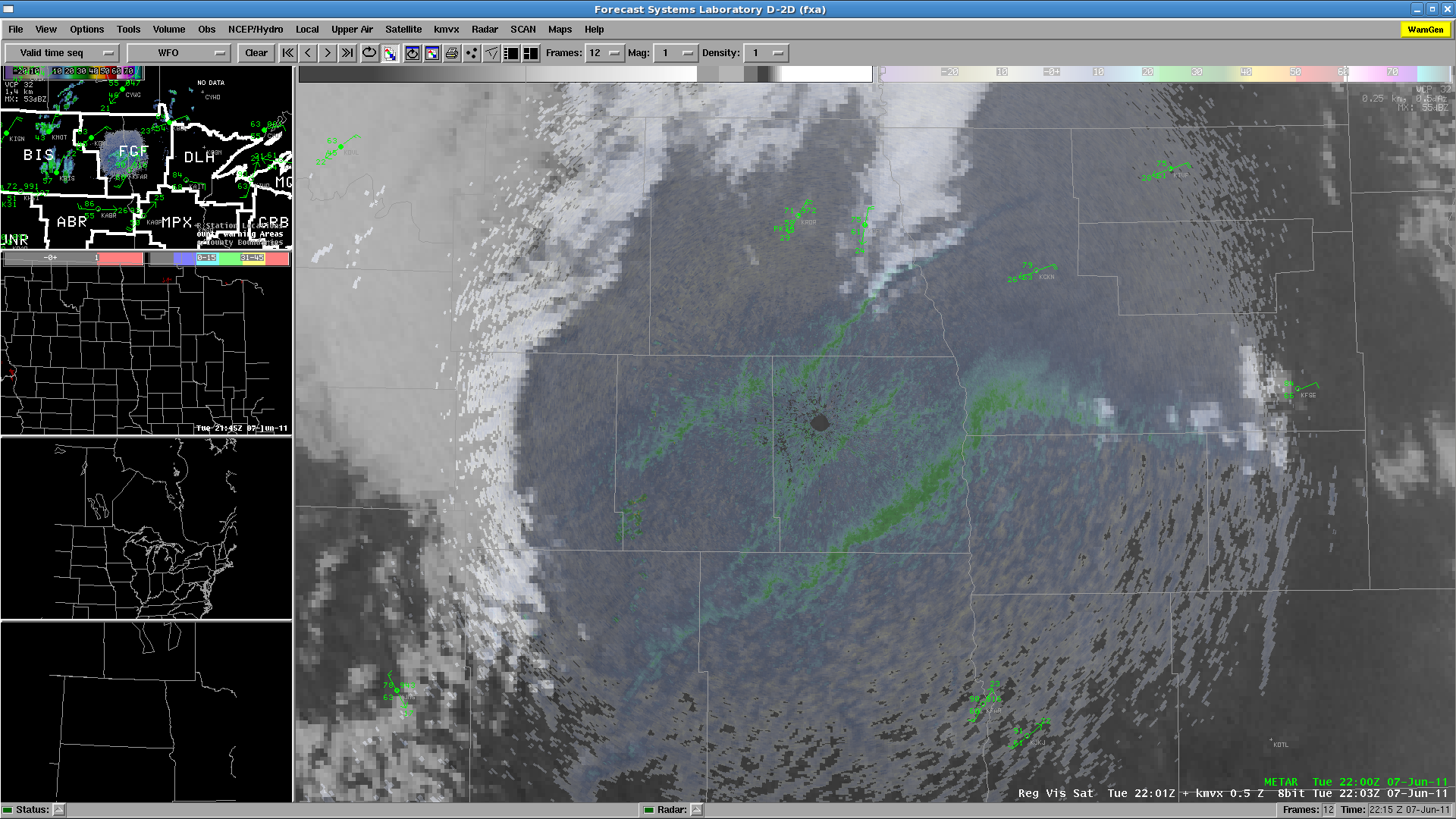
Well, we’ve been waiting, and there has been no CI in either DLH or FGF CWAs. There has been a hint of some towers on the bulging dryline near FGF, just east of the Red River in Minnesota:
but so far, most of the thunderstorms are remaining west in BIS’s CWA. Chris and Chris are ending their real-time shift and beginning their surveys. Meanwhile, Justin is being moved from the DLH WFO to join Bill on the FGF CWA, hoping for CI there, or even the storms in BIS area to move into the west edge of the CWA.
We are currently working two CWAs: Duluth MN and Grand Forks ND, in anticipation of convective initiation in our risk area. Nothing so far! The forecasters are monitoring the various CI products and the nearcast product, and we are in “wait mode”.
Satellite imagery reveals upper level energy…centered over southern Montana…with associated vort lobe extending through to northeast Colorado. Upper air analysis also indicates jet max from central Rockies region…then curves northward to the western Dakotas. Subjective surface analysis indicates a warm frontal boundary…from southeast North Dakota to northern Wisconsin.
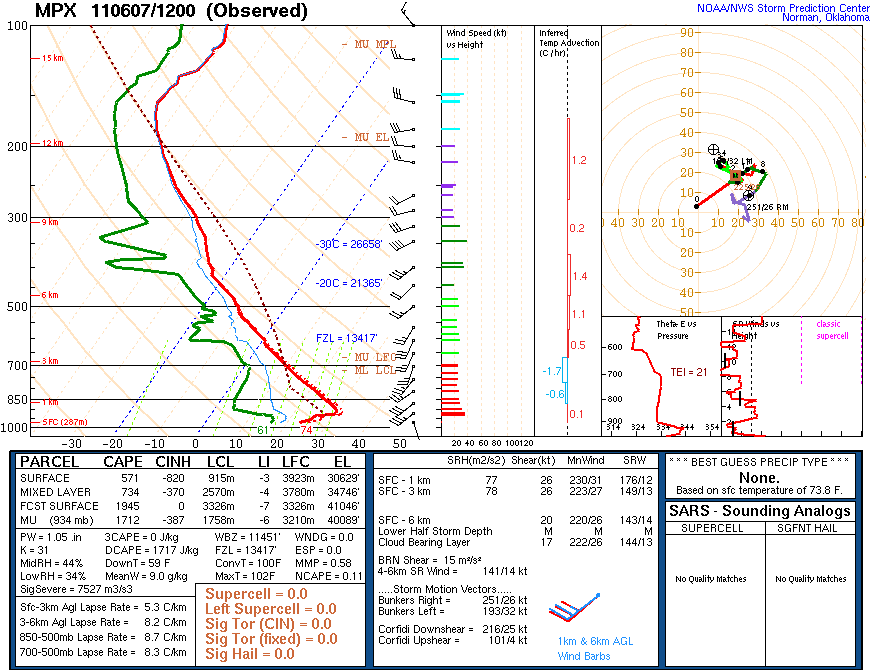
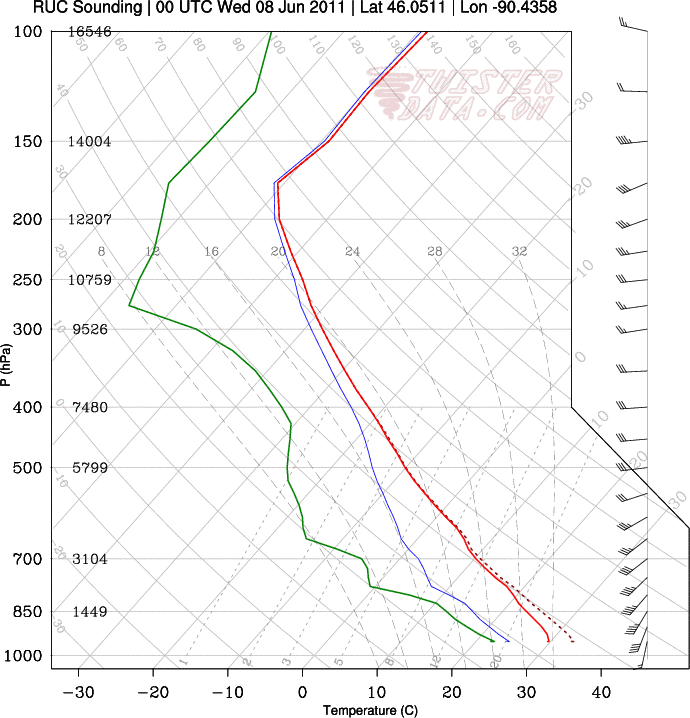
Surface based instability…south of the warm front…has already 2000 + j/kg….immediately south of warm front. Short term model output suggests that instability will reach extreme levels across much of Minnesota and Wisconsin…and the extreme eastern Dakotas…as the warm front lifts slowly northward this afternoon. Forecast soundings indicate deep layer shear will continue to be strong…as jet energy remains near the area. Forecast low level shear fields appear to be strongest…>200 m2/s2 …from long Canadian border from eastern North Dakota…northern Minnesota…to Lake Superior.
Forecast convective initiation will be affected by a considerable low-mid level cap…per 12z regional soundings.
However…this convective inhibition is expected to weaken…as upper wave rotates through the northern plains this afternoon and evening.
At this time…expect greatest potential for severe convection will be across these areas (in order of greatest potential) :
DLH
GRB/MQT
FGF
northern areas of MPX/ARX
At this time…supercells appeared to be preferred between 21z-03z..across areas 1 and 2…across areas of best distribution of surface based instability and deep layer shear.
DC LMA —
Limited possibility exists for thunderstorms in the D.C. LMA… as an ongoing mcs complex over eastern Ohio and northern West Virginia may continue to track southeast towards the DC LMA target area and/or provide a low level focus for new development. Models indicate better instabilities will be located over the western part of the LMA. Marginal deep level shear will limit the likelihood for supercell development.
Monday 6 June begins the fourth and final week of our four-week spring experiment of the 2011 NSSL-NWS Experimental Warning Program (EWP2011) in the NOAA Hazardous Weather Testbed at the National Weather Center in Norman, OK. Our distinguished NWS guests will be Bill Bunting (WFO Fort Worth, TX), Chris Buonanno (WFO Little Rock, AR), Justin Lane (WFO Greenville, SC), Chris Sohl (WFO Norman, OK), and Dan Miller (WFO Duluth, MN).
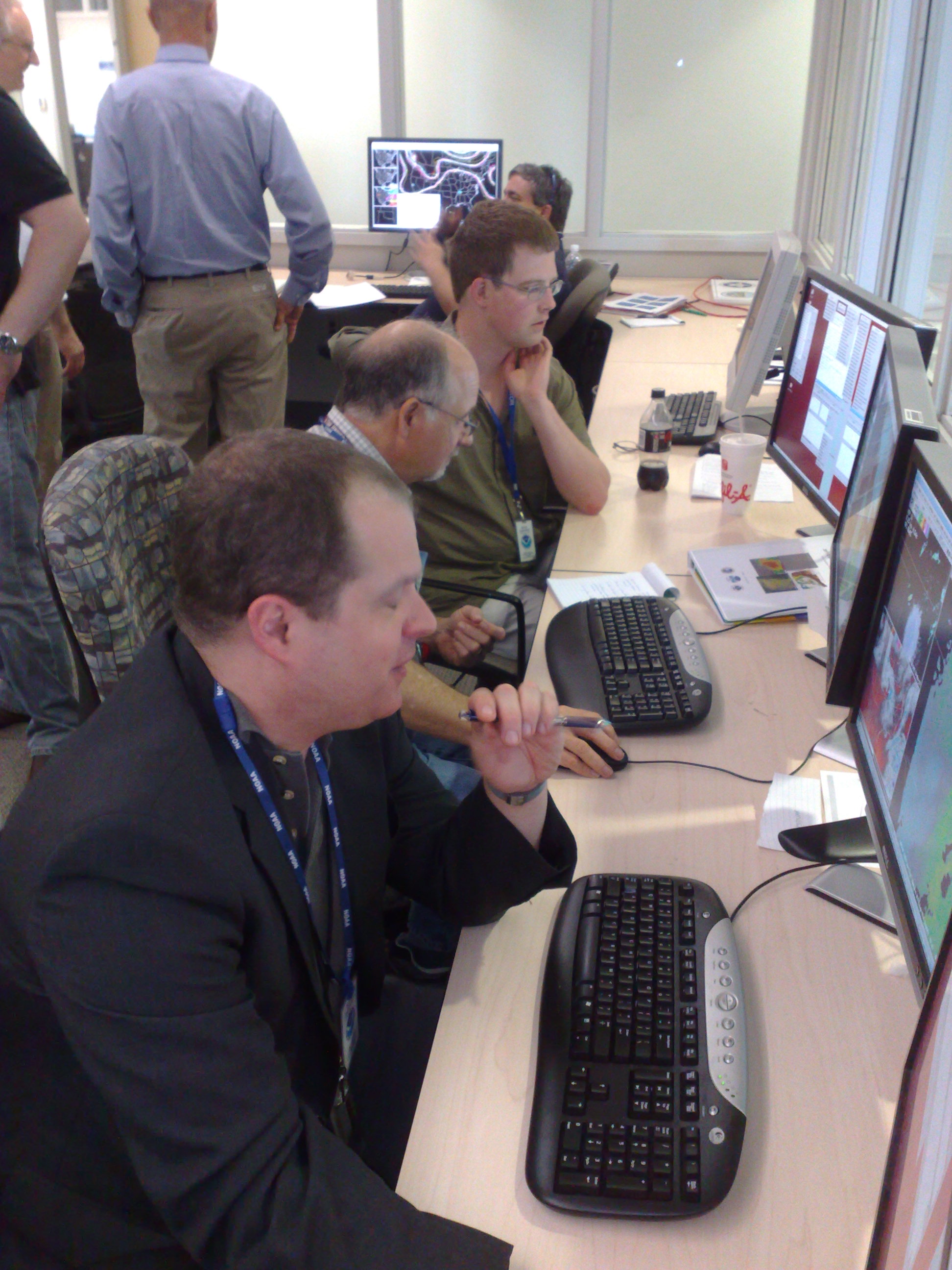
Photo 1: From the foreground…Chris Buonanno, Chris Sohl, and Pieter Groenemeijer.
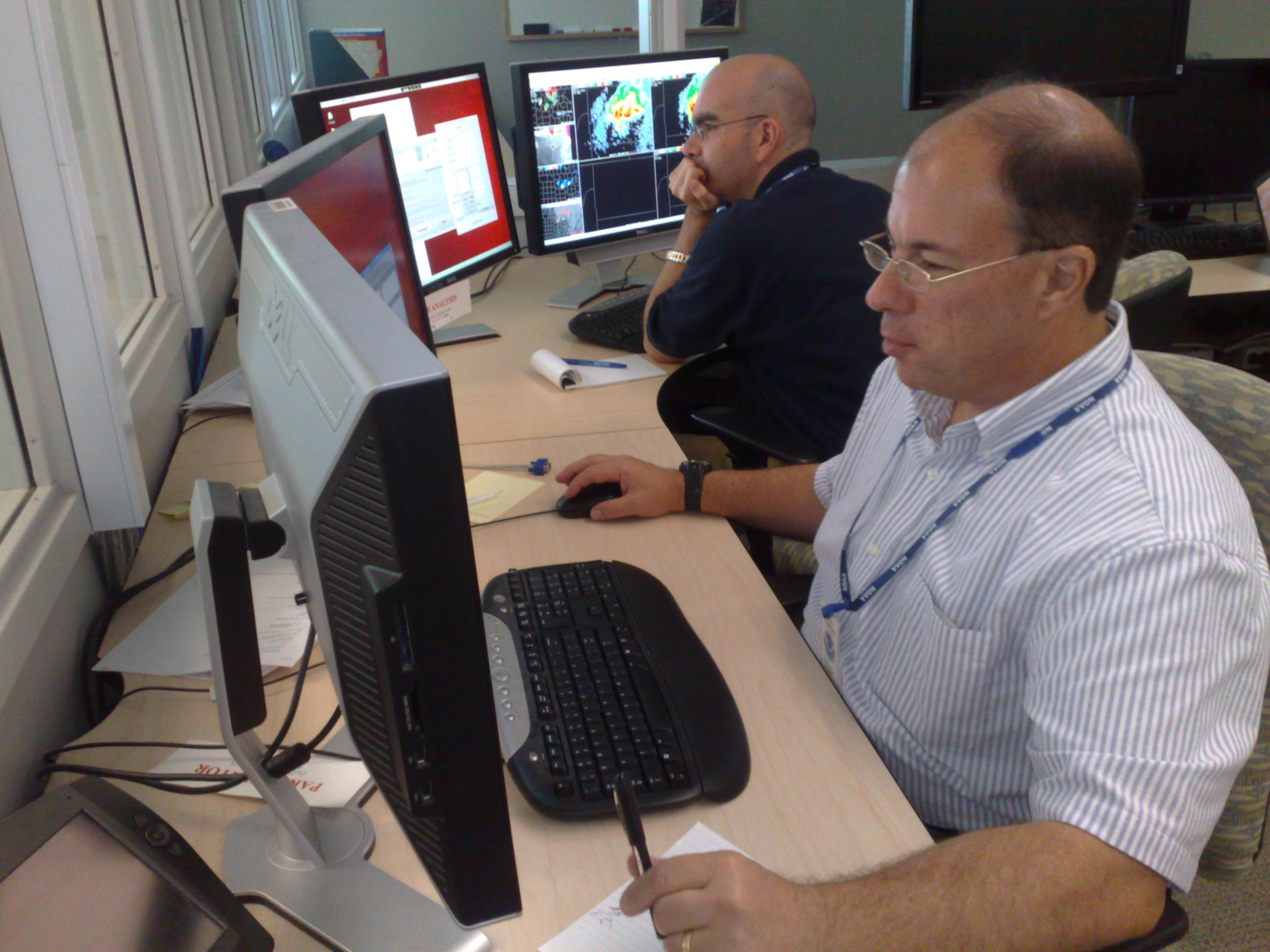
Photo 2: From the foreground…Bill Bunting and Justin Lane.
Other visiting participants this week will include Ralph Petersen (UW-CIMSS), Bob Aune (UW-CIMSS), Jordan Gerth (UW-CIMSS), Lori Schultz (UAH), Jim Gurka (NESDIS), and Pieter Groenemeijer (European Severe Storms Laboratory, Munich, Germany).
Today, Monday, is the time we spend training our visitors and getting them acquainted to the experimental products which they will be evaluating during real-time operations on Tue-Wed-Thu. The first half of the day consisted of PowerPoint presentations from the various project PIs. The second half of the day, they are perusing the experimental data on a displaced real-time case from 19 May 2010 over Central Oklahoma (High Risk supercell and tornado day).
Week #3 had a very interesting local event, with the following guest NWS forecasters: Jason Jordan (WFO Lubbock, TX), Daniel Leins (WFO Phoenix, AZ), Bobby Prentice (WDTB, Norman, OK), Pablo Santos (WFO Miami, FL), and Kevin E. Smith (WFO Paducah, KY). Other visiting participants this week will include Chris Jewett (UAH), Scott Rudlosky (UMD), Lee Cronce (UW-CIMSS), and Rudolf (Rudi) Kaltenböck (Austro Control, Vienna, Austria)
Overview of week 3
Monday was primarily a training day, and was spent familiarizing the forecasters with the products. They examined both the playback case we have used consistently each week of the experiment, as well as some real-time storms that developed in western OK.
Tuesday was possibly one of the more exciting days in the 5-year history of the EWP. The morning shift focused on examining the OUN WRF and other data sets, producing the discussion “Tornado Outbreak Likely over KS/OK/n TX.” We met with the EFP for a combined discussion at 1 pm, and quickly regrouped in the Development Lab for a more detailed strategy session, and were into operations mode by 2pm.
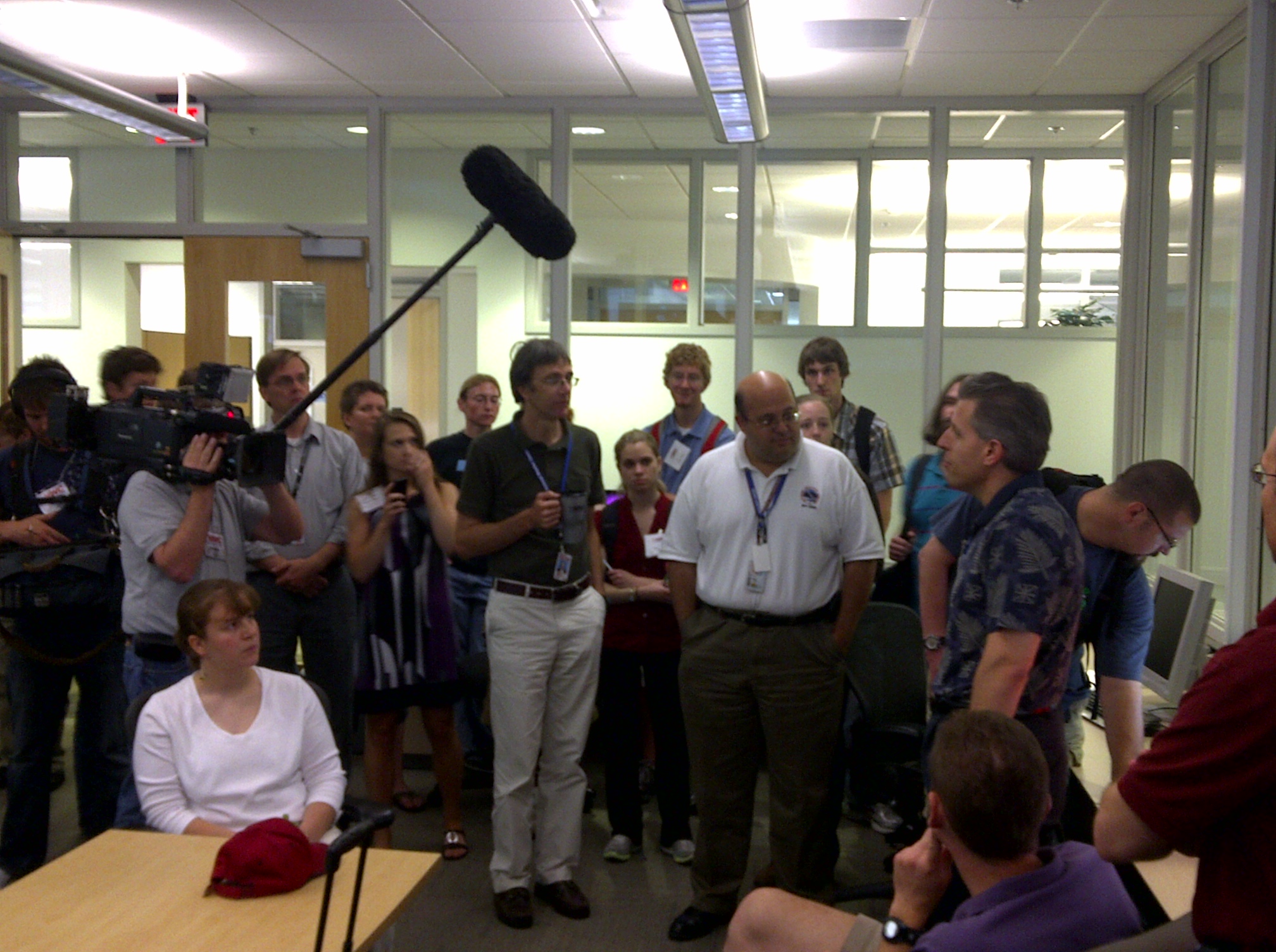
Bobby Prentice briefs the joint EWP/EFP (as well as a few media members) prior to the May 24th outbreak event.
As we moved into the mid-afternoon, supercells developed by 3:30pm, and by 4pm there were tornadoes being observed by spotters and shown in real-time on the Situational Awareness Display.
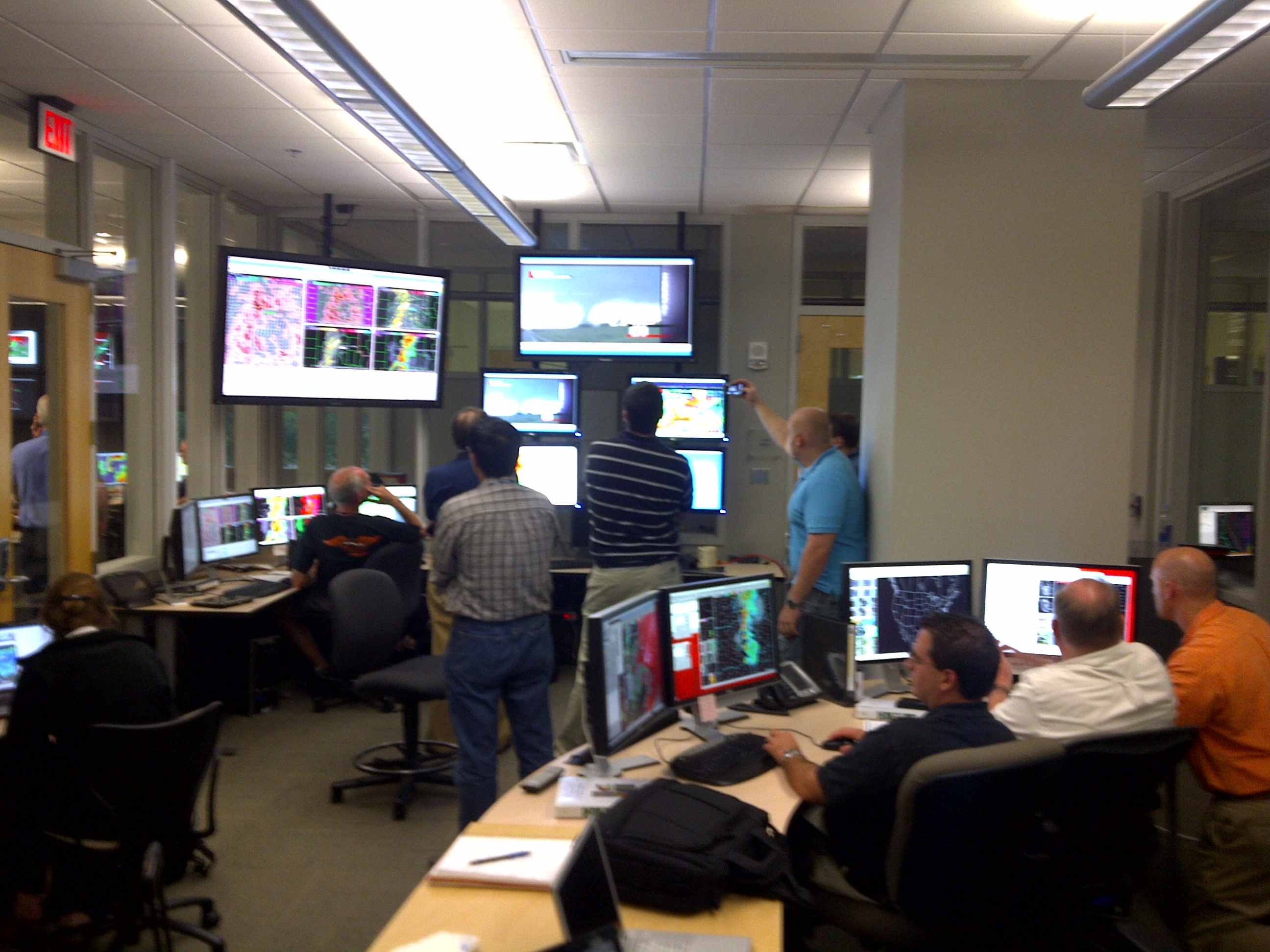
A tornado is observed in real-time on the HWT Situational Awareness Display.
With several supercells approaching central Oklahoma, one group took responsibility for the northern cluster of storms, while the other group observed the southern storms. Forecasters were able to evaluate all the experimental products (GOES-R, 3DVAR, OUN WRF), although the pGLM feed stopped when one of the OK Lightning Mapping Array sites was damaged by a tornado. At 5:45pm, the National Weather Center security desk called for everyone to take shelter on the lower level of the NWC. A few forecasters stayed and observed the storm approaching on radar, but operations were suspended.
As Jason Jordan wrote:
The majority of the forecasters stayed in the HWT to watch the storms as they approached the National Weather Center. Live data from the PAR along with area TDWRs and the KTLX radar showed an impressive evolution of two confirmed tornadic debris balls as the storms moved towards us.
The 3DVar products all handled the track and evolution of the storms very well and the combined radar products also have an excellent track of the tornadoes as well. Continuity was maintained as the storms moved into the cone of silence of the KTLX radar.
As the storms started to move into the metro OKC area, attention to the details/operations was lost as we watched live TV feeds and could see the hail falling outside the WFO window. The excitement rapidly turned to sorrow however as the live TV feeds showed homes and structures being ripped apart.
One last item that made it very clear how close we were to being impacted by the tornadoes directly; leaf and light matter debris was falling from the sky when several EWP members went up to the roof of the NWC to see the dissipation of the tornado moving south of Norman.
Because Central Oklahoma was affected by several violent tornadoes, we suspended operations on Wednesday, and all EWP participants assisted the Norman NWSFO in surveying the damage. With the help of the EWP teams and others from the Norman community, 8-10 groups of 2-3 people each were able to survey a majority of the damage in one day.
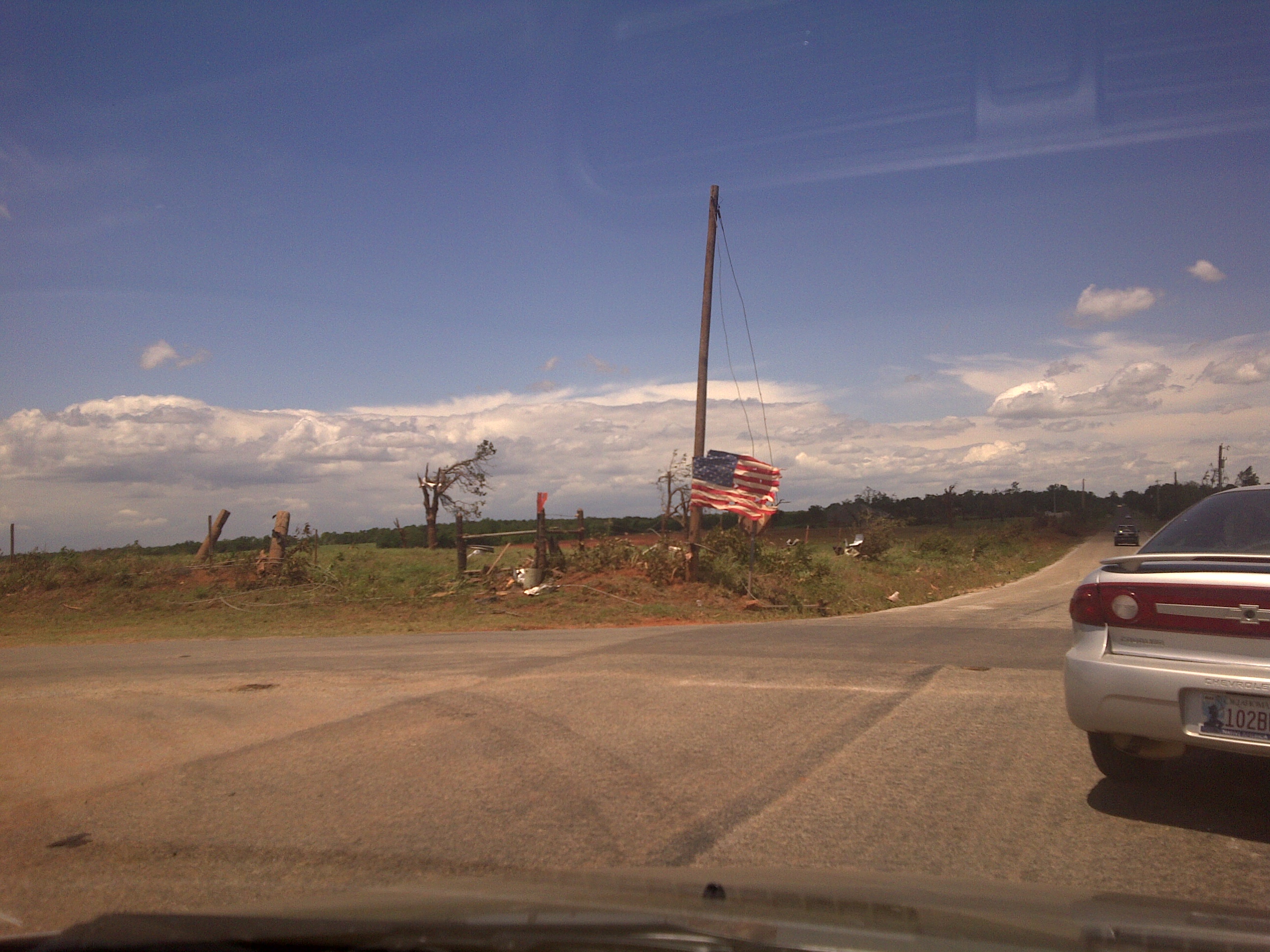
Old Glory flies near Blanchard OK, in the path of an EF4 tornado's destruction.
Thursday’s operations focused on convection in Pennsylvania and Maryland, which allowed additional use of the pGLM products from the DC LMA. The CI and Nearcast products were examined during the early shift, and the 3DVAR and other remaining satellite products were used during warning operations.
Our usual Friday round-table discussion of the week’s activities provided a lot of additional feedback. Comments:
UH CI:
performance should improve with next-gen satellites. Probabilities would be a good addition.
the CI algorithm may not work work outside the plains region (although it did work in Florida on Thursday)
Other Satellite products:
the precipitable water was a nice utility. Theta-E max on Tuesday showed that the storm was moving into an even more unstable environment. Gave some additional lead time. Chris S. commented that this was not the way the creators originally intended to use it, but is a nice fall-out from the research.
another forecaster commented that these products could be useful for off-shore significant weather.
pGLM:
Tuesday, looking start of El Reno storm, cell mergers, rapid increase in flash rate w/ big changes in updraft intensity. Downstream increase in anvil activity seemed predictive of where the supercell was moving / regenerating. We also saw that in the Sterling data on Thursday – rapid increase, led to a closer look and noticed that new cell generation was occurring.
10-15 minute lead time over CG network. Lots of potential uses, but need more research.
General consensus is the a ration of in-cloud to CG-lightning would be interesting.
The presence of persistent lightning over time may be related to flash flooding
OUN WRF:
it did really well on Tuesday. Looked at it hour-after-hour. Updraft Helicity, vorticity. Probably an accident (jokingly), but was surprised how well it did. Good groundwork for Warn-on-Forecast. Very promising.
echo previous comment. Could look at HRRR model for initial conditions. May be a good boundary condition for OUN WRF in situations where you have less-than-stellar data.
Florida forecasters were impressed with HRRR in FL so much that they have started to use it as initial boundary condition. Have you done any verification versus MR/MS products?
OUN would like to use the SPC methods for scoring output for this.
the displays are unviewable in some cases. Too cluttered.
Flash Flood – would be nice to have accumulated precip.
could do Rotation Tracks, trend analysis.
Side discussion on mesoscale and storm-scale ensembles:
need a way to establish reliability of ensembles
challenge to consider options – need a statistical complement to the ensemble – statistical distribution of storm behavior.
Mark DeMaria paper on blending statistical and dynamic model ensembles to determine improve reliability
also reference independent study in the Miami Herald on Probability of Precipitation forecast. Newspaper used a reliability diagram to show NWS PoP skill.
3DVAR :
liked updraft intensity a lot. Could be used in the microburst environment to detect which cells may be severe.
Did an outstanding job on the Tuesday event
No doubt that this would be useful. Need to get it into OSIP right away.
AWIPS thoughts:
need some default procedures in AWIPS. Half the battle was that it was very inefficient to view them. Lots of time wasted.
yes! Had to recreate his procedures. Much of his data was missing do to not having a full feed in AWIPS (note: this will be fixed in AWIPS2 next year).
most of these are just relational. Want to evaluate as many procdures as possible in as little time as possible. Synergistic across multiple projects.
Other forecaster thoughts:
Powerpoint training is not the best. Would prefer “Articulates”
include data from previous real-time case to demonstrate. Perhaps a Virtual Machine for AWIPS
forecasters should be required to do pre-work before arriving at the HWT. This would allow Monday to be used for operations instead of training.