


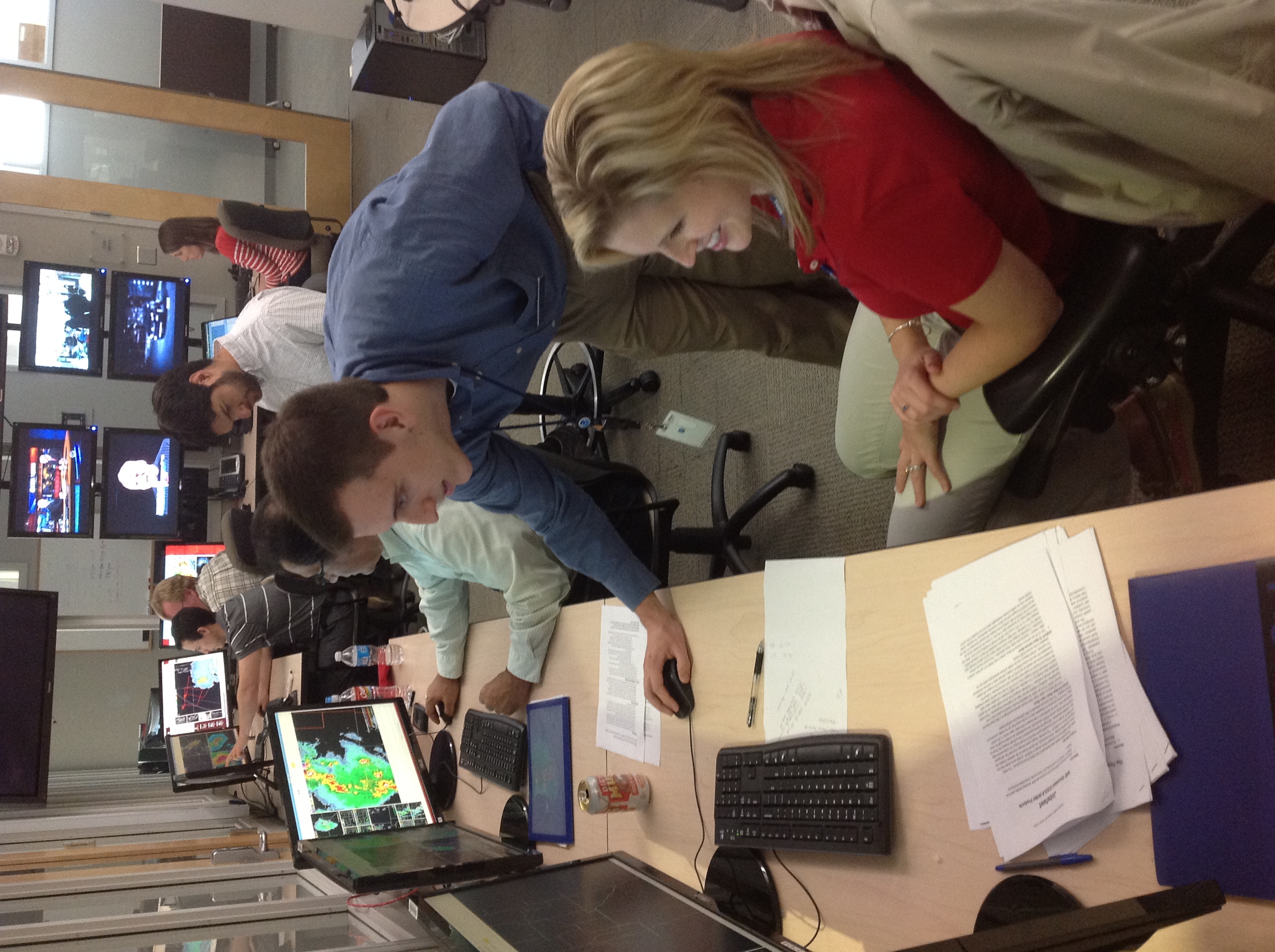
Our visiting forecasters and EWP support team hard at work issuing warnings for EPZ and BRO.
Greg Stumpf, EWP2012 Week #1 Coordinator
Official websites use .gov
A
.gov website belongs to an official government
organization in the United States.
Secure .gov websites use HTTPS
A
lock (
) or https:// means you’ve safely connected to
the .gov website. Share sensitive information only on official,
secure websites.

Our visiting forecasters and EWP support team hard at work issuing warnings for EPZ and BRO.
Greg Stumpf, EWP2012 Week #1 Coordinator
Possible Tornadic thunderstorm continues to push east across northeast Hidalgo county. Maximum Surface vorticity values have increase to 22 s-1 and updraft helicity values have increase to 447 m/s2. Have not received any reports from this storm. However…it has been moving across an area where not many people live. Hovis/Barnes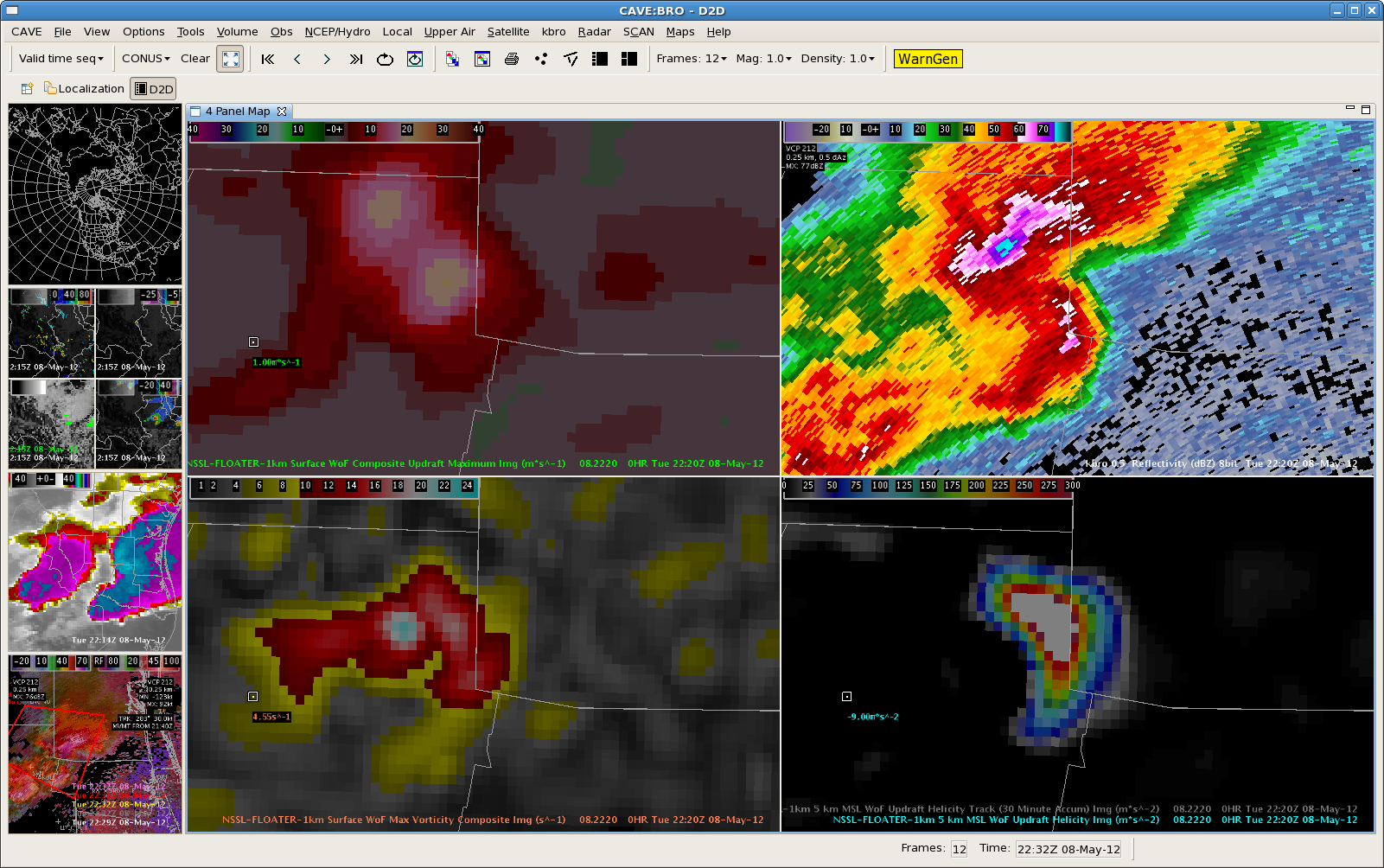
Impressive storm continues to move east across portions of south Texas. Max Vorticity values have increased to 21.5 s-1…with updraft helicity values to 539 m/s2. Maximum updraft values are much lower than expected with 19 m/s. However…feel these numbers are low because radars are all examining the storm around 7500 ft AGL. Hovi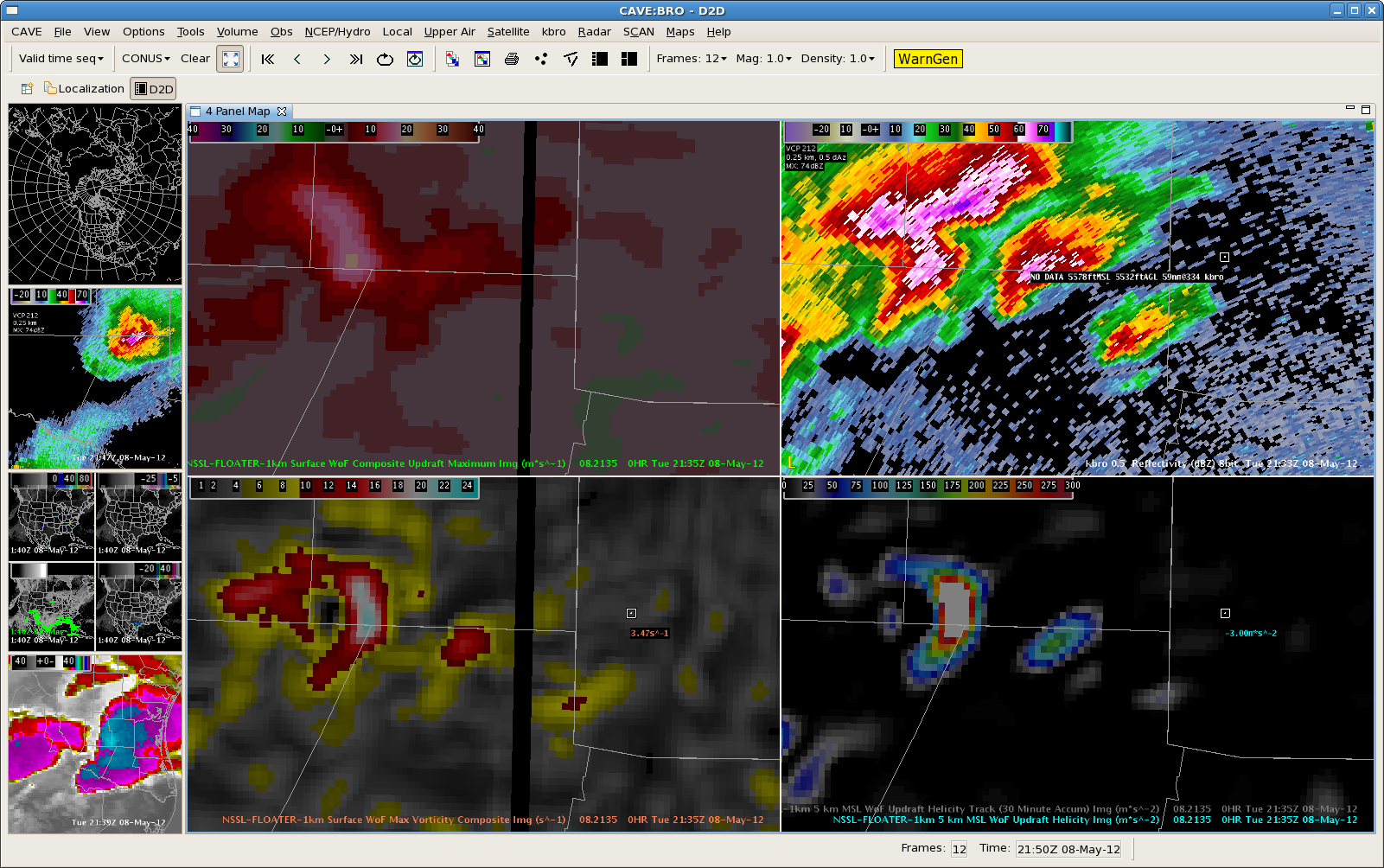 s/Barnes
The synthetic WRF run at 05082012 at 0Z correctly predicted several upper level features and mesoscales features correctly for the afternoon of 05082012. The following 4 images show synthetic WRF images of IR (upper left), WV (upper right), and 10.35u-12.3u IR Band Difference (lower left). Looking at the WV imagery you can see an upper low over the U.S. Southwest as well as an upper trough over the upper Midwest. In the IR and WV imagery you can see convection occurring from AZ to NM to TX to CO to Old Mexico. In the brighter white areas of IR, you can see low level cloud cover. In the Band Difference image, you can see the area of best moisture and “hot spot” for convective initiation in the southern tip of TX and into Mexico. The 5th image below is the true observed IR (upper left) and WV (upper right) which verifies the synthetic WRF.
This imagery would be very helpful to forecasters in the field because it seems to do a decent job of predicting upper level features, low level clouds, and convection 12-20 hrs in advance.
17Z Synthetic:
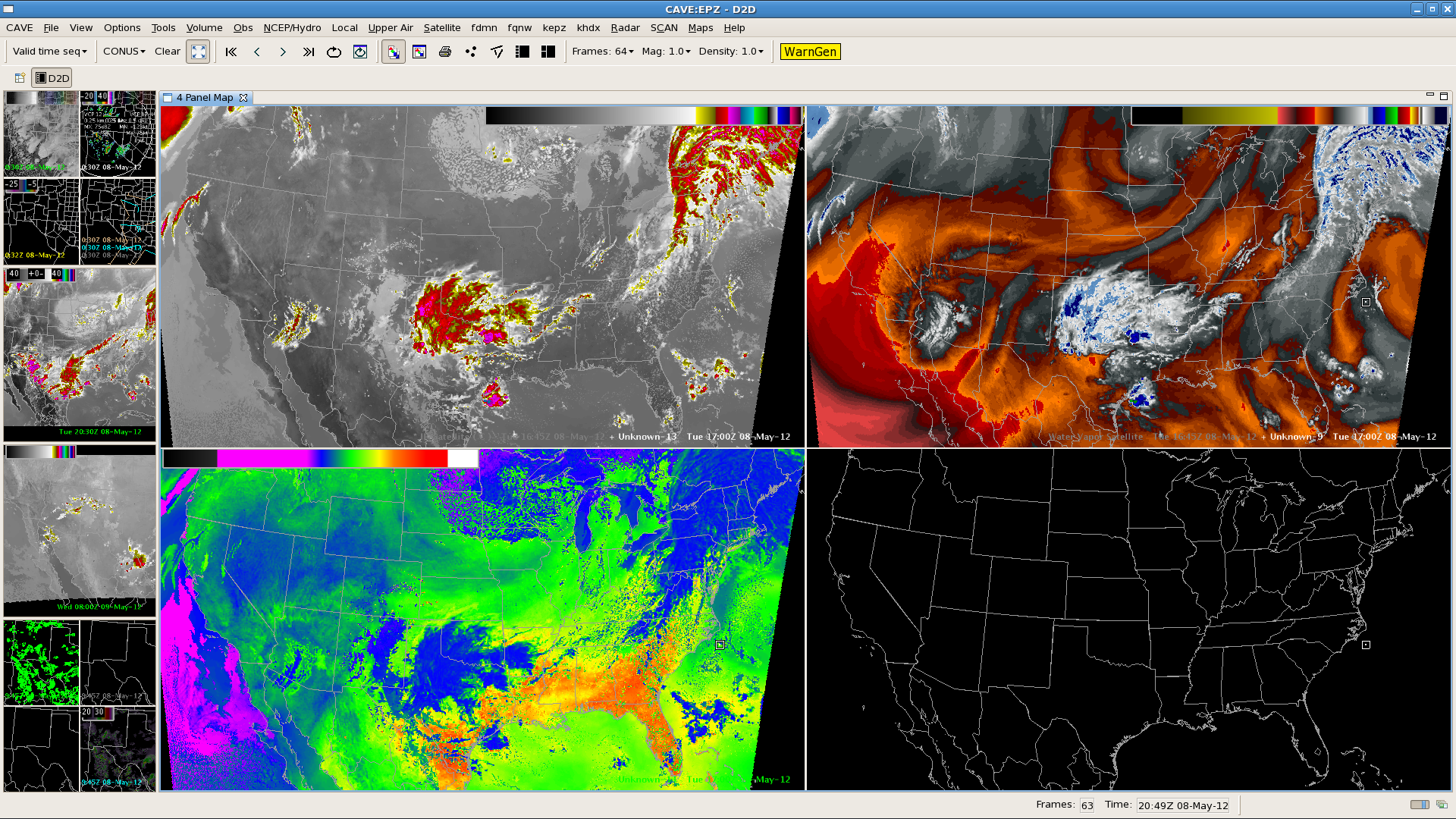
18Z Synthetic:
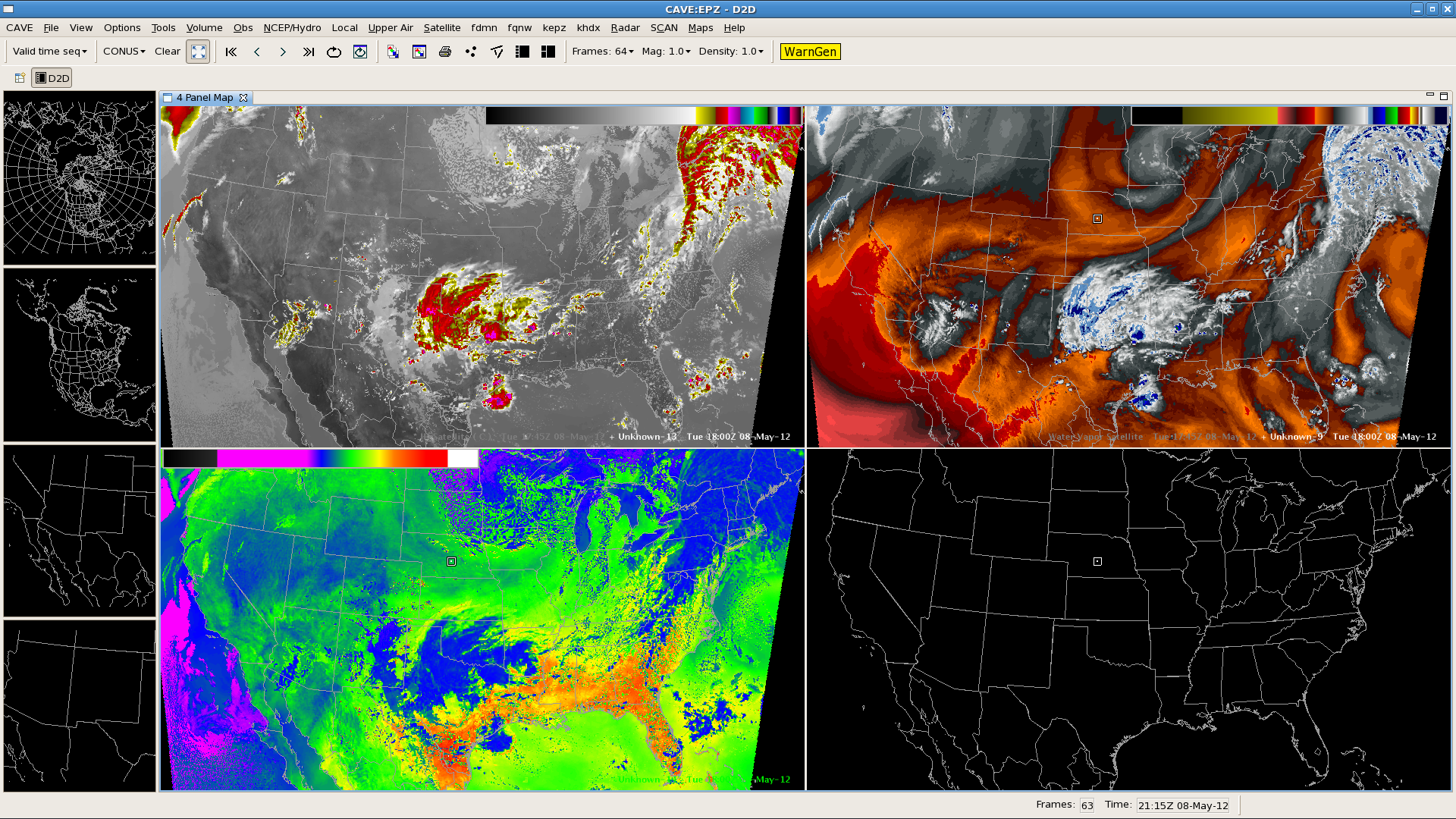
19Z Synthetic:
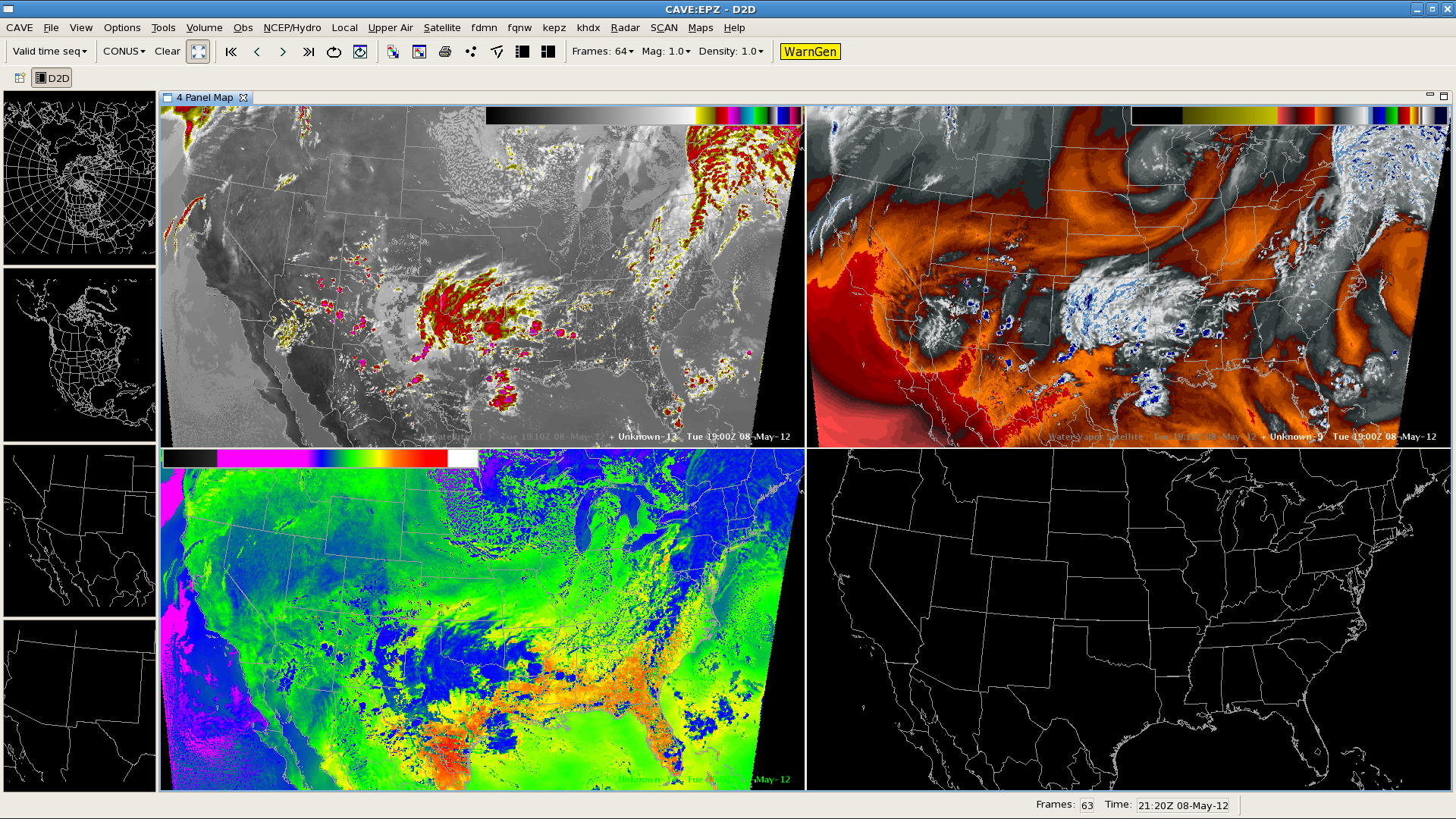
20Z Synthetic:
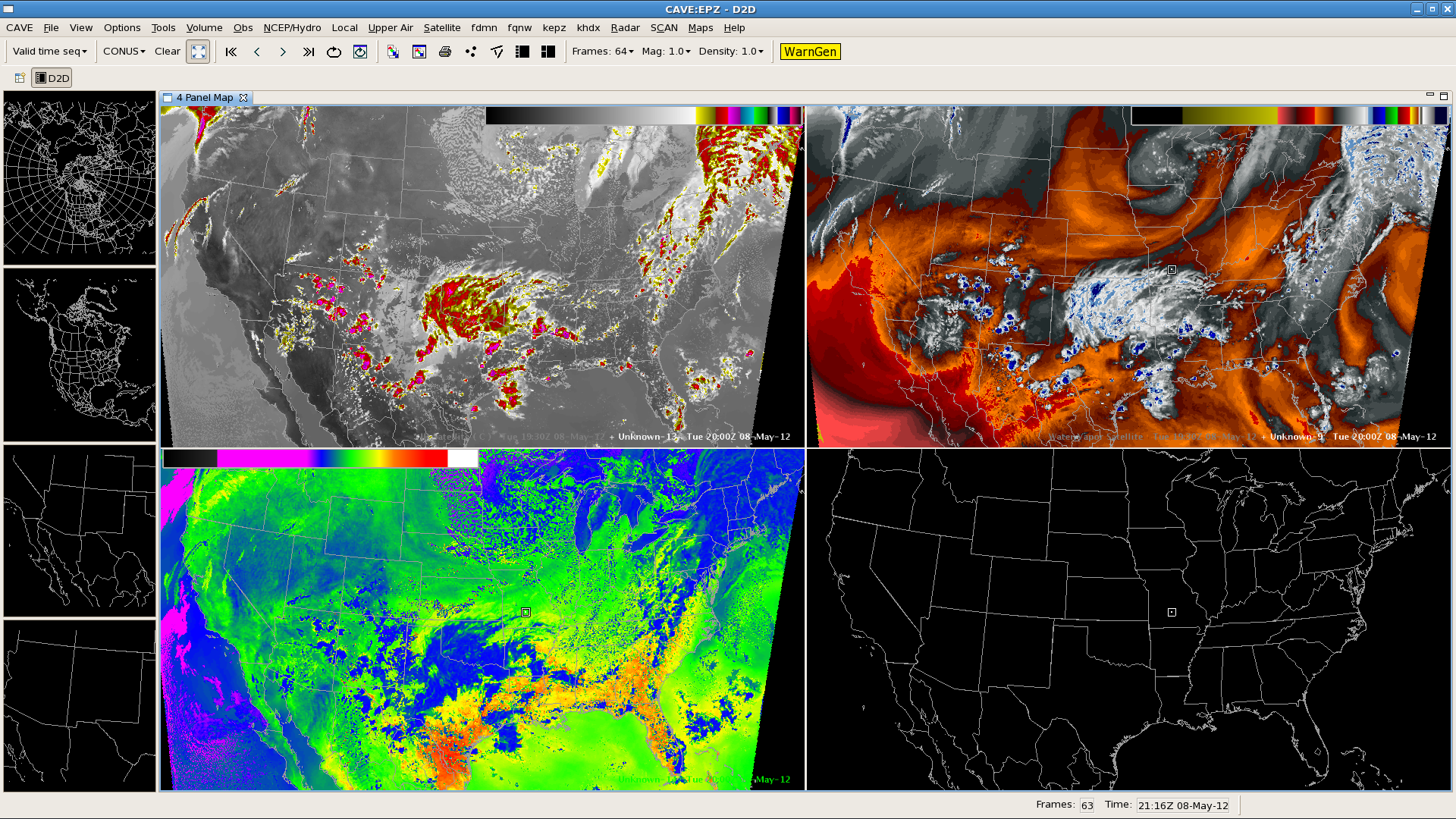
20Z Observed IR and WV:
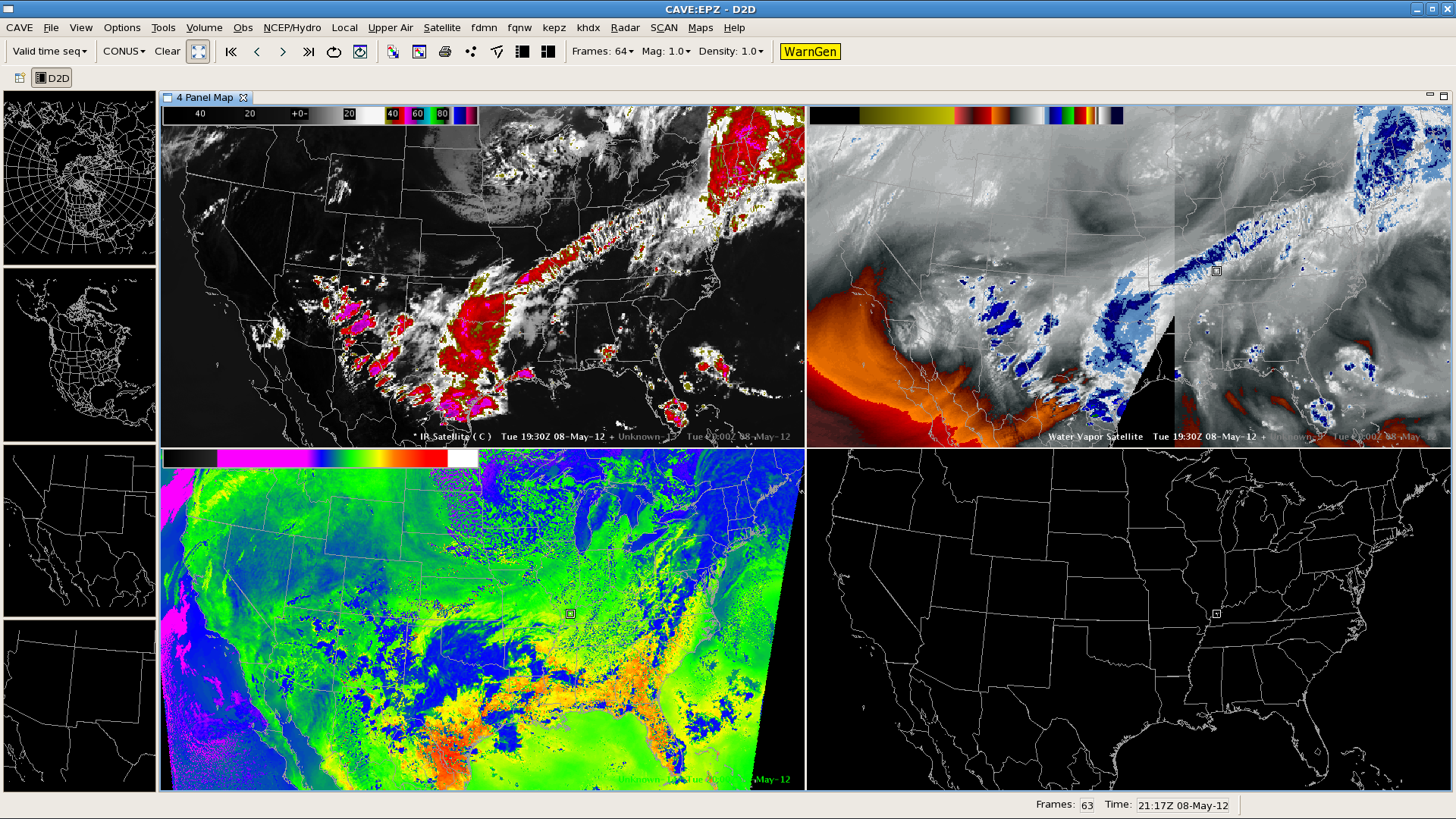
AMS
thunderstorms were strengthening south central NM. combination of legacy and GOES-R nearcast product support continued development. another area of storms were located just south of Luna and Dona Ana counties and moving north. we expect this activity to hold together and are likely to impact these two counties within the 1-2 hours. nunez

CI products were able to correctly depict a small hail producing t-storm about 1.5 hours ahead of time.
In the first image below, the UAH CI showed a 53 index (upper left) indicating significant cloud growth at 1732Z.

The next image below shows CIMSS CI of -7 to -8 K/15 min at 1745Z (lower left) which is typical of weak storms based on recent studies.

The next image below at 1901Z depicts the same storm, 1.5 hrs later when it first reaches 60 dbz in KEPZ comp reflectivity (upper right) and 77-80 DVIL (lower right). At this point the storm is likely producing small hail.

Another point to take away from this case is that for this environment, it takes about an index of 50 to 60 UAH CI to produce strong storms.
AMS
Here are a couple of FSI images of the storm that is still in Mexico. Definitely a supercell, worthy of a SVR for large hail. TOR? Perhaps. But alas, it is not in the U.S.


Greg Stumpf, EWP2012 Week #1 Coordinator
Storm over northern Mexico…west of Rio Grande City…is likely severe. MESH is indicating 2 inch hail. 1-5 km helicity has been increasing over past 35 mins. Also storm is 65 dBZ at minus -20 degC. Barns/Hovis
At 1732z…UAH-CI showed a signal strength in excess of 90 and the UW-CTC showed cloud top cooling of -9 degC. Storm did develop in the area where the two values were seen around 1745z and continued thru 1845z. Feel this is a success for both methods. Barnes/Hovis
Severe storm over northern Starr county increasing in intensity. This can be seen in the maximum updraft product. In addition…Max surface vorticity and Updraft Helicity associated with this storm have been increasing with time. Vorticity (up to 3 km & 3-7 km)(not shown) are also increasing. SRM still not showing any rotation…but will continue to monitor storm. Barnes/Hovis
