LAPS CAPE Forecasts and Radar Observations…

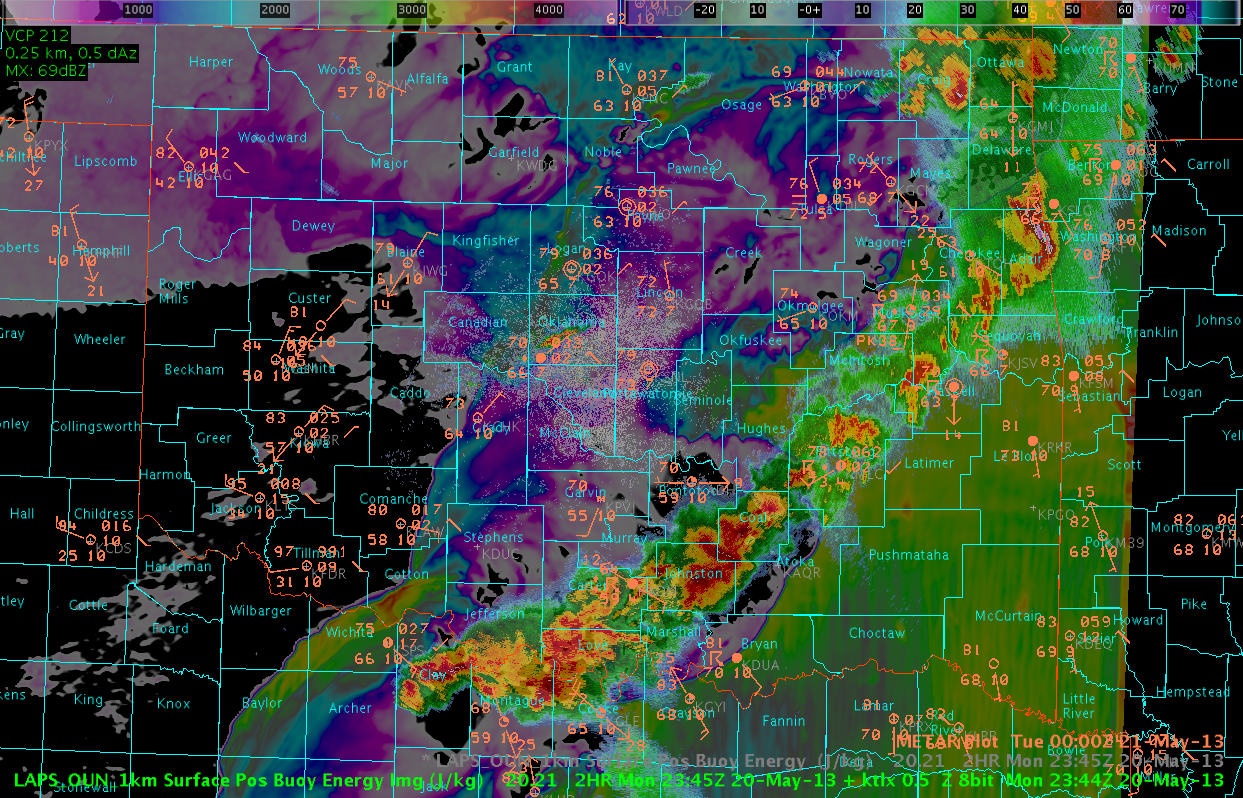
The following imagery are taken from the 21 UTC forecast run of the 1 km LAPS model and are overlaid with KTLX 0.5 reflectivity imagery.  At the first image below, valid at 21 UTC, or the model initialization time, you can see the ribbon of high CAPE values, exceeding 4-5000 J/KG is some areas, stretching from SW-NE across portions of north Texas and central Oklahoma.  The radar imagery initially are valid at 2116 UTC.  Notice the large supercell over the Red River in Clay and Jefferson Counties.  The LAPS CAPE values can serve as a proxy of sorts for the resulting reduction of CAPE in association with the outflow from this storm.  In subsequent imagery, the outlow (or relatively low CAPE field) can be seen to migrate quickly northward.  In image 2, the wind at KPJV is observed to shift from the south, as the outflow boundary crossed the area.  The timing matched the LAPS forecast values quite well.  Later, in images 3 and 4, as the outflow boundary intersected an area of higher CAPE in the OK City metro, a small storm suddenly develops.  The timing of the propagating outflow boundary was handled very well by the LAPS model in this particular case.
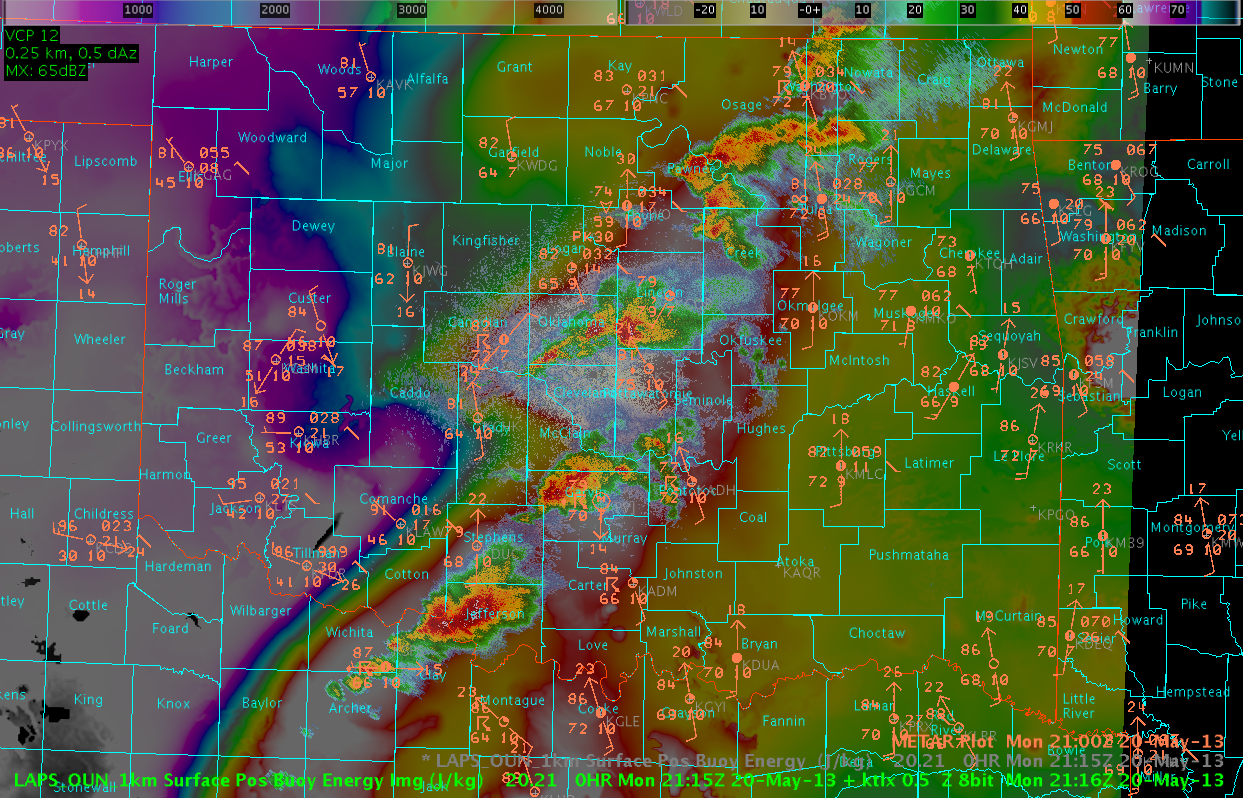
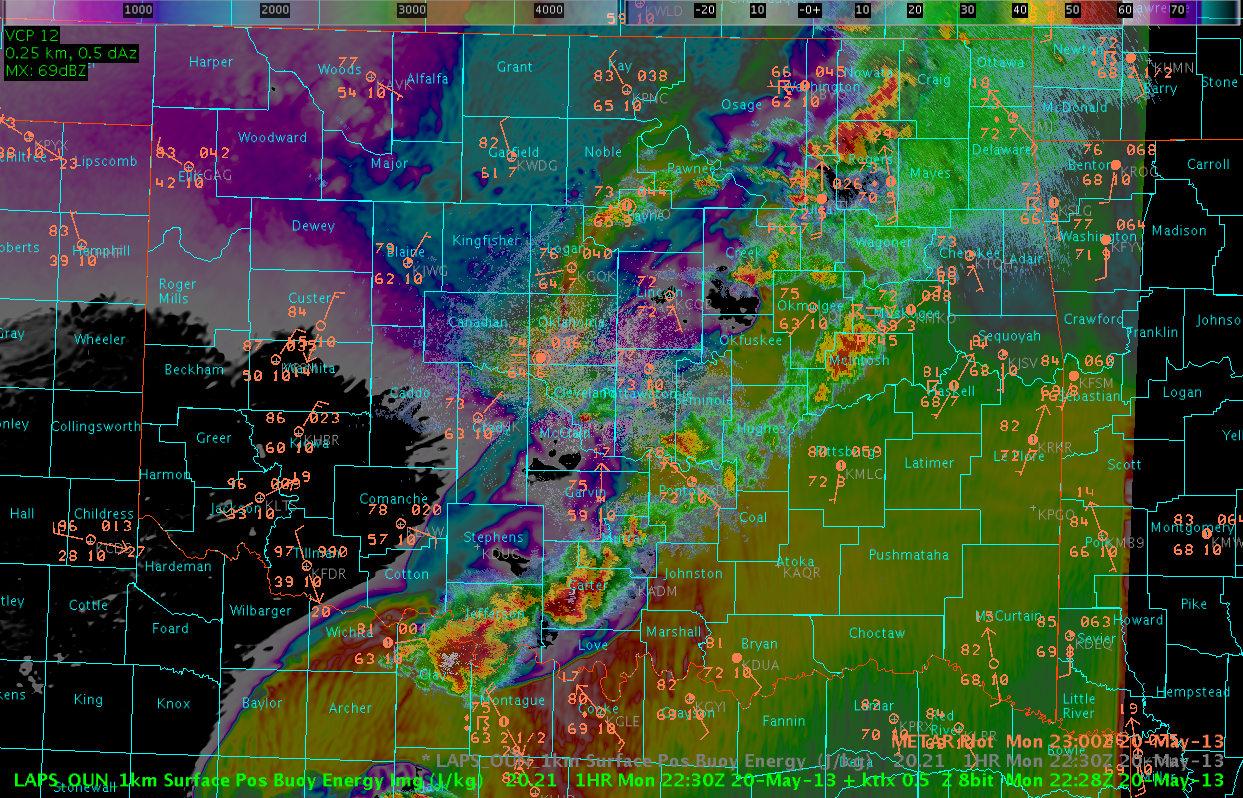
Image 1.  LAPS CAPE values (K) at 2115 UTC, overlaid with KLTX 0.5 degree reflectivity. Observations included.
Image 1. LAPS CAPE values (K) at 2115 UTC, overlaid with KLTX 0.5 degree reflectivity. Observations included.
Image 2.
Image 2.  LAPS CAPE values (K) at 2300 UTC, overlaid with KLTX 0.5 degree reflectivity.  Observations included.
Image 3.  LAPS CAPE values (K) at 2345 UTC, overlaid with KLTX 0.5 degree reflectivity. Observations included.
Image 3. LAPS CAPE values (K) at 2345 UTC, overlaid with KLTX 0.5 degree reflectivity. Observations included.  Notice the small cell that has developed over the OKC metro.
Image 4.  LAPS CAPE values (K) at 0000 UTC, overlaid with KLTX 0.5 degree reflectivity. Observations included.
Image 4. LAPS CAPE values (K) at 0000 UTC, overlaid with KLTX 0.5 degree reflectivity. Observations included.

Too bad we couldn’t show a loop of the imagery, because the LAPS’ handling of the outflow from the convection was rather stunning.

Tags: None

Severe Warning for Hail, Palo Pinto County, TX

We issued a severe thunderstorm warning for northern Palo Pinto County and close areas after noting an increase in vertically integrated ice and both POSH and MESH in a small column along the county border.  We didn’t see a lot of reflectivity above -20 C but felt the storm detail favored 1 inch hail.  Hail0014ZMonday

– McCormick

Tags: None

Oklahoma City Storm Dissipates

After developing off an old outflow boundary and near the triple point with the dryline, the storm encountered more stable air across northern OKC Metro.  Once this happened, the storm rapidly dissipated the storm rapidly per LAPS near time data and Theta-E trends in the near storm environment.

Tags: None

Flash Rates And Trends

Flash Rates have stayed steady or fallen across Johnstone/Coal counties in southern OK, but a have increased rapidly with a new some developing across northern OKC area.

This is likely the arriving of a second, strong shortwave disturbance arriving over the top of the cold front draped across central OK.

Tags: None

LAPS Observations and Determining Future Storm Development…

Just a quick post about observations of the LAPS theta-e field this afternoon. It was interesting to see the near stationary aspect of the theta-e boundary in assoc/w the dryline to our south across portions of north Texas this afternoon. This suggests that continued development is possible late this afternoon especially across northern Texas, where the gradients have been sustained and have even increased lately.  However, notice that the gradients have decreased generally across much of Oklahoma where convection and related effects (rain cooled air, cloud shield) have helped to stabilize the environment.

Image 1.  LAPS 2115 UTC analysis.  Shaded values are sfc theta-e, while wind vectors are in blue.
Image 1. LAPS 2115 UTC analysis. Shaded values are sfc theta-e (K), while wind vectors are in blue.
Image 1. LAPS 2130 UTC analysis. Shaded values are sfc theta-e (K), while wind vectors are in blue.


Image 1. LAPS 2115 UTC analysis. Shaded values are sfc theta-e (K), while wind vectors are in blue.
Image 1. LAPS 2145 UTC analysis. Shaded values are sfc theta-e (K), while wind vectors are in blue.
Image 1. LAPS 2115 UTC analysis. Shaded values are sfc theta-e (K), while wind vectors are in blue.
Image 1. LAPS 2200 UTC analysis. Shaded values are sfc theta-e (K), while wind vectors are in blue.
Image 1. LAPS 2115 UTC analysis. Shaded values are sfc theta-e (K), while wind vectors are in blue.
Image 1. LAPS 2215 UTC analysis. Shaded values are sfc theta-e (K), while wind vectors are in blue.

The 15-minute temporal resolution of the product can be very useful for diagnosing locations of continued convection especially in rapidly developing convective situations.

Tags: None

Polygon Placement

We issued a tornado warning for the Montague County Tx storm. The sfc rotation track was very useful in helping to draw the polygon as the velocity data was very messy with de-aliasing. This made the sfc rotation track a bit messy, but still easier to see the general idea of what was going on with rotation than the SRM data.

Wesely

Tags: None

Rotational Track Moore

rotation_trackMooreThe rotational track product did a great job really highlighting the Moore tornado start to finish. The white to blue values around 19 s-1 seemed like the point that if you didn’t have a warning out you should have, but you likely would have no lead time if you waited for 19 s-1.. The red values 11 s-1 on the sfc rotational track would have given you some lead time on this tornado and were a little easier to view than the 0.5 and 0.9 base data at this time.  The mid level rotational tracks were more of a mess but the white/blue 19 s-1 in the mid level rotation would have given some lead time. This strong mid level rotation was present near Bridge Creek prior to tornado genesis.

Wesely

Tags: None