EWP2012 Week 4 Summary: 4-8 June 2012

EWP2012 PROJECT OVERVIEW:

The National Oceanic and Atmospheric Administration (NOAA) Hazardous Weather Testbed (HWT) in Norman, Oklahoma, is a joint project of the National Weather Service (NWS) and the National Severe Storms Laboratory (NSSL).  The HWT provides a conceptual framework and a physical space to foster collaboration between research and operations to test and evaluate emerging technologies and science for NWS operations.  The Experimental Warning Program (EWP) at the HWT is hosting the 2012 Spring Program (EWP2012).  This is the fifth year for EWP activities in the testbed.  EWP2012 takes place across five weeks (Monday – Friday), from 7 May through 15 June.  There are no operations during Memorial Day week (28 May – 1 June).

EWP2012 is designed to test and evaluate new applications, techniques, and products to support Weather Forecast Office (WFO) severe convective weather warning operations.  There will be three primary projects geared toward WFO applications this spring, 1) evaluation of 3DVAR multi-radar real-time data assimilation fields being developed for the Warn-On-Forecast initiative, 2)  evaluation of multiple CONUS GOES-R convective applications, including pseudo-geostationary lightning mapper products when operations are expected within the Lightning Mapping Array domains (OK/west-TX, AL, DC, FL), and 3) evaluation of model performance and forecast utility of the OUN WRF when operations are expected in the Southern Plains.

WEEK 4 SUMMARY:

Week #4 travel support for visiting forecasters was provided by NSSL, the GOES-R program office, and the NWS Pilot Program.   We had six visiting NWS forecasters this week:  Marc Austin (WFO, Norman, OK), Rich Grumm (WFO, State College, PA), Chris Leonardi (WFO, Charleston, WV), Jennifer Palucki (WFO, Albuquerque, NM), Kristen Schuler (CWSU, Kansas City, MO), and Gary Skwira (WFO, Lubbock, TX).  Other visiting participants this week included Kathrin Wapler (Deutscher Wetterdienst, Germany), and Chris Karstens (Iowa State University).  The weather this week was once again characterized by severe weather events that were regionally-diverse.  However, there were no notably-exceptional severe weather events.
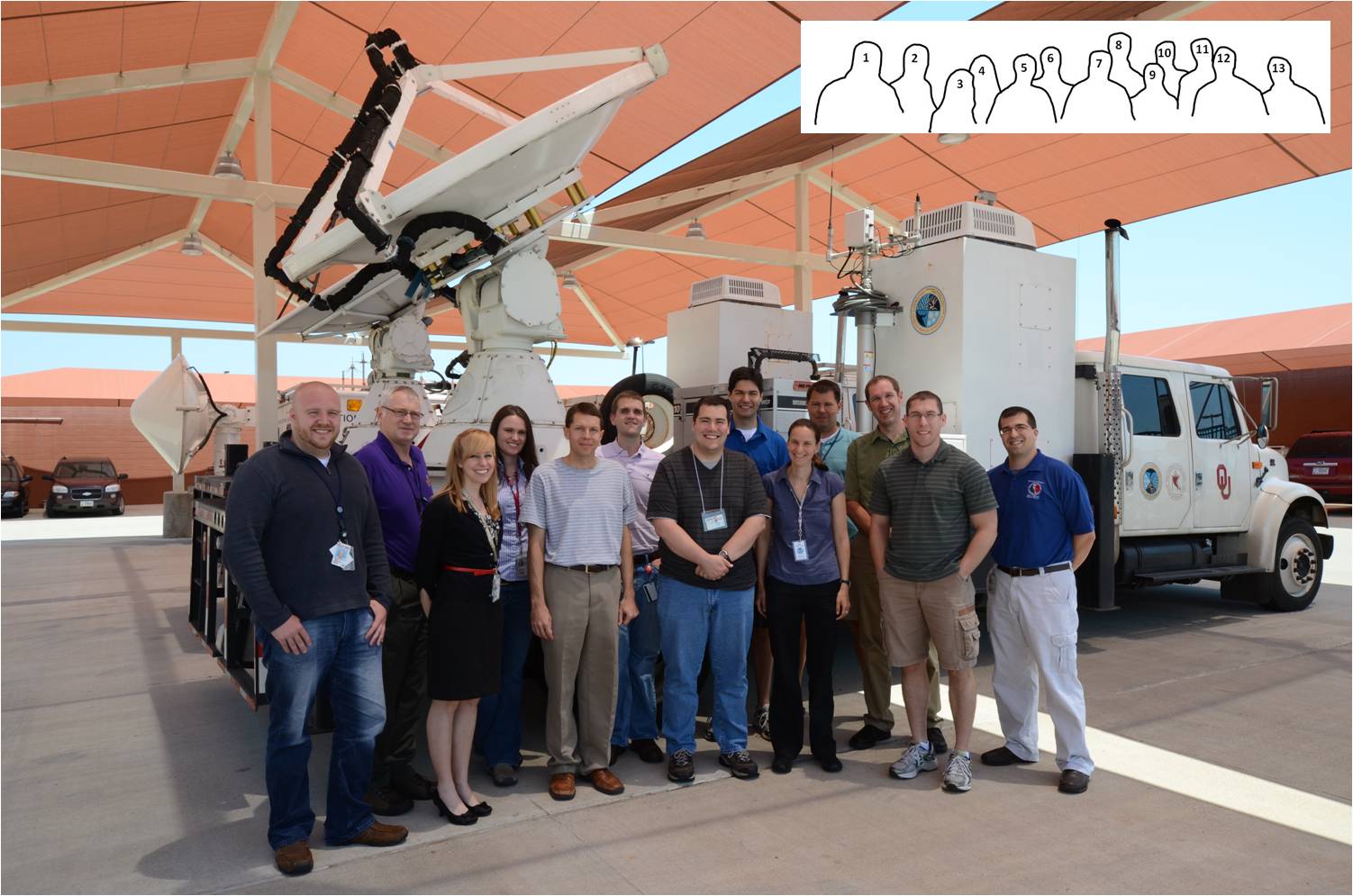
Photo:  1) Chris Siewert (CIMMS/SPC/GOES-R), 2)  Rich Grumm (WFO, State College, PA), 3)  Kristen Schuler (CWSU, Kansas City, MO), 4)  Jennifer Palucki (WFO, Albuquerque, NM), 5)  Gary Skwira (WFO, Lubbock, TX), 6)  Marc Austin (WFO, Norman, OK), 7)  Chris Leonardi (WFO, Charleston, WV), 8) Gabe Garfield (CIMMS/WFO Norman, OK), 9) Kathrin Wapler (Deutscher Wetterdienst, Germany), 10) Travis Smith (CIMMS/NSSL), 11) Greg Stumpf (CIMMS/NWS-MDL), 12) Chris Karstens (Iowa State University), and 13) Steve Martanaitis (NWS/WDTB). Photograph by Jim LaDue (NWS/WDTB).


REAL-TIME EVENT OVERVIEW:

4 June: Lubbock (LBB), Little Rock (LZK), Amarillo (AMA)

5 June: Norman (OUN), Jacksonville (JAX), Melbourne (MLB), Tallahassee (TAE), Great Falls (TFX)

6 June: Cheyenne (CYS), Boulder (BOU), Fort Worth (FWD)

7 June: Sterling (LWX), Boulder (BOU), Rapid City (UNR), Cheyenne (CYS)

FEEDBACK ON EXPERIMENTAL PRODUCTS:

3DVAR:

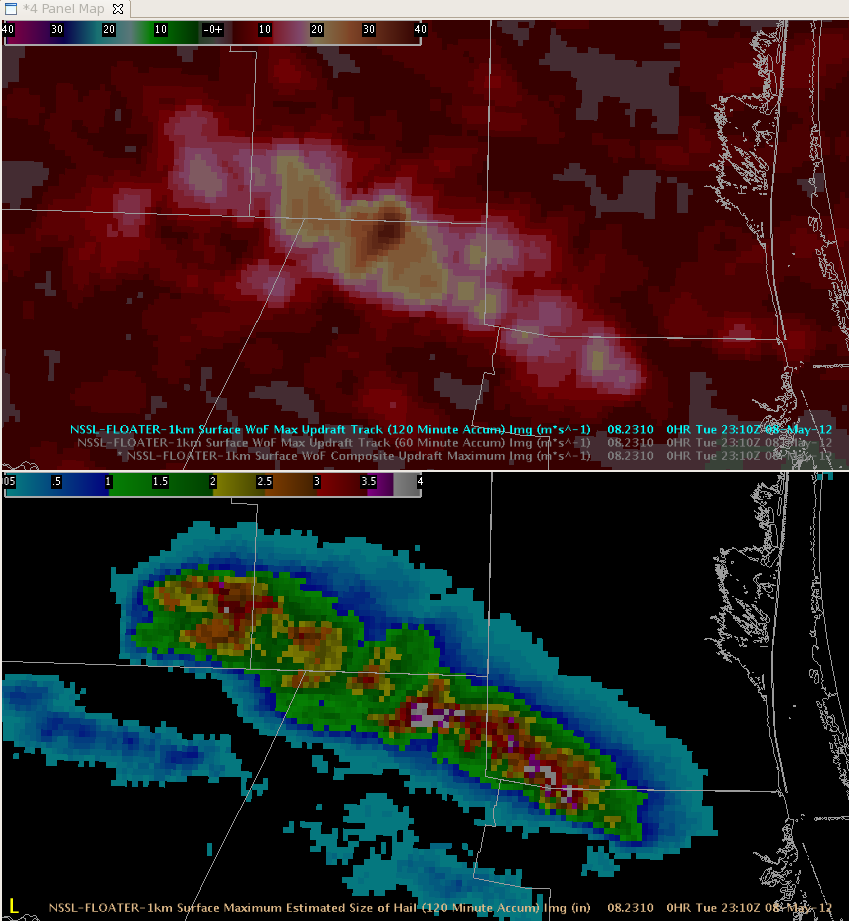
  • would like to see downdrafts depicted – for wet/dry microbursts
  • aviation uses:  downdrafts, turbulence (not necessarily related to convective weather)
  • does a pretty good job, with updraft strength.  Tornadoes also good.  But outflow winds are very radar dependent, range depend.  Assimilation methods may help with some of this.
  • would like to see TDWR data included.
  • would like to have a map depicting radar coverage (this is on the web site, but not in AWIPS2)

OUN-WRF:

This was the first week where the EWP has at least some forecasters working somewhere in the OUN WRF all four days.

  • it seems to be most useful for estimating storm mode and initiation time (though initiation sometimes has an early bias).
  • too many cold pool – interactions mess things up once convection is ongoing
  • used mostly pre-convection – then transitioned to radar-based products once convection was ongoing
  • was very useful to distinguish between supercells at day, and squall line at night on April 14
  • every run is so sensitive to the initial conditions.  But still does well on change of mode.  HRRR generated convection too far south on Thursday.  But OUN WRF was a little too far north
  • suggested improvement: add surface, dewpoint, wind flags, etc. To the special products.  To get an idea or sanity check to verify against sfc obs.  QPF would also be useful.

GOES-R Satellite products:

  • Simulated satellite was really useful.  Thought the NSSL WRF was spot-on
  • Nearcast products has agreement with OUN WRF
  • CI: “confetti” in UH product was interesting.  Lots of colors.  Liked the “Ultimate CI” AWIPS2 procedure
  • Returning forecaster really liked the probabilistic data field compared to the yes/no deterministic one shown last year

GOES-R PGLM:

  • was actually used this week – convection in the LMAs helps!
  • need 5- and 15-min products.  Also, color curves, hard to see grey
  • one “lightning jump” observed
  • forecasters would really like to see the 3D LMA data in FSI
  • to be deployed in 2016 (west) and 2017 (east)
  • useful for fire weather – source charges in dust storms creating CG lightning

There are more GOES-R feedback details on the GOES-R HWT Blog Weekly Summary.

OVERALL COMMENTS:

  • training before arriving is better than training all day Monday
  • would like to have more PI interaction to show them where to find the products on day #1, though
  • AWIPS2: better than expected.  Needs 64-bit version to fix multiple memory issues.
  • Liked discussion with developers.  Would like to see uncertainly in the products (when they work best / when they don’t) quantified in some way

CONTRIBUTORS:

Travis Smith, EWP2012 Week #4 Weekly Coordinator
Tags: None

EWP STATUS FOR 7 JUNE 2012: 1-9pm SHIFT

EWP STATUS FOR 7 JUNE 2012: 1-9pm SHIFT

We expect operations will again be focused in NE CO/SE WY.  SPC also has a 5% hail contour that clips the N part of the DC LMA, so we may focus on that early on.

We plan to wrap up operations around 7:30pm and then spend and hour and a half on surveys and preparation for Friday’s webinar.

– T. Smith, Week 4 coordinator

Tags: None

STATUS FOR 6 JUNE 2012: 1-9pm SHIFT

EWP STATUS FOR 6 JUNE 2012: 1-9pm SHIFT

We’ll plan on a 1pm start on Wed.  The most likely areas for operation based on the day 2 SPC outlook and 21Z SREF probabilities are NE Colorado (best chance of supercells) and OK/W TX (for low-shear pulse storms in the Lightning Mapping Array)

– T. Smith, Week 4 coordinator

Tags: None

EWP STATUS FOR 5 JUNE 2012: 1-9pm SHIFT

EWP STATUS FOR 5 JUNE 2012: 1-9pm SHIFT

SPC day 2 outlook has the highest risk (15%) of severe in SE GA/NE FL, where initiation is expected after 18Z.  Another area of 15% is in the NW US.  Both of these areas have the best forecast CAPE/shear, while other areas of the South have lots of CAPE, no cap, and less shear in the model forecasts.  We’ll keep our options open in the event of development in the W TX LMA or other locations.

– T. Smith, Week 4 coordinator

Tags: None

Week 3 summary (May 23-27)

Week #3 had a very interesting local event, with the following guest NWS forecasters:  Jason Jordan (WFO Lubbock, TX), Daniel Leins (WFO Phoenix, AZ), Bobby Prentice (WDTB, Norman, OK), Pablo Santos (WFO Miami, FL), and Kevin E. Smith (WFO Paducah, KY).  Other visiting participants this week will include Chris Jewett (UAH), Scott Rudlosky (UMD), Lee Cronce (UW-CIMSS), and Rudolf (Rudi) Kaltenböck (Austro Control, Vienna, Austria)

Overview of week 3

Monday was primarily a training day, and was spent familiarizing the forecasters with the products.  They examined both the playback case we have used consistently each week of the experiment, as well as some real-time storms that developed in western OK.

Tuesday was possibly one of the more exciting days in the 5-year history of the EWP.  The morning shift focused on examining the OUN WRF and other data sets, producing the discussion “Tornado Outbreak Likely over KS/OK/n TX.”  We met with the EFP for a combined discussion at 1 pm, and quickly regrouped in the Development Lab for a more detailed strategy session, and were into operations mode by 2pm.

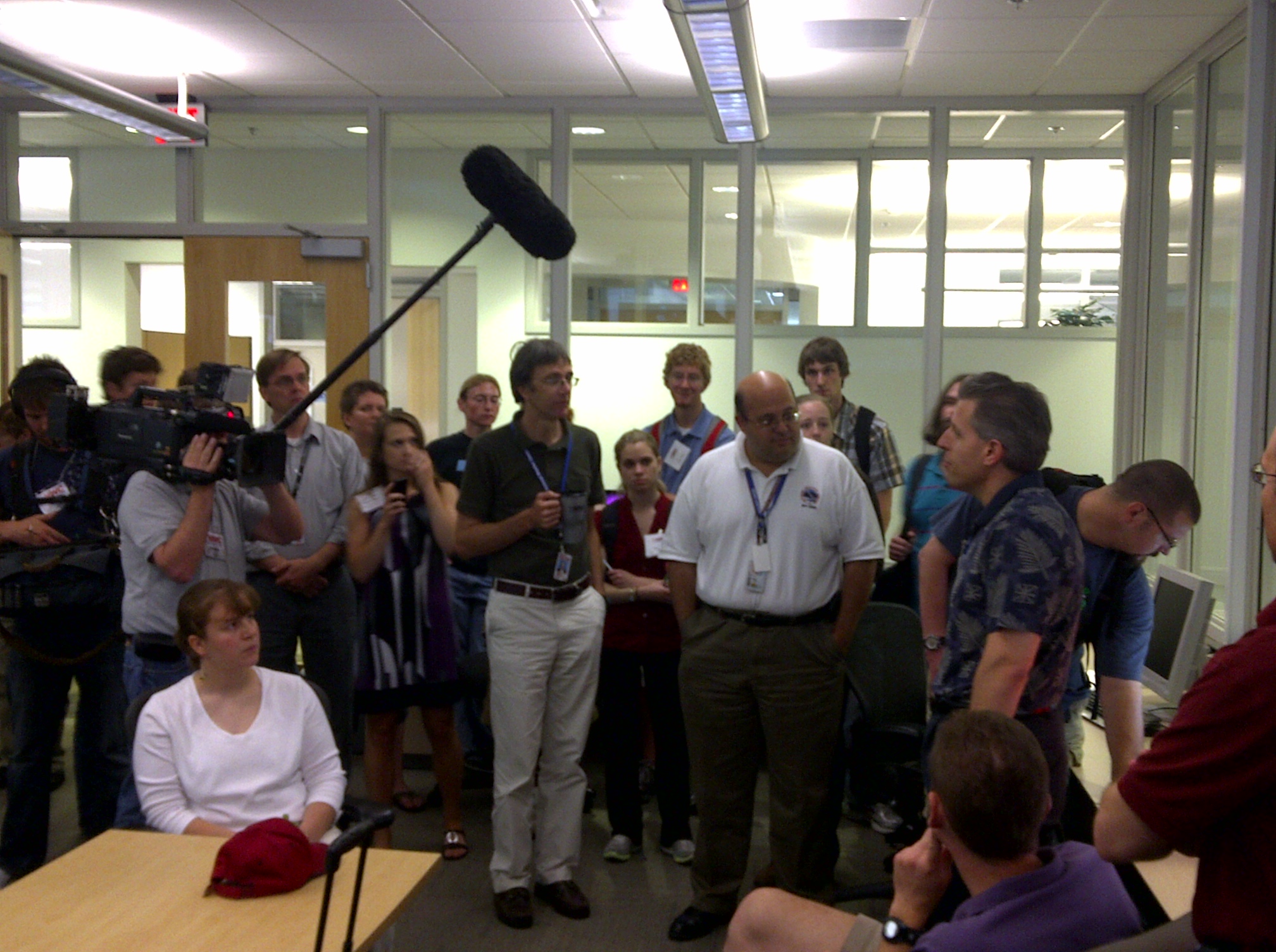
Bobby Prentice briefs the joint EWP/EFP (as well as a few media members) prior to the May 24th outbreak event.

As we moved into the mid-afternoon, supercells developed by 3:30pm, and by 4pm there were tornadoes being observed by spotters and shown in real-time on the Situational Awareness Display.

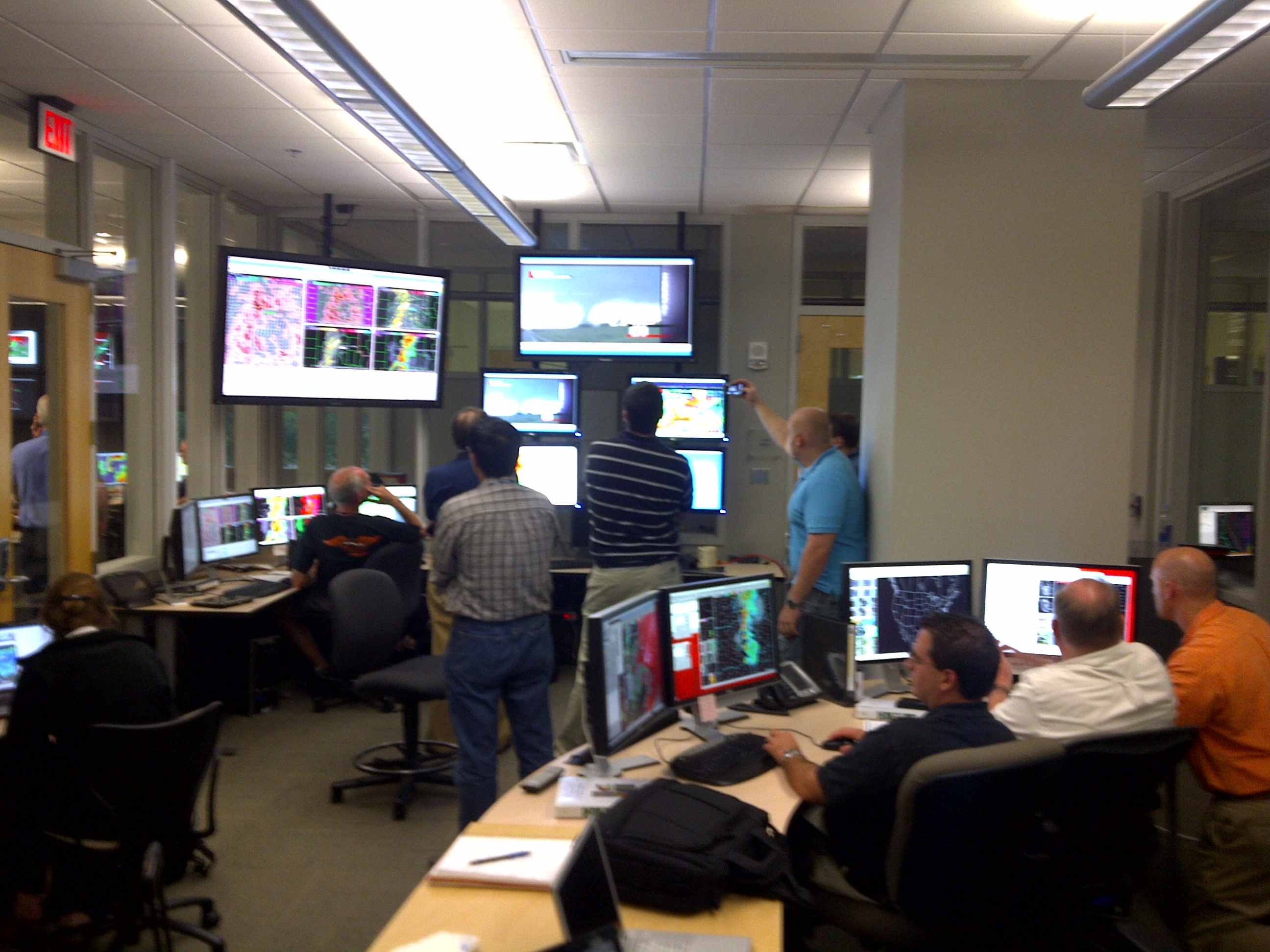
A tornado is observed in real-time on the HWT Situational Awareness Display.

With several supercells approaching central Oklahoma, one group took responsibility for the northern cluster of storms, while the other group observed the southern storms.  Forecasters were able to evaluate all the experimental products (GOES-R, 3DVAR, OUN WRF), although the pGLM feed stopped when one of the OK Lightning Mapping Array sites was damaged by a tornado.  At 5:45pm, the National Weather Center security desk called for everyone to take shelter on the lower level of the NWC.  A few forecasters stayed and observed the storm approaching on radar, but operations were suspended.

As Jason Jordan wrote:

The majority of the forecasters stayed in the HWT to watch the storms as they approached the National Weather Center. Live data from the PAR along with area TDWRs and the KTLX radar showed an impressive evolution of two confirmed tornadic debris balls as the storms moved towards us.

The 3DVar products all handled the track and evolution of the storms very well and the combined radar products also have an excellent track of the tornadoes as well. Continuity was maintained as the storms moved into the cone of silence of the KTLX radar.

As the storms started to move into the metro OKC area, attention to the details/operations was lost as we watched live TV feeds and could see the hail falling outside the WFO window. The excitement rapidly turned to sorrow however as the live TV feeds showed homes and structures being ripped apart.

One last item that made it very clear how close we were to being impacted by the tornadoes directly; leaf and light matter debris was falling from the sky when several EWP members went up to the roof of the NWC to see the dissipation of the tornado moving south of Norman.

Because Central Oklahoma was affected by several violent tornadoes, we suspended operations on Wednesday, and all EWP participants assisted the Norman NWSFO in surveying the damage.  With the help of the EWP teams and others from the Norman community, 8-10 groups of 2-3 people each were able to survey a majority of the damage in one day.

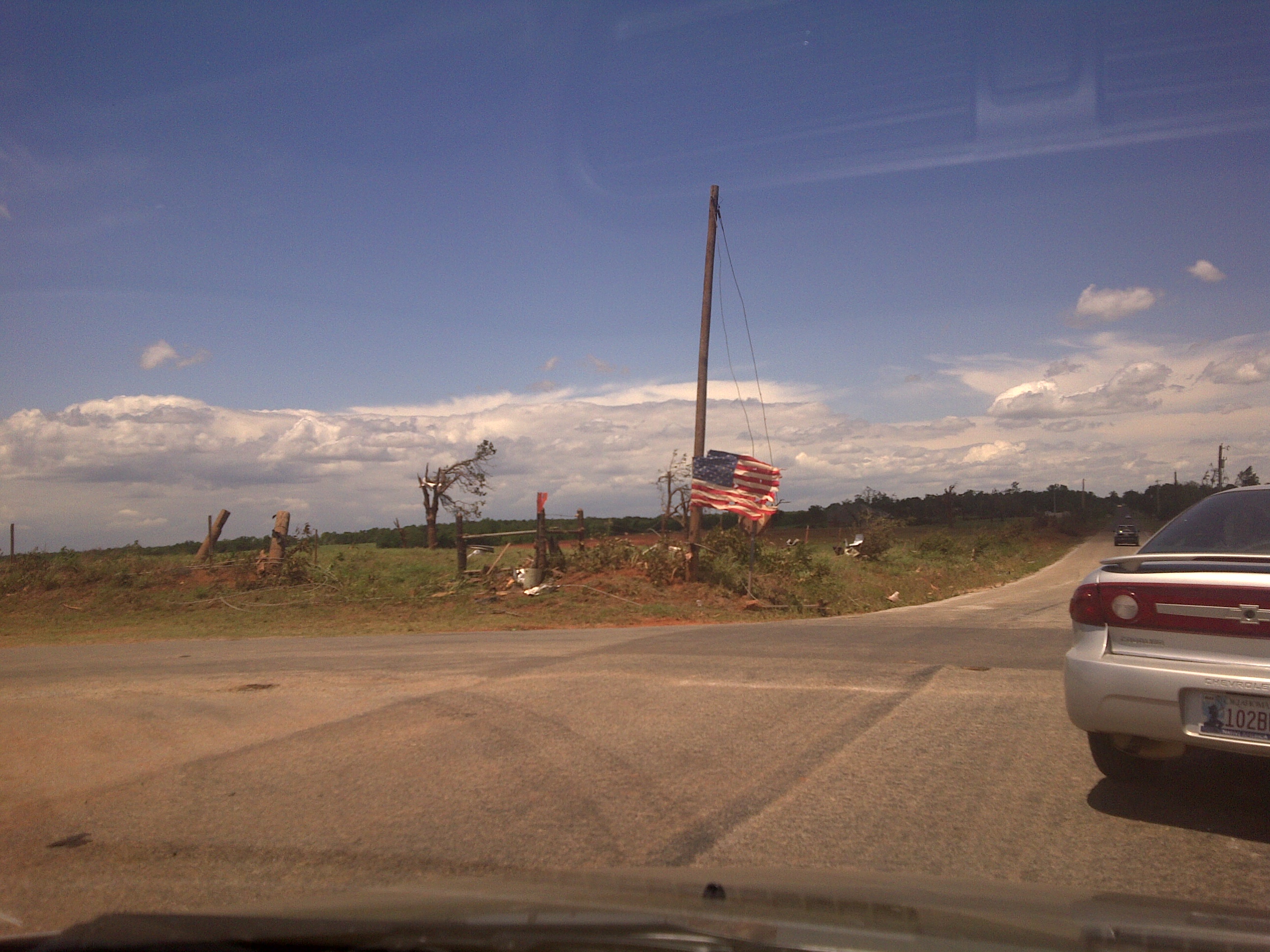
Old Glory flies near Blanchard OK, in the path of an EF4 tornado's destruction.

Thursday’s operations focused on convection in Pennsylvania and Maryland, which allowed additional use of the pGLM products from the DC LMA.  The CI and Nearcast products were examined during the early shift, and the 3DVAR and other remaining satellite products were used during warning operations.

Our usual Friday round-table discussion of the week’s activities provided a lot of additional feedback.  Comments:

UH CI:

  • performance should improve with next-gen satellites.  Probabilities would be a good addition.
  • the CI algorithm may not work work outside the plains region (although it did work in Florida on Thursday)

Other Satellite products:

  • the precipitable water was a nice utility.  Theta-E max on Tuesday showed that the storm was moving into an even more unstable environment.  Gave some additional lead time.  Chris S. commented that this was not the way the creators originally intended to use it, but is a nice fall-out from the research.
  • another forecaster commented that these products could be useful for off-shore significant weather.

pGLM:

  • Tuesday, looking start of El Reno storm, cell mergers, rapid increase in flash rate w/ big changes in updraft intensity.  Downstream increase in anvil activity seemed predictive of where the supercell was moving / regenerating.   We also saw that in the Sterling data on Thursday – rapid increase, led to a closer look and noticed that new cell generation was occurring.
  • 10-15 minute lead time over CG network.   Lots of potential uses, but need more research.
  • General consensus is the a ration of in-cloud to CG-lightning would be interesting.
  • The presence of persistent lightning over time may be related to flash flooding

OUN WRF:

  • it did really well on Tuesday.  Looked at it hour-after-hour.  Updraft Helicity, vorticity.  Probably an accident (jokingly), but was surprised how well it did.  Good groundwork for Warn-on-Forecast.  Very promising.
  • echo previous comment.  Could look at HRRR model for initial conditions.  May be a good boundary condition for OUN WRF in situations where you have less-than-stellar data.
  • Florida forecasters were impressed with HRRR in FL so much that they have started to use it as initial boundary condition.  Have you done any verification versus MR/MS products?
  • OUN would like to use the SPC methods for scoring output for this.
  • the displays are unviewable in some cases.  Too cluttered.
  • Flash Flood – would be nice to have accumulated precip.
  • could do Rotation Tracks, trend analysis.

Side discussion on mesoscale and storm-scale ensembles:

  • need a way to establish reliability of ensembles
  • challenge to consider options – need a statistical complement to the ensemble – statistical distribution of storm behavior.
  • Mark DeMaria paper on blending statistical and dynamic model ensembles to determine improve reliability
  • also reference independent study in the Miami Herald on Probability of Precipitation forecast.  Newspaper used a reliability diagram to show NWS PoP skill.

3DVAR :

  • liked updraft intensity a lot.  Could be used in the microburst environment to detect which cells may be severe.
  • Did an outstanding job on the Tuesday event
  • No doubt that this would be useful.  Need to get it into OSIP right away.

AWIPS thoughts:

  • need some default procedures in AWIPS.  Half the battle was that it was very inefficient to view them.   Lots of time wasted.
  • yes!  Had to recreate his procedures.   Much of his data was missing do to not having a full feed in AWIPS (note: this will be fixed in AWIPS2 next year).
  • most of these are just relational.  Want to evaluate as many procdures as possible in as little time as possible.    Synergistic across multiple projects.

Other forecaster thoughts:

  • Powerpoint training is not the best.  Would prefer “Articulates”
  • include data from previous real-time case to demonstrate.  Perhaps a Virtual Machine for AWIPS
  • forecasters should be required to do pre-work before arriving at the HWT.  This would allow Monday to be used for operations instead of training.

– Travis Smith, weekly coordinator

Tags: None

That was a close call!

The majority of the forecasters stayed in the HWT to watch the storms as they approached the National Weather Center. Live data from the PAR along with area TDWRs and the KTLX radar showed an impressive evolution of two confirmed tornadic debris balls as the storms moved towards us.

The 3DVar products all handled the track and evolution of the storms very well and the combined radar products also have an excellent track of the tornadoes as well. Continuity was maintained as the storms moved into the cone of silence of the KTLX radar.

As the storms started to move into the metro OKC area, attention to the details/operations was lost as we watched live TV feeds and could see the hail falling outside the WFO window. The excitement rapidly turned to sorrow however as the live TV feeds showed homes and structures being ripped apart.

One last item that made it very clear how close we were to being impacted by the tornadoes directly; leaf and light matter debris was falling from the sky when several EWP members went up to the roof of the NWC to see the dissipation of the tornado moving south of Norman.

Back to operations…

-Jason Jordan

Tags: None