Forecaster Thoughts – Bryan Tugwood (2008 Week 2), Dave Patrick (2008 Week 4), Mark Melsness (2008 Week 5)

In May 2008, we were given the opportunity to participate in NSSL’s Experimental Warning Program (EWP), which is part of the Hazardous Weather Testbed. It was held at the National Weather Center in Norman, Oklahoma for 6 weeks this year, running from April 28th to June 6th. This is the 2nd year of the EWP, and was born out of the Spring Program. The other component of the Hazardous Weather Testbed is the Experimental Forecast Program.

The purpose of the EWP is to evaluate new research and technology, and brings the researchers and developers into the same working environment as the forecasters. The goals of this year’s program were threefold:

  1. Evaluate the Phased Array Radar (PAR), located in Norman.
  2. Evaluate the 3 cm CASA radars in central Oklahoma.
  3. Evaluate gridded probabilistic warnings.

Before delving into any of the above 3 evaluations, we were given some training as well as time to practice with the software. During the evaluations, there was always help available as the learning curve was rather steep – especially for us Canadians who were unfamiliar with the Warning Decision Support System II (WDSSII) software. Above all, they wanted our feedback, as we were being “run” through the various implementations. Feedback was given to them both ongoing, and after the evaluation in a written survey. We will attempt to give a quick overview of each of our evaluations that we participated in.

Phased Array Radar: The PAR is being considered as a possible replacement for the WSR-88D, which is now 20 years old. The array consists of 4352 transmit/receive elements which form the array, as opposed to a large rotating antenna with one feedhorn. The radar beam is vertically polarized, as opposed to the horizontal polarization of the WSR-88D, the power is slightly reduced, thus features such as outflows and horizontal convective rolls are almost impossible to detect. Scans are available at one minute updates though, making storm evolution appear much more fluid. More information is available online at http://www.nssl.noaa.gov/projects/pardemo/ .

CASA Radar Network: There are four low power CASA (Collaborative Adaptive Sensing of the Atmosphere) radars to the southwest of Norman, filling the “gap” between two WSR-88D radars, namely Frederick, OK and Norman. The CASA radars are 3 cm wavelength, so although they suffer greatly from attenuation, having four of them in close proximity negates this problem in way of a composite image. The big advantage of the CASA radars is its high resolution, both spatially and temporally, with an added bonus of being able to collect data from as low as 200 metres above the ground. Additional information is available at these websites: http://www.casa.umass.edu/research/springexperiment.html and http://www.casa.umass.edu/

Experimental Gridded Probabilistic Warnings: Currently, the decision to warn a particular storm is subjective, and takes place when a forecaster has a certain degree of confidence (decision threshold crossed) that severe weather is occurring, or is likely to occur. There is no avenue available to explain how likely it is that severe weather is expected, other than in the discussion.

Recently the National Weather Service changed their warning areas from counties to polygons. You will notice while you are watching a radar animation that as a particular storm is tracking along, warning polygons will “jump” every 30 minutes or so to take into account new storm positions and expected motions. While storms appear to track along fairly smoothly, warning polygons do not. As a result, lead times for an approaching storm will differ from one locality to another, based on the warning issue time and the shape of the warning polygon.

Gridded probabilistic warnings (prob-warns) give forecasters the option to warn a storm before their mentally pre-defined threshold is crossed. Storms can be warned on as low as a 10% probability, all the way up to 100%. Storms are warned based on 3 categories: tornado, large hail, or damaging wind. In some supercells, there could be probability “cones” for all 3 simultaneously, each covering different areas depending on the specific threat.

Prob-warns are also given a velocity, thus they track along as smoothly as the storms being observed on a radar animation. Prob-warns can be assigned a changing threat level for storms that are expected to soon change in their intensity. Future versions will allow the warning “cones” to also depict curved probability paths.

The only drawback to prob-warns in the way they are currently set up (all experimentally of course), is they still don’t give you the option of tiered warnings. Even with prob-warn, we would still to a certain degree face the challenge of having more threats than bulletins (graphics) to express them. For example, a cold core tornado threat of 10% is considerably less threatening than an F5 tornado threat of 10%. Is it possible to design a “Tiered Gridded Probabilistic Warning System”?

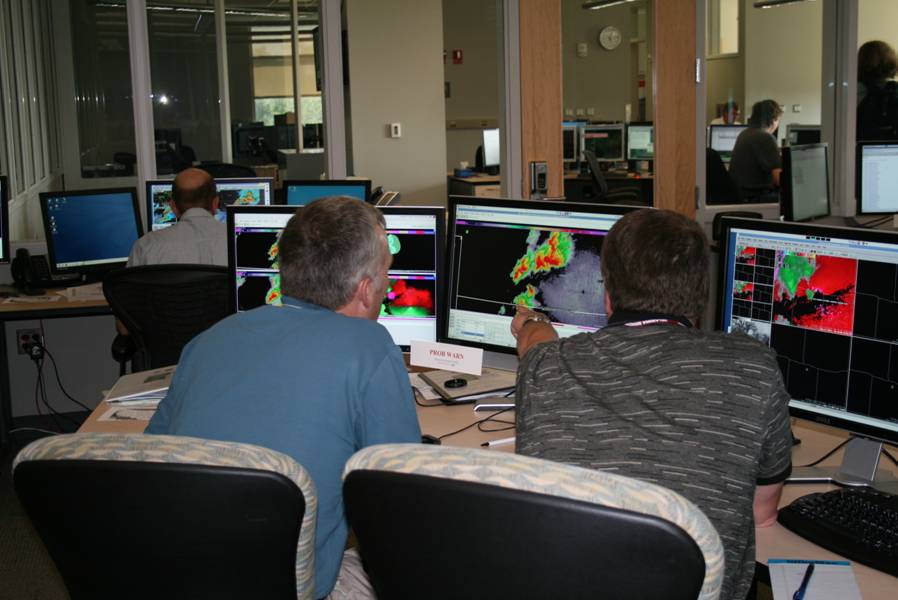
Mark Melsness, Environment Canada, Winnipeg and Kevin Brown, NWS, Norman discussing a severe Nebraska storm during a live probabilistic warning exercise.

Overall Impressions: The National Weather Center is an impressive facility located at the University of Oklahoma in Norman. It was completed in 2006 as a collaboration between NOAA and the University of Oklahoma. It is home to research scientists, operational meteorologists, faculty, students, engineers, and technicians. It is also the home of the SPC, NSSL and the Norman NWS.

We worked mainly in the Hazardous Weather Testbed (HWT), physically located between the SPC and the Norman NWS. The program ran for six consecutive weeks, with 3 or 4 operational forecasters present each week, coming from such diverse localities as Winnipeg, Toronto, Serbia, Fairbanks, Seattle and Norman to name a few. It was our input as operational forecasters that the researchers and developers wanted to tap into. We filled out several surveys, participated in daily debriefings, and also gave ongoing input to the HWT staff, who were most accommodating and professional.

The sheer scope of the forecasting challenge is much different in the United States than in Canada, especially in the Prairie and Arctic region where two to four severe weather meteorologists (two during the night and early morning hours) are responsible for issuing all warnings, watches, and special weather statements for half the land mass of Canada. These same two to four meteorologists monitor the nine radars which cover the populated portion of the Canadian Prairies – an area of comparable size, population density, and climate as 8 to 10 northern US NWS offices.

Having the ability to view minute by minute updates on both the CASA and Phased Array Radars was fascinating. Watching storms evolve in such a fluid motion was like the difference between watching a High Definition TV vs. an old black and white set. The main drawback for both radars was their inability to detect outflow boundaries and horizontal convective rolls. The amount of data to assimilate was huge, impossibly so when mentally translated into an Environment Canada office. The only way to incorporate this technology in a Canadian office would be to use an approach analogous to SCRIBE – quasi-automated warnings with the forecaster having the final say.

The scientists at the Hazardous Weather Testbed envision a time in the future, perhaps 10 to 15 years from now when warnings evolve from our current, “Warn on Detection” to “Warn on Forecast.” In other words, increased atmospheric monitoring coupled with an increased understanding of severe storms should allow us to issue warnings before a severe thunderstorm has even formed.

The Hazardous Weather Testbed is an excellent example of what could be accomplished here in Canada with a new National Laboratory dedicated to testing technology which could be used in Operations… with the goal of improving the forecasting and dissemination of severe weather.

We wish to thank our managers for allowing us to participate in this program, and the scientists at the National Weather Center for making our time there enjoyable and rewarding.

Bryan Tugwood (Environment Canada – Week 2 Participant)
Dave Patrick (Environment Canada – Week 4 Participant)
Mark Melsness (Environment Canada – Week 5 Participant)

Tags: None

Forecaster Thoughts – Chris Sohl (2008 Week 6)

While the weather in the local area started out rather quiet, it ultimately picked later in the week allowing us to view PAR and CASA radar data in real time. In the early part of the week we also had the opportunity to view archived data and issue real-time probabilistic forecasts for thunderstorms in the central plains.

For both the real-time and archived cases where we made probabilistic forecasts for thunderstorms, the process seemed to work reasonably well. The fact that many of the storms were discrete probably made the task relatively manageable. It would be interesting to experiment with cases of widespread strong/severe thunderstorm development including a few high-end storms such as supercells. Managing the boxology and frequency of updates could be a challenge.

I can envision the additional value that the probabilistic forecasts could provide to some customers especially for values below some “threshold” that might trigger a warning. For example, tornado probability trends for a supercell could give an EM or TV weather person some insight on the likelihood that a storm may subsequently have a tornado warning issued on it.

The strength of the PAR data was clearly its capability to perform rapid volume scans. Storm evolutions seemed to be easier to follow and also allowed the detection of features a little sooner than you might with the 88-D. The archive data of a developing microburst nicely demonstrated the advantage of having more frequent volume scans available.

While the range of the CASA radars was limited, they did provide additional information about the near surface wind speeds in storms than could be detected using the 88-D which was located farther away from the storms.

Although only available for a few volume scans, live radar data from a SMART radar was available for display on a workstation. To be able to view a remotely transmitted dataset in real time was impressive.

In the back of my mind, as I explored many of these datasets, I was trying to visualize how a warning forecaster could incorporate all of this information during warning operations. The long term solution may be short-term storm-scale forecast models that incorporate all available datasets. However, in the interim, it might be worthwhile to also explore the development of tools that would allow all available radar data sources to be combined into a seamless dataset for interrogation by the forecaster. This would also include developing robust 3D and 4D visualization tools.

Chris Sohl (NWS Norman OK – Week 6 Participant)

Tags: None

Forecaster Thoughts – George Phillips (2008 Week 6)

While PAR, CASA and probabilistic warnings are quite away down the road, I appreciated the fact that they are obtaining considerable input so far in advance.  This is, of course, the way every significant change in technology/operations should be tested and input from operational people received.

PAR – We only had one day where real storms impacted the PAR coverage area.  On the other days we played back archived cases.  While working the real weather day, it didn’t seem to help a great deal while I was the one investigating the storms early in the event.  Very strong wind fields on that day (June 5th) led to multiple dealiasing failures, making especially the early part of the real-time case, difficult.  As the event progressed and storms moved closer to the radar, rotation could sometimes be seen earlier on the PAR than on the 88D.

On the playback cases, the high temporal resolution would have helped greatly with the issuance of warnings for pulse storms, and would have led to more lead time in a tornado case.  If the high frequency updates from the PAR were coupled with a display like GR2AE, the ability to see updraft/core development and downdraft/core descent, would greatly help in visualizing what was going on with storms, and could easily help with understanding when warnings are or aren’t warranted based on their evolution.

Another advantage of the PAR was obtaining time continuity for questionable quality data.  Let’s say on the 88D you see an interesting velocity signature in an interesting area of the storm, but it doesn’t quite look right.  You may have to wait for another volume scan (4-5 minutes) before making a decision based on this signature to see if it is a dealiasing failure.  With the PAR, you have time continuity in very short order and can usually evaluate data quality much quicker.

On the challenging side was the fact that we are not used to such high frequency updates.  Transient features, that may or may not mean anything from a warning perspective, are seen much more frequently.  It will take awhile to adjust to mentally calibrate the WDM process with such high temporal resolution updates.  Concern was expressed about possible data overload as the volume scan could come in at 30 second or 1 minute periodicity.  While this is a valid concern, good visualization software would certainly help with this situation

CASA -  These radars are southwest of Norman, and are only about 30 km from each other.  Once again, only one day had real weather that impacted the radars, and that was late in the shift on the last day, so real-time evaluation was not extremely useful during that week.

We played back a few cases using the CASA radars and they showed some of the strengths.  In particular, with wind storms, the actual winds are often at some large angle to the 88D radar beam.  Or, the 88D is showing strong winds with a storm, but 0.5 degrees is intercepting the storms at 8000 ft.  Are those strong winds making it to the surface?  With CASA radars spaced relatively close together, sampling the lower atmosphere is easy, and the likelihood of being able to obtain a good estimate of the winds as they approach (or move away from) one or more of the radars, is also good.

Also, being able to sample the lower atmosphere in high resolution means that velocity and reflectivity signatures of small scale features should show up much better/more frequently.  We saw this in an example case with a mini-supercell associated with a tropical system, which had a nice little hook, and decent velocity couplet on the CASA display, while the 88D showed it as a blob with no real velocity signature until after the tornado had touched down.

Of course at 3 cm wavelength, attenuation occurs frequently, so any future CASA network would seem to need to be a supplement to a network of 10 cm radars.

Probabilistic “Warnings” -  Ever issued a deterministic warning and wish 10 minutes later you could cancel it, or reorient it, but are concerned about the verification implications, or possible consequences if you are wrong?  In the era of probabilstic warnings, one simply decreases/increase the probabilities, or reorients the track to produce a different area of probabilities.

We did this each day, in real time for various CWAs across the Plains.  We also did this on the last day with a canned case that all the participants in the EWP went through.

This actually worked better than I had expected.  But one could see that following more than two storms around with probabilities for tornadoes, winds and hail, quickly became a workload.  Of course there are also challenges with reasonably assigning probabilities, since that is not something we are used to.

On the last day we worked an archived case that all the participants in this EWP went through.  We had VERY limited environmental information for this event.  Assigning tornado probabilities without good environmental information was very frustrating, and really emphasized the importance of having this data.

There are a number of problems with the current warning system.  How we would transition from what we do now, to this method is not entirely clear, and how some of our users would react to this change is also unclear.  However, one can see that sophisticated users could obtain useful information that they currently don’t have.  Frequent updates to threat areas has the potential to give earlier heads up to people downstream of the ongoing severe storms, than issuing periodic warnings does.

George Phillips (NWS Topeka KS – Week 6 Participant)

Tags: None

Forecaster Thoughts – Milovan Radmanovac (2008 Week 6)

Coming from Serbia, my intention was to get familiar with the new technologies and new endeavors in meteorology, especially in radar meteorology, because that is the field where I’ve worked in for more than 15 years. The 2008 Experimental Warning Program spring experiment was a great opportunity to see the possibilities and practical implementation of some ongoing projects like the Phased Array Radar, CASA radars, probabilistic warnings…At the same time, through the EWP, I learned a lot about some other projects and systems (Mesonet, verification of severe weather, collaboration with TV and radio stations) and got a lot of ideas which can be applied or implemented within the meteorological services in Serbia. The Experimental Warning Project is especially important because there is the intention for improvement and modernization of the Serbian warning system, so the experience I got here will have a great practical value in my country.

Personally and on behalf of Hydrometeorological Service of Serbia, I’d like to thank you for being kind and making it possible for me to be a part of this program.

Milovan Radmanovac (Hydrometeorological Service of Serbia – Week 6 Participant)

Tags: None

Forecaster Thoughts – Kevin Brown (2008 Week 5)

I felt quite fortunate to be able to look at real-time CASA/PAR data sets. Although the amount of time and coverage of echoes was fairly limited, being able to see the rapid updates in real-time was valuable. Along with the higher resolution of CASA data, the increased frequency volume scans from both CASA and PAR appear to be challenges for the operational forecasters. The faster updates do not allow a lot of time for base data interrogation/interpretation, so forecasters will need to be more selective in what data to interrogate. This is primarily a training issue, to varying degrees, for each forecaster.

On two different days, we were able to work with probabilistic warnings in real-time, and from an operational forecaster perspective, I see great utility with this program. Currently, it can be quite difficult to get the overall thinking of the warning forecaster(s) across to his/her users and partners. There are shades of uncertainty that cannot be conveyed with the warn-no warn concept. Being able to issue probabilistic information should provide much more useful information to our partners and more sophisticated users. Conveying information probabilistically will allow some of our more advanced users to “get into the head of the warning forecaster”. During our probabilistic operations we mainly dealt with discrete supercells, and after a minimal amount of time, became somewhat proficient at issuing single and even multiple threat probabilities. However, I could see it being more challenging with squall lines and LEWP events.

I enjoyed the time I spent in the EWP, and am grateful for being able to work with such talented scientists.

Kevin Brown (WFO Norman OK – Week 5 Participant)

Tags: None

Forecaster Thoughts – Jonathan Howell (2008 Week 4)

The Hazardous Weather Testbed (HWT) provided an excellent opportunity for forecasters to work side by side with researchers to evaluate radar technology and warning strategies developed for future use.  While participating in the experiment, I had the opportunity to evaluate the Phased Array Radar (PAR) and the Collaborative Adaptive Sensing of the Atmosphere (CASA) radars in both a real-time and archived environment.  Our group also tested the new experimental process which integrated short-term severe threat probabilities into operational severe thunderstorm and tornado warnings.  The outcomes of the experiments demonstrated potential significant advantages and challenges if implemented into an operational weather forecast office (WFO) setting.

My experiences with the PAR radar equipment were very positive.  This technology will likely exceed the capabilities of the current WSR-88D radar network.  The primary advantage to using the PAR radar technology is the rapid update of base radar data.  During the experiment, I was able to rapidly identify important convective structural features that led to quicker warning decisions and longer warning lead times.  Another important advantage of the rapidly updating PAR data was the ability to identify important storm features in the 1 minute PAR data that would not have been sampled by the 5 minute WSR-88D scans.  In addition, the 1 minute update PAR data better portrayed storm evolution.  This was particularly advantageous during an archived unorganized pulse severe thunderstorm event which we used the PAR radar to conduct warning operations.  As a warning decision maker, I was able to observe the initiation of collapsing cores aloft and issue warnings with enhanced lead time.  The current scan limitations of the WSR-88D likely would have further delayed my decision to warn during this event.

Advantages of the PAR radar exceed any limitations that I experienced.  The only minor limitation to the PAR radar will be the ability of the radar operator to adjust to the much faster influx of additional radar data.  I think this will primarily be an initial challenge which will be overcome quickly by warning forecasters.  In fact, I felt comfortable with the increased radar data flow after a few days of use.  Overall, my experiences using the PAR radar were very positive and I hope that this technology will eventually be implemented into the NWS field offices.

Another radar system which we experimented with was the CASA radar network.  The CASA radars also proved to be a robust network that provided advantages to warning forecasters during experimental warning operations.  As is the case in most NWS County Warning Areas (CWA) and in the Memphis CWA, sampling low-level storm characteristics using the current WSR-88D radar network at extended distances from the radar is very difficult or impossible due to radar spacing issues and curvature of the earth.  This greatly limits warning forecaster’s ability to observe important low level storm at large distances from the radar.  The greatest advantage that I see to implementing the CASA radar network is the ability to limit gaps in low-level radar coverage.  This will provide warning forecasters with improved radar information necessary for longer lead time and improved warnings.  In addition, enhanced low level radar information allows warning forecasters to better define geographically where the greatest storm threats exist.  While participating in the HWT, I experienced these benefits firsthand.  The CASA network would likely be best implemented as a compliment to the PAR radar network.  By locating CASA radars in between the traditional PAR (current WSR-88D sites) radars, the system would become very robust and most beneficial to the NWS warning process.

The HWT also tested the capabilities and practicality of probabilistic warnings.  Probabilistic warnings appear to present the greatest challenge of all the new techniques tested.  Researchers envision probabilistic warnings eventually replacing current NWS warning practices.  As a forecaster using the new probabilistic warning technique, I found the process difficult to employ and likely confusing to the public.  The primary limiting factors of probabilistic warnings in my opinion include, (1) quantifying specific threats and expressing those threats in a proper manner to the public, (2) warning forecaster work load issues, and (3) public response problems associated with different threat percentages.  The NWS mission statement clearly reflects the important role that severe weather warnings play in protecting life and property.  The primary reason that the NWS issues severe weather warnings is to encourage the public to take actions required to protect themselves from dangerous weather.  I believe that eliciting public response to probabilistic warnings will be a significant challenge since every person’s threat threshold is different.  Probabilistic warnings may create confusion and limit public response to warnings and should primarily be available only to very high end users (if they can understand the process and find it beneficial).

Overall the HWT was a great opportunity for me to evaluate potential NWS technology of the future.  Collaboration between researchers and operational forecasters is a great way to share ideas, provide feedback, and get useful technology into NWS field offices.  The HWT and similar collaborative experiments hopefully will continue into the future.  I look forward to the eventual release of new and improved technology into the field.  Finally, I would like to thank those involved for giving me the opportunity to participate in this experiment and hope to again be involved in similar projects in the future.

Jonathan Howell (NWS Memphis TN – Week 4 Participant)

Tags: None

Summary – 22 May 2008

There was an HP Supercell event in Western Oklahoma, outside the PAR domain, but we worked it anyway to try to get the forecasters a real-time PAR event.

Otherwise, there was a cluster supercell outbreak in Central KS along I-70 as advertised by the SPC MODT Risk. Since we had the storm in Central Oklahoma, we did not work a ProbWarn IOP on the KS storms. Many storm chasers saw many fast-moving tornadoes.

A repeat performance is expected over KS and NW OK on Friday 23 May, however, we do not conduct operations on Fridays.  In fact, it looks quite active through 26 May, the Memorial Day Weekend, but we are off for the holiday.

Greg Stumpf (EWP Operations Coordinator)

Tags: None

Outlook – 22 May 2008

SPC has higlighted a MODT Risk of severe storms, with emphasis on long-tracked tornadoes, in their 1630 UTC outlook, across portions of Western KS, and adjacent areas of CO and NE.  A SLGT Risk extends along a progged dryline into Western Oklahoma.  Concerns for the southern target include cap strength and weaker low-level shear.  Plans are to conduct a ProbWarn IOP for the KS area, unless storms develop in Western Oklahoma, where instead we’d conduct PAR operations, since there haven’t been live PAR operations yet this week.

Greg Stumpf (EWP Operations Coordinator)

Tags: None

Forecaster Thoughts – David Hotz (2008 Week 3)

First, thanks for the opportunity to provide feedback on the various programs-research. Your work is crucial to the future success of the National Weather Service.

I appreciate your willingness to listen to my viewpoints about the CASA, PAR, and PROBWARN programs. Even though we did not see eye-to-eye on some of the issues related to PROBWARN, I do believe we must explore innovate ways of expanding our services to the EMAs. I feel the future of the local WFO offices will be to expand our short-term warning and forecast programs to our customers. Our daily relationships with our core customers must be closer, either face-to-face or through up-to-date technologies.

I commend you and your staff for your dedication, hard work, and hospitality. Thanks again for allowing me to participate.

David Hotz (NWS Morristown TN – Week 3 Participant)

Tags: None