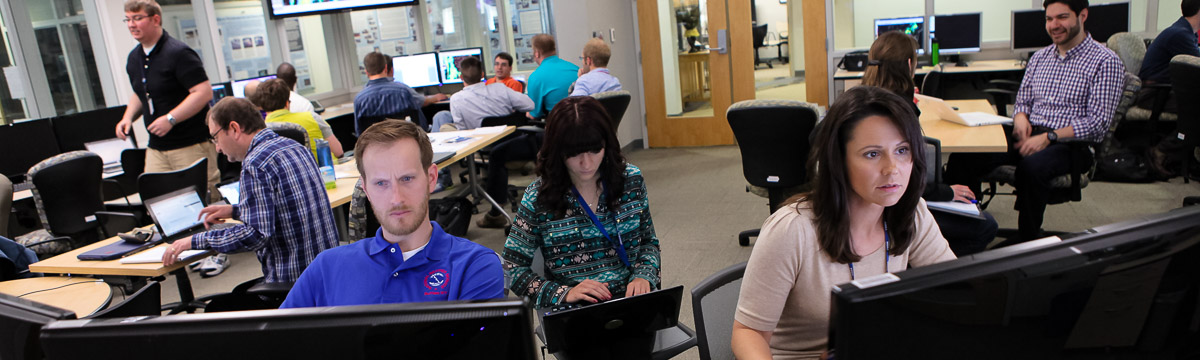
Forecaster Thoughts – Pat Spoden (2010 Week 8 – MRMS/GOES-R)

I was part of a group of 5 new forecasters who reported for duty at 1PM on Monday, June 7, 2010. It was week 8 of the EWP, with each week bringing in new forecasters. The first couple of hours were spent training on the new products we were being asked to evaluate. The objective was to determine which, if any, of the newer products would be useful in a short-fused warning situation. Our feedback would be given via surveys at the end of each day and during debriefs at the start of the following day. Real-time reports were supplied by students and the SHAVE (Severe Hazards Analysis & Verification Experiment), if applicable, during the week.

Each spring, NSSL and SPC jointly put together the Hazardous Weather Testbed (HWT) in Norman, Oklahoma. The two main program areas are the Experimental Forecast Program (EFP) and the Experimental Warning Program (EWP). The EFP focuses on the weather prediction models while the EWP tests concepts and technology and focuses on short-fused warnings.

Severe weather was expected Monday afternoon over the Central Plains. I have to admit, the first day, I was relying more on the products with which I was comfortable with rather than the new products. However, I did try to compare their output to the real-time reports we were given and my “crutch” products. Several of us did participate in a “canned” case using the total lightning products with storms over northern Oklahoma. The lightning data was helpful, yet confusing, because there were several lightning jumps as the updrafts increased. These storms were made up of multiple updrafts so it was difficult to determine which updraft was key in forecasting severe weather.

During the debrief on Tuesday, I was not overly confident that the “new” products were going to be of much help. But, I thought, it was early, and I needed to give them a chance. Plus, it was a slightly different environment than back at my office and that probably had an impact on my analysis so far.

Thankfully, more severe weather was expected that day. The software allow us to create a virtual forecast just about anywhere. We were not allowed to see what the actual forecast office was doing so that we would not be biased. The focus Tuesday afternoon and evening was over Kansas. I really worked to bring more of the new products into use and my comfort level was rising. We were able to make use of the convective initiation products as long as cirrus was not in the area. The convective initiation products did show convection quickly developing over Texas where the skies were generally clear.

It became clear to me that reflectivity on the -20 degree C surface was extremely helpful and I began to bring in more of the estimated hail size (MESH). These were the MRMS (Multiple Radar/Multiple Sensor) products. The MRMS products took advantage of all radars and were helpful as storms moved over the KICT WSR-88D’s “cone of silence” where one could see the storm increasing in intensity, but probably not to severe levels. Many of the products would allow a forecaster to pick out the strongest storms rather quickly. While there were many products available to us, not all of them appeared helpful.

On Wednesday, the debrief was more vocal as we began to find more and more useful products and examples were given of where certain products excelled and where they were not helpful. There were a few storms in the Alabama lightning network area, so that was the area of focus that day. We saw several instances where the total lightning was picking up on storms before the AWIPS lightning mapper program picked up on them. One could see the utility of this in the future, bringing with it a potential for lighting statements and potentially lightning based warnings. We continued to test all of the products available to us.

By Thursday, I was excited about the prospect of testing more of the new products. It seemed that everyone’s confidence was increasing dramatically using the newer products, especially the MRMS products. We were in luck as supercells were developing outside of Denver. We could see via the situational awareness display that VORTEX 2 was going to be on those storms. They provided us with real-time written reports and live video of the storms. I thought how nice this would be to have on a regular basis back in Paducah.

My partner and I were warning on the supercells. I relied heavily on the MESH and both the 0-2 km and 3-6 km 30 minute rotational track products. They clearly pointed out the areas of concern. I did look at the traditional products, but with the reverse weighting of what I used back on Monday. As the event moved on, one supercell became several. This is where the MRMS products shined. We created a split screen situation awareness display. The MESH and our warnings were contained on one side with the rotational tracks and our warnings on the other. From this, you could quickly look up and ensure that everything was covered. We were not too concerned with becoming overly focused on these storms with that configuration.

Friday was an early day, arriving at the weather building at 10AM. We reviewed the week’s events and discussed ways to improve them. Some ideas were as simple as changing color scales, while others were to allow more “on-the-fly” changes to look at reflectivity on different temperature surfaces and different dBZ cores. Before we left, Dan Neitfield, SOO WFO OAX, gave a presentation on how they handle tornado warnings in Omaha.

My experience at the EWP was fantastic and I hope to go back again. I have learned a tremendous amount about what may be available shortly to the field, and hopefully, helped the researchers look at different ideas and improve upon all of the work that has already been done. I could clearly see how several of these products would immediately help back at the office. While we are blessed with good radar coverage at Paducah,   these products would help us even further in critical situations. I could recall past situations where we would have benefited from having these products available. I knew I was going to miss having them once I got back to Paducah. Thankfully, they are available as test products on the WDSS-II website. http://wdssii.nssl.noaa.gov/ .

Pat Spoden (SOO, NWS Paducah, KY – 2010 Week 8 Evaluator)

Tags: None

Forecaster Thoughts – Frank Alsheimer (2010 Week 8 – MRMS/GOES-R)

I took part in the EWP for a week during June. I was able to experimentally use satellite and lightning products from the GOES-R Proving Ground applications as well as algorithms and products from the Multi-Radar/Multi-Sensor project. I will talk about the benefits and weaknesses of both.

GOES-R products — The products I got to experiment with were the convective initiation, overshooting tops, and the pseudo-lightning. I see both promise and limitations, but some of the limitations will be rectified once GOES-R becomes reality.

Convective Initiation — During the week of the experiment, I found myself only occasionally being able to use the product. The lack of ability to detect initiation through cirrus is a major drawback, significantly limiting the number of signals. However, some of that may have been due to issues with the satellite images themselves on which the algorithm is based. Especially noticeable was a one hour period around 00Z when we only got 3 images in an hour’s time. That really made it hard for the algorithm to do its job up to its potential, and therefore made it difficult to give it a true workout for when it would be operational with GOES-R. In theory, the product would have use in operations before a convective event begins.

Overshooting Tops — There were a few more opportunities during the week to see this algorithm in action.While it did a good job in determining many of the overshooting tops during the events I worked, I did not get a whole lot of additional lead time over just using traditional radar interrogation. This is another case, however, where more frequent (at least every 5 minute) images from the GOES-R satellite may show more benefit to the product.

Pseudo Lightning — I found this product to be complimentary to, and in a few cases superior to, the ground based lightning detection networks to which we currently have access. There was one specific real-time case I remember where the total lightning product actual gave lead time to a cell that had become electrically active over both traditional radar interrogation methods as well as the ground based lightning network. This is very important since many lightning fatalities are recorded with the first strike. It will also prove very beneficial as we get more into decision support services, especially to support the safety of responders to incidents who are exposed to lightning hazards.

Multi-Radar/Multi-Sensor — I found some of these products more beneficial than others. I will talk about each grouping of products individually.

Gridded Hail Detection Algorithm (HDA) products — The bias-corrected version of the MESH algorithm created a product that was far superior to the current MESH algorithm associated with individual radars during the week I participated in the test. Once I got used to the product, I used it as a primary tool in the warning decision process and would definitely use it regularly were it available in the AWIPS system at my office. The non-bias corrected product was not quite as reliable, but it was still nice to have a product that updated more frequently than any VCP we have available today, as well as helped to mitigate the “cone of silence” issue we have with individual radars. I used the 30 minute swaths occasional when following a supercell, but did not find a lot of real-time use for the 120 minute swath products.

Hail/Lightning/Convective diagnostic products — The most beneficial of these products was the reflectivity products at specific temperature altitudes, especially the -20degC. The two minute updates of these products helped to identify rapidly increasing convective cores. The 50 dBZ echo tops as well as the height of the 50 dBZ above specific temperature levels (i.e. 0degC and -20degC) was also beneficial, but 60 dBZ would likely have been a better product to access. I didn’t find much use  for the VIL, VIL Density, and LRA products, although I have to say I didn’t really use them a  whole lot once I found some of the other products I liked better.

Derived Shear Products —  I found some cases where the products were helpful and some others where it was not. It has a tendency to increase values as one gets closer to an RDA because of the weighting process, which is a bit of an issue at times (although it’s an issue on the individual radars as well). Similar to the HDA products, I thought the 30 minute tracks had some benefit for tracking purposes, but not so much the 120 minute.

Cloud-To-Ground Lightning Products — I found the density product useful as it gave a discreet value which could be compared both to the trend of the cell in question as well as other cells. It would occasionally be better than the individual strike product we currently get on AWIPS because it was easier to discern the lightning frequency near an individual cell.

Frank Alsheimer (Science and Operations Officer, NWS Charleston SC – Week 8 Evaluator)

Tags: None

Week 8 EWP Summary: 7-11 June 2010

SUMMARY:

Week #8 of EWP2010 wrapped up the first week of MRMS and GOES-R experimentation.  We spent a lot of time in the High Plains this week, however we were able to get one event over the Alabama Lightning Mapping Array.  During this week, NSSL and the GOES-R program hosted the following National Weather Service participants:  Frank Alsheimer (WFO Charleston, SC), Dan Darbe (WFO Atlanta/Peachtree City, GA), Daniel Nietfeld (WFO Omaha, NE), Pat Spoden (WFO Paducah, KY), and Andy Taylor (Norman, OK).

REAL-TIME EVENT OVERVIEW:

7 June: Evening “practice” IOP for southeast Wyoming and western Nebraska, including Scottsbluff tornado that V2 was on.

8 June: All day IOP over Kansas.

9 June: IOP for the Northern Alabama Lightning Mapping Array area today.

10 June: Front Range IOP today, including a tornadic supercell near Deer Trail Colorado that V2 was on.

MRMS:

One forecaster felt that the MRMS products helped add confidence to his decision making, but there was not enough time during the one week period to warm up to them.  However, another forecaster felt the rapid updates and multi-radar nature helped with quick identification of the severe storms, and then sparse grid products made the big cores really stand out from the rest.

As the week wore on, they became more comfortable with the MRMS products, and started to hone in on the specific products that worked best for their decision making.  They wanted to note that on the first few days, they weren’t as concerned about getting the warnings out sooner than the official warnings, knowing that there was no risk in a late warning.  [NOTE:  We’ll need to take that into account, hence why we’re doing some of the day-of-the-week composites in our analysis.]

They noted that there were big benefits that these were multiple-radar products.  They spent less time having to do an all-tilts analysis on all storms from each radar sensing the storm, or choosing the “correct” radar.

One forecaster commented that he was a firm believer in using MESH or another sparse grid designed for hail diagnosis to really narrow down the hail threat and make the polygons slimmer to avoid overwarning.

The rotation tracks really helped hone in on which storms to watch for tornado warnings.

Suggested improvements:  Add height information to the isothermal reflectivity products (could do multi-parameter sampling); an on-demand MRMS system where forecasters could create their own products (e.g., Reflectivity at -12 degC for winter precip) would be very beneficial.

GOES-R:

All agreed that cirrus presents major problems for the Convective Initiation (CI) product.  They also mentioned that the CI products do best in the first 10-15 minutes of an event.  Once warnings are starting to be issued, it was rarely looked at again.  CI would be useful on pre-dawn low-level jet warm advection situations to determine location of first convection, but that there needs to be some kind of alarm/trigger to notify the forecasters who might not be paying close attention.  A nighttime WES archive case was suggested for future experiments.  These forecasters also commented that there are too few CI detections, and wouldn’t mind lowering thresholds and adding uncertainty to get more detections.  There were concerns that CI, OT, and TC are too sparse sometimes to see, and better alerting/icons would help.  But some others abhor the bells and whistles of SCAN and GUARDIAN, and would want another way to alert.  Also, there might be need for separate day and night CI products.

Forecasters felt that the OT products were not needed when you can see them in the visible data, but it certainly adds more confidence about the storm being severe.

Regarding the PGLM products, suggestions included a cell table concept to plot trends, adding a lightning jump algorithm, a wintertime total lightning app, combining lightning data with other sensors, and rate of change products.  A discussion also ensued regarding short-term lightning threat products, or advisories for frequent cloud-to-ground lightning.

There are more details on the GOES-R HWT Blog Weekly Summary.

OVERALL COMMENTS:

Some comments echoed by former participants, including pre-made default AWIPS procedures (don’t like using others’ procedures), and fixing the MRMS loading issues with better hardware.  It was noted that the recommended hotel (Country Garden Inns & Suites) has taken a major turn for the worse this year and should no longer be used.  Not only did our software have bugs….

A LOOK AHEAD:

Next week will wrap up the 2010 spring experiment.  The pattern looks favorable for continued severe weather, mainly shifting into the Northern Plains by the end of the week.

Greg Stumpf, EWP2010 Operations Coordinator

Tags: None

Week 7 EWP Summary: 24-28 May 2010

SUMMARY:

Week #7 of EWP2010 wrapped up the first week of MRMS and GOES-R experimentation.  We were all over the CONUS this week, including a perfectly timed event over the Washington DC area for our Headquarters visitors.  During this week, NSSL and the GOES-R program hosted the following National Weather Service participants:  Rod Donavon (Des Moines, IA), John Murray (New York, NY), James Sieveking (St. Louis, MO), and David Zaff (Buffalo, NY).

REAL-TIME EVENT OVERVIEW:

24 May: “Practice” IOP, first looking at CI products for AMA and DDC, then MRMS products for OUN.

25 May: 6-hour IOP, working High Plains storms, working AMA, PUB, and DDC CWAs.

26 May: Early IOP over Oklahoma (no severe reports), later IOP for the Front Range, DEN and CYS.

27 May: 6-hour IOP over the Northeast U.S., PHI, CTP, and the LMA network near Washington DC.

MRMS:

With Rod Donavon here this week as one of our participants, we were able to get an idea of how his hail diagnosis technique adapted to the MRMS data.  The Donavon Technique uses the Thickness between the 50dBZ Echo Top and the height of the melting level (0degC), but diagnosed using traditional D2D methods (all tilts or 4-panels with data sampling) using single radar data and an estimate of the melting level height from either nearby sounding or model data.  A suggestion included taking his severe hail probability values based on the technique and gridding them as an additional MRMS product.  But his new technique, adapted for the new 1″ hail criteria, also looks at the height of the 65 dBZ Echo over the melting level height, a possible new product we could add to the suite.

A lot of the forecasters liked the Reflectivity at the -20C level, and Jim Sieveking added his unique “red-white-blue” colormap to our system.  He and other forecasters create this product locally using the Volume Browser and RUC temperature profiles to sample as you go up in elevation, but that version is single-radar based.  The biggest advantage is that the MRMS product is already in a gridded form.

Some of the “sparse grid” MRMS products are good for situational awareness – they show the few storms that “stand out” against the rest, those storms that are obviously severe.  These included the 50 dBZ Echo Top and the H50_above_H253.

One forecaster was curious as to what Azimuthal Shear values correlated best with tornadoes.  However, as with MDA and TDA, there are distributions of tornadic and non-tornadic storms at all strengths, with a higher probability of tornadoes at higher values.  But there was a definite advantage of using the Rotation Tracks to help with polygon orientation and determining intensity trends.

The forecasters felt more comfortable using the MRMS products as the week went along.  But they commented that they needed more information about how the 3D reflectivity cube was created, and what went into each product.  We re-tooled the training for the following weeks to include more of that information, and eventually will include this in a 20-min Articulate presentation for the Google Earth KML-wrapped PNG image users.

All forecaster mentioned that it would be nice to have more MRMS applications to help with the severe wind decision making.  We’ve got enough for hail, lightning, and tornadoes.

GOES-R:

The Convective Initiation (CI) product once again suffered from cirrus obscuration, and very few detections.  Some suggestions were to somehow include audible or Guardian alerts for CI detections, and the ability to display contours cloud-top-cooling rates over satellite or radar imagery.

Overshooting Tops and Thermal Couplet detections were rare this week.

We had an opportunity to view real-time pseudo-GLM (PGLM) products over the Washington DC LMA data this week, but the highest flash rates seen (37) were no where near the values seen during the Oklahoma archive case (100+).  Some forecasters commented that they still were unsure of what the value meant relative to storm severity that that more experience would be needed to know.  They did like to compare the PGLM data with the MRMS data or just the height of the 50 dBZ Echo Tops determined manually.  Noted trending up with storm severity, and even a drop right before the tornado in the archive case.  Others would like to see a winter convective archive case used.  Some also felt that total lightning was a good discriminator of convective initiation.

There are more details on the GOES-R HWT Blog Weekly Summary.

OVERALL COMMENTS:

We had a good discussion on how the AWIPS environment is set up in the HWT.  There was a debate over using WES archive cases for all events, in which we could control the diversity of cases looked at, versus real-time events where there is the element of surprise.  Noted was the fact that during real-time events, the storm reports are usually delayed, and the reporting time is rarely recorded so it would be difficult to recreate this in an archive situation (unless we guessed at a delay time).

The forecasters were hoping for some default AWIPS procedures to get them started.  This was also noted in other weeks, as well as last year, so we’ll have to strongly consider this for 2011.

Greg said he was struggling with the decision to “nudge” the forecasters to look at certain products, or to just let them go on their own to discover them.  It was suggested that perhaps next time, to make a checklist of what products should be looked at.  [NOTE:  Now that the project has ended, I’m realizing that perhaps we needed to include some MRMS “best warning practices” information, for examples:  1) be sure to use the track products to orient the warning polygons at all times, 2) make sure all polygons are “storm-based” – i.e., only one polygon per storm, and 3) separate hail/wind threat from tornadoes with separate polygons.]

Finally, there was a suggestion that we start Monday at a normal shift time of 9am for training, and then leave the option to stay for an overtime shift past 5pm for a real-time event.  One issue is that the researchers/developers live local and may not have the flexibility with family schedules to pull a 12-hour shift.

A LOOK AHEAD:

We are taking next week off due to the Memorial Day holiday and a short week.  The next operational week is two weeks away, too far into the future for any reasonable prediction.

Greg Stumpf, EWP2010 Operations Coordinator

Tags: None

Daily Summary – 27 May 2010

Today was EWP “Big Wig” day, with visits by OS&T Director Don Berchoff, GOES-R Program Manager Greg Mandt, and NCEP Director Louis Ucellini.  The atmosphere behaved once again, like last year, to provide a severe event over the Washington DC metro area, as well into eastern PA and NJ.  We started by issuing for Mt. Holly NJ (PHI), Sterling (LWX), and State College PA (CTP), although it became apparent that CTP was going to be non-productive so we shut it down.  We used Sterling (LWX) so we could capitalize on the pseudo-GLM data.  It ended up being a low-end severe event, with mostly wind reports for the PHI CWA.

We finally made the change that displays the PGLM data in AWIPS as 8 km grid squares.  But most of the storms in LWX area were marginally severe.

The MRMS data was used mainly by the PHI WFO, and noted that most of the hail numbers were showing a bit high compared to the actual reports.

Greg Stumpf (EWP2010 Operations Coordinator)

Tags: None

Live Blog – 27 May 2010 (7:30pm)

Here is a Warning Decision Support System – II (WDSSII) image of the DC Lightning Mapping Array (LMA) Pseudo GLM product (colored grid squares) and a 3D mapping of the lightning flashes for a storm near Baltimore MD that was deemed severe by the EWP meteorologists.  The image on the left is a view looking toward the northeast.  The image on the right is a view looking toward the north west.  The storm is moving southward, with is opposite the direction of the arrow on the cross section line.  The orange polygons are the experimental severe thunderstorm warnings issued within the HWT.

Greg Stumpf (MRMS Principle Scientist)

Tags: None

Live Blog – 27 May 2010 (7:00pm)

After many hours of waiting for anything severe in the CTP CWA, we decided to cut them loose, and we are operating only with PHI and LWX.

Here’s a screen capture showing the isothermal reflectivity at -20C and Jim’s new color scale.  He likes the 60 dBZ threshold at that level, so he turns it from white to blue, and thus has SVRed that cell.

Greg Stumpf (MRMS Principle Scientist)

Tags: None

Live Blog – 27 May 2010 (5:40pm)

We’re still operating as three CWAs, CTP, PHI, and LWX.  CTP has remained quiet, with no warnings issued.  LWX has started issuing warnings for storms over western VA and easter WV, based on hail.  They have been using the Ref -20C and ET 50.

PHI has been the most active with a number of warnings.  The PHI team has been using various MRMS products such as echo top, Ref at -20C, POSH, and MESH.  MESH has had “varying” results, but they have been varifying their warnings with hail reports.  Here’s a picture of PHI’s recent warnings

Greg Stumpf (MRMS Principle Scientist)

Tags: None

Live Blog – 27 May 2010 (5:35pm)

For the first time, we are actually running three CWAs:  PHI, CTP, and LWX.  The most convection, with some severe as deemed by our EWP participants, are in the PHI CWA, but we expect some severe weather in the other CWAs.  But for the most part, this is a low-end severe weather event.  Attached is a screen shot of the 120 min Hail Swath product from the multi-radar/multi-sensor (MRMS) system.

Greg Stumpf (MRMS Principle Scientist)

Tags: None