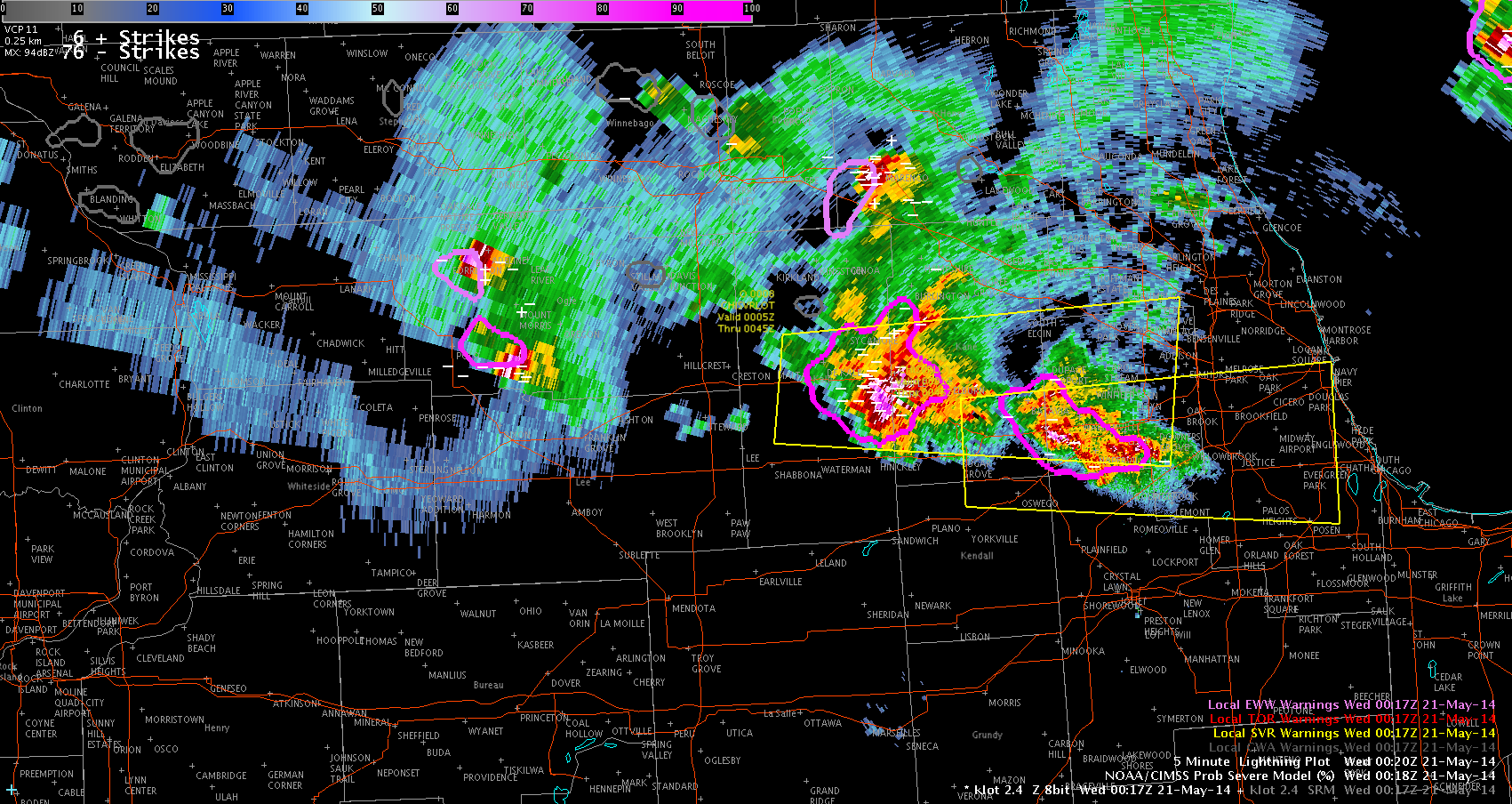
EWP Status for Wednesday May 21th – 12:30pm to 8:30pm Shift

Another split decision day ahead with two areas of favourable convection.

1) NE Colorado area – Deepening low pressure center will push southward, bringing flow out of the south/southwest and pulling moisture into the region. Model soundings show destabilization occurring in NE Colorado between 18-21z with forecast PW values exceeding 1″ over the region by early afternoon. I don’t know how many people were chanting “UPSLOPE! UPSLOPE!” in the HWT today but there were quite a few.21z NAM12 forecast sounding over Adams County, Colorado.
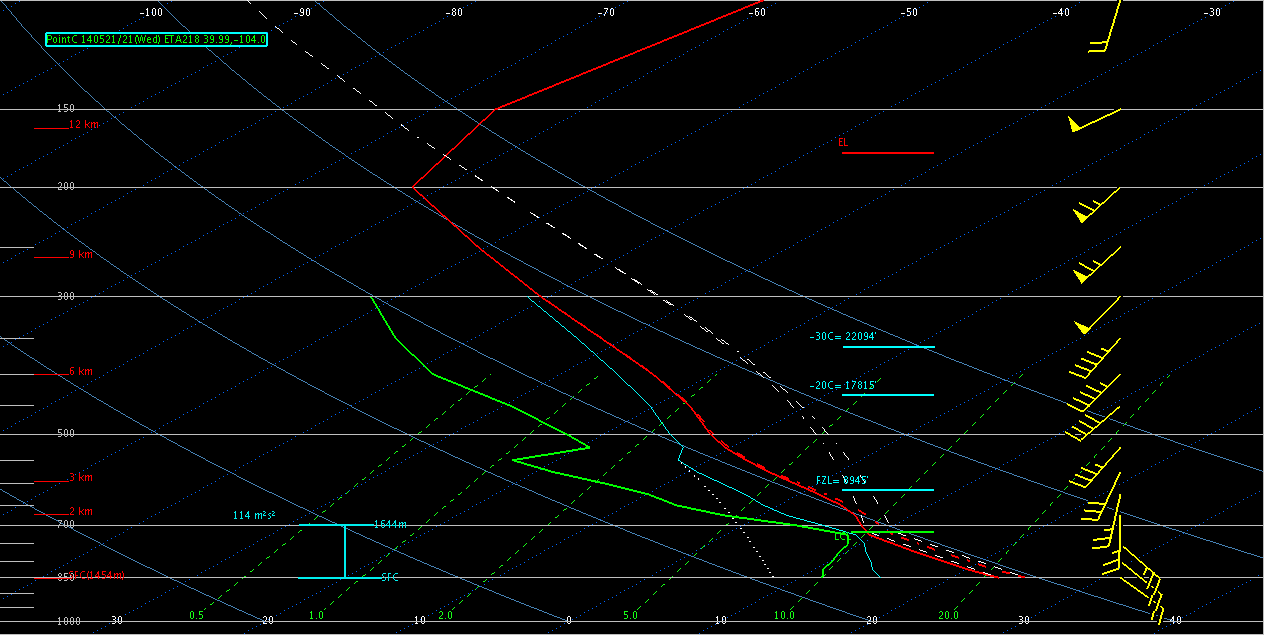
21z NAM12 forecast sounding over Adams County, Colorado.

Ohio Valley/Lower Mid-Atlantic – Forecast surface dewpoints in this area in the upper 60’s/low 70’s with mid-level shear between 40-50 knots over the entire region. EFP forecast probabilities remain low over this region as there is quite a bit of uncertainty of what dominant storm mode will persist overnight. We will see in the morning!
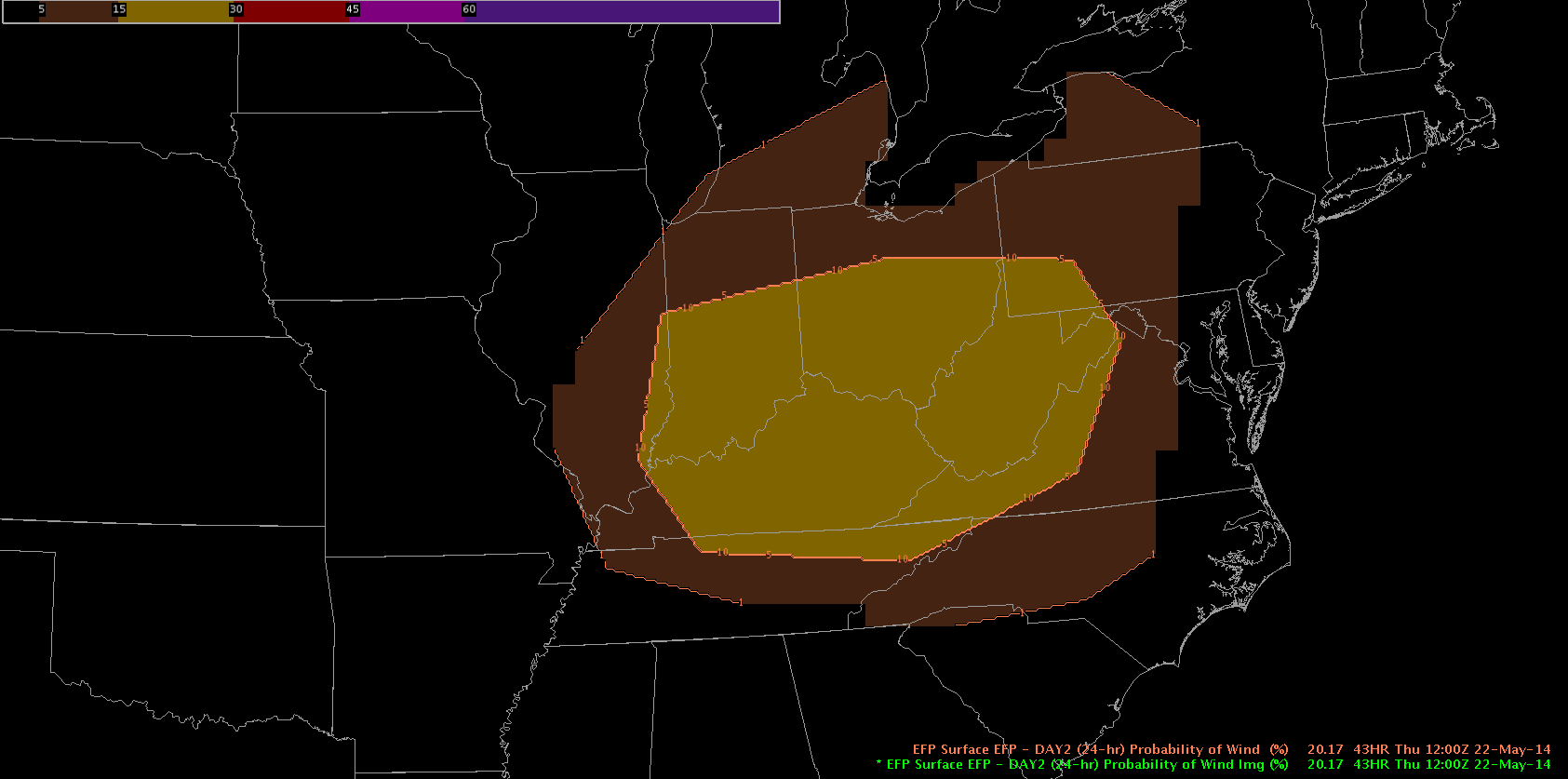
EFP Day 2 Forecast of Hail for May 22, 2014.

We’ll meet in the Dev Lab tomorrow at 12:30pm and debrief our exciting adventures today before heading over to the HWT at 1pm.

-Darrel Kingfield
EWP Week 3 Coordinator
Tags: None

A NearCast Update for DVN

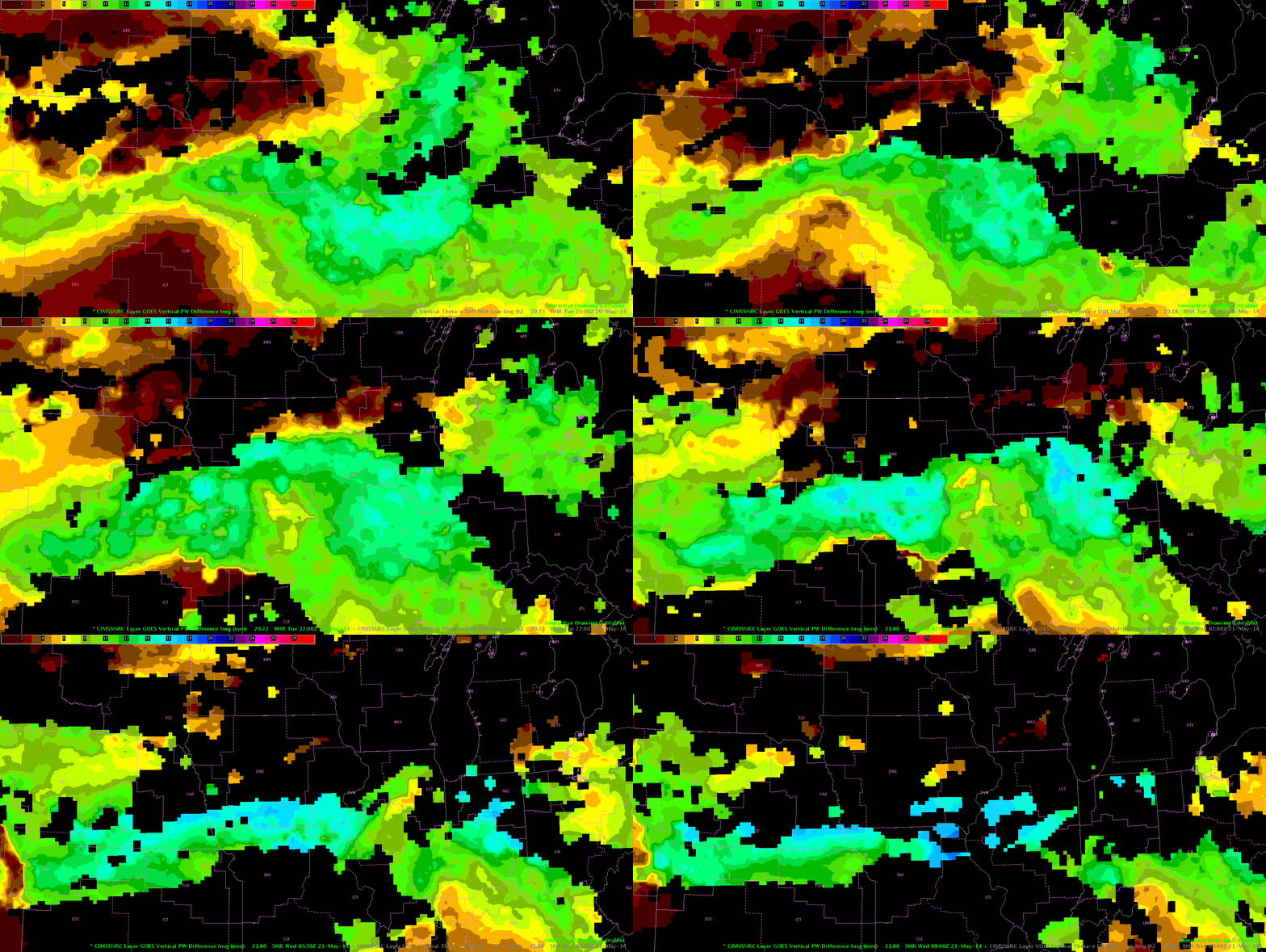
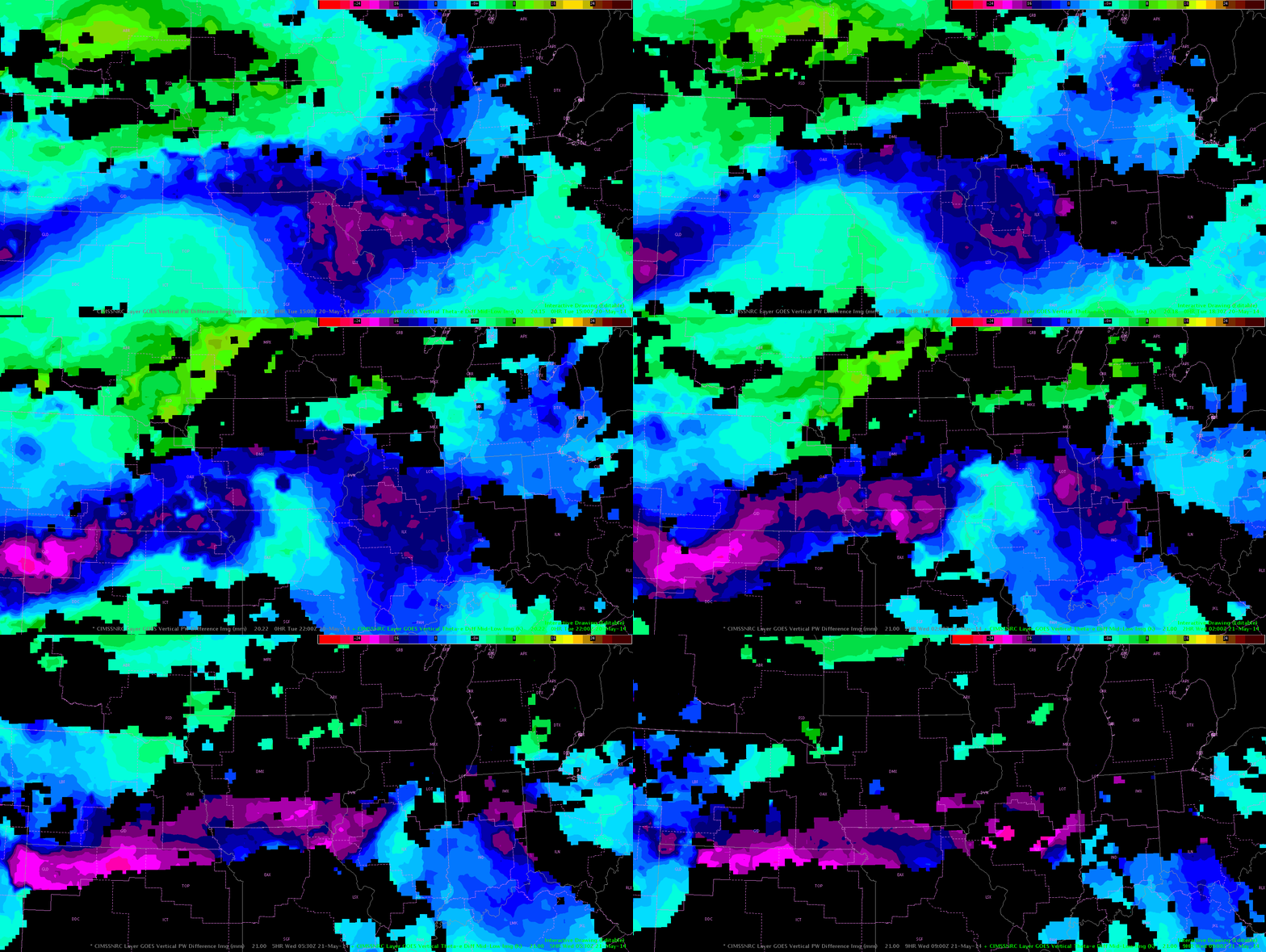
After a long afternoon/evening of analyzing convection over the northern half of DVN’s CWA, I took a few minutes to take a look back at the NearCast theta-e and PW difference products. Starting with the PW difference product, it was good to see the increased moisture advecting into the region and it lined up exactly with where storms initiated and persisted throughout the day. It did take some interpolating since there were some blacked out spots, similar to the theta-e difference product, but both are still helpful tools to see local storm environment as well as what’s coming upstream. The same trend could be seen in the theta-e product and combining these two, it raises my confidence level in being able to use these products when performing a mesoscale analysis.

15Z-02Z_pw_diff 15Z-02Z_theta-e_diff

~Linda

Tags: None

Daily Summary: Week 3, Day 2 (May 20th, 2014)

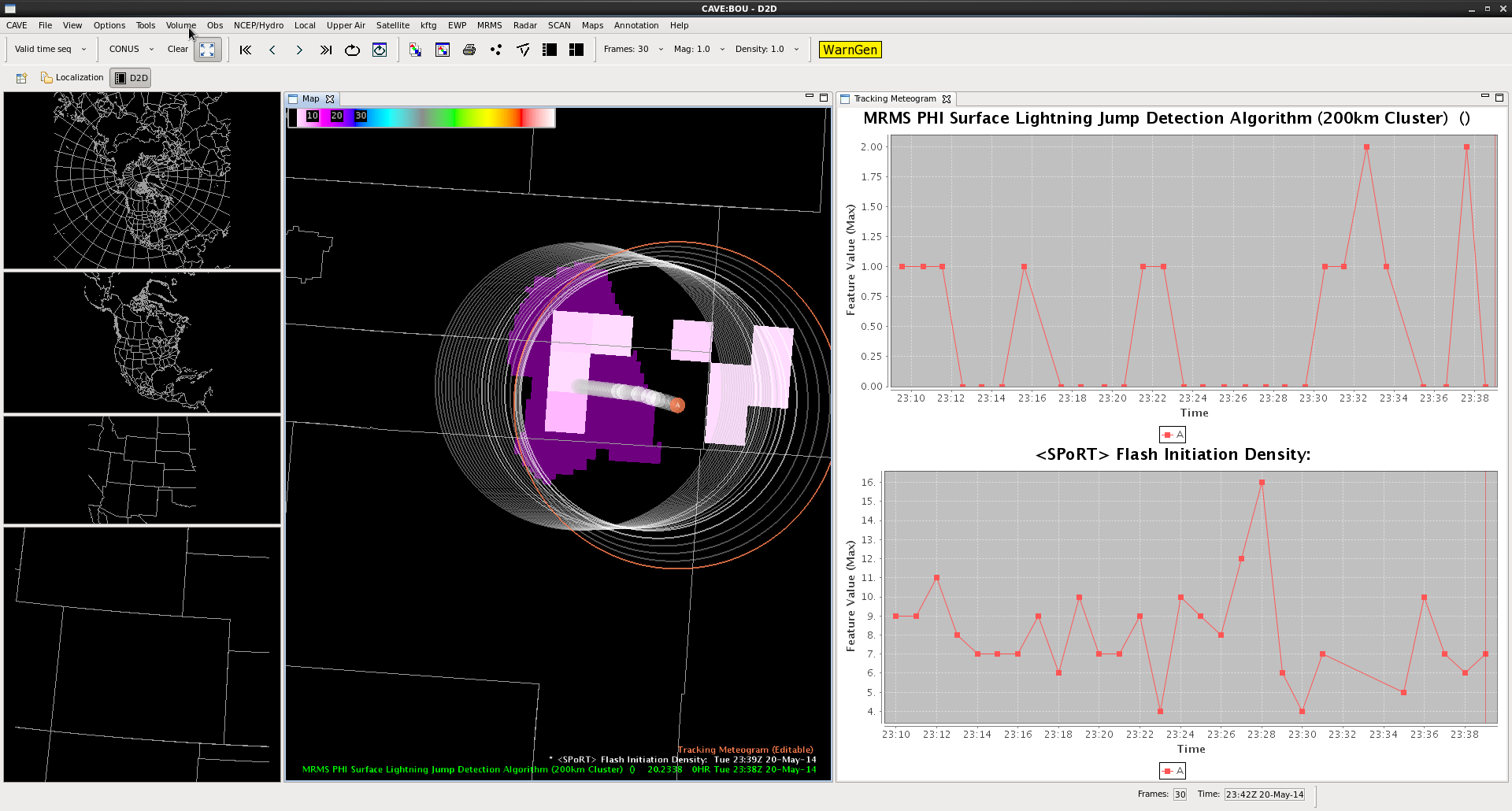
What some people (including me) called a marginal day last night were pleasantly surprised with the amount and extent of convection observed in all CWAs utilized today. For a majority of the day we operated in the Cheyenne, WY and Quad Cities, IA/IL CWAs (CYS and DVN). As a supercell fired east of Denver, CO (BOU) forecasters leveraged this opportunity to look at the lightning jump detection algorithm and track total lightning on the tornado warned storm. In the late afternoon as the storms in the CYS area weakened, we shifted our product evaluation to Chicago, IL (LOT) for a DVN/LOT side-by-side warning operations session.

By splitting our operations into West vs. East, we were able to take advantage of (and blog about) almost all products brought into the experiment…with the exception of OUNWRF (sorry Gabe 🙁 ). The tracking meteogram was put to the test again today with  forecasters wanting to track multiple product types simultaneously (radar + MR/MS, etc.) with mixed results. All forecasters issued their fair share of warnings (especially Danielle!) this afternoon. The training storms in the DVN region provided quite the challenge and convection is firing like crazy in LOT right now. I think it will be hard to pull the forecasters away from their computers tonight.

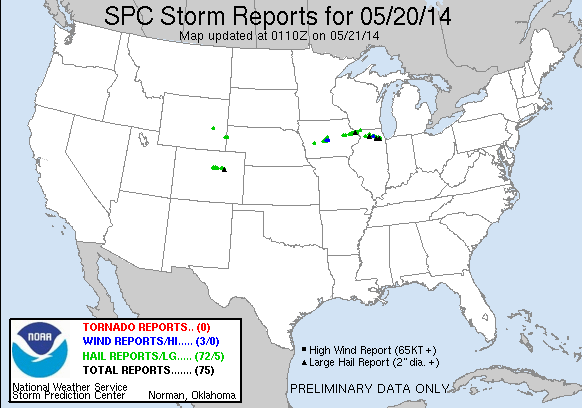
SPC Storm Reports as of 8:10pm on May 20th, 2014

-Darrel Kingfield
EWP Week 3 Coordinator
Tags: None

Changing Colors for Prob Severe

I found it nice to change the default color scheme on the prob severe procedure. The default colors sceme doens’t provide high contract between different levels of probability of severe. I changed the color scheme to highlight higher values of prob severe.

-JB
prob_svr_color

Tags: None

LAPs color bar change? Run to Run legend standardization issues.

May20th 2346Z

May 21st 0102Z

Just wanted to point out in the above two LAPs images. The color bar associated with number of CAPE is NOT fixed. This can cause some confusion when one model run is being actively overwritten with a new one. In this case the 22Z was overwritten with the 23Z model. The color for around 3000 j/kg dropped from Yellow/Orange to Green/Yellow. I believe this may be due to lower end of the CAPE spectrum being dynamic with runs (in this case -500 switched to -1000). It may be an idea to permanently fixed color bars to keep this from becoming a problem for the non-number oriented mets. Yes, they/we do exist!

Grant H.

Tags: None

NearCast, Prob of Severe, and MESH Verify

Severe Warning with Severe Prob MESH NearCast

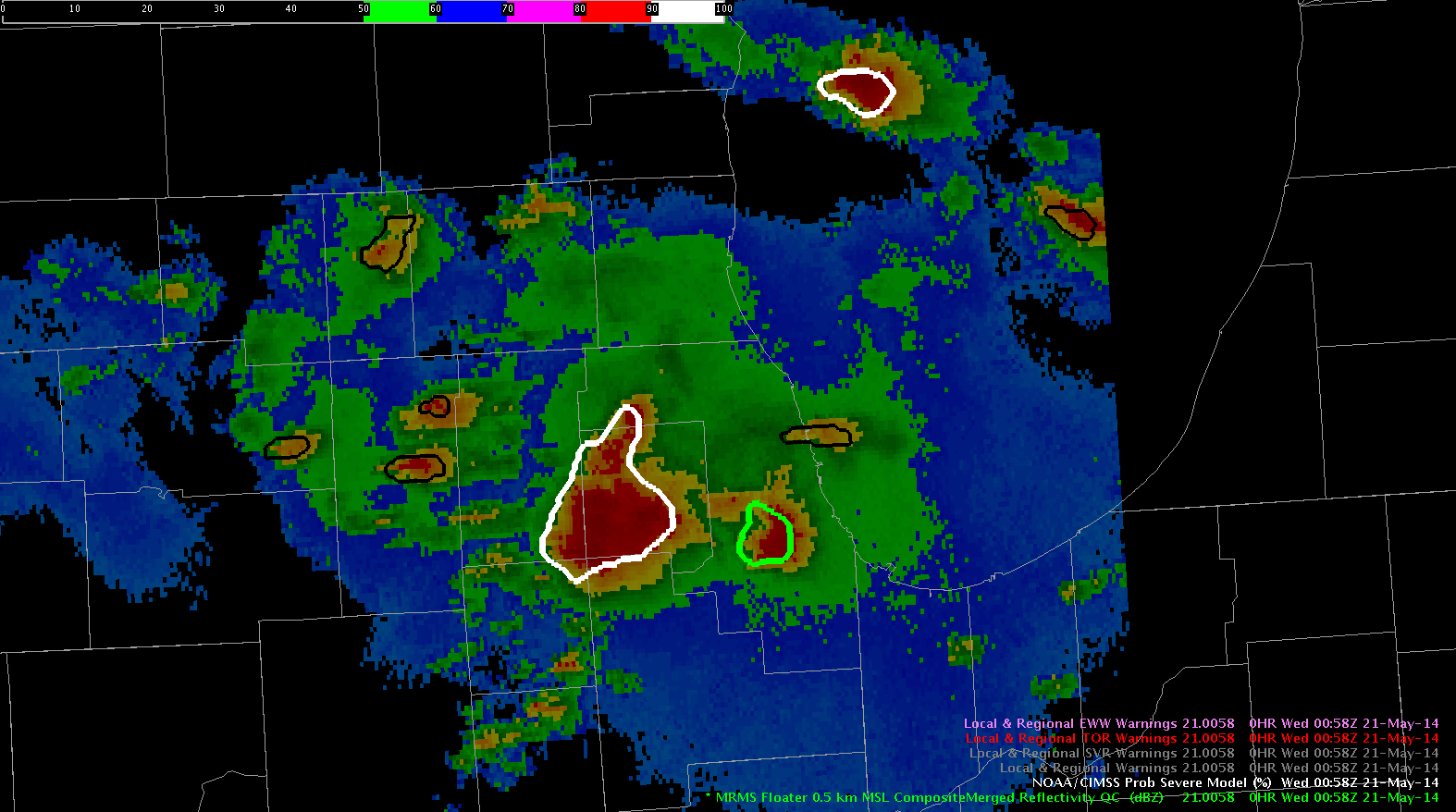
I issued a severe t’storm warning for Linn County thanks to the Prob of Severe/MRMS data (bottom left) product and also looking at the NearCast (top right) which showed me that the environment was unstable to keep the storm severe.  Shortly after, I looked at the MESH (top left) and it shows hail around an 1″ or so and then a spotter reported 1″ hail in Alburnett which is right near the 1″ area.  All and all these products were good and my warning was verified. ~ Vollmar

Tags: None

My First Go at the Tracking Meteogram Tool

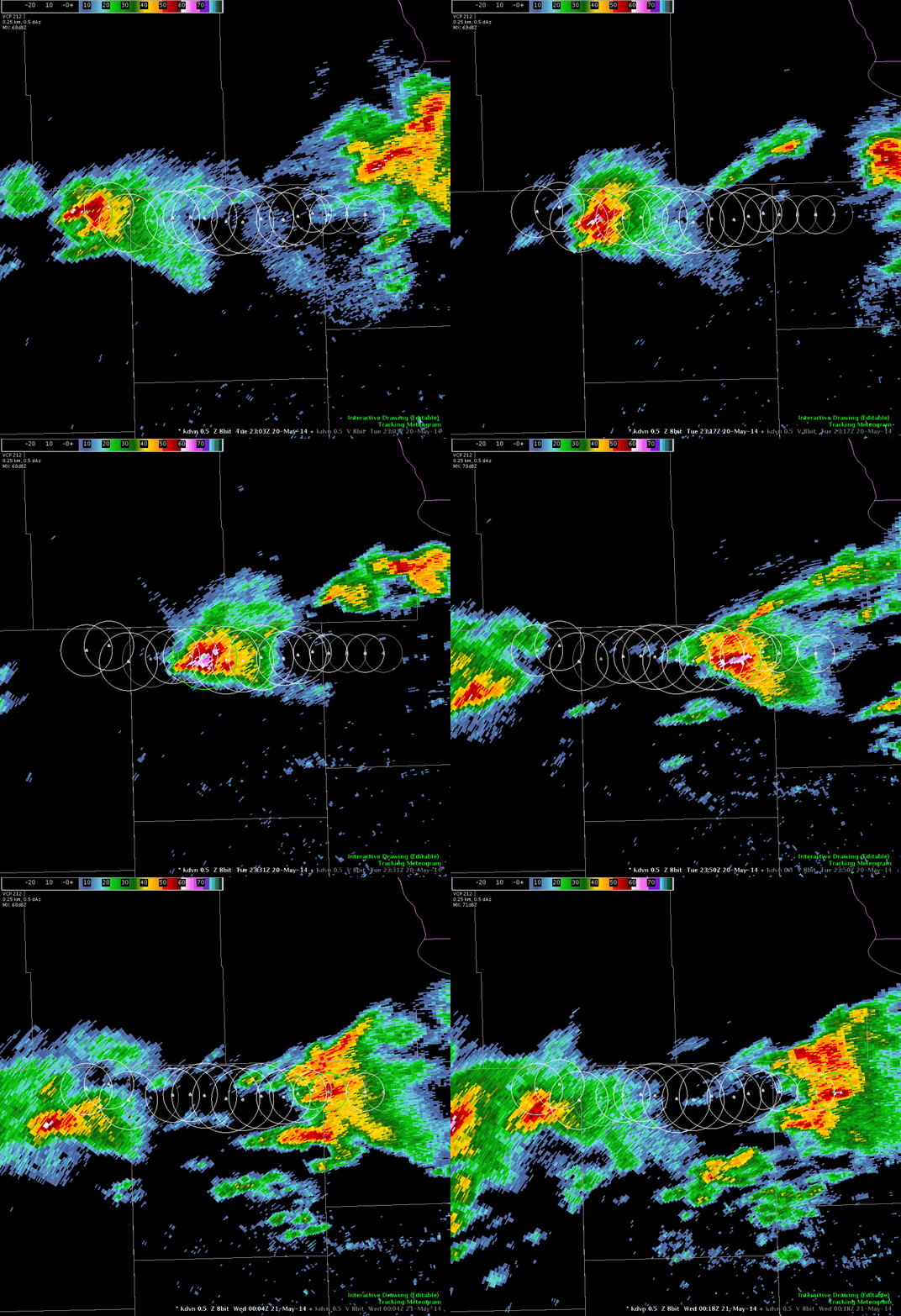
Well… unfortunately, my first crack at this tool has not gone well. When I initially pulled up the tool, it looked fine but then at some point, I had closed the Tracking Meteogram tab and could not figure out a way to pull it back up without reloading it all over again. I consulted with folks and we could not figure out how to bring a closed tab back up. It is unfortunate because I had already created a track and my points so I had to redo it.

Another problem I ran into was when the tab was opened, the meteogram would sporadically go blank/missing. Additionally, I received constant red banners that said An internal error occurred during: “Loading Tracking Meteogram.,” whether the meteogram was visible or missing. Lastly, I was testing the meteogram with KDVN 0.5 Z/V products and the Z meteogram did not line up temporally with V. Every time a new radar scan would come in, the V meteogram would update with the latest scan but the Z meteogram increased in the amount of points on the x-axis without accurately or correctly updating the time (x-axis)/max reflectivity value (y-axis).

I do like the ability to move individual points (instead of the entire line like with similar tracking tools in AWIPS-I) and it was interesting to be able to increase/decrease the circle size to capture certain storm features. I also like the capability that it has to offer to be able to see trends laid out in graph form for a particular product or set of products.

2303Z-0018Z_TrackTool

0023Z_incorrect_time_cropped

~Linda

Tags: None

Three Meteogram Boxes One Product

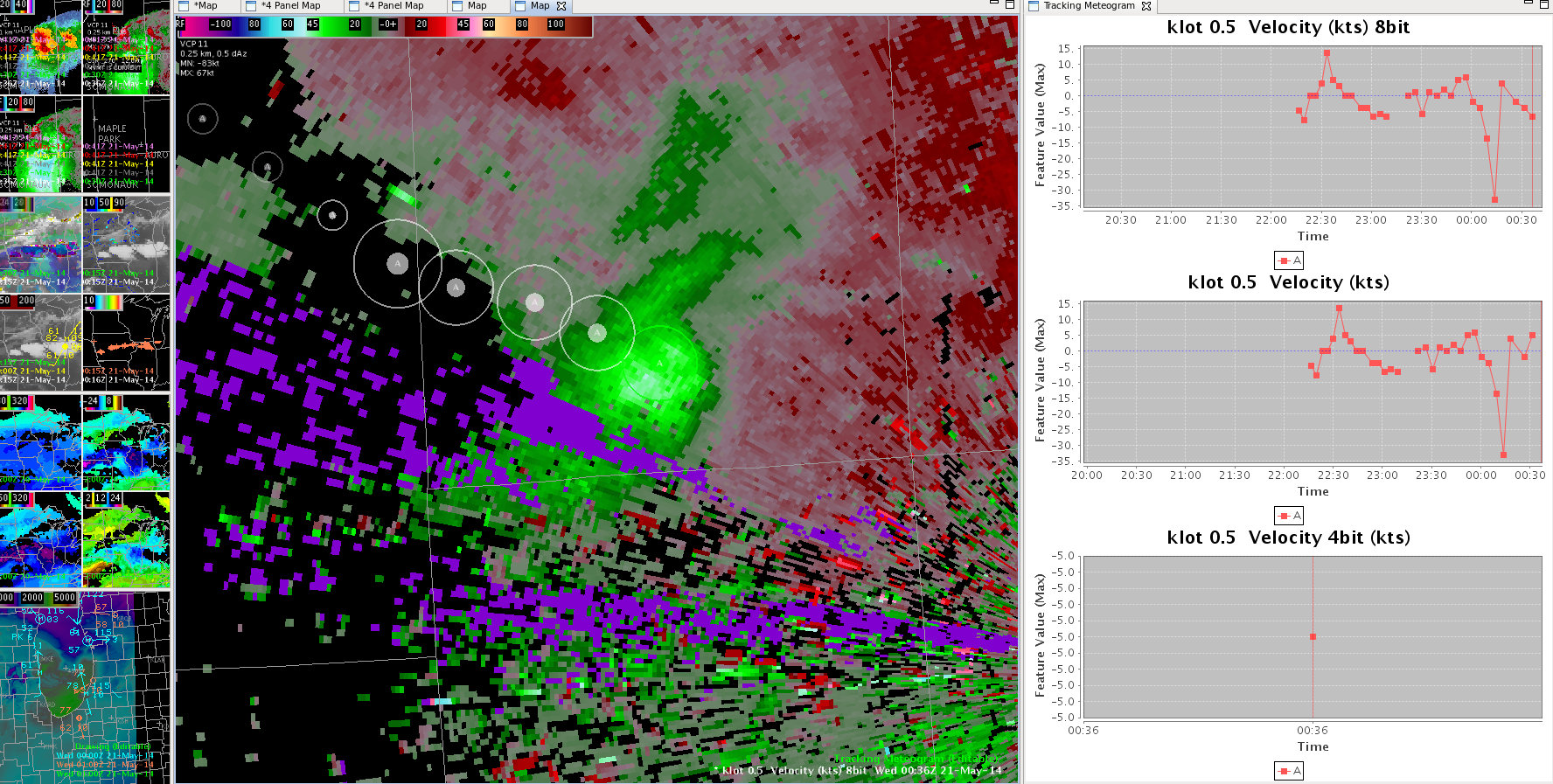
I loaded the the base velocity product and then the meteogram program and it seemed to work well initially, but as the radar product updated the meteorgram split into two boxes, one for 8 bit and one that just indicated velocity. It later added a 3rd box that included 4-bit after the screen updated again.

-JB

meteogram_interesting

Tags: None

Reasons for the slow warns.

May 21st 0021Z

Just wanted to add that on some of these storms I have been a little slower on the draw to warn. This is due to examining other new products such as LAPs CAPE and composite reflectivity MESH, while also participating in a round table discussion with some extra students on why and how they impact the mesoscale forecast, how newer dual pol products interact with the old legacy products, and examining the new prob of severe function that surrounds these storms.

MESH seems to be doing excellent here. However MESH and Prob of SVR do not capture  information of the latest lowest scan because the volume is not complete yet. It is important to use Prob of Svr as a trend tool and seeing a quick graph of Prob of Svr rising would be very helpful.  (Again a tie in to SCAN for ease of graphing would be wonderful. )

Grant H.


Tags: None

Same Storm Different Lightning Jump

jump_delay_2310_2338UTC

A secondary lightning jump occurs at 23:28 UTC with the same storm east of Denver Co. The lightning jump here reached the 2 sigma level when the total flash rate increased from 8 flashes per minute to 16 flashes per minute in the span of two minutes. This reinforcing lightning jump indicates that the storm’s updraft was still undergoing periods of intensification.  Baseball size hail was being reported at the time of the jump, and ping pong ball size hail was reported at 23:35 UTC in association with this storm.  Hail was reported as deep as 3 inches on the ground.

*There appears to be a delay between the jump occurrence in the Flash Initiation Density (23:28 UTC) and the LJA sigma plot (23:33 UTC).