Comparing storm development with satellite derived CAPE/LI

Used satellite LAP algorithm to track the change in the environment over the course of the afternoon. Best instability was in the southeast CWA. Overlayed one hour total lightning with the CAPES and LI to see how the coverage of storms lined up with the best instability. Image shows this overlay at 21z.
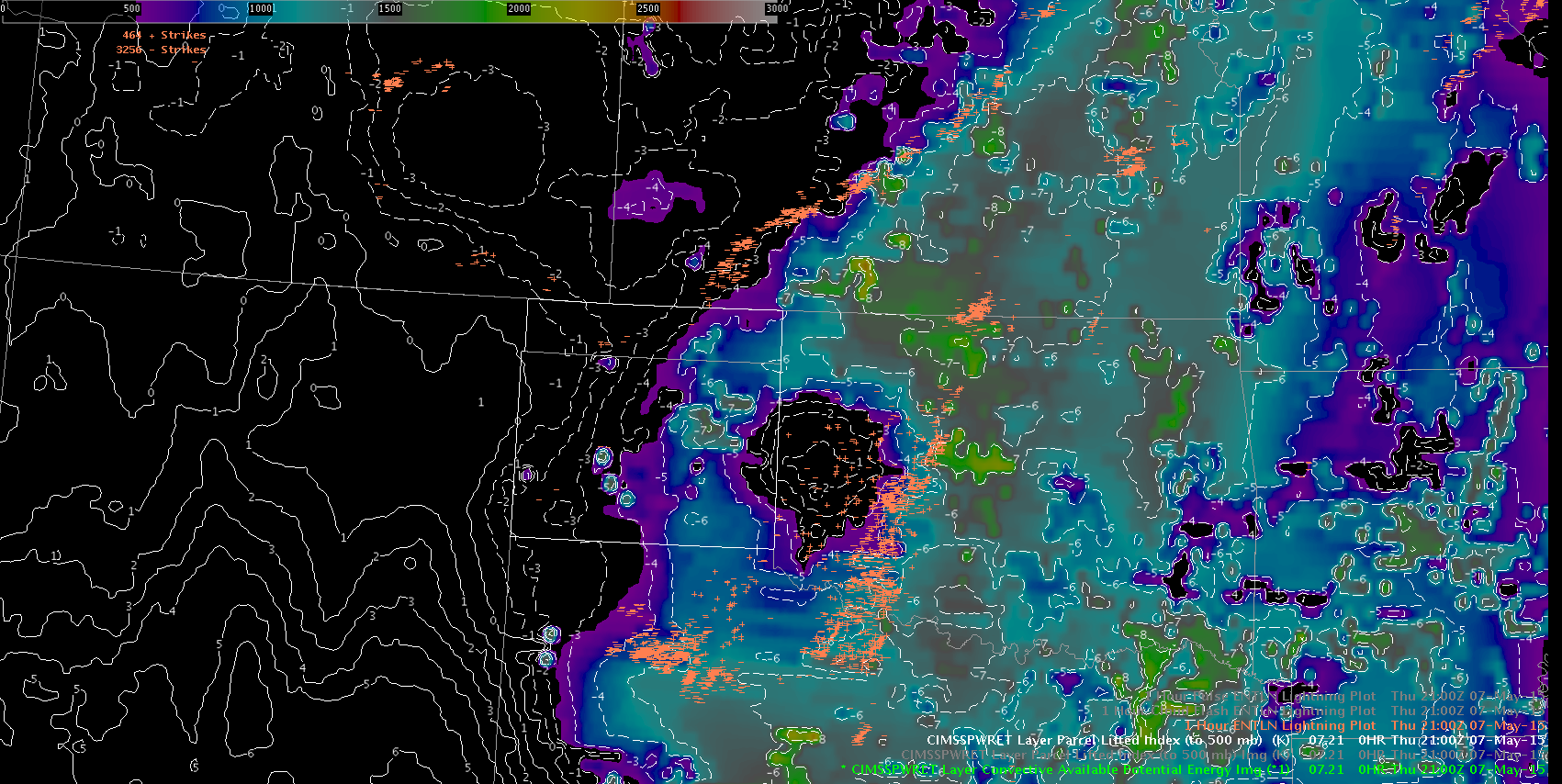
Lightning and instability

Ongoing MCS from this morning accounted for the lightning east and south of the forecast area. Narrow strip of lightning west of the better instability was where outflow boundary intersected cold front/dry line. This area had better low level lapse rates and more time to recover after the morning MCS.

The mesoanalysis from SPC showed much higher CAPS at 21 and 22z than the values from the LAP algorithm. SPC was 1000-1500 J/KG while satellite derived was less than 500 J/KG.
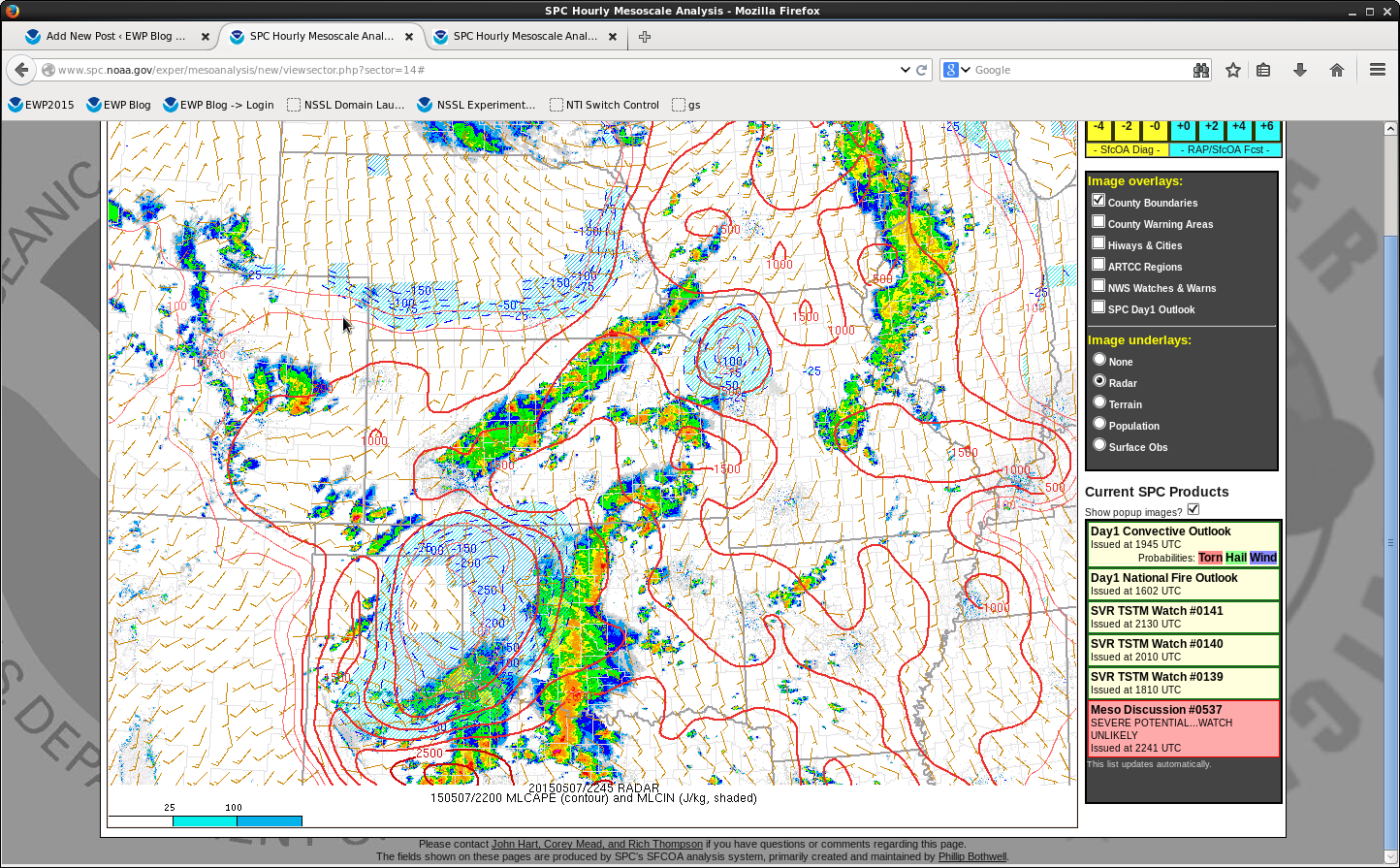
SPC 22z Mesoscale Analysis May 7

Lynford


Tags: None

Custom Dangerous Lightning Alerts

One of the other groups had a good suggestion of raising the Dangerous Lightning Alert custom values to 50/75/100 flashes per minute. That increase was significantly larger than the default values and based off some of the situations we have seen over the SW OUN cwa, that may not have been high enough. This image below (taken around 2143Z) shows just the 75/100 flash alerts and those are too overwhelming with the amount of polygons.

20150507_2140Z_CustomLightningAlert-SRF

Tags: None

ENI Time Series and ProbSevere

New convection has been initiating along the nose of stronger instability feeding northward across north central TX and I have been watching one cell in particular in Young county TX.

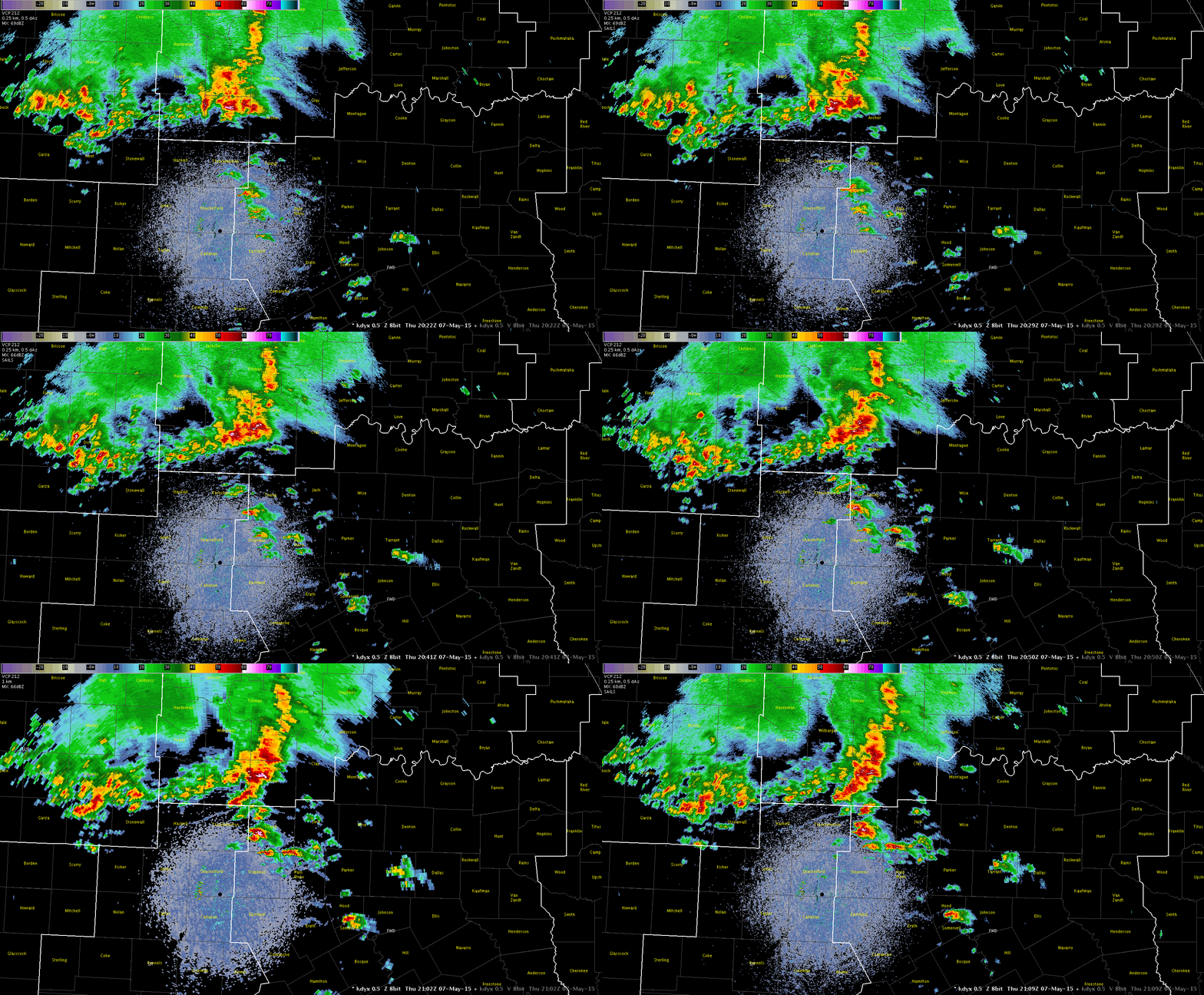
RadarLoop_2109

The ENI time series has provided a nice trend in the strengthening of the storm and showed a large jump in flash rate just before 2050 UTC.  Looking at the base data all tilts at the time of the jump revealed a deep 50 dbz core to almost 40kft and a 70 dbz core to over 21kft.

ENI_Timeseries_YoungTx
ENI Time Series

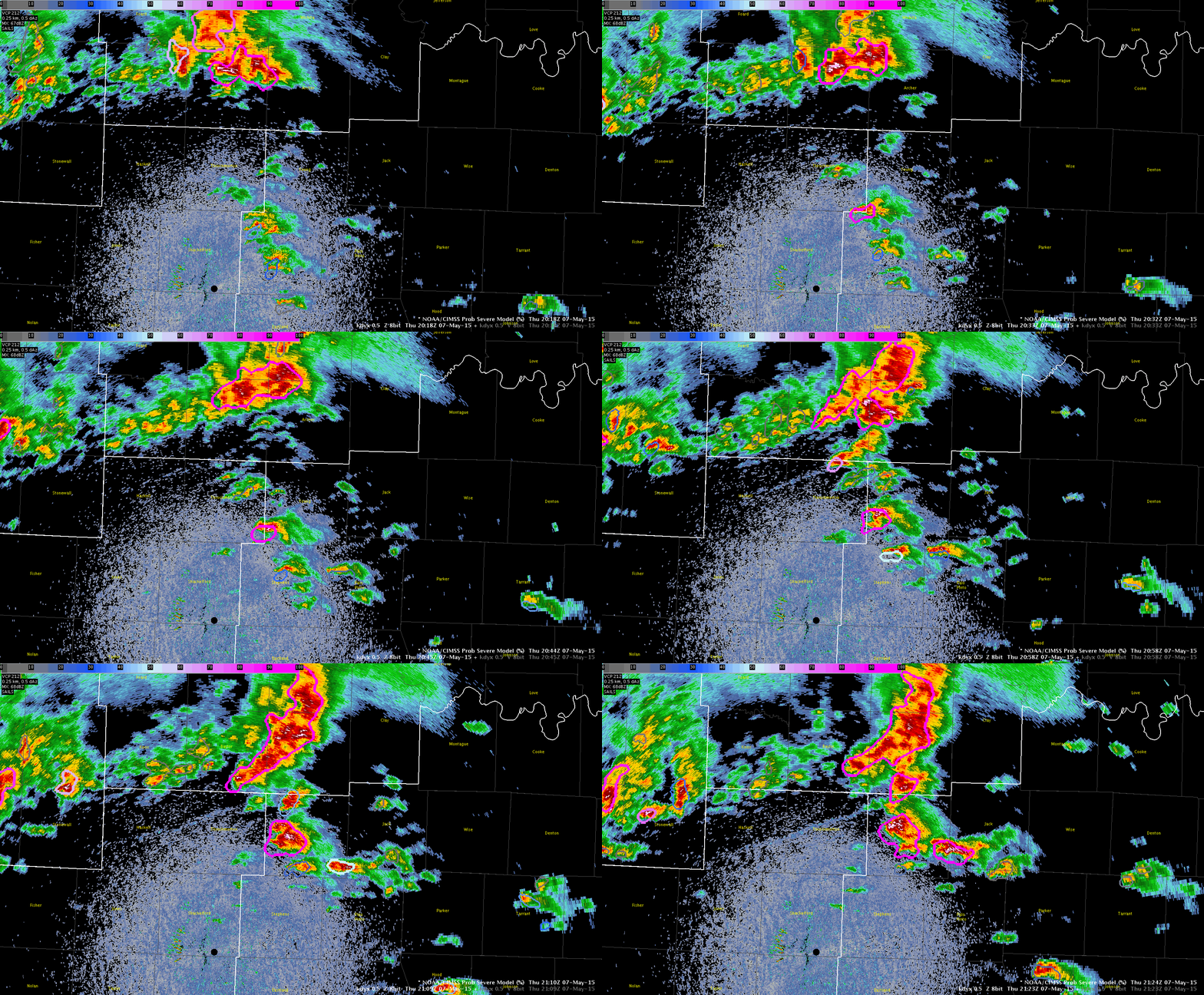
I think this ETN time series data was useful in identifying a rapidly developing updraft. Interesting to note, the ProbSevere model indicated a 74% severe threat at 2024 UTC on this storm which then went to 88% at 2033 UTC and then 98% at 2040 UTC.

ProvSevereLoop
Radar image loop with ProbSevere overlay

The ProbSevere output on the storm when it showed the 74% threat showed a strong glaciation rate and moderate growth rate with MESH of 0.68 inches.

Jack Bauer

Tags: None

Lightning Cell Within Another Cell

Saw this interesting situation today and I’m not sure if it is an issue. There were several instances in a row where lightning cells were within another lightning cells. I have included an animation below (click to view), but I would have thought they should have been combined and lead to a much higher lightning rate and in turn a alert.

20150507_2126Z_LightningCellInside

Tags: None

NUCAPS in Amarillo CWA

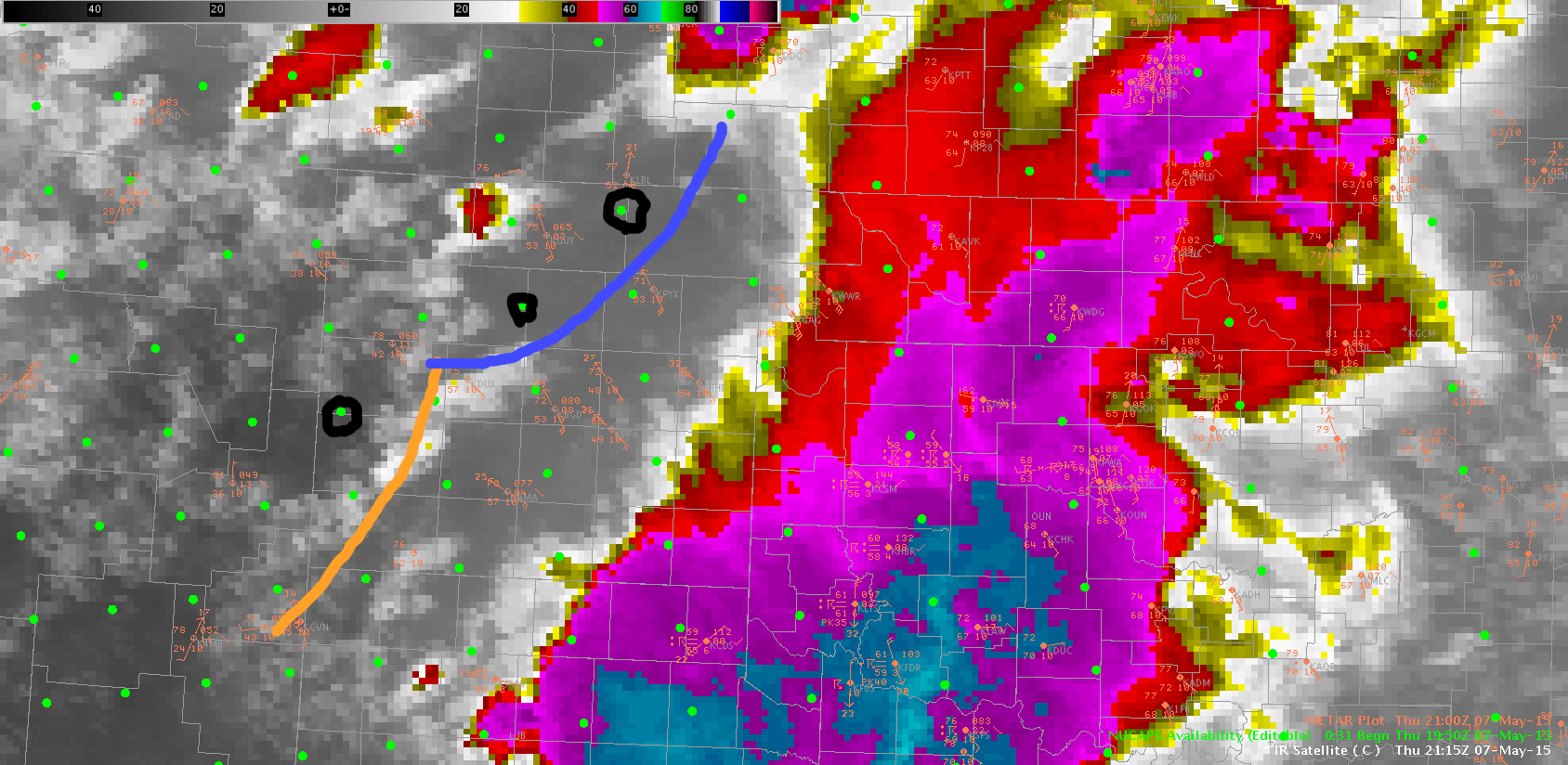
Three NUCAPS soundings were sampled this afternoon around the Amarillo CWA.  Several boundaries are observed in the CWA today…of most interest, a westward propagating outflow boundary from morning MCS and the dryline.  The northern and central soundings were west of the ouflow boundary, but east of the dryline.  Both of these soundings were about 8 degrees too cool (temperature) and 15 degrees too dry (dewpoint) at the surface.  Once the profiles were modified, they yielded 1500 J/kg and 2770 J/kg CAPE, respectively.  The sounding behind the dryline was a close match to observations…and little modification to the sounding was needed.AMANUCAPS

Blue line is westward moving outflow…dryline is marked in yellow.  NUCAPS soundings modified are circled in black.

ALEXANDER’S DARK BAND/LYNFORD

Tags: None

Convective Initiation Miss

At 1930 UTC the Convective Initiation product showed a probability over 60% over Montague/Cooke/Denton counties in TX.

VIS_CI_1930z

However radar imagery over the next hour did not show any development with reflectivities 35 dbz or higher, in fact very little at all was noted.  The image below shows the radar data at 2030 UTC with little if any returns.

Radar_20150507_2030z

Jack Bauer

Tags: None

Warned Storm Lightning Data (OUN)

Thought I would do a quick post on the lightning data from a warned storm in the SW part of OUN area. Earlier, there were a few cell mergers that caused some jumps on the time series (right around 2020Z on the image below), but otherwise there was a steady rise in the total lightning data, with a few smaller jumps as it reached its peak.

20150507_2052Z_WarnTimeSeriesThe second image has the two main lightning cells within the warning, but you can see one smaller cell that was seperated out at that time before quickly merging back into the larger cell.

20150507_2052Z_WarnLightningCell-SRF


Tags: None

pGLM, lightning jump, and prob severe

Amongst a mess of convection in the Lubbock CWA, some of the new tools definitely help focus your attention on certain cells.

One sigma lightning jump

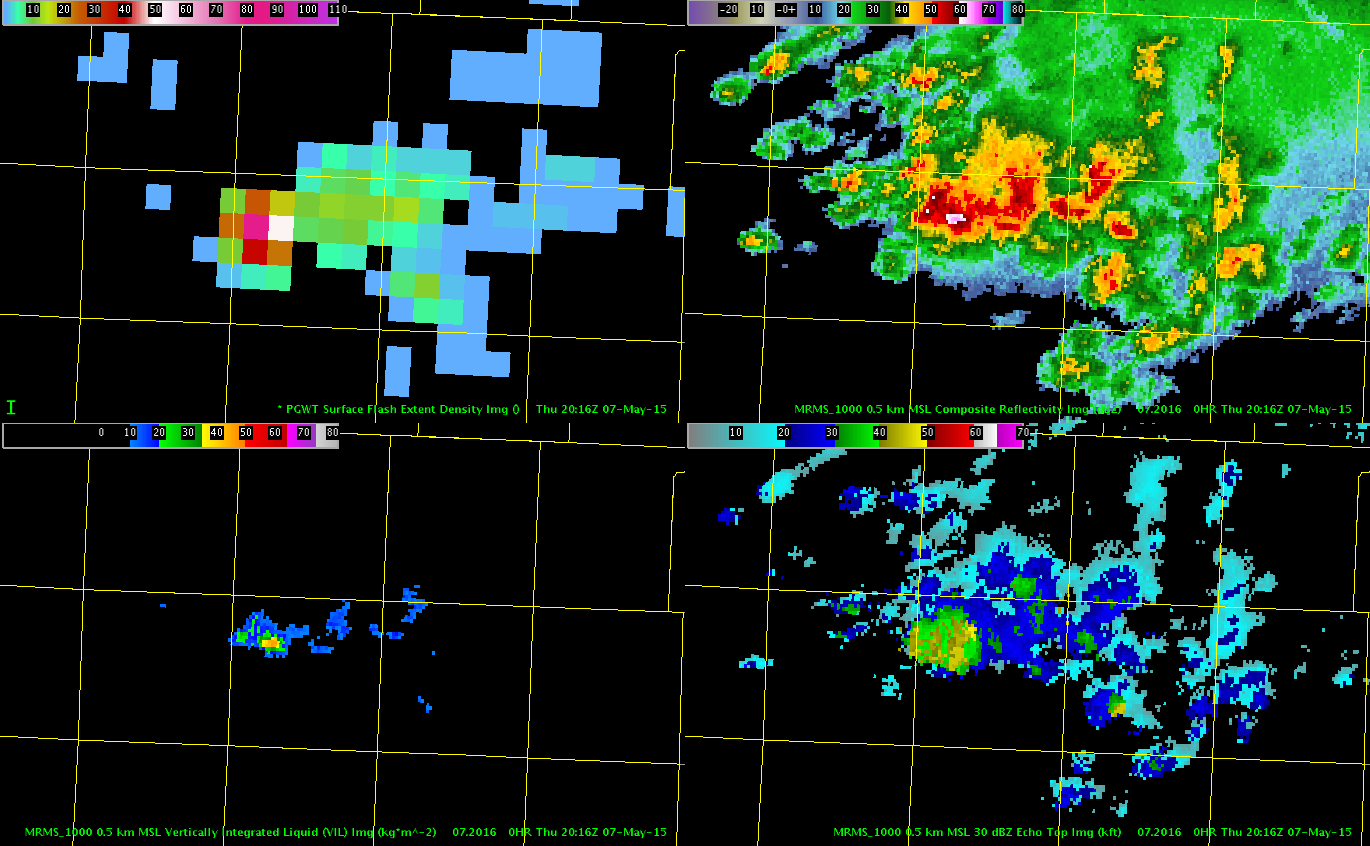
Just looking at the radar data, not much stands out. However, the lightning jump and prob severe (86%) definitely catch your attention.

KLBB pGLM 2016ZAt 2016Z, the lightning density peaked at 81, the highest I’ve seen so far.

KLBB prob severe 2016ZBy this time the prob severe was up to 94%. Based on radar data the storm looked like it intensified for a short time and was definitely stronger than other cells in the CWA. Nothing was reported with it (so far). This is a good case for using these tools for situational awareness, and perhaps giving you longer lead time on certain cells within a mult-cell cluster or line of convection.

-V. Darkbloom


Tags: None

UAH/GOES-R CI across southern LUB

The predominant scenario for convection across the central/northern LUB CWA is the continued slow movement of the MCS. A weak outflow/remnant boundary exists west and south of the slowly easterly moving MCS that has acted as a trigger from some storms to fire as the mean southerly flow advects a shallow cumulus field toward the MCS. The dryline remains just west of the CWA and may be a focus for storms later this afternoon.

The CI field below continues to possess high percentages as it advects towards the outflow/remnant boundary. Overall it has been a good situational awareness aid. The example below shows a small cluster of cumulus with higher percentages near Girard, TX, at 2007Z that crossed the outflow boundary and quickly ramped up with increasing reflectivity values well above 35 dBZ (images from 2003 to 2011Z).

CI_2007Z_southernLUB2003ZLUB2006ZLUB2008ZLUB2011ZLUBBrick Tamland

Tags: None

Currently Using ProbSvr for Situational Awareness

Storm in the southern portion of our forecast area have been posing the greatest threat for severe weather, actually receiving a 2 inch hail report near Mabelle TX.  While focusing my attention there, I have been using the ProbSevere model to provide me with general situational awareness for the north-south line of storms further to the north.  I will also run through the all tilts base data just to confirm there is no significant threat to monitor but this is a nice tool to have to provide situational awareness for multiple storms in the forecast area, especially if you are in a situation where staffing would not allow for sectorization.  Notice in the image below the very low ProbSevere values along the north-south line of storms.

ProbSevere_SA

Jack Bauer

Tags: None