



CI indicated 83% chance for a cell in Claiborne, Co., TN as of 21:45Z. Subtle impulse and perhaps outflow from old convection to the east may be puffing up the Cu…we’ll see how it develops over the next hour.—DB
Month: May 2014
EWP Big Spring Day 1: 5 May 2014
Day one of our Big Spring Experiment and operations are already well underway.
The focus for today is primarily hands-on training. The forecasters have been asked to examine all the experimental products and issue occasional blog posts as they see interesting or note-worthy items. The goal is to develop a familiarity with both the new products and blogging process.
Two forecasters (Thoren / Maples) are localized to the Sterling, VA (LWX) WFO and watching ongoing convection there and areas south including the Blackburg, VA WFO. The other forecasters (Rudge / Bickford) are localized to the Cheyenne, WY (CYS) WFO, monitoring the region for CI.
As the week continues, are focus will become a little more defined and move to writing mesoscale / forecast discussions and warnings. Expectations are that the probability for severe convection will increase with each day of operations this week.
-Kristin Calhoun, Week 1 Coordinator
Western VA High Prob Storm
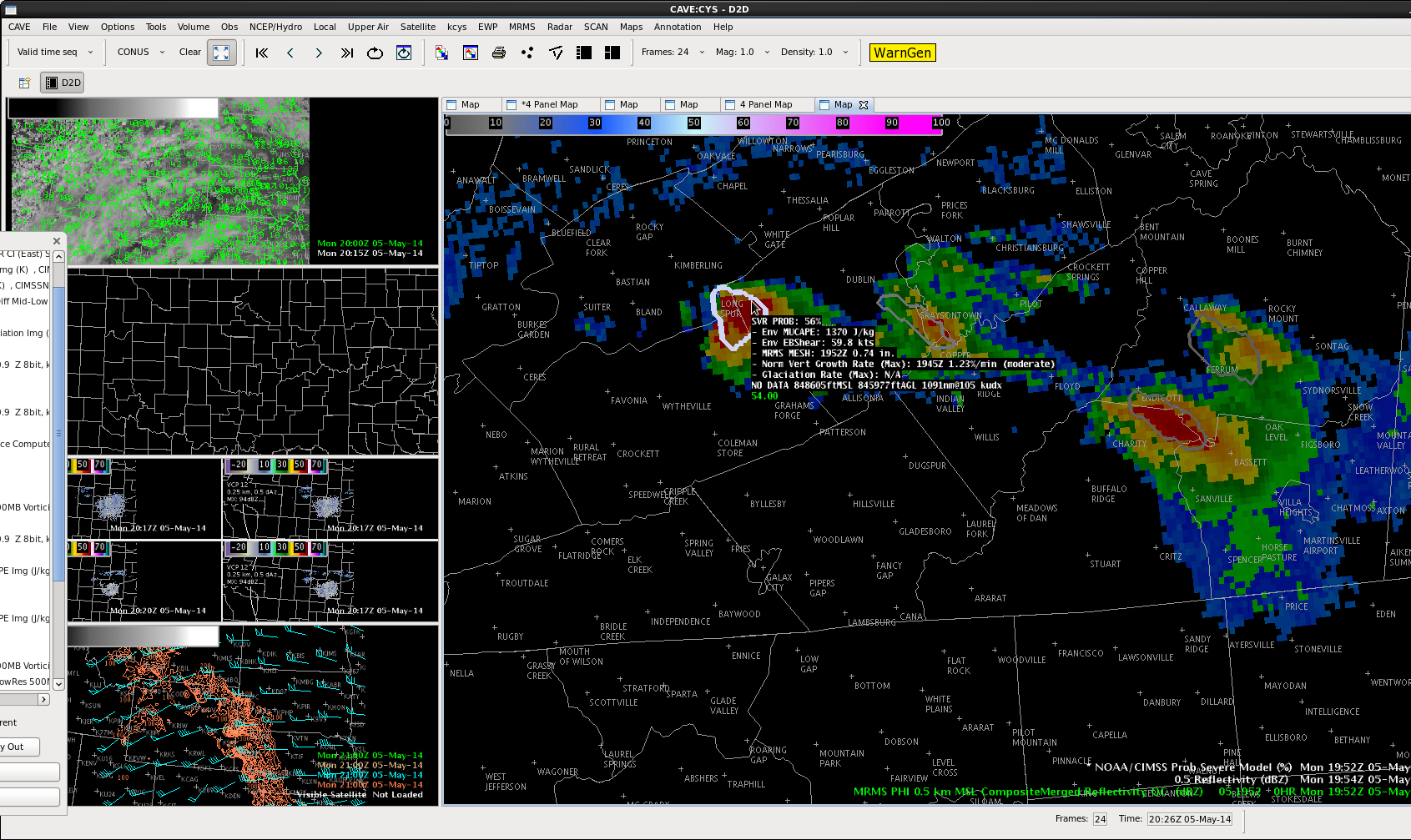
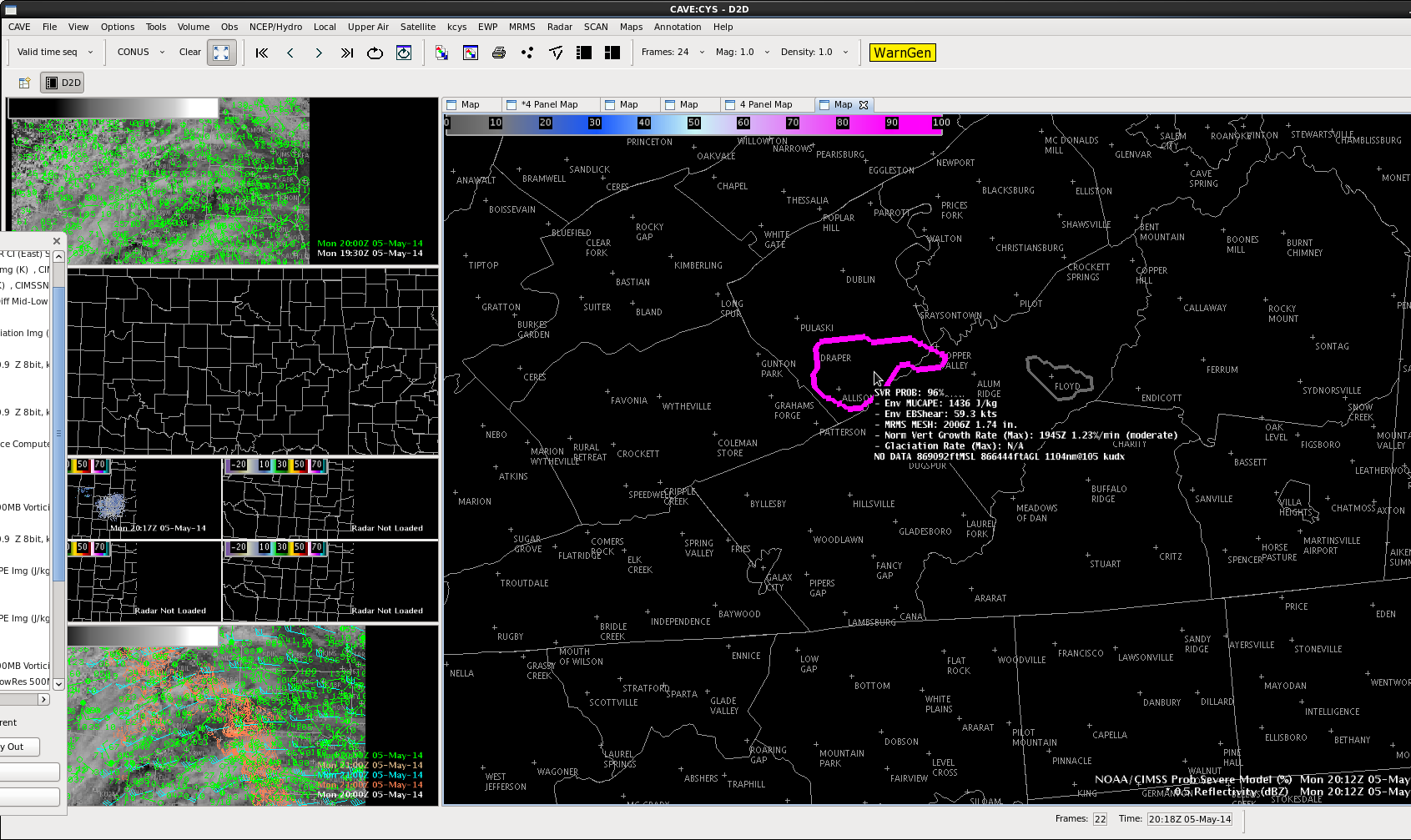
A storm developed in Western Virginia around Long Spur, just west of Pulaski. In early stages of development, probabilities of severe weather occurring were low. Radar reflectivity was generally between 50-60 Dbz. Severe probability quickly increased from 11% to 96% within 18 minutes. In the same time span reflectivity of up to 71 Dbz was detected. MRMS MESH maximum was 1.74 inches, while there was a notable increase in MUCAPE and EBSHEAR.
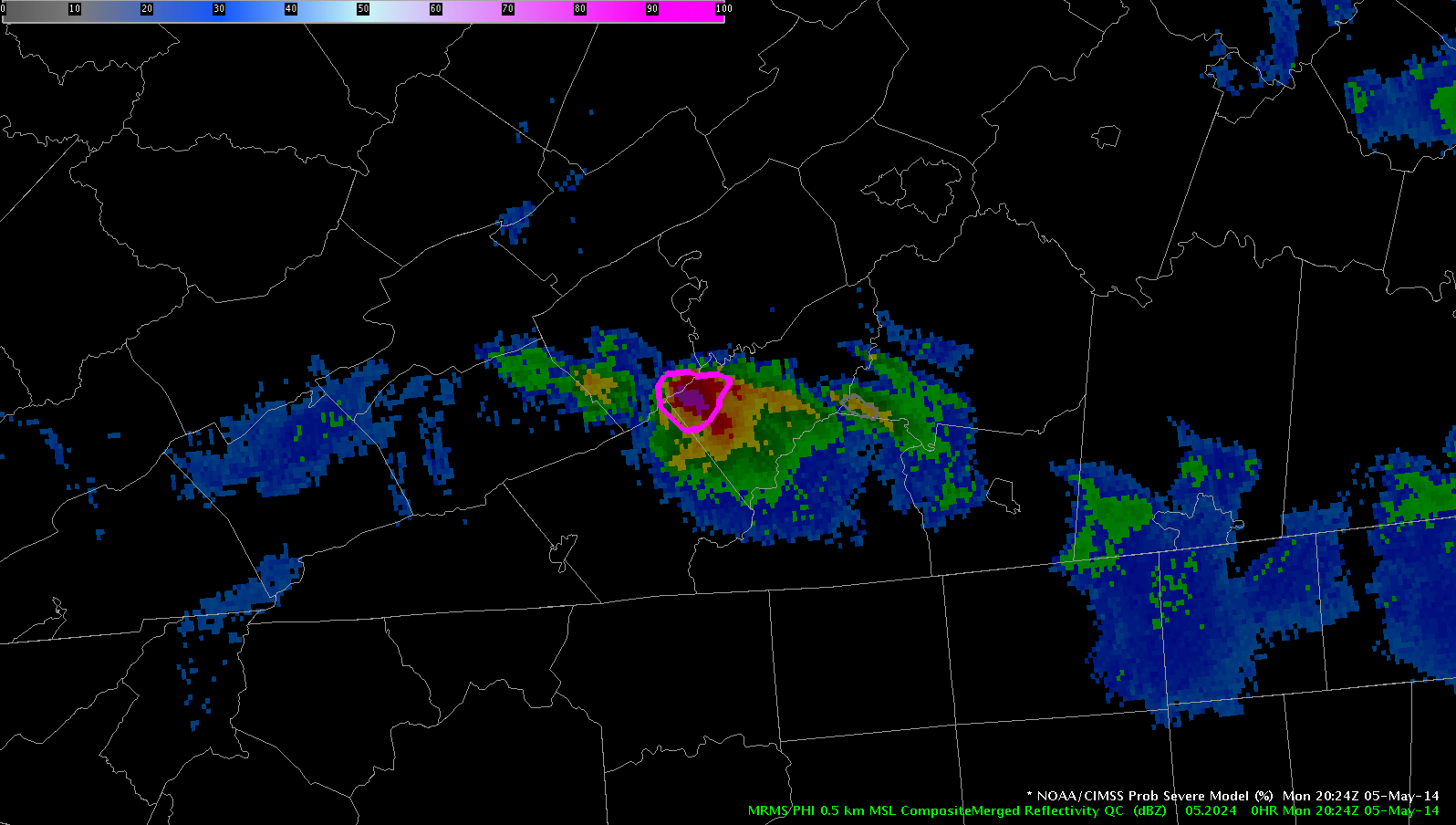
Prob Severe Model
Not really our area today, but prob severe model indicated
a 56% chance this storm would produce severe weather
at 1950Z . At 2012Z prob was up to 96%. Model has
low probabilities with other storms in area.
b thoren
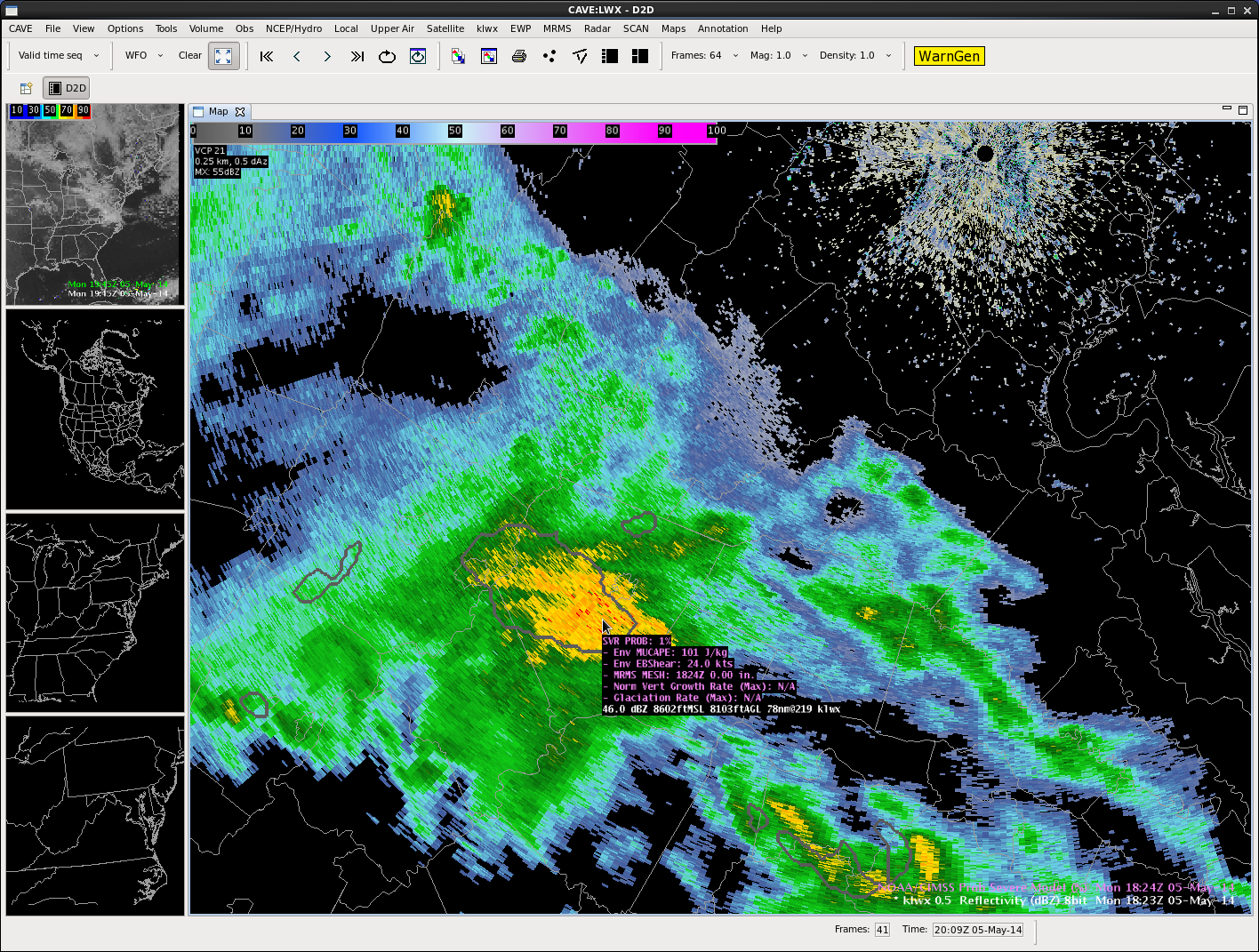
Prob Severe in VA
Probability of this cell in VA producing severe wx in the next hour is 1% !!!
Scott Rudge
Watching Testbed Tools Cinco de Mayo
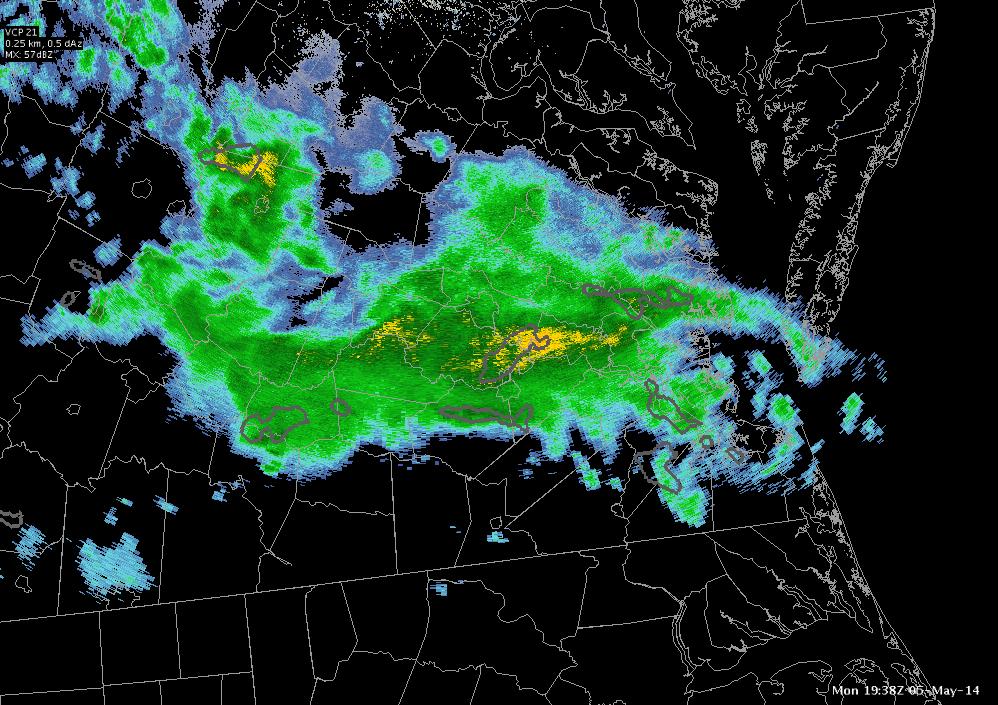
Been watching an area of showers across central Virginia…located north and east of a cold front.
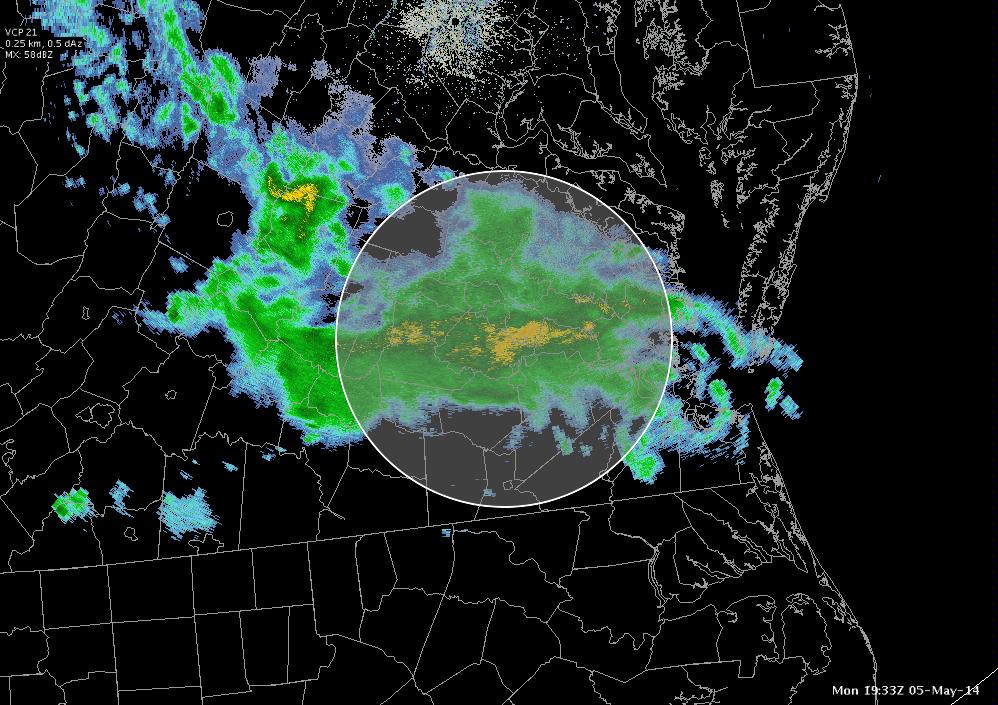
Typically would not expect to see vigorous convective development in the relatively stable air here. The NOAA/CIMSS ProbSevere Model agrees….it’s been outlining some cells, but typically have not seen anything higher than a 10% severe probability.
Of some interest is the GOES-R CI model, which for a time pegged a 60% chance for some more cell development to the south and west of the current area of precipitation in southwest VA. Surface analysis shows this area to be much closer to a surface boundary separating 80s from 60s.
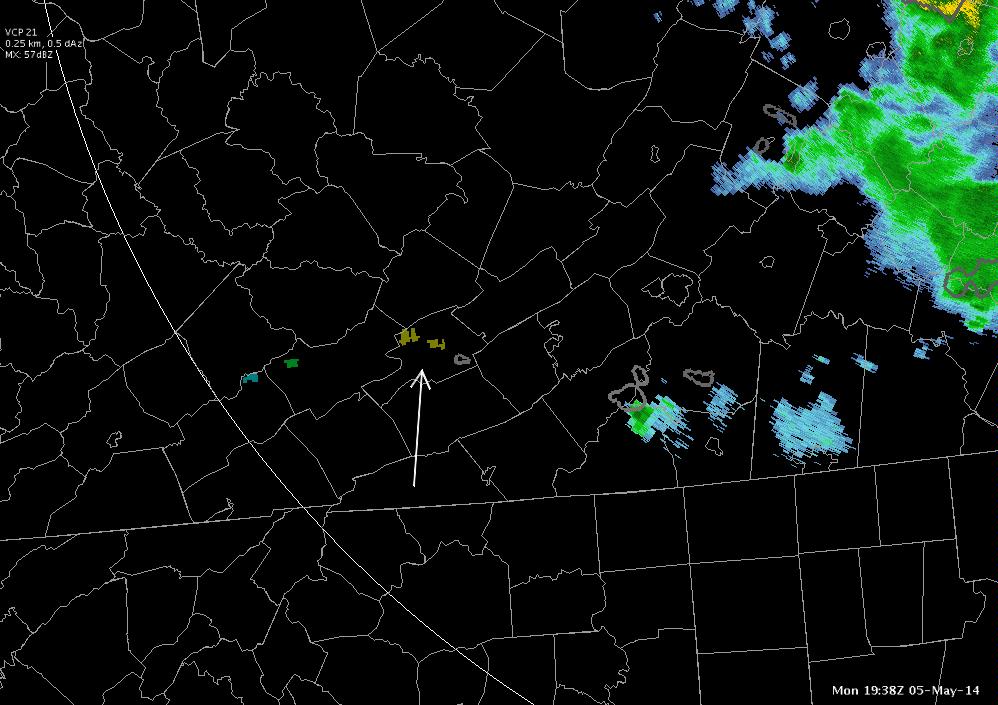
Some further monitoring of the CI has seen the value dip back into the 40% range within about 15 minutes time. Will be interesting to see if this parameter continues to move some over the next hour or so…or if any development actually occurs.
UPDATE
Convection developed within the hour…with high severe probs!
Also to be noted after the fact: the forecast theta-e difference between 500 and 780 mb leading into the convection showed a nice and persistent…although not overwhelming in magnitude (-6 at worst)…piece of instability rolling into SW VA.
So far, the forecast tools have done a good job in pointing to an area…even if it was marginally outlooked this morning…of an area of vigorous convection that did develop.
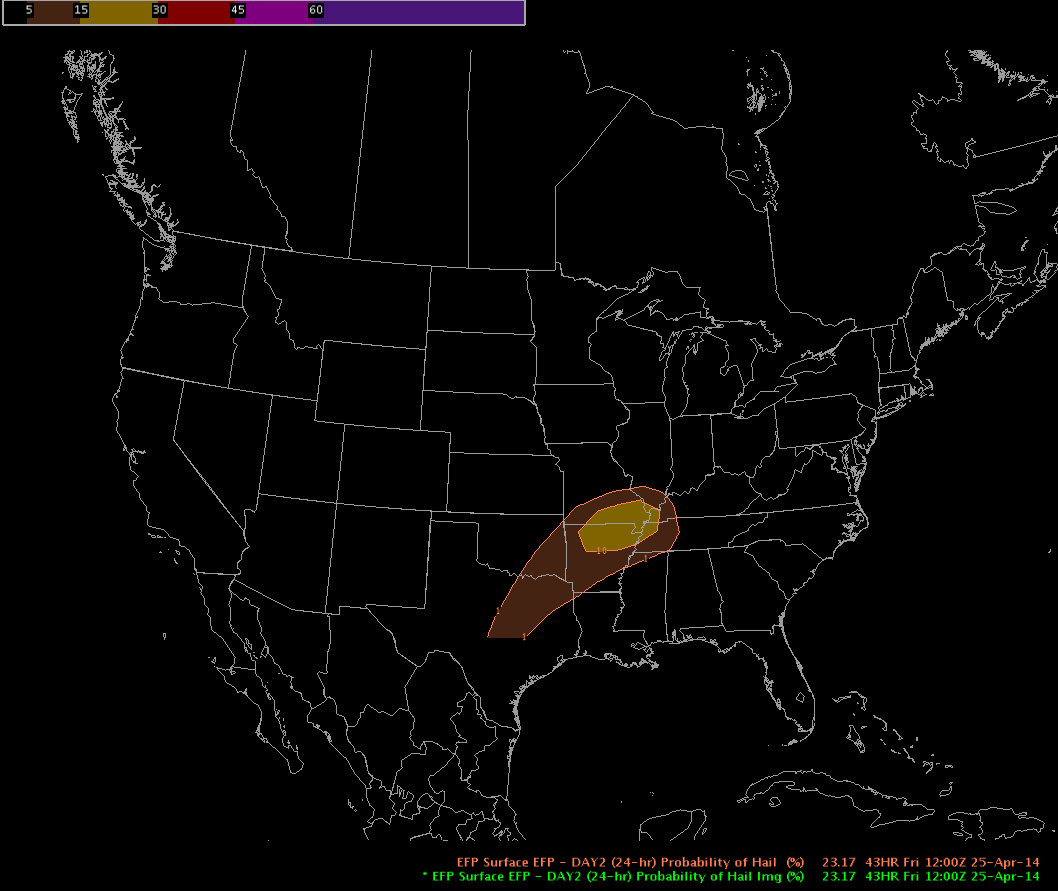
Probability of Hail
Probability of hail over the next 24 hours.
Scott Rudge
The PHI and Big Spring Experiments – Week #1 Welcome
Monday 5 May 2014 begins the first week of our four-week spring experiment of the 2014 NSSL-NWS Experimental Warning Program (EWP2014) in the NOAA Hazardous Weather Testbed at the National Weather Center in Norman, OK. There will be two primary projects geared toward WFO applications, 1) a test of a Probabilistic Hazards Information (PHI) prototype, as part of the FACETS program and 2) an evaluation of multiple experimental products (formerly referred to as “The Spring Experiment”). The latter project – known as “The Big Experiment” – will have three components including a) an evaluation of multiple CONUS GOES-R convective applications, including satellite and lightning; b) an evaluation of the model performance and forecast utility of two convection-allowing models (the variational Local Analysis Prediction System and the Norman WRF); c) and an evaluation of a new feature tracking tool. We will also be coordinating with and evaluating the Experimental Forecast Program’s probabilistic severe weather outlooks as guidance for our warning operations. Operational activities will take place during the week Monday through Friday.
For the week of 5-9 May, our distinguished NWS guests will be John Keyes (WFO Pocatello, ID), Jared Maples (WFO Grand Rapids, MI), Scott Rudge (WFO Rapid City, SD), Kris White (WFO Huntsville, AL), Bruce Thoren (WFO Norman, OK), and Jonathan Wolfe (WFO Charleston, WV). Additionally, we will be hosting a weather broadcaster to work with the NWS forecasters at the forecast desk. This week, our distinguished guest will be Daniel Bickford of WSPA-TV (Greenville, SC). If you see any of these folks walking around the building with a “NOAA Spring Experiment” visitor tag, please welcome them! The GOES-R program office, the NOAA Global Systems Divisions (GSD), and the National Severe Storms Laboratory have generously provided travel stipends for our participants from NWS forecast offices and television stations nationwide.
Visiting scientists this week will include Steve Goodman (NESDIS), Hongli Jiang (GSD), Paola Salio (Ciudad Universitaria, Buenos Aires, Argentina), Justin Sieglaff (CIMSS), and Ed Szoke (GSD).
Kristin Calhoun will be the weekly coordinator. Lance VandenBoogart (WDTB) will be our “Tales from the Testbed” Webinar facilitator. Our support team also includes Darrel Kingfield, Gabe Garfield, Bill Line, Chris Karstens, Greg Stumpf, Karen Cooper, Vicki Farmer, Lans Rothfusz, Travis Smith, Aaron Anderson, and David Andra.
Here are several links of interest:
You can learn more about the EWP here:
NOAA employees can access the internal EWP2014 page with their LDAP credentials:
https://hwt.nssl.noaa.gov/ewp/internal/2014/
Gabe Garfield
CIMMS/NWS OUN
2014 EWP Operations Coordinator