
13 May 2013: Day 1, Week 2, Summary

The first day of operations worked primarily as a get to know AWIPS2, the products and the PIs. Forecasters were primarily located in the Missoula, MT CWA, with a late shift for a couple over to the Great Falls, MT domain.  Storms remained marginally severe through the  operational period, with only one experimental warning issued the entire evening. The majority of severe reports occurred post operations as an MCS moved across N.Dakota.
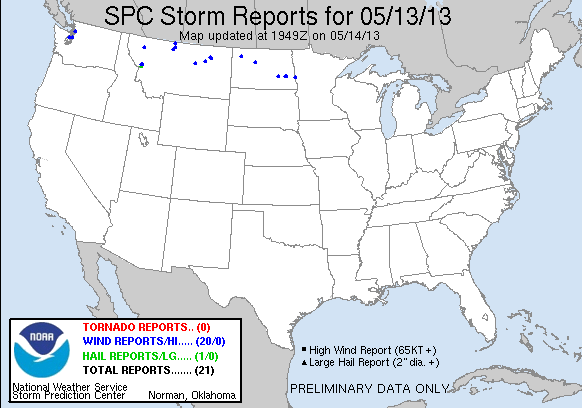
SPC Storm Reports for 13 May 2012.

Even though severe weather was a bit lacking, forecasters were able to explore the GOESR CI /CTC and nearcast products as well as the NSSL MRMS and HSDA algorithms.  The simulated satellite (from NSSL WRF) and CONUS LAPS products were also analyzed during operations.  Forecasters did not have a chance to review the PGLM / SPORT Lightning Tracking Tool, but it still remains a possibility Wed and/or Thurs of this week.

K. Calhoun, Week 3 Coordinator.
Tags: None

14May2013 2000Z Mesoscale Discussion (Area #2 – W Great Lakes)

Monitoring the potential for convective development across W Minnesota / SE South Dakota, and across central Nebraska.

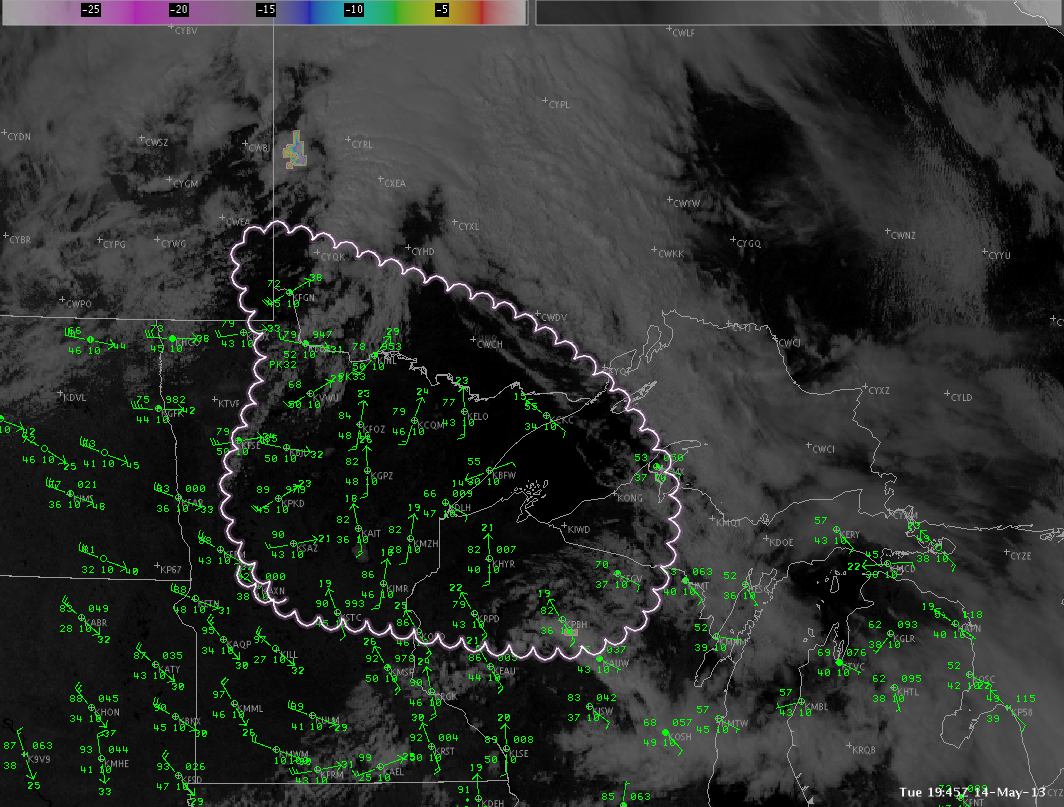
Shortwave trough currently progressing east across S Saskatchewan into E Ontario providing support for some initial development across the Canadian provinces, as seen in IR / VIS / CTC data. Large-scale lift aloft, in association with eastward progressing frontal boundary is supporting a line of agitated cumulus extending south into NW Minnesota. Nearcast difference CAPE product indicates an axis of weak-to-moderate instability (500-1000 J/kg) in front of this boundary extending south into NE and IA. WRF simulated IR fails to develop much of any activity across N Minnesota, keeping all activity developing after dark across the UP of Michigan. Farther south and west, it shows better development across Iowa and Nebraska around 00Z. However, considering best large-scale forcing exists closer to the Canadian border, and model fields were generally overestimating surface dew points farther south (forecast >60 versus AOB lower 50s being observed), thought is that best potential may exist closer to the international border over the next few hours.

If storms can develop, dry low levels and steep lapse rates support a high wind threat from higher based storms. Better wind fields farther north (0-6 km shear >50 kts) and slightly cooler temps also support an enhanced threat for marginal severe hail closer to the Canadian border.

14may2013_2

Picca

Tags: None

Mesoscale Discussion for West/Central Texas

Isolated to scattered unorganized thunderstorms currently over beautiful West Texas will likely increase in coverage through the afternoon and may congeal into one or more MCS by 00z as the storms move east into increasing 0-6 km bulk shear (from 30-40 kt) depected by the RAP13 and increasing MLCAPE (800-1500 J/kg) suggested by LAPS.  The image below shows the LAPS surface-based CAPE…depicting the area of highest instability at present where storms will be favored to develop.

LAPS_CAPE_051413_2000  The 18 UTC OUNWRF model reflectivity depicts the expected scenario.  The first image shows the model composite reflectivity forecast at 2030Z, and the second is for 0200 Z, showing the change in mode from multicells to MCS.  The main hazards will most likely transition from isolated large hail reports to more damaging wind reports as the storms become better organized.  The MCS may weaken with the loss of daytime heating and become more elevated after 02z with a diminishing wind and hail threat.

OUNWRF_compref_051413_2030

OUNWRF_compref_051513_0200

Tags: None

Scattered initiation in far west Texas

Placed beneath the left exit region of an approaching mid/upper jet from the SW, scattered storms evolved in a weakly sheared environment. Latest reflectivity scans reveal a few 60 dBz scans with strongest cores and MRMS MESH pointing to some small hail…still sub-severe. With SBCAPE already exceeding 1500 J/kg in many places, the overall hail and wind gust risk constantly increases during the following hours…however scattered initiation likely causes messy clustering of storms with decreasing diabatic heating. The focus for more severe storms will be east of the Midland area, when storms finally evolve in a stronger shear environment. We’ll look for current storms to send outflow boundaries to the east for initiation in SPC’s SLGT risk area next to forced initiation as the upper trough further approaches.

radar_MESH

Radar reflectivity with MESH atop.

Helge

Tags: None

A neat way to visualize OUNWRF parameters on one display

Gabe, the OUNWRF PI, showed us an interesting way to monitor a few model output fields simultaneously.  The display here includes the model derived radar reflectivity as a background image, with the green contours showing updraft helicity and the salmon contours the maximum hourly column hail.  The display here is consistent with the expected mode of convection over the next few hours…namely, pulse storms or multicell clusters.  With marginal bulk shear values, we aren’t expected a lot of deeply rotating storms, but there will be a large hail and/or damaging wind threat with some of the stronger cores.  I will continue to watch this display through the evening to see how it all pans out.

CL

OUNWRF_display_01413_1927

Tags: None

Convection Comparison Between OUNWRF/Actual Reflectivity across Beautiful W TX/SE NM

This is a image of the OUNWRF 16 UTC run 05/14/13 for 1845 UTC 1 km AGL Derived Radar Reflectivity compared to 0.5 Degree Reflectivity from KMAF at 1845 UTC.  They compared well with the OUNWRF doing a fine job with the location and storm mode (isolated cells/multicell clusters) near and just southwest of Midland.  The OUNWRF underestimated unorganized convection across SE NM.  Michael Scotten

Tags: None

Possible location shift for 14 May 2013:

Models have been trending upward for severe chances in southwest Texas for today and the most recent day 1 outlook from SPC has moved from a “see text” to an actual “slight risk” for the region.  The combination of a dryline circulation, forced lifting and an upper-level jet streak will increase the probability of severe weather compared to the western great lakes region we had previously targeted which is still dealing with a lack of moisture and a strong cap.

Possible CWAs:  San Angelo, Austin/San Antonio, Midland

K. Calhoun, Week 2 Coordinator

Tags: None

LAPS Surface Analysis Near Terrain and Convection

The 2.5 km variational LAPS did a relatively good job at resolving various boundaries that became apparent through the afternoon. Looking at the LAPS surface dew point and wind fields across the northern Rockies around 22Z…higher terrain locations had lower dew points in the 20s and 30s…with the lower terrain locations in the valleys and plains of northern Montana showing dew points in the 40s and 50s. In addition…locations in the wake of convective activity across northeast Oregon and points to the northeast both showed higher dew points and outflow boundary-like signatures in the wind field. These both matched reasonably well with the METAR observations. The model also did well with identifying the convergence boundary in the wind fields stretching from eastern Oregon through central Montana. LAPS_boundaryMazur

Tags: None

EWP Status for 14 May 2013: 1-9 pm Shift

EWP STATUS FOR 14 MAY 2013: 1 – 9 PM SHIFT

Another conditional / marginally severe day is on tap for Tues. We will likely be operating over Minnesota, Wisconsin, Michigan as a strong frontal system moves across the region.  Warm air advection will be the story over the region tomorrow with surface temperatures reaching the mid-to-upper 80s behind the warm front by the mid afternoon. Showers and storms are likely along the warm front, though at the moment, these look unlikely to become severe.  Further west ahead of the cold front, instability seems slightly better, but a strong cap and low moisture will possibly inhibit storm growth.  Models have been a bit mixed in terms of the amount of low-level moisture that will be available.

Possible CWAs of operation tomorrow:  Duluth, Marquette, and Twin Cities (MSP)

K. Calhoun, Week 2 Coordinator 

Tags: None