Live Blog – 26 May 2010 (4:15pm)

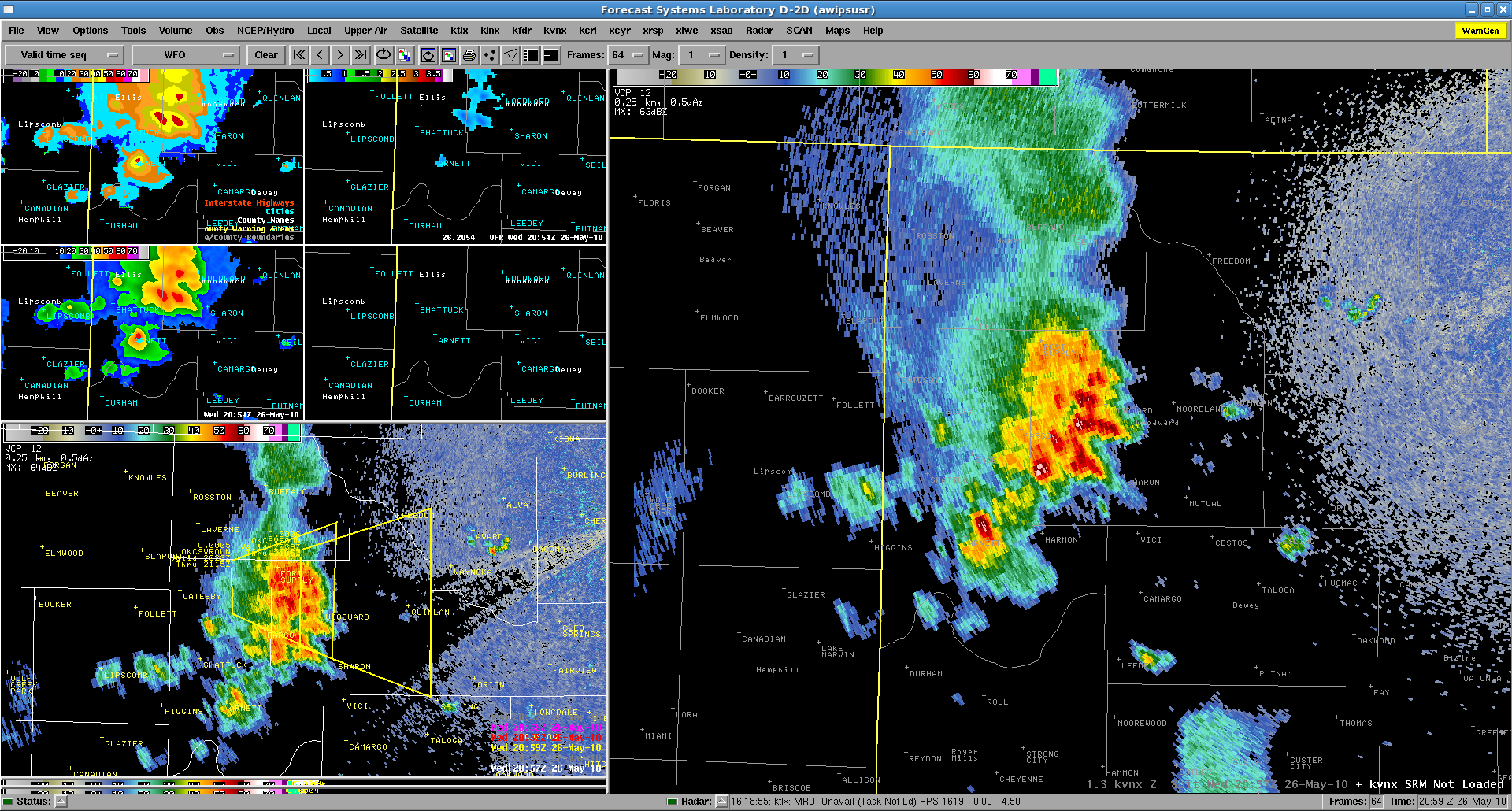
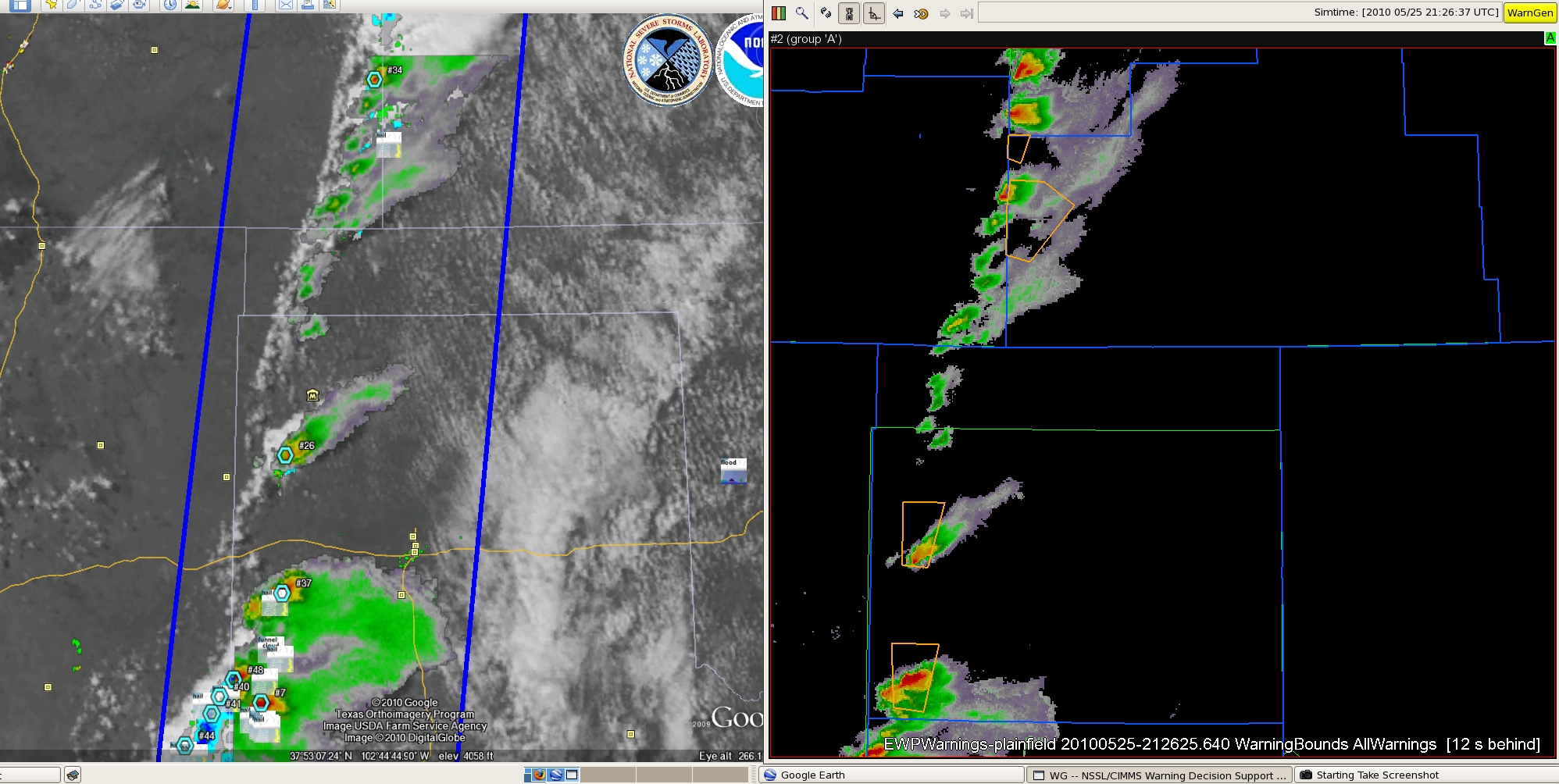
SVR warnings are currently being issued/updated on the storm cluster moving into western Woodward county. In addition to base radar data many of the MRMS products are also being evaluated.

As the forecaster group completes the archive event approaching 4:30 pm CDT, localization of real-time ops will be reevaluated to possibly move the domain to the NE Colorado, SE Wyoming region where supercell storms have formed.

The archive event is a focus on the GOES-R products including a psuedo-GLM (produced locally using OKLMA data and flash algorithms from WDSSII) plus cloud-top-cooling and overshooting top products (provided by UW-CIMSS).

Kristin Kuhlman (EWP Weekly Coordinator, 24-28 May 2010)

Tags: None

Live Blog – 25 May 2010 (7:55pm)

A lack of storms in the AMA region has caused another switch in CWA’s to DDC.

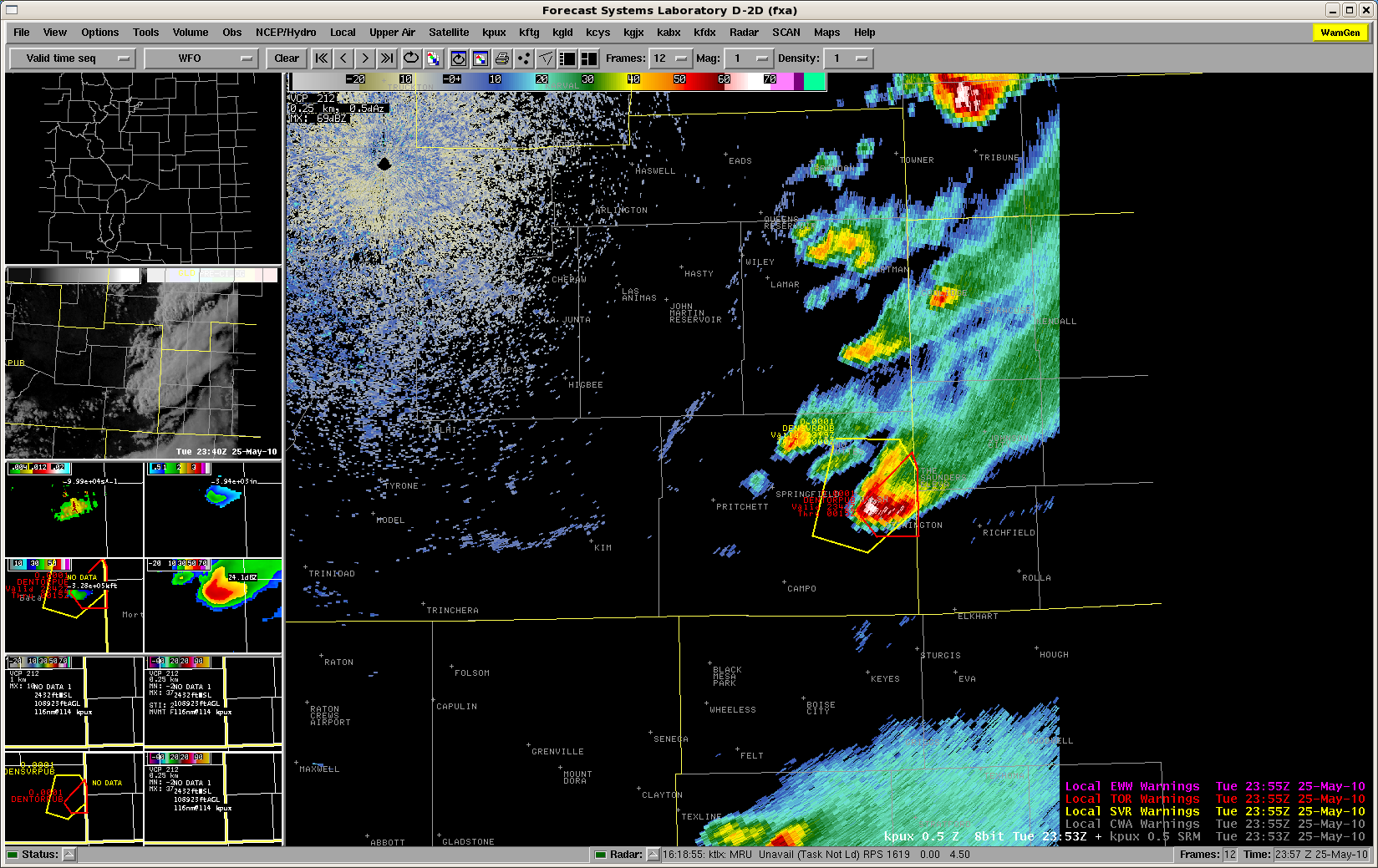
Group 1:  Continues with operations in the PUB region.  A TOR warning region was issued for the Baca County storm after grew vertically and the velocity signature increased.   AzShear product doubled in a 2 min time span at the time of the warning.  3 in hail was reported with the storm, MESH was reporting 2.7 in hail (one of the AWIPS stations, Tupelo, lost the MESH feed at 2314).

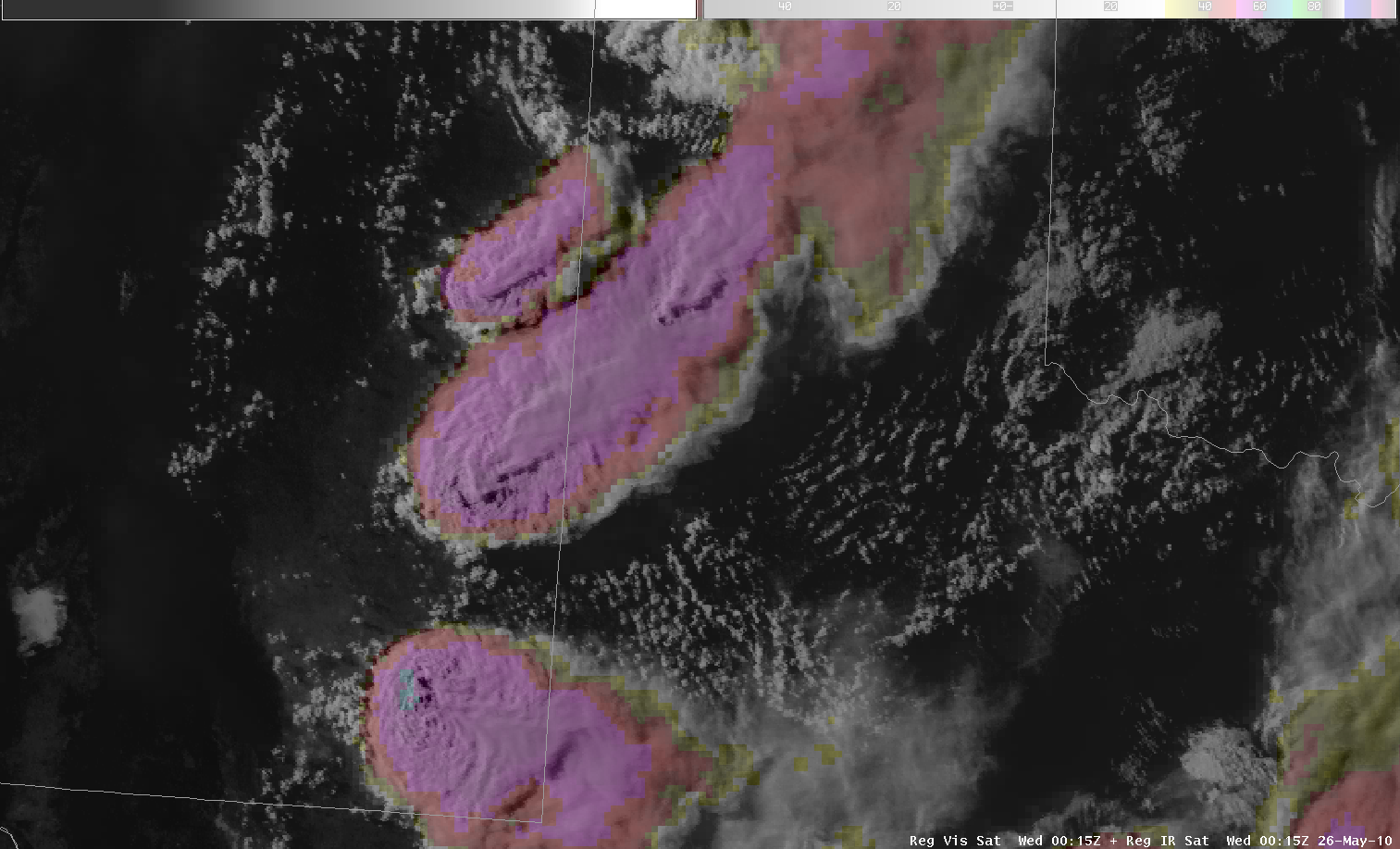
Group 2: Now in DDC CWA, forecasters are also examining the Boca Co storm as it moves NNE towards the CWA.  The forecasters are also watching storms in GLD CWA and LBB CWA — matching the timing and value of the Overshooting Top product and with storm reports of large hail and funnel clouds.  The 1km visible imagery alone picks up the overshooting tops and enhanced V-signature that the CIMSS products are unable to detect from the 4 km IR data.

Kristin Kuhlman (EWP Weekly Coordinator, 24-28 May 2010)

Tags: None

Live Blog – 25 May 2010 (7:00pm)

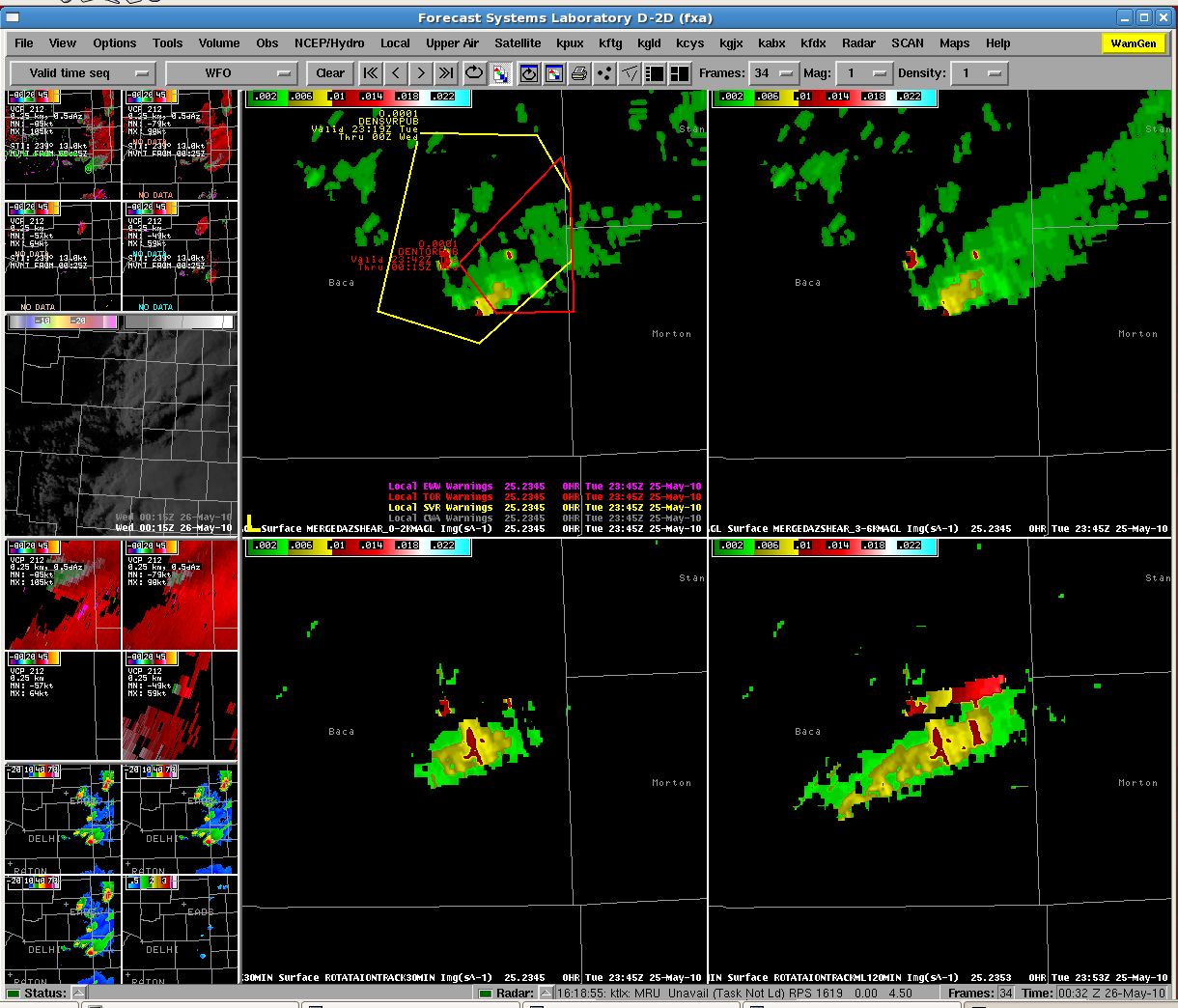
PUB team working a single supercell in Baca County, hvaing issued a SVR and then a TOR based on reports.  Rotation tracks show storm motion from about 230-240 degrees.  Image here:

Kristin Kuhlman (EWP Weekly Coordinator, 24-28 May 2010)

Tags: None

Live Blog – 25 May 2010 (6:30pm)

We now have teams working the PUB and AMA CWAs.  The AMA storms are now below severe limits, and they don’t have warnings out on the storms.  The PUB folks are working a few severe storms along the CO-KS state line, which have had numerous tornado reports (likely non-supercell tornadoes, at first).

Kristin Kuhlman (EWP Weekly Coordinator, 24-28 May 2010)

Tags: None

Live Blog – 25 May 2010 (5:30pm)

We finally have the slow load problem for the experimental data on AWIPS fixed, and ORPG issues fixed, so for the last 45 minutes or longer, all data have been loading on time and fast.  Crossing our fingers that our electronic duct tape will hold together.

One team is working storms for DDC’s area, but unfortunately, most of the storms have been hanging out just west of their CWA in PUBs area.  So after a couple of hours waiting for storms (one SVR was issued and the storm dies rapidly), we ae going to switch that team to PUB.

Meanwhile, the other team has been working AMA’s area, and has been quite active issuing SVRs, mainly for hail threat.  There is one significant left moving storm, and another “right mover”, actually nearly stationary, which are both hail threats.  No TORs issued yet.

Greg Stumpf (MRMS Principle Scientist)

Tags: None

Live Blog – 24 May 2010 (8:25pm)

After a dinner break, the forecasters completed the MRMS training with project scientist Greg Stumpf and the AWIPS localization was reset to to OUN for a brief live data operations period to conclude the day.   The main goal of this period is for the forecasters to familiarize themselves with the multiple products they will be able to use through the rest of the week including reflectivity at 0, -10, -20, MESH, Rotation Tracks and AzShear and how they might configure these products in AWIPS in future IOPs.  If storms move closer into the OKLMA domain, the psuedoGLM product will be added as well.

Kristin Kuhlman (EWP Weekly Coordinator, 24-28 May 2010)

Tags: None

Live Blog – 20 May 2010 (7:00pm)

Both teams are operating in the Huntsville, AL CWA this evening due to the availability of lightning data in the region.  Main concern is damaging wind associated with line of storms in the area.   One team is issuing warnings while the other is focusing on an in-depth examination of the storms along the line and the multiple data sources available.  A couple of the forecasters are watching for the development of QLCS features along the line moving through the Lynchburg area (at the current time circulations remain too weak to warrant a special warning beyond the severe for straight line winds).  Highest density of lightning is with the lone warned storm.

Discussion of high-resolution data in time and space:  Feeling is that for density graphics updates of less than 1 min would not be useful as data rate too fast to make use of with the multitude of other products.  However, in trends associated with the storms updates as often as 20 sec may not pose a problem as could examine quickly on a single plot.

Forecasters are finding many of the test products useful through the week including the multi-radar plots of reflectivity at 0, -10, and -20 C, AzShear, and MESH.   Lightning data overlaid with reflectivity (see image below) is giving perspective on extent of lightning into the ‘stratiform’ region and what areas may be electrified for aviation and public safety applications.

*Minor problem with data latency in AWIPS with lightning data.  Seem to be receiving 1 min product in 3 min chunks (3 previous plots show up at the same time).  MRMS products also running with a 3-5 min latency tonight (this has not been true during earlier IOPs).  Will check for these issues again after install of new network card.

Kristin Kuhlman (GOES-R/PGLM Principle Scientist)

Tags: None

Live Blog – 20 May 2010 (4:15pm)

Dave has set up an 8-panel set-up that he likes:

  • RotationTrackML30min
  • RotationTrack30min
  • AzShear0-2
  • AzShear3-6
  • MESH
  • EchoTops50
  • Reflectivity_-20C
  • Base-tilt of reflectivity from nearest radar

Gives a nice overview of all the main parameters that he is interested in monitoring, and makes for fast toggling.

Volume browser loading was slow in HWT — may be faster in real AWIPS.

Travis Smith (EWP Weekly Coordinator, 17-21 May 2010)

Tags: None