


Just thought I would show everyone what it looked like to see a snow contamination error on CI…

Lauren13
Official websites use .gov
A
.gov website belongs to an official government
organization in the United States.
Secure .gov websites use HTTPS
A
lock (
) or https:// means you’ve safely connected to
the .gov website. Share sensitive information only on official,
secure websites.

General Information and News
Just thought I would show everyone what it looked like to see a snow contamination error on CI…
Lauren13
Monitoring the ongoing thunderstorms, Earth Networks continue to supply helpful lightning data. This is a good supplement to watch indicating future thunderstorm growth or at least some pulsing. The lightning flash data drops out, much like a missed satellite frame. Interestingly enough, there are a couple other troubling notes. Multiple lightning lines (streamers of history) are located in the same circled area. What exactly does this mean to the forecaster? Additionally, four areas inside the circle are showing flash rates above 25 strikes per minute. It is confusing to an operational forecaster and takes time to interpret data that should be straightforward. The display has to be massaged to increase ease and usability. At 2315z there is a circle inside a circle…. and a dangerous thunderstorm alert inside a thunderstorm alerts.
UFFSU

Switching to Colorado, there was a storm that the LMA picked up on while there were no ENTLN data and a scan later only a few…
This is from 2303Z where the LMA was picking up on something.

Then at 2308, the ENTLN data is finally picking up on “something.” It is really hard to see in this degraded image but there is one negative CG strike and then 3 “pulses.”

I usually see “some” in cloud lightning before I see any LMA detection so this was interesting to see especially with such a weak cell.
Lauren13
Looking at some slow moving multicell storms over the Gulf (near Houston) and the cell polygons jump around as new cells merge/develop around the original cell polygon. The end result is a pretty interesting storm track!

Ertel
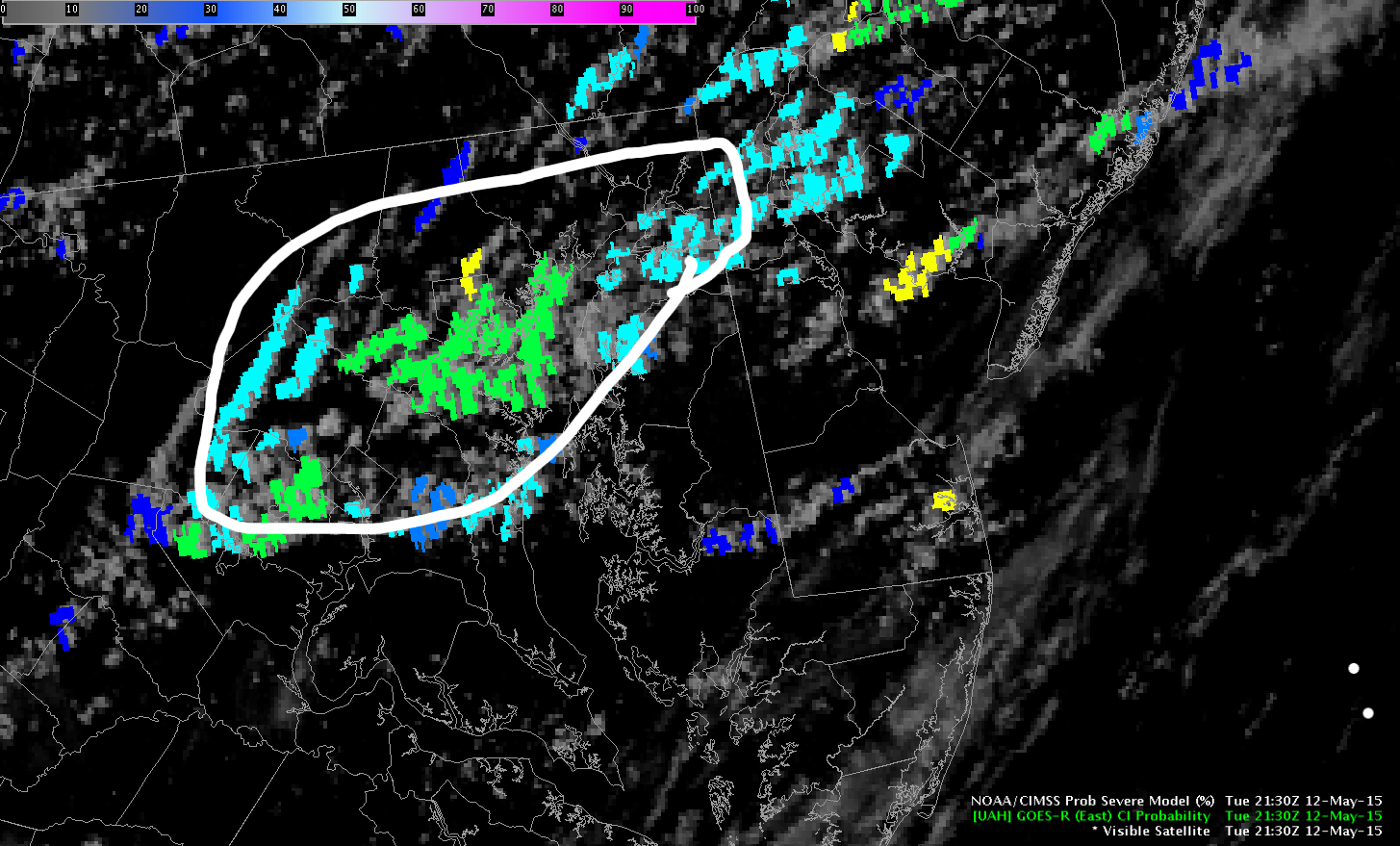
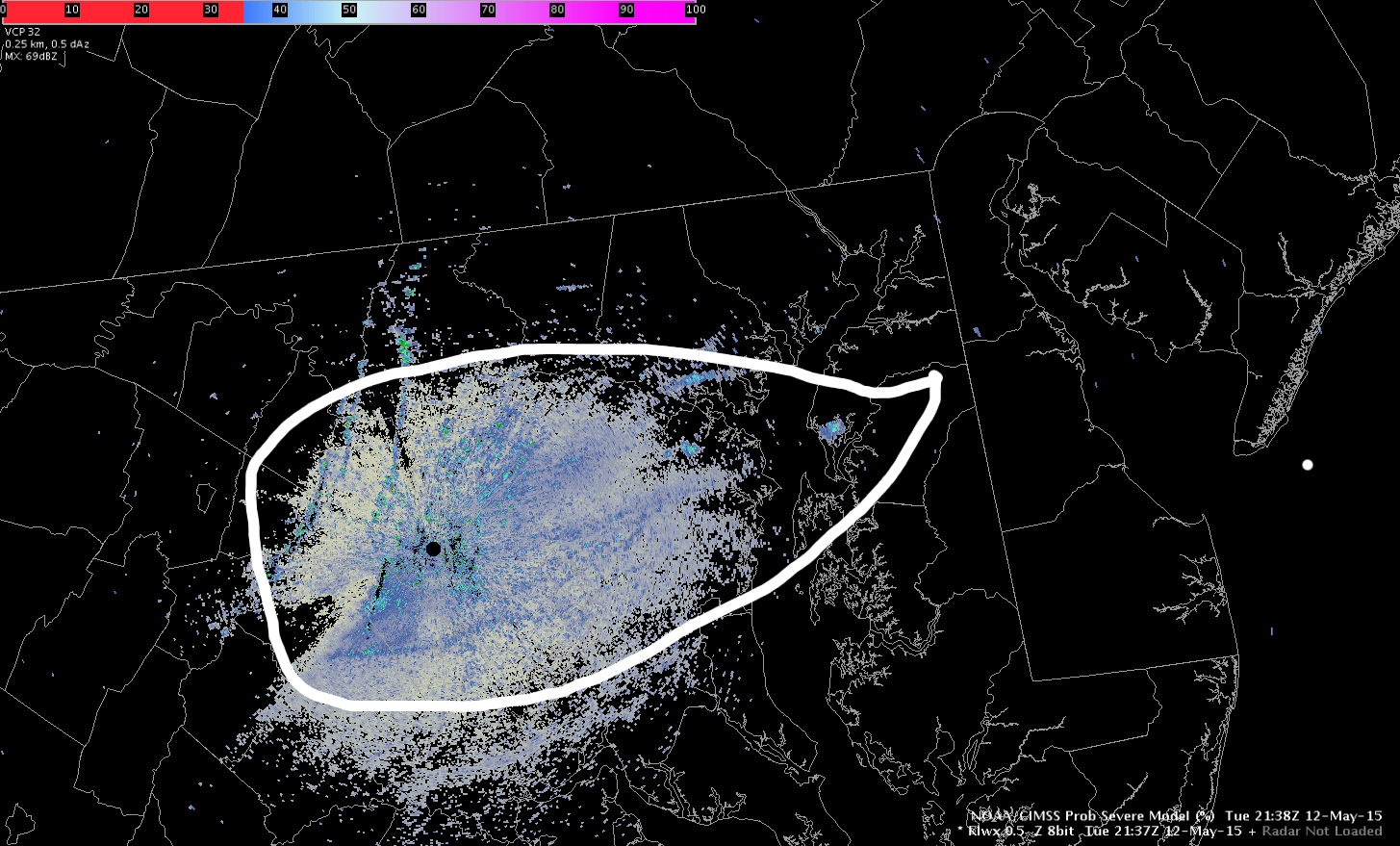
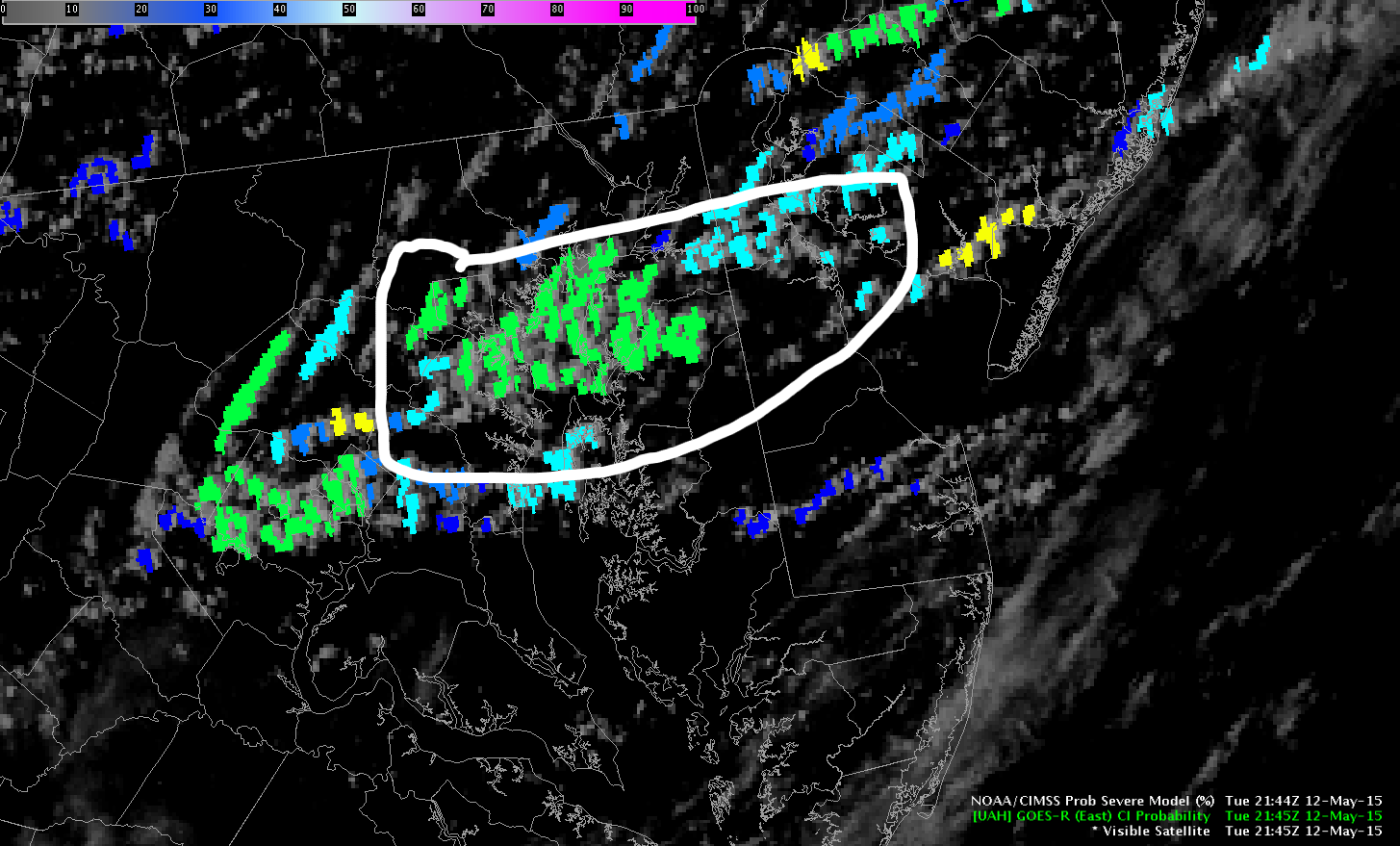
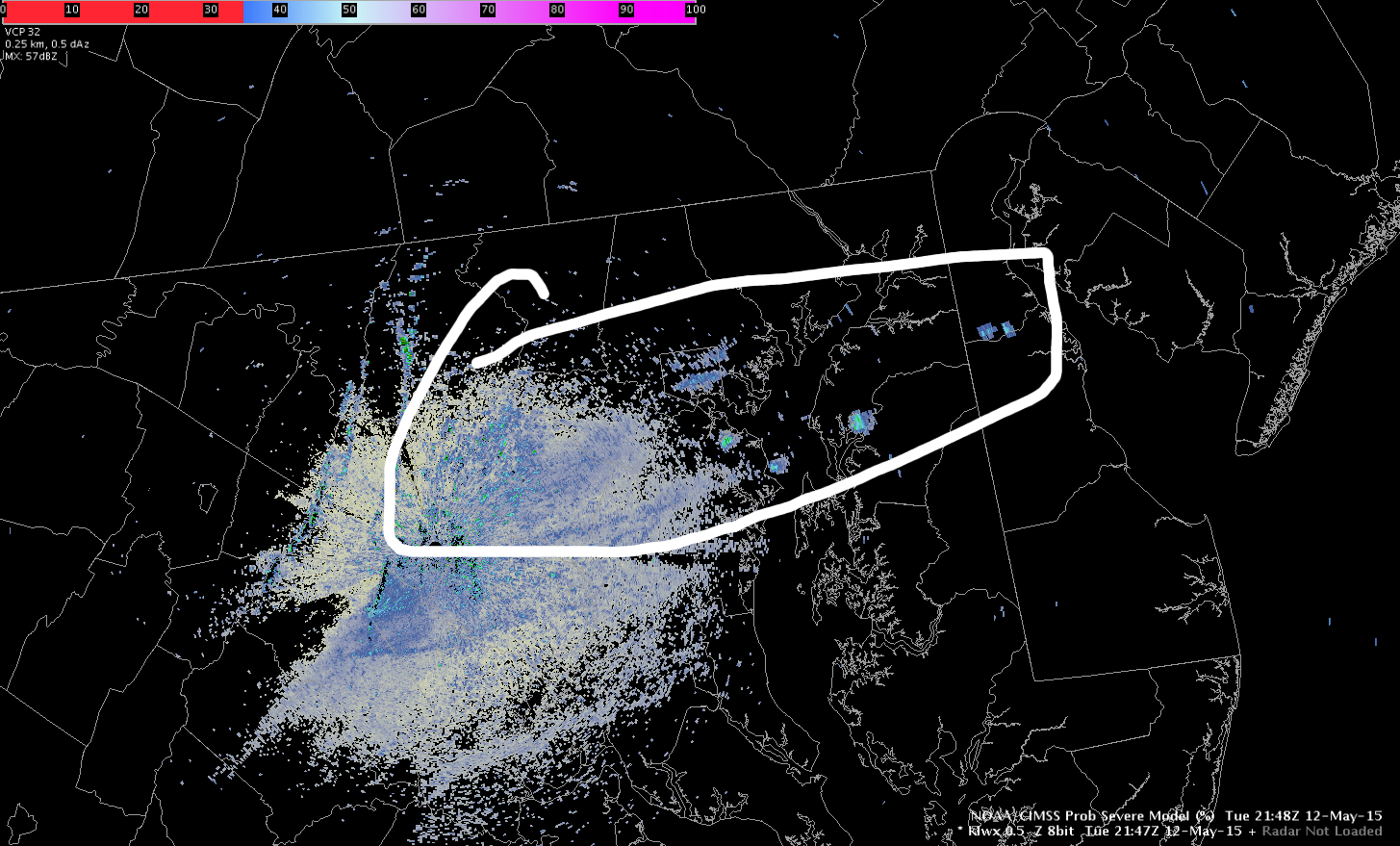
Here is another set of images showing some shower development (there is no lightning).
2130Z CI product
2137Z Radar- not much to see, maybe “a” shower.
2145Z CI product- the highest probabilities have moved east
2147Z Radar.
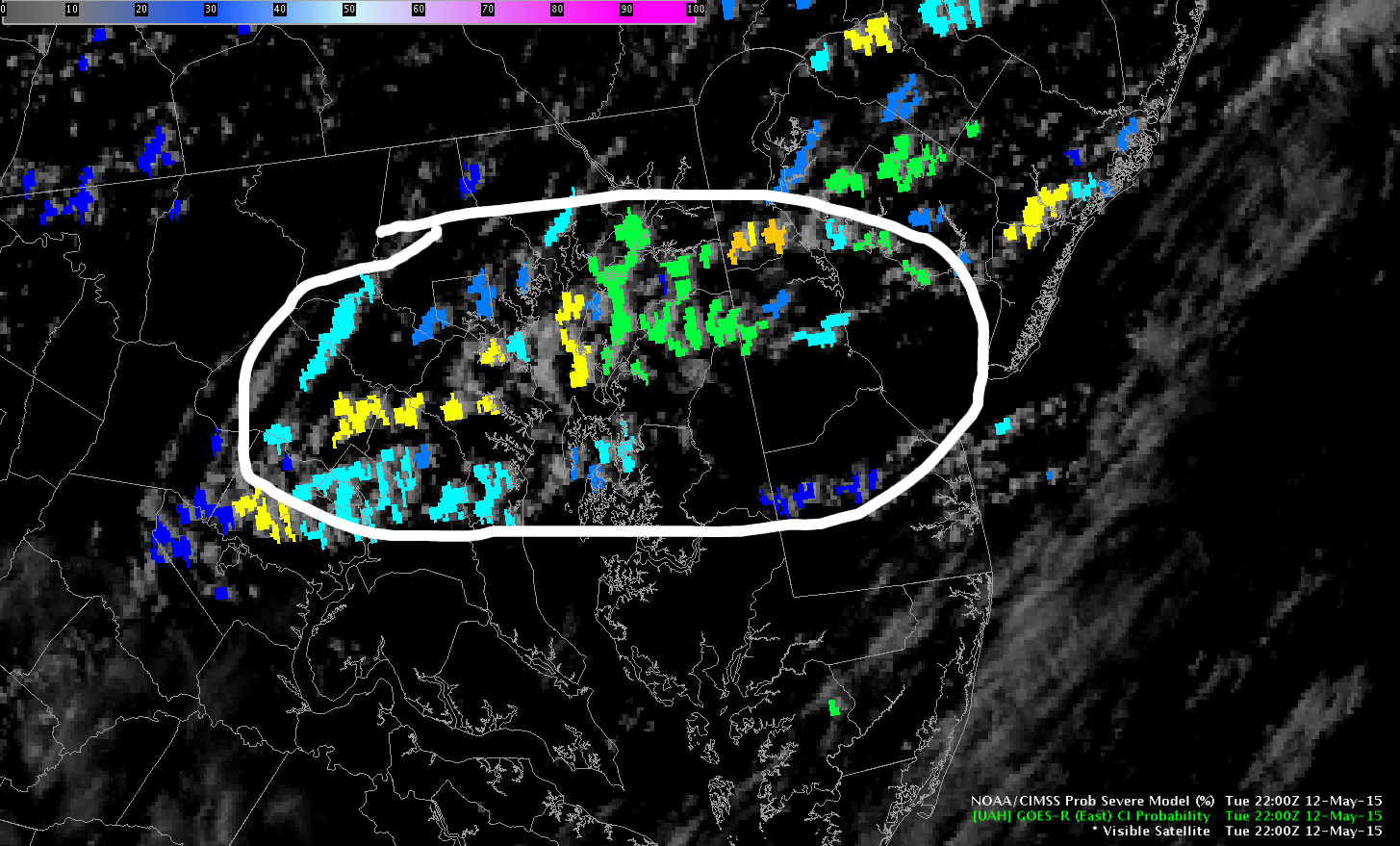
2200 CI has increased in some areas. The yellow is over 60% while the green is 50%
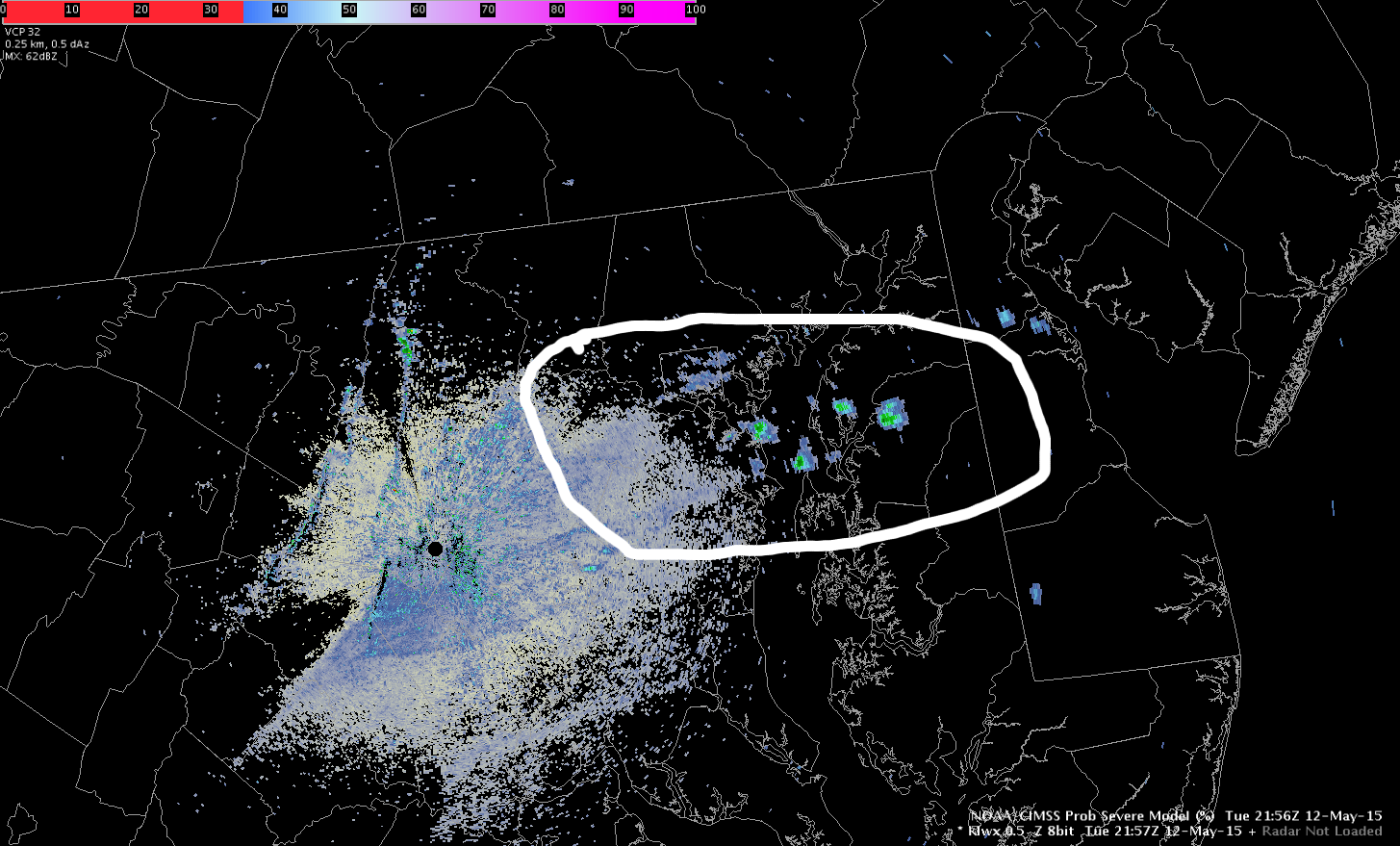
2156Z radar is showing some shower developing
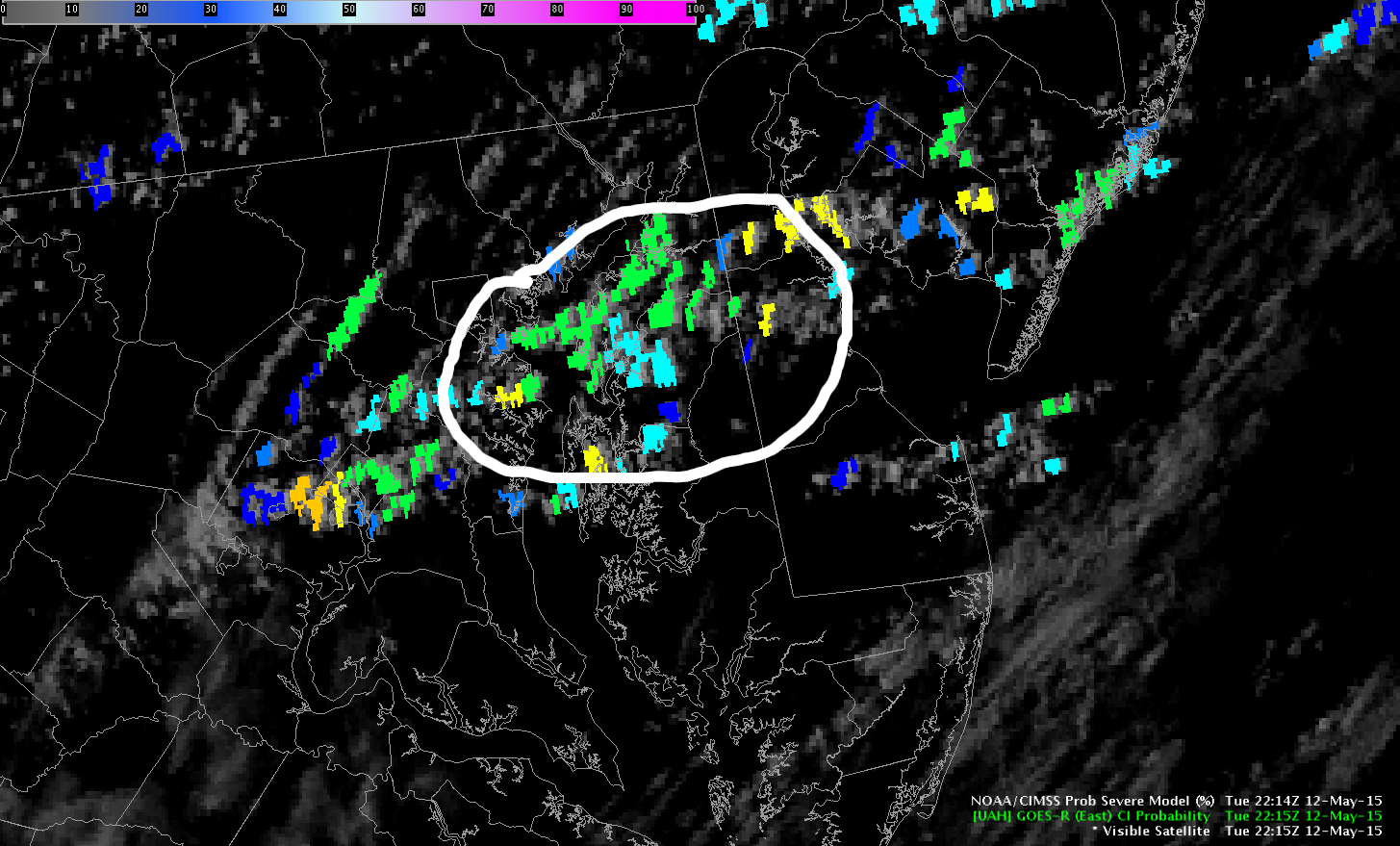
2215Z CI…still showing moderately high probabilities
2216 radar shows more showers
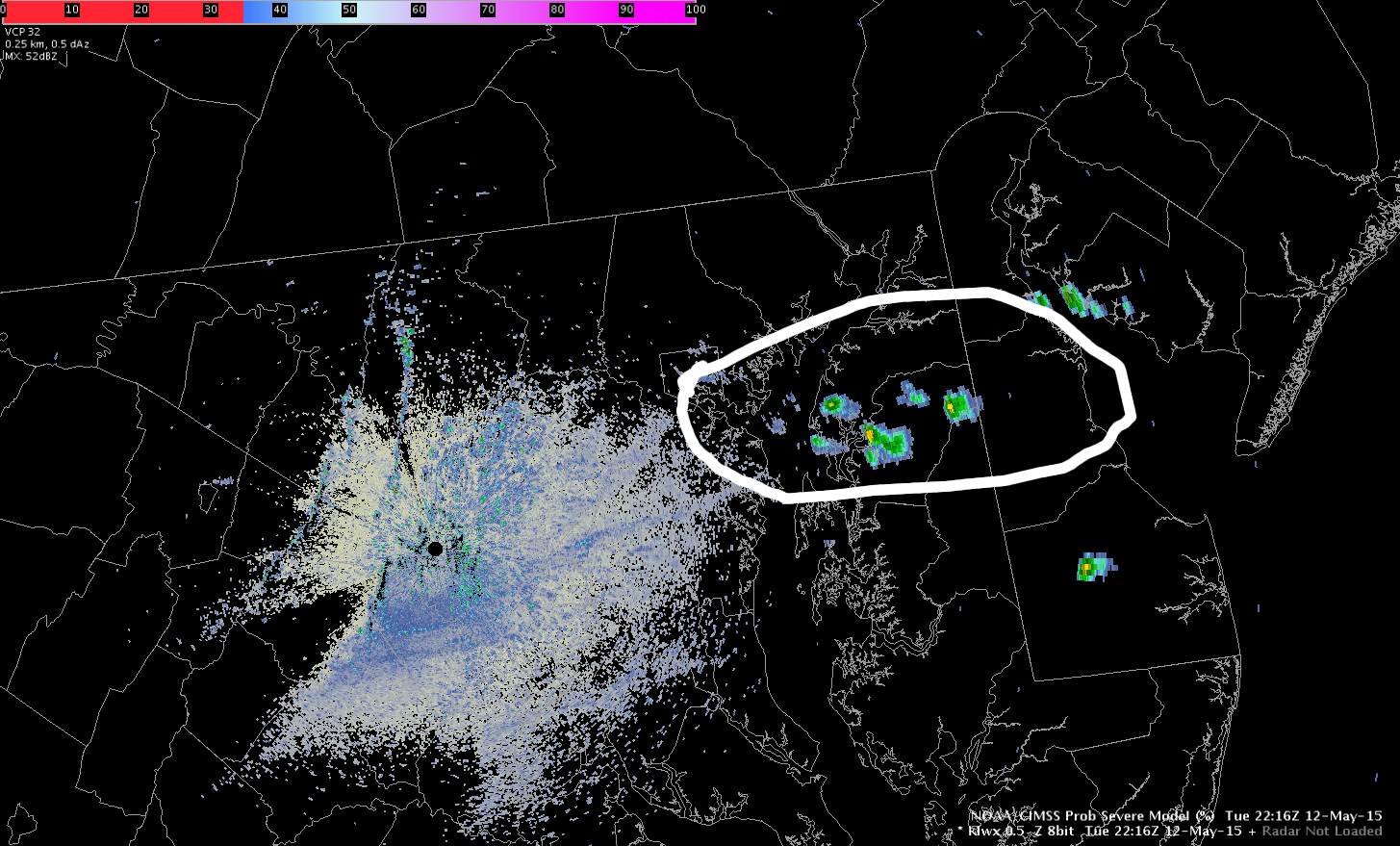
What is interesting about this example is that even when showers started showing up, even some that are near or above 35dbz, the CI is still picking up CI’s on it. This is likely because the CI product actually stops at a certain glaciation rate which is roughly equal to 35 dbz. So CI doesn’t “know” about the radar and the dbz levels. It just shows that even though CI may still be showing probabilities, there could still be something on radar.
Lauren13
A few rounds of storms have moved through Tampa Bay this afternoon and evening. I have been monitoring another round of development on a 4 panel showing Prob Severe, reflectivity, and Earth Networks alert data with lightning track. While Earth Networks has had issues with over-alerting, this product was the first to alert to a developing strong storm. The boxes from Earth Networks are overlapping and confusing as it appears lightning data is being pulled from the same storm, but parsed into separate tracks. These alerts were posted at least 45 minutes before Prob Severe indicated 77% probability of going severe in the next 60 minutes. Reflectivity did a better job that prob severe hinting, at least, at the chance for thunderstorm growth.
UFFSU

Storms continue to move through the Tampa Bay area. Storms continue to display a high degree of electrical charge. Alerts from the Earth Networks lightning guidance remains on. As these storms move slowly to the west, one notices a tremendous amount of alerts. The photos below show dangerous and significant thunderstorm alerts in the bottom right page. You can see that there are a number of alert boxes present at 2100z. The times associated with these boxes all expire after 2115z. Yet, these boxes come and go so rapidly that they are really useless, disappearing when lightning ramps down it appears. It just lacks reliability with its current display.
UFFSU
2100z 
2115z 
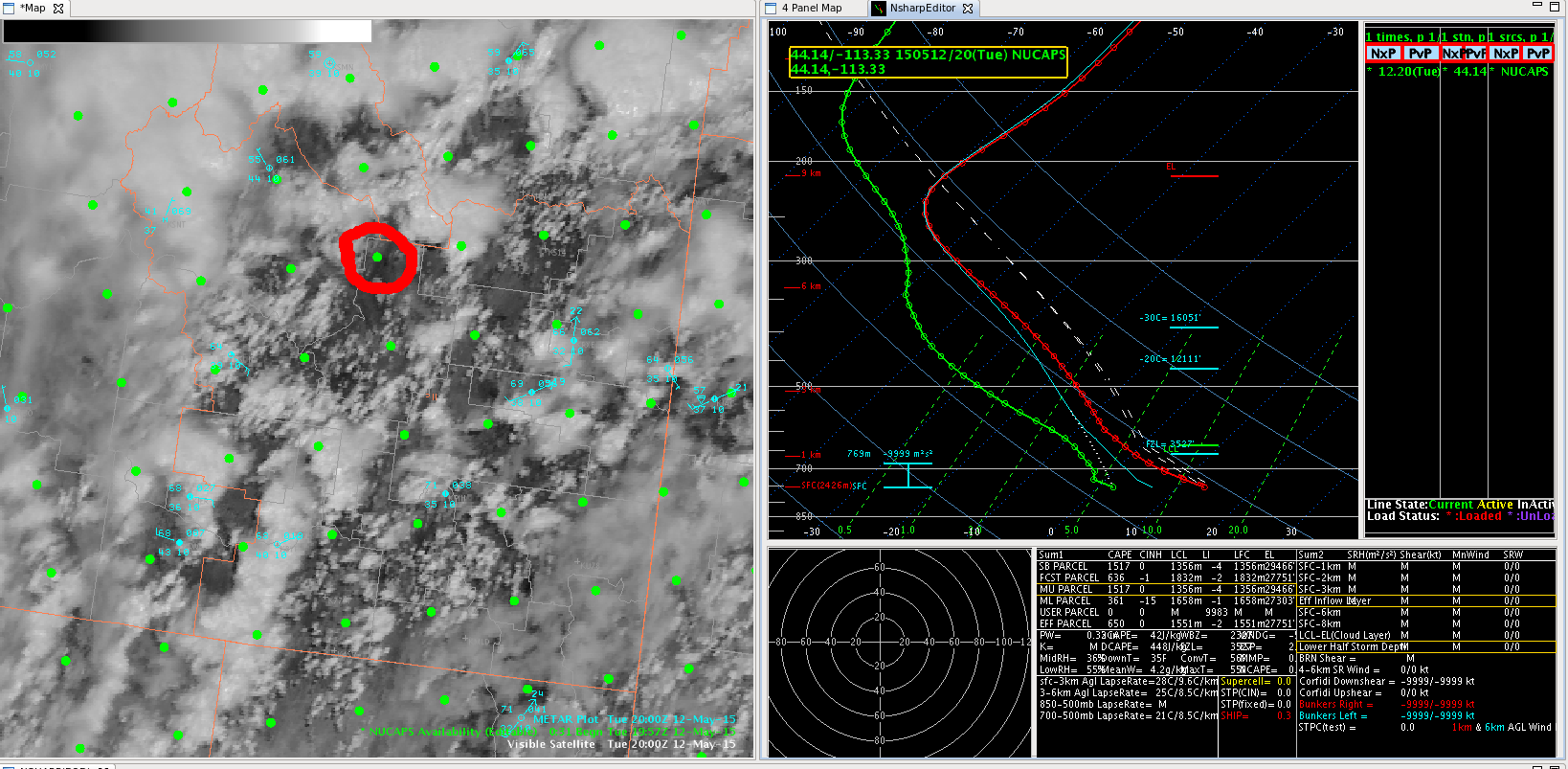
Tested NUCAPS sounding for southeast Idaho. The point used is circled. The visible image was close to the sample time, but there may have been some cloud contamination. Adjusted the surface observations upward based on the nearest MesoWest surface observation. It was difficult because a lot of the lower points needed to be adjusted to keep it realistic. The instability seems a little high, but it could be localized. Will see how the thunderstorms in the area develop over the next few hours.
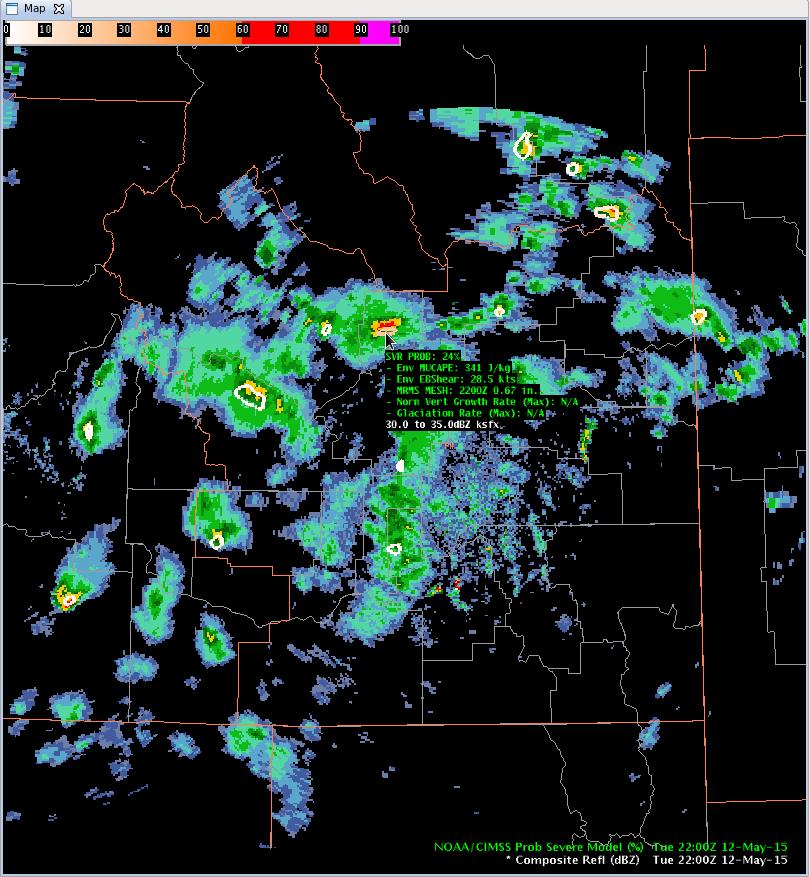
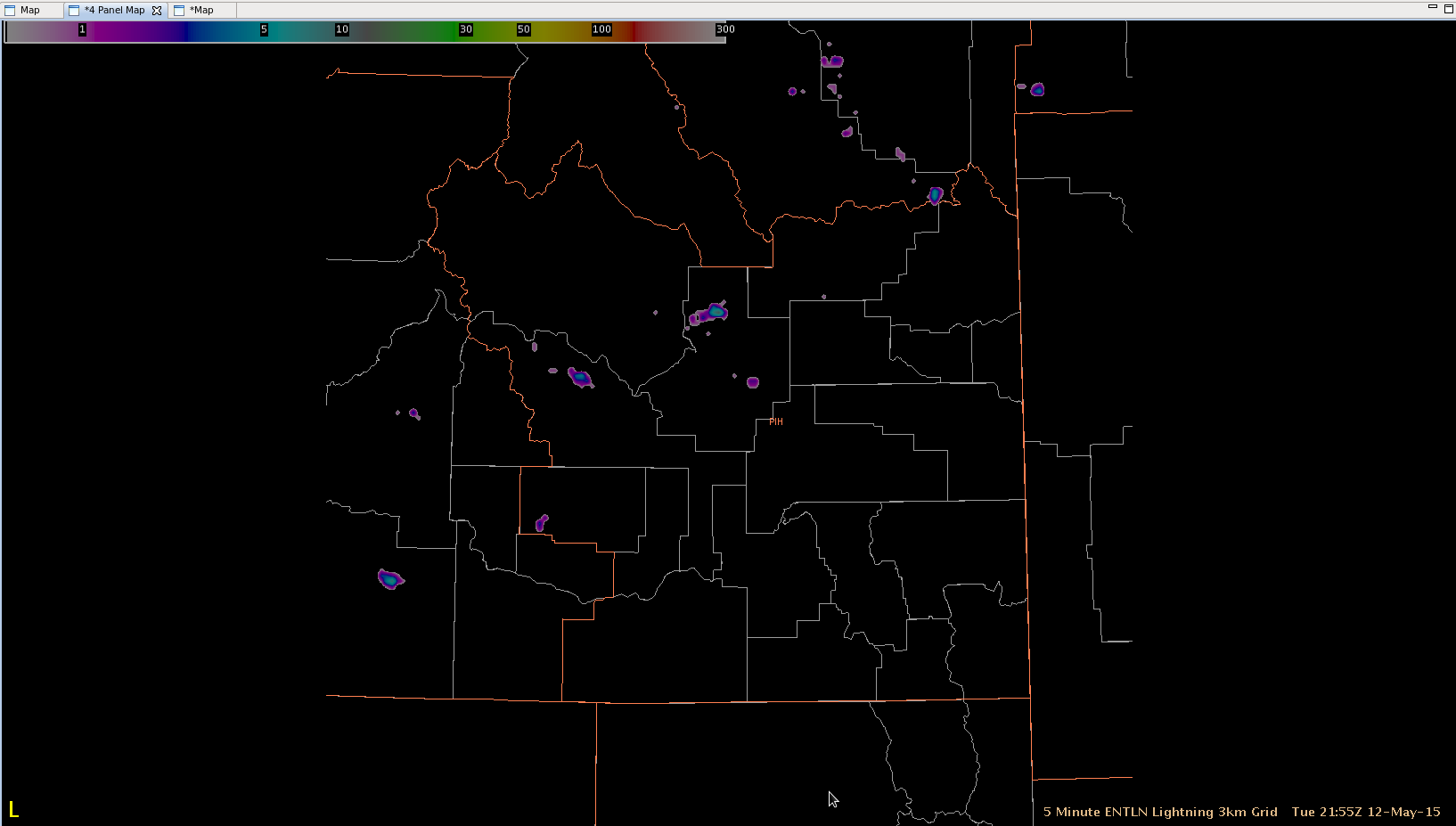
Update: This thunderstorm moved over the sampled area about two hours later. It peaked at about 55-60 dBZ Composite Refl and had a NOAA/CIMSS Prob Severe Model reading of 24% at that time. The 5-minute ENTLN Lightning 3 km grid peaked at 11 with this storm. There was no ground truth to verify what happened there. But will note the complex mountain terrain in that area and how difficult thunderstorm modeling and forecasting is in Western Region (with local effects, etc.). This was a decent test.
-Champion
ProbSevere prompted a third significant weather advisory. In this example, the probability increased from 13% to 74% in 10 minutes:


The base data confirmed strong winds and small hail would be possible with this storm.
Cape Coral Police reported several trees and power lines down in Cape Coral and South Cape Coral areas. They estimated the damage occurred between 3:40 PM and 3:55 PM.
This is another example where the trends in ProbSevere can be extremely useful to warning forecasters to find storms that need further integration (“all-tilts without looking at all-tilts”).
Polarimetric Researcher
The way the current time series is plotted makes it difficult to determine when the cell is no longer being tracked (i.e., the flash rate falls below a certain threshold). One way to see if it is no longer being tracked is to look at the Pt/time and compare it to the product time in the legend. If the product time in the legend is ahead of the Pt/time, then the cell is no longer being tracked and no more data will be added to the time series plot. Perhaps there could be a way to show that the cell is no longer being tracked so inexperienced forecasters could quickly determine this.

Ertel