ProbSvr/Time Series for Warning Decision Making

With the severe thunderstorms that moved through the EWX CWA, we used ProbSvr and TimeSeries to help us decide if we were going to issue a new warning or expire/cancel a warning. Here are the examples from the two that we had going.

Here at 2308..the warning on the right was expiring at 2315z and the one on the left expires at 2330z. We needed to make a decision soon on the one on the right. It wasn’t too impressive in terms of reflectivity but we noted that the ProbSvr remained high and hadn’t faltered through the life of the storm. As well, the DTA (not shown) was continuing through the life of the storm as well. 2308Radar

At 2312..they are looking similar. At this point we decided to reissue a severe on the storm on the right. The ProbSvr holding strong every two minutes definitely helped us make this decision. Also to note the time series (shown at the bottom) is also steady on the one on the right.

2312Radar

At 2314z…we have issued a new severe on the one on the right and now the storm on the left is weakening per the ProbSvr. We were already considering letting the warning on that one expire so this helped our decision.

2314Radar


At 2322z…the storm on the right is still holding a strong ProbSvr Probability while the one on the left continues to diminish. We were still deciding if we wanted to issue a new one for the left for possibly a wind threat but at this point we decided to expire it.

2322radar

And as you can see at 2335…the left storm has dissipated.

2335z

Here are the time series for both storms. The one on the left is the strom from the left above and you can see the quick drop off. The one on the right held steady and continued to help our decision to issue a new warning.

TimeTwo


Also to note…this is a GIF from 13z-22z of the LAP CAPE data. We have been watching this each hour and the storms have been following the instability axis along the Texas border. We saw this earlier and were prepared for the storms to take that track.

CAPE

Lauren13/Ertel

Tags: None

Lightning Jump Detection Algorithm Suggestion

Image 1.  2238Z.  Sigma 1.

13

Image 2.  2239Z.  Sigma 2.

14

Image 3.  2240Z.  Sigma 3.

15

Image 4.  2241Z.  Sigma 5.

16

Image 5.  2242Z.  Sigma 0?

17

It’s nice having this information update every minute to capture trends.  However, since it updates every minute on AWIPS2 the color could change every minute over a short time (like above).  Forecasters can easily miss these fast changes given all of the data they need to look at.  It would be better for the data to update every minute, but leave the strongest Sigma in place longer.  (Maybe for 5 minutes using a separate product?)  This would allow forecasters to see the largest Sigma more easily.

So in the example above, Image 4 would show Sigma 5 for the area highlighted from 2241Z until 2246Z.  At 2247 the Sigma 5 color for the area highlighted would be replaced by the next strongest Sigma in that area (if any).

-Champion

Tags: None

T’Storm Development Ahead of Line

Thunderstorms have combined to form a line moving southeast across the southwestern SJT cwa. CI Prob was indicating further developing and convection ahead of line. The model showed a good bit of possible development ahead of this line.  The indication of convection has so far been overdone. This is similar to surface based warming that fuels PM convection. Though, a the line has extended north into this region and one new cell has formed in the area being watched closely. The first photo indicated CI Prob and the area forecasters should focus on.

051315 open development ahead of line

Here you can see where a cell in the concerned area within SJT cwa developed and the line elongated northward.

051315 storm pop

UFFSU

Tags: None

DTA/Time Series thoughts on the SVR Cell

Check out the ENI Plots/Time Series for the severe storm going through the NW corner of EWX’s area.

I want to point out the storm history on the “tail” trailing behind the storm. We noticed even on reflectivity that the storm had come down briefly and then went back up. Check out where I put the white “Y” looking thing. Right there it went down to an “orange” alert (significant thunderstorm alert) and then you can see it went back up to Dangerous.

Side note: I have no clue why there is a DTA going to the northeast on this storm. It is consistently moving to the southeast.

ENIGood

Here is the time series for the storm as well. You can see the decrease in lightning around the same time the alert downgraded from the DTA and then back up.

LTG-TimeSeries


Lauren13


Tags: None

NUCAPS Sample

In southwest TX.  Modified for the surface.  Severe thunderstorm with a TBSS moved through the area later.

10

11

Plus, another point to the north where nothing happened.

12

-Champion

Tags: None

ENI Time Series Plots – Ways to View

I’m a big fan of the ENI time series plots. There are a lot of different ways to view the plots themselves, between the mono- and multi-color plots, 4-panels, etc. I wanted to compare them and see which might be the most useful.

First, it is helpful to have a dedicated pane for the ENI DTA cell polygons and cell flash rates, with the Interactive Points overlaid on it. Move the points to 4 (or less) different cell polygons. You have to keep moving the points to keep them within their respective cell polygons, which is time and work-load intensive if you are in an intense warning situation.

point7

There are 4 main ways to view the time series data:

The 4-panel mono-color: better for seeing overall trends in flash rate with multiple cells. In general though, I don’t like the mono color. There’s all these lines and everything is the same color, it’s hard to differentiate what you are looking at.

4Panel_mono

The 4-panel multi-color: better for keeping track of the partitioning of Total, CG, cloud, etc.

4Panel_multi

The 4-panel multi-color and mono-color are each a good way to view multiple cells at once. they can be viewed all on one screen or larger by entering panel combo rotate mode. If you are looking at one storm in particular, or there aren’t many cells around, viewing the single panel multi-color is probably more useful.

Single-Panel Multi-color (single cell): Great for situations where there aren’t many cells going on, and you really want to investigate the cell for warning purposes. Seeing the trends in the various flash components can help decide if a storm is intensifying or weakening.

single_multi

Single-panel Stacked:

The single panel stacked is not very appealing. If you have a lot of cells at once, the plot can get very busy, very quickly. Yes, you can turn cell off to focus on one or another, but then the individual plots are still mono-color and difficult to pick out the flash components.

SinglePanel_stacked

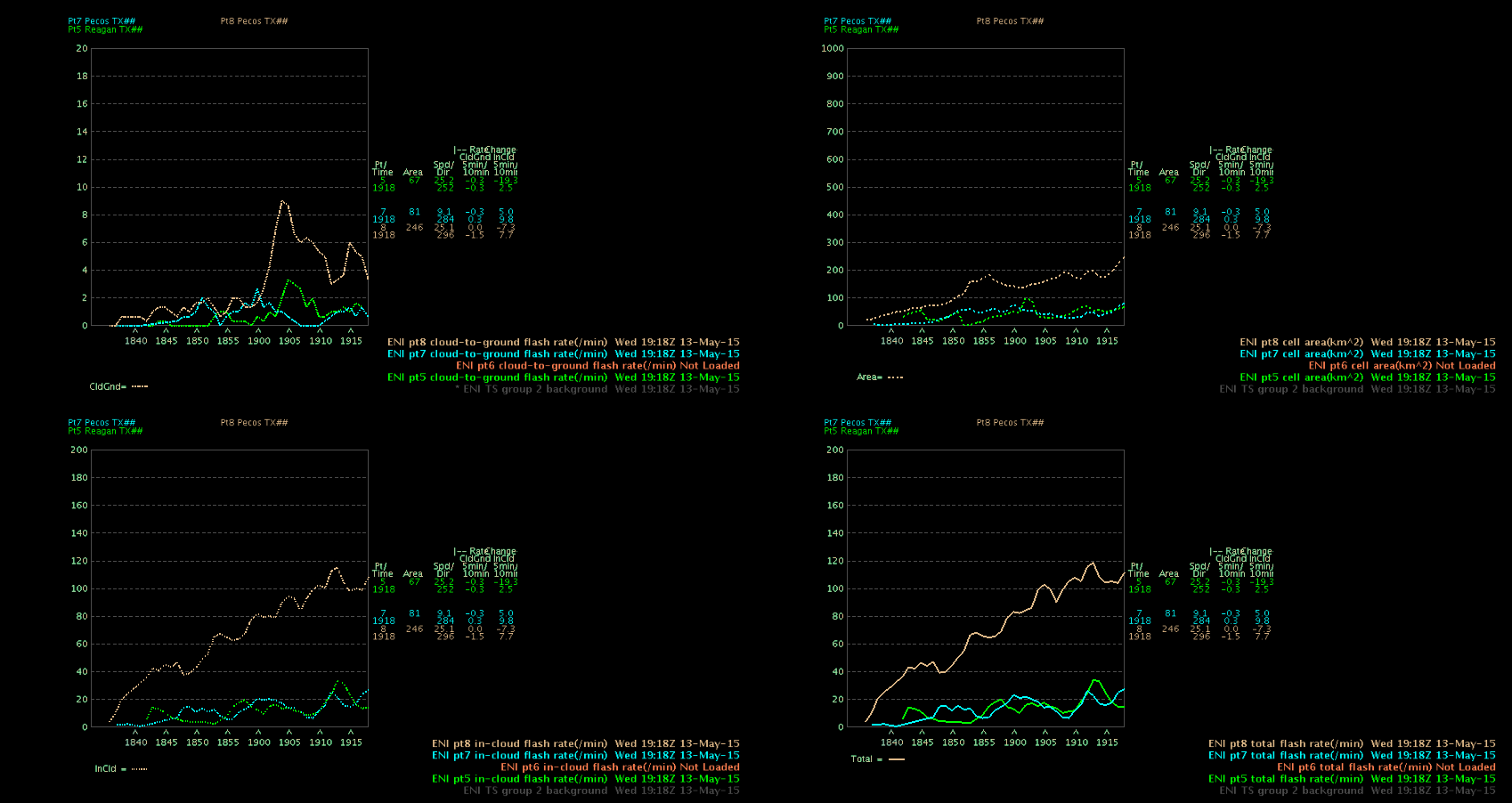
And finally, a 4-Panel composite. The composite product is interesting. It is a stacked 4-panel with each panel devoted to one of the time series components. While it is interesting to look at, I don’t see the utility in a real-time warning situation. It might be good to archive or screen capture and use for case studies after the fact or something like that.

4Panel_composite

Overall, I find the 4-panel mono-color and the single panel multi-color (or 4-panel in panel combo rotate mode) the most useful of the time series displays. The 4-panel mono-color gives you a good overview of the trends for all cells you are tracking. The multi-color plots are very helpful in analyzing individual cells. When comparing with radar reflectivity, you notice changes in the flash rate before the cell exhibits increases or decreases in reflectivity. The faster updates of the flash rate data allows you to see trends in storm cells before they show up in the radar products. This could be immensely helpful in the warning process with a “heads up” without waiting for “one more radar scan”. In the Southwest US, especially, waiting one more scan can be the difference between hitting or missing a warning.

~Regina Phalange

Tags: None

ENI vs ProbSvr for Developing Storm

In the line we are watching the southern storm started to strengthen more than the middle storm.  At 2044Z it started showing something like below with both storms in one PorbSvr bubble. It took until 2058z for it to slowly make the southern storm larger. After this scan, at 21z, it finally split the two storms.

2stormProbSvr


However, at 2047 the ENI DTA had already lost the middle cell at focused on the southern storm. This image is at 2101 but just shows how long it took ProbSvr to separate them vs the ENI DTA.

2stormENI


Lauren13

Tags: None

ENI Time Series Case Study

Setting: Northwestern edge of the San Angelo, TX CWA.

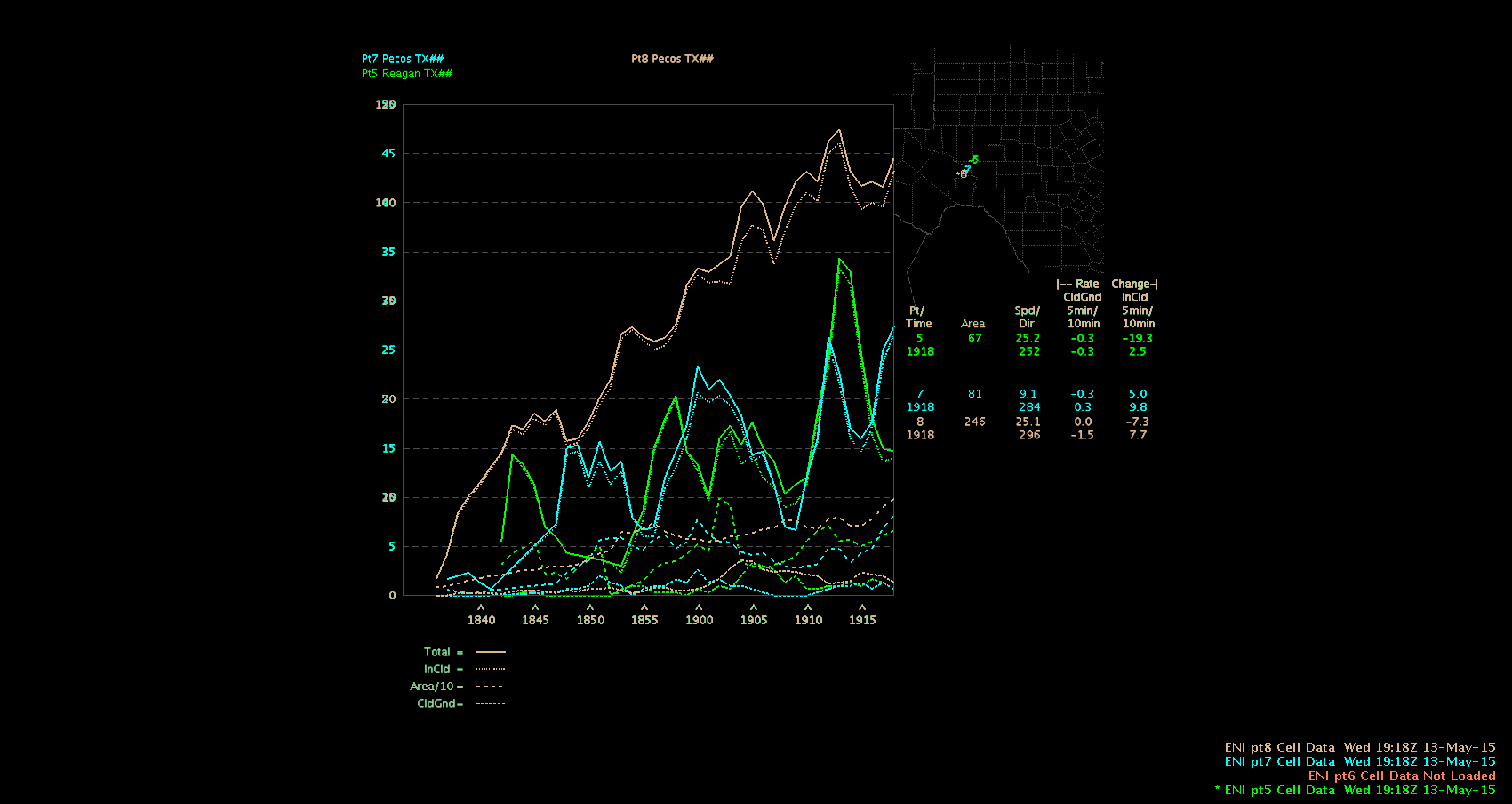
I pulled up the ENI time series for a strong cell that exhibited a high flash rate and saw a large peak followed by a rapid drop-off and a subsequent increase again. I wanted to look at radar to see if it matched up with the trend in strength. The cell in question is the northern-most cell in the short, loosely-connected line along the border of the San Angelo CWA (point 7/northern cell polygon in the image below).

point7CZ_1930 Composite Radar image at 1930Z

The northern-most cell has a reflectivity core peak corresponding to the rapid increase that the flash rate on the time series had been showing. The increase/peak in flash rate occurred between 1928-1932Z.

ENI_1930_2006ENI multi-color time series plot for Point 7

The next two radar images at 1936 and 1942Z, respectively, reflect the rapid decrease and subsequent increase again in the time series plot between 1933 and 1938.

  CZ_19361936Z CZ_19421942Z

The flash rate then began a steady, but quick final decline just before 2000Z.

ENI_1930_2010

This was finally reflected in the reflectivity scans at 2000Z and 2006Z.CZ_20002000Z

CZ_20062006Z

I found myself watching the time series plot when it would take a sharp turn to increase or decrease flash rate and going back to the radar, waiting for it to be reflected there, and it usually did. Since the lightning data comes in more often than/ahead of the radar imagery, the time series plots could be used to anticipate increases or decreases in storm cell strength, potentially aiding in the warning process (ie whether to issue (lead time), continue, or let a warning expire).

~ Regina Phalange

Tags: None

Misleading Lightning Jumps

ENI lightning data has been useful at times today.  However, when monitoring lightning jumps all forecasters must exercise caution. The charts can be misleading when tracking cells. Watching the last hour of data in SJT, one can see lightning cells converge, causing a tremendous spike in lightning strikes.  This could lead a forecaster to believe the storm is strengthening, when in fact data is being absorbed. A forecaster must use different tools and further investigate to ensure lightning jumps are indeed really happening.


Panel 1 shows a lightning jump.

051315 lightning jump 2042

This image shows how two different cells later converged according to ENI leading to an unwarranted lightning jump.

051315 eni cell absorbtion

UFFSU

Tags: None

ENI and splitting cells

We are watching a line of storms that the ENI Alerts are handling very well. I took these screen captures to watch and see how the alerts handled the split.

This is at 1958z looking at the northern line of storms you can see a cell rapidly developing in the middle of the two with alerts.

eniSPLIT1958

Here at 2010z…it caught the split but put the alert to the northeast which is not the general direction of the line at all.

enisplit2010

Lauren13

Tags: None