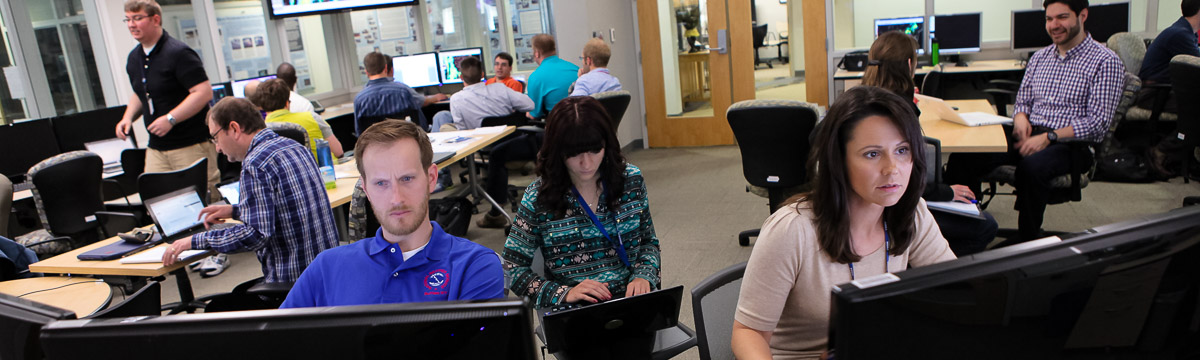
Live Blog – 28 May 2008 (7:48pm)

Operations continue with two teams alternating positions every hr… forecasters seem to appreciate the ease of updating the warnings with this method, though the start-up in its current format is a bit tedious. Can also get confused with multiple warnings on the same storm by highlighting the wrong threat polygon, though hasn’t been a huge issue tonight… Forecasters again would like to see a preview of ProbHail (or other threat) swath before saving it…

Team 1 issuing a lower prob tor warning on storm in northern Chaves Co.; storm in SW Chaves Co has moved out of threat area with lack of attn to storm. New cell has developed to west and the team is debating covering both cells with one warning or beginning new warning on western cell. (Team has joked it would like a “maybe” button on choosing whether a deterministic warning would be issued for this cell, probabilistic warning covers this uncertainty much better).

Team 2 plans on tackling wind threat on storm with HP nature nw of Tucumcari and bringing down probs on tor threat.

Kristin Kuhlman (Gridded Warning Cognizant Scientist)

Tags: None

Live Blog – 28 May 2008 (7:15pm)

Both teams appear comfortable with handling multiple threats, even on multiple storms. Team 1 is warning for hail with the storm east of Chaves. They are curious to see how this storm evolves upon interacting with a NNW-SSE oriented boundary located in the path of the storm. They also issued a high confidence hail warning for a storm southeast of Alamagordo…which has a 3-body scatter spike, and for which MESH indicates 3 inch hail.

Team 2 has been following a long-lived supercell which has occasionally produced a TVS, and at one time a fairly strong TVS…tracking just north of I-40 toward Tucumcari. They are maintaining high probabilities for hail and tornado with this cell…and have just added a low probability for tornado with a second supercell following in the path of the first. These cells are moving along an east-west oriented boundary of unknown origin…which may have bee produced by differential heating.

Patrick Burke (EWP Weekly Coordinator, 27-30 May)

Tags: None

Live Blog – 28 May 2008 (6:47pm)

Possible software guidance for future: Encircle large area and grid points exceeding some threshold value (e.g., MESH > 1.25 in) gives an initial first guess polygon for threat area.

Team 1 is expecting their storm to decrease in intensity as it moves off the terrain and are going to begin issuing warnings on the storm NW of Roswell (Chaves Co). Velocities from KFDX are not good on WDSSII, so will begin with hail threat and then possibly tackle tor next (funnel cloud reported with storm). They have also tackled the hail threat on a separate storm in far SW Chaves Co.

Team 2 is discussing possibilities of probabilities of hail > 2 in or 3 in (sig hail?). Move to allowing others (the public) to decide what is important for themselves (e.g, different thresholds for action)–the NWS issues probabilities of events occurring (not warnings)…

Kristin Kuhlman (Gridded Warning Cognizant Scientist)

Tags: None

Live Blog – 28 May 2008 (6:06pm)

We finished a first training exercise using live data in southern NM around 5:30 pm and have moved to issuing warnings on two separate storms in NM. Team 1, Mark and Brad (on Moore), concentrating on the hail threat near Los Alamos. Team 2, Kevin and Eric (on Higgins), are looking at both the hail and tornado threat in southeastern Santa Fe.

Team 2 have noticed that threat areas can be a bit ahead of radar / mesh output as update times 1min for the former, 5 min for the latter. Both teams have discussed how often should update product, see it as a continuous product that you don’t have to wait until the end of the “warning” to update/reissue.

Kristin Kuhlman (Gridded Warning Cognizant Scientist)

Tags: None

Live Blog – 28 May 2008 (4:30pm)

PROB-WARN Ramping Up

Forecasters will head back to the Hazardous Weather Testbed to practice drawing probabilistic warnings…then an intensive operations period is planned beginning sometime after 2200 UTC…most likely in the area just east and southeast of Albuquerque, NM. Northeast parts of the state may be too stable to support a long-lived storm.

Patrick Burke (EWP Weekly Coordinator, 27-30 May)

Tags: None

Live Blog – 28 May 2008 (3:37pm)

Eastern New Mexico Heating Up

The SPC has outlined a mesoscale discussion for eastern New Mexico, where a weather watch may be needed soon. Satellite and surface observations suggest the original target of northeast NM has been slow to warm up beneath widespread stratocumulus clouds north of the frontal boundary. Greater destabilization has taken place along the I-25 corridor and into east-central/southeast NM. This zone of greater instability should develop northward this afternoon. Thunderstorms are initiating in a widely scattered fashion between Albuquerque, Pecos, and Clovis. One cell near ABQ briefly exhibited supercell character with a small appendage and sharp reflectivity gradient.

Patrick Burke (EWP Weekly Coordinator, 27-30 May)

Tags: None

Live Blog – 28 May 2008 (3:26pm)

Archive Cases Ending…Prob Warn Training to Begin

Our teams are filling out PAR and CASA evaluations following their archived events.

Kevin/Eric discussed how to best display CASA data. They would like to be able to easily choose one radar and tilt up to higher elevation. They like the utility of CASA at low levels for wind/tornado threat without much thought to hail threat.

Yesterday…they were hanging on every 1-minute update with PAR, looking intently for changes in storm character. They did not experience the same type of anticipation with CASA today. This could be related to the case selection. Some positives they point out are the fine spatial resolution and near ground sampling.

With both PAR and CASA, Kevin sees need for substantial training to avoid dramatic increase in false alarm rate. These small scale signatures and short-lived shear couplets or RFDs have always been out there. Now that we can see them, it doesn’t necessarily mean we should be warning for each of them.

Brad/Eric are discussing when additional information becomes too much. “Rarely would a meteorologist decline more information, but in some cases it just becomes more on the floor (or tossed aside).”

All forecasters are moving to a seminar room for training on Probabilistic Warnings from 2045-2130 UTC.

Patrick Burke (EWP Weekly Coordinator, 27-30 May)

Tags: None

Outlook – 28 May 2008

We have potential for a Prob-Warn exercise this afternoon across the high plains adjacent to the mountains of eastern Wyoming through eastern New Mexico. Thunderstorms are not imminent, however, so to make the most of this shortened week, we will run archive PAR and CASA events between 1830 and 2030 UTC. The forecaster teams will be the same as yesterday, with Kevin and Eric moving over to the CASA desk and Mark and Brad working PAR.

Training on probabilistic warnings will ensue between 2030 and 2200 UTC. We then intend to run Prob-Warn operations in eastern New Mexico from 2200-0200 UTC. Moderate southwesterly upper flow is in place on the far western high plains, while moist southeasterly low-level upslope is increasing. A stalled frontal boundary will begin to lift northward through New Mexico this afternoon, and veering wind profiles north of the front will favor rotation with updrafts initiating in the deep mixing zone along the high terrain. Deep layer shear may actually be stronger up north toward Wyoming…but greater moisture/instablity, and a potentially wider CAPE axis favors operations in northeast New Mexico…where several models, including the short range ensemble, suggest a high probability of thunderstorms. The SPC has outlooked that area with a Slight Risk, including a small 5% tornado contour.

Day1 Outlook

Patrick Burke (EWP Weekly Coordinator, 27-30 May)

Tags: None

Summary – 27 May 2008

Our four visiting forecasters arrived ready to work, and the day promised a fair chance of Oklahoma-based operations. After a quick tour of the National Weather Center, the group convened in the NSSL Develoment Lab for orientation, followed by a map discussion. Participants were trained on the PAR and CASA data platforms before moving to the Hazardous Weather Testbed around 21 UTC. Software training for the WDSSII used real-time data of a supercell occurring near Altus, OK.

Kevin (WFO OUN) and Eric (WFO AFG) then jumped on at the PAR workstation to dissect the Altus supercell at long range. Brad (WFO SEA) and Mark (Environment Canada – Winnipeg) practiced WDSSII using KFDR data on the same supercell, and were on standby for possible CASA operations. By 23 UTC, though, it became clear that thunderstorms would propagate southward into northwest Texas…as stable air emanating from a second storm complex had overspread the CASA domain.

By 2330 UTC…real-time operations ended, and both groups of forecasters turned to archive events. The pace slowed down, allowing more time for discussion of data strengths and weaknesses. The PAR data, in particular, spurred some interesting ideas as to what forecasters would ideally like to receive from a radar system. The CASA participants expressed some difficulty operating in a small domain using multiple radars. They also noted that the KTLX 88D better sampled one occurrence of strong straight-line winds, simply owing to viewing angle. They were impressed, however, at the temporal and spatial resolution of the CASA data which captures many interesting storm and sub-storm scale features.

Patrick Burke (EWP Weekly Coordinator, 27-30 May)

Tags: None

Live Blog – 27 May 2008 (6:29pm)

Storms in western Oklahoma have either weakened or moved southward to very long range from central Oklahoma radars. Today’s severe potential is largely driven by the diurnal cycle, and there is little hope of additional activity; the MCS outflow from this morning simply proved too deep and widespread across central Oklahoma. The event did provide Eric and Kevin a chance to become familiar with PAR data, and they will continue that theme by working an archived event this evening.

Eric and Kevin Examine archived PAR data.

Meanwhile, Brad and Mark are viewing archived CASA data to increase their comfort level with the look and feel of that data. Between 2330 UTC and 0130 UTC they plan to run through another event in real-time playback to evaluate the utility of CASA data in making warning decisions.

Brad and Mark work with Jerry Brotzge viewing archive CASA data.

Patrick Burke (EWP Weekly Coordinator, 27-30 May)

Tags: None