OCTANE Cloud Top Divergence and Cooling to Analyze Thunderstorm Severity

The distribution characteristic of the derived cloud top divergence product has been helpful in highlighting potentially severe thundretsorms. Here the purple/pink colors are fairly consistent compared to the more “broken” distribution of colors to the east. Additionally, cloud top cooling is appearing as an overshooting top (and continued to reappear after this animation ended). Even if radar data was absent the severity of the thunderstorm would be apparant. A warning was issued on this storm (shown below).

-Joaq


Tags: None

Comparing PHS Reflectivity with the HRRR and MRMS Reflectivity


In this animation we track the progression of MRMS composite reflectivity (right) hourly over the previous three hours compared to the PHS (left) and HRRR (center) reflectivity. This morning convection allowing models were slow to initiate convection compared to reality and it seems that trend is continuing this afternoon with the southeastern progression of ongoing convection. The PHS has been slowest today with the southeastern movement, while the HRRR is a bit closer to reality but still behind (especially in the in the northeastern portion of the CWA.

-Joaq

Tags: None

Using GREMLIN for Time of Arrival

LightningCast has been running high near the PGA Tournament today near Fort Worth as a result of several thunderstorms around the region, but not over the region. As a result, decided to swap over towards trying to use GREMLIN to find the time of arrival of the boundary noted earlier.

So an attempt was made to highlight this in the DSS image to provide an estimate of when these hazards would arrive. Perhaps another proofread would’ve caught the initial typo from copying it over. However, a value of about 40 percent was noted. Partners still had information that storms would become increasingly likely over a narrower time frame in addition to the probabilistic information from LightningCast.

But nature had other plans with a strike and a few pulses of lightning over the event at the time this was “sent out”. An area of weak convection was in the area, and so I would’ve thought that this would not produce lightning.
Sneaking in information on the RGB evaluation, you can see how this was not a young storm and likely something in decay, and that may track with a bit of the surprise element.

Kadic

Tags: None

Speed of Incoming Surface Boundary

One of the things that we noticed was that it appears that model guidance is too slow dropping a weak surface boundary to the south. As a result the convection in model guidance is likely being developed too far to the north of what is likely to actually occur.

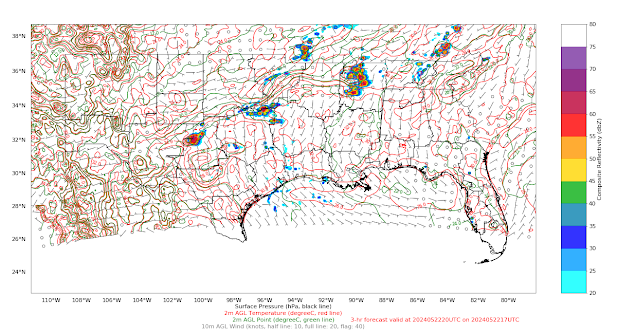
Below is the surface winds from the PHS model forecast from the 17z run for 20z. It has a boundary that is near or north of the Texas-Oklahoma border.

In reality, the boundary has been a bit further south. However, this has been the theme of the day, with convection generally advancing east faster than most high-resolution model guidance. Below are the surface observations across Texas showing how much further south the boundary is, in addition to the fact that the wind field is stronger than what PHS is indicating.


The image below has the forecast model composite reflectivity (top right) nearly a degree longitude to the west of MRMS radar reflectivity (bottom right).

This raises additional concerns, as out ahead of the convection, the PHS forecasts an increase in SRH. If this is unchanged considering the current placement of convection, it may indicate a greater probability of storms rotating. The fact that we’re also seeing a sharper boundary present in the wind field suggests we could also see stronger convergence along the band of developing convection than may be indicated within the PHS forecast.

Kadic

Tags: None

Using OCTANE to diagnose three convective environments along the Missouri border

Currently monitoring OCTANE data in the vicinity of the Missouri border at about 1850Z on Tuesday, May 24.
North of the border (far southwest Iowa) there is mature convection, with a clear signal for changes in direction and speed on the anvil (top two panes). The mature convection shows cloud top divergence, with new convection on the southern flank showing a sharp signal for cloud top cooling (bottom left).
There is an area of banded cirrus moving through the region just south of this. This cirrus shows up on day cloud phase imagery (bottom right) but also in the OCTANE speed product. Looking at satellite data qualitatively, it’s clear the cumulus field is much less impressive in this area. Convection is not yet initiating here. Surface observations don’t show a clear signal for a less favorable air mass, so it’s possible the mid-level conditions are not as favorable.
South of all of this, we are looking at a new area of updraft initiation occurring just on the Kansas side of the border. On conventional satellite imagery we can see updrafts reaching upper levels and shearing off (orphaned anvils) indicating true convective initiation is still a little ways off, but we are getting very close. There is a consistent signal on OCTANE cloud top cooling for some of these spotty updrafts. Comparing with conventional imagery, the OCTANE cloud top cooling signals provided 5-10 minutes of lead time on the orphaned anvils. This is useful information, as once these storms begin maturing, they may provide a little more lead time on the initiation of lightning in addition to just the initiation of mature updrafts.
–Insolation
Tags: None

Storm Hopping Over Subarray

We noticed a change in the storm on GLM as it tracked northeast. GLM seemed to decrease as the storm passed through the subarray region, but the number of flashes remained relatively the same according to the ground network. Knowing the location of this subarray and also comparing GLM to the ground network gave us confidence that the dip in GLM was not due to a reduction in flashes/storm intensity.
Cumulus and Kadic
Tags: None

GLM Trends In A Warning Decision

Severe thunderstorm and tornado warnings were issued partially driven by the increasing intensity of GLM FED. With the indication of a strengthening updraft due to increasing lightning activity atop the convergence signature on radar, a warning decision was made for both damaging winds and a tornado threat.

OCTANE cloud top divergence also highlights the strongest thunderstorms in our CWA below.


-Joaq

Tags: None

Tracking Convective Development With OCTANE storm top divergence and LightningCast

Developing convection along a surface front in eastern Kansas was producing signals in the OCTANE storm top divergence product, signs of glaciation, in the day cloud phase product, and increasing LightningCast probabilities. Along northern areas of the surface boundary, the divergence product and visible characteristics were stronger, while updrafts further south still struggled to sustain themselves. This may be due to residual convective inhibition evident on MCI ACARS soundings. Even about 20 minutes after these screen shots were taken, the GLM activity was fairly weak, while the storm top divergence only really showed showed up on storms near and north of the KC metro. While severe convection is still likely downstream, the OCTANE divergence product definitely highlights where better synoptic forcing is overcoming any convective inhibition.


-Joaq

Tags: None

PHS vs Visible Satellite and Radar

PHS was a bit slower with the convection entering the DMX CWA compared to visible satellite initially. However, by 22Z it looks like it caught up!

PHS Composite Reflectivity overlayed on Visible Satellite (right) vs only Visible Satellite (left)

Looking at 22Z (once the timing was better aligned), I was curious how the reflectivity in PHS looked compared to the radar. The overall shape and look of the broken line of storms lines up fairly well (even with the model smoothing things out). The intensity didn’t look like it matched up at first because I was looking for “red”. But, when using the sampling tool and seeing the values, the yellow-green colors in PHS indicated 63-67 dBZ (where the label DMX is in the image).


PHS Composite Reflectivity (right) versus KDMX radar reflectivity (left)


Overall, I think PHS is proving to be valuable with CI (as seen in Day 1) as well as adjusting as storms evolve (such as timing in this case).

Forecaster Cumulus

Tags: None

Learning More About GLM and the GLM-DQP!

Honestly, for warning operations, I am used to using/focusing on the GLM Flash Extent Density and on the warmer color pixels and trends when lighting increases. I also wouldn’t consider myself an expert on lightning – I came into this HWT not having a lot of knowledge on the details of these products, the instrument, and the specifics of lightning. So, I am really grateful that I continue to learn more about this and GLM in general (thanks HWT and SMEs!).

GLM-DQP: It’s really useful to know where the subarray areas are, in case the GLM data looks “funky” (near/at saturation). I feel that this would not only be useful for my “home CWA” but also for when we back up other offices. It was also interesting that we (WFO DMX) found a case today where a storm passed through the subarray line and the GLM FED data pixels looked like it “dipped”, but the flashes stayed relatively the same (or even increased after passing through) when comparing with the ground network.

Forecaster Cumulus

Tags: None