OCTANE Signal With New Convection Near Chicago

At 1910Z on May 20, OCTANE picked up a good signal on convection developing just northwest of Chicago, IL. On the Speed Direction product, there was a well-defined difference in direction vector on the southeast flank of the anvil (250deg) versus the western flank of the anvil (200deg).


There is also a subtle signal on the OCTANE speed sandwich product, though not as pronounced. Regardless, for a fresh storm just reaching severe levels, it was worth noting.


–Insolation

Tags: None

Identifying potentially stronger thunderstorms with IR OCTANE divergence and LightningCast


Displayed here are OCTANE products built from both visible (right panel) and IR (left panel). What caught my eye is the characteristic of the OCTANE direction in the IR panel, where directional divergence is showing up much more clearly than in the visible OCTANE product. This is especially showing up in the northern set of storms, where LightningCast is also highlighting for a probability of >10 flashes in the next 60 minutes (shown below). These both highlight an area with a higher probability for more intense convection in the near-term.

-Joaq
Tags: None

LightningCast and DSS

Viewing CI and LightningCast (LC). LC probabilities on the SW portion of the storm (in the center) at 1958Z ranged between 70-75%. Just before GLM signatures pop up at 2007Z, LC probabilities jump up to around 82%. Not included in the animation, but at 1951Z, LC probabilities were around 50%. The overall trend upward would give me confidence that I can use this product to tell an emergency manager the potential for lightning is medium to high within the next 10-20 minutes (using this case, hypothetically starting at 1951Z).

Lightning Cast product overlaid on Cloud Phase Distinction on the left and radar reflectivity on the right. 20 May 2024

Forecaster Cumulus

Tags: None

GREMLIN versus Radar

Overall, GREMLIN performs fairly well with the zoomed out shape of the precipitation returns compared to radar, but perhaps a bit larger extent. Picks up on a few heavier cells moreso versus heavier stratiform rain. Since the overall radar mosaic of GREMLIN looks so close to current radar, it would increase my confidence in using it for the big picture (especially if the radar data were to go out for some reason).

GREMLIN vs radar reflectivity 2010Z through 2058Z 20 May 2024
Focusing on the two cells in the west… it’s interesting because it looks like GREMLIN resolves both cells fairly well initially but follows the evolution of the southern cell for a time a bit better than the northern cell. In this instance, I couldn’t say much about confidence (sort of cancels out). But, it would be important to make sure to take into account the environment and also maybe use multiple tools in addition to GREMLIN to help with confidence.
Zoomed in GREMLIN vs radar reflectivity 2010Z through 2058Z 20 May 2024

Forecaster Cumulus

Tags: None

Waiting For Convection To Go

While looking for thunderstorm initiation, my eyes are turned towards anything that informs me whether convection will develop further or decay. There have been several things to note while waiting for instability to move into the region.

The main forecast challenge is the favorable ingredients to produce severe convection has to be advected into the region. The WRF with PHS data demonstrates that initial convection intensifies later in the day as better instability arrives across the region on the bottom right panel. This also corresponds with better dynamics noted across the others entering eastern Colorado. Model reflectivity on the bottom right increases as a result of better forcing over time. Until then, it’s monitoring at what point things actually start turning the corner and using the new tools available to find that point.


And so far, the things found have been what it’s not. So here are some things being observed in this period of waiting. At the beginning of the day, one of the things I noticed was related to the OCTANE detecting warming and cooling. As clouds moved off snowy foothills, it was apparent on the viewer where water clouds appeared warmer than the snow surface, and caused a pocket of cooling to appear on the eastern foothills once satellite could see the frozen snow, and warming whenever a cloud layer shifted overhead obscuring the snow. In the middle of convection, this would probably be irrelevant, but just a thing to note while we wait.


I like the idea of mashing together several products that we’re testing at once. So, I’ve applied the LightningCast, WRF with PHS CAPE, and GLM. The idea will be to monitor how the storm is pulsing compared to with what information is provided from PHS. It’ll also help track in what area LightningCast is lighting up and whether it is heading towards a favorable or unfavorable environment. With LightningCast aiming for detection within an hour, it began highlight a cell that corresponded with favorable instability. The combination of these two helped me hone in on this cell as being more likely to produce lightning than a similar LightningCast to the northwest. The 10% contour formed just before 20z, and steadily increased leading up to the first flashes on GLM roughly 30-40 minutes later. Nicely done!
While waiting, a small cell caught my eye. The area was almost completely clear, and showed very dark on visible imagery, to being cloud covered near Palmer. This made it appear this was about to blow up, but then you can see the OCTANE tool quickly reverse course once it becomes clear it will not develop and it begins to come down on visible.
Off to our west, there were a couple cells. Analyzing the tool on GREMLIN, the southern cell was less intense on GREMLIN compared to MRMS, and reversed for the storm to the north. However, neither are particularly intense, but it does indicate to keep a watchful eye and use other products like GLM to assess intensity.
As we move past 22Z and how the WRF with PHS data, it has done an excellent job forming the convection near the Denver Airport, but by Shamrock/Leader/Adena, that cell has not formed. This is creating a region of spurious data due to convective feedback. Some of the model appears to drive convection by the cold pool from this storm meeting instability advecting in from the east. It then focuses on this cell over the others, but this appears unlikely to verify at this point given how it is performing so far. By 00z, the 0-3km SRH bullseye creeps above 1600 m2/s2 moving towards Fremont. I won’t put the image of the new cycle that just came in, but the bullseye got more dramatic over 2000 m2/s2. Not sure if how much those magnitudes are in the realm of possibility.
One of the interesting behaviors lately has been a few storms forming in the cold pool as we approach 23Z. There has been convection developing on the western side of decaying cells. This has me thinking about how this would look for backbuilding precipitation. Would it have this look of the cool purples remain anchored in place while reds for new convection continuously appear to upstream that rides atop the areas of divergence? The signals may not appear robust, since there may not be fast storm motions.
Looking back at LightningCast, I have noted the known limitation of the forecast trying to bridge separate pieces of convection. The gap seems quite large though, and I wonder if there may be other means to QC the LightningCast with existing radar without making it slow to process. Or we can trust that the human eye is capable of noting that radar will confirm the lack of reflectivity at -10 C or higher.

That’s all I have today!

Kadic
Tags: None

OCTANE – IR Example of CI and Divergence

Found an example showing the application of OCTANE using IR – convective initiation and eventually divergence. Can see this in the color differences in the speed (NE) and direction (NW/SE) IR panels in the top left and top right in the image below, but also the cloud top divergence panel (bottom left). Could use the products alone (especially the direction panel), but I like seeing all three together to have the whole picture.

OCTANE (from AWIPS) using IR showing CI and divergence (20 May 2024)

Forecaster Cumulus

Tags: None

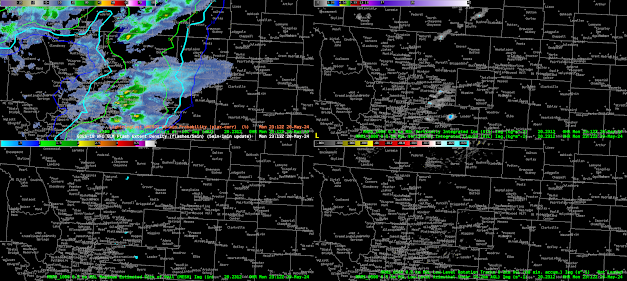
GLM Probabilities of 10 Flashes Followed By More Intense Convection

While more intense convection has been slow to develop in southeastern, the LightningCast probability for >10fl started to increase as synoptic forcing improved. About 13 minutes later (image below), the GLM flash extent density increased to around 30 flashes per 5 minutes, which was well signaled by LightningCast. While the probability depicted by LightningCast wasn’t terribly high (to around 15 percent initially), the upward trend in probability did signal the potential.


-Joaq

Tags: None

Color Curves Reign Supreme in OCTANE Products

OCTANE Night Direction and Speed Products

Today’s challenge was to try and see if we could draw out features better in both the OCTANE Night direction and speed products. The night products rely on IR satellite imagery and the lower resolution washes out a lot of the features we can normally see in daytime imagery. The easiest way to try and attain this was to first play around with the color curves in the IR brightness temp (CH-13-10.35um) overlay. Adjusting the colormap starting with black at 40 to white at -45 back to black at -80 then interpolating the ‘Alpha’.

Original OCTANE Night Color Curve – Direction

New OCTANE Night Color Curve – Direction


Original OCTANE Night Color Curve – Speed


New OCTANE Night Color Curve – Speed

Tags: None

HWT Day 4: Freed from MCS

Supercells of Midland, TX

As always, the first thing I did when I sat down this afternoon is AWIPS is immediately start fooling with the color tables. Today’s chimera was a combination of OCTANE Cloud Top Divergence and Cooling with MRMS Reflectivity at -20° C. MRMS was modified to only show values that exceeded 40DBZ to interrogate the relationship between cloud top divergence and highest reflectivity. At this point in the week, I’m throwing science against the wall to see what sticks.

My primary radar was MAF with MESH overlay for estimated hail size greater than two inches. Taking a look at MAF sounding this morning, it’s giving me big hail vibes and I wanted to see how MESH correlated with the convergence signatures from OCTANE.


Spice Level: Cayenne  🌶🌶🌶

At first glance of the Midland sounding I’m drawn to the fact that we have a substantial amount of CAPE (~3000J/KG). A little bit of a CAP at 700MB should be quickly overcome as there is a pretty good clearing in the clouds over most of Midland’s CWA. Lapse rates from 7-500MB is nearly 9C/KM, with a pair of dry layers from 8-500MB and between 5-300MB. Our hodograph, while not perfect, is generally a straight line from left to right.  Effective shear is around 45kts. My conclusion: hail. Possibly big hail, and we may have a chance of some splitting cells at some point today.

One of the cool things we noticed that the OCTANE Divergence/Cooling product picked up a splitting super cell around 15 minutes before the radar did. This was really cool and could be an excellent way of identifying splitting supercells and getting out warnings with an extra 10 minutes of lead time.


The inverted images on the OCTANE DIV/COOL product I think does a good job of highlighting areas in which those storms have entered an environment in which they are ready to split. Studying splitting supercells using sat imagery may give us abetter understanding of when storms are more likely to split.

Thanks for accepting me into this HWT! I got a lot out of it and am excited for what satellite can do for ops in the future!

-Charmander

Tags: None