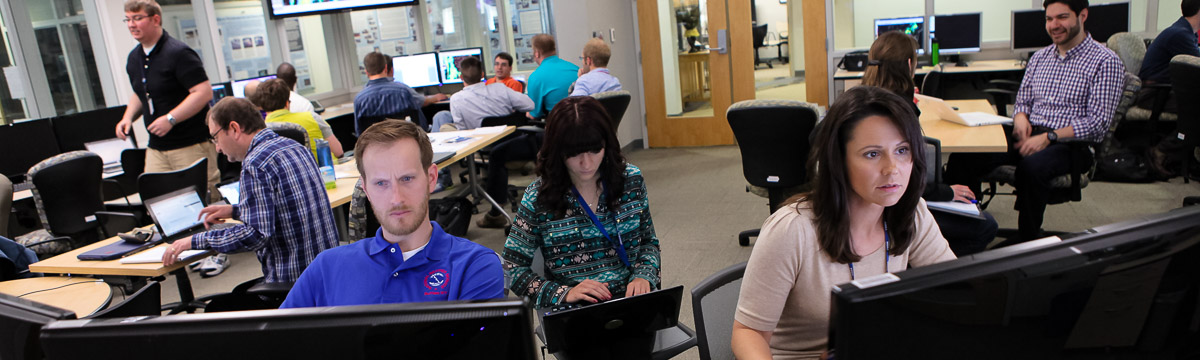
Here is our Thank You post for EWP2012, expressing our gratitude to the hard work and long hours put in by our forecasters, developers, and other participants for our spring experiment. Even though we had a quiet severe weather season this year, we found storms on pretty much all the operational days in the five weeks we operated. This was the first year we used AWIPS2, and it was a great success and mostly-well received by our participants and staff.
The biggest expression of thanks goes to our new full-time AWIPS2 support person Darrel Kingfield(CIMMS/NSSL), who put in many extra hours to pull off the transition to the new software. AWIPS2 performed very well, both due to Darrel’s efforts, and the fact that it is a better software package than AWIPS1.
These scientists brought their expertise to the experiment and were available to observe live operations and provide support to our visitors:
For the Warn-On-Forecast 3D Radar Data Assimilation project we’d like to thank the principle scientists, Travis Smith (CIMMS/NSSL), Kristin Calhoun (CIMMS/NSSL), and Jidong Gao (NSSL).
For the OUN WRF project, they included principle investigators Gabe Garfield (CIMMS/NWS WFO OUN) and David Andra (NWS WFO OUN).
For the GOES-R Proving Ground experimental warning activities, including the Pseudo-Geostationary Lightning Mapping (pglm) array experiment, our thanks go to principle scientists Chris Siewert (CIMMS/SPC) and Kristin Calhoun (CIMMS/NSSL), along with John Walker (UAH), Chris Jewett (UAH), Lori Schultz (UAH), Wayne Feltz (UW-CIMSS), Justin Sieglaff (UW-CIMSS), Lee Cronce (UW-CIMSS), Bob Aune (UW-CIMSS), Jordan Gerth (UW-CIMSS), Dan Lindsey (CSU-CIRA), Amanda Terborg (GOES-R AWC liaison, Kansas City, MO), and Chad Gravelle (GOES-R NWSTC liaison, Kansas City, MO).
We had undergraduate students helping out in some real-time support roles including monitor real-time severe weather reports. They included Bethany Hardzinski, Madison Miller, Christopher Reidel, Craig Schwer, and Jennifer Tate (all CIMMS/NSSL).
Next, we’d like to thank out Weekly Coordinators for keeping operations on track: Greg Stumpf (CIMMS/NWS-MDL), Jim LaDue (NWS/WDTB), Kristin Calhoun (CIMMS/NSSL), Travis Smith (CIMMS/NSSL), and Gabe Garfield (CIMMS/NWS WFO OUN), as well as “guest” co-coordinator, Chris Karstens (Iowa State University).
We also want to thank our overall EWP2012 Operations Coordinator who handled the experiment logistics, Greg Stumpf (CIMMS/NWS-MDL).
The following individuals from NWS/WDTB were instrumental in facilitating the “Tales From the Testbed” Webinars: Clark Payne, Robert Prentice, Mark Sessing, and Steve Martinaitis. And thanks to Ed Mahoney for spearheading the idea.
We had IT help from Aaron Anderson (NWS/WFO Norman, OK), Jeff Brogden (CIMMS/NSSL), Karen Cooper (INDUS/NSSL), Vicki Farmer (INDUS/NSSL), Paul Griffin (NSSL), Darrel Kingfield (CIMMS/NSSL), Brad Sagowitz (NSSL), and Greg Stumpf (CIMMS/NWS-MDL).
Public Relations were handled by Susan Cobb (CIMMS/NSSL) and Keli Pirtle (NSSL).
The EWP leadership team of Travis Smith (CIMMS/NSSL) and David Andra (NWS/WFO Norman, OK), along with the other HWT management committee members (Steve Weiss (SPC), Jack Kain (NSSL), Mike Foster (NWS/WFO Norman, OK), Russ Schneider (SPC), and Steve Koch (NSSL), Stephan Smith (MDL Decision Assistance Branch), Steve Goodman (GOES-R program office), and Jeff Waldstreicher (NWS Eastern Region Headquarters and Decision Support Services Pilot Project) were all instrumental in providing the necessary resources to make the EWP spring experiment happen.
Finally, we express a multitude of gratitude to our National Weather Service and international operational meteorologists who traveled to Norman to participate as evaluators in this experiment (and we also thank their local and regional management for providing the personnel). They are:
Marc Austin (WFO, Norman, OK)
Ryan Barnes (WFO, Norman, OK)
Brian Carcione (WFO, Huntsville, AL)
Dave Carlsen (Environment Canada)
Todd Dankers (WFO, Denver, CO)
Michael Dutter (WFO, Marquette, MI)
Jeff Garmon (WFO, Mobile, AL)
Rich Grumm (WFO, State College, PA)
Matt Hirsch (WFO, Phoenix, AZ)
Jeffrey Hovis (WFO, Charleston, WV)
Ty Judd (WFO, Norman, OK)
Stephen Kearney (CWSU, Kansas City, MO)
Andy Kleinsasser (WFO, Wichita, KS)
Chris Leonardi (WFO, Charleston, WV)
James McCormick (AFWA, Offutt AFB, Omaha, NE)
Chris McKinney (WFO, Houston, TX)
Steve Nelson (WFO, Peachtree City, GA)
Roland Nuñez (CWSU, Houston, TX)
Jennifer Palucki (WFO, Albuquerque, NM)
Julia Ruthford (WFO, Charleston, WV)
Andrea Schoettmer (WFO, Louisville, KY)
Kristen Schuler (CWSU, Kansas City, MO)
Randy Skov (CWSU, Atlanta, GA)
Gary Skwira (WFO, Lubbock, TX)
Gordon Strassberg (CWSU, New York, NY)
Tim Tinsley (WFO, Brownsville, TX)
Helge Tuschy (Deutscher Wetterdienst, Germany)
Kathrin Wapler (Deutscher Wetterdienst, Germany)
Many thanks to everyone, including those we may have inadvertently left off this list. Please let us know if we missed anyone. We can certainly edit this post and include their names later.
The EWP2012 Team