Operational Feedback of Gremlin, Octane, and LightningCast during a Severe Weather Outbreak in Central Oklahoma

I tested the OCTANE, GREMLIN, and LightningCast products during an actual severe weather event on 6/3/2025. My role during this testbed was that of the mesoanalyst.

Initial environmental analysis shows weak to moderate shear, which was determined via ARARS soundings and SPC Mesoanalysis, along with OCTANE imagery showing divergent / accelerating speeds within the storm anvils. VAD hodographs were used as convection developed to see rapid changes within the shear profile during the course of the event (as convection altered the broader environment). Shear increased as the event progressed. OCTANE and LightningCast were both useful showing the uptick in storm intensity as shear increased.
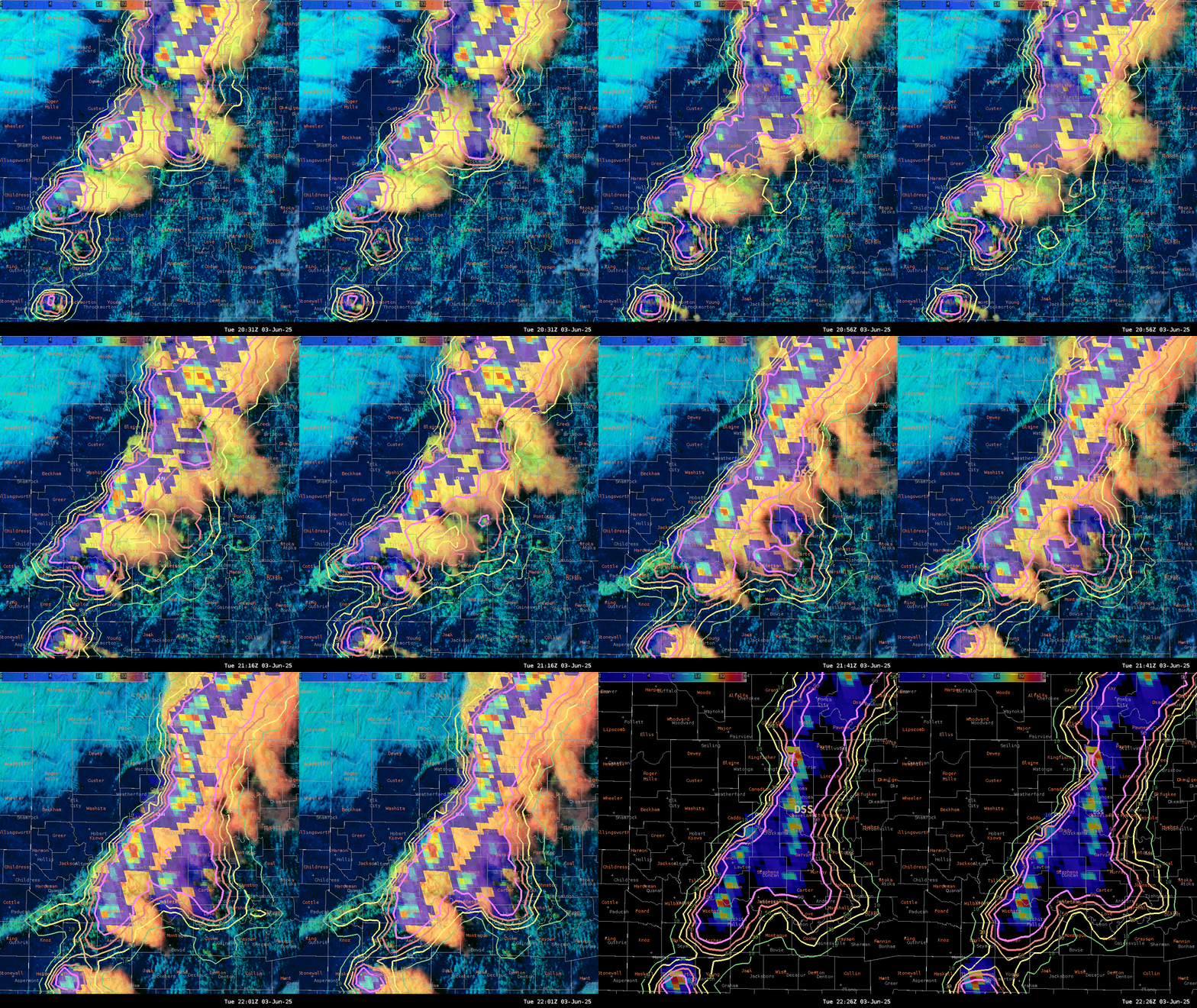
LightningCast was very useful picking out developing updrafts and embedded updrafts within broader areas of convection. We used this product to gauge which updrafts had the greatest potential to become severe in the near term. A strong uptick in lightning would indicate a rapidly strengthening updraft which would warrant further interrogation.
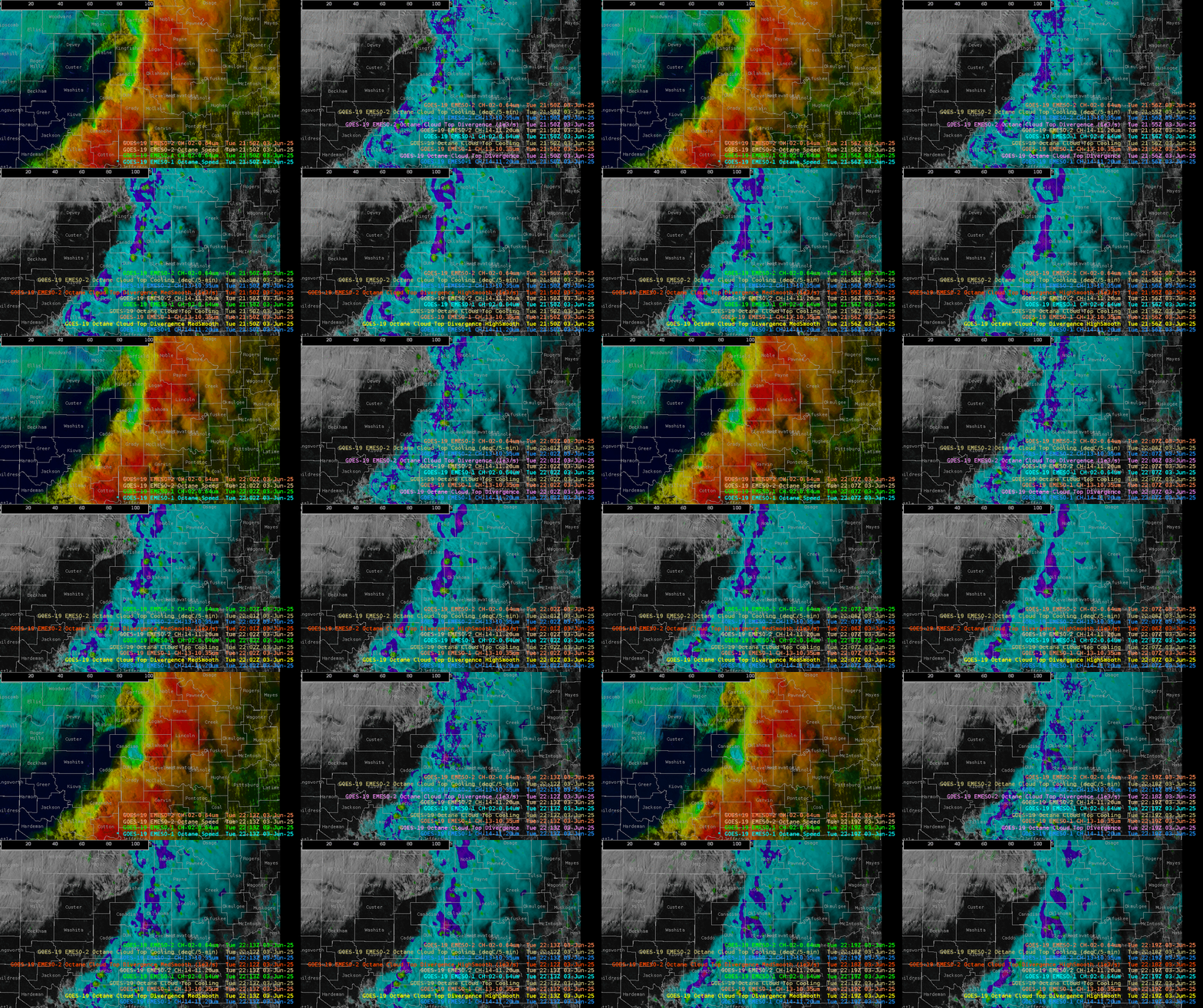
Similar to LightningCast, OCTANE was useful in determining which updrafts were trending towards severe. While in the mesoanalyst role, I would check to see which updrafts looked most intense (warmer colors paired with a very bubbly/convective appearance) and showed strong divergence. Radar analysis would then help us determine which individual cells to warn on, especially if the area of convection is multicellular and warning the entire thing isn’t ideal.
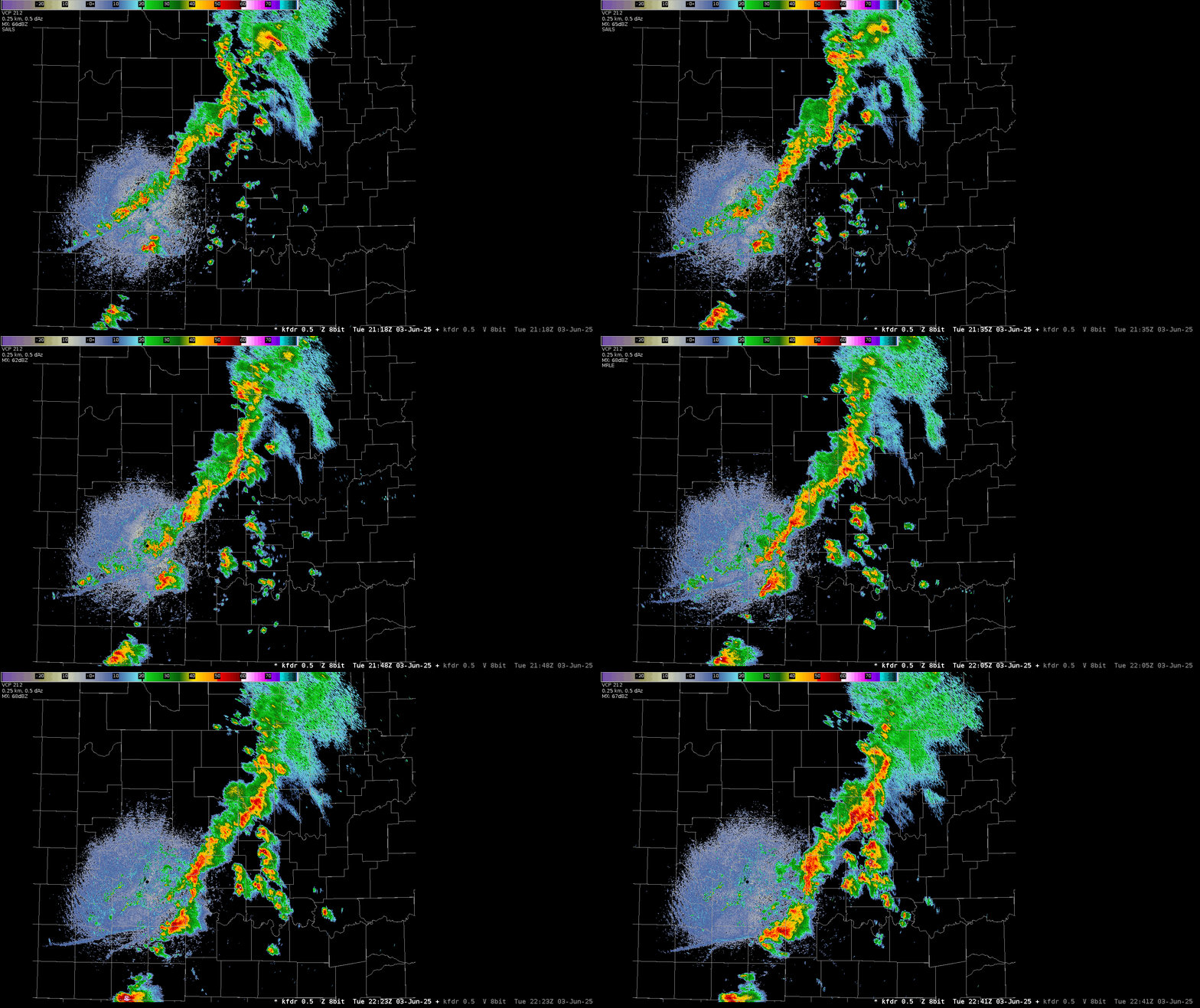
I didn’t use GREMLIN as much, since this area had good radar coverage. However, I did use it to keep tabs on its performance. The product seems to do well with picking out the strongest discrete/semi-discrete cells and potentially struggles with smaller/shallower storms and mergers.

Using these products, and working as a team with good communication, we were able to successfully warn a tornado in the Norman area along with various severe wind and hail.

– WxAnt
Tags: None

PUB LightningCast and GREMLIN Nowcasting

LightningCast

For this first day, I started out looking at Lightning Cast to gain familiarity with version 2 and see how it compares to version 1. The first thing I noticed was in southwest Pueblo County, where there seemed to be fairly frequent lightning. Version 1 in the top left panel (Figure 1 below) actually decreased in probability from 70% to 50%, whereas Version 2 in the top right panel remained at 70%. With both GLM and ENTLN depicting ongoing lightning, I think both versions should be showing higher probabilities. I’m wondering if it’s because both versions are so focused on the convection moving into southeast Pueblo County that they’re less focused on the stratiform lightning/less mature convection?

Figure 1: Four panel comparing LightningCast v1 (left panels) and LightningCast v2 (right panels)

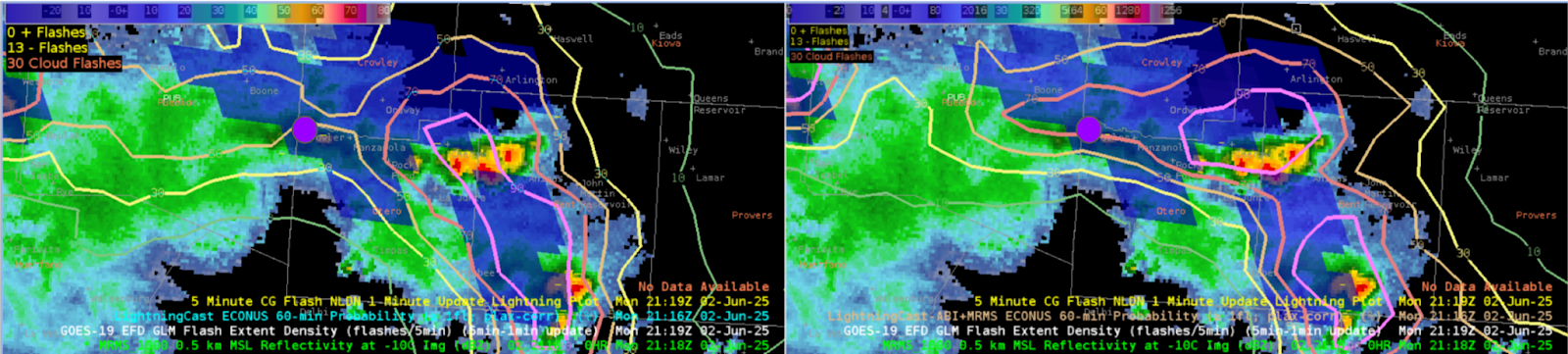
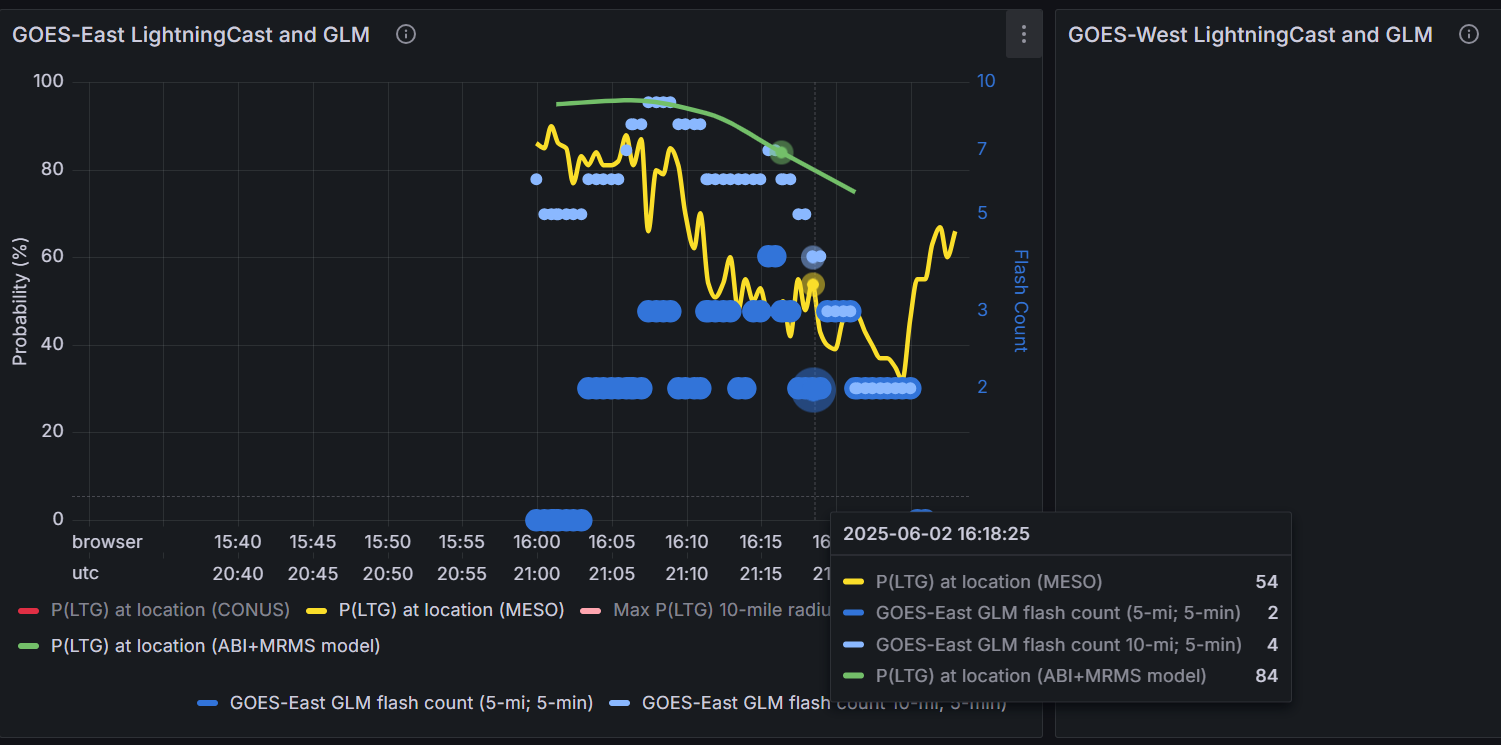
Additionally, I tested out using the LightningCast dashboard for Fowler, CO beginning at 3PM MDT. One interesting thing to note was that it seemed to match better with the version 2 LightningCast in AWIPS versus with version 1, however both versions weren’t too far off. In the Figure 2 below, the left panel (version 1) shows between 30-50% probability of lightning, whereas the right panel (version 2) shows Fowler (purple dot in the image)  right on the border of the 70% probability. Comparing that to the dashboard (Figure 3) for the same time, the yellow line (version 1) depicts a 54% probability, with the green line (version 2) showing an 84% probability for 21:18Z. With MRMS reflectivity at the -10C level showing a cell up to 42 dBz just southeast of Fowler, I would tend to lean towards utilizing version 2.

Figure 2: LightningCast v1 (left panel) and LightningCast v2 (right panel)

Figure 3: LightningCast Dashboard

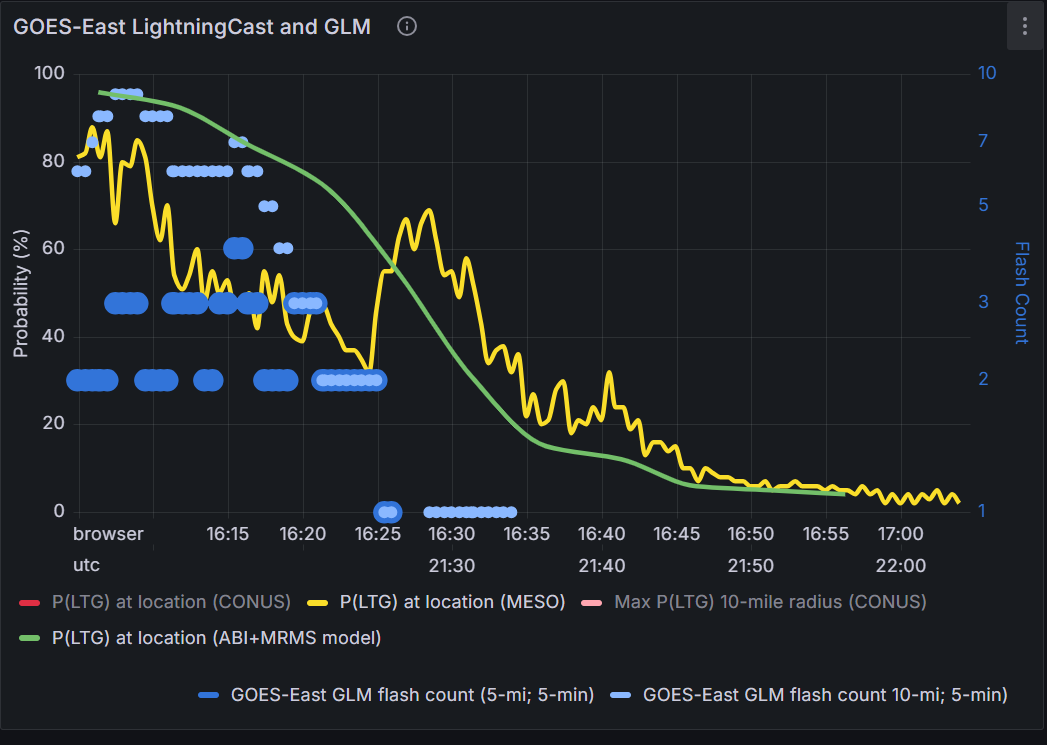
One final note on the LightningCast Dashboard – I thought it was interesting to see that version 1 in Figure 4 below, the yellow line (version 1) shows two separate upticks in lightning probability versus the green line (version 2) showing a steady decline in probability.

Figure 4: LightningCast Dashboard

GREMLIN

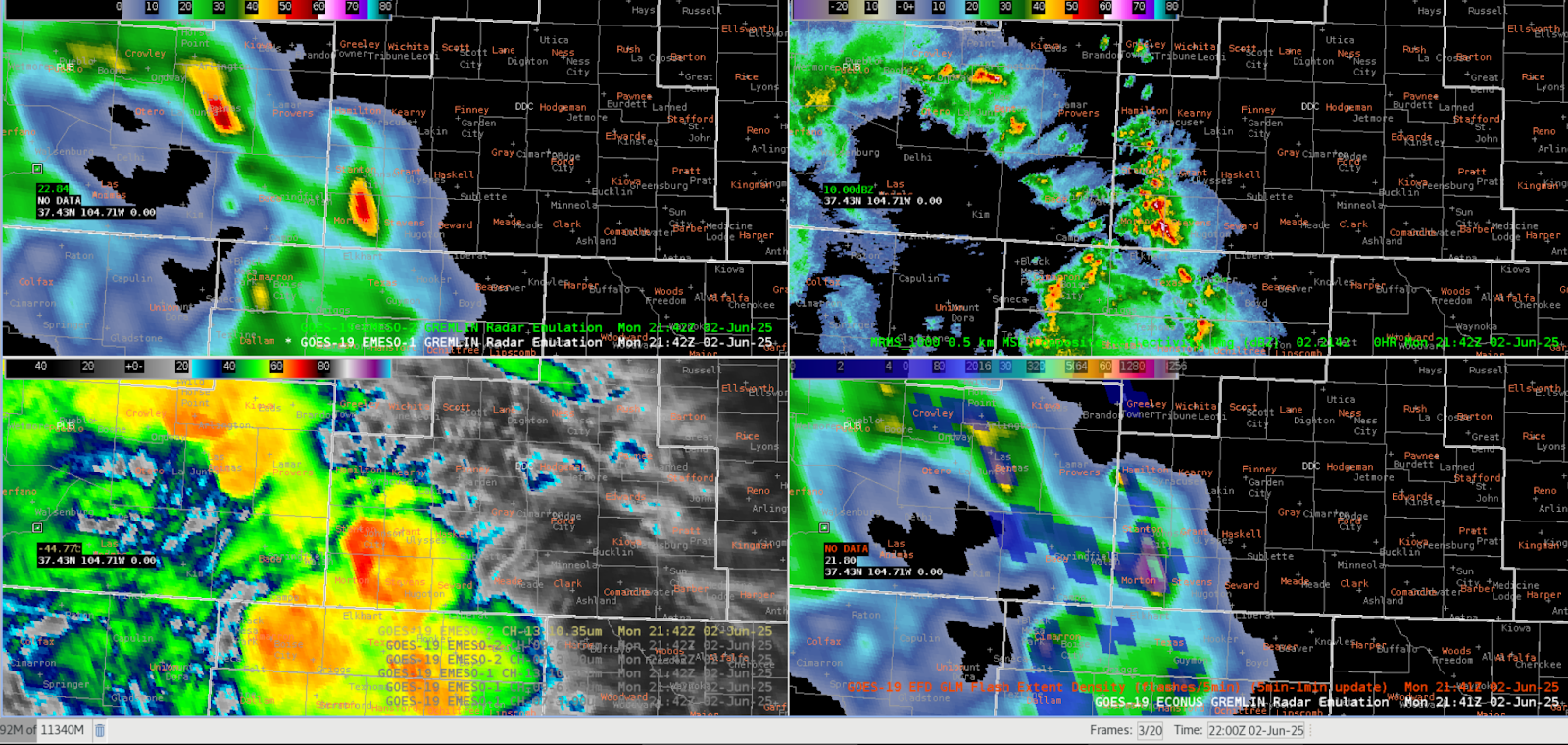
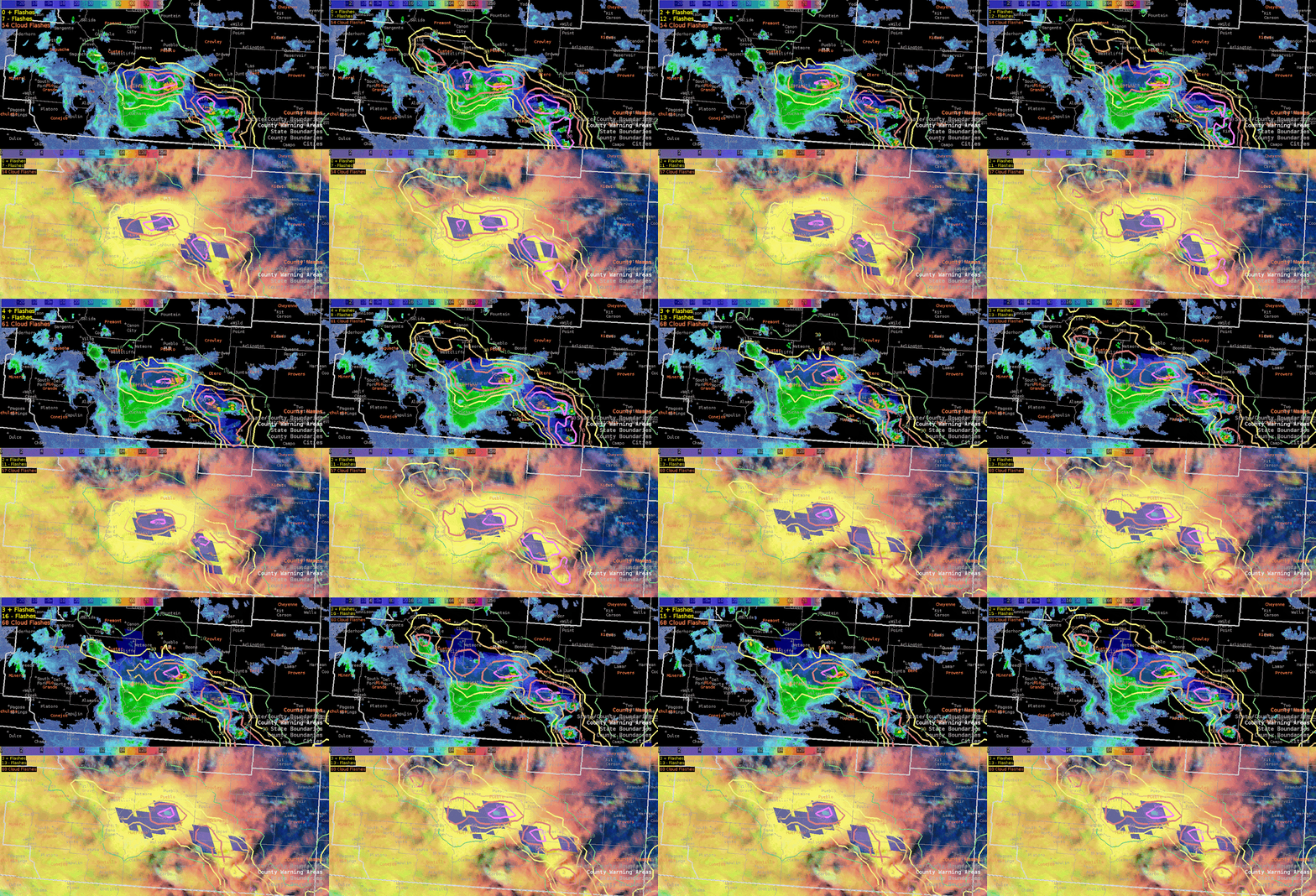
I was also able to look at GREMLIN, which was my first time assessing this product. Figure 5 below shows a four-panel, with GREMLIN (top left), MRMS Reflectivity (top right), Satellite IR sandwich (bottom left), and GLM Flash Extent Density (bottom right). Just looking at MRMS and IR, the first cell that draws my attention is the cell in southeast Pueblo County as it has higher reflectivities and cooler cloud tops. The cell in southern Otero county looks like the cloud tops are slightly warming with time. However once we start looking at GREMLIN, those two cells look to go back and forth in reflectivity, leading to less confidence in overall intensity. If I were located in an area with poor radar coverage, or if a radar was down and I had to rely on GREMLIN, it may not be straightforward as to which cell could eventually warrant a warning.

Figure 5: Four Panel comparing GREMLIN (top left), MRMS Reflectivity (top right), Satellite IR Sandwich (bottom left), and GLM (bottom right).

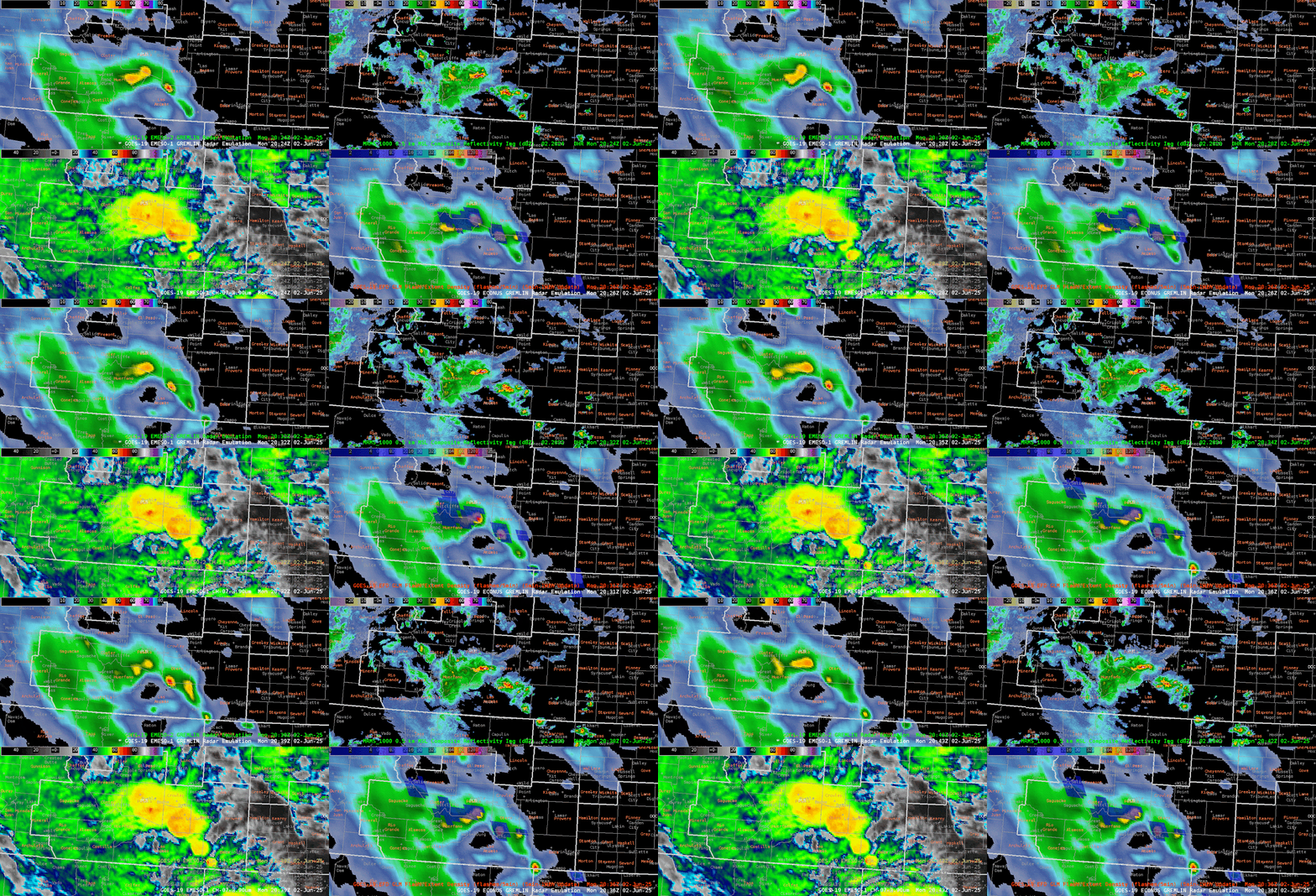
That being said, Figure 6 below shows a screenshot of the same four-panel at 21:41Z, which shows GREMLIN having a pretty good grasp on the convection in Stanton and Morton counties (just outside of the PUB CWA). So in this instance, confidence in the GREMLIN product would at least be higher than the previous example shown.

Figure 6: Four Panel comparing GREMLIN (top left), MRMS Reflectivity (top right), Satellite IR Sandwich (bottom left), and GLM (bottom right).

Final Thoughts for Day 1

Overall I enjoyed testing out both of these products. I definitely want to get more hands-on experience with GREMLIN as well as the LightningCast dashboard in order to see these in different scenarios/environments.

– Fropa

Tags: None

LightningCast for Convective Initiation and IDSS

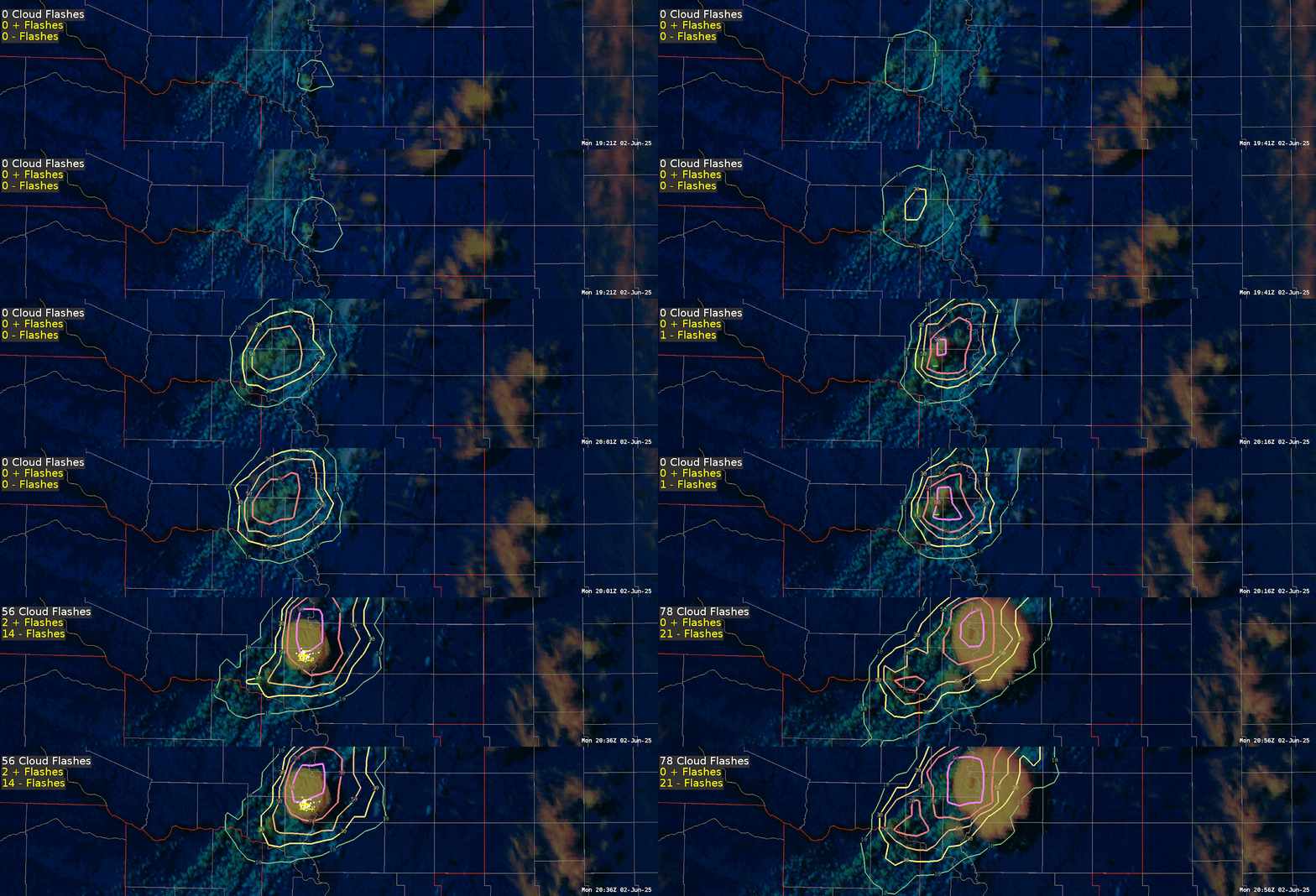
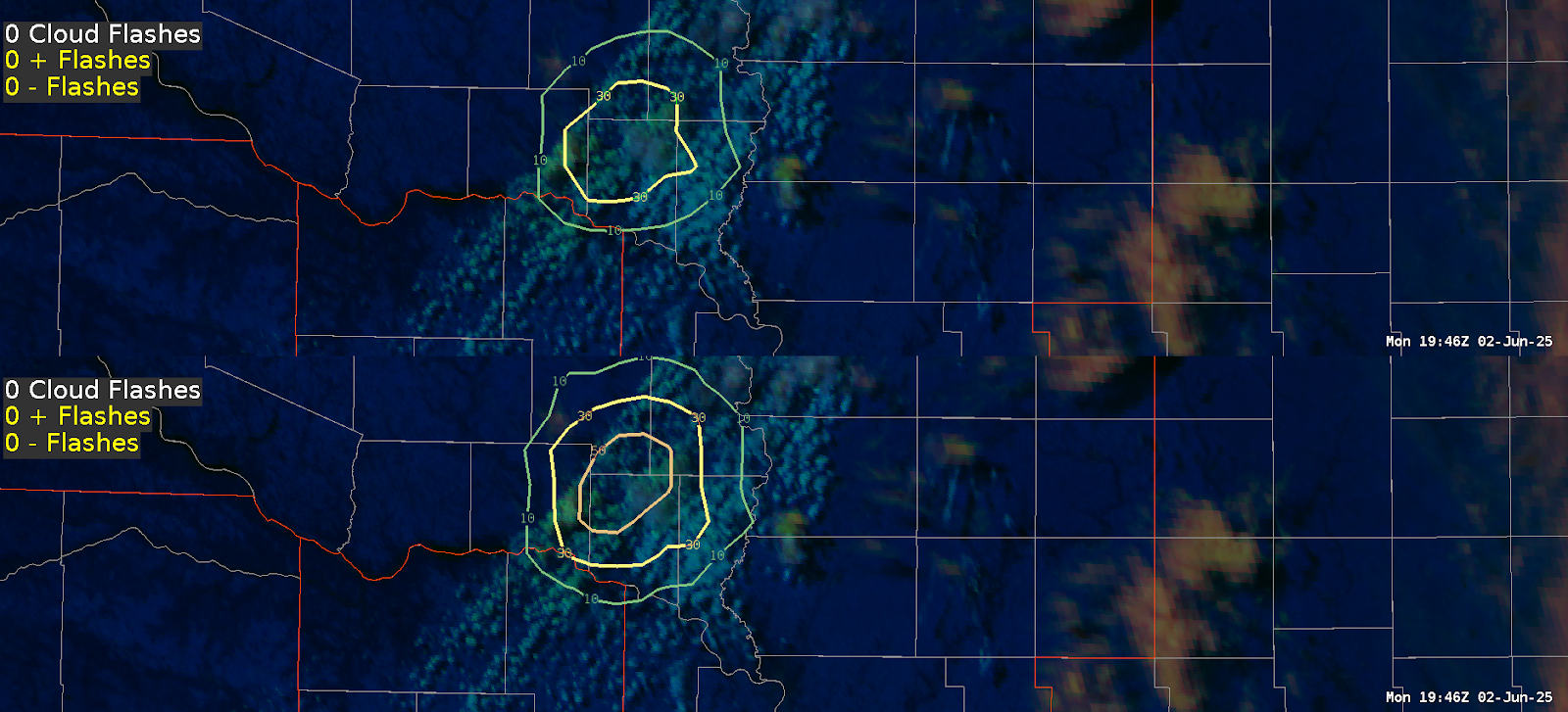
LightningCast V2 did a great job predicting lighting development with developing convection along a frontal boundary in northwest Iowa. It outperformed version 1, as shown by the loop and images below.

Animated GIF showing LightningCast V1 (top) and V2 (bottom) with the day cloud phase darkened to show detail. The ENI total lighting (yellow CTG flashes, white cloud flashes) is also displayed.

At 1946Z, V2 has a higher probability of lightning (50%) than V1 (30%).

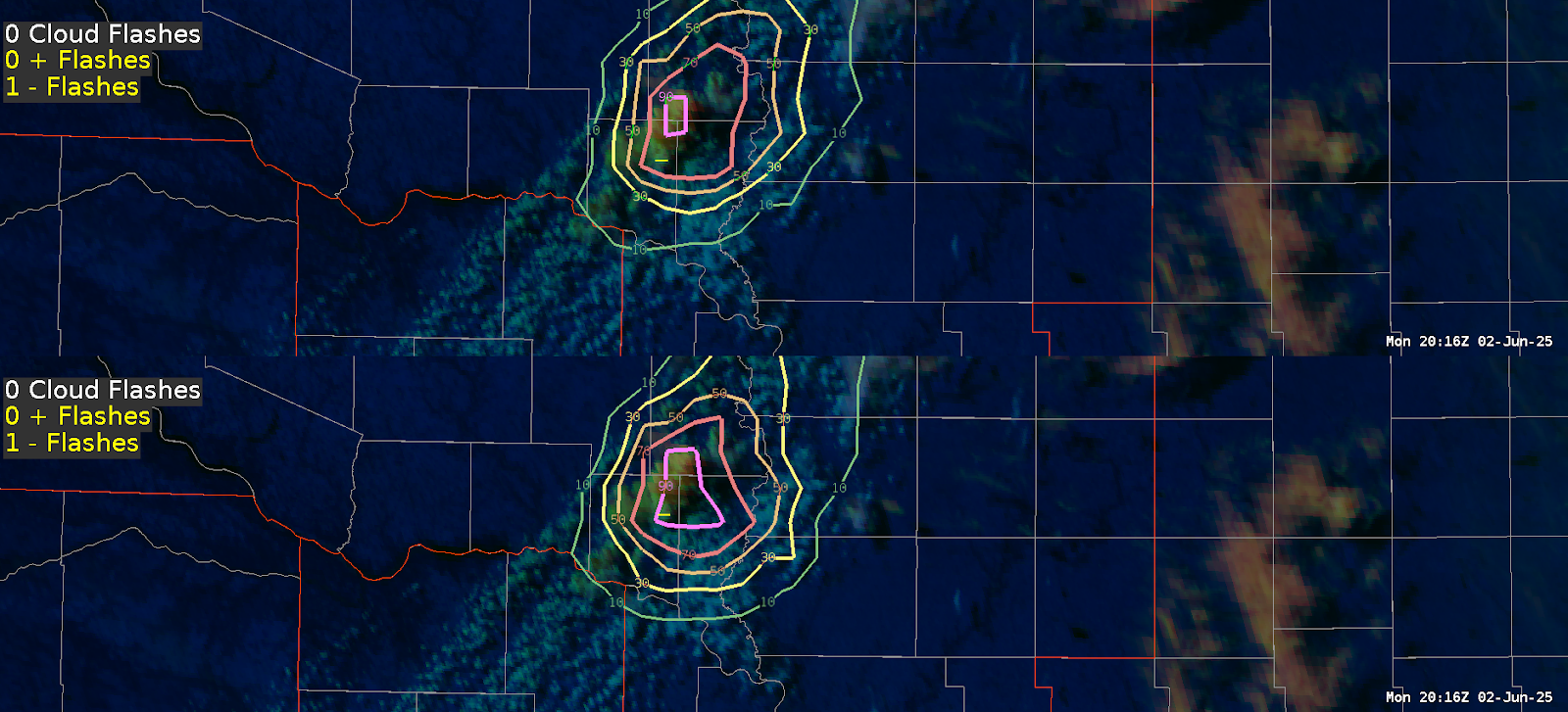
This trend continued throughout, and at 2016Z the first lighting strike was detected. That’s 30 minutes of lead time, which would be helpful for outdoor event IDSS.

LightningCast at 2016Z with initial cloud to ground strike shown in the yellow dash.

– Updraft

Tags: None

Cloud Top Cooling, Cloud Top Divergence, and MESH

After looking at the Cloud Top Cooling and Divergence, there was a case from MPX where a severe thunder warning was issued across southwest Minnesota. The cloud top divergence overlaid with visible satellite did a really nice job showing areas of deep convection (texture) with areas of divergence. This signal preceded the MESH severe hail by 5 to 10 minutes.

Animated GIF showing a 4-panel plow with visible satellite (channel 2) underlaid on all 4 images. The contrast between the cold and warm hues in the top left was one of the strongest seen of the day. The other 3 panels show cloud top divergence (CTD) with small smooth (top right), medium smooth (lower left) and high smooth (lower right). MESH greater than 1 inch is shown in the lower left as well using the default MESH color curve. Green is > 1 inch hail, an the occasional yellow pixels are >2 inch hail. The white text on the lower right is just a placeholder to mark areas of high CTD at the start of the loop.

Notice the area of high cloud top divergence at the start of the loop (red, center of panels). However, there is not a coarse texture of the clouds indicating a strong updraft. Later on in the loop, you’ll see that same red area overlaid with deep, coarse texture of rigorous updrafts on the southwest part of the storm. This is followed by MESH output of severe hail.

A SVR was issued at 2146Z, MESH shows 2” hail at 2152Z, and the satellite signature preceded both of those.

At 2145Z, 1 minute prior to severe TS warning issuance. There is a strong signal of cloud top divergence colocated with a rigorous updraft. The MESH (green, lower right) had a hail greater than an inch at this time.

At 2152Z, MESH (green, lower right) had a hail greater than 2 inches at this time.

At 2110Z, MESH indicated another small area of hail greater than 2 inches. There were two reports (green dots) of 1.25” hail with this storm near this time.

– Updraft

Tags: None

GREMLIN and Lightning Cast – Observational Notes and Feedback

SYNOPSIS – A broken line of thunderstorms lifted north through SE Colorado in a weakly sheared, high LCL environment with modest instability (1000-2000j/kg MUCAPE) and high DCAPE (1000+ j/kg). This environment appears to favor pulse severe potential, with primarily a gusty/damaging wind risk.

OPERATIONAL NOTES AND FEEDBACK – Using GREMLIN and Lightning Cast Together

I used a 4-panel to compare GREMLIN, satellite, radar, MRMS, and LTG Cast data. I’ve not typically used LTG Cast to nowcast the severity of convection, but when combined with GREMLIN, it kind of reminds me of looking for signals in model data. For the most sustained convection, for example, GREMLIN had a fairly consistent signal of 40-50dBZ echoes in tandem with consistently high LTG probabilities. In the past, I’ve typically just focused on GLM lightning data on its own separate from LTG probs. Overlaying LTG Cast probs with GLM data seems to provide a more uniform / smoothed view of the evolution of lightning within convection as opposed to using GLM on its own. GLM can be jumpy at times, which can give the impression that a thunderstorm is weakening. However, if LTG cast probabilities remain high, it may give the forecaster more confidence that a thunderstorm is not weakening. This seemed to be the case with multiple different thunderstorms in SE CO today.

OPERATIONAL NOTES AND FEEDBACK – GREMLIN

It was interesting to note how closely the increase and decrease in GREMLIN reflectivity was tied to the increase and decrease in lightning. The developers noted that this is to be expected. Since GLM data can sometimes be jumpy, and isn’t always reflective of the severity of a storm at a given moment in time, it might be interesting to see if there is a way to offset this. Perhaps there is some way to mesh GLM data with Lightning Cast data (reference the notes in the observation section about nowcasting convective strengths) or through some other means (longer averaging time, etc.). When GLM data isn’t jumpy, GREMLIN seemed to compare very nicely with MRMS. But, when GLM data was jumpy, GREMLIN seemed to struggle some, showing more rapid increases and decreases in reflectivity that what MRMS showed. As an alternative, I could see where simply overlaying LightningCast data on top of GREMLIN data could provide a more “smoothed” and uniform trend in convection over time, in a way that could still provide useful information for warning decisions.

From an operations standpoint, GREMLIN seemed to provide a great overview of convective evolution, especially when overlaid with LightningCast data. It’s possible this could translate to warning decisions, but this initial runthrough with the product suggests its biggest advantage may be nowcasting the general evolution of convection as opposed to making specific warning decisions. Admittedly this is my first use of the product, and I’m looking forward to trying it in future days of the HWT to see if anything different stands out.

– NW Flow

Tags: None

Day 1 – Analyzing GREMLIN

GREMLIN

An area of showers and thunderstorms formed across southern Colorado this afternoon. A dryline was just to the east and coincided with a gradient of mixed-layer instability. Thunderstorms developed along an arc from Pueblo county to Baca county and slowly moved north-northeastward before weakening in the late afternoon hours. The Clean IR-CH13 band depicted a strengthening storm to the west while warming cloud tops were occurring over Otero county. GREMLIN picked up the deepening convection while quickly weakening convection to the east.

-Eagle

Tags: None

Cloud Top Cooling and Lightning

This was a case from MPX that showed two areas of intense cloud top cooling that corresponded to lightning jumps. Overall this is more of an observational post than a clear example of how OCTANE could be used for decision making.

Animated GIF showing two distinct areas of cloud top cooling (red, midway through the loop)

Animated GIF zoomed in on the area of interest, with ENL lightning overlaid. The cloud top cooling lines up well, and slightly precedes, the electrification of the developing cumulonimbus.

– Updraft

Tags: None

DSS LightningCast Dashboard

GOES-East LightningCast for DSS event in CYS CWA


GOES-West LightningCast for same DSS event in CYS CWA over same time period

When using the DSS event/stadium GLM dashboard on the web, with an event that is located in the CYS CWA in the mid-CONUS, there was a significant difference in the probability of lightning from GOES-West compared to GOES-East. The GOES-West data was ultimately better and more reflective of actual lightning trends in that area, despite GOES-East  having two mesosectors located over the point in question.

Top panel, LightningCast version 1. Bottom panel, LightningCast version 2.

Meanwhile, in a different area (BOU), comparing LightningCast v1 to v2, it appears that v1 does better in areas with poor radar coverage, while v2 does better in areas with better radar coverage.  In the image above, version 1 has a better handle on the isolated first GLM pixel (50%) than version 2 (10%). Meanwhile, the more robust lightning area is more accurately represented on version 2 (which happens to have better radar coverage) compared to version 1.

– prob30

Tags: None