


SYNOPSIS – Scattered to numerous thunderstorms developed along a frontal boundary as it moved south into KS/OK/TX. These thunderstorms developed in a strong instability (3000+ j/kg MLCAPE) and modest shear (20-30kt effective, ~100 m2/s2 0-1km SRH) environment.
OPERATIONAL NOTES AND FEEDBACK – Using OCTANE to nowcast convective intensity and improve mesoanalysis situational awareness
Today’s event seemed to highlight a significant advantage of using OCTANE products to keep situationally aware during scenarios where there is a lot of convection. Oftentimes, radar can get incredibly messy when numerous thunderstorms are present, making it challenging to know which thunderstorms to focus messaging and warnings on. OCTANE products made this less challenging, by highlighting the thunderstorms with the strongest updrafts and/or most persistent updrafts. This combined with GLM lightning density provided valuable information for warning forecasters to decide which thunderstorms were the best candidates for warnings, and which ones to hold off on. Situational awareness (SA) can be quickly lost in events like these, and it is crucial to have a way to keep good SA. OCTANE provided an important tool in this endeavor.
The image below is one such example, showing two separate areas of convection over the WFO Norman (OUN) CWA (outlined in orange). In west-central OK, the OCTANE Cloud top Cooling/Divergence product shows notable updrafts with a persistent signal for notable storm top divergence, suggesting an increased risk for severe thunderstorms. Meanwhile, the thunderstorm activity to the east, in central OK, seemed to have more of a transient signal for strong cloud top divergence, with a somewhat less persistent signal. This suggested that the central OK convection would favor more of a pulse-type of severe weather setup, which informed future warning decisions (in my experience, pulse environments are often handled differently than environments that support long-lived / long-swaths of severe weather).
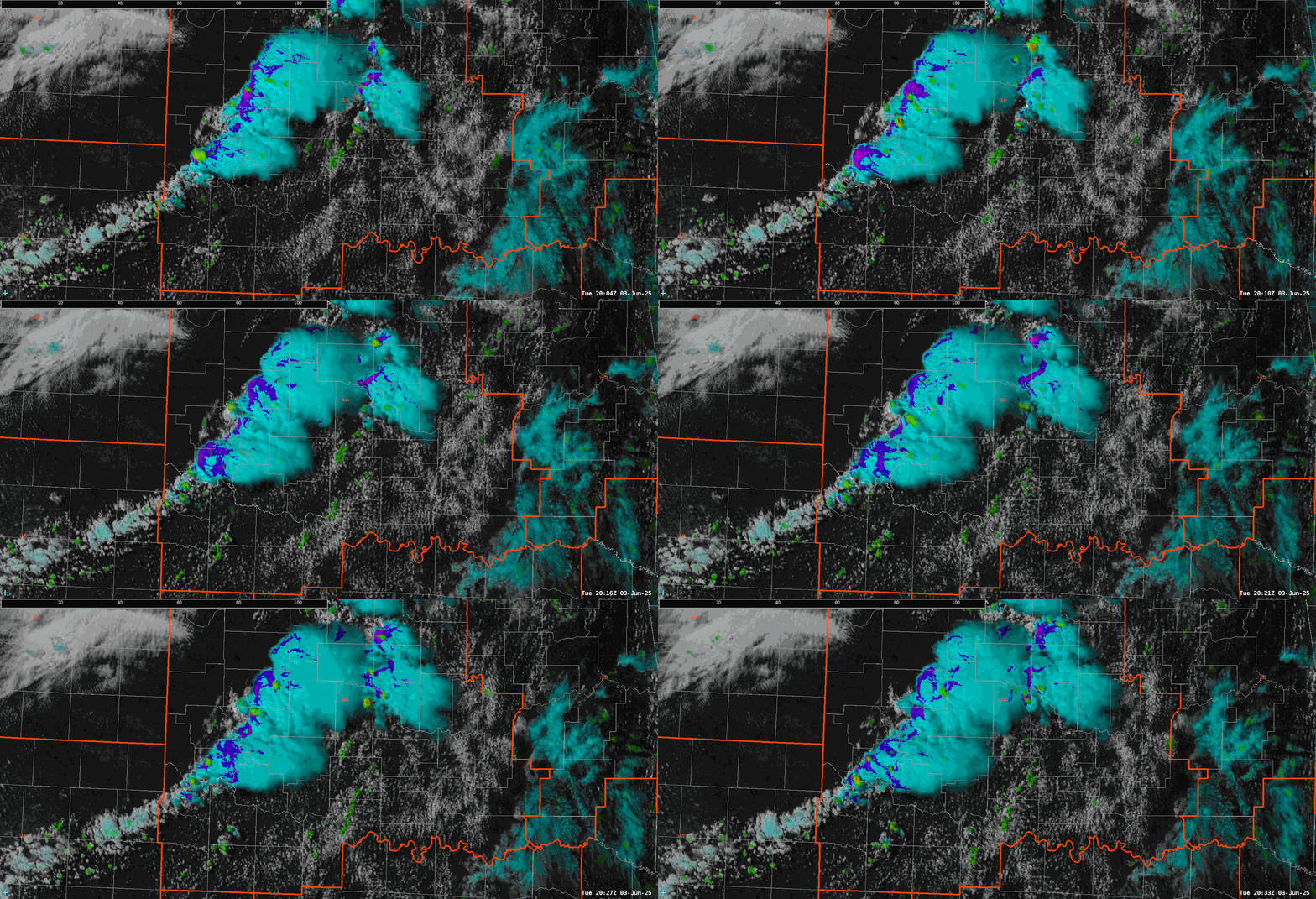
Additionally, the cumulus fields with green shading in the image above gave forecasters a heads up for which areas were seeing the most vertical development (ie. towering cumulus), which also was a tip-off for which areas may see new convective initiation.
While not shown, there was also a notable updraft that developed on a severe-warned thunderstorm west of Norman, OK. The OCTANE products nicely depicted this updraft as being more prominent than surrounding updrafts, and this particular thunderstorm went on to produce a tornado a short time later. This thunderstorm was embedded within a larger line of thunderstorms, which sometimes makes it less prominent when compared to radar interpretation, alone.
Probably the biggest takeaway here is that this one image provides a very quick overview of where convection may initiate, where convection is the strongest, what mode the convection is taking on, and where the biggest target of opportunity is for warnings and IDSS.
It’s recommended that satellite interpretation continue to be an important part of the mesoanalysis role of NWS operations, and OCTANE products appear to more quickly mesh what forecasters often look for in visible and IR products separately. This more efficient overview could save the mesoanalyst valuable time in assessing thunderstorm trends, providing quicker insight to warning and DSS forecasters.
– NW Flow