


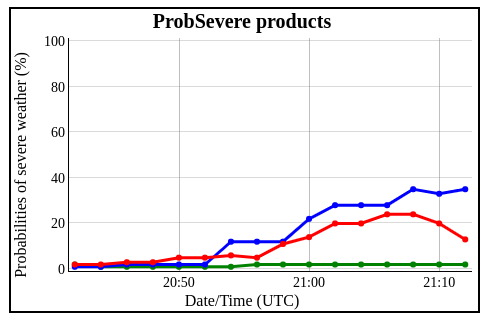
ProbSVR time series graphs with the online version continues to be one of my favorite for tracking trends. Uncertain how to display this cleanly in AWIPS II? – Jake Johnson
Official websites use .gov
A
.gov website belongs to an official government
organization in the United States.
Secure .gov websites use HTTPS
A
lock (
) or https:// means you’ve safely connected to
the .gov website. Share sensitive information only on official,
secure websites.

ProbSVR time series graphs with the online version continues to be one of my favorite for tracking trends. Uncertain how to display this cleanly in AWIPS II? – Jake Johnson
ProbTor jumped from 37% to 74% over an 8 min period with the circulation over SW MO as a TDS became evident and a tornado was reported.
–SCoulomb
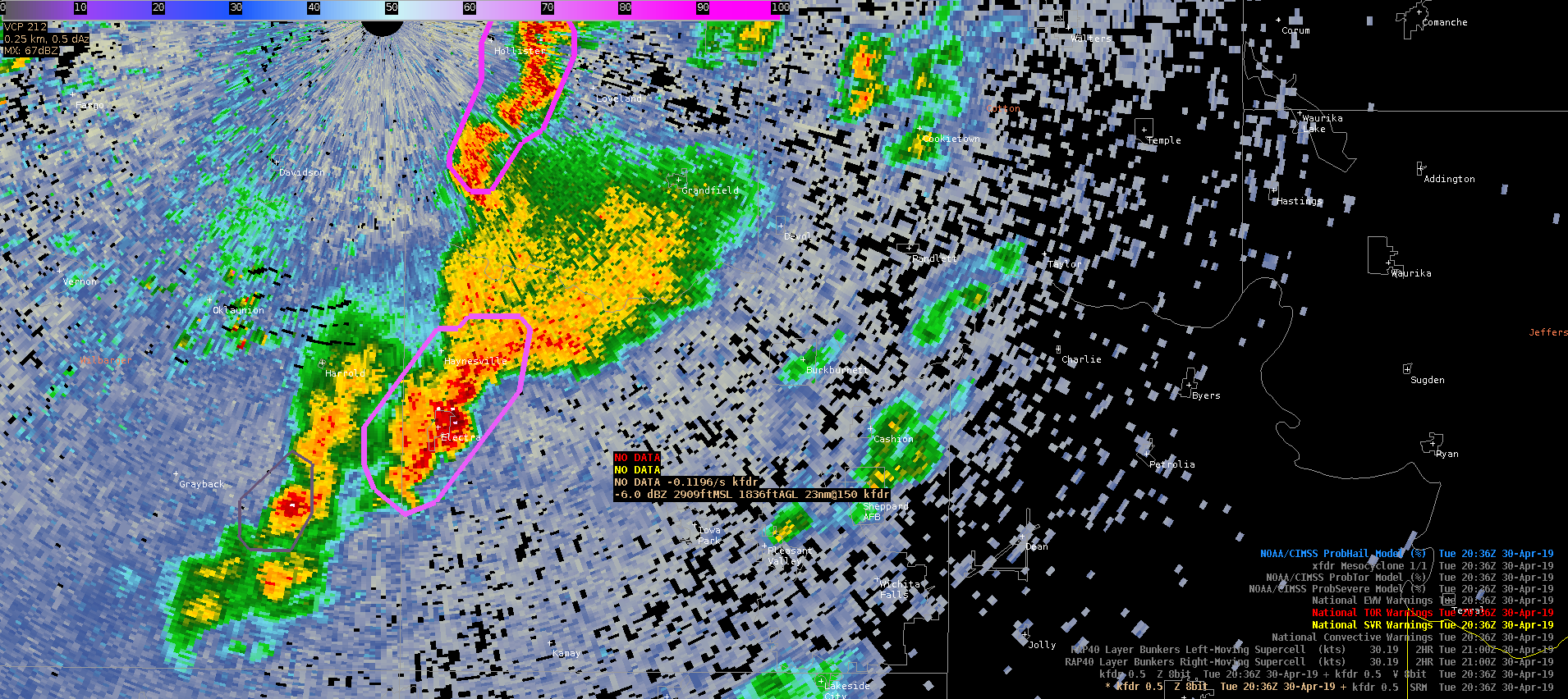
At 336pm CDT, a supercell storm near Electra, TX produced golf ball sized hail despite MRMS MESH showing sub-severe hail (~0.85″). Despite the low MESH, ProbSevere hail was progged at 75%. KFDR data had 50+ dBZ above 34K feet MSL and the storm was highly tilted downshear (a known limitation of MESH – underestimates in this case). This storm highlights the need to couple MESH/ProbSevere products with a thorough analysis of the base radar data and a fundamental understanding of strengths and limitations of supplementary datasets.
–Stanley Cupp
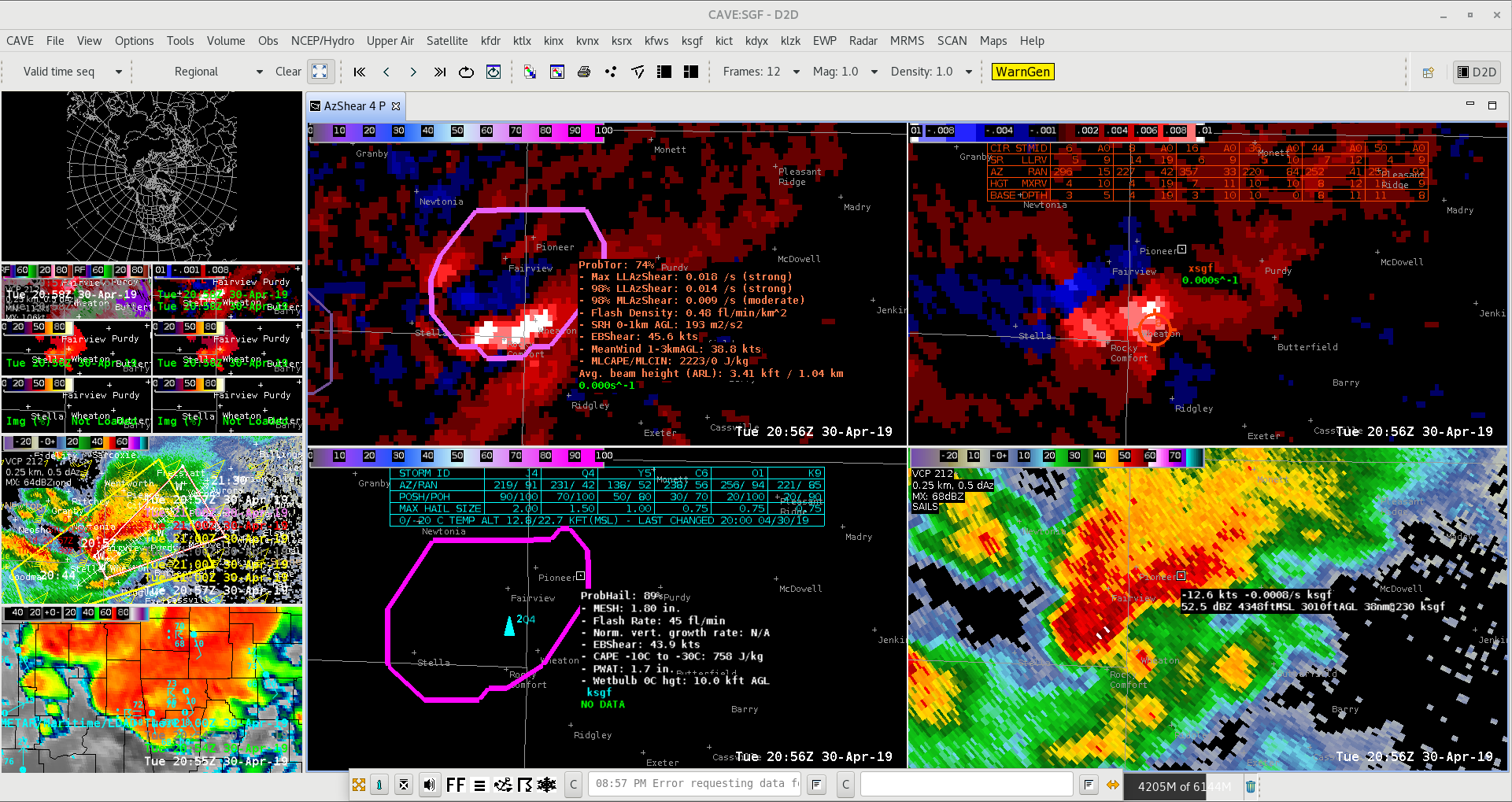
AzShear increased ahead of an approaching tornadic storm. At the same time the CPTI product also indicated an enhanced probability in the same area. Velocity data in the lowest few tilts became suspicious along the radials ahead of the storm as PRFs struggled to improve range folding.
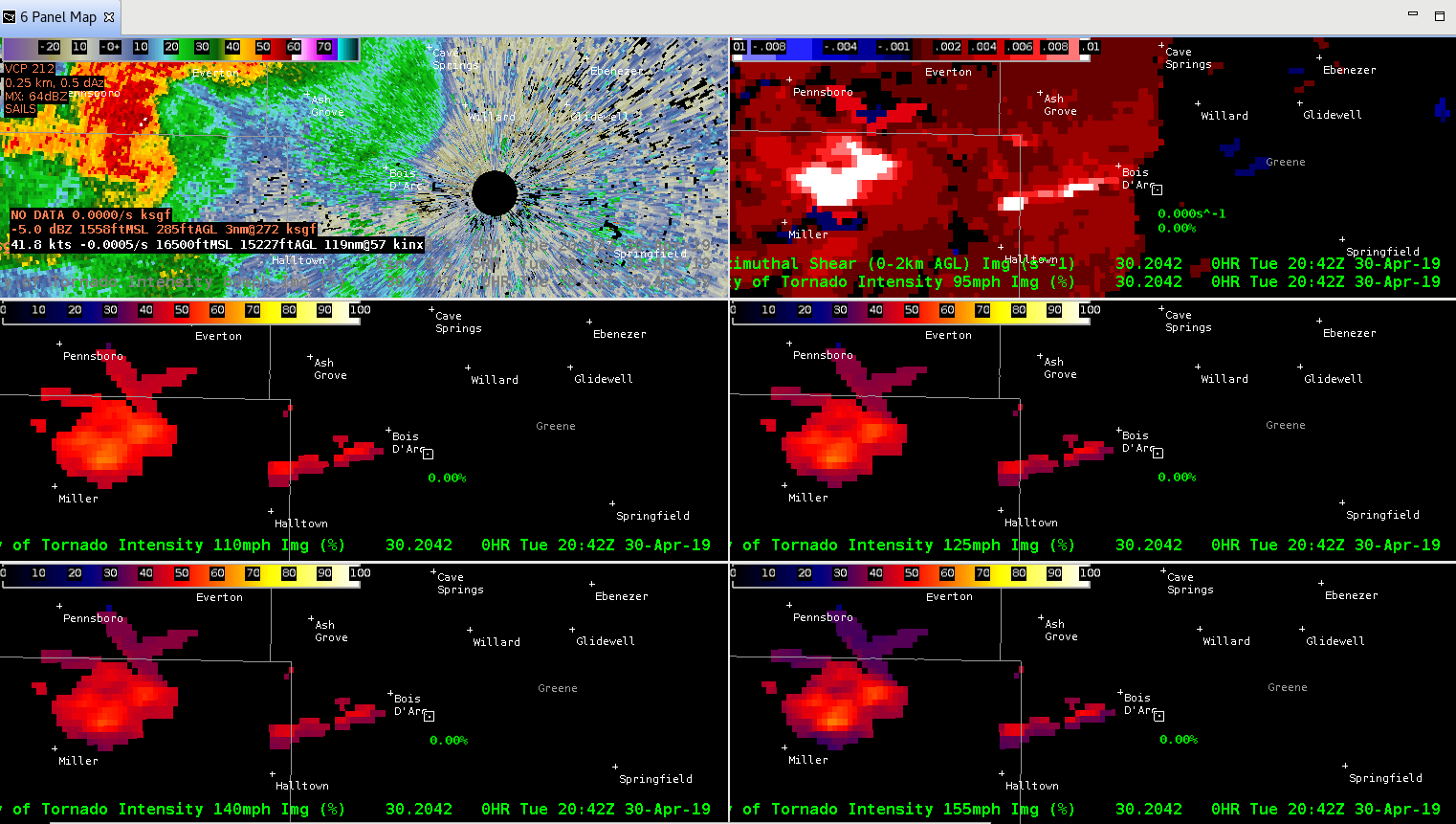
— SCoulomb
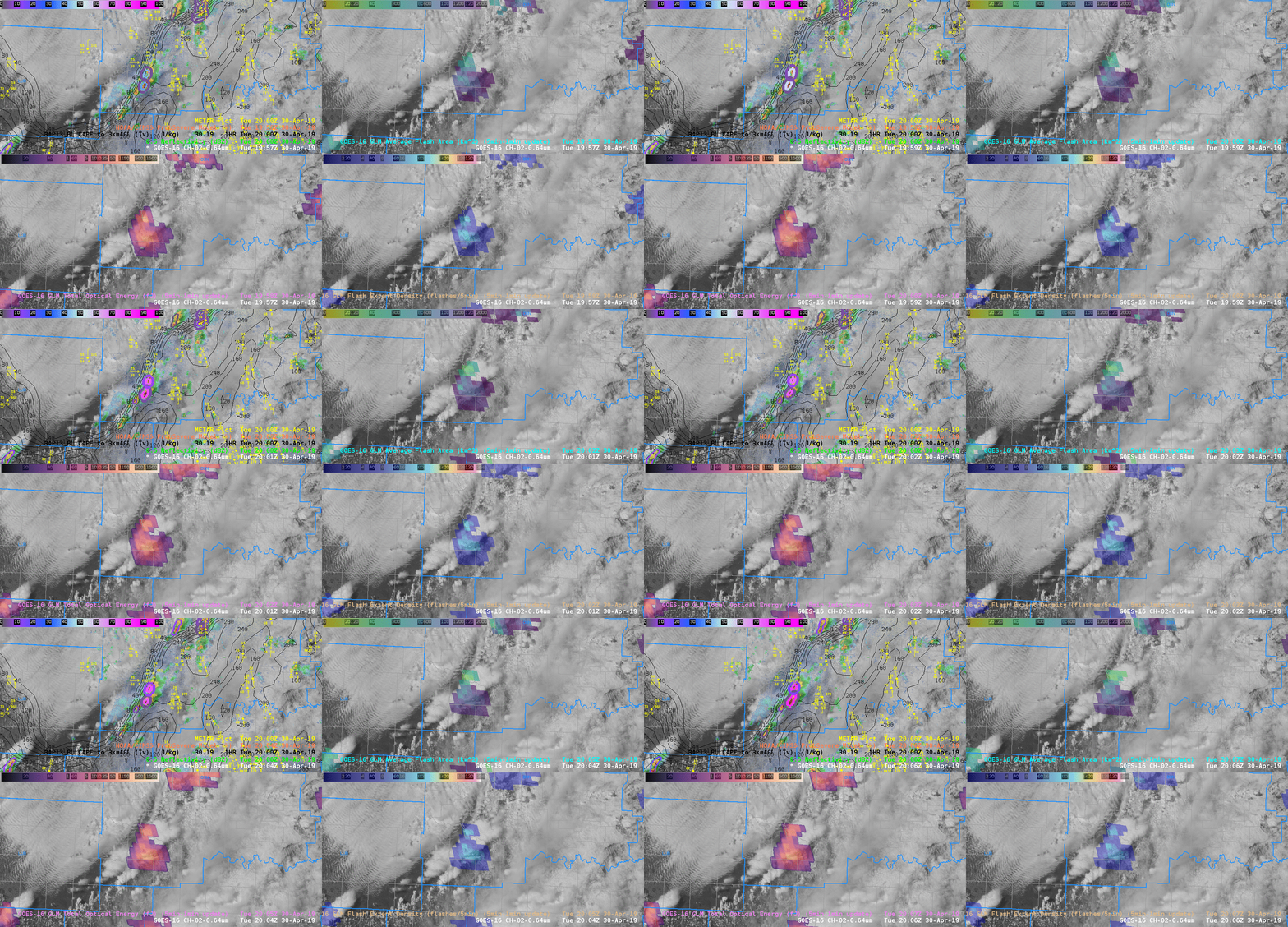
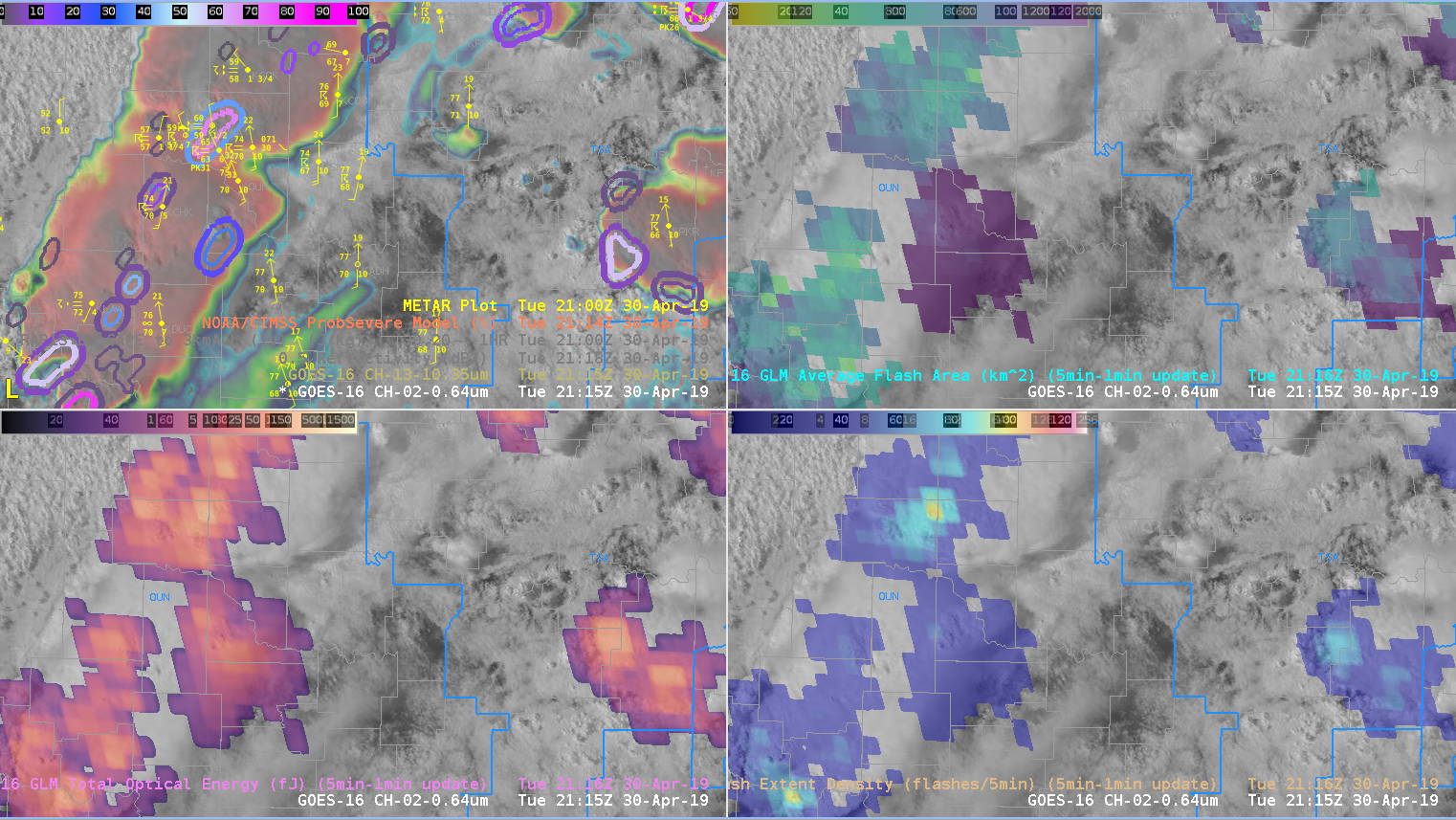
Two supercells developed in far southwest Oklahoma along 0-3km CAPE gradient. At 1957Z ProbSVR Hail 10% Wind 39% Tor 3%, then 6 minutes later at 2003Z ProbSRV Hail 63% Wind 75% Tor 5% on the southern storm. GLM Total Optical Energy in lower left image performed well with the increase in lightning activity for both supercells. -Jake Johnson
Here’s a look at some attempts to use the CPTI for storm carrying a theoretical tornado warning. I have a fair number of thoughts on the product. In terms of a primary application. I think it would be best suited to the first update/continuation on a tornado warning. Basically allowing you to chose what types of language to use…if the CPTI is picking up on a very high intensity circulation than you are going to want to ramp up the intensity of the wording within a warning. This could be used to communicate how dangerous a storm is. Especially since the damage associated with a 80mph circulation will be drastically different from a 170+ mph circulation.
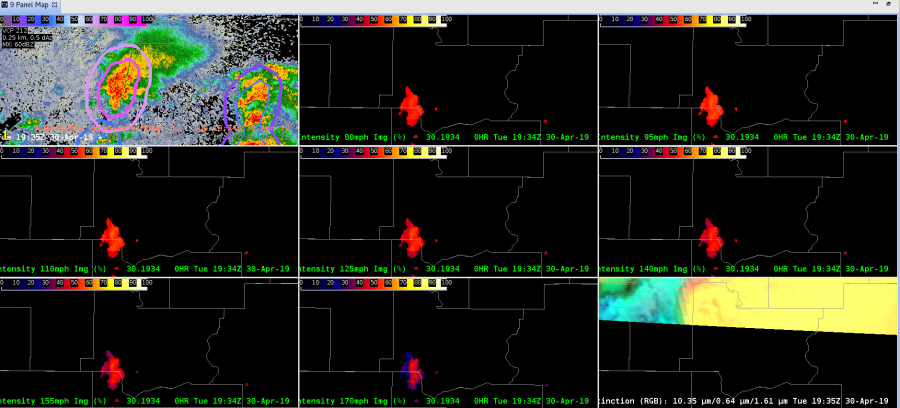
Now for areas that I would improve/and or change. The CPTI might be better off using a category scale/range of values. Intuitively, I would expect probabilities to increase if the storm is more intense. I.E. if the circulation is 155mph then I might expect the 80mph CPTI to be close to say 80% while the 155 mph CPTI is something like 50%. If the tornado intensifies maybe the 80mph CPTI would increase to something like 95% while the 155 mph CPTI increases to a value such as 75%. Currently, there are a lot of very similar values as the image below shows 80, 95, 110, and 125 mph all have pretty much the same value within 3% of one another. I would want there to be a much larger variance in these values, so that I could easily gauge , how intense the tornado is. I think CPTI has a great potential, but I would change it so that it was more of an probability of exceedence scale and could be used as a quick product to determine intensity wording in products.
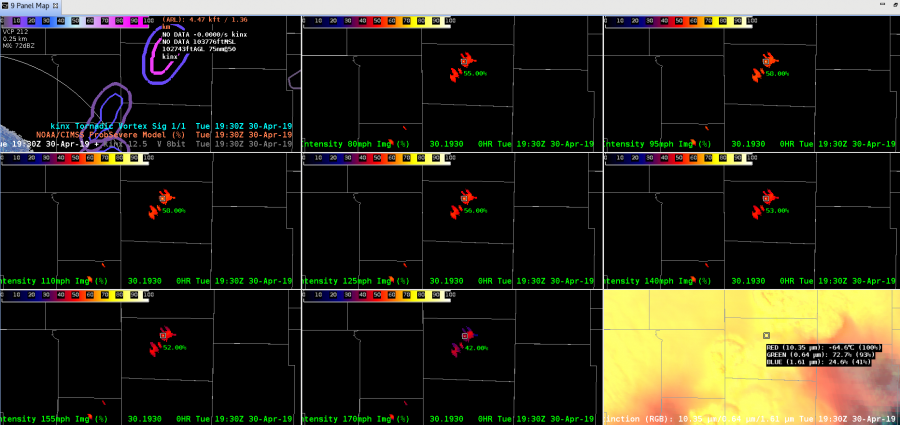
South Beach
ProbHail on the storm in southwest MO seemed to be too low based on other derived parameters (MESH/Hail Index) and storm structure. ProbHail was consistently 70-75%. It was explained that the hail cape (~750 J/kg), the EBShear (47kt) and lightning (29 flash/min) were relatively lower than one would expect given the environment. Justin showed the parameter space for each of the ingredients and how they were weighting down the overall ProbHail due to the ratios being <1.
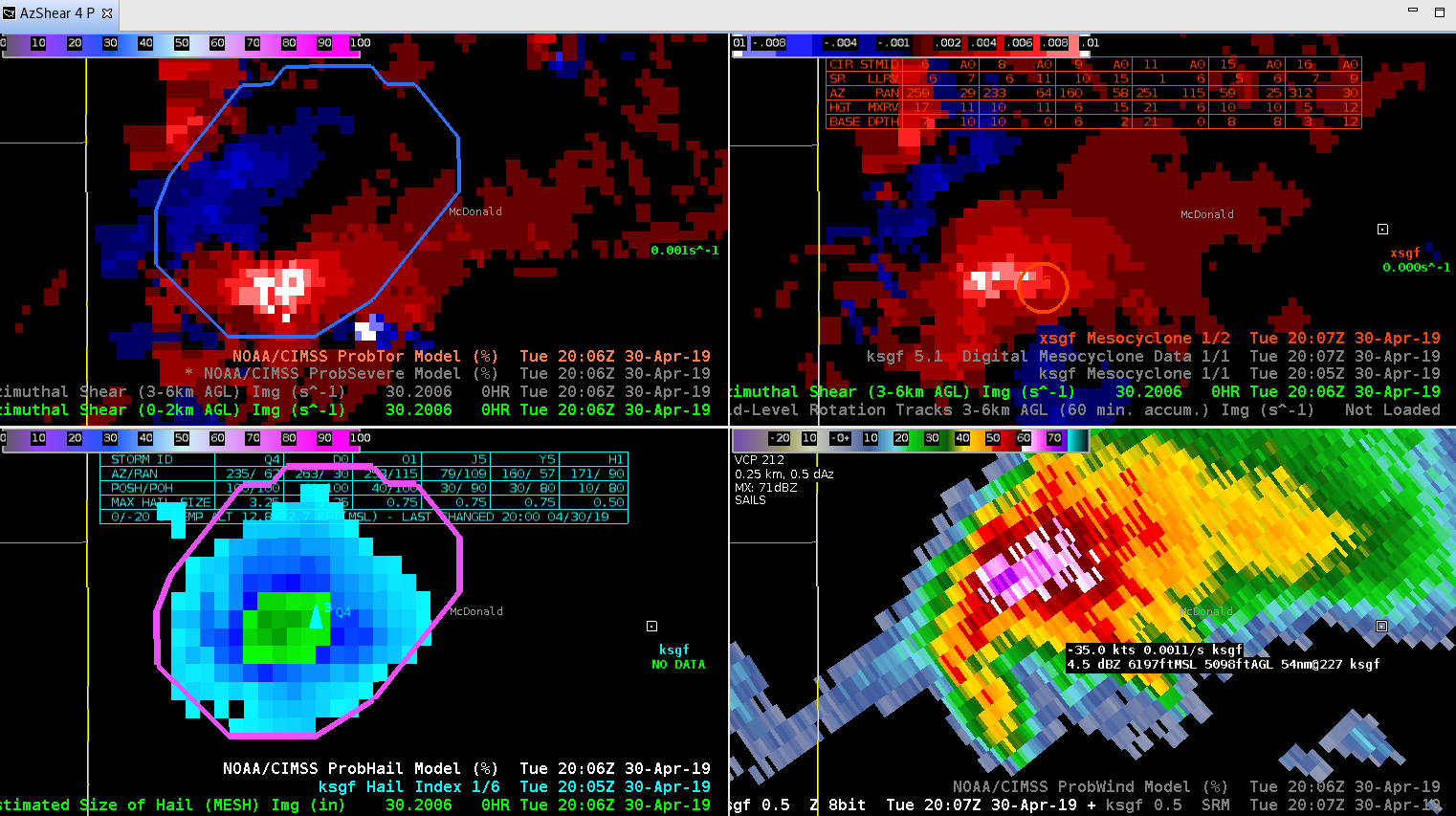
— SCoulomb
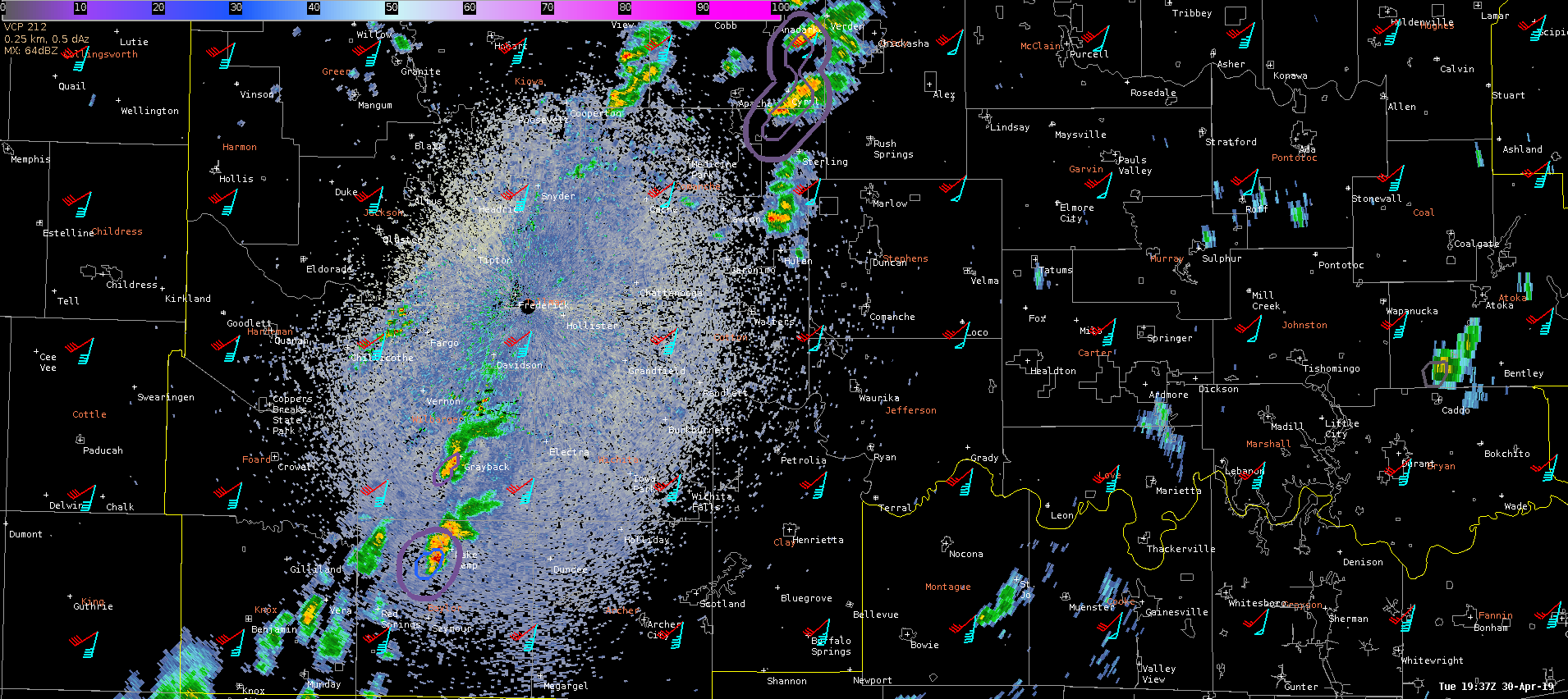
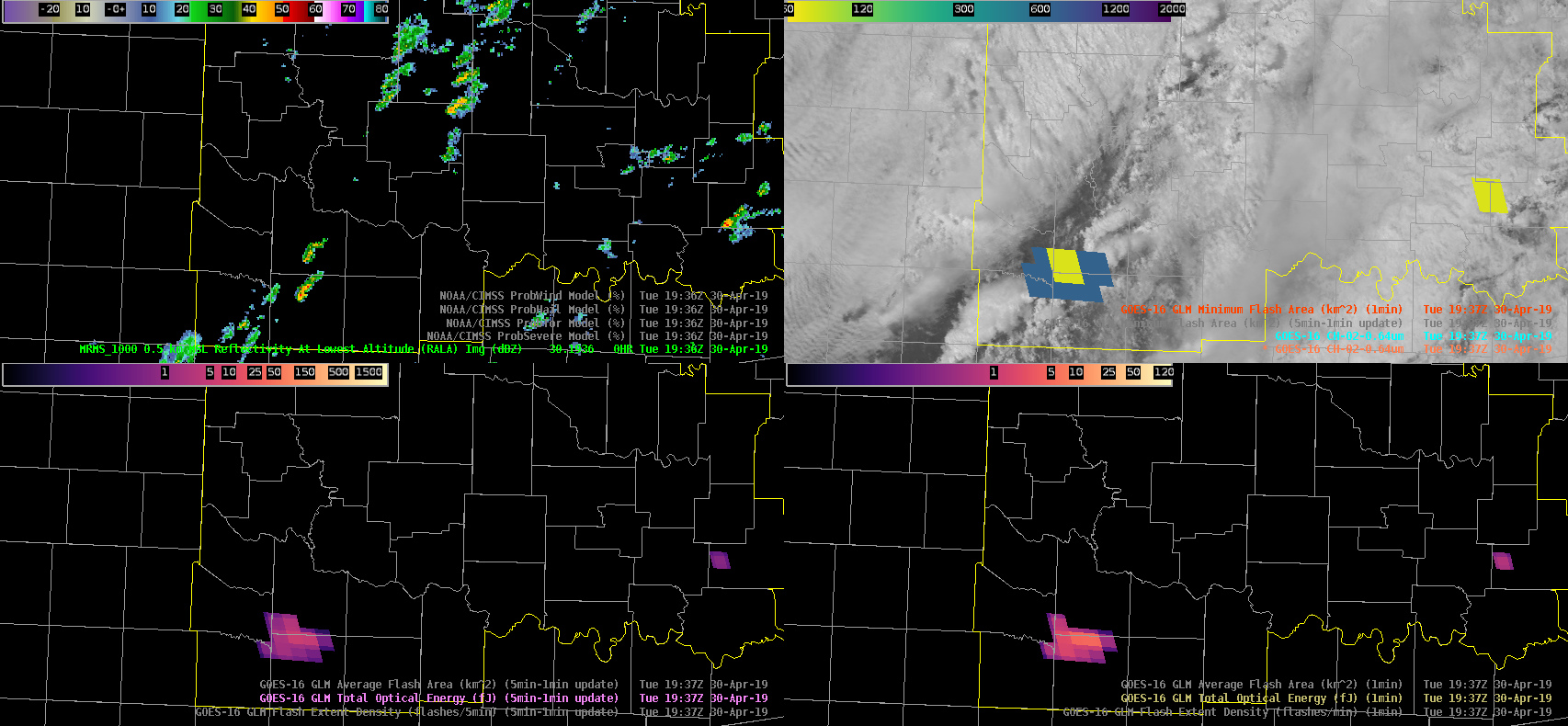
Beginning to see CI in the southwest portion of OUN’s CWA. ProbSevere has progged a 3-4% tornado probability for two areas: the SW storm and a few weaker/young storms in the central CWA. GLM minimum flash area along with total optical energy clearly indicate that the SW storm is the most promising of the two with more persistent updraft(s). Subsequently, 0-2km merged AzShear has perked up with the storm in the southwestern portion of the CWA. Given the storm’s favorable environment (ample 0-3km CAPE, bulk shear, and SRH), this storm warrants watching. Based upon the combination of GLM data, ProbSevere/AzShear, and 1 minute satellite imagery, a forecaster can quickly hone in on the most pressing storms at the moment.
–Stanley Cupp
1937z KFDR base reflectivity with ProbSevere overlays (double contour –> tornado prob progged)
Top left: MRMS RALA; Top right: visibile sat plus 1 minute minimum flash area; Bottom left: 5 minute total optical energy w/ 1 minute updates; Bottom right: 1 minute total optical energy
0-2km merged AzShear
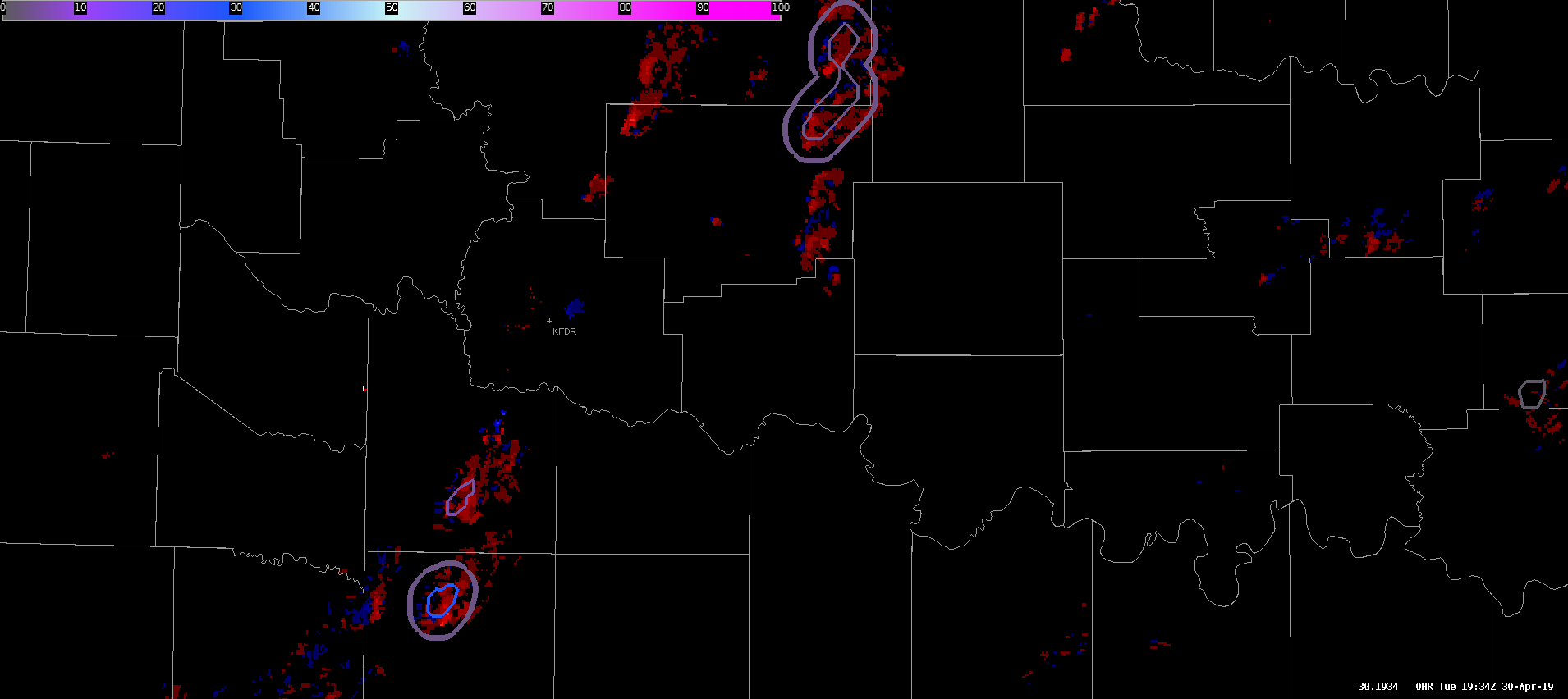
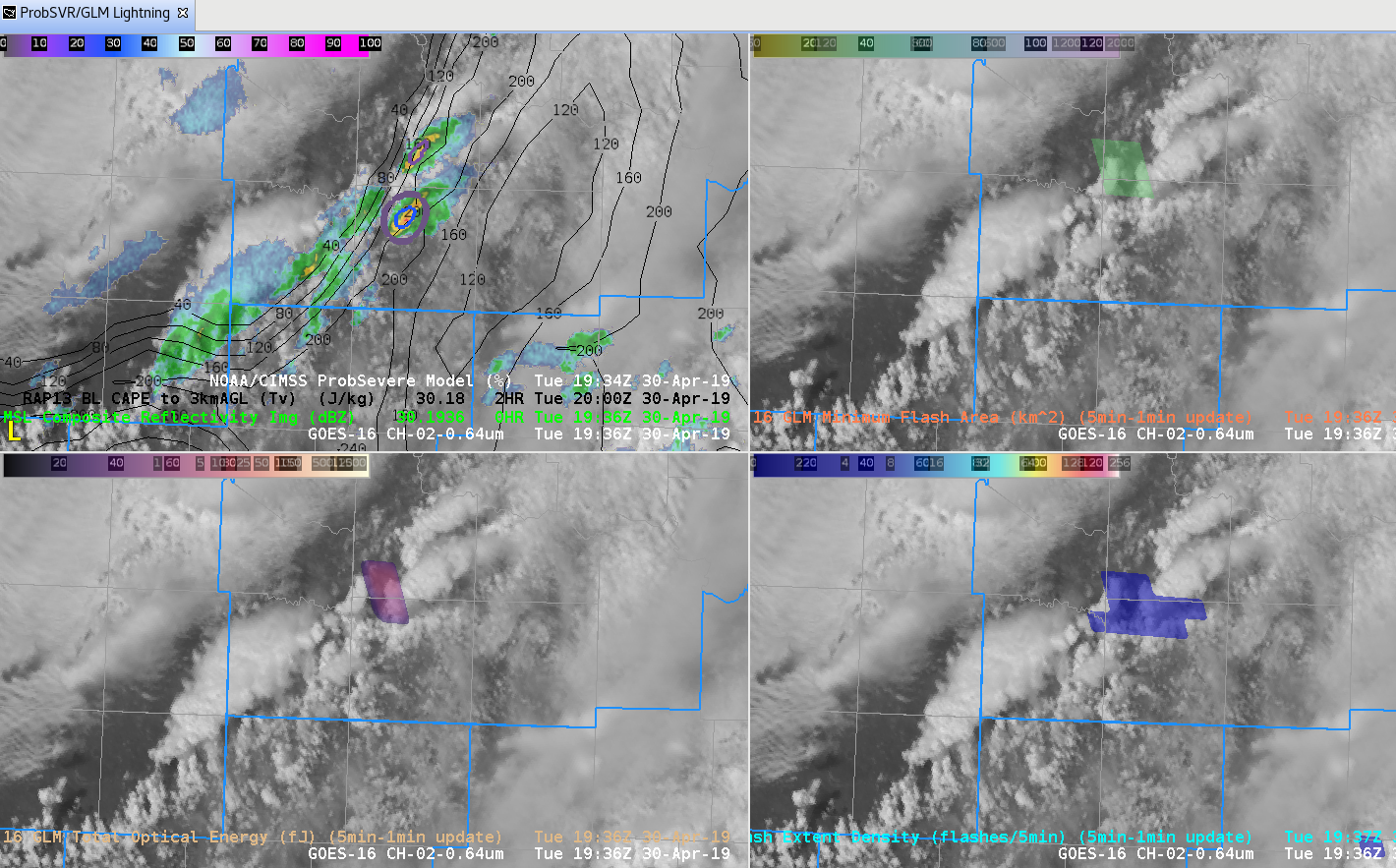
Figure 1936Z
Thunderstorm developing in southwest Oklahoma along 0-3km CAPE boundary with GLM showing first signs of lightning. If this storm remains attached to this boundary the environment supports possible tornadic development. ProbTOR is showing 3% with this early development Figure 1936Z. -Jake Johnson
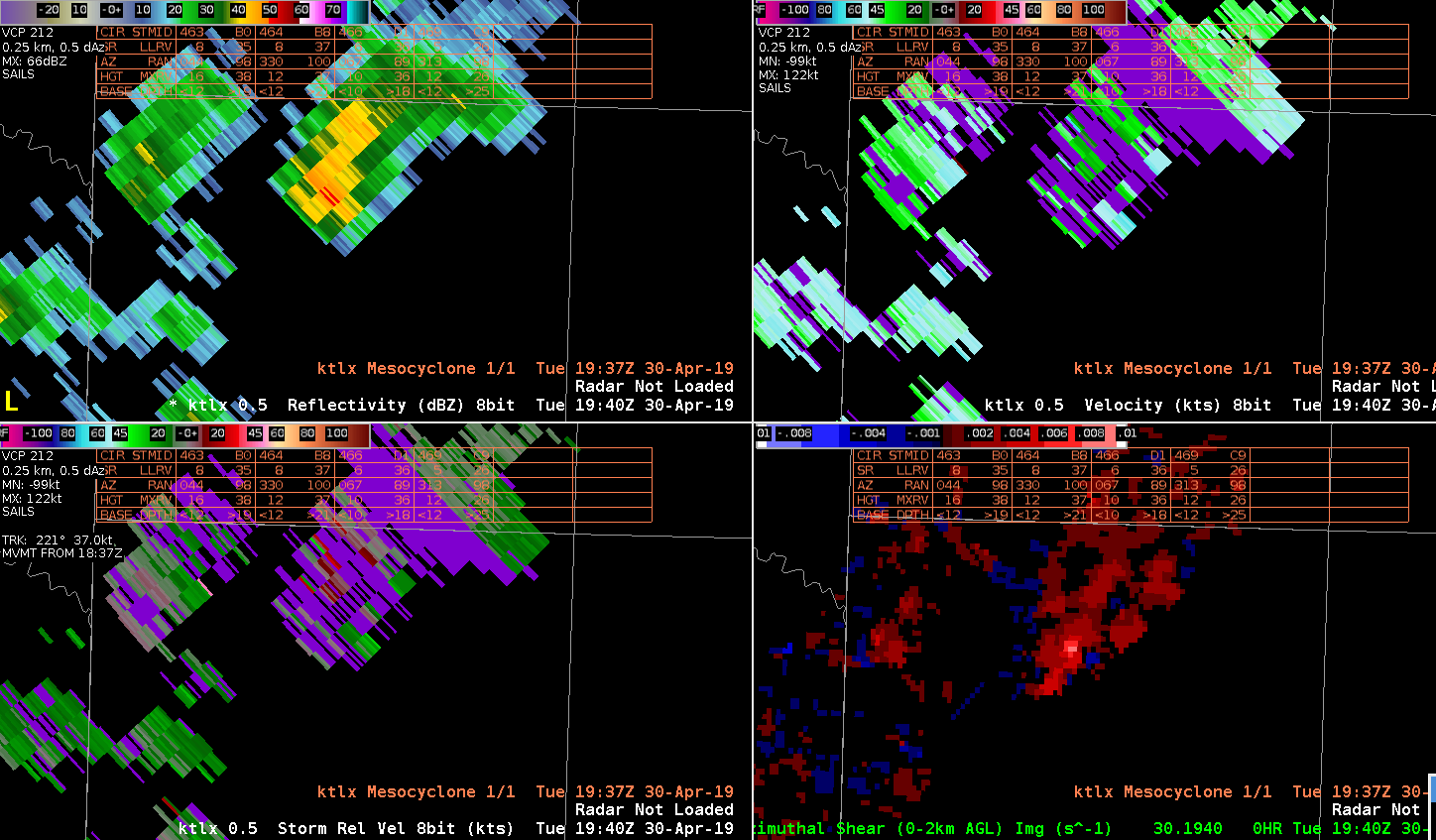
A positive for AZ-Shear product it does not show range folding like base velocity/SRM products. Might be useful tip. -Jake Johnson
Prob Tor up to 88% with 63% CPTI 80 mph winds. AZShear has been very persistent last several Volume scans and Z/SRM suggested tornado . WARNGEN would not issue TOR got error but tornado warning out! Quik TWIP