NUCAPS

A VIIRS Satellite Pass at 1944Z provided a NUCAPS Profile near some developing storms in Texas. It provided a nice snapshot of the atmosphere in between soundings. The surface temp and dewpoint were modified in the sounding below based on nearby obs. When evaluating these storms with the Prob Severe Model it showed MUCAPE values of around 3800 J/KG. Meanwhile the GOES R Sounder product indicated layer CAPE of around 2700 J/KG in this area. The NUCAP reinforced the higher values. It seems like it would be useful in identifying areas to watch for convective development or monitoring modification of the atmosphere (like a dissipating cap).

Although the lat/lon is shown in the NUCAPS sounding, it would also be useful to have the point plotted on a map within the sounding. For quicker review of nearby soundings it would be nice to just mouse from point to pNUCAPSPoint

NUCAPSCIMMSLayerCape


Tags: None

A Win For NUCAPS

The NUCAPS sounder represented the environment across Oklahoma this afternoon really well compared to the nearby surface observations. Below is a sounding from a mostly sunny region near some developing convection.

NUCAPS

The near surface environment shows a temperature of 76 to 77 degrees and dewpoint of 67. The closest surface observation had a temperature of 80 with a dewpoint of 65. Pretty good.

Tags: None

CI Signal Consistency Hits Initiation

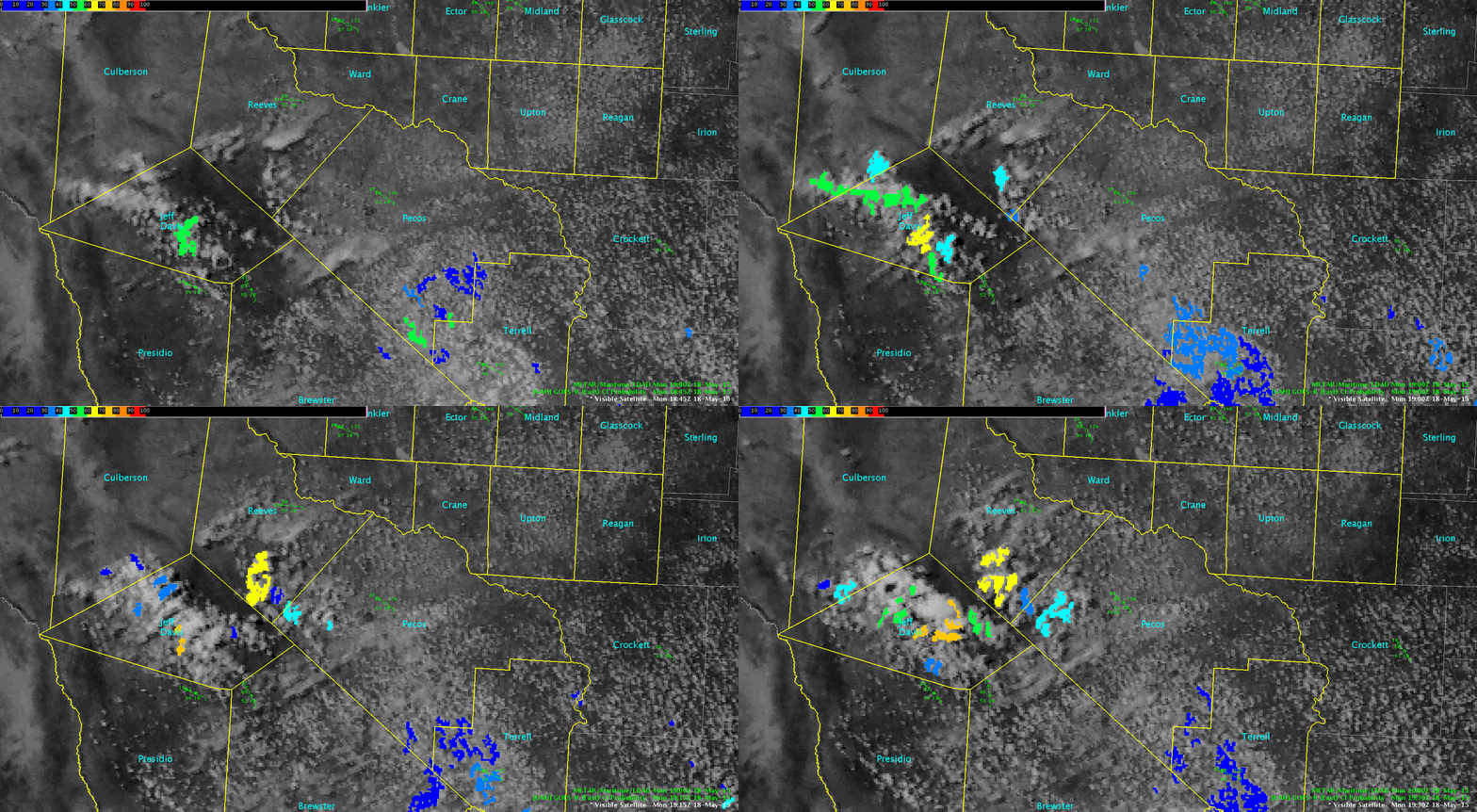
When monitoring boundary layer cumulus, some sporadic CI pixels over 50% would occasionally be seen. However, an area was seen to slowly increase in probability with each CI/Vis product evaluated over 60 minutes in southern Reeves county. A great contrast can be seen with CI data over southern Reeves county in srn TX /MAF forecast area/ vs the county to the south /Jeff Davis/. The southern county had inconsistent CI signal versus the northern signal in Reeves county, which initiated and did cause a warnable storm.

CI_May18_1930Z

Tags: None

Prob Severe Causes Expansion of Warning Polygon Area

When considering two storms in the southern MAF forecast area, one was clearly warnable for large hail. However, with ProbSevere model indicating >80% on a somewhat close western storm, the decision was made to include the western storm within the same SVR polygon. The radar data was unremarkable for the western storm at the time the eastern storm was warned for – so this was a ProbSevere inclusion. In the radar scans that followed, the western storm /northwest of Pecos/ saw 63 dbZ to -20C, and 64dbZ to 0C, indicating the probability of 1″ hail was more likely (via radar data). Lightning data continued to be unremarkable, possibly due to location in the network.

ProbSevere_May18_2101Z_MAF

Rocky Balboa

Tags: None

Splitting Cells Central Texas (FWD)

Two splitting cells over central Texas in FWD CWA showed favorable signatures both for convective initiation, ProbSevere and ENI lightning jump and flash rates.

At 1845z, the UAH Convective Initiation product maximized at about 70% in the vicinity of the developing storms. However, there were numerous other signals of similar value across central Texas, which did develop into thunderstorms.

CI_1845z_test2

About 45 minutes later (1930z), the NOAA/CIMSS ProbSevere signals started off at approximately 40%. Over the next hour (2006z and 2030z), the ProbSevere increased to greater than 80% and then hit a maximum value of 94% (at 2008z). Environment around this time was characterized by CAPE between 2000-3000 J/kg and effective shear about 30 kts.

1930z_probsevere

ProbSevere at 1930z

2006z_probsevere

ProbSevere at 2006z

2030z_probsevere

ProbSevere at 2030z

Examining the ENI lightning jump algorithm, the two cells bounced around 1.0 sigma level for awhile but never reached 2 (the ‘threshold’ for severe).

Looking at the time series, it’s clear that there was at least a in-cloud jump from around 2000z to 2012z. However, plotting the ENI total lightning plan view showed between 40 and 50 flashes, however the time series only had approximately 10 or less. There were some conflicting data between the two products.

Overall, felt these storms were marginally severe in a higher CAPE environment. No storm reports were received.

surface_lightning_jump

lightning_jump_FWD

ENT_Total

Tags: None

Pickles – 5-18-2015 21z

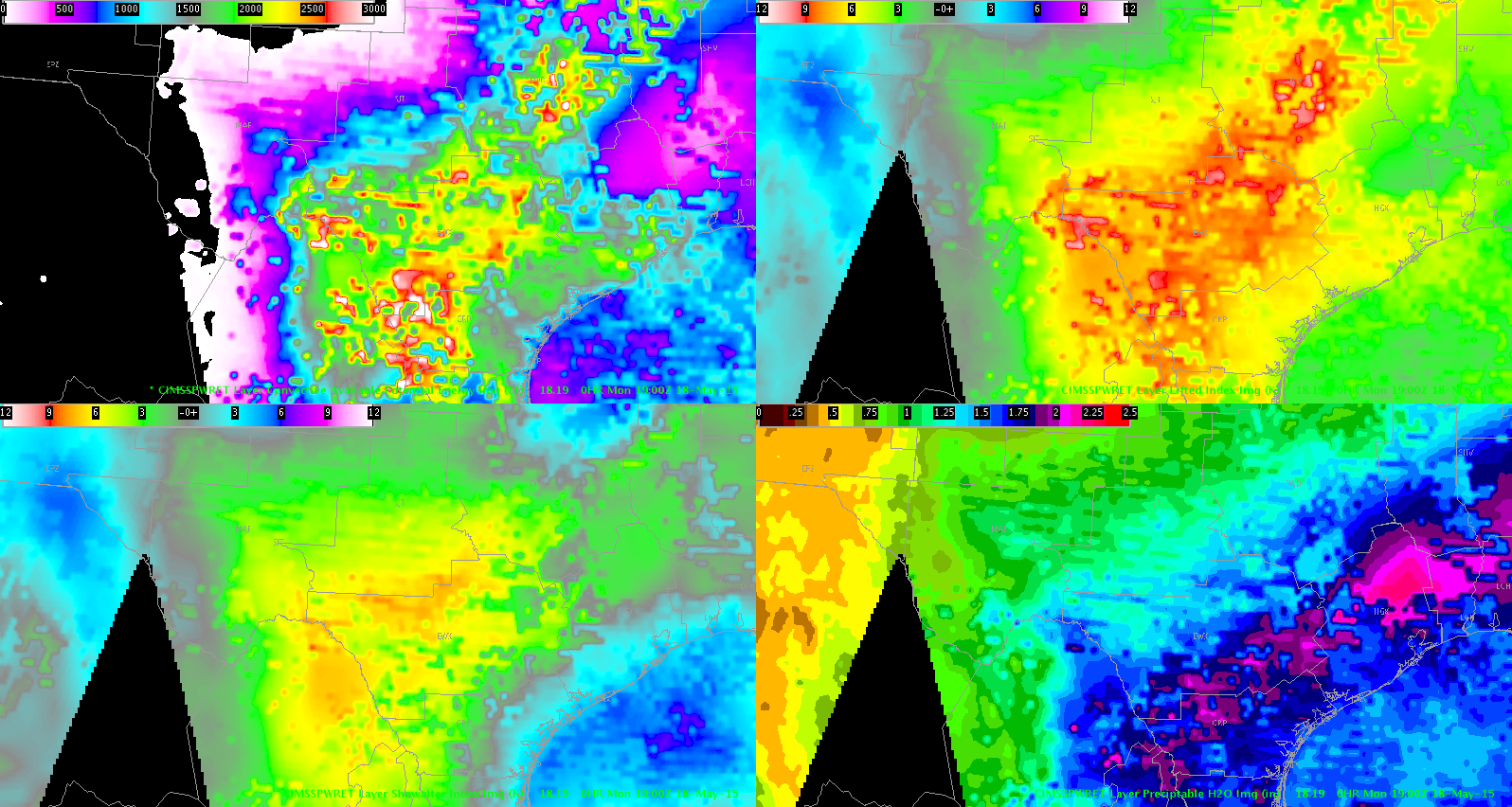
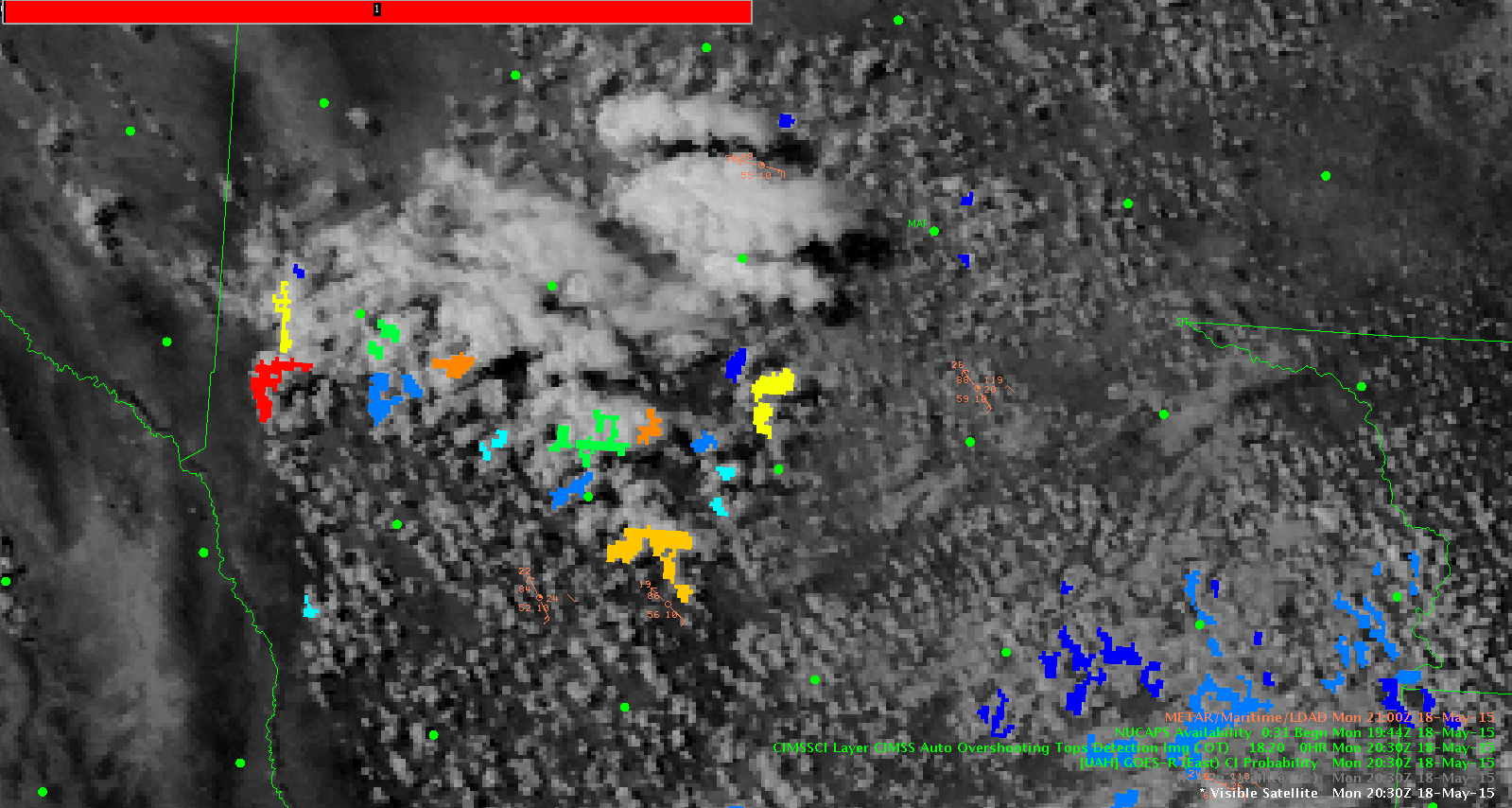
Increasing moisture and heating to the south of a cold front across western texas (Fig1)…and 35-40 kt 0-6km shear making for an increasingly favorable environment for some strong to severe storms to develop off the mountains. These are being fed by a low-level se flow feeding in MUCAPE’s ranging from 1500 to 3000 J/KG from se portions of the CWA towards mountains. This trend is noted in GOES R derived moisture/instability products. Note: The discontinuity in the GOES R instability fields…likely due to the product below being disturbed by cloud cover from convection. (Fig2) Latest GOES R CI prob are showing greater than 60 percent prob for convective initiation for severe cloud elements(Fig 3)…while Latest NOAA/CIMSS prob severe model showing greater than 90 percent severe potential for shown storms east of radar. (Fig4) So…prepare for increasing potetnial for severe storms over the next couple of hours.

FIG1screenCapture

FIG2

CAVEDrawing

FIG3

CSI

Fig 4.

pronsvr model


Tags: None

Nearcast Model Aids Destabilization Situational Awareness

In assessing the Midland, TX forecast area destabilization forecast, the Nearcast model differential theta-e product provided a good visualization of the next several hours. Low-level southeasterly flow over srn TX was forecast to bring higher dewpoints (10-12F) into the srn Midland TX forecast area through the day. The Nearcast model provided another opinion/visualization of the advective process, as well as both the relative magnitude (geographically) and the northern extent of the instability through 02Z.

As a forecaster, this 1) added to the confidence of destabilization 2) allowed me to better visualize the 3D atmospheric changes expected on this day and 3) concentrated my SA to the srn forecast area.

NearcastMay18_18z

Rocky Balboa

Tags: None

EWP Week 2 Summary (May 11-14, 2015)

The second week of the EWP is in the books with forecasters participating from the San Diego, Eureka, Huntsville, Sterling and Norman WFO’s, as well as a broadcast meteorologist from NBC4 Columbus, OH. In the early part of the week, forecasters were fairly spread out across the country with operations in Sterling, Tampa Bay, Pocatello, Wilmington, and Louisville. With the ridge building in the center of the country, our operations domain became much smaller as we moved to Texas for the latter part of the week. The WFOs worked in Texas included Houston, San Antonio, San Angelo, Midland, and Lubbock. Overall, forecasters had a good mix of forecasting/warning on convective modes and time scales. Similar to last week, we were able to evaluate the entire product suite of GOES-R and ENI products.

Below is a synopsis of feedback for the GOES-R products:
GOES-R LAP
– The striping and blotchiness/unnatural extreme gradients lower my confidence in these products. It would be great if this issue could be resolved.
– At the beginning of shift yesterday, the CAPE and PW gradients seemed to match up well with the dryline via surface obs.
– The cell that developed behind the dryline in a stable atmosphere as indicated by LAP CAPE remained sub-severe.
– I wouldn’t use it by itself, but I would compare and contrast to SPC meso page and LAPS to boost confidence.
– It was most useful to pay attention to the gradients and trends in the fields. Most often, convection developed along these boundaries and in areas of increasing instability/moisture.
– The PW fields, including the three layers, were nice to have. I had most confidence in this field.

NUCAPS
– It was cumbersome to have to modify the surface conditions with most profiles. It would be nice if this process was automated.
– QC flags would be helpful to have so we know with confidence which profiles to trust.
– It would be nice to have the ability to sample the green dots for information such as QC, instability, moisture, etc, giving you some quick information about those soundings.
– The profiles are smoothed out, but they still give you unique information about the environment.
– I liked that it is observed sounding information
– The timing is great (between 12z and 00z RAOBs).
– I see this having utility for my office over ocean on west coast.
– We would definitely use it in our office.
– I look forward to using this during the winter season
– There were a couple cases throughout the week where the NUCAPS soundings showed instability, and convection developed/strengthened as it moved through that area
GOES-R CI
– I wish it was better through cirrus
– I would like it if you could somehow signal why the probability is going away. Is it because the storm has reached the necessary degree of maturation, or because that cloud is no longer expected to initiate?
– I look forward to using it with routine 5-min imagery in the GOES-R era. I think that will definitely make the algorithm more useful and display less messy.
– For me, broadcaster, it was the most useful tool. It gives me a quick look at where convective activity is most likely in the near future
– I provides information we don’t already have
– I was most useful when I monitored trends over a certain area, as opposed to trying to track individual cu
– I think it could even be put on tv
ProbSevere
– SigTor might help with tornado environments, DCAPE for high wind.
– Having a time series would be helpful to see changes in probabilities through time. It is pretty easy to follow as is, but a times series would just add to it as an alternative method of visualizing past tendencies
– Definitely performed best as a hail predictor
– We had slam dunk, hail days this week, so it will be interesting to evaluate it with lower end and non-hail days
– In Florida, I used it to indicate a wind threat with a collapsing cell by looking at decreasing probabilities in probsevere. The storm did result in some wind damage. If you know environment might be conducive to microbursts, and see probsevere falling, you might want to have elevated awareness for an imminent damaging wind threat
– I am a fan of the descriptive words in the readout (weak, mod, strong).
– Satellite input field’s added lead time when we had the satellite information previous days. Lead time was lessened when we didn’t have the satellite information because of cirrus yesterday.
– A different color scale might be necessary for WR, where probabilities were much lower.
Lightning jump
– Worked great for us yesterday, it was often the first indication that a storm was intensifying. It signaled us to interrogate radar data for a given storm.
– One example yesterday, there was not much originally on radar at lowest level, then we had a jump, so we looked at the storm more closely, and found good signals in radar dual pol and at upper levels. Storm then strengthened.
– Some sort of colorscale for negative “lightning jumps” would be helpful. Also more research and training on the negative jumps. Do rapid decreases in lightning activity precede rapid storm weakening?
– Overall, display is simple, easy to use, good SA for fast changing event.
– It would be helpful to display the max value for the last 5-6 minutes in LJ, so significant changes would be be more difficult to miss.
– I really started to pay attention when jumps were to 4+
PGLM
– Flash extent density was awesome, and it has science behind it which is good
– The 6-min summation product needs to have a higher color scale.
– Yesterday, it did a great job of pinpointing strengthening storms as they intensified
– Shades of blue at low end of color scale I was using is helpful for more marginal cases, while a different color bar may be more applicable for storms with much increased lightning activity.
– It will be nice to have uniform detection efficiency across domain with GOES-R GLM.

-Darrel Kingfield, CIMMS/NSSL Research Associate & Week 2 EWP Coordinator

Tags: None

CAPE LAP helped with confidence

Here is an example where having the hourly CAPE LAP data helped with environmental awareness. Some storms were forming to the SW of the main storms and at first glance, you may think they will go severe since all the other storms have as well. This is especially true if you weren’t really looking at the current environment.

Take a look here at the 21z analysis and specifically at the lightning that is circle. There was a line of moderately strong thunderstorms developing here. You can see it is clearly outside of any CAPE analysis. I was fairly confident with this that the storms wouldn’t go severe. To note, the dry line was also to the east at this time.


CAPE21zfixed

At 22Z, the CAPE has continued moving east and the convection is still there but not severe.

CAPE22zfixed

Between about 2222z-2232z the ProbSvr did increase to the 60-70% range but nothing higher than that and that was in two different cells. Again, looking at this hourly LAP data helped confirm to me that these storms likely wouldn’t amount to much.


Lauren13

Tags: None