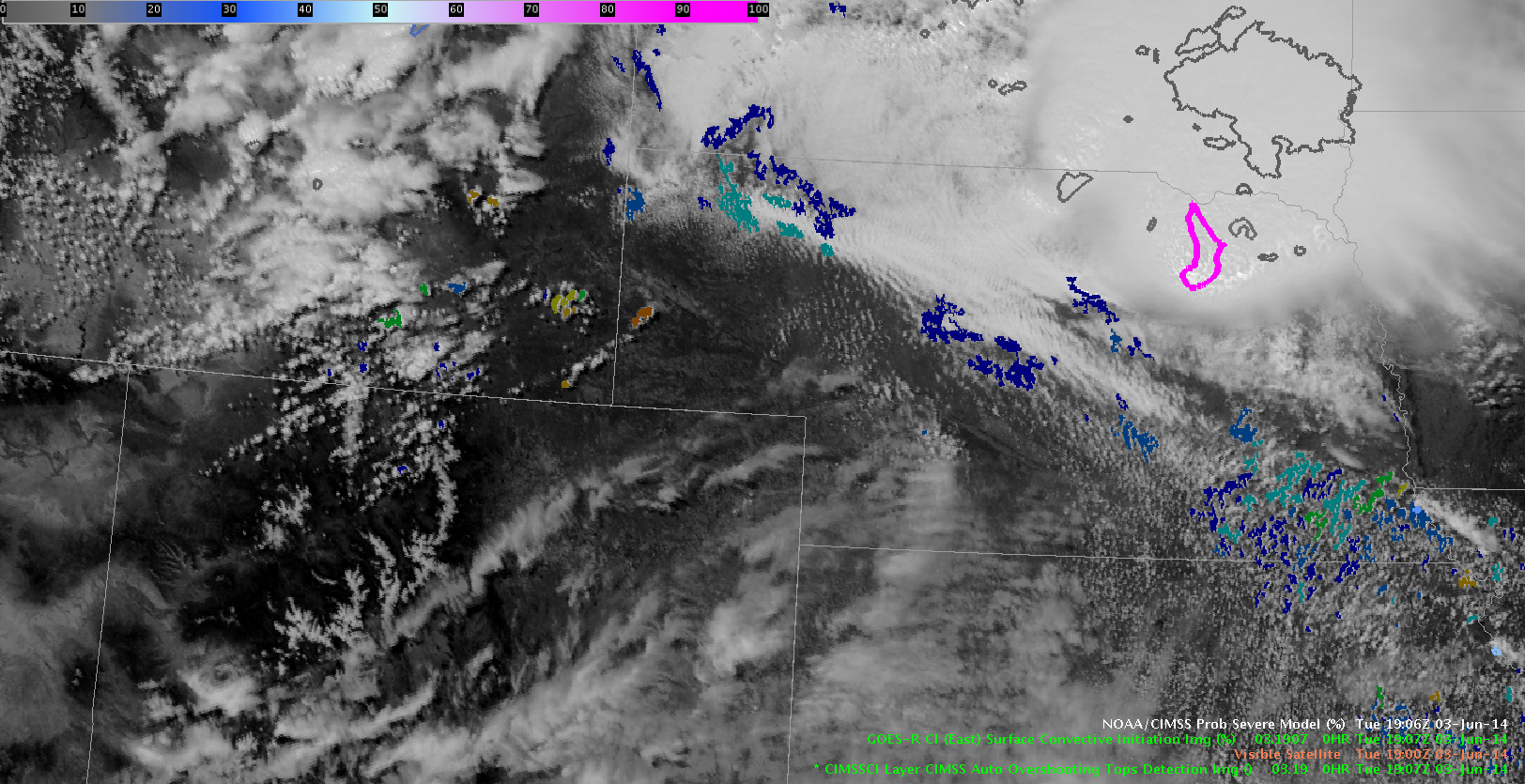
prob severe color curve

probseverecolorThis image shows the prob serve “ring” of ~60%. This color is very similar to the colors of 10% or less. I don’t know exactly how to change the colors, but I would suggest a different color curve since seeing this image made me think that the storm had decreased a lot instead of increasing more than 10%.

jca

Tags: None

North Platte Sector June 3 pt 1

High risk day for Nebraska Iowa and we are focusing on North Platte area, Getting situation awareness. seeing extreme instability and high theta e diff. over our area. Ongoing storms underway to our north and expect a strong tornado or two along with a developing derecho type wind event into Illinois and perhaps Indiana by 06-08Z on 4 June.


Looking at v laps and discussing areas of highest cape. High cape seems to be advecting into Nebraska from KS where there was and is extreme heating south of the warm front. V laps proving valuable for sit awareness as I noted yday.

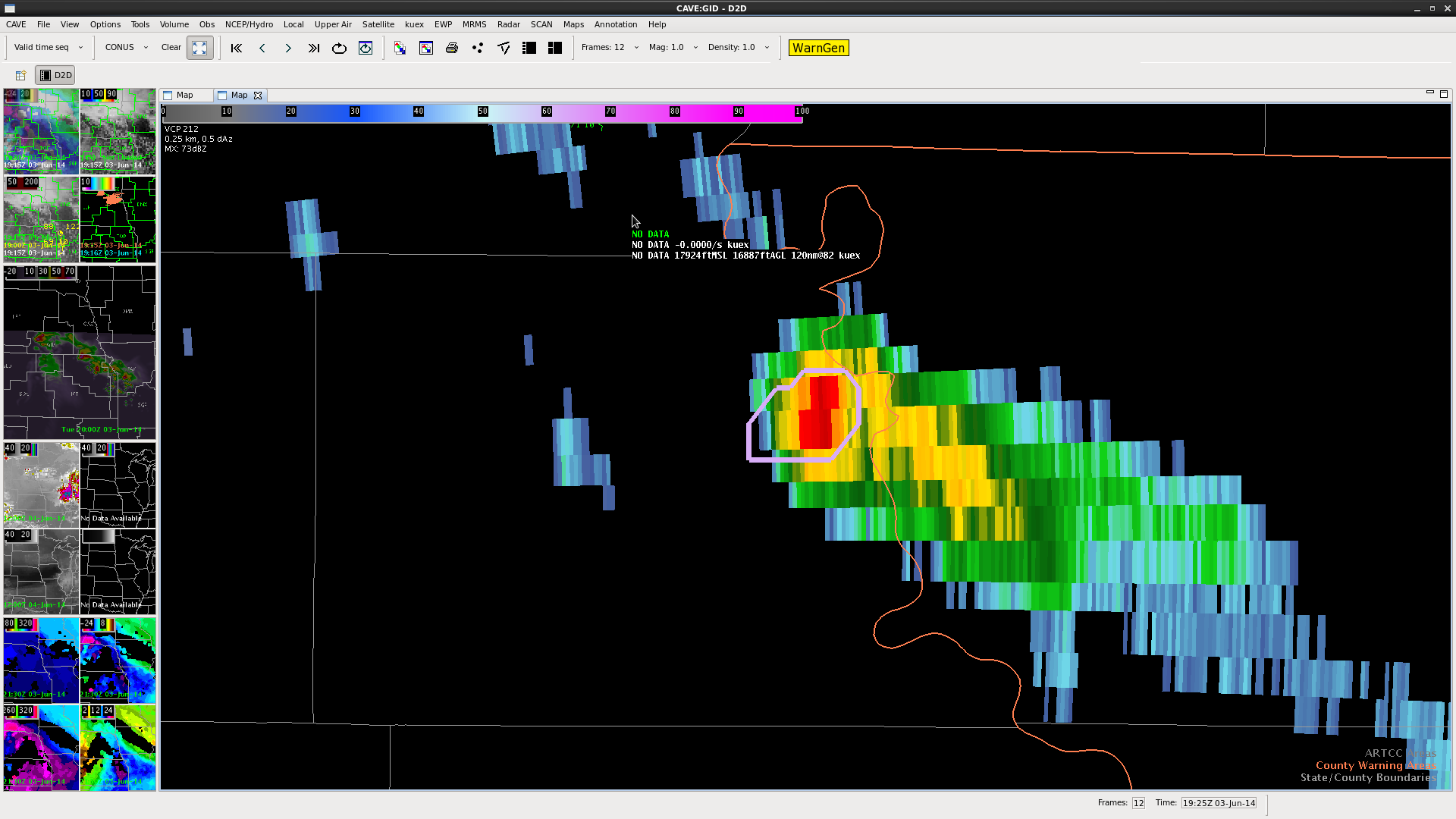
Looking at storm over northern NB and prob severe shows 92% for 2 consec scans. OUN WRF and V-laps forecasting a severe cell in SW NB near Colorado border. Nothing yet but theta diff is large in area and watching area closely.

Update 1930Z 3 june

1939 3juneConvective init. parameter is keying on on convection to the west of an area that vlaps indicated would fire and also an area that theta diff is indicating a key area. See extreme west NB and WY in image above. CONVEC INIT is adding valuable info to confirm our thinking about this area. Watching now for an indication of overshooting top… none yet!

d satterfield
WBOC TV

Tags: None

EWP Operations Update – Tuesday 6/3 – 2:40 pm

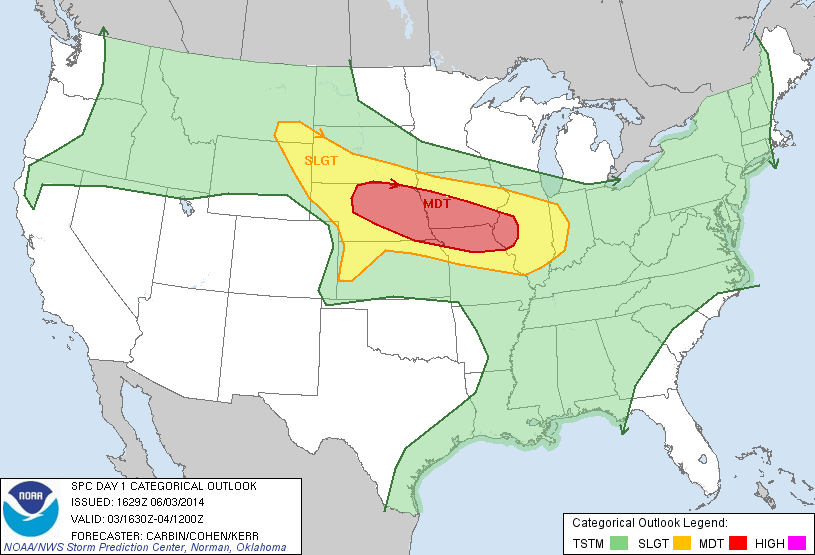
0603_day1Today, there is a moderate risk for severe storms across much of the Central Great Plains.  A warm front / outflow boundary is positioned over southern and central Nebraska, arcing to the northwest toward Wyoming.  High-resolution model guidance suggests that convective initiation will occur within the next hour over much of Nebraska, as the upper-level wave approaches.

Given the ongoing convection in N Nebraska, we have elected to choose the more quiescent environment over W/C Nebraska for operations today.  We are now operating in the North Platte and Hastings CWAs.

-Gabe Garfield

Week 4 Coordinator

Tags: None

Near cast potential convection.

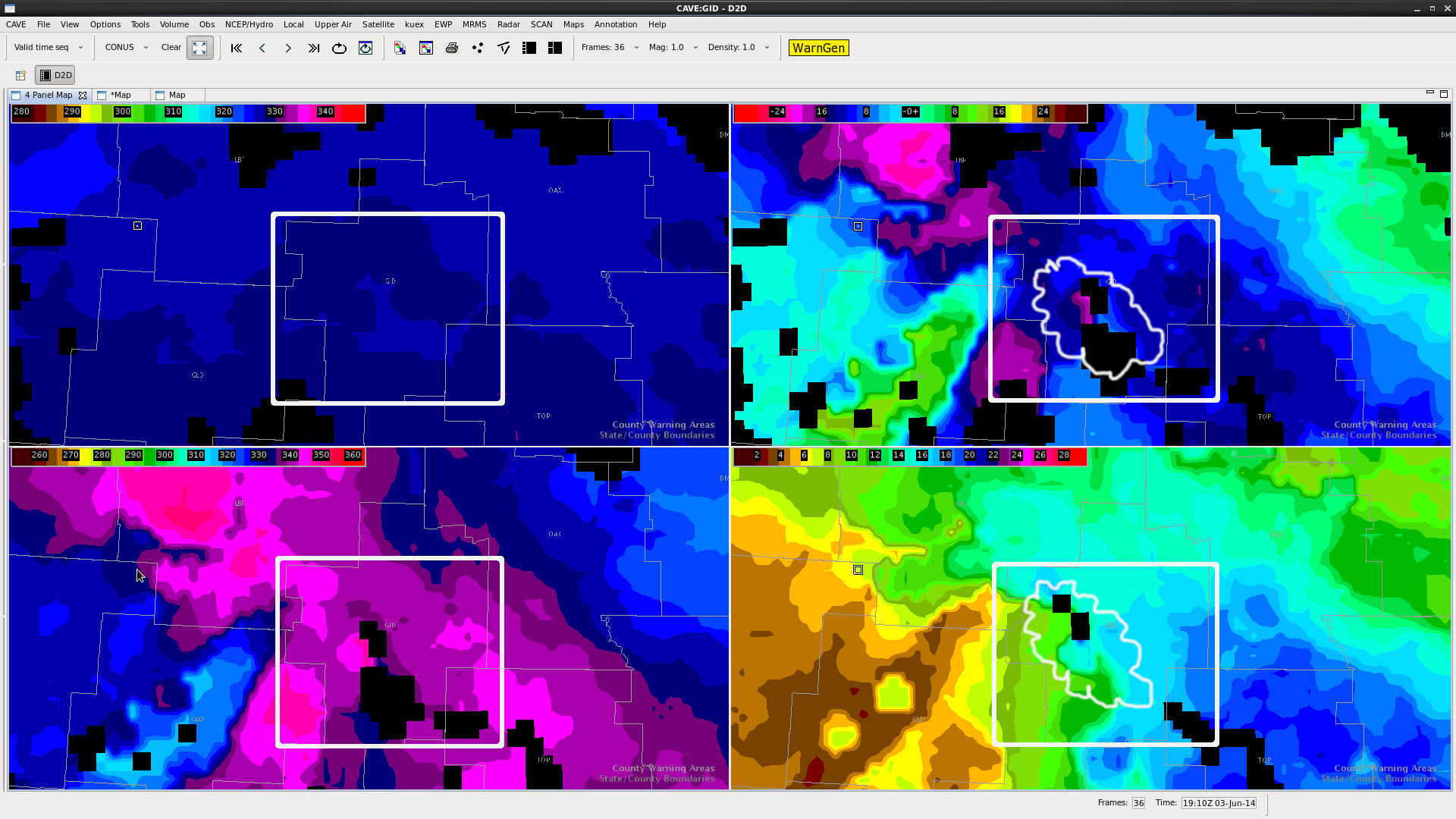
nearcast4panel18ZaNear cast variables all lining up in the boxed area with cooler dry air overrunning warm moist air (shown on left) and a good theta-e difference gradient and PW gradient (shown in bubble area) that is propagating northeast. The boxed area will be one to monitor over the next few hours.

-KP

Tags: None

satellite comparison 19z

satcomparison19zLooking at a comparison of simulated and actual satellite images at 19z shows that the model is too aggressive with convection, or at least clouds in south central NE. It did not at all capture the ongoing supercell in far northern NE.

jca


Tags: None

Daily Summary: Week 4, Day 1 (2 June 2014)

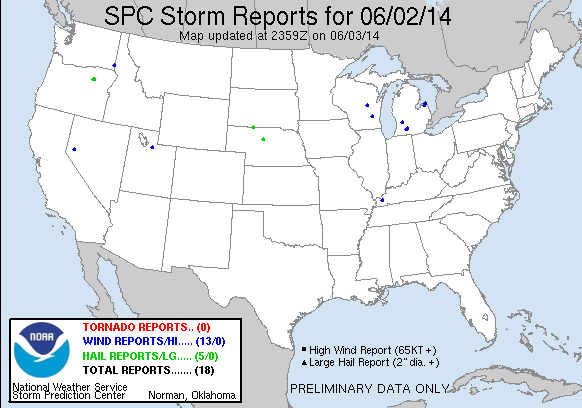
0602_reportsAs usual, Monday was an orientation day for the EWP.  Forecasters learned how to use the experimental products in the AWIPS2 environment, and began to develop comfort using the blog.

We monitored the potential for severe storms in the Wichita and Norman CWAs.  Forecasters Pelczynski and Anderson operated in Norman; forecasters Fowle and Satterfield operated in Wichita.  Severe storms never developed, in spite of early optimism from the OUN WRF.

-G. Garfield

Week 4 Coordinator

Tags: None

EWP Status for 3 June – 1:00pm to 9:00pm Shift

tues_day2 tues_day2_prob

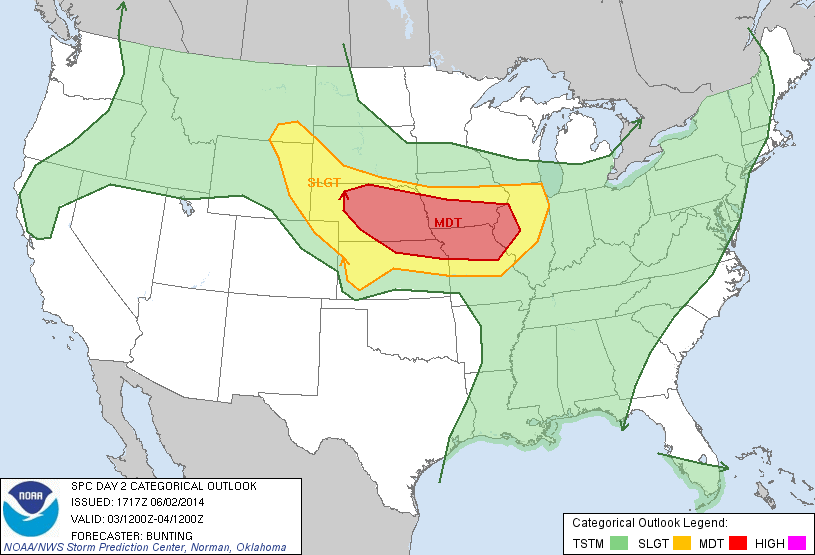
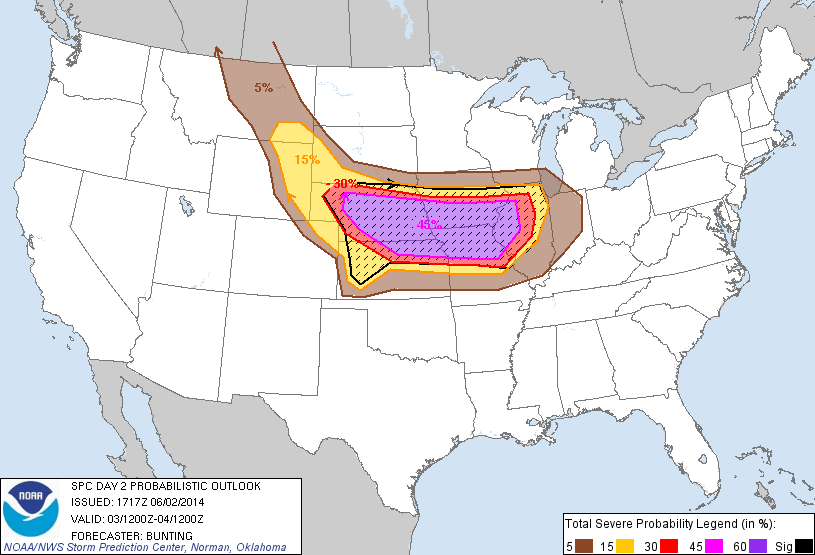
On Tuesday, a much-anticipated mid-level wave will arrive in the Central Plains, creating the potential for a significant severe weather episode.  Seasonally-rich moisture will continue to advect northward in response to deepening low pressure in the lee of the Rockies.  Meanwhile, a strong elevated mixed-layer (EML) will advect over the moist layer, creating the potential for strong instability.  Morning convection over Nebraska and Iowa may delay surface heating somewhat, but it is likely that – at least – strong instability will develop.

A warm front / outflow boundary looks to be the primary focus for severe weather tomorrow, though storms may fire further south on the dryline.  Given the a) strong to, perhaps, extreme instability, b) strong shear at all levels, and c) deep moisture, the potential exists for high-end severe, including tornadoes.  The greatest threat for tornadoes will likely exist along the warm front in central and eastern Nebraska.  Storm mode will be key, as upscale growth could limit the tornado potential.  Some high-resolution models hint at the development of a strong squall line – perhaps, even a derecho – not long after convective initiation.

In order to capture the initial development, we have elected to start the shift at 1 pm. We will meet in the Hazardous Weather Testbed to listen to the EFP daily briefing.

-G. Garfield
Week 4 Coordinator

Tags: None

EWP – Day 1 – Initial Random Thoughts

Good overview of the products – even with little sensible weather.

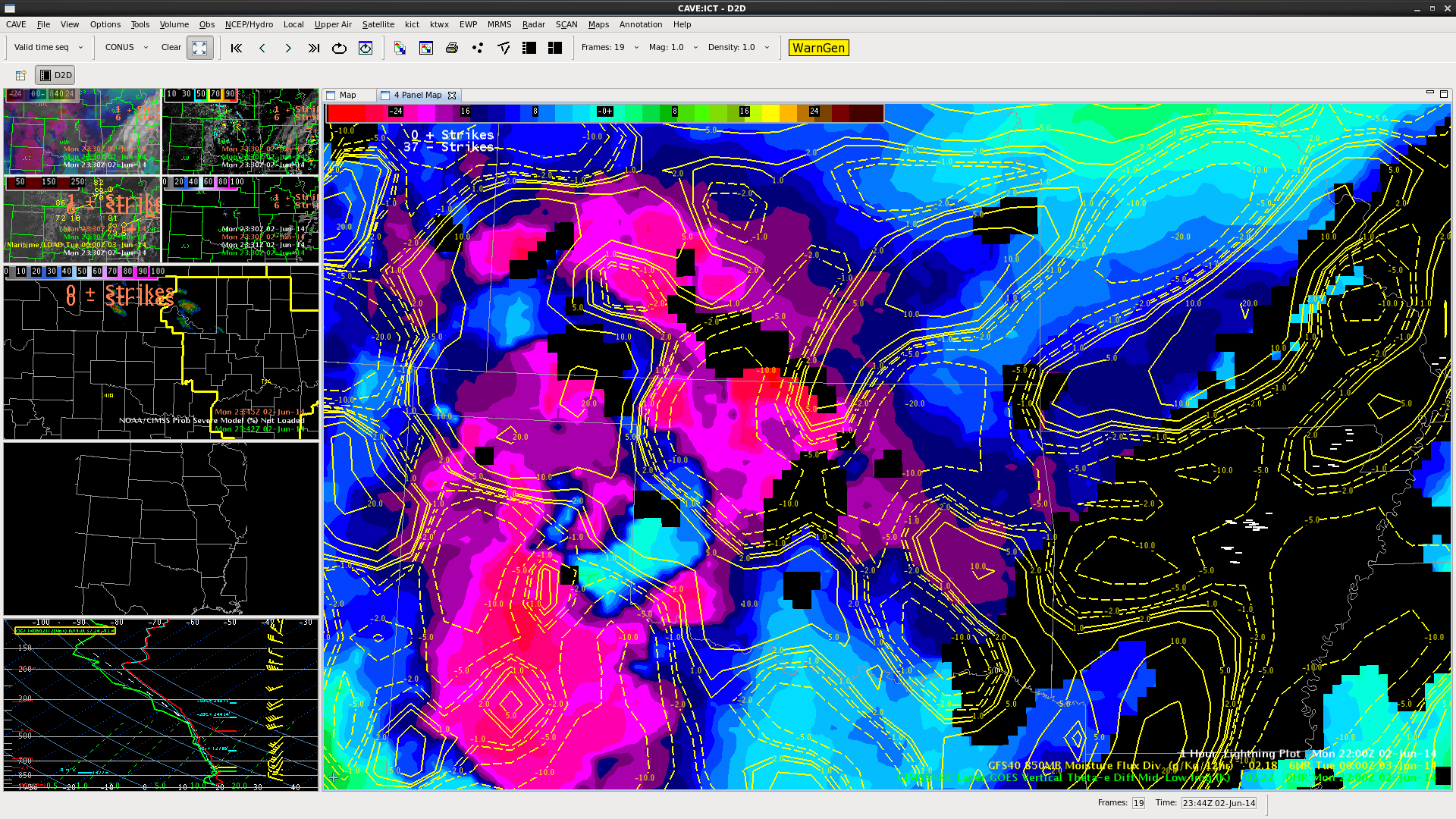
First thought – will try to “enhance” a few color curves to make interrogation easier. I have spent “lots” of hours in the WFO setting enhancing color tables – and I believe these will help.  One easy change is to reduce the “noise” of the CI product – e.g. remove values below 40%.  This allows you to focus only the storms of interest.

4PNL_GOES CI_ColorTable_CorrectionThought #2 is to combine/overlay the observed fields (e.g. ThetaE_NearCast) with relevant forcing.  For instance, in the image below I used the ThetaE difference with GFS40 850mb moisture convergence.  In essence, combine the observed environment with model forcing parameters.

ThetaE_V3Mike Fowle


Tags: None

Question/Suggestion on Convective Initiation

In looking at the CI in and around Osage Cty Okla. the question arises about a developing cell that is only showing a low prob of development. It has a small 50 dbz echo now and the CI pretty much missed it. At some point, it might be a good idea to label cells that CI has determined are already initiated and is no longer being tracked in the algorithm.The 50dbz cell in west Osage (see below) is a good example of one that I was initially unsure of. (The latest update tells me that the algorithm is tracking the cell still, but the idea above remains as something that should be considered.

CI Osage CtyD Satterfield
WBOC Salisbury,Md

Tags: None

HWT Day 1 Part Two

Am now familiar enough with running the AWIPS and am well underway in evaluating the products for this week. We did notice the overshooting top algorithm missed a rather well defined one in NE Michigan (Well outside of our forecast area but we are looking around to get a feel for the products). The prob of severe product is being looked at at we can easily see the value of the satellite imagery in computing this. The higher res. when GOES R comes along will make this much better I suspect. This product seems to me on day one to be very valuable. I work on the broadcast side of things and during major severe weather events we have to do the dual tasks of talking on camera and having a minute or two every 3-5 mins. to update situational awareness. If this product does well, it will be extremely valuable.

At 2250Z on 2 June I am looking at the image below. The boundary of theta E difference is what we are focusing on for convection. SPC has put put out an MD for the area now as well.

2 june 2151Z

Convec Init 2155Z 2 june

Dan Satterfield
WBOC Salisbury,MD

Tags: None