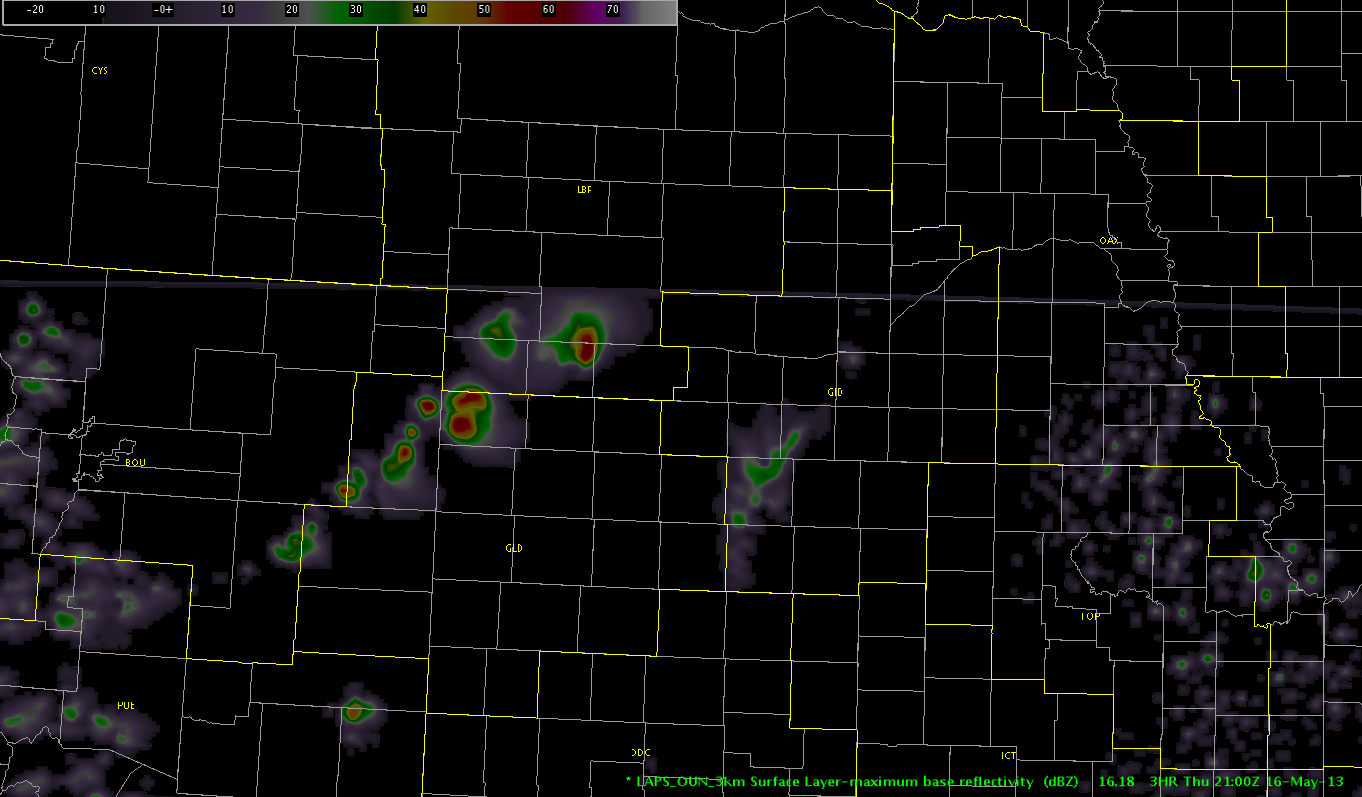
3 km LAPS Forecast for Comparison with OUN WRF

Looking at the 18Z run of the 3km LAPS…the model has a ribbon of north-south oriented CAPE further west into eastern Colorado than the Nearcast model and is much skinner. LAPS_NOWCAST_CAPE

Much lower values of CAPE are forecast in far eastern Colorado into western Kansas…and as a result…the storms that fire along the sfc convergence boundary in eastern CO develop quick but quickly die as they move off into the lower CAPE fields along the CO/KS border. This is more or less opposite the Nearcast model.
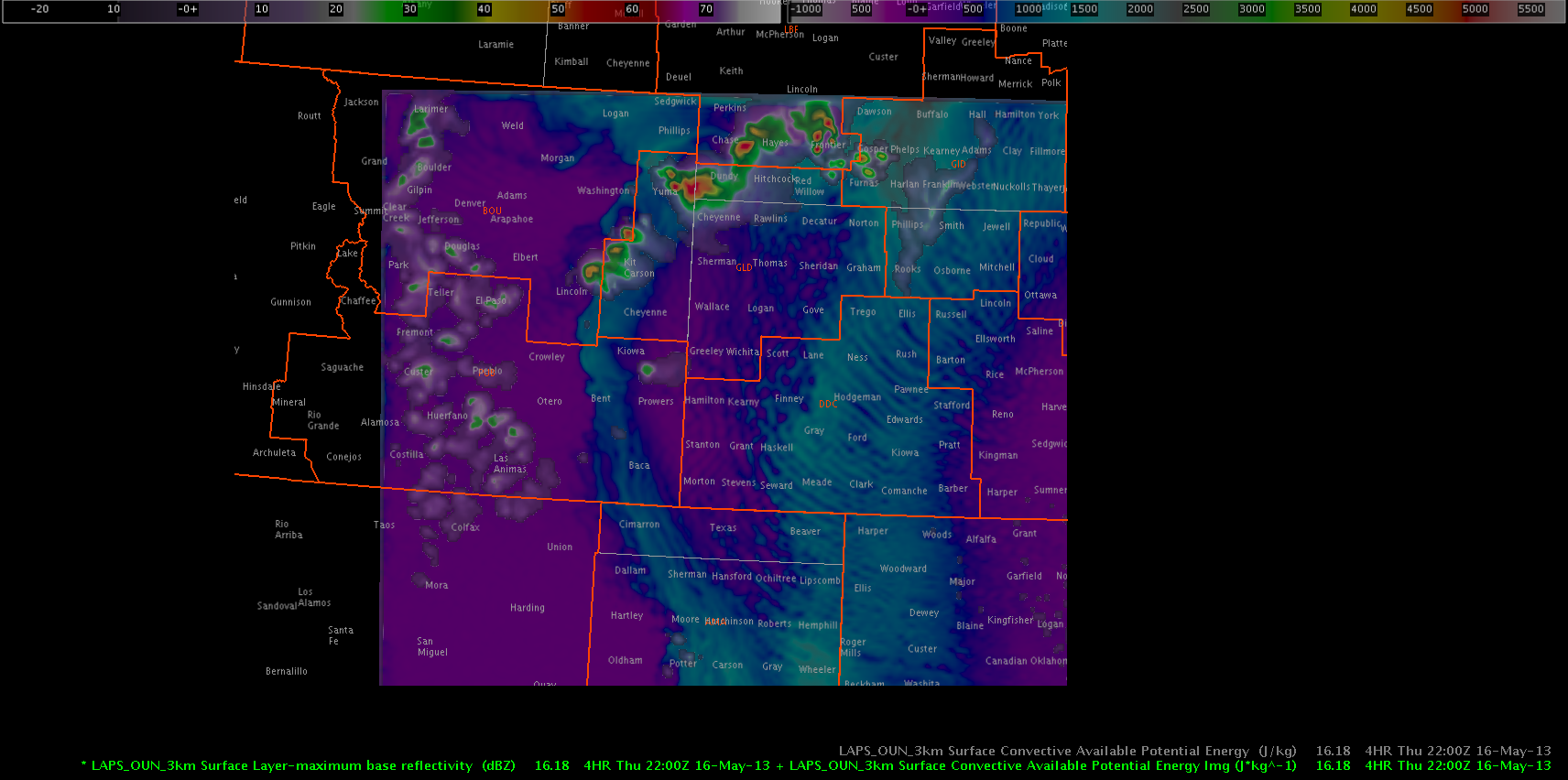
LAPS_Combined_reflCAPE

In a similar fashion…updraft helicity is relativly weak throughout the region although the storm in eastern Yuma county has more persistent helicity field maximized at 58 m2/s2 at 22Z. LAPS_Hel_18Zvalid22ZComposite radar verification at 22z indicates the 18Z LAPS run is slow to move the strongest convection in northwest Kansas to the southeast and is significantly further west with the storms than reality in southeast Colorado. In addition…the LAPS convection is weaker than reality.22zcomp


Looking at the 21Z run…the CAPE ribbon is a bit further east than the previous run and the model is capturing the return flow of higher instability as moisture is advecting in from the southeast. However…the slower advection of moisture as seen on the surface obs makes me think the LAPS is a bit aggressive with this moisture return.  The reflectivity fields both along the line in northwest Kansas and the weak cluster in southeast Colorado are better analyzed initially although are a bit weaker than reality at 23Z. The 21Z run does however show the cold pool associated with the squall line really well as it traverses southeast across GLD CWA. It also has very good definition of the individual cell’s cold pool boudaries as well.

*see image /bmazur/23ZLAPSanalysis.png

*see image /bmazur/23zcomp.png

I would like to attach an image of the 3km instantaneous updraft helicity as well but am not able to load the data at this time.

An interesting feature showed up at the 2115Z timestep of the 21Z run. A donut of nearly 5000 J/kg of CAPE showed up surrounding a weak isolated cell in Prowers county. This area of high CAPE was then dispersed with time along the CAPE ribbon. Not sure what would cause this in the model but found it to be an interesting feature.

*see image /bmazur/capebomb.png

RJM


Tags: None

Struggling High Based Convection in Colorful SE Colorado Using CI/CTC

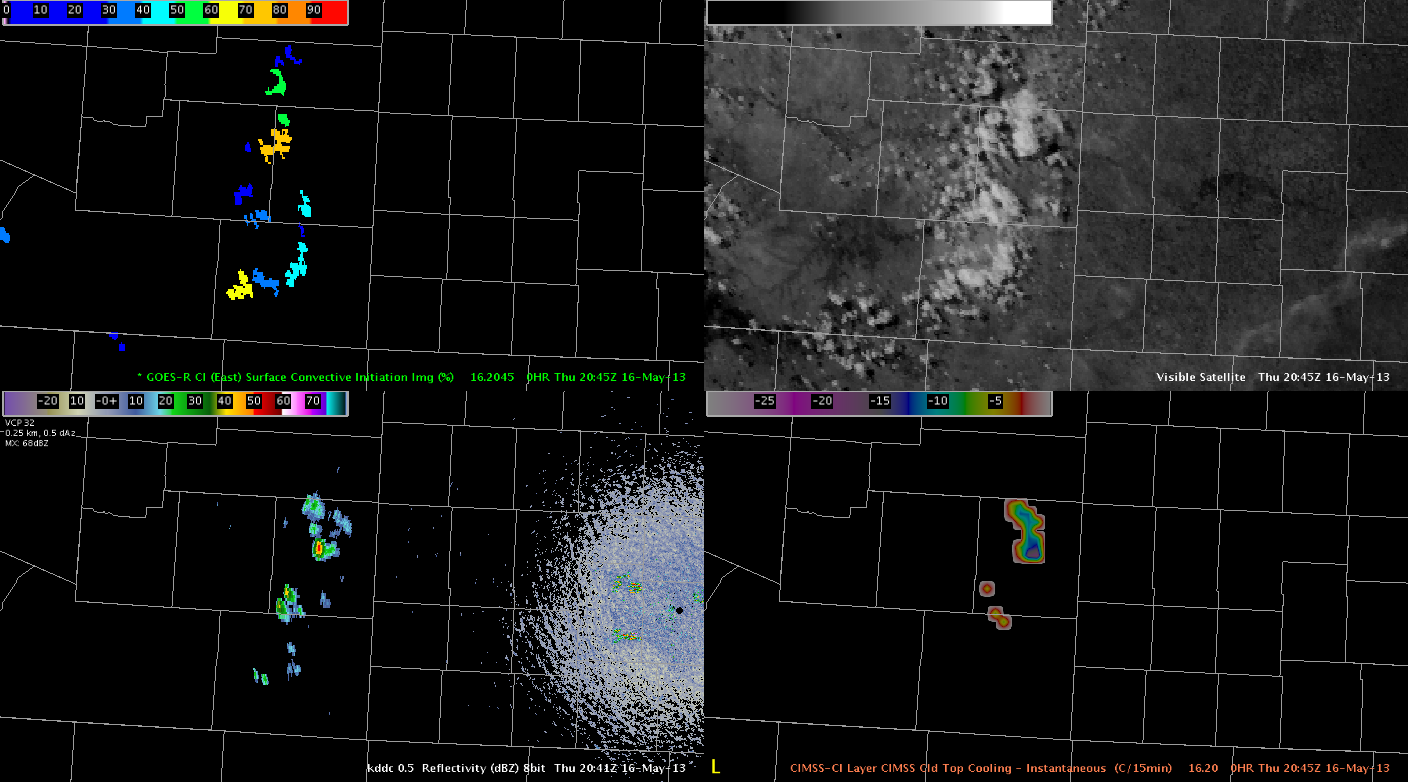
A few high based storms have been struggling to develop across southeast Colorado due to abundant dry air and SBCAPE 500-1000 J/kg.

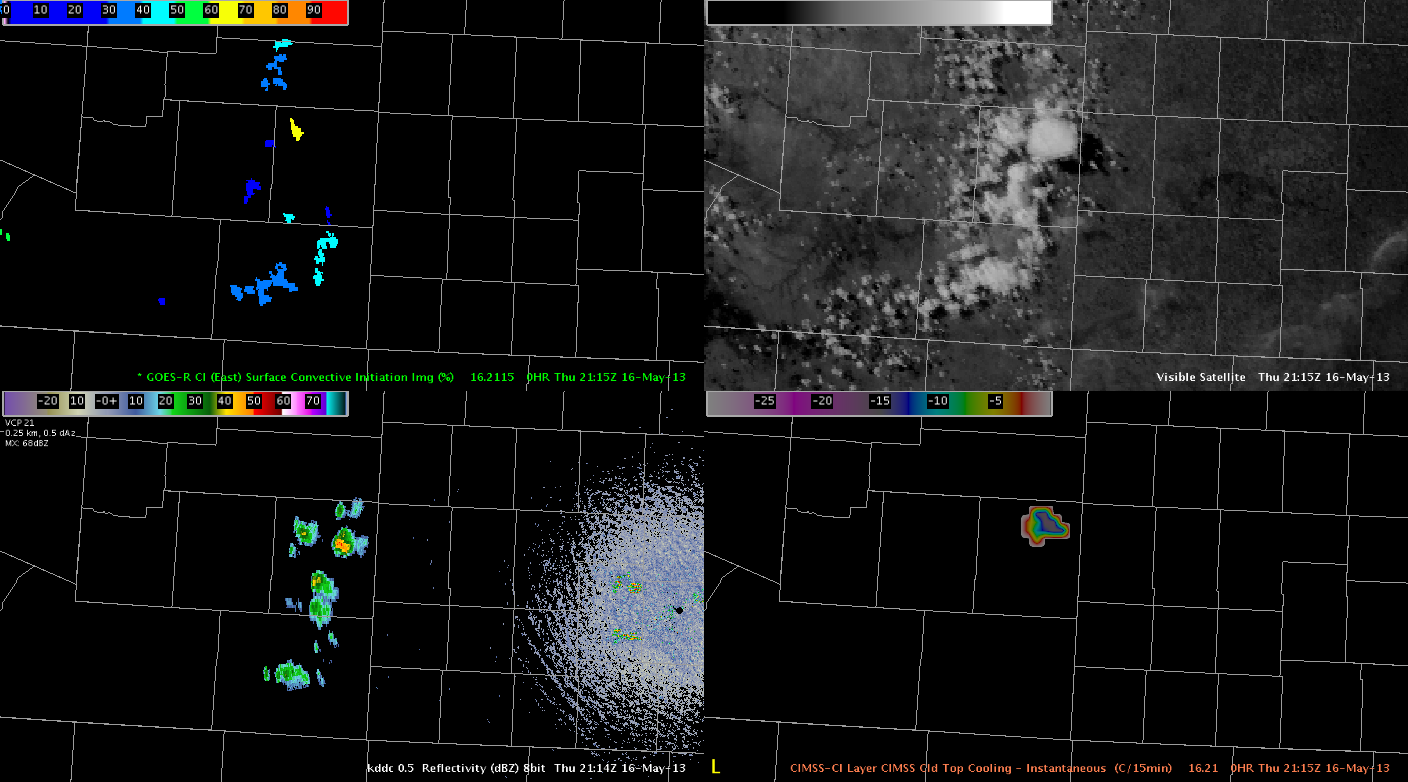
4PanelCICTCDDC2045UTC051613The first image was at 2045 UTC on May 16 where the GOESR UAH CI suggested some potential for convection with a few locations 61-78%, and the CIMSS CTC depicted a maximum of -18C/15 min.  This appeared promising for deep convection.

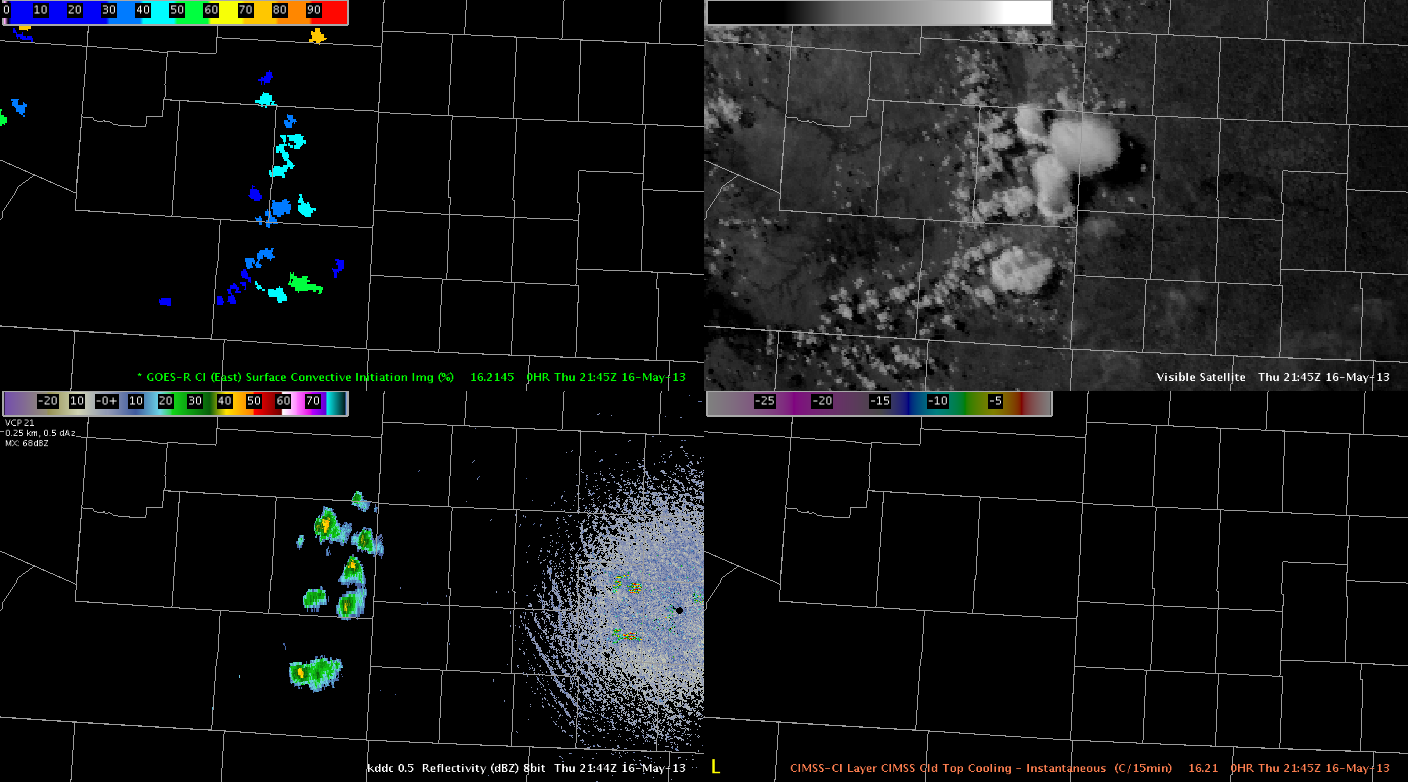
4PanelCICTCDDC2115UTC051613 The next image was at 2115 UTC and continued to depict a few areas 20-62% for CI as well as -16C/15 min along with a few weak cells.  At this point, there still remained hope for some deep convection.4PanelCICTCDDC2145UTC051613The last image was at 2145 UTC respectively with lower CI and CTC values as well as a few non-severe/rather weak cells. So far, these cells have failed to intensify or become severe. Weak forcing aloft in conjunction with the lack of low level moisture may be the main culprits for the poor development of storms.

Tags: None

Daily Summary for EWP Week 2, Day 3, 15 May 2013:

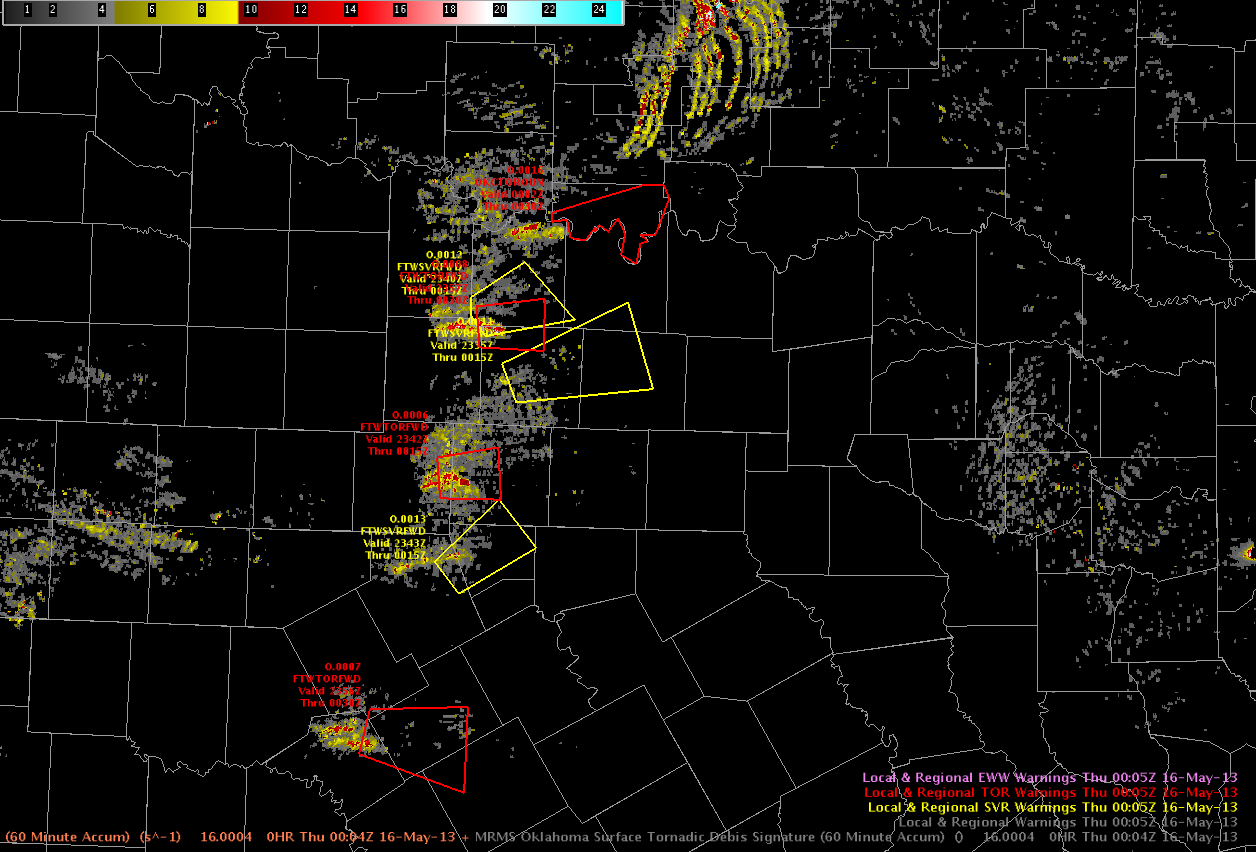
Yesterday was the busiest day of the week 2, if not our entire experiment.  We localized to the OUN and FWD county warning areas.  Mazur/Ostuno handled to the OUN domain, taking time to examine pGLM lightning data from the OKLMA and work with the NASA-SPoRT moving trace tool.  Along the way they issued a number of severe warnings and a few tornado warnings on radar circulations.  Scotten/Helge managed the mesoscale desk across the region, providing some detailed updates on the LAPS/OUN-WRF and GOESR CI products.  Picca/Leonardi managed the warnings over the FWD CWA.  Though activity across this region began slowly, the evening finished with multiple tornadoes still on the ground.  They

EWP warnings and Rotation Tracks at 0005 UTC on 16 May 2013.


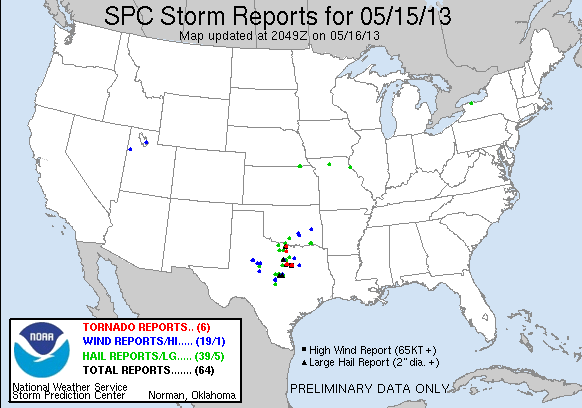
SPC storm reports from 15 May 2013.  (Likely to updated as more tornadoes are added)
SPC storm reports from 15 May 2013. (Likely to updated as more tornadoes are added)

A bit of the feedback from the debrief:

–The HSDA performed better than previous days this week, however, it may be nice to add an area or volume criteria (compared to individual pixels) to increase forecaster confidence.

–The MESH and lightning flash rates had comparable trends in the OK region, with the flash rates typically preceding MESH by ~1-2 min and reports on the ground by ~15 min.

–The forecasters found manually adjusting the moving trace for every frame to be a bit tedious and would prefer an “apply to all” option.  As it stands now, the tool is difficult to use in realtime, but still could be useful for post-analysis and shows great promise for future operations.  Forecasters are particularly interested in the capability of displaying trends from multiple fields on the same graph (e.g., flash rates and hail size).

–The LAPS instability field was quite useful when combined with a radar mosaic.  Particularly early on in the FWD domain, this field provided clues to when storms would decrease or increase in intensity with time.

–The LAPS 22 UTC 1-km forecast was incredibly accurate 2 hrs out.  The updraft helicity product was useful in visualizing the location/strength of the activity.

–MRMS rotation tracks were commonly utilized by the warning forecasters.  They found that they helped draw polygon size / shape and reduced FAR area.  The rotation tracks / AzShear product was a time saver particularly for situational awareness (calling attention to storms /locations).

-Kristin Calhoun, Week 2 Coordinator

Tags: None

Can it be…LAPS CAPE is wrong?

Storms continue in a linear convective mode across the GLD CWA.  The 18Z run of the LAPS suggested lower instability ahead of the line as it continues to sink south.  Here is the current setup.  As you can see, the storms are maintaining some level of strength as they move into this supposedly more hostile environment.  The mesoscale desk noted that the GOES NEARCAST products maintained higher instability across the CWA and are probably more correct in this scenario.  Just goes to show that no product is right all of the time, or even most of the time!

CL

LAPS_radar_051613_2153

Tags: None

Close…but No Cigar/Held Off SVR Across N NE Based on MRMS/GOESR

SevereDecision2138UTC

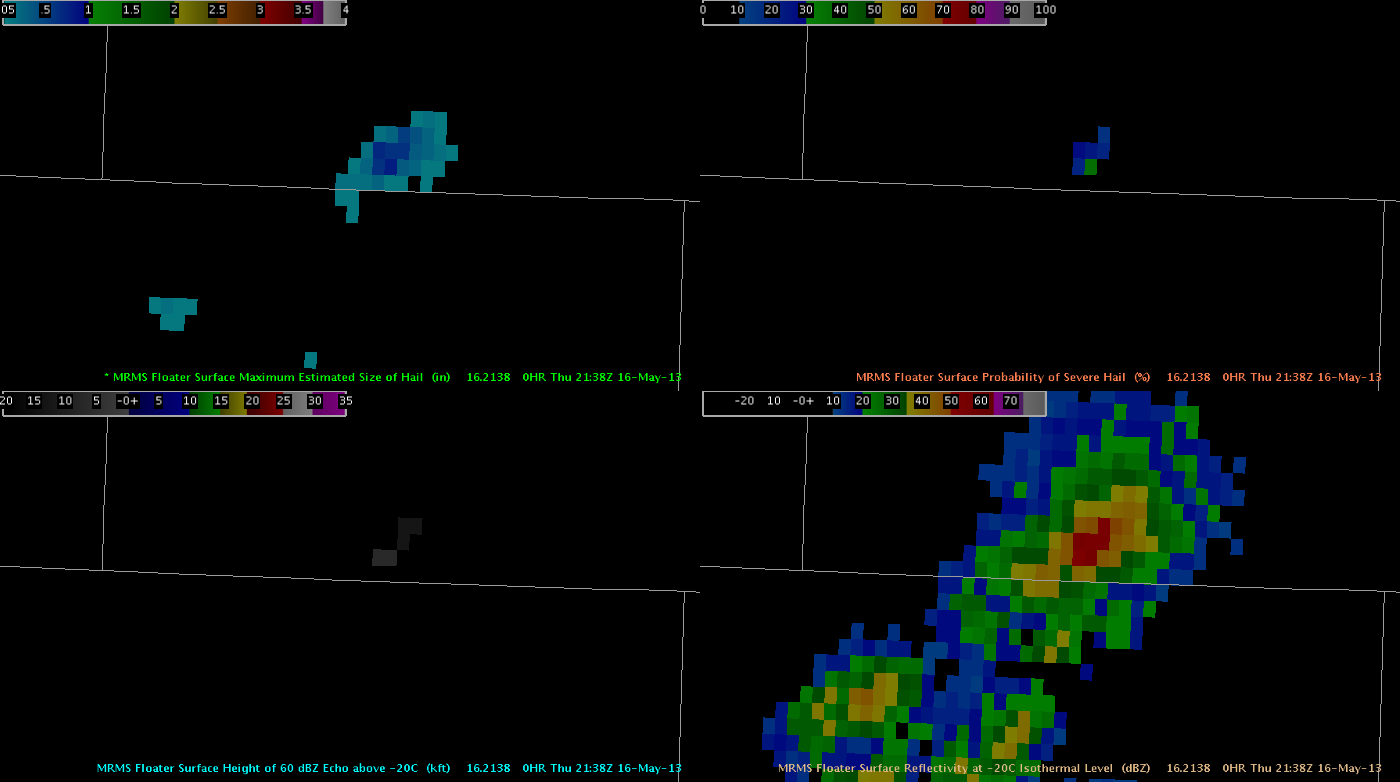
Held off issuing a severe thunderstorm warning for a developing storm over northern Nebraska due to MESH staying around 0.75 inch and maximum reflectivity of only 55 dBZ at the -20C level.

2SevereDecision2138UTC

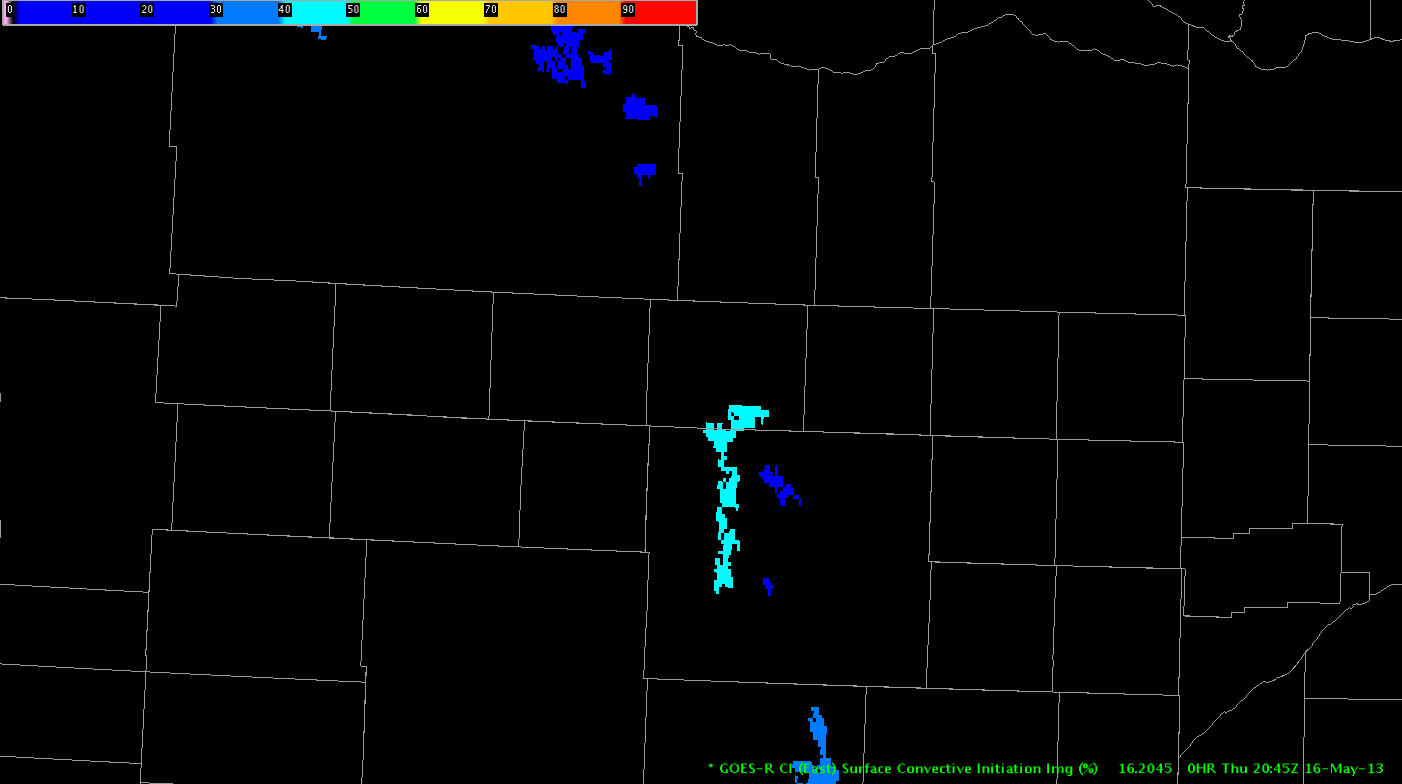
In addition, the GOESR UAH Convection Initiation Products depicted a few pixels of 10-40% in the hour prior to this storm developing, perhaps suggesting that the environment may not be conductive for explosive storm development.

Tags: None

Flash Initiation Density product and updraft strength

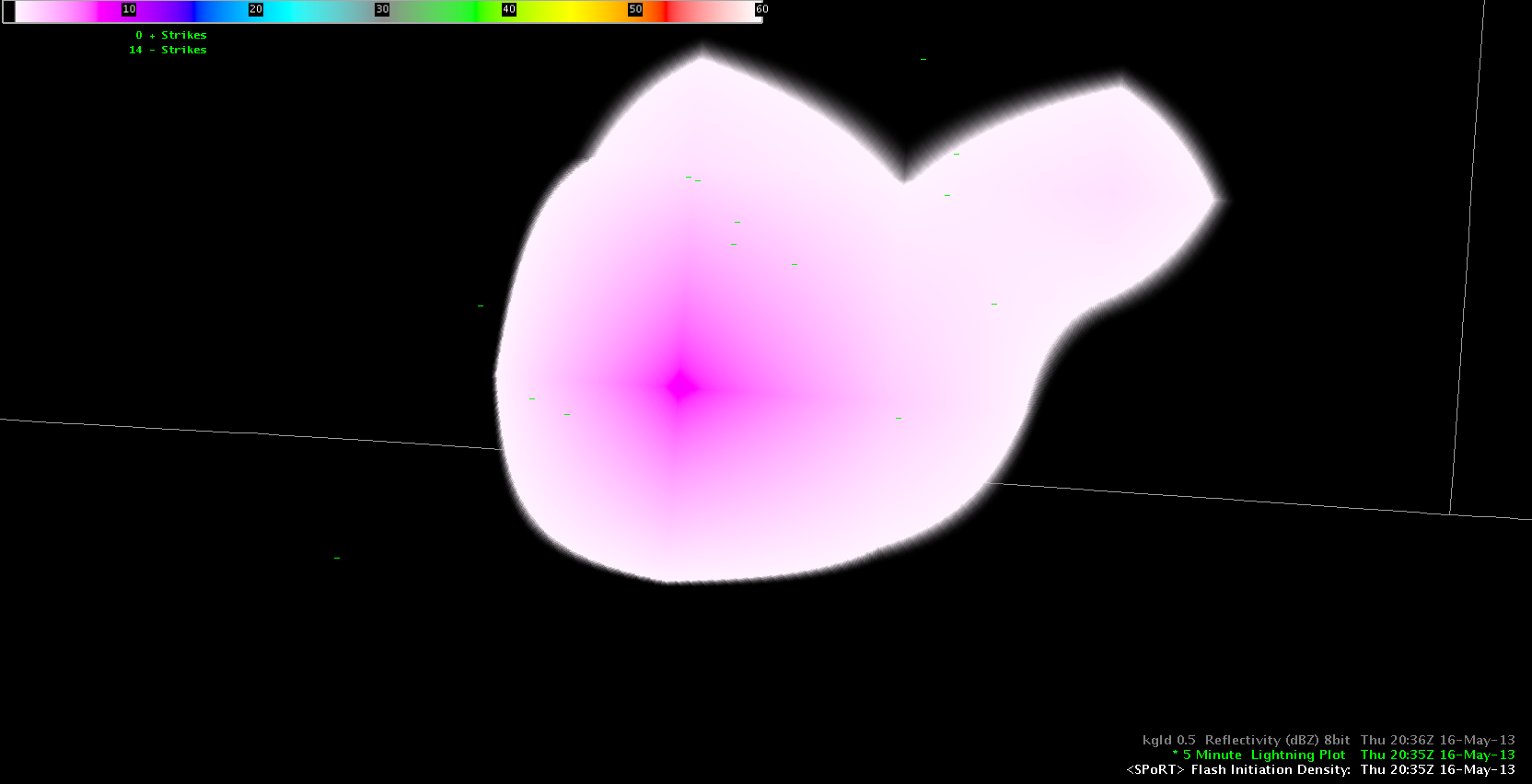
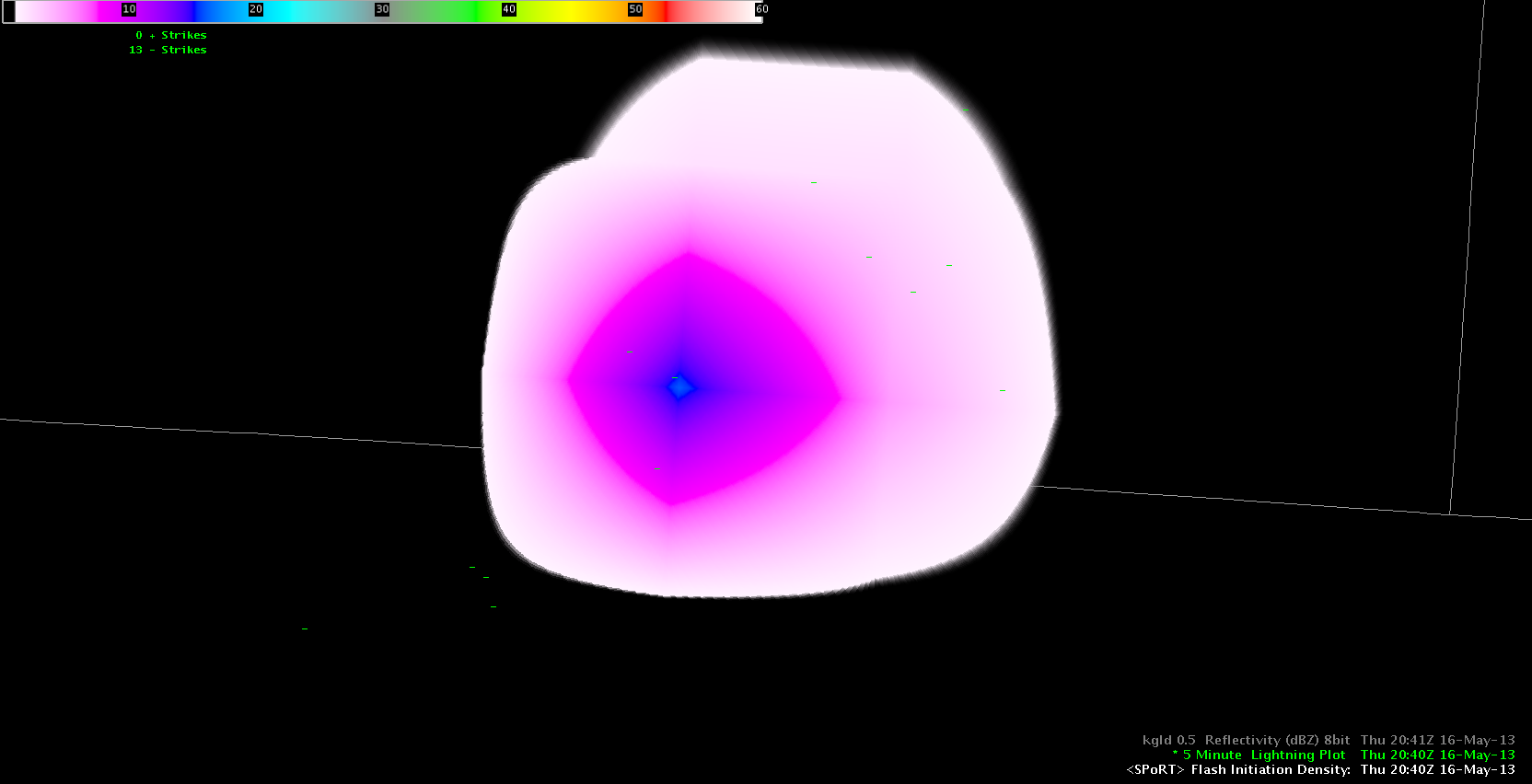
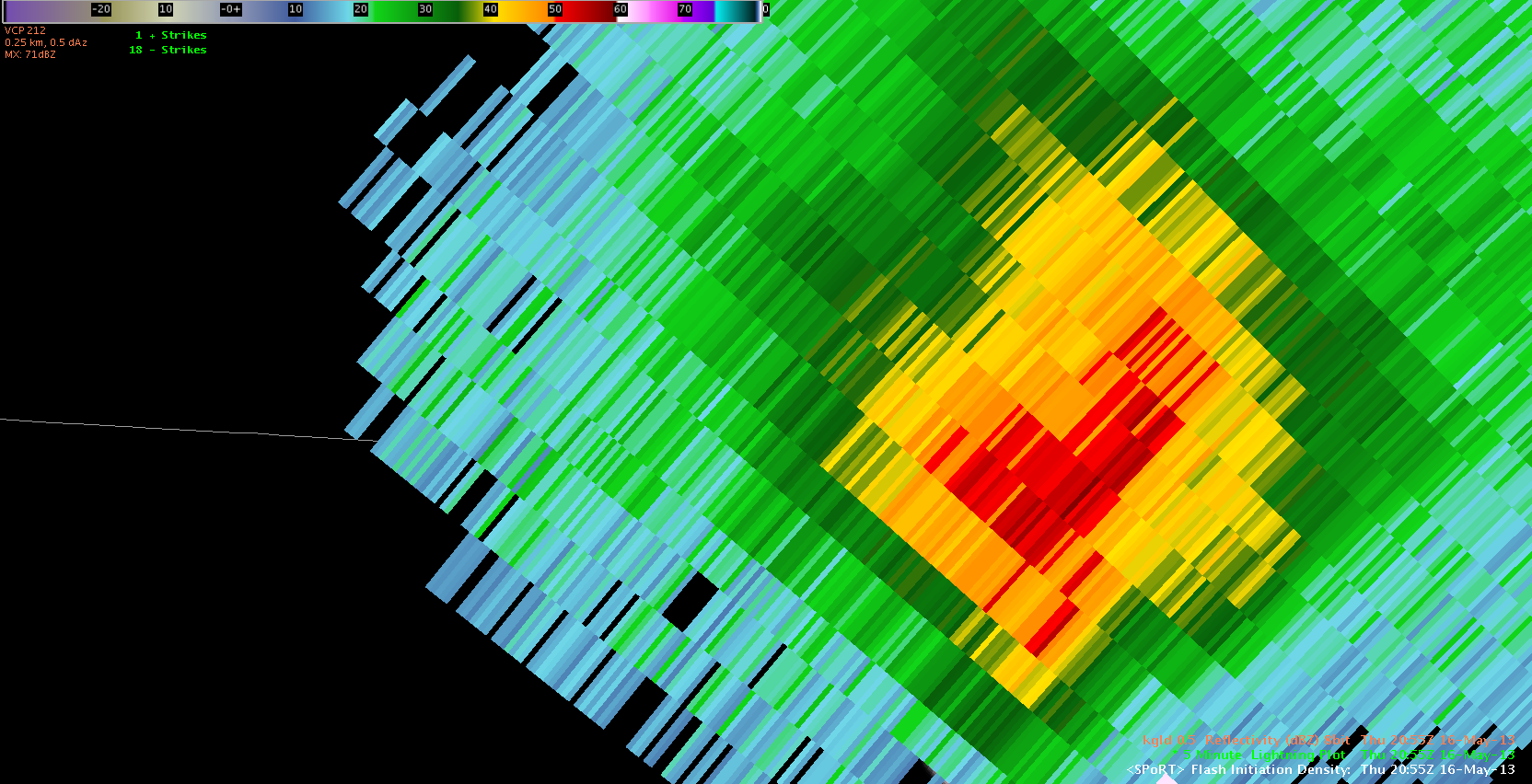
Playing a bit with the SPoRT flash initiation density product and the evolution of an  updraft. Although it’s not a serious storm, it represents the ongoing pulsating activity very well which could eventually gain strength when entering a more unstable air mass to the east. Below you can find the ‘Flash initiation density product’ at 2035Z and 2040Z, showing a marginal increase in lightning activity. Reflectivity at the same time showed a core with 35-40 dBz and only a few isolated lightning strikes occurred.

pglm_2035Z pglm_2040Zradar_2055ZAt 2055Z, the storm finally strengthened in reflectivity fields (the core peaked at near 60 dBz) . Although that was just a temporal strengthening trend of that storm it is great to see the lead time you get with that lightning product before the updraft eventually strengthens. Helge

Tags: None

Comparison of OUN-WRF / 3km LAPS / Actual Reflectivity

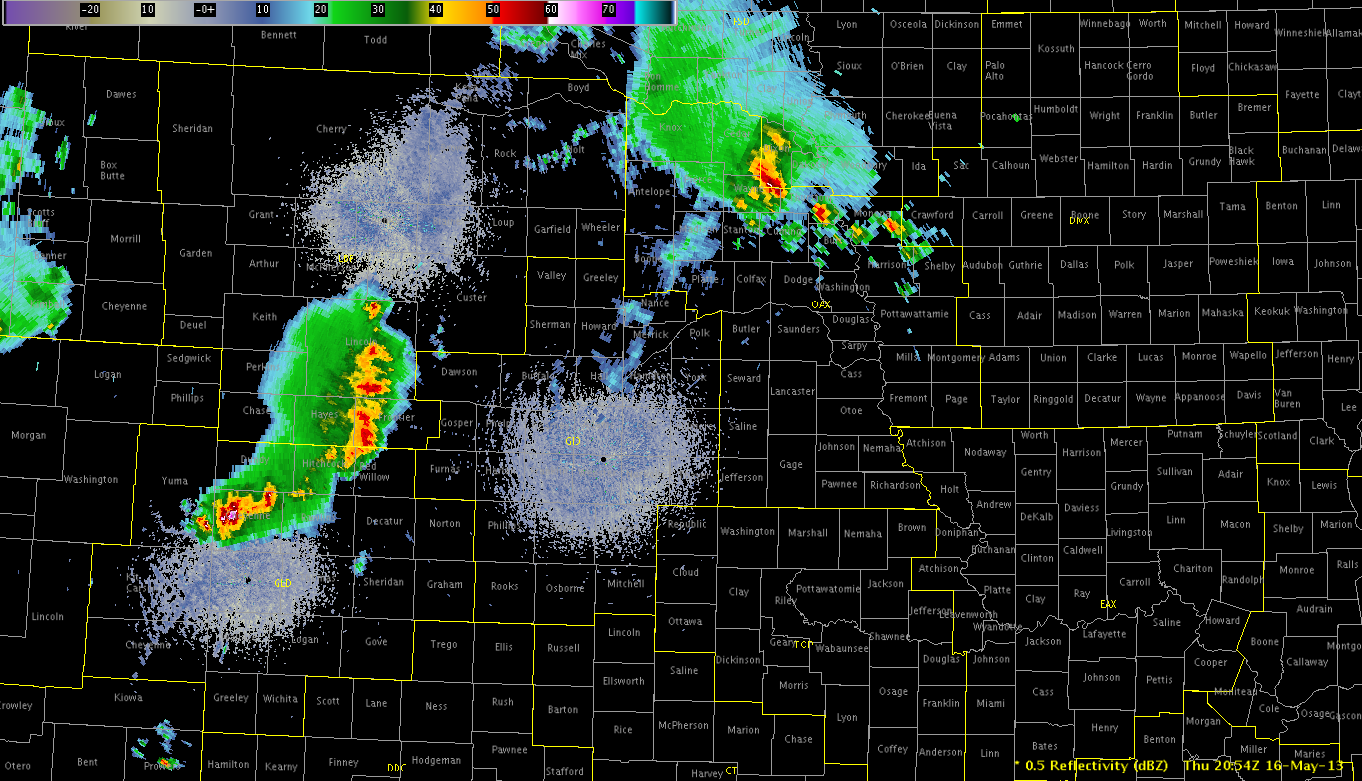
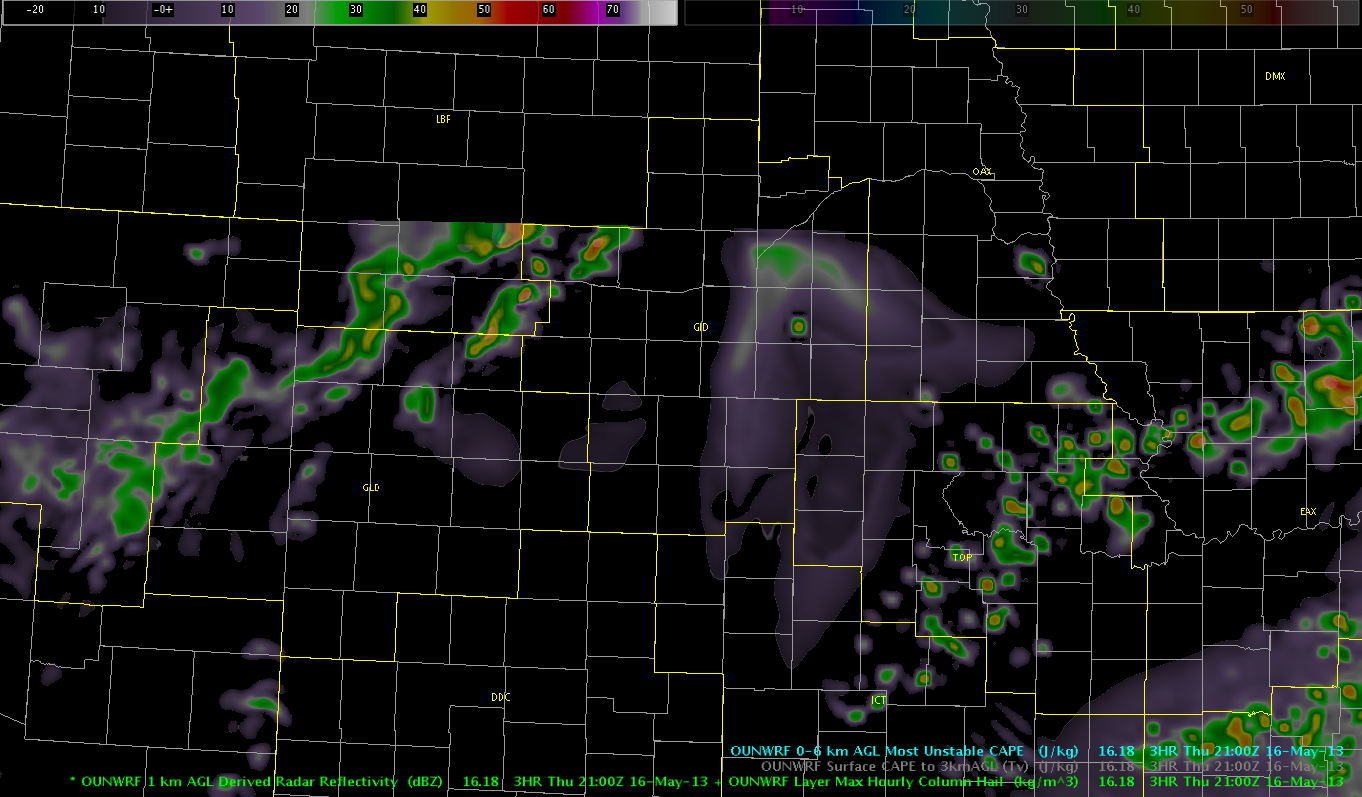
Setting up shop in North Platte, NE today. Quite a marginal setup with relatively low instability / higher based storms based upon Nearcast, higher res LAPS, and more conventional data. Enough shear to organize structures into small line segments at present. Here’s a comparison of some of the higher res model Z output and actual Z at 2100Z. Neither have reality nailed perfectly, but it looks like the OUN-WRF has a slightly better idea of the structure, whereas LAPS has more discrete cells.

Actual Reflectivity

mosaic

OUN-WRF

ounwrf_simzLAPS

laps_oun_sim_zPicca

Tags: None

Close, but not quite…GLD CWA and MESH/CTC

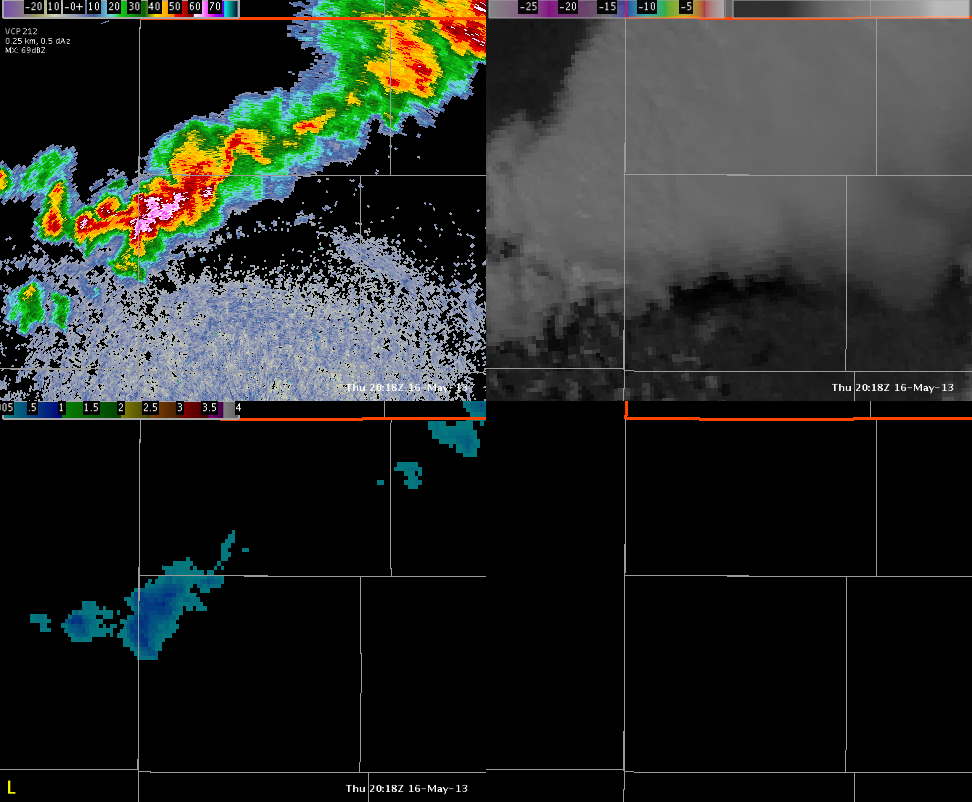
Setting up in the Goodland KS CWA today.  A small cluster of storms is ongoing and certainly producing a lot of rainfall and lightning…note the 0.5 reflectivity on the upper left.  To the upper right is CTC on top of the visible.  No detections here…likely due to anvil cirrus hinderance.  On the lower left, we have MESH from MRMS.  Nothing at one inch or above here either.  Reports from the area have consisted of small hail lately…0.75″ and less.  This seems to reinforce the marginal nature of the storms depicted by MESH and other experimental products.

CL

ref_ctc_mesh_051613_2018

Tags: None

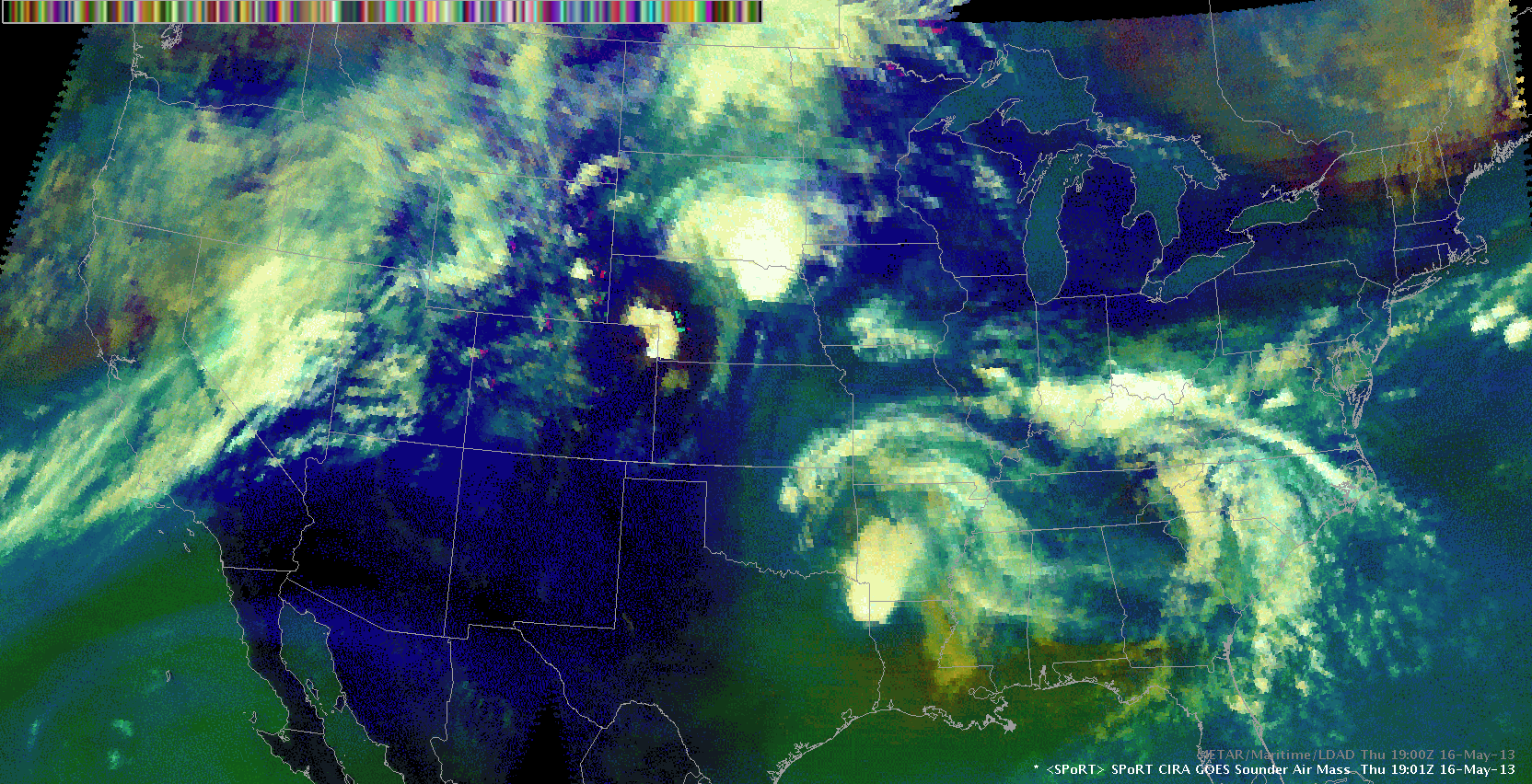
GOES Sounder Air Mass

RGB_20ZThe GOES Sounder Air Mass image is very useful in highlighting the different features of interest for today. First of all the compact disturbance which is about to leave NE Colorado to the east/northeast is well visualized by mid-level drying in the image. Weak forcing ahead of that feature already caused some initiation over N/NE Nebraska with another round of storms evolving over extreme NE Colorado. Of interest is a southward extending and weakening vorticity lobe which is about to enter Kansas from the west right now. Also, the dryline is well recognized by that product, showing warm/moist air ahead of the dryline advecting to the north (green-ish colour). This correlates well with mid-level moisture, seen in latest RAP output. A gradual transition from ‘green to blue’ occurs when moving westward (e.g. towards the  TX Panhandle). This corresponds well with some residual low-level moisture f.ex. in the lowest 850 hPa, which gradually mixes out. We will monitor both the dryline and the eastward moving but weakening PVA lobe for some kind of interaction during the following hours and eventually for sporadic CI.  Helge

Tags: None

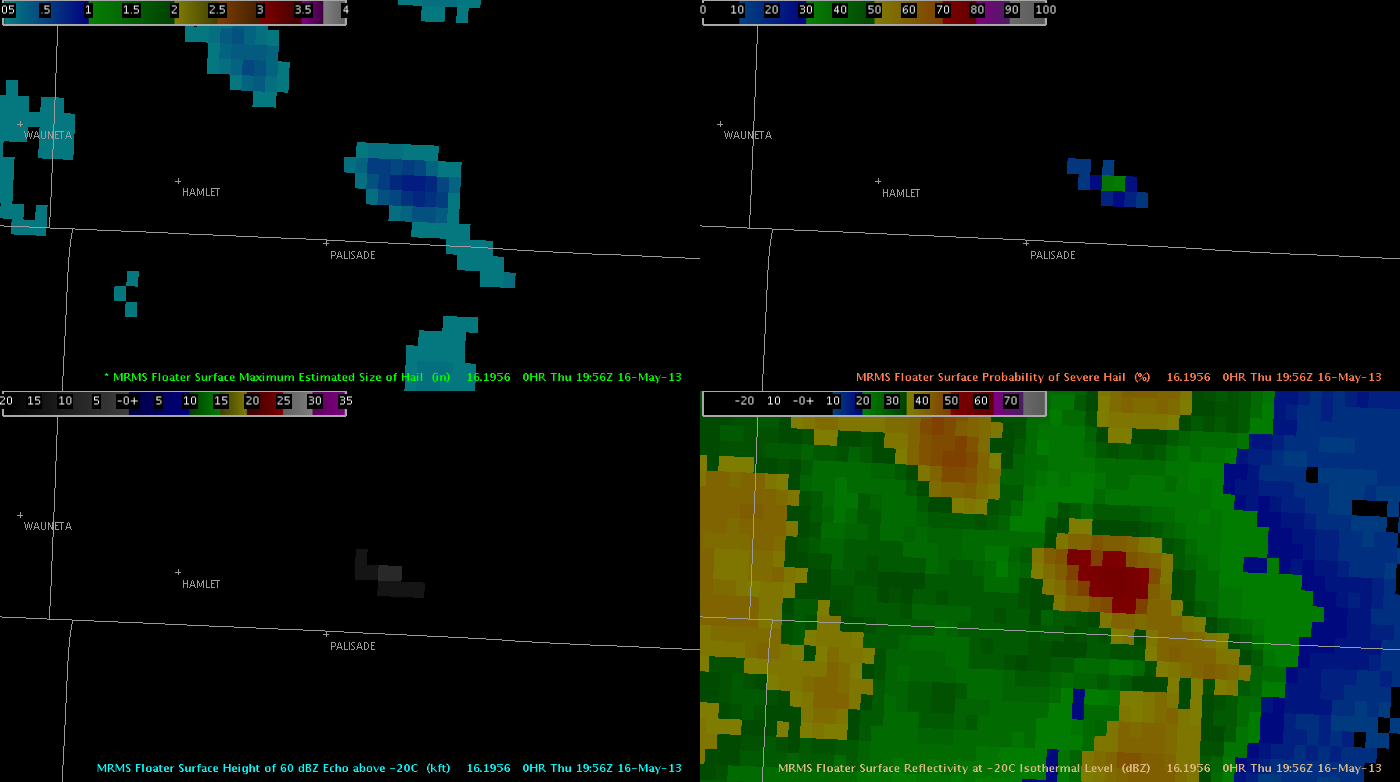
Examination of MRMS Products During Quarter Hail Event in SW NE

HaysCenterHail1954UTC051613The following images occurred at 1954 UTC on May 16, one minute before quarter size hail was reported 9 S of Hays Center, Nebraska.  MESH slightly underestimated the hail size with a value of 0.79 inch.  Severe hail probabilities had a maximum of 36%.  The 60 dBZ echo was -13.12 kft below the -20C level, due to possible underestimation due to the lack of nearby radars.  There was a maximum of 57 dBZ at the -20C level.

Tags: None