MAF: “Worst Testbed Polygon Ever”?

Forces are conspiring against me. The SVR polygon was originally issued this way.

Over the next 45 minutes, the two storms split and the left-mover from the original eastern storm split again. All the storms eventually moved at 60-90 deg angles away from the original track.

The coup de grace was the “right-mover” from the second split later showed a very strong antimesocyclone from KLBB. It is also moving VERY slowly SW. Will have to upgrade to a TOR and probably a FFW.  Ug.

Glad these warnings aren’t going anywhere…..or are they?

SNELSON

Tags: None

LBB: Finally a Thunderstorm (and it’s Severe)

Issued a severe thunderstorm warning for Yoakum county. A splitting supercell over Lea county New Mexico moved north-northeast toward Yoakum county. Although the most severe portion of the storm looked to remain west of our CWA border, a new updraft on the east side developed and moved toward/into the southwest corner of the storm.

MESH showed max hail of around quarter size, but opted to go slightly higher based on anticipated updraft strength.

Update:

The storm has begun to surge northeast. LBB radar now shows 60 dbz to almost 40kft. MESH product has shown some increase to ~1.5, but had not responded yet to the strengthening supercell. Added 2″ diameter hail to the warning, as well as gusts aoa 60 mph.

Tags: None

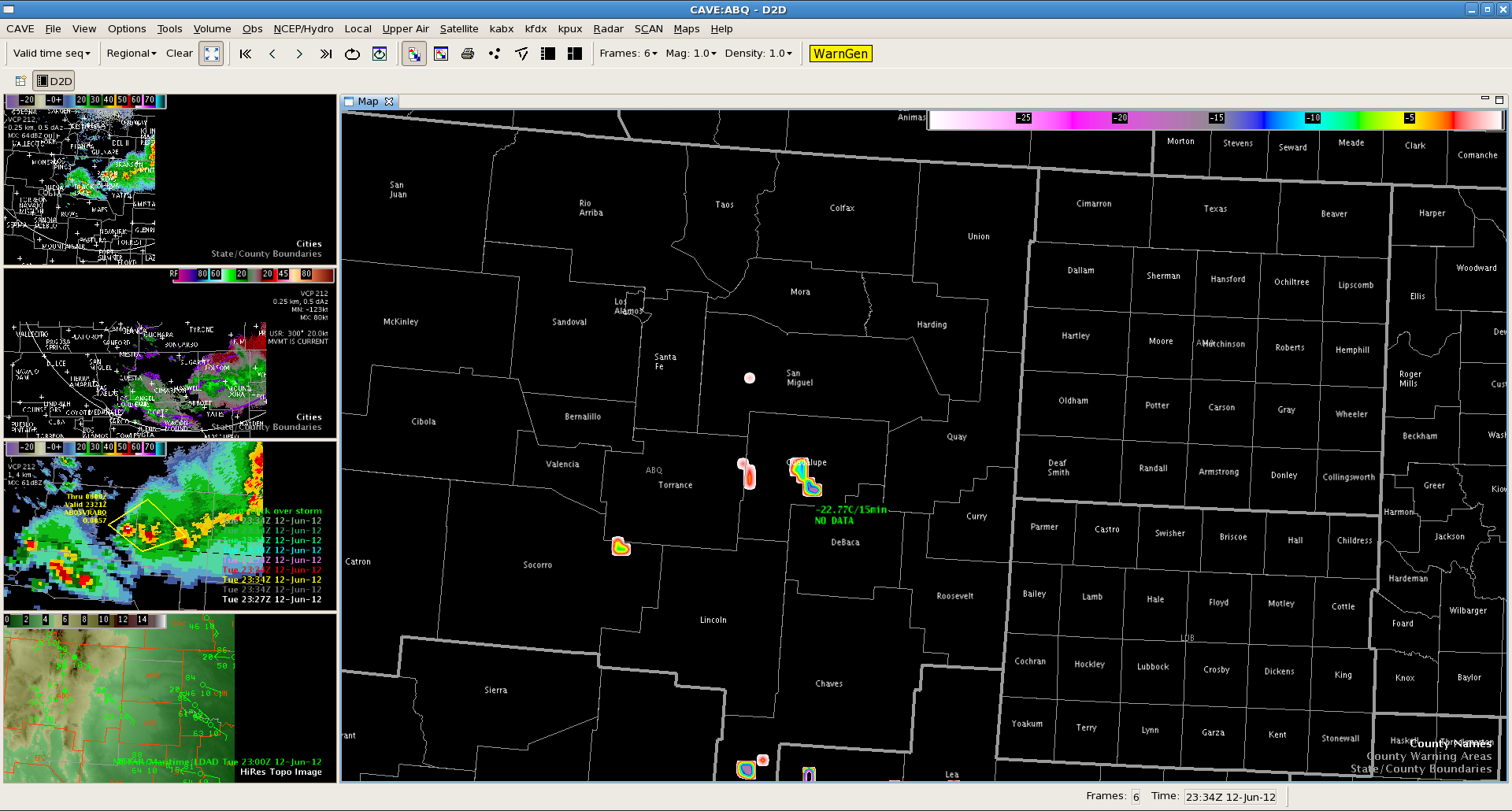
Watching New Development in San Miguel and Western Guadalupe Counties for Possible Warnings…0021Z ABQ Update

New towers going up western Guadalupe and San Miguel Counties being watched closely for cooling cloud tops around -15C/15min.  If growth rate increases slightly, may need additional SVRs for this area shortly. Last minute report just came in of 1 inch hail with warned storm over eastern Guadalupe County southeast of Santa Rosa.

Garmon/Dutter

Tags: None

MAF: Missed a Left-Moving Storm in Lea county

Had to issue a new warning to account for a left moving storm in eastern Lea County, NM. 3DVAR did not pick up any sign of the antimesocyclone, which is not easily seen in the low levels.  Should the updraft helicity or more likely, helicity show negative values for cases like this?

Update: we also missed the right moving split from the western storm. Would not want to be the warning forecaster in MAF. Notice the splits in the MESH tracks.

Tags: None

LUB – We’re BACK!

Strong convection has finally initiated over southeastern New Mexico. Storms are exhibiting splitting characteristics as they move toward the South Plains. Again, the latest OUN WRF seems to have a good handle on location as storms move into the southwest part of the CWA.

The Cloud Top Cooling was rather impressive with the cells that increased in severity over Lea County NM. Cloud top cooling rate was above 30 degrees C/15 min in northern Lea County. Close to issuing severe thunderstorm warning for Yoakum County but left movement of storm causing some hesitation at the moment.

Tim/Ty

Tags: None

MAF: Monster storms in Lea County, NM

These images from MRMS should make it clear: these storms are twin terrors of terrible hail.

60 to 67 dBZ to -20C and max MESH values of 2.0 to 2.5 in. Gabe was showing us some nice storm chaser video feeds of the updraft. We put tennis ball size hail in the warning.

Update: Looked at 3DVAR fields for these storms and updraft just increased to 21 m/s with the western storm.  Strong inflow around 17 m/s seen by 1km 3DVAR winds too.

Trained spotter at 700pm reported golfball size hail.

0700 PM     HAIL             LOVINGTON               32.95N 103.35W
06/12/2012  M1.75 INCH       LEA                NM   TRAINED SPOTTER

SNELSON/SKOV

Tags: None

MAF: Very Heavy Rainfall – 88D legacy STP vs Q2

We blogged earlier about flooding likely in the storm on the Reeves/Pecos county line. The KMAF Storm Total Precip shows 4 to 5.5 inches of rain. This seems high for this area. You’d need 2.5 in/hr rain rates to get this, pretty hard with today’s precipitable water, even with high cape and Sfc dewpoints approaching 60F.

We looked at experimental Q2 from NSSL. Greg Stumpf pointed us to the SHSR VPR CORR. He can explain it better, but I believe it uses satellite data to improve radar estimates, especially when few radars are available. The 2300 UTC experimental Q2 with the correction is below.

The “vanilla” radar-only Q2 looks like this at 2300 UTC.

The Q2 is less than the STP, which is probably more accurate. The corrected Q2 looks a little higher than radar only Q2, but still more accurate than the 88D STP.

SNELSON/SKOV

Tags: None