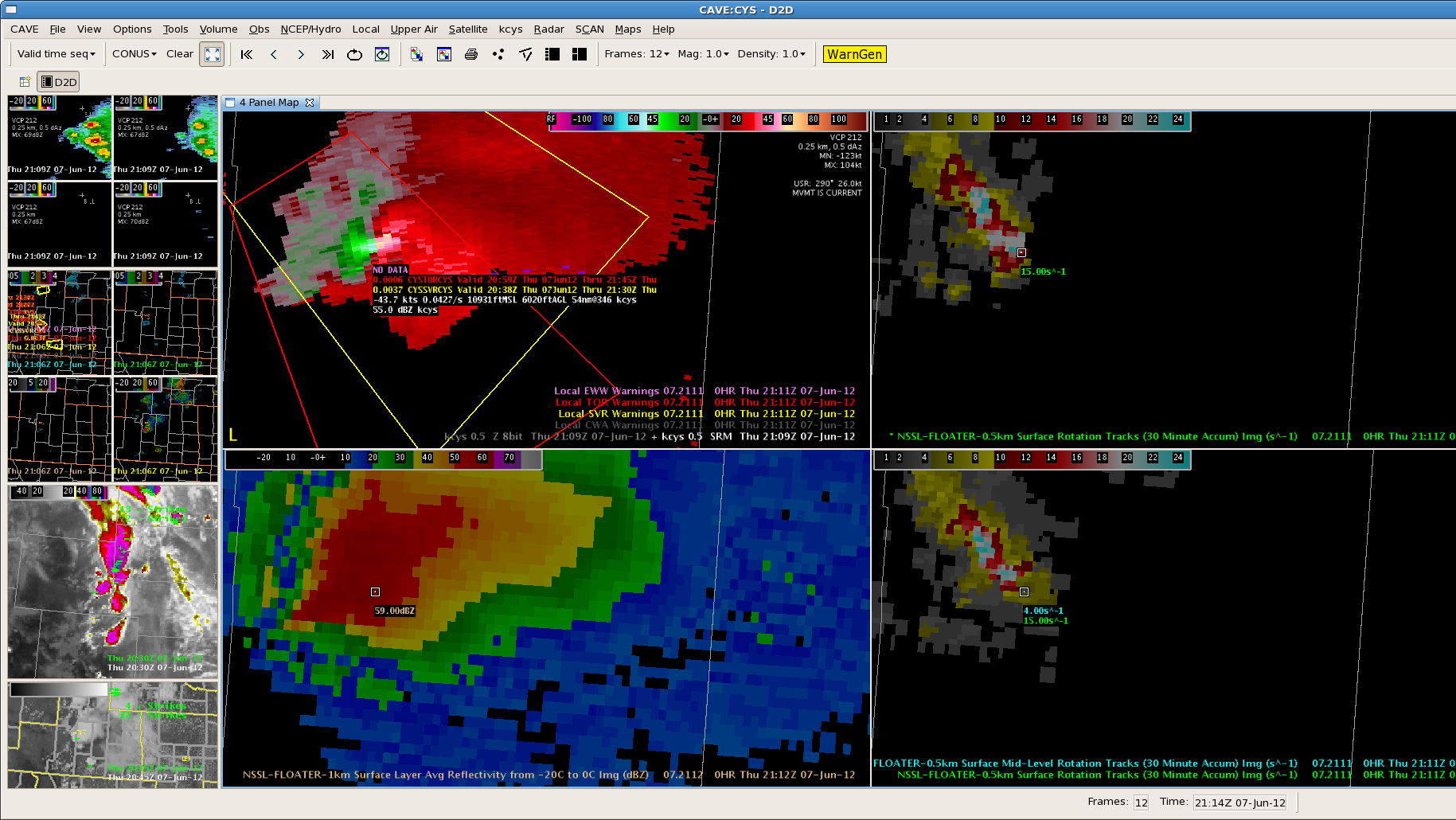
BOU: Here we go!

Well…we decided to issue our first warning based on the UW-CTC. Let’s see what kind of lead time we get!

CTC rates were around -20C/15 min and we are just beginning to see some reflectivity.

We will update to let you know if we get any verification or if this turns out to be a false alarm!

Update: A great question was just posed: do you plot the warning downstream of the developing storm – based on the Warn-on-Forecast? Or do you just use the CTC as a ‘red flag’ and follow the development as it progresses…issuing the warning at a later time?? What are YOUR thoughts?!?!
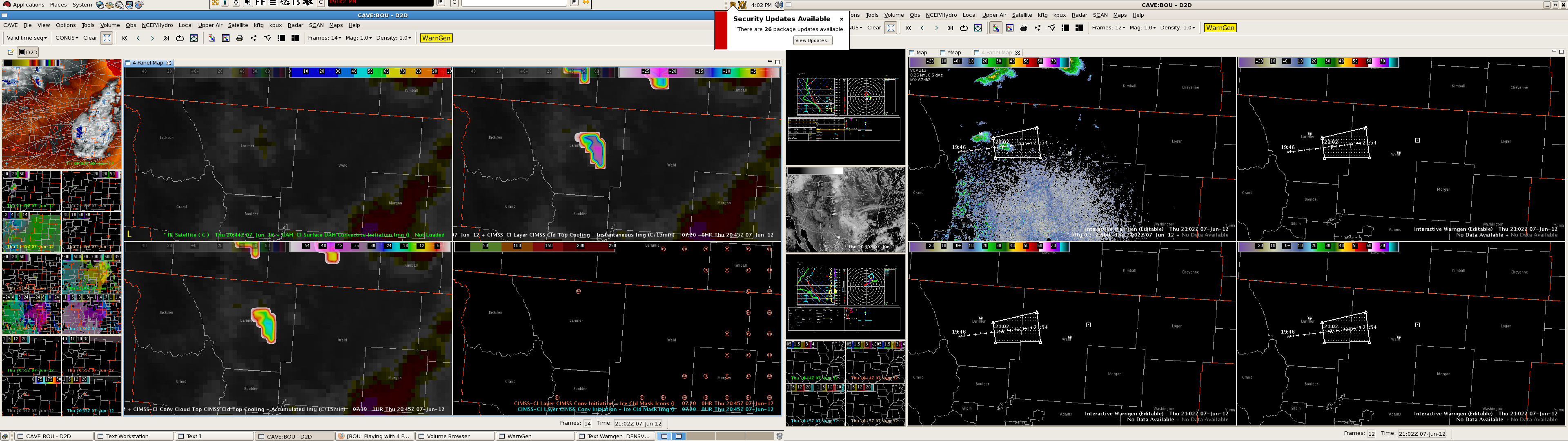
CTC (upper right image on left panel) with first severe thunderstorm warning (right panels)

Update: 2207z….

We issued another warning based on CTC! We seemed to kill any potential with the first CTC-based warning….perhaps this one will work out!!
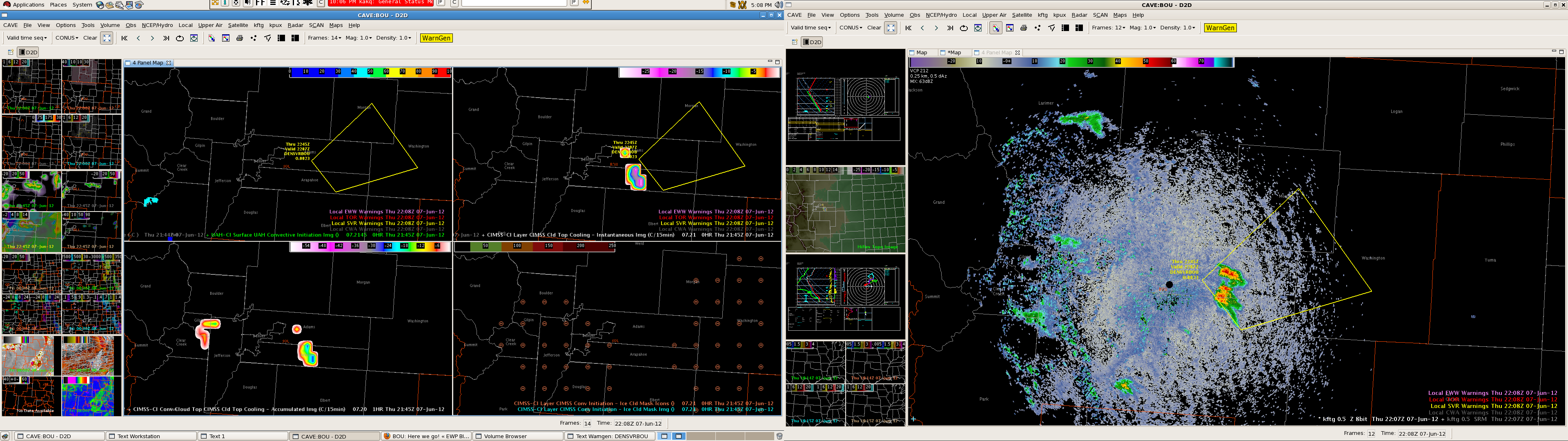
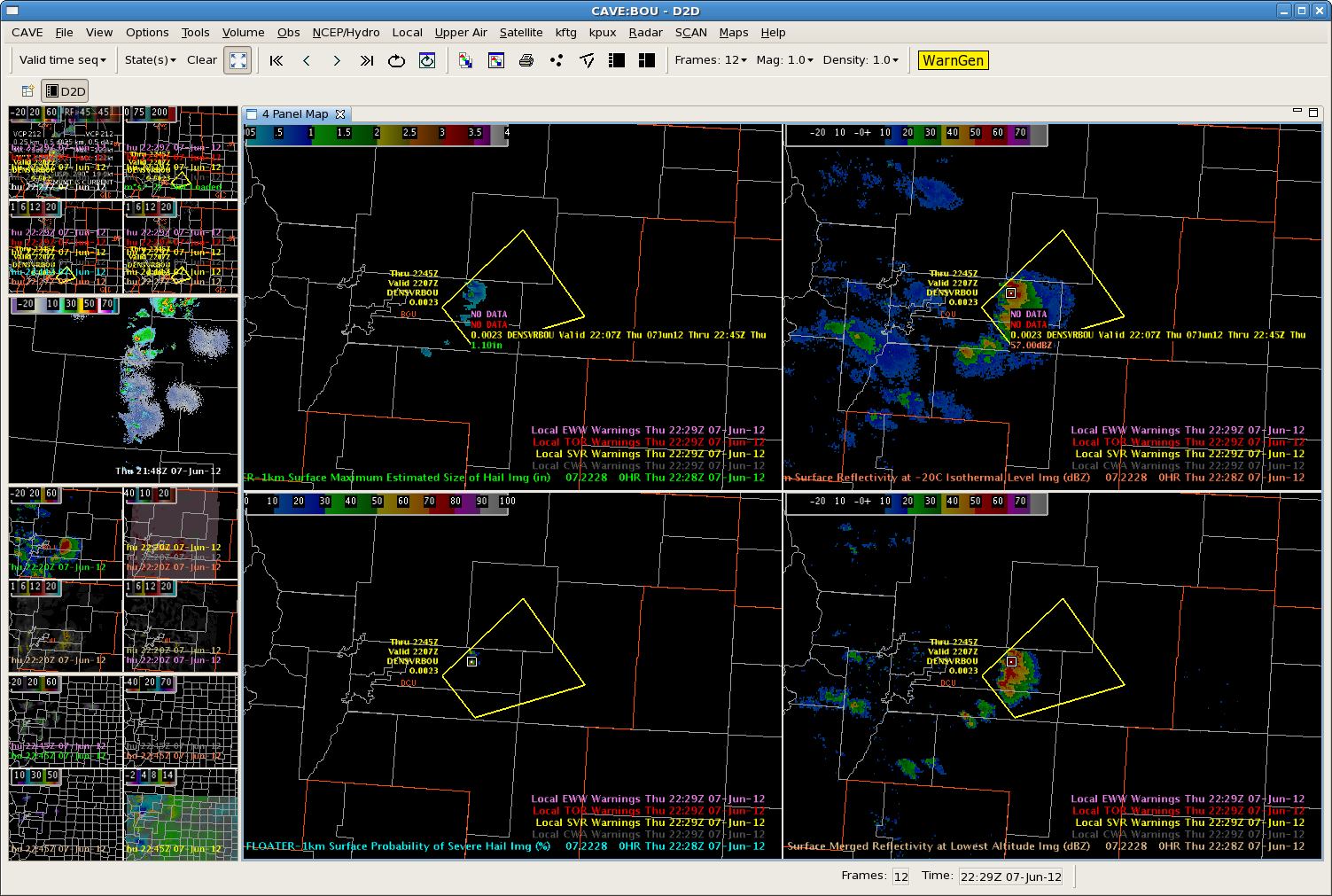
CTC based warning #2

Trends on MESH and reflectivity have improved on this storm and now appears severe on radar.

5:43pm CDT update: VERIFIED! 1.50″ 4:30pm local time (MDT)!! The initial warning was issued at 4:07pm MDT.

Tags: None

BOU: Playing with 4 Panel Displays

Initially, I had the current radar in the upper left panel….and the GOES East and GOES West CAPE, Theta-E diff and PW diff combined into a 4-Panel. Out of curiosity, I decided to load the OUNWRF 1km AGL Derived Radar Reflectivity into the upper right panel. It was kind of interesting to see how the derived reflectivity moved into the more favorable areas of CAPE, Theta-e diff low-mid lvls, and PW diff.

Figure 1: OUN WRF 1km AGL Reflectivity combined with GOES East and West Instability Forecasts

The GOES East / GOES West products are a bit rough to read, but its a nice ‘generalization’.

-KJS

Tags: None

BOU view of the GOESR Nearcast

View of the GOES-R Nearcast values of of CAPE and thetae difference.  In this particular case BOU was located on the GOES E and W boundaries and had two values shown for each parameter. In this example, the E satellite showed more unstable values for the same point (in comparison to the west). As pointed out, this could be correct since each satellite may be looking at different effective levels. Regardless, these products showed the best axis of instability along the eastern 1/3 of CO (along the front range), with the greatest instability maintaining itself across NE CO well past 00Z.

Tags: None

LWX: Watching for lightning…and seeing confetti

We’ve started out watching the LWX CWA in the hopes of getting a feel for the DC Lightning Mapping Array.  The equipment, as well as the storms, are not cooperating however.  So, we have been monitoring the CI products in the hopes of seeing some more significant storms pop up.  The UAH CI algorithm has been treating us to a “confetti” pattern such as in the upper left on the IR image, and the lower right on the visible.  This kind of appearance is not surprising given the relative cool pool of air in place across the northeast U.S.  We have gotten a couple of minor UW CI CTC hits that developed into a couple of decent showers on the LWX 88D, which can be seen in the upper right panel. So far though, not a lot of lightning data to look at, and our domain may be shifting soon.  CL

Tags: None

BOU initial look at OUNWRF

The 18Z OUNWRF indicates that convective activity may quickly become quasi-linear across northeast CO, though with a southern supercell developing off the line toward 00Z. The max updraft helicity peaks in excess of 100 m2/s2 between 23:30 and 00Z before weaken. In addition, the max wind speed field peaks above 20 m/s with many of the convective outflow.  We’ll see how things evolve.

Tags: None

BOU: Another busy day for Traffic Management folks!

Another day…same problem…convection firing up in the vicinity of some major jet routes and arrival gates in the DEN airspace. That means traffic headaches not only for controllers in Denver air space…but for people in ZKC, ZFW, ZAB…etc. You get the idea.

Once again, I’m able to test out the Sim Sat products. Already some activity firing up along the front range….but had I come in at 0530 (for a normal shift), I could have used the Sim Sat products to provide TMU with some good information for their planning purposes. Figure 1, below, illustrates the 19z Sim Sat compared to the 19z IR (lower left). You can see that the Sim Sat products have under-forecast the convection – one of the major limitations of the tool. However – the general location and trends are highlighted very well. With the exception of the development over BOU 😛

-KJS

Figure 1: 19z Sim Sat vs. IR Comparison
Tags: None

CYS:THURS01

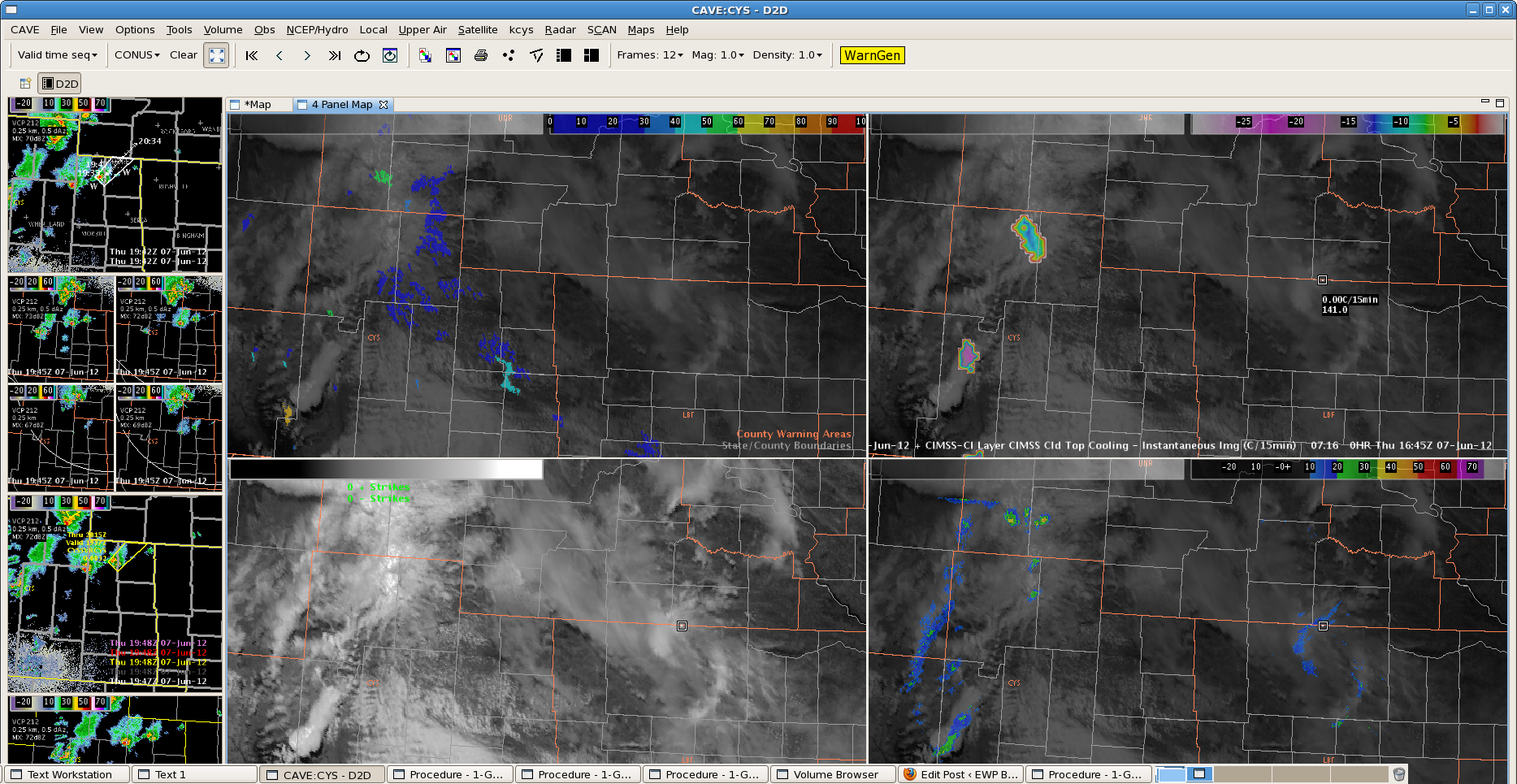
4 Panel cyclone tracks and velocity
Tornadic storm

We have big storms as we sit. Limited 3D-VAR domain and data today. -20C is about 17.5kt we sit down and have 55dBZ over 25kft out the door.

Cooling was earlier with our storms with about 10-15 minutes heads up for 1 or 2 of them.

Cloud tops were cooling before we sat down

Blog trouble….fixed for now. Looking at HRRR for new cell evolutions. The HRRR promising soon with good evolutions in our SE.

23Z dBZ

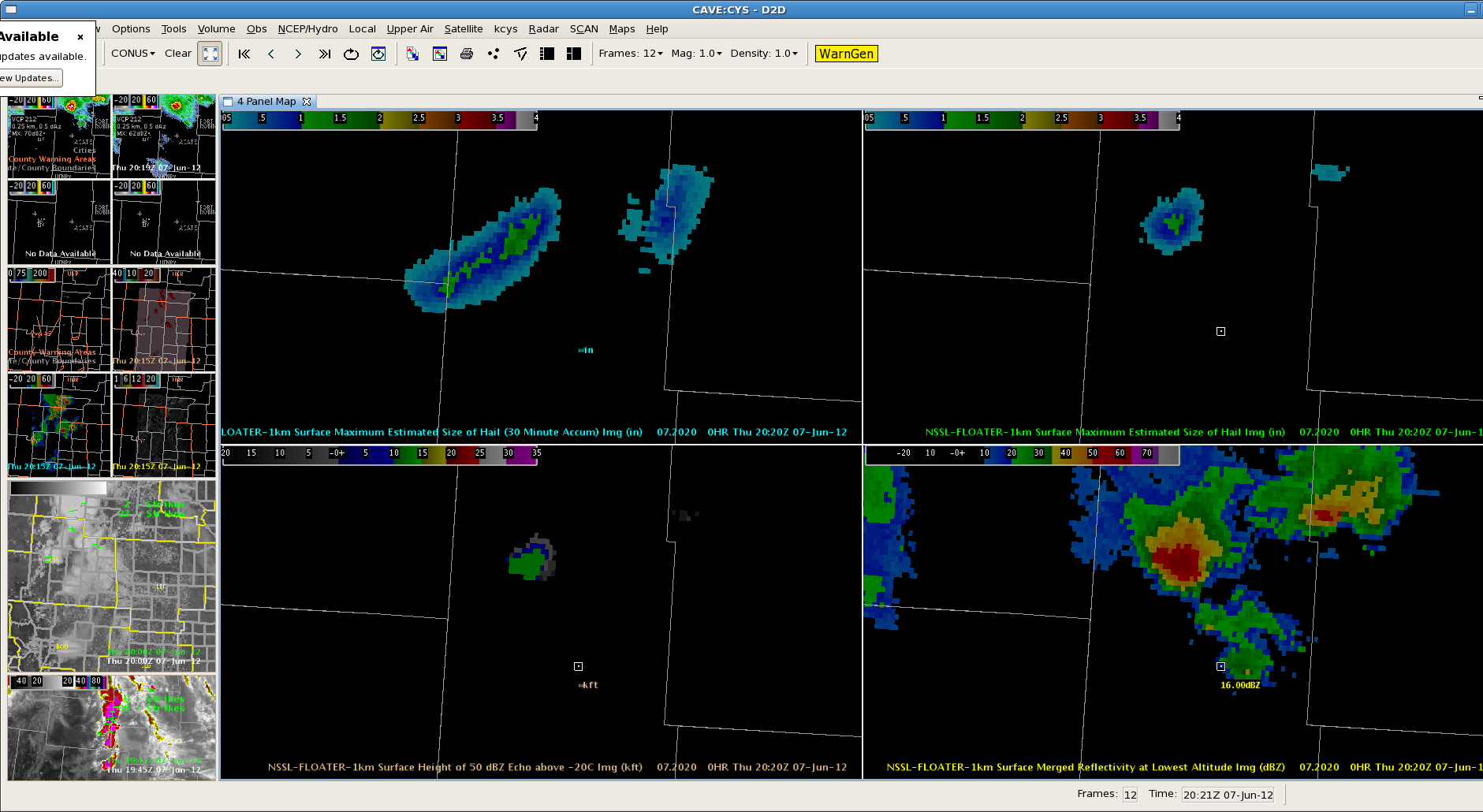
Big storms on KUDX hook echo outside of our CWA. MESH has 1.5 inch hail on our 1 warned storm. SVS issued to update hail size.

MESH 30 and instant
MESH

We got one good report of hail in Albany county with the stronger rotating storm. 1.25 inches at Cow Camp our MESH peaked over 2.0 inches.

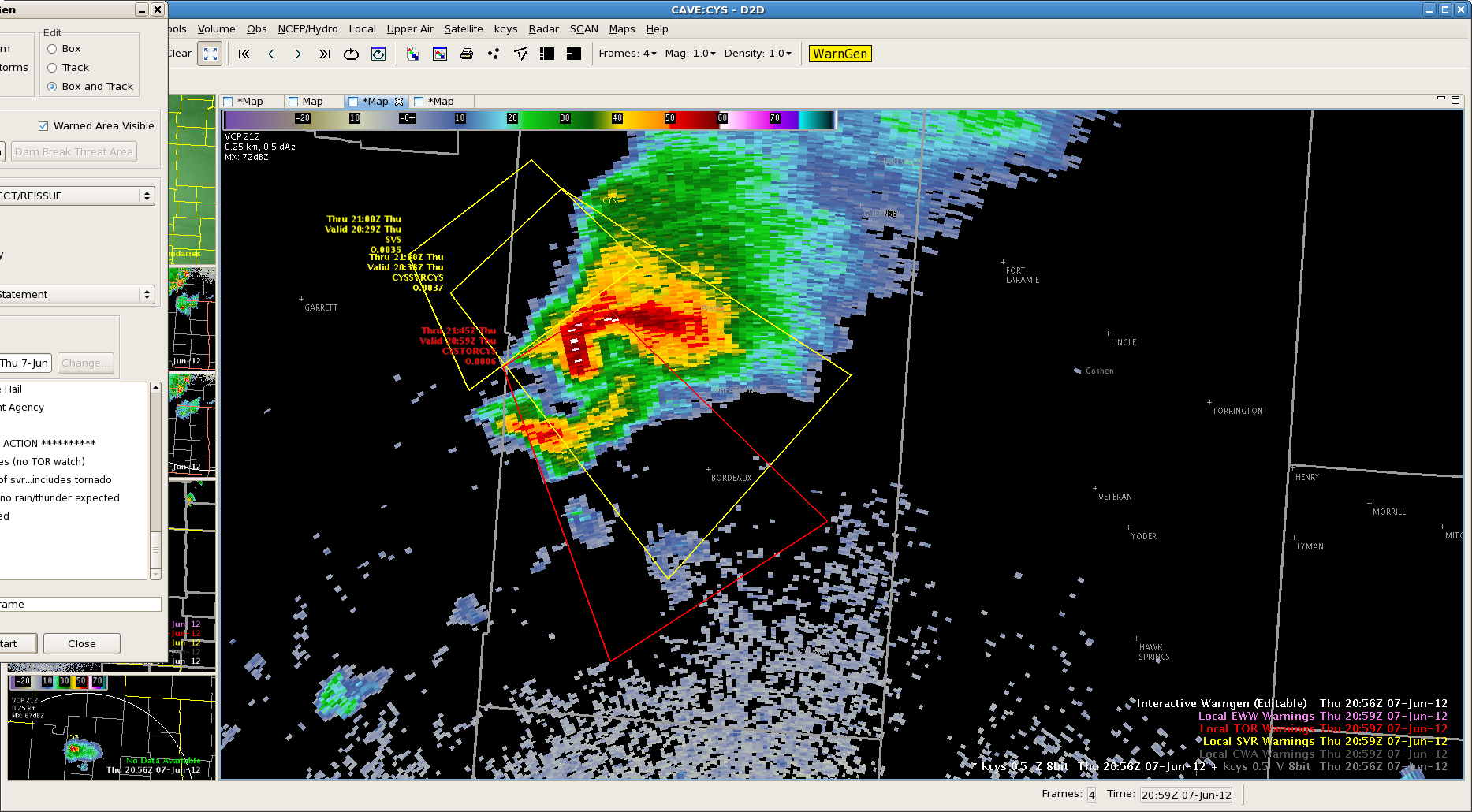
The big storm with previous hail took on better rotation and RFD increased. Mark issued TOR. Nice looking hook. Where is the worm?

Hook with our warnings

The warning now has golfball size hail and eyes on tornado about 305 Local time. Good rotation track data on this storm. Values near high end of scale, maxing out.

Reissued on storm with good pictures of the tornado. Spotter 7 miles south of Bordeaux at 2142.

more tracks and current velocity. Reports of 2nd tornado.

4 panel with the meso and potential tvs

Our main storm still going strong. MESH now firing off on new storms developing to the south. Quiet north. Now have potential 2 inch hail in new storm to south. Began with SVR…Mark issuing 3rd TOR on storm to the north.

New storm developed and quickly spun up. MESH has over 3.25 inches of hail. Good rotation track. Storm may be tornadic. Report now golfball size hail with this new storm. Image included.

Laramie CTY Storm
Laramie CTY Storm
Tags: None

EWP STATUS FOR 7 JUNE 2012: 1-9pm SHIFT

EWP STATUS FOR 7 JUNE 2012: 1-9pm SHIFT

We expect operations will again be focused in NE CO/SE WY.  SPC also has a 5% hail contour that clips the N part of the DC LMA, so we may focus on that early on.

We plan to wrap up operations around 7:30pm and then spend and hour and a half on surveys and preparation for Friday’s webinar.

– T. Smith, Week 4 coordinator

Tags: None

CYS: Loved the Sim Sat Products!

I am very pleased with how well the Sim Sat products performed today. This event was the first time I was able to fully utilize these tools! Based on the training…the sim sat products tended to under-do the convection…here, you can see that the sim sat OVER did some of the convection…most notably over BOU.

Figure 1: Sim Sat Forecast vs Real Time

Had I used this application in my forecast, TMU would have been very  happy with me! This would have been fantastic for planning/re-routing purposes.

Tags: None

CYS: Awesome CI rate…going for lead time!

Was starting to think that anvil contamination would limit use of the CI products by this point.  However, the algorithm put out a nice little surprise.  The cooling rate tops out at -33C/15 min…which is likely the highest anyone has seen so far!  Went ahead and quickly issued a warning on it…going for good lead time…and took a chance and called for 2 inch diameter hail.  Let’s see what happens!  CL

EDIT:  As far as we know, no severe weather from the resulting cell.  An outflow boundary from the eastern convective cells did cause the storm to flare up just before 00Z, but it so far does not look particularly strong.

Tags: None