ILM-RAH early trends

ILM shift began around 18Z.  Disorganized clusters of convection  in Central NC at this time, with widely scattered strong cells, tracking east.  Mostly in RAH, one near the very northern edge of the ILM CWA.  Anticipating some more storm development in Northeast South Carolina and existing storms growing into the CWA.

Substantial downward trend in Hoke County (10) cell noted after reaching DTA threshold.  Robeson Co cell (11) dropped below tracking threshold, and not as a result of cell definition.

SRSOR overshooting top detected for a few scans around 1827Z on Harnett Co/Cumberland Co Cell (9).  Only overshooting top in the Carolinas to this time.

Will consider this when evaluating if new cells can maintain updraft strength.

This corresponds to decreases in Prob Severe, too.

0521 ILM ENI trend 10521 RAH overshoot
[Click to animate]

-Holaday

Tags: None

CI in South Florida

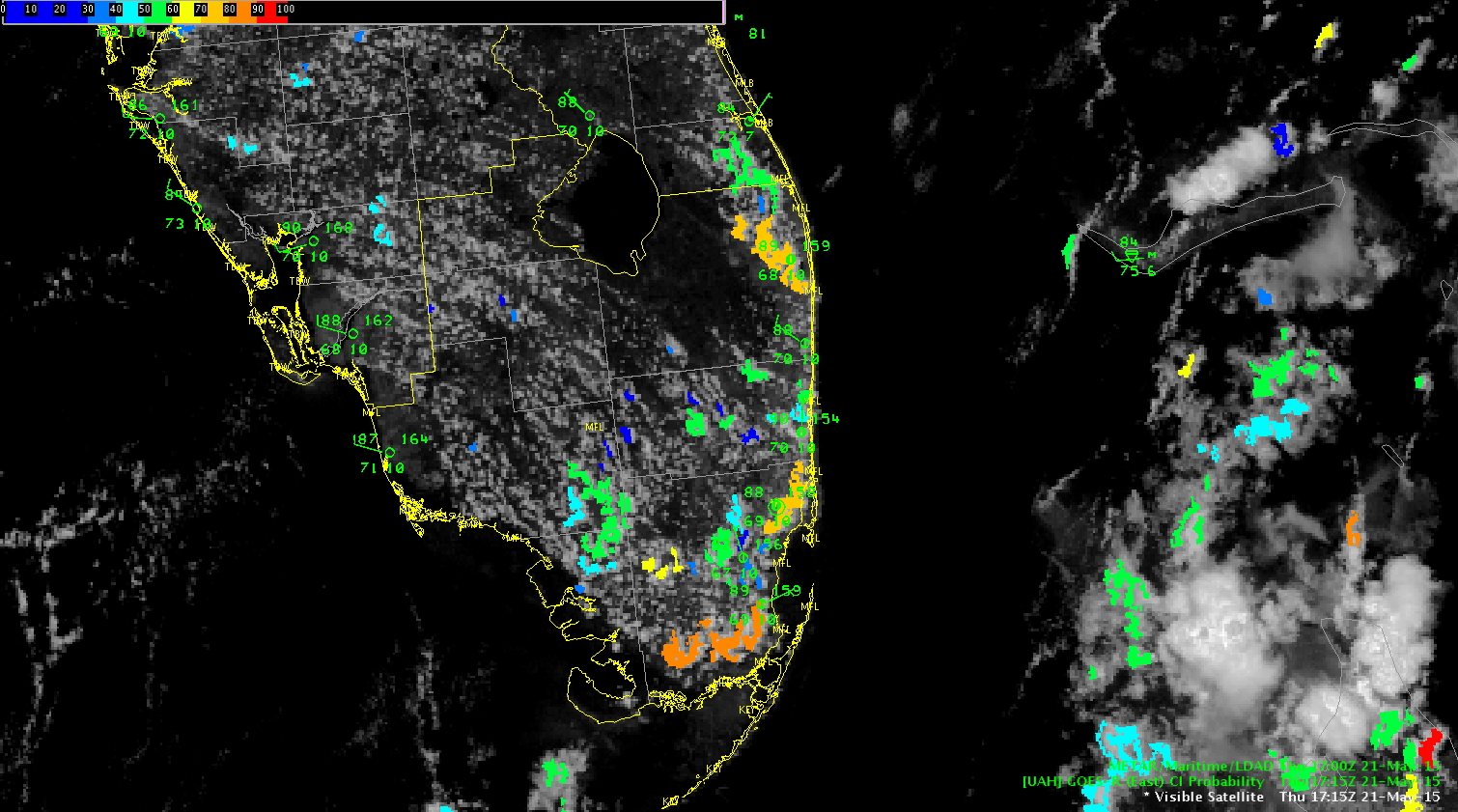
Initial look at CI during spin-up (1715UTC) for MFL CWA shows high percentages along the east coast of southern Florida. Low level flow was NW with temps into the mid 80s to lower 90s. Sea breezes kicked in and CI began to increase. The highest values here (in orange) are 73% to 89%.CI_SouthFL

The first radar image that I was able to see (1800UTC) shows cells popping up in 2 of the 3 highest percentage CI areas.

RadarImage

-snowstrm

Tags: None

Origins of MCV Seen In GOES 1min Imagery?

After many hours of convection over the higher terrain in northern Mexico, it seems as if a cyclonic curl is seen within the GOES 1 min Visible imagery on the top of the complex. The cyclonic rotation is larger in scale than lower mesoscale, and may represent the beginning a convective MCV.

Rocky

1minGoes_MCVOrigin

1minGoes_MCVOrigin

Tags: None

MAF, revisiting product timeline

Earlier post involved timeline of developments with first storms of the shift in Brewster Co, TX.

Some four hours later, a look at Presidio Co storm, near Marfa.  Notable mostly that it represents the challenges of today’s CWA.  (and promise of GOES-R capabilities)
– roughly 150 nm from KMAF NEXRAD, on other side of higher terrain
– along 104 degree W longitude Eastern US/Western US ENI zones
– in area of declining total lightning detection efficiency
– at edge of today’s rapid scan window

Prob Severe
2244Z – first passes 50% (71%), growth rate and glaciation n/a
2356Z – peak value 82%

CI (N/A), stymied by cirrus in this instance

ENI trend also really N/A, cell tracking was not started until 2359

MESH
2348Z – first passes 1″ mark

Tags: None

PGLM 1 min vs 6 min summation

Both the 1 min and 6 min summation PGLM data was useful in diagnosing the storm over HUN. For the CAVE displays, I preferred having both datasets displayed (side by side). Overall, I found the 1 minute data more useful though I wasn’t necessarily loading it with radar data at the same time.

pglm_1min

pglm_6min


George

Tags: None