


The national weather radar system used throughout the United States by NOAA National Weather Service forecasters to “see” weather across the country is unique because it can be upgraded and modified with the newest capabilities,…
Official websites use .gov
A
.gov website belongs to an official government
organization in the United States.
Secure .gov websites use HTTPS
A
lock (
) or https:// means you’ve safely connected to
the .gov website. Share sensitive information only on official,
secure websites.
The national weather radar system used throughout the United States by NOAA National Weather Service forecasters to “see” weather across the country is unique because it can be upgraded and modified with the newest capabilities,…
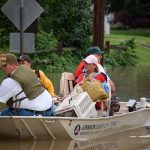
Researchers with the Coastal and Inland Flooding Observation and Warning (CI-FLOW) project are preparing for Tropical Storm Hermine to test their total water level system in North Carolina. The CI-FLOW system captures the complex interaction between rainfall, river flows, waves, tides and storm surge, and how they impact water levels in coastal North Carolina.

Katie is a Ph.D. candidate at OU, studying the impact of rapid-scan radar data on forecaster warning decision-making. Learn more.
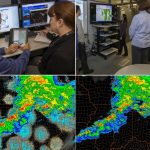
NSSL has partnered with NOAA’s National Weather Service and the Federal Aviation Administration to develop new tools to improve aviation forecasts.

Representatives from NASA’s Jet Propulsion Laboratory will spend a day at NOAA’s National Severe Storms Laboratory in Norman, Oklahoma, Thursday (Sept. 3) to discuss opportunities for collaboration and clarify current areas of development. Following a…
As an operational meteorologist, have you ever thought, “I have a great idea to improve weather forecasting and decision support, but I need someone to help with science, research, and/or development?” Or, as a research…
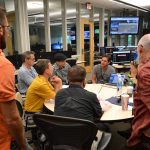
The 2015 Multi-Radar / Multi-Sensor (MRMS) Hydro Experiment aimed to improve the accuracy, timing, and specificity of flash flood watches and warnings.
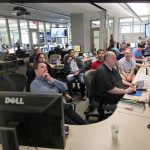
Experiments designed to improve National Weather Service severe weather forecasts will be conducted in the 2015 Spring Forecasting Experiment from May 4 through June 5, part of the NOAA Hazardous Weather Testbed (HWT) Experimental Forecast…
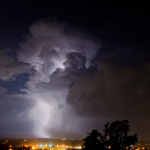
Kristin Calhoun (NSSL/CIMMS) will give an invited webinar to National Weather Service meteorologists and hydrologists on April 1, 2015, about current lightning prediction products in research and development at NSSL.
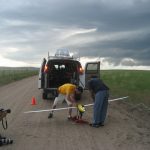
Dr. Brian Argrow, Professor of Aerospace Engineering Sciences at the University of Colorado and an expert in Unmanned Aerial Systems (UAS), will temporarily join NSSL to conduct collaborative research and help advance NOAA and NSSL observational and research capabilities.