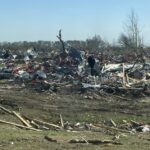
Uncrewed Aerial Systems are opening new avenues for researchers to study tornadoes and gather data while staying safe.
Official websites use .gov
A
.gov website belongs to an official government
organization in the United States.
Secure .gov websites use HTTPS
A
lock (
) or https:// means you’ve safely connected to
the .gov website. Share sensitive information only on official,
secure websites.
Uncrewed Aerial Systems are opening new avenues for researchers to study tornadoes and gather data while staying safe.

On May 18, 2025 a tornado touched down near the town of Arnett, Oklahoma. Researchers with the NOAA National Severe Storms Laboratory (NSSL) were in place to intercept the storm and capture stunning data of the EF3-rated tornado from beginning to end.

New high-speed camera captures hail in free fall to improve public safety

The Warn-on-Forecast System, a revolutionary new forecasting tool being developed by NOAA’s National Severe Storms Laboratory, seeks to equip forecasters with critical information between watches and warnings to allow them to offer longer lead times…
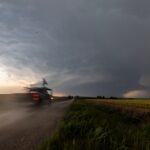
The way violent tornadoes in the United States are rated has changed over time, resulting in no EF5-rated tornadoes since 2013, according to researchers from the NOAA National Severe Storms Laboratory in a paper published…

For the first time, the NOAA National Severe Storms Laboratory’s Warn-on-Forecast System (WoFS) has successfully run short-term forecasts for three geographic areas at once—predicting severe weather, winter weather, and fire weather. The historic milestone demonstrates…

For more than 30 years, the nation’s weather forecasting has relied heavily on the NEXRAD radar network. This network has been the global gold standard in weather radar, however the system is reaching the end of its designed lifespan.
Phased array radar stands as a potential paradigm-shift solution for the future of weather radar in the United States.
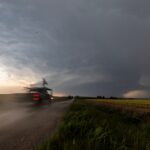
LIFT (Low-Level Internal Flows in Tornadoes) seeks to better understand winds in the lowest levels of tornadoes. To do so, scientists will have to get up close and personal.
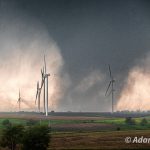
SCIENCE IMPACT: NSSL’s Warn-on-Forecast System yields 75 lead time on Greenfield, Iowa tornado, demonstrating potential for long-range tornado warnings.