NSSL/CIMMS researchers mentor undergraduate students for the summer

NSSL and NSSL/Cooperative Institute for Mesoscale Meteorological Studies (CIMMS) researchers donated their time this summer to mentor undergraduate students through research projects.

The students were selected through the prestigious NOAA Hollings Scholars program and the National Weather Center Research Experiences for Undergraduates (NWC REU). Both programs are designed to encourage students to pursue a future career in atmospheric science research through mentoring, tours, lectures and field trips.

NOAA Hollings Scholars and NWC REU programs support NOAA Education goals to develop a future workforce skilled in disciplines critical to NOAA’s mission.

The students are presenting the results of their research projects this week.

Hannah Huelsing (University of Northern Colorado) – REU – “Evaluation of Precipitation Diurnal Variability by TRMM: Case of Pakistan’s 2010 Intense Monsoon”
Mentors: Dr. Yang Hong, Dr. Sadiq Kahn, Dr. Jonathan Gourley (NSSL) and Nicole Grams

Veronica Fall (Valparaiso University) – REU – “Intercomparison of Vertical Structure of Storms Revealed by Ground-based (NMQ) and Spaceborne Radars (CloudSat-CPR and TRMM-PR)”
Mentors: Dr. Yang Hong, Dr. Qing Cao, Dr. Jonathan Gourley( NSSL) and Nicole Grams

Jonathan Labriola (University of Miami) – REU – “Investigating the Relationship of Multi-Radar Multi-Sensor Parameters to Tornado Intensity”
Mentors: Kiel Ortega (CIMMS), Darrel Kingfield (CIMMS) and Madison Miller (NSSL)

Hope Weldon (Jackson State University) – REU – “Toward a Better Understanding of Tornado Fatalities”
Mentors: Greg Carbin and Dr. Harold Brooks (NSSL)

Phillip Ware (Jackson State University) – REU – “Evaluation of a Lightning Jump Algorithm with High Resolution Storm Reports”
Mentors: Dr. Kristin Calhoun (CIMMS), Kiel Ortega (CIMMS) and Greg Stumpf (NWS MDL)

Nathan Korfe (St. Cloud State University) – REU – “Sensitivity of Planetary Boundary Layer Parameterization Schemes on Forecasting Blizzard Conditions for the 11–12 December 2010 Snowstorm”
Mentors: Dr. Heather Reeves (CIMMS) and Dr. Adam Clark (CIMMS)

Lindsay Blank (Millersville University) – Hollings – “On the Predictability of Thunderstorms over the Southwestern United States”
Mentor: Dr. David Stensrud (NSSL)

Rebecca Steeves (North Carolina State University) – REU – “A Comparison of Mesoscale Analysis Systems Used for Severe Weather Forecasting”
Mentors: Dr. Dustan Wheatley (CIMMS) and Dr. Michael Coniglio (NSSL)

Matthew Vaughan (Embry-Riddle Aeronautical University) – Hollings – “The Analyses and Prediction of a Supercell Storm from Assimilating Radar and Satellite Observations using EnKF”
Mentors: Dr. Nusrat Yussouf (CIMMS) and Dr. Thomas Jones (CIMMS)

Burkely Twiest (Penn State University) – Hollings – “Localizing Tornado Climatology in the Contiguous United States: An Environmental Parameter and Convective Mode Focus.”
Mentors: Bryan Smith, Rich Thompson, Andy Dean, Dr. Chris Melick, Dr. Harold Brooks (NSSL), and Patrick Marsh (CIMMS)

Share this:

NSSL partnership with private industry benefits thousands in Arizona
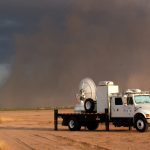
NSSL's mobile radar scans a dust storm near Phoenix, AZ.

NOAA’s National Severe Storms Laboratory (NSSL) has a ten-year cooperative research venture with the Salt River Project (SRP), an Arizona power and water utility, to develop weather decision support tools for the company’s power dispatch, transmission operations, and water diversion. In 2011, an NSSL-produced prototype algorithm that provided advance notice to prepare for the impact of a severe dust storm in Phoenix. This week, NSSL launches a month-long study using mobile radar to verify its microburst and haboob prediction algorithms. These data help SRP serve 920,000 electric customers in the Phoenix area and deliver nearly 1 million acre-feet of water annually to a service area in central Arizona.

Share this:

Evolution of a Quasi-Linear Convective System Sampled by Phased Array Radar

Journal: Monthly Weather Review

Expected publication date: Early online release, June 5, 2012

Authors: Jennifer Newman, Pamela Heinselman (NSSL)

Summary: The National Weather Radar Testbed Phased Array Radar in Norman, Oklahoma scanned a strong line of thunderstorms as it produced damaging wind events across central Oklahoma. The rapid scanning phased array radar created a detailed depiction of these wind events including microbursts, an intensifying midlevel jet, and a small area of rotation.

Important conclusions: The depiction of these events in the phased array radar data demonstrates the complex and rapidly changing nature of strong
lines of thunderstorms.

Significance: Using rapid-scan phased array radar, developing severe weather is easier to detect and important changes in the strength of storms can be
revealed.

Share this: