NSSL team releases Spring 2013 radar software upgrades

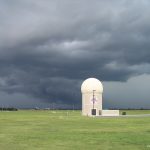
Lowering west of PAR, 2006Twice each year NSSL engineers release a software upgrade to improve the capabilities of the National Weather Radar Testbed Phased Array Radar (NWRT PAR).  The Spring 2013 upgrade was released this week and is now operational.
Specific goals for this project are to improve the quality of meteorological data produced by the NWRT PAR, to demonstrate adaptive scanning capabilities for weather observations, and to demonstrate dynamic scheduling of multi-function scanning strategies.

The new software release includes:

– A new algorithm that identifies and tracks clusters of storms

– Automatic time-based scheduling of storm regions

– Scheduling and processing of a scan that quickly detects newly formed storms

– Real-time controller improvements to reduce initial range of collection and to allow frequent switching between pulse repetition times

– Improvements to control and monitor the system and its algorithms

– Improvements to handle ground-clutter and range-and-velocity ambiguity issues

– Software infrastructure improvements to prevent data drops

New and advanced real-time signal processing techniques continue to provide researchers and users with an optimum platform for demonstrating and evaluating the Multi-function Phased Array Radar (MPAR) concept.

More information about the MPARSUP project can be found at:

http://www.nssl.noaa.gov/projects/mparsup/

Share this:

New video: NOAA National Severe Storms Laboratory Radar Research

New video about NSSL radar research

NOAA’s National Severe Storms Laboratory has led the nation in severe weather research for more than 40 years.

A new video traces NSSL’s legacy of life saving weather radar research from the development of Doppler weather radar to the most recent research with phased array radar. This technology has moved the U.S. from having no warning of severe weather to now an average of 15-minutes advanced notice.  Current research with phased array radar promises to extend the warning lead-time much further.
The video also highlights the unique research to operations partnership between NSSL and the NOAA NWSFO in Norman, Okla.

 http://www.youtube.com/NOAAWP

Share this:

High and Dry – Probing Greenland’s Atmosphere and Clouds

ICECAPS1

– by Matthew Shupe (Cooperative Institute for Research in Environmental Studies)

High atop the Greenland Ice Sheet, cloudy skies portend warmer temperatures and higher winds.  These clouds alter the surface energy budget, diminish the strong near-surface atmospheric stability, and precipitate ice crystal to the surface.  Together these processes comprise the focus of the Integrated Characterization of Energy, Clouds, Atmospheric state, and Precipitation at Summit (ICECAPS) project that has been underway at Summit, Greenland since summer 2010.  Exciting initial results are rolling out, providing the first detailed look at cloud and atmosphere properties and processes over the Greenland Ice Sheet.  The action observed by the extensive, ground-based instrument suite can be followed via daily imagery available at www.esrl.noaa.gov/psd/arctic/observatories/summit.

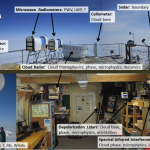
Playing key roles in the U.S. Arctic Observing Network (AON) and the International Arctic Systems for Observing the Atmosphere (IASOA) network, ICECAPS is a collaborative project between the Universities of Colorado, Idaho, and Wisconsin, with substantial support from the National Science Foundation, the National Oceanic and Atmospheric Administration, the Department of Energy, and Environment Canada.  Principle Investigators Von Walden (University of Idaho), Matthew Shupe (ESRL/CIRES), David Turner (NSSL), and Ralf Bennartz (University of Wisconsin) lead a large team of field technicians, engineers, graduate students, and collaborators as they endeavor to make year-round measurements of the atmosphere and clouds in the extreme Greenland Ice Sheet environment.  The instrument suite, housed in a movable facility, includes highly complementary observational perspectives from microwave and infrared radiometers, lidars, radar, ceilometer, sodar, precipitation sensor, and twice-daily radiosonde profiles (see Figure1).  These measurements can be jointly used to characterize the diurnal and seasonal variability of atmospheric structure, cloud microphysical and radiative properties, and precipitation.  ICECAPS provides a new and unique observational examination of these climatically-important aspects of the ice sheet environment and will offer important context for ongoing precipitation and surface energy budget measurements at the site.

At Summit, the atmosphere is extremely dry and cold with strong near-surface static stability predominating throughout the year, particularly in winter.  This low-level thermodynamic structure, coupled with frequent moisture inversions, conveys the importance of advection for local cloud and precipitation formation.  Cloud liquid water is observed in all months of the year, even in the particularly cold and dry winter, while annual cycle observations indicate the largest atmospheric moisture amounts, cloud water contents, and snowfall occur in summer and under southwesterly flow.  Atmospheric ice crystals, or diamond dust, readily form as advecting air masses cool over the ice sheet, leading to outstanding optical displays.  Surprisingly, many of the basic structural properties of clouds observed at Summit, and particularly the low-level stratiform clouds, are very similar to their counterparts in other Arctic regions in spite of the unique environment encountered on top of the ice sheet.  The ICECAPS observations and accompanying analyses will be used to improve the understanding of key cloud–atmosphere processes and the manner in which they interact with the GIS. Furthermore, they will facilitate model evaluation and development in this data-sparse but environmentally unique region.

Related Article:  Shupe, M. D., D. D. Turner, V. P. Walden, R. Bennartz, M. Cadeddu, B. Castellani, C. Cox, D. Hudak, M. Kulie, N. Miller, R. R. Neely III, W. Neff, and P. Rowe, 2013:  High and Dry:  New observations of tropospheric and cloud properties above the Greenland Ice Sheet.  Bull. Amer. Meteor. Soc., 94, 169-186, doi:10.1175/BAMS-D-11-00249.1.


Share this: