CIMMS researcher showcases weather research to local tribe

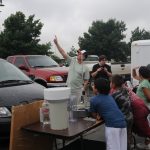
Randy Peppler describes the instruments on top of the mobile mesonet.

NSSL’s mobile mesonet was on display for the third year at the Apache Tribe Environmental Camp, held annually near Apache or Fort Cobb Okla., about one hour southwest of Oklahoma City.

Randy Peppler, Cooperative Institute for Mesoscale Meteorological Studies (CIMMS) Associate Director and Assistant Director of NOAA Relations showcased the minivian with weather instruments mounted on top to expose Native American children to science and science education.  He also engaged them in conversations about clouds and weather research.

“Native farmers provided me with their knowledge on weather and climate for my dissertation.  This is my way to give back,” said Peppler.

The environmental outreach camp is the only event of its kind in Oklahoma to show young Native Americans the importance of our environment and natural resources, along with letting them know what programs and careers are available to them.  The camp also offered cultural teachings such as bow and arrow making, making fry bread, setting up a tee-pee, and drum history talks.

CIMMS/NSSL, the USDA’s Farm Service Agency and Natural Resources Conservation Service, the Apache Tribe Environmental Program, Langston University, Kiowa Native Farms LLC, and farmers and ranchers were all participants.

Share this:

No Tornado Deaths in May 2012

In May 2012, there were no tornado deaths in the United States. How unusual was that?

We can look at the record of tornado deaths, discussed here, dating back to 1875. The last time there were no deaths in the month of May was in 2005. Prior to that, it was 1994. Overall, there have been 15 years in the 138 years of the record (1875-2012) with no deaths in the month of May, so we’d expect that to happen about once every decade.

May 2012 stands in dramatic contrast to May 2011, when 178 people died in tornadoes, 158 of them in the Joplin, Missouri tornado of 22 May. 178 deaths is the fifth highest death toll in the period 1875-2012, and the largest since 211 people died in 1933. The deadliest May on record was 1896, when 502 people were killed, including 255 in the Saint Louis, MO-East Saint Louis, MO tornado of 27 May. Adjusted for wealth of the country, that tornado was the costliest in US history, with damage adjusted to 2011 dollars of over $6 billion.

Share this:

We celebrate Doug Forsyth! Retiring at the end of June…

Changes in latitudes…Jimmy Buffett goes south, but Doug Forsyth goes north. Lake Cochrane in South Dakota is a long way from Margaritaville, or a “Salty Piece of Land,” but it’s all the same attitude to Doug. For a couple of weeks each summer, his lake cabin is little bit of boating, a little bit of golf, some trapshooting, playing his guitar, stargazing, and the annual puzzle that gets hung on the wall. A little bit of everything but not too much of anything.

It’s a little bit like Doug’s work history: tree trimmer, meat cutter, bartender, grain bin builder, Air Force…and when the Air Force needed meteorologists – they sent him to Penn State to earn a degree in meteorology. He always went where he was needed – to work on data models and flight simulators at Air Force Global Weather Central in Nebraska, then to work on the first Solar Optical Observation network at the Palehua Solar Observatory in Hawaii, next to the Pentagon and then to a 10cm radar at the Air Force Geophysics Lab in Sudbury, Massachusetts. His experiences made him an expert in radar, algorithm development, and automation.

It was also during this time Doug was sent to Oklahoma. He first came as an Air Force representative as part of the Joint Doppler Operational Project (JDOP) to prove to the National Weather Service and the public that Doppler radar really had an advantage. Working on JDOP also gave Doug the opportunity to earn his Master’s degree at the University of Oklahoma. He came back to Oklahoma again, courtesy of the Air Force, as part of the NEXRAD Interim Operational Test Facility (the beginning of the Radar Operations Center) in 1982. It was then he decided he really loved radar work and chose to stay in Oklahoma.

Doug officially came on board at NSSL in 1985 as a special projects manager.  Since then he’s filled many roles including division director, manager, deputy director, and acting director of NSSL.  He is now retiring as Chief of Radar Research and Development.  Doug and his team explored phased array radar technology and its rapid-scan capabilities.  “We’re seeing things we’ve never seen before,” Doug said.  “It’s a better radar.  NSSL is state of the art – pushing the envelope of new horizons of knowledge – it is fun to be a part of something that benefits the nation.” Doug thinks he has the best job in the world, and NSSL is the ideal place to work: “You have the freedom to do what you think needs to be done.”

Doug has always had a passion to make things better and seized an opportunity to make a unique working environment for the weather community in Norman. He worked tirelessly as the program manager on behalf of NOAA during the planning, design, and construction of the National Weather Center (NWC). He now has a tremendous sense of satisfaction sitting in his new office on the fourth floor of the NWC, surrounded by a dozen prestigious weather organizations. “It’s serene, amazing, wonderful.” He had the honor of “topping out” the building with co-worker Bob Staples by planting the American flag on top of the NWC. “It was a once in a lifetime experience.”

“My dad, the greatest man I know.” A strong endorsement from Doug’s daughter, Rachel, a former intern at NSSL.  Rachel has a twin brother, Ross. “I hear all the time when I’m introduced around the Weather Center about what a great guy my father is.” Doug and his wife, Ann have a new high school graduate at home, Holly. “My dad is the greatest listener, supporter, and the greatest role model when it comes to living each day with a passion for life. He only lifts me up and is the calmer of all storms (no pun intended! ha!).” Doug is active in his church and community working towards helping the chronically homeless. He also enjoys hi-tech adventure movies and talking to other folks around the U.S. on amateur radio. What continues to tug though, is that lake in South Dakota. For him, it’s “where the song of the ocean meets the salty piece of land.”

Share this:

2012 Atlantic hurricane season to provide CI-FLOW research opportunity

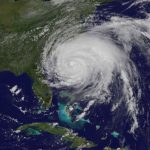
Hurricane Irene in 2011

The 2012 Atlantic hurricane season will provide a valuable research opportunity for the Coastal and Inland-Flooding Observation and Warning Project (CI-FLOW). The goal during the 2012 hurricane season is to produce realistic simulations of total water level in real time for coastal storms. National Weather Service forecasters will have access to CI-FLOW during these events to help them evaluate the system for application in the flood and flash-flood warning process.

CI-FLOW is a demonstration project that captures the complex interaction between rainfall, river flows, waves, tides and storm surge, and how these factors affect water levels in the Tar-Pamlico and Neuse rivers and the Pamlico Sound in North Carolina.

CI-FLOW was tested in August 2011 as Hurricane Irene made landfall near Morehead City, NC.  CI-FLOW total water-level simulations were compared with water levels observed during the storm. Researchers found a high level of agreement in both the timing and water-level heights for the Tar-Pamlico and Neuse coastal watershed.

The CI-FLOW project is motivated by NOAA’s critical forecast need for detailed water-level predictions in coastal areas and has a vision to transition CI-FLOW research findings and technologies to other U.S. coastal watersheds.

This real-time demonstration will offer valuable insight on the accuracy and utility of total water level predictions for communities in the coastal plain of the Tar-Pamlico and Neuse rivers and the Pamlico Sound. Real-time simulations of coastal water levels for the 2012 Atlantic hurricane season are available on the CI-FLOW website (http://www.nssl.noaa.gov/projects/ciflow/). The site also includes an introductory video that highlights the flooding from Hurricane Floyd in 1999 and the response from Sea Grant and NOAA partners. (http://www.nssl.noaa.gov/ciflow/)

The NOAA National Severe Storms Laboratory with support from the NOAA National Sea Grant College Program leads the unique interdisciplinary team including the North Carolina, South Carolina, and Texas Sea Grant Programs; University of Oklahoma; Renaissance Computing Institute (RENCI), University of North Carolina at Chapel Hill; Seahorse Consulting; NWS Forecast Offices in Raleigh, and Newport/Morehead City; NWS Southeast River Forecast Center; NOAA’s Coastal Services Center; NOAA in the Carolinas; NOAA Southeast and Caribbean Regional Team (SECART); NOAA-Integrated Ocean Observing System; Department of Homeland Security, Center of Excellence-Natural Disasters, Coastal Infrastructure and Emergency Management; Centers for Ocean Sciences Education Excellence SouthEast; Coast Survey Development Laboratory; and NWS Office of Hydrologic Development.

Share this: