Severe weather luminary, former NOAA NSSL director passes away

James "Jeff" Kimpel
James “Jeff” Kimpel

The weather community mourns the loss of leader and luminary James “Jeff” Kimpel, who passed away early Saturday morning.

Kimpel served as the NOAA National Severe Storms Laboratory director for 13 years and was instrumental in creating NSSL’s legacy in severe weather research. As NSSL’s third director from 1997 to 2010 he had a vision for the lab — transitioning science and technology to NOAA National Weather Service operations, archiving publications and increasing education and outreach — and created programs to fulfill that vision.

His leadership

His passion for weather and improving forecasts was evident in all of his endeavors. He was instrumental in establishing support for new facilities for NSSL. His collaborative efforts led to the eventual construction of the magnificent National Weather Center building in Norman, Oklahoma, shared with the NWS and the University of Oklahoma.

“For those who knew Jeff, you know that words are inadequate to approximate this man and his achievements,” said Craig McLean, Assistant Administrator for NOAA Oceanic and Atmospheric Research. “As Director of NSSL, he was the architect for the unique research-university-operations relationship we enjoy today between the National Weather Center and the University of Oklahoma. He was among the most humble people I know yet had so much to be proud of.”

In 2006, Kimpel addressed the Norman Chamber of Commerce to give an overview of what the NWC and NOAA provide to Norman. He said the collaborative efforts between OU student interns and federal employees had a $55.3 million impact on the economy at that time.

“We’re all in the same building now. Nowhere else in the country is this done,” Kimpel said in a news article. “The agencies work together for the taxpayers of this country.”

“Weather affects one-third of the $10 trillion economy. We want to know how we can affect the economy in a positive way.”

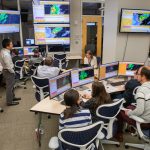
Jeff Kimpel sitting on a desk with computer screens behind him talking to someone.
Former NOAA NSSL Director Jeff Kimpel in the former NOAA NWS SPC forecast area before it moved to the National Weather Center.

Along with the NWC, Kimpel was a leader in creating the NOAA Hazardous Weather Testbed in collaboration with the NOAA NWS Storm Prediction Center and the NWS Norman Forecast Office. Kimpel wanted to create a place to accelerate the transition of new science into operational warning and forecasting decision processes. He understood the value of forecasters and researchers collaborating in a hands-on environment. He would say he was doing his job and serving the public but he was creating a space researchers use every year to successfully advance the tools used by forecasters.

Kimpel supported scientists and equipment to participate in 17 national and international field studies, including the Verification of the ORigin of Tornadoes Experiment, or VORTEX2, that led to the Congressionally funded VORTEX-Southeast. Kimpel oversaw the scientific and technological research required to upgrade the NEXRAD radar network, the current radar. Such upgrades included improvements to dual-polarization, which significantly increased the accuracy of rainfall estimates, the ability to differentiate between rain, snow and provide an estimated hail size. He encouraged radar-based rainfall analyses for flash flood and river forecasting as well.

Kimpel championed for NSSL’s Multi-Function Phased Array Radar, or MPAR, and Phased Array Radar to demonstrate radar’s rapid scanning, dynamic capabilities, and potential. He supported the lab’s division chief’s vision to implement such revolutionary programs.

One of NSSL’s current research programs, Warn-on-Forecast Systems, was advocated by Kimpel. The program aims to increase tornado, severe thunderstorm and flash flood warning lead times. Kimpel was instrumental in advocating for funding of this important project.

His connections

Jami Boettcher met Kimpel in the early 1980s. She describes him as everyone’s champion.

“I remember he [Kimpel] made an impression on me at the University of Oklahoma — enough so I told my father about him,” said Boettcher, an OU Cooperative Institute for Mesoscale Meteorological researcher supporting NSSL. “A lot of OU administrators and faculty were customers of my father’s business and my father shared my story.”

An OU Dean was also a customer of her father’s and heard good things about Kimpel. Shortly after, Kimpel was having lunch with the Dean and Kimpel always told Boettcher that was the start of his administration career.

“Jeff taught me you always have opportunities and each conversation you have is a job interview,” she said. “He championed me into the National Weather Service [when Boettcher was a forecaster]. He singled me out to let me know the NWS was coming to recruit in Norman. I was hired right after I finished my undergraduate degree. Jeff had a powerful gift of knowing which people he needed to connect.”

Ten years later, Boettcher returned to Norman and reconnected with Kimpel. The two taught a course through OU where Boettcher learned more about Norman, the weather enterprise and saw his enthusiasm for encouraging the next generation.

“I’ll never forget he cared about me personally and wanted the best for me, whatever that may be,” Boettcher said. “I may not hold the most accolades in the building, but I felt like I mattered just as much. He had the ability to connect to everyone in a unique way. He treated me like I always mattered.”

“He was giving a tour once and said, ‘I came to Norman for a job but I stayed because of the people,’” Boettcher said. “That is not a one-way exchange and it was not an accident.”

His legacy

Kimpel credited his research start in part to the first NSSL Director Edwin Kessler. Kimpel’s first-ever research grant came from NSSL at Kessler’s coaching. Kimpel followed Kessler’s footsteps and counseled hundreds of students throughout his time at OU and in the NWC. He developed a Master of Professional Meteorology program, a degree designed to provide graduate students with the skills needed by employers engaged in weather-related business.

“Jeff always had pearls of wisdom and advice,” said NSSL Deputy Director Kurt Hondl. “The one that I remember most of all was to ‘hire people better/smarter than yourself.’ He was a real leader, a mentor to many, and an all-around good guy.”

Former NOAA NSSL Director Jeff Kimpel in front of the former lab and research vehicle in Norman, Oklahoma.
Former NOAA NSSL Director Jeff Kimpel in front of the former lab signage and research vehicle in Norman, Oklahoma.

After his retirement, Kimpel continued to maintain an office in the NWC and provided career advice to anyone fascinated by the science of weather. His personality warmed the hearts of his peers and his humor could brighten anyone’s day. He provided tours to incoming and prospective students, researchers and colleagues.

His service, passion and endless work to help save lives and property and encourage future researchers was noted by the United States Congress in 2010. Rep. Tom Cole, R-Ok, recognized Kimpel for his federal service, awards and impact to Norman, Oklahoma, in a Congressional Commendation.

“Dr. Kimpel has made a mark on weather forecasting that will be felt for decades to come,” read Cole. “Dr. Kimpel has been one of the main proponents of improving the connection of Doppler-radar systems, or NEXRAD, which would advance and improve radar resolution and increase the accuracy of rain, snow, and other weather predictions. This program, which was created under Dr. Kimpel, has also generated forecast models and has largely improved the ability to predict tornadoes, windstorms, lighting, and other types of severe precipitation. These programs are extremely vital and important to Oklahoma in particular, but Dr. Kimpel has brought them into other regions that also deal with inclement weather and specific weather storms.”

The list of professional publications with Kimpel’s name as author or co-author is formidable. The topics range from severe weather research to reducing the costs of natural disasters. He received his PhD in meteorology from the University of Wisconsin in Madison.

Former NOAA NSSL Director Jeff Kimpel receiving an award from NOAA Acting Chief Scientist Craig McLean at Kimpel's reitrement in 2010.
Former NOAA NSSL Director Jeff Kimpel and NOAA Acting Chief Scientist Craig McLean at Kimpel’s retirement in 2010.


James “Jeff” Kimpel’s Awards & Service

  • James “Jeff” Kimpel

    Vietnam Air Force – he received a Bronze Star Medal for his service

  • OU Associate Dean of the College of Engineering
  • OU Director of the School of Meteorology
  • OU Regents’ Award for Superior University and Professional Service
  • 1989 American Meteorological Society Fellow
  • OU Dean of the College of Geosciences
  • OU Director of Weather Center Programs
  • OU Senior Vice President & Provost of the Norman Campus
  • President of Applied Systems Institute, Inc.
  • Chaired the Board of Trustees of the University Corporation for Atmospheric Research
  • Chaired the National Science Foundation’s Advisory Committee for Atmospheric Sciences
  • Chaired the National Weather Service NCEP Advisory Panel
  • NOAA NSSL Director, 1997-2010
  • 1998 American Meteorological Councilor
  • 2000 American Meteorological Society President
  • OU Regents’ Alumni Award
  • Denison University’s Distinguished Alumni Citation
  • 2005 Presidential Rank Award
  • 2010 U.S. Congressional Commendation
  • 2016 Charles Franklin Brooks Award
  • Norman Regional Hospital Authority Board Member

Video


Share this:

Researchers test experimental severe weather warning tools


When severe weather threatens, NOAA National Weather Service forecasters issue warnings to alert people. Based on the location of the storm, the same warning gives some communities more time than others. Researchers are testing an experimental concept to provide more continuous hazardous weather information for the public.

Throughout February, NOAA National Severe Storms Laboratory, University of Oklahoma Cooperative Institute for Mesoscale Meteorological Studies and Earth Systems Research Laboratory Global Systems Division researchers are testing technologies to allow warnings to follow storms continuously, called Threats in Motion, in NOAA’s Hazardous Weather Testbed.

Gif of a leadtime polygonCurrently, when NWS forecasters issue a warning for a specific area, the warning remains over that area and may last up to 45 minutes. If forecasters see the storm is about to exit that current warning area, forecasters will issue an additional warning where the storm is about to move.

Gif of the Threats in Motion conceptThis often results in in-equitable lead times for those who are on the border of a severe thunderstorm or tornado warning. Threats in Motion aims at transforming this traditional warning paradigm.

Threats in Motion, or TiM, warnings move with the storm and thus result in more equitable lead time for all impacted by the storm. Forecasters may tell residents in a more timely manner when they can leave their shelters.

Research and operations collaboration

A paradigm shift cannot be implemented in 122 NWS forecast offices immediately. Each office serves a specific geographic area called a County Warning Area, or CWA, said Alyssa Bates, OU CIMMS researcher supporting NOAA NWS Warning Decision Training Division.

“Our inter-office collaboration experiment is unique because we’re studying the complex interactions between forecasters across the CWA boundary,” Bates said.

The process of transferring ownership of a static warning polygon from one NWS office’s jurisdiction to another may be different office to office as well as situationally based.

“In our research of NWS offices, we ask what drives collaboration and when are warning decisions the most complex,” said Kim Klockow-McClain OU CIMMS research scientist and societal impacts coordinator supporting NOAA NSSL. “We documented those responses and are implementing some of those challenges and decision making into this experiment. Different offices have different warning philosophies.”

Researchers and forecasters testing new forecasting technologies on a computer screen.
NOAA and cooperative institute researchers are working with forecasters to assess new tools in the NOAA Hazardous Weather Testbed during the HS-PHI Interoffice Collaboration experiment. This experiment is part of an effort involving the NWS warning paradigm known as Forecasting a Continuum of Environmental Threats, or FACETs. (Photo by James Murnan/NOAA)

Klockow-McClain said researchers must test not only the technical applications but how forecasters utilize the tools. Otherwise, researchers cannot transfer research to operations if they do not ensure all challenges are tested.

“Warnings are an institutional process and we have to know how that process works to see what the implementation of a moving warning system looks like,” she said. “We want to improve, not harm.”

Simulating an operational work environment with forecasters from across the United States is vital to the success of the experiment before GSD decides the best implementation of TiM into NWS forecaster’s operational software.

“We bring in forecasters to the NOAA HWT to test these concepts not only because we value diverse perspectives, but because we need to test the products in all the different severe weather scenarios that are experienced in the United States,” Bates said.

TiM is part of a broader framework known as Probabilistic-Hazard Information and FACETs, or Forecasting a Continuum of Environmental Threats. FACETs is a paradigm shift to provide more information between the watch and warning system currently in place. NOAA NSSL focuses on severe weather research as it pertains to FACETs. The implementation of TiM is aimed at guiding future products in severe weather of the FACETs paradigm. 

“These concepts are complex, and it requires lots of research to grasp and understand the probabilistic nature of them and how to make them interpretable by NWS forecasters — that’s my job as a trainer,” Bates said.

“These concepts are being thoroughly tested and steps are being taken to ensure the products and concepts are created with forecaster and public well-being and interpretations in mind,” Bates said.


Share this: