Renowned physicist to speak at National Weather Center

Slakey to speak at NWC

The National Weather Center will host renowned physicist Dr. Francis Slakey, Associate Director of Public Affairs at the American Physical Society, at 4 p.m. April 23 in Room 1313. Slakey ‘s topic is also the title of his book, “To the Last Breath – A Memoir of Going to Extremes.” The book is on Amazon’s “2012 Best Books of the Year” list.
In 2009, Slakey became the first person to summit the highest mountain on every continent and surf every ocean (including the Arctic) on Earth. He plans to share how he used the laws of physics to his advantage in his climbing expeditions and the knowledge of the geophysics of waves to surf. He will also talk about how his adventures led him on a path to address global challenges such as climate change. For years Slakey has inspired students and researchers across the nation to address societal challenges through science and motivated them to turn their ideas into legislation.

This seminar is part of a new “Science Policy and Its Significance to Weather, Water and Climate” class offered by the University of Oklahoma and taught by NSSL /CIMMS research meteorologist Subhashree Mishra. Speakers include:

– Harold Brooks, NSSL Research Meteorologist

– Mike Douglas, NSSL Research Meteorologist

– Pam Heinselman, NSSL Research Meteorologist

– Kevin Kelleher, NSSL deputy director

– Edwin Kessler, retired NSSL director

– Pete Lamb, CIMMS director

More information is available here: http://som.ou.edu/seminars/

Share this:

R2O success in Birmingham

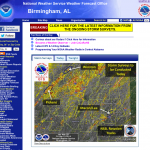
The NWSFO in Birmingham, Ala. used an NSSL product to plan surveys of damage caused by the tornadoes yesterday.

The NWSFO in Birmingham, Ala. used an NSSL product to plan surveys of damage caused by the tornadoes yesterday.  NSSL’s On Demand is a web-based tool that can be used to help confirm when and where severe weather occurred.
Bright reds and yellows show more intense circulations.

On Demand uses data gathered and sorted by NSSL’s Warning Decision Support System-Integrated Information (WDSS-II) to estimate the tracks of rotating storms and where hail fell. The rotation tracks or hail swath data can be overlaid on high-resolution street maps in Google Earth/Maps to pinpoint areas affected by the hazardous weather.

The WDSS-II system receives data in real-time from the nationwide networks of weather radars, satellites, surface observations and lightning detectors. WDSS-II then processes, analyzes and displays the data in a way that is useful to people who need to diagnose severe weather quickly.

The growing list of users include other NWSFO’s, emergency responders and the American Red Cross.

Share this:

NSSL researcher works with Native Alaskan students on weather and climate

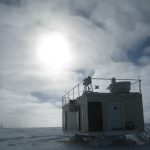
Students make observations at ESRL's site
Students make observations in Barrow

NSSL’s Bob Rabin attended the 18th Inuit Studies conference at the Smithsonian Museum in Washington, D.C. last October.  He was there to support Native Alaskan students giving presentations on weather and climate.  The students attended the STEM camp last summer held at the Illisagvik Tribal College in Barrow, AK.  Bob provided the activities at the STEM camp to give the students an opportunity to learn about remote observations, such as satellites, and how they are used in research and weather forecasting.

Share this:

NSSL, partners: Thin, low Arctic clouds played an important role in the massive 2012 Greenland ice melt

Thin low clouds over Greenland caused unusual melting.

Better understanding of Arctic clouds will help improve climate and weather forecasts

Clouds over the central Greenland Ice Sheet last July were “just right” for driving surface temperatures there above the melting point, according to a new study by scientists at NOAA and the Universities of Wisconsin, Idaho and Colorado. The study, published today in Nature, found that thin, low-lying clouds allowed the sun’s energy to pass through and warm the surface of the ice, while at the same time trapping heat near the surface of the ice cap. This combination played a significant role in last summer’s record-breaking melt.

“Thicker cloud conditions would not have led to the same amount of surface warming,” said Matthew Shupe, research meteorologist with NOAA’s Cooperative Institute for Research in Environmental Sciences at the University of Colorado and the NOAA Earth System Research Laboratory. “To understand the region’s future, you’ll need to understand its clouds. Our finding has implications for the fate of ice throughout the Arctic.”

Scientists around the world are trying to understand how quickly Greenland is warming because ice melt there contributes to sea level rise globally. The Greenland Ice Sheet is second only to Antarctica in ice volume. In July, more than 97 percent of the Greenland Ice Sheet surface experienced some degree of melting, including at the National Science Foundation’s Summit Station, high atop the ice sheet. According to ice core records, the last time the surface at Summit experienced any degree of melting was in 1889, but it is not known whether this extended across the entire ice sheet.

To investigate whether clouds contributed to, or counteracted, the surface warming that melted the ice, the authors modeled the near-surface conditions. The model was based on observations from a suite of sophisticated atmospheric sensors operated as part of a study called the Integrated Characterization of Energy, Clouds, Atmospheric State and Precipitation at Summit.

“The July 2012 ice melt was triggered by an influx of unusually warm air sweeping in from North America, but that was only one factor,” said David Turner, research meteorologist with the NOAA National Severe Storms Laboratory and one of the lead investigators. “In our paper, we show that low-lying clouds containing a low amount of condensed water were instrumental in pushing surface air temperatures up above freezing and causing the surface ice to melt.”

Clouds can cool the surface by reflecting solar energy back into space, and can warm it by radiating heat energy back down to the surface. The balance of those two processes depends on many factors, including wind speed, turbulence, humidity and cloud “thickness,” or liquid water content.

In certain conditions, these clouds can be thin enough to allow some solar radiation to pass through, while still “trapping” infrared radiation at ground level. That is exactly what happened last July: the clouds were just right for maximum surface warming. Thicker clouds would have reflected away more solar radiation; thinner ones couldn’t have trapped as much heat, and in either of those cases, there would have been less surface warming.

The researchers also found these thin, low-lying liquid clouds occur 30 to 50 percent of the time in summer, both over Greenland and across the Arctic. Current climate models tend to underestimate their occurrence in the Arctic, which limits those models’ ability to predict how clouds and their warming or cooling effects may respond to climate change.

“The cloud properties and atmospheric processes observed with the Summit Station instrument array provide a unique dataset to answer the large range of scientific questions we want to address,” said Turner. “Clouds play a big role in the surface mass and energy budgets over the Greenland Ice Sheet. Melting of the world’s major ice sheets can significantly impact human and environmental conditions via its contribution to sea-level rise.”

Better understanding of clouds also improves climate and weather models.

“Our results may help to explain some of the difficulties that current global climate models have in simulating the Arctic surface energy budget, including the contributions of clouds,” said Ralf Bennartz, lead author for the study and professor at the University of Wisconsin-Madison. “Above all, this study highlights the importance of continuous and detailed ground-based observations over the Greenland Ice Sheet and elsewhere. Only such detailed observations will lead to a better understanding of the processes that drive Arctic climate.”

NOAA’s mission is to understand and predict changes in the Earth’s environment, from the depths of the ocean to the surface of the sun, and to conserve and manage our coastal and marine resources.

Contact:

Keli Pirtle   405-325-6933

keli.pirtle@noaa.gov

Share this: