KC Warning OCTANE

For Day 2, we were the Wichita Office. They had mainly multi-cell convection, so we only issued 2 warnings, and these were for wind based on the 0.5 deg radar scan. In addition, our IDSS event was in lightning pretty much the entire time, so it was a fairly easy forecast to warn them, and then move on.

However, while evaluating the OCTANE, there was one event in WFO Pleasant Hill that showed persistent divergence aloft, and had this storm have been in our CWA, I would have issued a warning.

The animated gif above shows OCTANE speed (top left), Cloud top cooling (top right), Cloud Top Divergence (bottom left), and Cloud Top Divergence High Smooth (bottom right). In this case, notice the persistent high divergence values (red) in the lower two panels.

The image above shows a zoomed-in look at the storm of interest. I would have issued a severe TS warning had this been in our area.

Tags: None

Day 2- Using OCTANE In Warning Process

Synopsis: A broken line of thunderstorms formed along a warm front from southern Oklahoma to east-central Kansas Tuesday afternoon. Storms entered a very moist environment with moderate to high MLCAPE and marginal shear. Due to a southwest to northeast storm motion, the largest threat was flash flooding, if storms became strong, damaging winds and large hail were possible.

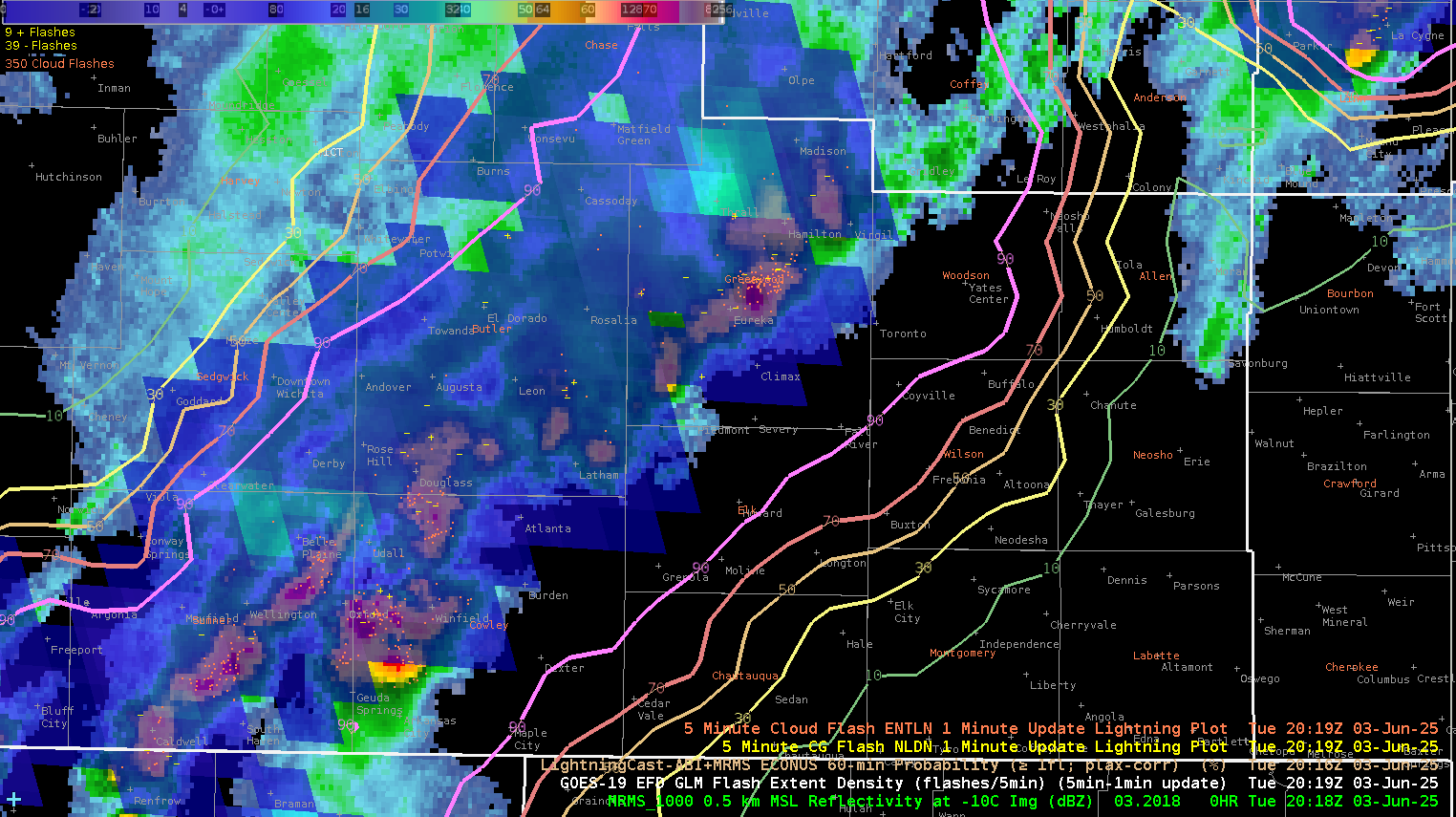
Most of the activity in the ICT CWA was sub-severe (with the exception of flash flooding,) however there were times when a few storms pulsed-up enough to potentially produce damaging winds and/or large hail. One storm in particular had a lightning jump (GLM and ENTLN) at 2019Z over Greenwood county. This storm was entering an area that was untapped, however isolation was low.

Image 1 Caption: Snapshot of MRMS Reflectivity at -10C, GLM Flash Density, LightningCast ABI+MRMS, 5 Minute CG Flash NLDN and ENTLN 1 Minute Update Lightning

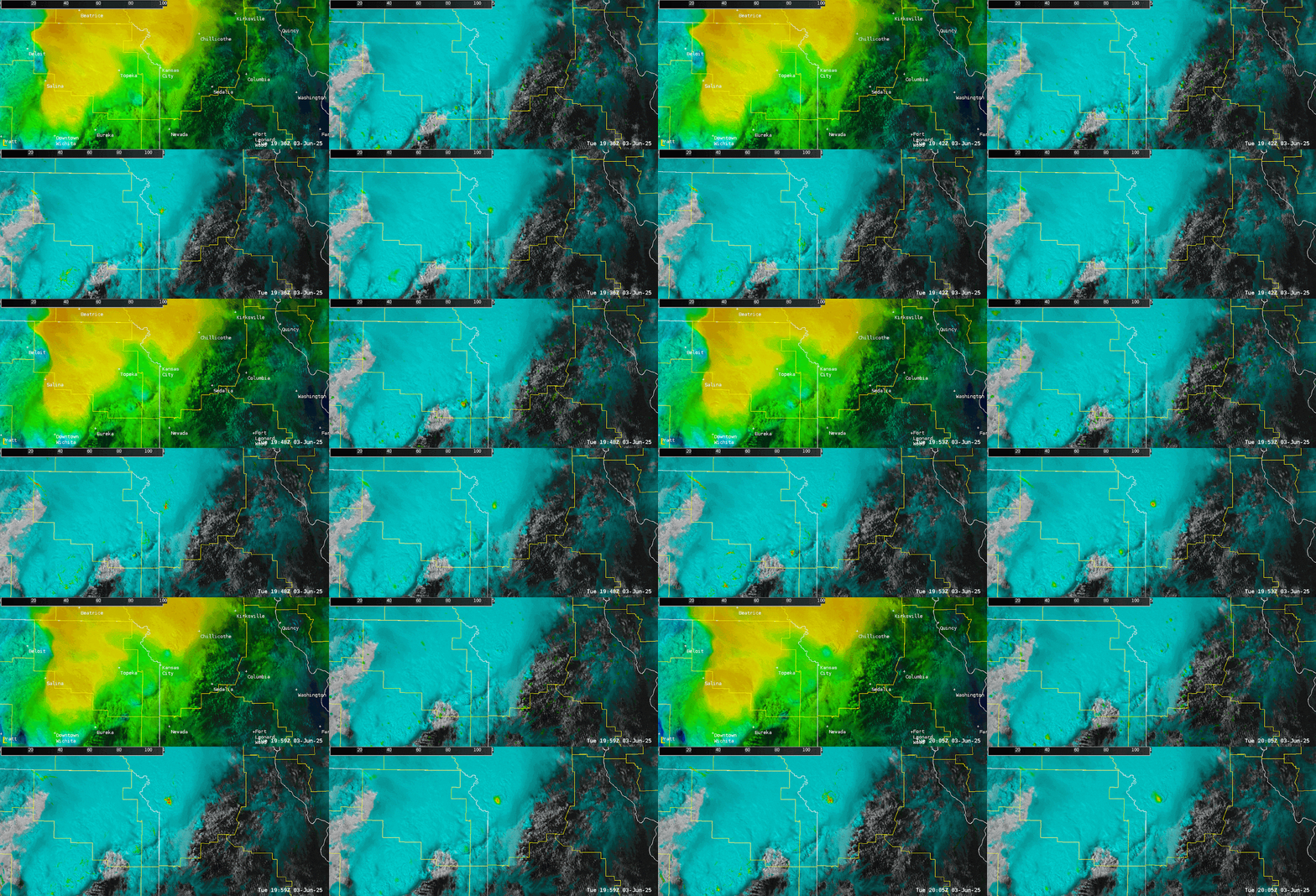
Using the OCTANE Speed and Direction Sandwich product it was evident that the storm of concern in Greenwood county showed changes in local shear coinciding with the lightning jump. The combination of this product with radar and lightning trends increased my confidence to issue a severe thunderstorm warning for damaging winds for 60 minutes.

Image 2 Caption: GOES-19 EMESO-1 and EMESO-2 CH-02 and Octane Speed products
– Eagle
Tags: None

OCTANE Speed, Cloud Top Cooling, and Divergence Products in Central Oklahoma Storms, 3 June 2025

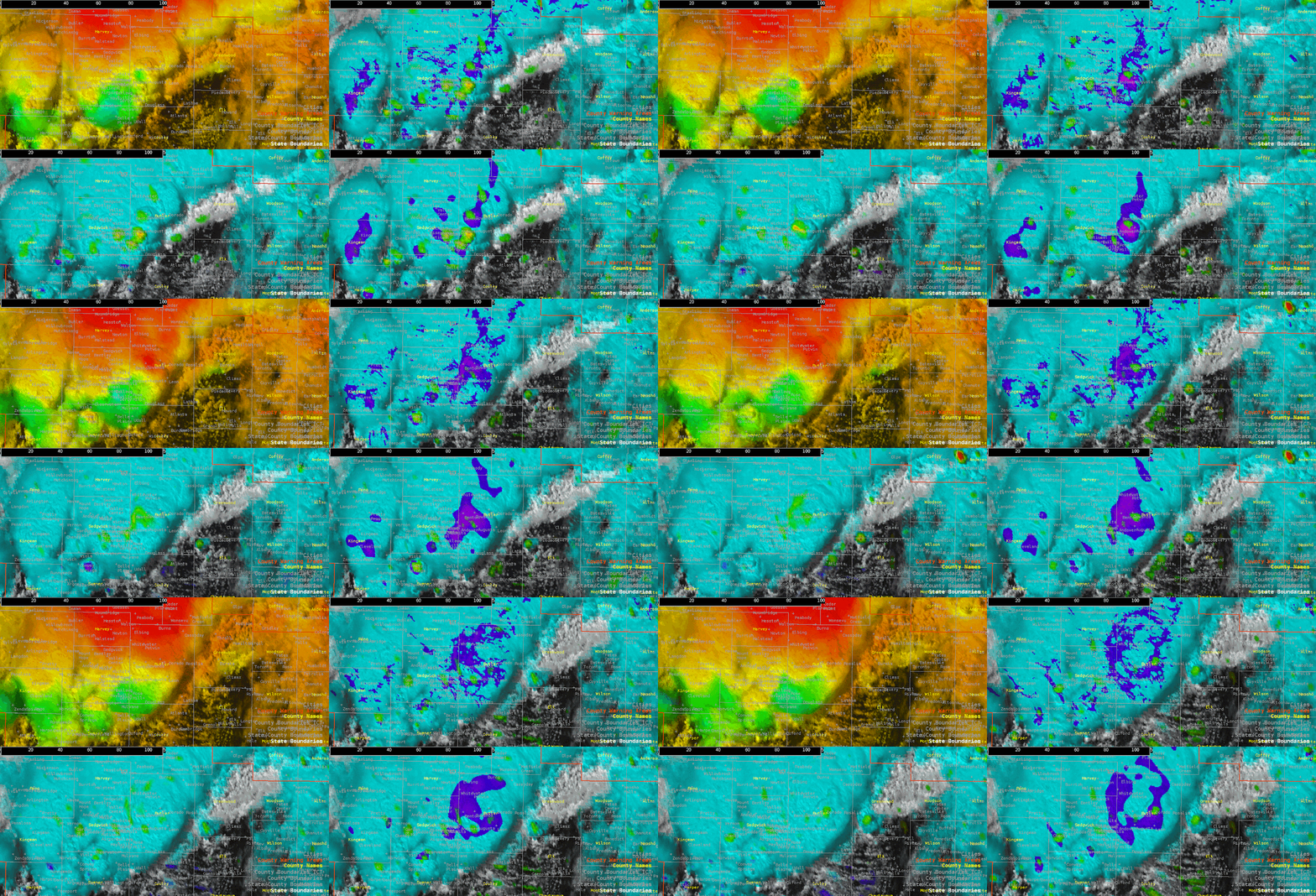
With both discrete and cluster/multicell/linear storm modes, the cloud top cooling, speed, and divergence products proved fruitful in identifying convective intensity trends.

(Sorry, the gif got messed up a little bit)

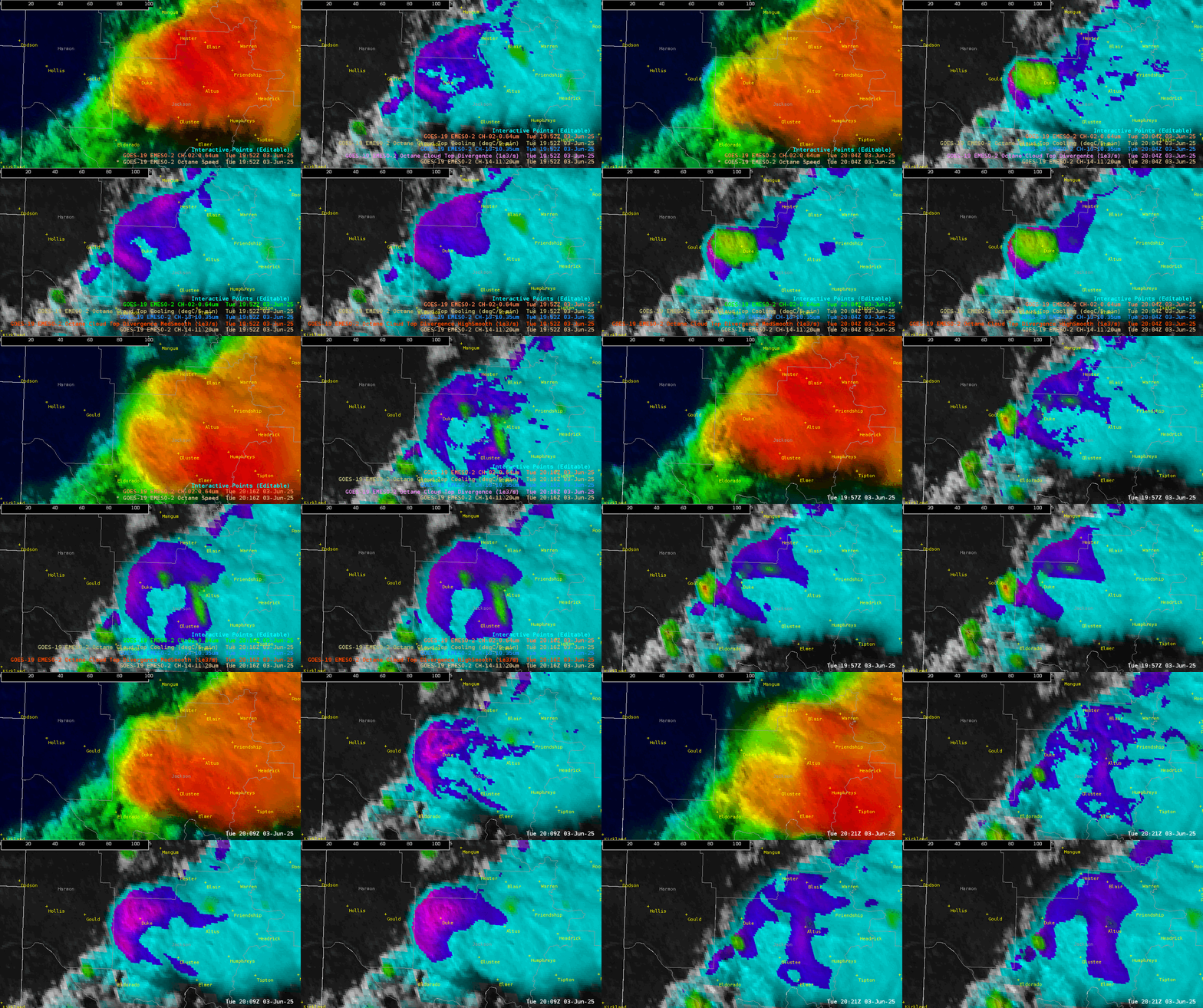
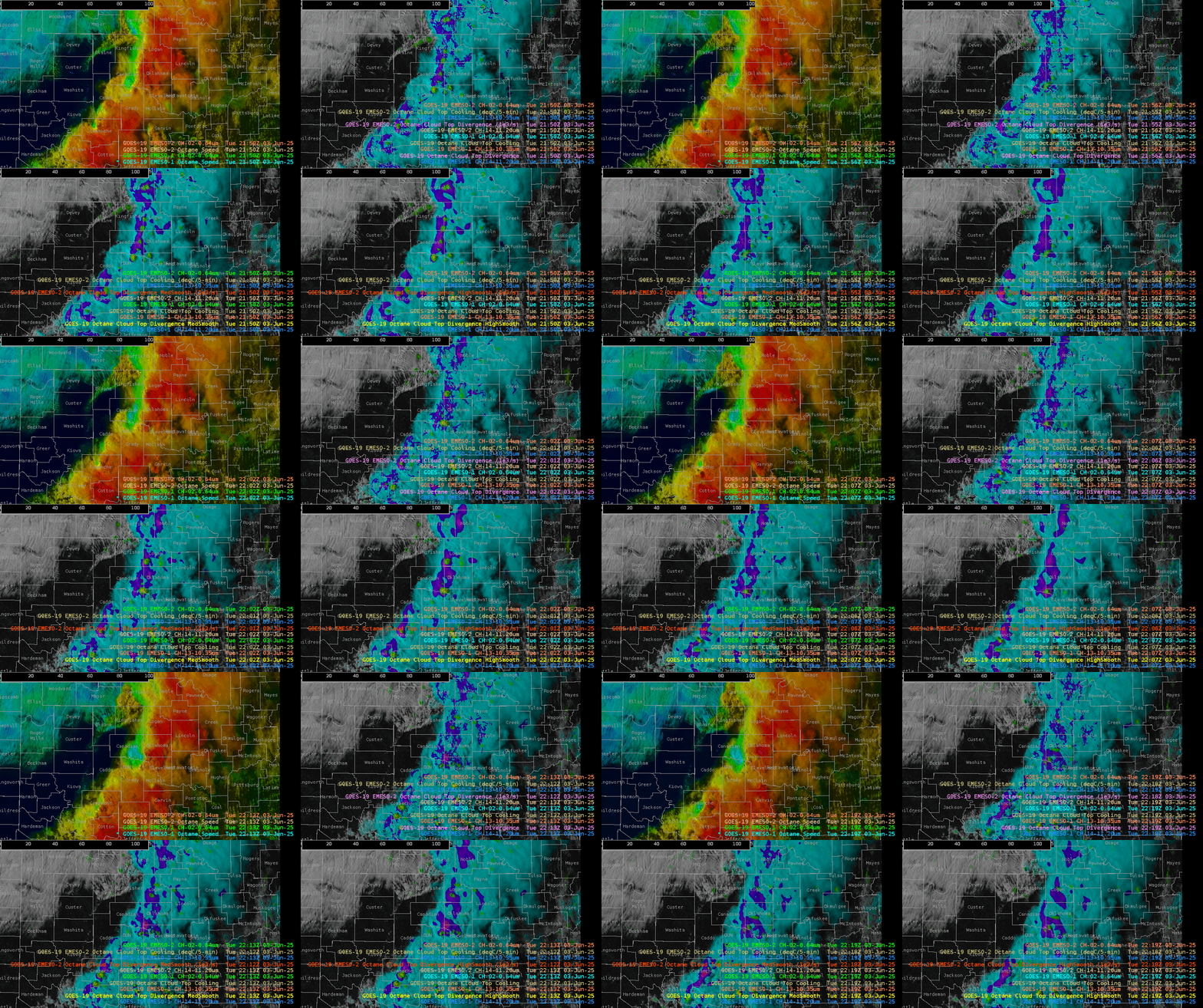
Top right: OCTANE Speed

Others: OCTANE Cloud Top Cooling (stoplight) and OCTANE Divergence (blues/purples)

The speed product showed not only the motion of the storm tops and the acceleration tendencies of the storm top features, but also highlighted (through the texture and color curves) the presence of other storm scale features like the overshooting tops and above anvil cirrus plumes. The color curve had been modified for this product to be the “compressed” color curve, which made gradients stand out. Additionally, this provided information about the environment the storms were tapping into, in this case showing that storms had ample shear to tap into and use to persist.

The divergence and cloud top cooling products were beneficial at different stages of life. The cloud top cooling products were a bit more useful in the initiation stage of storms, showing strong intensification of new updrafts, but became less useful as the updrafts became better established because the cooling was not the same magnitude you would expect from the initiation stage and it stood out less.

The divergence product felt useful in both of these stages of life, but especially once the storm had matured, since the relative strength of signals were about the same during both (i.e. same pink/red hues). While the re-intensification of the updrafts that cycled was signaled by the re-appearance of the green colors, the persistent signals of strong divergence gave better insight into the intensity trends over the storm’s lifespan compared to the cooling product, which was more instantaneous in nature. Once storms reached the mature phase, the channel 13 IR imagery became a better way of assessing storm top temperatures (not shown).

On the DSS front, the Cloud Top Cooling was more beneficial when used in tandem with LightningCast (not shown) during the initiation stage to assess the storm/updraft motions and decide whether DSS calls needed to be made. The early indication of convective cloud top cooling was a signal to forecasters that the clouds would likely become strong enough in the near future and would begin posing a lightning threat to Rudy’s event.

– prob30

Tags: None

Nowcasting Convection with OCTANE

SYNOPSIS – Scattered to numerous thunderstorms developed along a frontal boundary as it moved south into KS/OK/TX. These thunderstorms developed in a strong instability (3000+ j/kg MLCAPE) and modest shear (20-30kt effective, ~100 m2/s2 0-1km SRH) environment.

OPERATIONAL NOTES AND FEEDBACK – Using OCTANE to nowcast convective intensity and improve mesoanalysis situational awareness

Today’s event seemed to highlight a significant advantage of using OCTANE products to keep situationally aware during scenarios where there is a lot of convection. Oftentimes, radar can get incredibly messy when numerous thunderstorms are present, making it challenging to know which thunderstorms to focus messaging and warnings on. OCTANE products made this less challenging, by highlighting the thunderstorms with the strongest updrafts and/or most persistent updrafts. This combined with GLM lightning density provided valuable information for warning forecasters to decide which thunderstorms were the best candidates for warnings, and which ones to hold off on. Situational awareness (SA) can be quickly lost in events like these, and it is crucial to have a way to keep good SA. OCTANE provided an important tool in this endeavor.

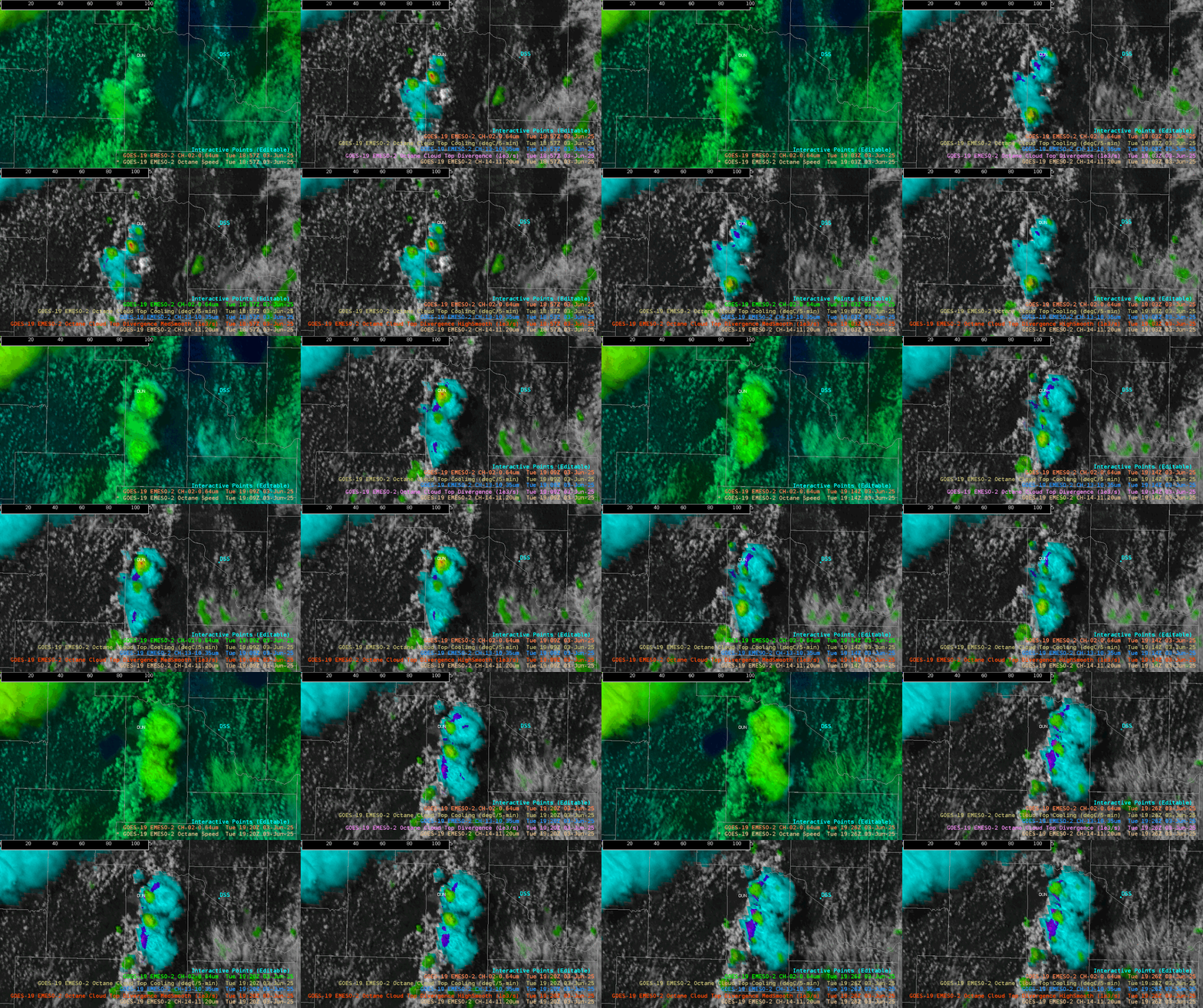
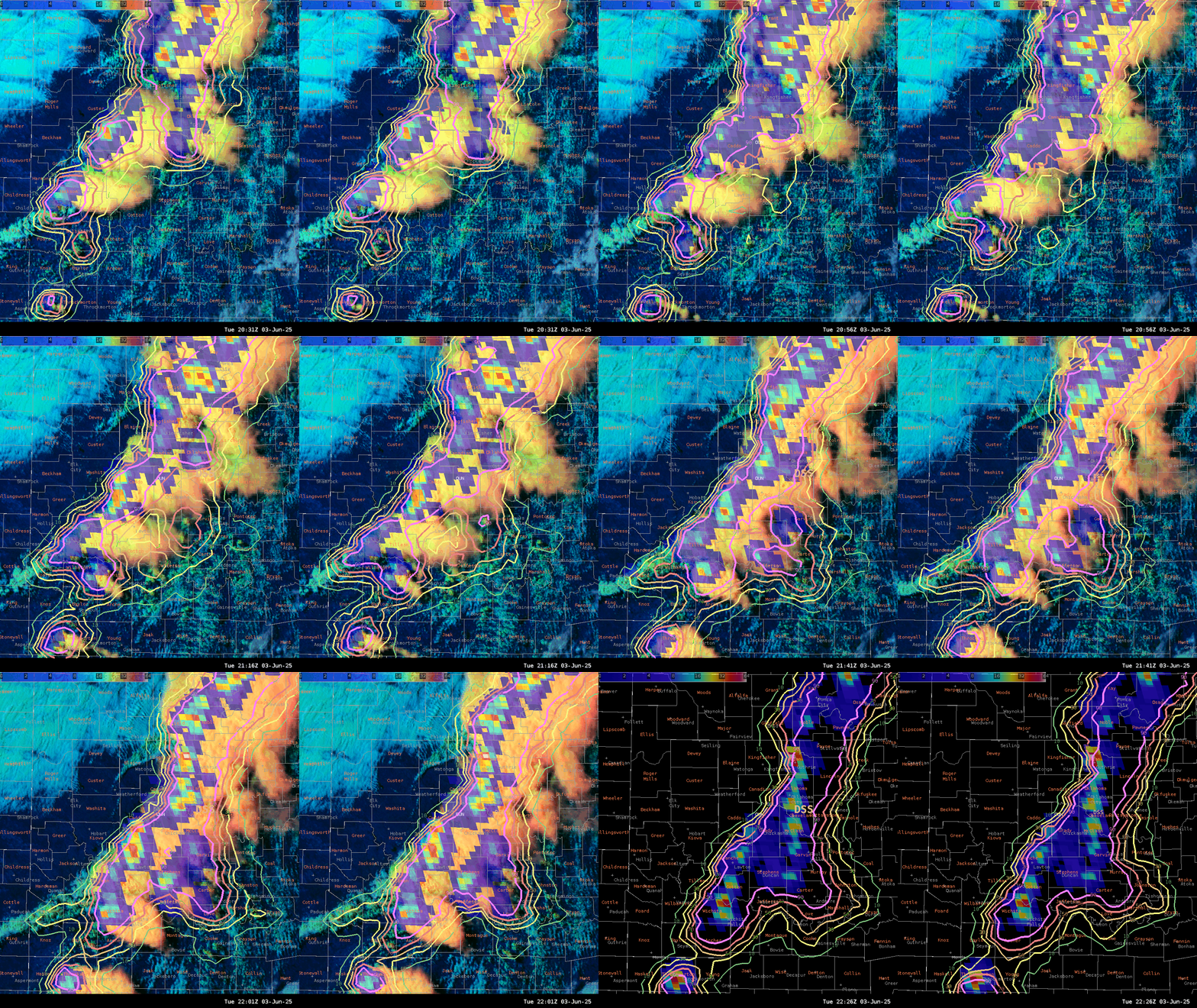
The image below is one such example, showing two separate areas of convection over the WFO Norman (OUN) CWA (outlined in orange). In west-central OK, the OCTANE Cloud top Cooling/Divergence product shows notable updrafts with a persistent signal for notable storm top divergence, suggesting an increased risk for severe thunderstorms. Meanwhile, the thunderstorm activity to the east, in central OK, seemed to have more of a transient signal for strong cloud top divergence, with a somewhat less persistent signal. This suggested that the central OK convection would favor more of a pulse-type of severe weather setup, which informed future warning decisions (in my experience, pulse environments are often handled differently than environments that support long-lived / long-swaths of severe weather).
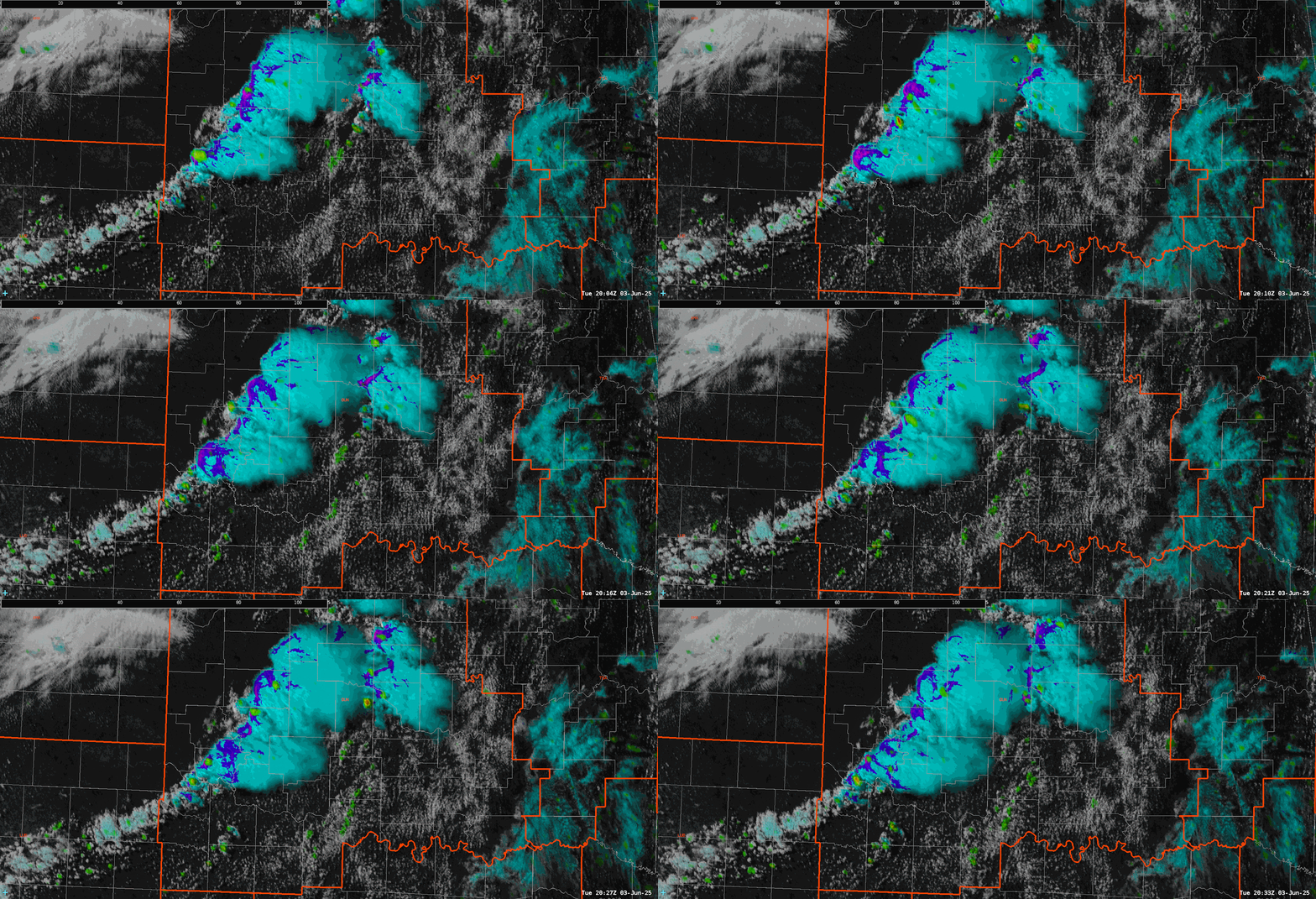
Additionally, the cumulus fields with green shading in the image above gave forecasters a heads up for which areas were seeing the most vertical development (ie. towering cumulus), which also was a tip-off for which areas may see new convective initiation.

While not shown, there was also a notable updraft that developed on a severe-warned thunderstorm west of Norman, OK. The OCTANE products nicely depicted this updraft as being more prominent than surrounding updrafts, and this particular thunderstorm went on to produce a tornado a short time later. This thunderstorm was embedded within a larger line of thunderstorms, which sometimes makes it less prominent when compared to radar interpretation, alone.

Probably the biggest takeaway here is that this one image provides a very quick overview of where convection may initiate, where convection is the strongest, what mode the convection is taking on, and where the biggest target of opportunity is for warnings and IDSS.

It’s recommended that satellite interpretation continue to be an important part of the mesoanalysis role of NWS operations, and OCTANE products appear to more quickly mesh what forecasters often look for in visible and IR products separately. This more efficient overview could save the mesoanalyst valuable time in assessing thunderstorm trends, providing quicker insight to warning and DSS forecasters.

– NW Flow

Tags: None

Operational Feedback of Gremlin, Octane, and LightningCast during a Severe Weather Outbreak in Central Oklahoma

I tested the OCTANE, GREMLIN, and LightningCast products during an actual severe weather event on 6/3/2025. My role during this testbed was that of the mesoanalyst.

Initial environmental analysis shows weak to moderate shear, which was determined via ARARS soundings and SPC Mesoanalysis, along with OCTANE imagery showing divergent / accelerating speeds within the storm anvils. VAD hodographs were used as convection developed to see rapid changes within the shear profile during the course of the event (as convection altered the broader environment). Shear increased as the event progressed. OCTANE and LightningCast were both useful showing the uptick in storm intensity as shear increased.

LightningCast was very useful picking out developing updrafts and embedded updrafts within broader areas of convection. We used this product to gauge which updrafts had the greatest potential to become severe in the near term. A strong uptick in lightning would indicate a rapidly strengthening updraft which would warrant further interrogation.

Similar to LightningCast, OCTANE was useful in determining which updrafts were trending towards severe. While in the mesoanalyst role, I would check to see which updrafts looked most intense (warmer colors paired with a very bubbly/convective appearance) and showed strong divergence. Radar analysis would then help us determine which individual cells to warn on, especially if the area of convection is multicellular and warning the entire thing isn’t ideal.

I didn’t use GREMLIN as much, since this area had good radar coverage. However, I did use it to keep tabs on its performance. The product seems to do well with picking out the strongest discrete/semi-discrete cells and potentially struggles with smaller/shallower storms and mergers.

Using these products, and working as a team with good communication, we were able to successfully warn a tornado in the Norman area along with various severe wind and hail.

– WxAnt

Tags: None

ICT Convection with Octane and LightningCast

 LightningCast

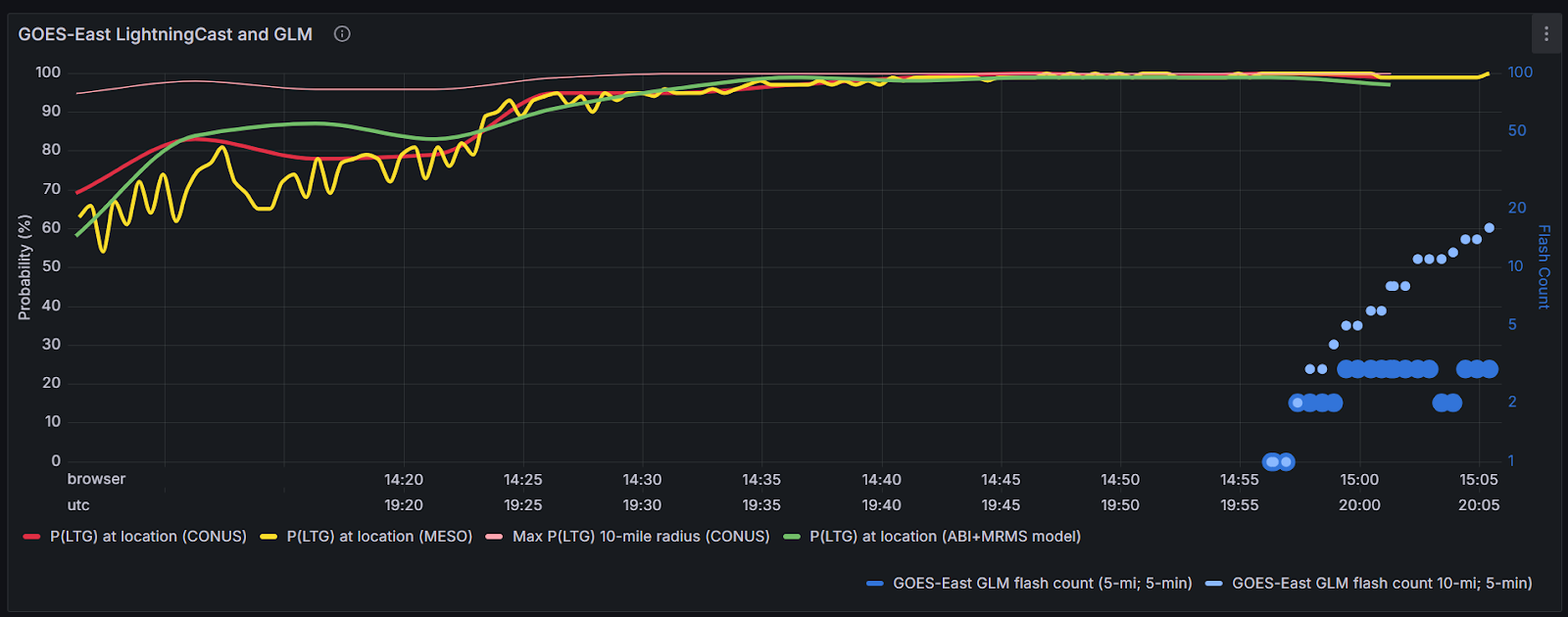
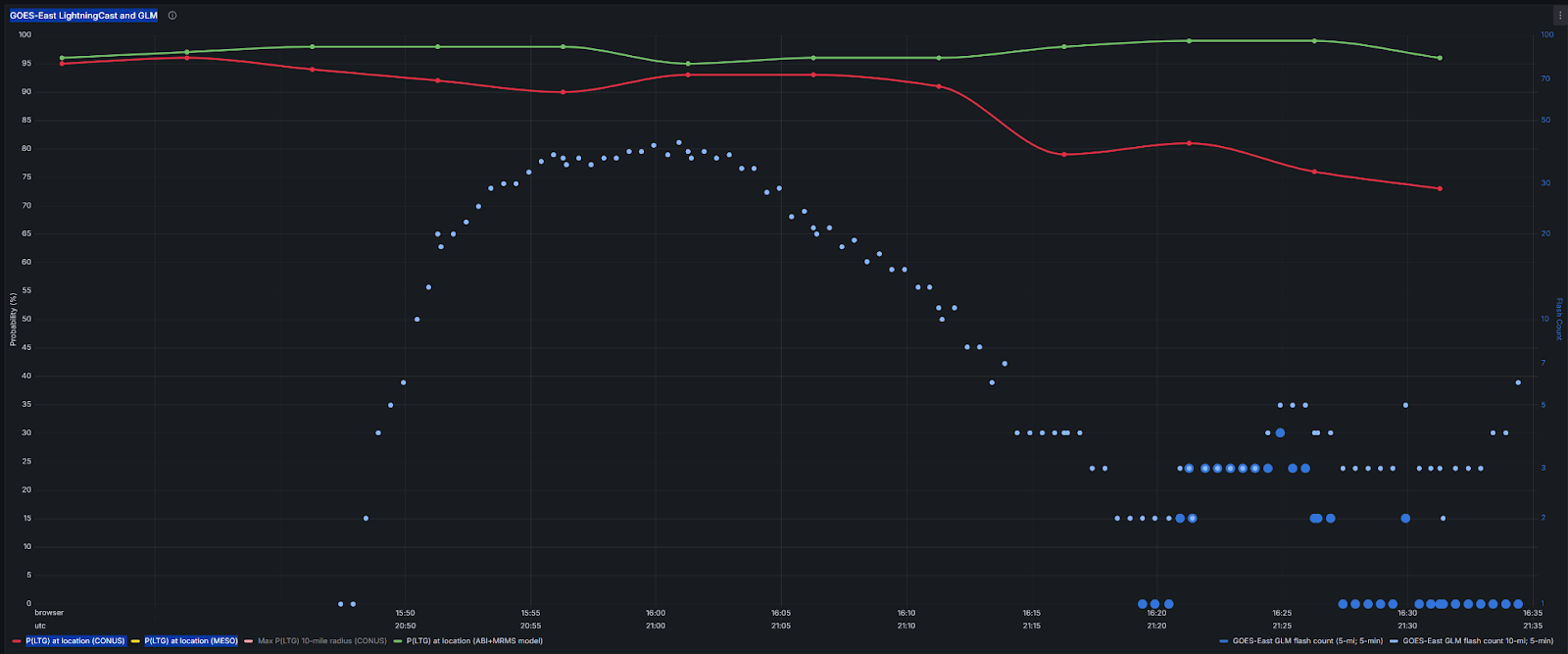
The LightningCast contours didn’t provide much insight due to high probability (>90%) of lightning pretty much the entire event. However we were able to utilize the dashboard for a DSS event. In Figure 1 below, the first thing I noticed was that the first lightning flash was recognized at approximately 2:57PM CDT where both v1 and v2 showed 90-100% probabilities. Looking back within the past hour at around 2:05 PM (not shown in the image), probabilities of lightning occurring within the next hour were approximately in the 50-60% range. It makes sense that the probabilities would increase with shorter lead times, however if this were being utilized for a DSS event and a partner was briefed at 2:05pm, they might decide to take a risk and hold off on sheltering since the probability is only 55% (therefore giving them a 50/50 chance in their eyes). Whereas around 2:20 PM when the probabilities started increasing to 80+%, there was only about a 30 minute lead time at that point. So the DSS events that require additional lead time due to further sheltering options or larger crowds may not be able to fully shelter by the time the first lightning flash occurs.

All that to say, I really like the utilization of this dashboard, however it would need to be used with additional tools (satellite, radar, etc.) in order to provide the most accurate information.

Figure 1: LightningCast Dashboard

Another item that was pointed out was that in Figure 2 below, you can see that the probabilities in v1 (red line) start to decrease around 4:10pm whereas v2 (green) remains above 95%. This could be due to the fact that maybe there were warming cloud tops, however with the ongoing lightning flashes in the vicinity, v2 would be the more reliable tool in my opinion

Figure 2: LightningCast Dashboard

Octane

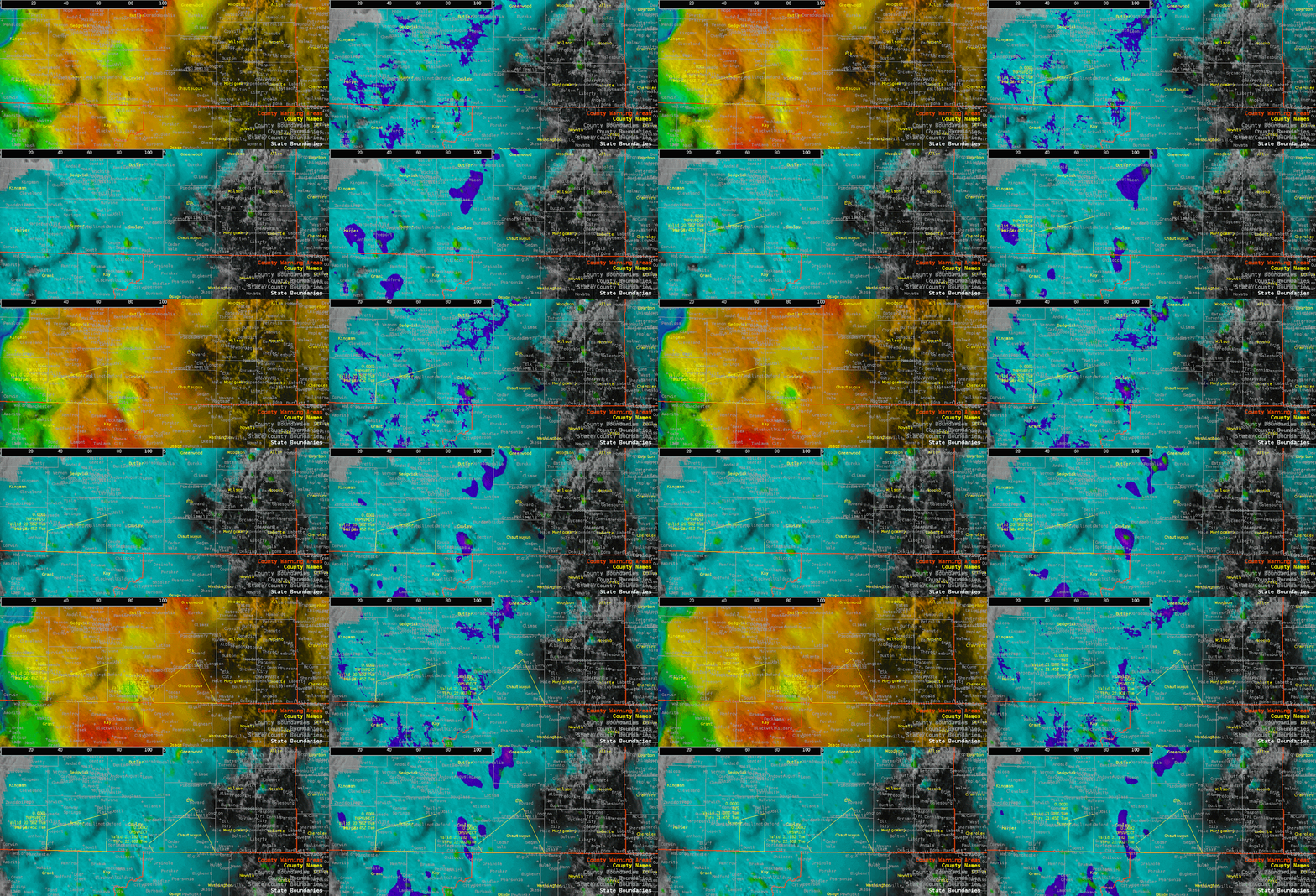
The first cell that caught our attention was the cell in southwest Butler County. Figure 3 below shows the cloud top cooling and cloud top divergence (top right and bottom two panels), and you can see that cell shoot up with decent divergence aloft. We didn’t end up warning on it since radar looked pretty subsevere, however it was a good situational awareness tool to keep an eye on where the stronger storms were located.

Figure 3: Octane four panel

Later in the period, we did end up issuing two different warnings. The gif below (Figure 4) honestly doesn’t do it justice since I grabbed it a little too late, but there was a pretty pronounced divergence signature that started in Harper County near the city of Anthony that later pushed east into Sumner county. With the divergence remaining consistent and radar showing a pretty good wind signature, we ended up issuing a warning.

Figure 4: Octane four panel

I messed around with the colortables a little bit in Octane, switching to a stoplight color scale for the divergence and the magenta hue for the cooling. I’m still not fully sure which colorscale I prefer, so I’ll need to continue playing with both. However, comparing the three smoothing techniques for the divergence, I found myself looking at the highest smoothing (bottom right panel) more frequently since the lowest smoothing (top right panel) often looked too noisy. I think for situational awareness and assessing which storms to dive deeper into, the highest smoothing should work well.

-Fropa

Tags: None

Cloud Top Cooling, Cloud Top Divergence, and MESH

After looking at the Cloud Top Cooling and Divergence, there was a case from MPX where a severe thunder warning was issued across southwest Minnesota. The cloud top divergence overlaid with visible satellite did a really nice job showing areas of deep convection (texture) with areas of divergence. This signal preceded the MESH severe hail by 5 to 10 minutes.

Animated GIF showing a 4-panel plow with visible satellite (channel 2) underlaid on all 4 images. The contrast between the cold and warm hues in the top left was one of the strongest seen of the day. The other 3 panels show cloud top divergence (CTD) with small smooth (top right), medium smooth (lower left) and high smooth (lower right). MESH greater than 1 inch is shown in the lower left as well using the default MESH color curve. Green is > 1 inch hail, an the occasional yellow pixels are >2 inch hail. The white text on the lower right is just a placeholder to mark areas of high CTD at the start of the loop.

Notice the area of high cloud top divergence at the start of the loop (red, center of panels). However, there is not a coarse texture of the clouds indicating a strong updraft. Later on in the loop, you’ll see that same red area overlaid with deep, coarse texture of rigorous updrafts on the southwest part of the storm. This is followed by MESH output of severe hail.

A SVR was issued at 2146Z, MESH shows 2” hail at 2152Z, and the satellite signature preceded both of those.

At 2145Z, 1 minute prior to severe TS warning issuance. There is a strong signal of cloud top divergence colocated with a rigorous updraft. The MESH (green, lower right) had a hail greater than an inch at this time.

At 2152Z, MESH (green, lower right) had a hail greater than 2 inches at this time.

At 2110Z, MESH indicated another small area of hail greater than 2 inches. There were two reports (green dots) of 1.25” hail with this storm near this time.

– Updraft

Tags: None

Cloud Top Cooling and Lightning

This was a case from MPX that showed two areas of intense cloud top cooling that corresponded to lightning jumps. Overall this is more of an observational post than a clear example of how OCTANE could be used for decision making.

Animated GIF showing two distinct areas of cloud top cooling (red, midway through the loop)

Animated GIF zoomed in on the area of interest, with ENL lightning overlaid. The cloud top cooling lines up well, and slightly precedes, the electrification of the developing cumulonimbus.

– Updraft

Tags: None

Storm Initiation for FWD and Gremlin gets Going

From a top down perspective looking at Octane products down to Gremlin and actual radar data from KFWS, it provides a clear picture of what you might want to be looking at as far as what the Octane products can show you and to take a targeted approach to potential warning operations. Taking a look at some satellite data, we can see two areas of interest to the north and then a second one to the west where strong Cloud top Cooling and Cloud top Divergence is seen. In addition to all of this, the greatest gradients from the Octane Speed/Direction images show a rather robust cell to the north and west of the Dallas Fort Worth CWA and this is the cell we will be focusing on.Figure 1: Four panel with Octane Speed Sandwich in upper left corner, Octane CTC/CTD with no smoothing upper right, Octane CTC/CTD High smoothing lower right, and Octance CTC/CTD Mod smoothing lower left. Times were between 1902Z-1932Z

Taking a look at the Gremlin data we can clearly see the MesoSector began to pick up on the previously mentioned cells and further strengthening of these cells located to the north and west of the Forth Worth CWA a few minutes prior to MRMS showing some reflectivities, as this initial CI began to strengthen further. We can also see a bit of a lightning jump with these cells as well.

Figure 2: Four panel with GREMLIN Mesosector on the top right, MRMS reflectivity on the lot left, ECONUS Gremlin with GLM flash density on bottom right and finally GOES Meso sector 3.9 Micron Imagery on bottom left. Times were between 1921Z-1945Z

Finally with radar returns finally noting a strengthening trend with the cell of note to the northwest of the Dallas Fort Worth Metro, and with the previous signals from the stronger cloud top cooling and resultant Divergence, we could infer if these storms did develop in our CWA that they had an increasingly likely chance to become severe within the next 30  minutes or so.

Tags: None

OCTANE and a supercell

Day 4 OCTANE

I had a severe storm in the southern part of the CWA that was a little pulse-y, and I found that I was able to look at OCTANE to see when it was on the way back up. Below, I have the OCTANE and radar at the same time stamp- OCTANE shows cooling cloud tops, and the ProbSevere MESH was 1.12”.

OCTANE product and base reflectivity at 21:25z, MESH of 1.12”

A short time later, the MESH jumped up to 2.17” and OCTANE depicted it as a mature cell.

OCTANE product at 21:33z, base reflectivity at 21:38z, MESH 2.17”

I don’t know if anyone reported how big the hail ended up being, but I wouldn’t doubt it was over 1.5”.

– Lightning McQueen

Tags: None