


I wanted to see how the two types of simulated imagery compared to each other, and compared to reality. Of course, the best way to look at reality is to use the super rapid scan GOES visible. Here it is at 19Z:
 We also have the OT product on this image. I tried to draw a circle around the OTs of interest with an annotation tool, but with 1-min temporal resolution, I wasn’t able to save my annotated image fast enough. (I tried 3 times with no success). I was surprised that the OTs were only showing up in the convective line from northeast MS to southeast TN. I thought we might see some in the cool-looking bubbly cloud structures in southeast AL as well. (Those clouds had produced FFWs in the area).
The simulated IR imagery below is also from 19Z. The model doesn’t show the area of overshooting tops that we were seeing in reality in northeast MS and southeast TN. However, it picked up very well on the larger, older convective shield in southeastern AL.
 The simulated WV imagery also appears to have missed out on this convection firing at 19Z in that same corridor. It’s also worth noting that further south in Mississippi, the convection appears to be overdone. But this area of convection matches up with an area that was under a FFW due to a high-precip event earlier in the day.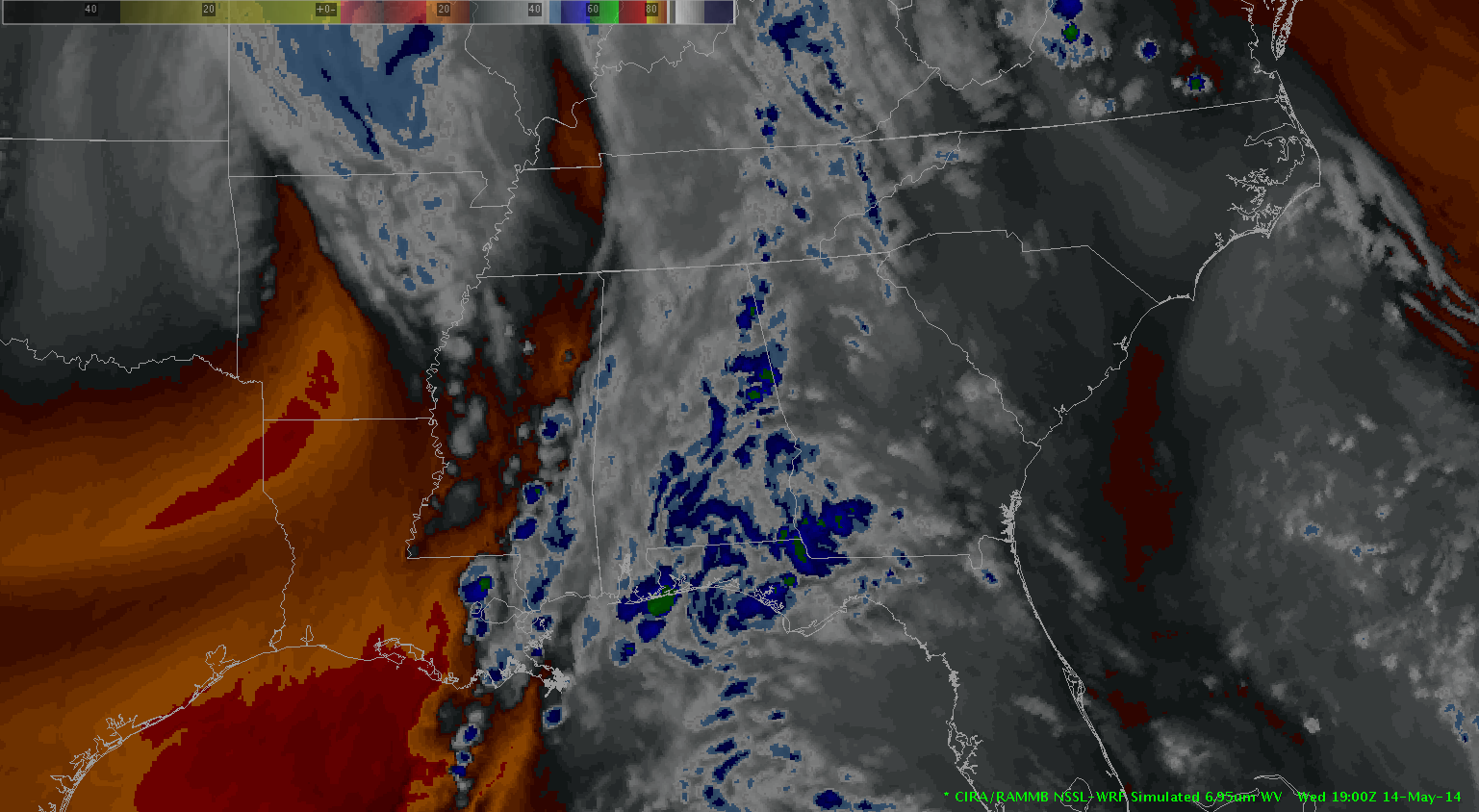
This case gives the appearance that the NSSL-WRF is doing a better job of simulating cloud cover in areas that have already experienced cloud cover and convection, and is not doing as well in areas where convection has not yet developed at the model’s run time. However, the overall spatial coverage of the cloud cover simulation is fairly accurate, and I believe it would be very useful, especially in the cold weather season, when convection is not so much of an issue.